

If you have been researching diving Nusa Penida, you have almost certainly seen two phrases show up again and again: Blue Corner Nusa Penida and Blue Corner dive Nusa Penida. You may also have seen Blue Corner Nusa Lembongan, Blue Corner dive site Bali, and even diving Nusa Lembongan used in the same breath. That is not sloppy marketing alone. It is geography.
Here is the key fact serious divers need on day one: the Blue Corner dive site is most accurately described as lying off the southern tip of Nusa Lembongan, the smaller island that sits immediately north of Nusa Penida, separated by a narrow channel. Many boats run diving Nusa Penida itineraries from Toyapakeh and other harbours on Penida, then cross to Lembongan waters to dive Blue Corner. In everyday trip language, people often say “Penida diving” to mean “the Nusa islands area,” even when a site is technically off Lembongan.
This article is about the underwater site called Blue Corner, not a similarly named dive centre or resort. Names collide in Bali, and it matters because beginners sometimes book a holiday expecting a gentle reef, then discover Blue Corner is famous for strong currents, strong drift, and conditions that are not suitable every day.
Neptune Scuba Diving operates in Bali’s dive environment with a safety first mindset. If you want to dive Blue Corner responsibly, treat it like what it is, an advanced drift site where planning, tide windows, and honest self assessment matter as much as your camera settings.
Where is Blue Corner, exactly?
According to widely published dive references, including PADI’s dive site listing, Blue Corner sits at approximately coordinates -8.66128, 115.44247 in the waters around Nusa Lembongan, near the southern end of the island where the reef meets open water and currents can accelerate.
A practical way to picture it on a map:
- Nusa Penida is the large island to the south.
- Nusa Lembongan is the long, thin island to the north.
- Nusa Ceningan sits between them, linked by the yellow bridge many tourists walk across.
Blue Corner is one of the “channel” style sites where water movement can intensify because you are close to a corner of reef and open blue water, the “corner” in the name is not decorative.
Why people say “Blue Corner Bali”
Blue Corner Bali is a normal search phrase because most international travellers fly into Denpasar on Bali and treat the Nusa islands as a Bali diving extension. Legally and geographically, the Nusa islands are part of the Bali province area for tourism planning, even though the crossing is by boat.
Why “Nusa Penida diving PADI” shows up next to Blue Corner
Nusa Penida diving PADI is a common search because Penida has become the main hub for many dive operators, training, and daily boats. PADI courses and fun dives are widely advertised out of Penida, and Blue Corner remains a flagship site for experienced divers on those routes.
Blue Corner dive site versus “Blue Corner Dive”
This guide uses the phrase Blue Corner dive to mean the dive, not a business name.
In the real world, you may encounter businesses with similar branding in the same region. That can confuse trip planning. When you book, confirm you are booking:
- a fun dive or guided drift dive at the Blue Corner dive site, and
- not accidentally assuming a shop name equals a site name.
If your confirmation email only says “Blue Corner” without a map pin or site description, ask for clarity. Good operators expect that question.
How to get to Blue Corner (boat access, harbours, and realistic travel times)
You do not shore dive Blue Corner like a sandy training bay. Access is by boat, and your departure point shapes your morning.
From Bali (Sanur and nearby harbours)
Many divers leave from Sanur on Bali east coast, especially for fast boats toward the Nusa islands. Travel time varies with sea conditions and boat type, but it is common to budget roughly 30 to 45 minutes or more for the crossing, depending on operator routing and swell.
From Nusa Penida (Toyapakeh and other Penida harbours)
If you are already staying on Nusa Penida, operators may run a short boat ride toward Nusa Lembongan to reach Blue Corner. One published operator description mentions roughly 15 minutes navigation from Toyapakeh toward Lembongan waters, though real world timing changes daily with routing and conditions.
From Nusa Lembongan
If you are based on Nusa Lembongan, Blue Corner can be among the closer “signature” sites, but proximity does not mean calm water. Local access still depends on tide and current planning.
The important practical point
Blue Corner is not “easy to reach” in the sense of easy diving. It is easy to reach by boat on the right day, and it can be the wrong choice on the wrong tide.
What kind of diving is Blue Corner?
Blue Corner is widely categorized as:
- drift diving
- wall diving in many descriptions
- deep diving potential depending on profile
PADI’s public site lists maximum depth around 40 metres for the location entry, with much of the action often discussed in the 25 to 30 metre range depending on plan and conditions.
Currents: strong drift, not a gentle glide
This is the heart of the matter. Blue Corner is famous because currents can be very strong and unpredictable, and the dive is often described as an adrenaline drift rather than a relaxed reef tour.
That does not mean it is always raging. It means you cannot assume it will be mild. The site sits in a region influenced by major water movement patterns, including the broader dynamics sometimes discussed as part of the Indonesian Throughflow concept, where water exchanges between the Pacific and Indian Ocean create powerful flows through Indonesian archipelago choke points. You do not need to be an oceanographer to dive safely, but you should respect what that means at a corner site with open blue water.
Thermoclines and cold water surprises
Divers frequently report cold water and thermoclines, sudden shifts in temperature where water masses meet. That can be uncomfortable if you wear too thin a suit, and it can affect buoyancy feel during the dive.
Visibility is variable. Some sources cite ranges such as 10 to 30 metres depending on tide, plankton, and current. Blue water can look spectacular one week and milky the next.
Minimum experience: who should dive Blue Corner, and who should wait
Different operators set different rules, and you should follow the shop that knows the conditions that week. Still, the industry consensus is clear in public materials: Blue Corner is not a site for fresh Open Water divers who have only seen calm reefs.
What “advanced” means in plain language
Blue Corner is commonly treated as advanced divers only, often with additional expectations such as:
- prior drift diving experience in real current, not just a course skill practice day
- comfort near wall environments
- comfort with blue water moments where reference is limited
- ability to stay calm when the group moves faster than a slow photo stop
Dive counts and honesty about skill
Some local guidance you may see online suggests 50+ logged dives for certain strong drift sites in the region. Whether a shop uses a number threshold or evaluates case by case, the underlying point is the same: Blue Corner punishes hesitation and poor buoyancy control.
Training that genuinely helps
PADI’s public Blue Corner page suggests useful training paths such as:
- Advanced Open Water style training for deeper, more variable profiles
- Enriched Air Nitrox where appropriate for longer bottom time margins on deeper plans, within certification and safe oxygen exposure rules
- Deep Diver training for better understanding of gas planning, narcosis awareness, and conservative margins
None of that replaces judgement. A card does not make current safe.
Equipment mindset
Suggested equipment discussions for this style of site often include:
- a dive computer for every diver
- a surface marker buoy and reel habits suited to drift exits
- a reef hook only if you are trained, allowed by the operator, and use it ethically without damaging reef
Neptune Scuba Diving emphasises conservative planning and honest briefings. If conditions are not right, the right call is to change site.
Marine life: what you might see at Blue Corner (and what requires luck)
Blue Corner is known for big fish potential, but no ethical operator should promise a checklist on a schedule. The ocean is not a zoo.
Ocean sunfish (Mola mola)
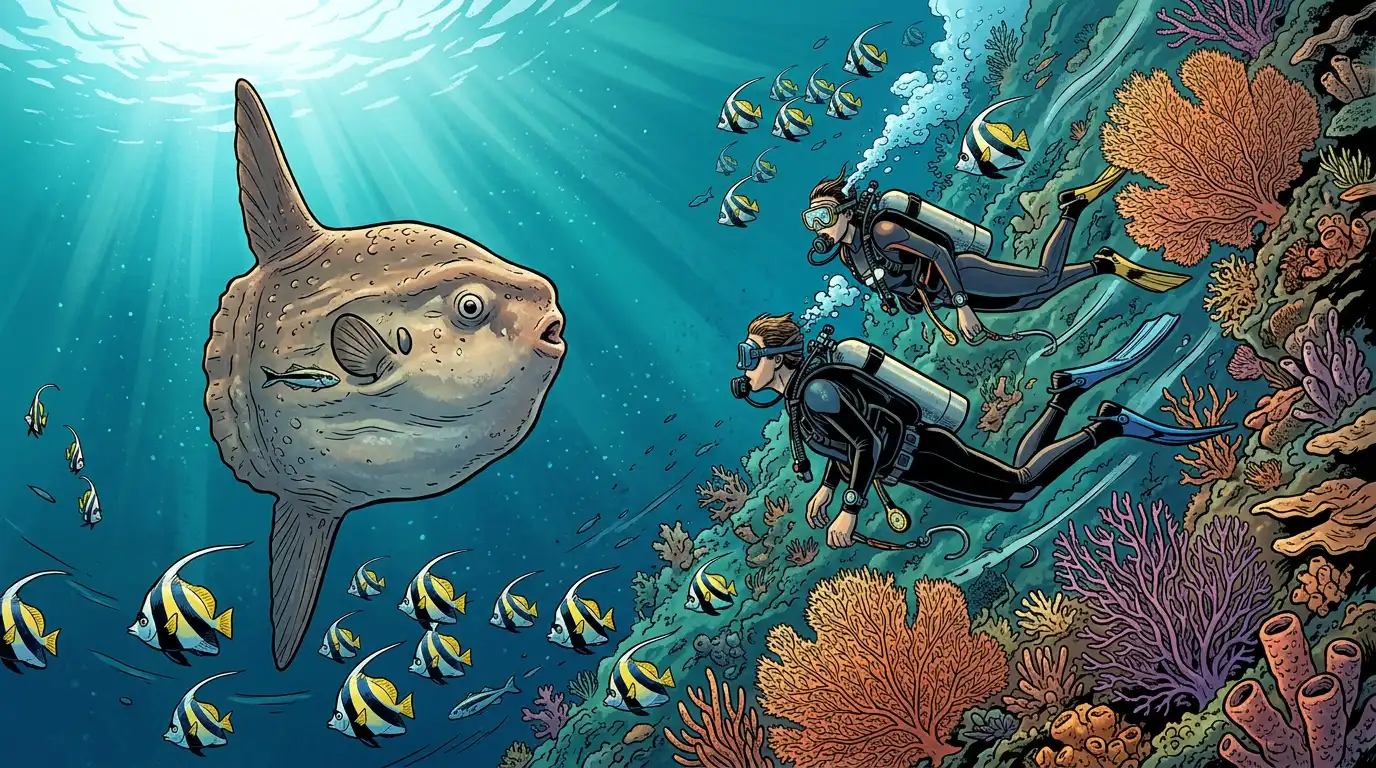
The mola mola in Bali, also called the ocean sunfish, is one of the headline reasons divers book the Nusa region in season. Public descriptions for Blue Corner frequently mention Mola mola as a key possibility.
Seasonality is often discussed as roughly July through November for sunfish-focused diving around Bali and the Nusa islands, though sightings remain never guaranteed. Mola behaviour ties to cold upwellings, cleaning interactions, and conditions that change year to year.
Rays: eagle rays, marble rays, and more
Many trip reports and site summaries mention eagle rays and marble rays as part of the regional big fish scenery. These are the kinds of animals that show up when currents concentrate life and visibility supports wide angle moments.
Sharks: whitetip reef sharks and other possibilities
It is common to see references to reef sharks in the broader Nusa area. Some Blue Corner descriptions mention whitetip reef sharks using plateau areas and structure.
Turtles
Sea turtles are frequent stars around the Nusa islands on many sites, and Blue Corner trip write ups often include turtles as part of the “usual suspects” community.
Moray eels, lobsters, macro on the wall
Atlantis Bali Diving style descriptions mention moray eels, large lobsters, and a busy wall with bumps where nudibranch species and pygmy seahorses can appear if you balance big fish scanning with macro discipline.
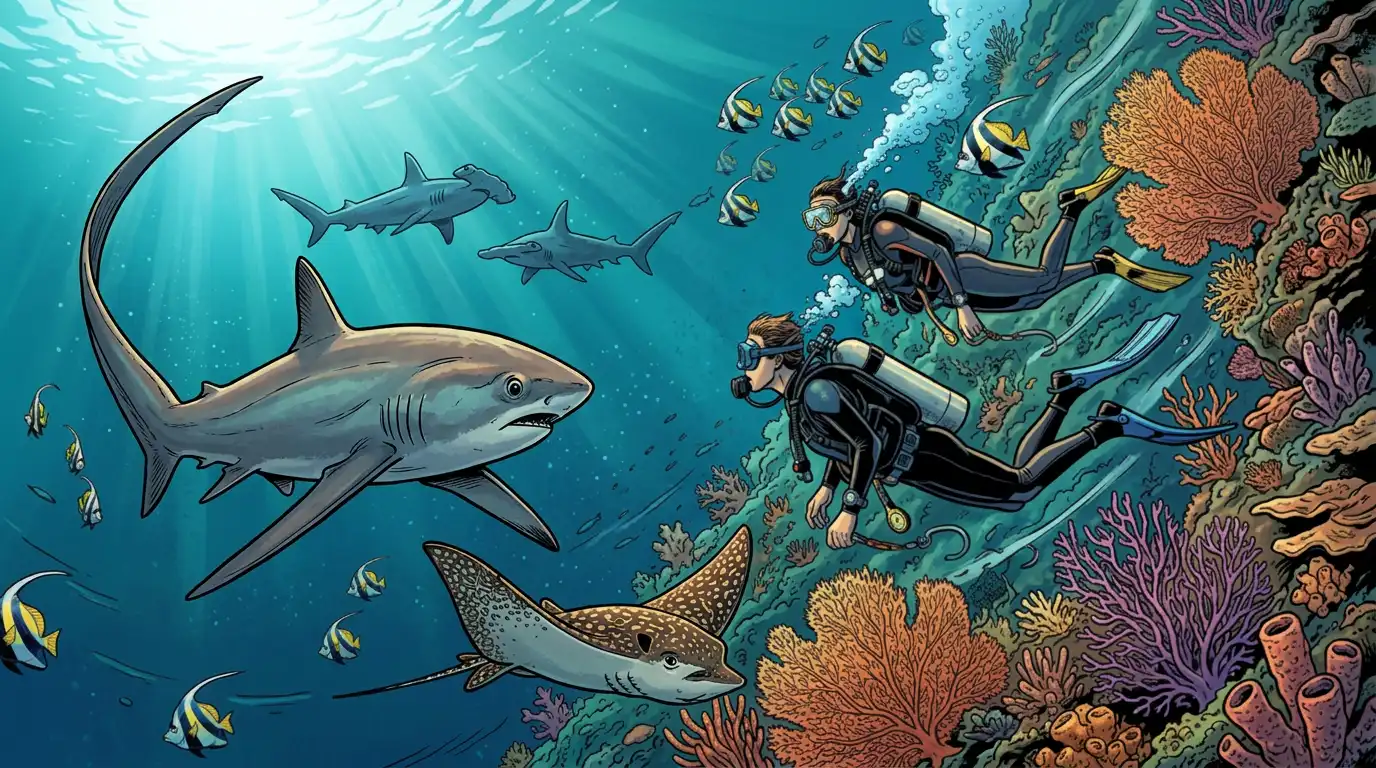
Hammerhead sharks and thresher sharks: be careful with promises
You may want hammerhead sharks and thresher sharks in your dreams, and that is normal, big pelagic energy is why people fly halfway across the world.
Here is the honest framing for Blue Corner specifically:
- These species are not what most local briefings treat as “likely” on an average Blue Corner morning.
- Thresher sharks have been widely discussed in the region in connection with sites such as Crystal Bay on Nusa Penida, often as early morning deep possibilities, depending on season and luck.
- Hammerhead shark encounters happen in Indonesian waters in some destinations, but for Bali and the Nusa islands, many operators treat hammerheads as rare, lucky, and not site specific enough to sell as a Blue Corner guarantee.
If you want a thresher focused strategy, you typically plan a different site window and a different risk profile, not a generic drift day.
Dolphins and whales in broad sightings lists
Some aggregator pages list dolphins and whales in “possible sightings” categories for the region. Treat those as rare bonus categories unless your operator has a specific seasonal pattern backed by local observation.
When is the best time to dive Blue Corner, and why it is not suitable every day
This is the sentence that should be bold on every itinerary: Blue Corner is not suitable every day.
Tide and current windows beat Instagram aesthetics
Strong drift sites often depend on slack windows, incoming versus outgoing flow, and local knowledge about how the corner accelerates water. What looks “fine” on the surface can still be a strong down current or washing pattern on the wall.
That is why experienced operators sometimes say Blue Corner is “on request” or “conditions dependent,” even if your heart is set on it.
Seasonality for comfort and visibility
Some operator materials describe Blue Corner as broadly accessible across the year for planning purposes, while also acknowledging variable visibility and temperature swings.
For mola mola focused motivation, many divers aim for the mid year to late year window commonly discussed online, while remembering that molas are never promised.
The best time for you personally
The best time is when:
- your skills match the plan
- your guide says the tide window fits
- sea conditions allow safe boat handling
- you are not dehydrated, sick, or under pressure to force a bad day
Diving Nusa Lembongan versus diving Nusa Penida: how Blue Corner fits your trip
If you are comparing diving Nusa Lembongan with diving Nusa Penida, try not to treat them as totally separate universes. The islands are minutes apart by boat, and many shops route sites across both.
Blue Corner is a strong example of a site that is Lembongan adjacent but still appears on Nusa Penida marketing because Penida is the hub for many divers.
Neptune Scuba Diving and how to approach Blue Corner like a professional
Neptune Scuba Diving is built around safe, well guided diving in Bali’s variable conditions. For sites like Blue Corner, the priority sequence is simple:
- Match the diver to the site honestly.
- Match the day to the tide responsibly.
- Plan the profile conservatively with drift exits and surface protocols that suit real boats and real currents.
If you are early in your diving journey, Bali still offers calmer training sites and beautiful reefs. If you are advancing, Blue Corner can be the kind of drift you remember for years, for the right reasons.
Environmental etiquette on a high traffic drift site
Strong current sites attract experienced divers, and experienced divers should model best behaviour:
- maintain buoyancy to avoid contact with reef
- avoid chasing animals for photos
- do not touch mola mola or block their path
- follow local rules if manta or sunfish guidelines apply in the region you dive
The goal is to keep these sites healthy so the next decade of divers sees the same magic.
Final thoughts
Searching blue corner nusa penida will keep leading divers toward one of Bali’s most famous drift dives. The name will keep mixing Penida and Lembongan together, because boats and fish do not care about island labels the way tourists do.
If you treat Blue Corner with respect, plan around tides, and match your experience level honestly, it can be exactly what people say, a blue water ride along a living wall where the ocean feels big again.
If the day is wrong, the best dive is the one you do not force.