

Bali is one of the best places in the world to try diving and learn to dive. Warm water, calm bays, and clear visibility make it ideal for beginners. Whether you want a one-day introduction with Discover Scuba Diving or a full certification with the PADI Open Water Diver course, Bali offers strong training and memorable dives.
This guide explains how to try diving Bali, what Discover Scuba Diving Bali involves, and how to move on to the PADI Open Water Diver course in Bali.
Why Bali Is Ideal for Learning to Dive
Bali diving has conditions that suit new divers: warm water year-round, sheltered bays for confined water, and varied sites for open water. Many dive centers are PADI-affiliated, so you can start with PADI Discover Scuba Diving and progress to the PADI Open Water Diver course in the same place.
Popular areas for diving in Bali for learning include Sanur, Amed, Tulamben, and Nusa Penida. Each offers different environments, wrecks, reefs, and gentle slopes, so you can choose what fits your comfort level.
Try Diving Bali: Your First Step
If you’re curious about scuba diving in Bali but not ready for a full course, try diving Bali with a PADI Discover Scuba Diving experience. It’s a one-day introduction that lets you breathe underwater and see marine life without committing to certification.
What Is PADI Discover Scuba Diving?
PADI Discover Scuba Diving is a non-certification program for people who want to try scuba in a controlled, supervised setting. You learn basic skills in shallow water, then do one or two dives to a maximum of 12 meters (40 feet) under direct instructor supervision.
It does not lead to certification, but it counts as credit toward the PADI Open Water Diver course if you decide to continue.
Who Is PADI Discover Scuba Diving For?
Discover Scuba Diving is for anyone who:
- Wants to try diving before committing to a full course
- Is on a short trip and has limited time
- Wants to see if they enjoy breathing underwater
- Is considering the PADI Open Water Diver course and wants a preview
You must be at least 10 years old and in reasonable health. You’ll complete a medical questionnaire; some conditions may require a doctor’s approval before diving.
The PADI Discover Scuba Diving Curriculum and Experience
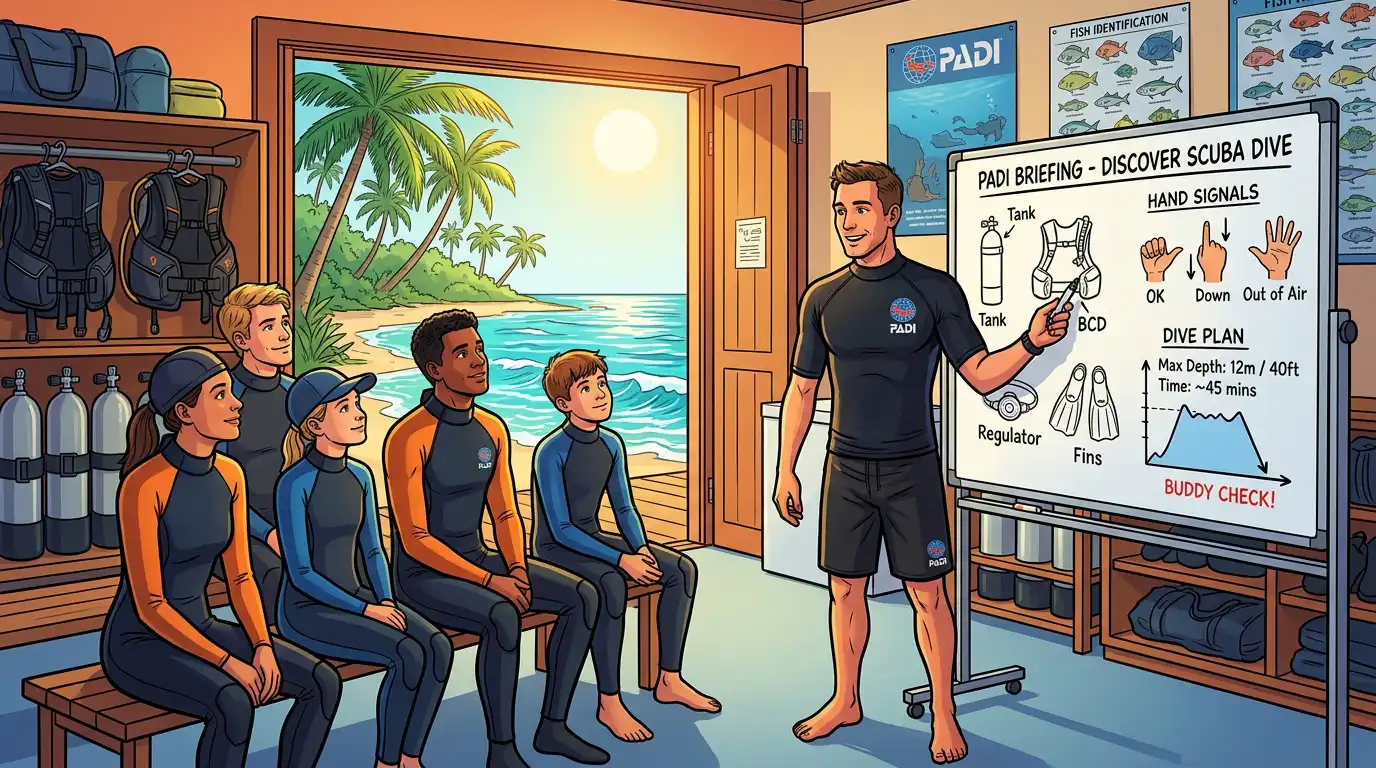
1. Knowledge Development (Briefing)
Before getting in the water, your instructor explains:
- How scuba equipment works — Tank, regulator, BCD, mask, fins, and weights
- Breathing underwater — Breathe slowly and continuously; never hold your breath
- Equalizing — How to clear your ears as you go deeper
- Hand signals — Basic communication underwater (OK, problem, ascend, etc.)
- Safety rules — Stay with your instructor, monitor your air, ascend slowly
This usually takes 30–45 minutes and is done in a relaxed, conversational way.
2. Confined Water Skills (Shallow Water Practice)
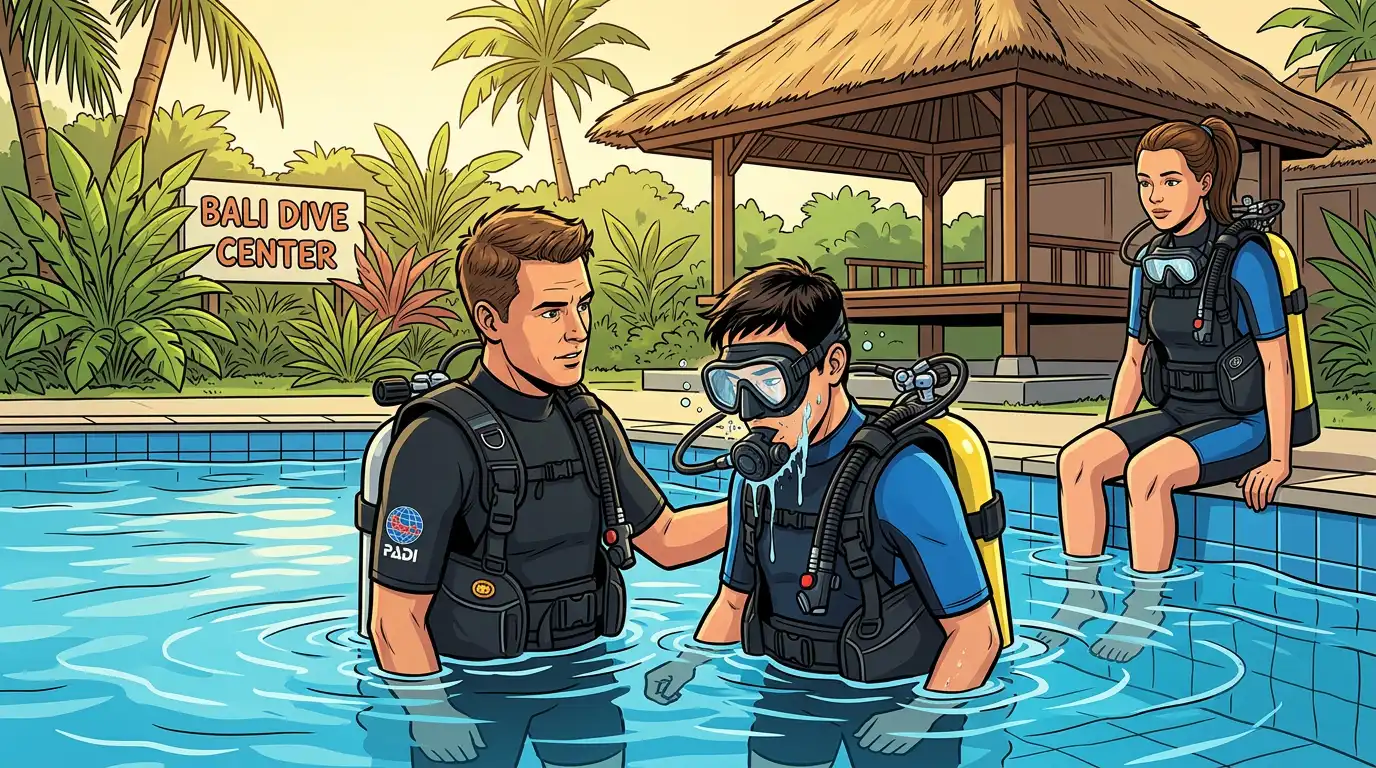
You practice in shallow water (pool or calm bay, about 1–2 meters deep):
- Setting up your gear — With instructor help
- Entering the water — Giant stride or controlled entry from shore
- Breathing from the regulator — First at the surface, then with your face in the water
- Clearing your mask — If water gets in
- Recovering your regulator — If it comes out of your mouth
- Using your BCD — Inflate and deflate to control buoyancy
- Equalizing — As you go a bit deeper
You only move on when you feel comfortable. The instructor stays close and can assist at any time.
3. Open Water Dive(s)
After the skills, you do one or two open water dives, typically to 6–12 meters. You’ll:
- Follow your instructor
- Practice the skills you learned, as needed
- Explore the reef and see fish, coral, and sometimes turtles
The instructor leads the dive, manages depth and time, and keeps you within safe limits. You focus on breathing, equalizing, and enjoying the experience.
4. What You’ll See on a Discover Scuba Diving Experience in Bali
Depending on the site, you might see:
- Colorful reef fish (angelfish, parrotfish, clownfish)
- Soft and hard corals
- Sea turtles
- Reef structures and small caves
- In Tulamben, the USAT Liberty wreck (in shallow areas)
Bali’s reefs are rich and varied, so even shallow dives feel rewarding.
How Long Does Discover Scuba Diving Take?
A typical PADI Discover Scuba Diving program in Bali is a full day (about 6–8 hours), including briefing, confined water, and one or two open water dives. Some operators offer half-day options with one dive.
What’s Included in Discover Scuba Diving Bali?
Usually included:
- Full equipment rental
- PADI instructor
- Confined water session
- One or two open water dives
- Briefing and debriefing
Check with your dive center for exact inclusions, transport, and any extra fees involving PADI Bali Diving.
Learn Diving Bali: The PADI Open Water Diver Course
If you want to dive independently (with a buddy) and get certified, the next step is the PADI Open Water Diver course. This is the standard entry-level certification recognized worldwide.
What Is the PADI Open Water Diver Course?
The PADI Open Water Diver course Bali teaches you the knowledge and skills to plan and conduct dives with a buddy, without an instructor, to 18 meters (60 feet). It’s the foundation for all further PADI training.
Who Is the PADI Open Water Diver Course For?
The course is for anyone who wants to:
- Learn diving properly and get certified
- Dive on future trips without an instructor
- Progress to advanced and specialty courses
- Build a solid base of skills and knowledge
You must be at least 10 years old (or 15 for the standard course) and medically fit to dive.
The PADI Open Water Diver Course Curriculum
The course has three parts: Knowledge Development, Confined Water Dives, and Open Water Dives.
1. Knowledge Development
You learn the theory behind safe diving:
- Module 1 — The underwater world, equipment, and buddy system
- Module 2 — Adapting to the underwater environment (pressure, buoyancy, breathing)
- Module 3 — Dive planning, safety, and problem management
- Module 4 — Dive tables/computers, repetitive dives, and dive planning
- Module 5 — Dive environment, aquatic life, and responsible diving
You can do this via:
- PADI eLearning — Online, at your own pace (often before you arrive)
- Classroom — With an instructor at the dive center
Each module has a short knowledge review. There is no long written exam; the focus is on understanding.
2. Confined Water Dives (5 Sessions)
You practice skills in a pool or calm, shallow water:
Confined Water Dive 1 — Equipment setup, entries, breathing, regulator skills, mask clearing, BCD use
Confined Water Dive 2 — Buoyancy, fin pivots, regulator recovery, no-mask breathing
Confined Water Dive 3 — Alternate air source, cramp release, tired diver tow
Confined Water Dive 4 — Controlled emergency swimming ascent (CESA), weight removal at surface
Confined Water Dive 5 — Skill integration and optional skills
You repeat skills until you’re comfortable. The instructor can combine or adjust sessions to suit conditions and your progress.
3. Open Water Dives (4 Dives)
You apply your skills in the ocean over four dives:
Open Water Dives 1 & 2 — Usually to about 12 meters. You practice key skills (mask clear, regulator recovery, etc.) and explore the reef.
Open Water Dives 3 & 4 — To a maximum of 18 meters. You plan the dive with your instructor, perform a few skills, and enjoy the dive.
By the end, you should be able to plan and conduct a dive with a buddy within your training limits.
How Long Does the PADI Open Water Diver Course Take?
The standard schedule is 3–4 days:
- Day 1 — Knowledge Development (or eLearning) + Confined Water Dives 1–3
- Day 2 — Confined Water Dives 4–5 + Open Water Dives 1–2
- Day 3 — Open Water Dives 3–4
- Day 4 — Optional extra day for skills practice or extra dives
Some Bali dive centers offer longer schedules for a more relaxed pace. With PADI eLearning, you can finish the theory before you travel to Bali and focus on in-water training in Bali.
What’s Included in the PADI Open Water Diver Course in Bali?
Typically included:
- PADI eLearning or classroom materials
- Full equipment rental for the course
- PADI instructor
- All confined and open water dives
- PADI certification fee (card)
Transport, accommodation, and any extra dives are usually extra. Confirm with your dive center.
Discover Scuba Diving vs. PADI Open Water: Which Should You Choose?
Choose PADI Discover Scuba Diving if you:
- Want to try diving once or twice
- Have limited time (e.g. one day)
- Aren’t sure you’ll like it
- Want a low-commitment introduction
Choose the PADI Open Water Diver course if you:
- Want to become a certified diver
- Plan to dive on future trips
- Have 3–4 days available
- Are ready to invest in proper training
Progression path: Many people do Discover Scuba Diving Bali first, then sign up for the Open Water course. The Discover Scuba Diving experience can count toward your Open Water training, so you may be able to skip some confined water sessions (at the instructor’s discretion).
Diving Trips in Bali: Where to Learn
Bali diving has several areas suited to learning and especially for try diving Bali:
Sanur
Sanur has calm, shallow water and several dive centers. It’s good for confined water and first open water dives. Boat dives to nearby sites are easy to arrange.
Tulamben
Tulamben is famous for the USAT Liberty wreck, which starts in shallow water. The slope is gradual, and visibility is often good. Popular for both Discover Scuba Diving and Open Water courses.
Amed
Amed offers calm bays, reefs, and the Japanese wreck. It’s quieter than Tulamben and good for beginners who prefer a relaxed setting.
Nusa Penida / Nusa Lembongan
Nusa Penida has stronger currents and is better for certified divers although try diving Bali is also possible when the water conditions are calm. Some dive centers in Bali use calmer sites around Nusa Lembongan for training. Confirm with your dive center which sites they use for courses.
Practical Tips for Learning to Dive in Bali
Book in advance — Especially in high season, so you get your preferred dates and instructor.
Complete eLearning before you travel — If you choose eLearning, finish it before Bali to save time and focus on diving.
Stay hydrated — Drink plenty of water; avoid alcohol the night before.
Don’t fly immediately after diving — Wait at least 18–24 hours after your last dive before flying.
Ask questions — Instructors expect questions. If something is unclear, ask before or during the dive.
Relax — Diving is easier when you’re calm. Breathe slowly and take your time with skills.
Choose a reputable dive center — Look for PADI Dive Centers or Resorts with good reviews and small student-to-instructor ratios.
What Happens After Your PADI Open Water Certification?
Once certified, you can:
- Dive with a buddy to 18 meters on dive trips worldwide
- Join diving trips in Bali and elsewhere
- Continue with PADI Advanced Open Water, specialties, and professional levels
Your dive certification does not expire. Refresher courses are recommended if you haven’t dived for a long time.
Conclusion
Bali is an excellent place to try diving and learn to dive. PADI Discover Scuba Diving gives you a safe, supervised introduction in one day. The PADI Open Water Diver course turns that into a full certification so you can dive independently on future trips.
Whether you start with Discover Scuba Diving Bali or go straight to the Open Water course, choose a PADI-affiliated dive center such as Neptune Scuba Diving, follow the curriculum, and enjoy the experience. Diving in Bali opens the door to a lifetime of underwater exploration.