科莫多
PADI Deep Diver in Komodo
The PADI Deep Diver specialty trains you to plan and execute dives beyond the typical 18–30 m recreational band with clearer judgment about gas use, narcosis, and contingency planning. Komodo National Park—known for steep walls, seamounts, and current-swept channels—offers memorable settings to practise those skills against a backdrop of world-class biodiversity. This guide explains what Deep Diver is, why Komodo is a strong place to take it, how the standard two-day programme is organised, how to think about narcosis, who qualifies, and what safety means when you add depth.

What is the PADI Deep Diver specialty?
Deep Diver is a PADI specialty focused on planning and conducting dives in the 18–40 m / 60–130 ft range (within recreational limits and local regulations). It is not technical diving: you stay on air or enriched air as appropriate, use standard single-tank recreational equipment, and follow no-decompression limits. The emphasis is on mental discipline, understanding how depth changes colour perception, gas consumption, and task loading, and building habits that keep you within conservative margins.
The course connects classroom or digital knowledge with supervised open-water training dives where you rehearse descents, depth monitoring, buddy awareness, and controlled ascents with safety stops. Graduates are better equipped to join charters advertising deeper profiles and to decide when a site is within their personal comfort zone—not simply when it is inside a table or computer limit.
Why deep diving in Komodo?
Komodo sits at a confluence of currents and upwellings that feed reefs, walls, and offshore pinnacles. Many signature sites feature vertical topography: drop-offs where pelagic fish patrol the blue, overhangs where soft corals billow, and ridges where you may stage a deeper portion of the dive before drifting shallower for a safety stop. That variety means instructors can match training to realistic profiles—wall orientation, mild current awareness, and navigation along depth contours— rather than only practising in featureless sand.
Marine life at depth often differs from the shallows: larger schools, occasional sharks or rays, and cryptic species tucked under ledges. Experiencing that context while supervised helps you separate curiosity from complacency: the scenery is extraordinary, but the same environment demands tighter gas rules, clearer communication, and a plan for surfacing together if conditions or narcosis shift the mood of the dive.
Course structure: four deep dives over two days
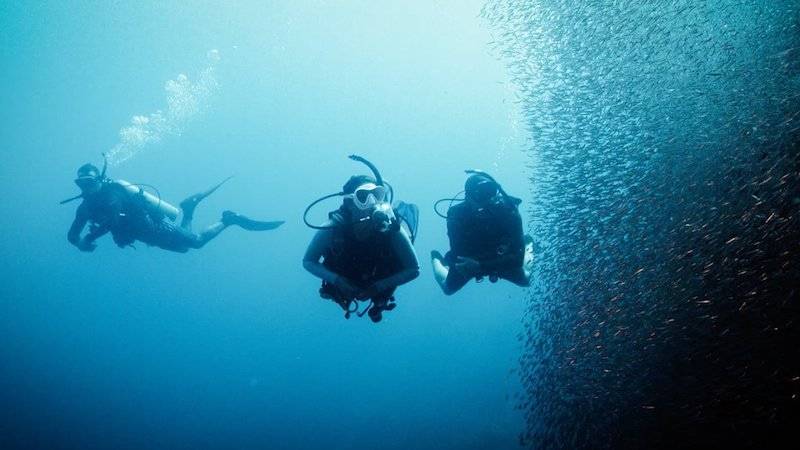
The standard PADI Deep Diver programme includes four open-water training dives, often spread across two days so you surface with time to debrief, hydrate, and absorb knowledge reviews. Each dive builds on the last: precise buoyancy on descent, reference points for depth and time, and teamwork patterns that work when visibility or current fluctuates.
A core theme is gas management. You learn to estimate consumption at depth, set turn pressures with buffers for your buddy and the ascent, and recognise that breathing rate often rises with task load or stress before you consciously notice it. Safety stops are treated as non-negotiable parts of the ascent—typically around 3–5 minutes at 5 m / 15 ft unless your training agency and computer prescribe otherwise—giving dissolved nitrogen time to release safely and giving your group a stable zone to regroup before the final approach to the surface.
Knowledge development (eLearning or instructor-led) usually runs alongside the dives so theory and water sessions stay linked: colour absorption, nitrogen loading, and the limits of recreational equipment at depth.
Managing nitrogen narcosis
Narcosis is a temporary change in cognition and reaction timelinked to elevated partial pressure of nitrogen at depth. It is not identical for every diver or every dive; cold, fatigue, carbon dioxide retention, and anxiety can change its onset and character. Deep Diver does not promise to “cure” narcosis—it teaches you to recognise subtle signs in yourself and your buddy, slow tasks when needed, and ascend slightly if judgement feels impaired.
Practical drills in the course—such as comparing performance on simple tasks at depth versus shallower— help you build an honest baseline. The goal is self-awareness and conservative decision-making, not bravado. If a site, workload, or social pressure pushes you past where you feel sharp, the right response is to adjust the plan, not to rationalise the depth.
Prerequisites: Advanced Open Water Diver
PADI requires Advanced Open Water Diver (or a qualifying certification from another agency, subject to instructor verification) before Deep Diver. Advanced Open Water already includes a supervised deep dive and broader adventure exposure, so Deep Diver is the next step when you want dedicated depth training rather than a single taste of deeper water within a five-dive sampler course.
Minimum age and medical fitness follow PADI standards; your instructor will confirm recent diving experience so skills are current. If you have been away from diving, an instructor may recommend a tune-up day before committing to multi-day depth work in dynamic conditions.
Safety and emergency procedures at depth
Safety on deep dives rests on redundancy in planning: agreed maximum depth and time, clear turn pressures, lost-buddy protocols, and surface signals understood by everyone on the boat. At depth, problems escalate faster—gas runs low sooner, and ascending safely takes longer—so early communication beats heroic fixes at the last bar.
The course reviews how to assist a stressed or low-on-gas buddy, manage buoyant ascents without blocking each other, and when to abort a dive for conservatism. In Komodo, factoring in current, surface chop, and skiff pickup is part of realism: your safety stop is not only about tables but about arriving at the surface where the boat expects you, visible and coordinated.
Deep Diver complements other specialties—Enriched Air (Nitrox) for longer no-stop time within certain depth bands, Drift Diver for current-rich sites, and Rescue Diver for broader emergency preparedness. Together they describe a thoughtful recreational diver in challenging environments, without crossing into technical certification territory.