Komodo
PADI Rescue Diver in Komodo
The PADI Rescue Diver course is where recreational training shifts from personal competence to teamwork and prevention. In Komodo’s challenging currents and remote dive settings, those skills matter: you learn to recognise stress early, manage incidents calmly, and assist others without becoming part of the problem yourself.

What is the PADI Rescue Diver course?

PADI Rescue Diver focuses on self-rescue and assisting other divers in realistic conditions. Unlike courses that mainly add new dive skills for yourself, Rescue Diver trains you to notice when something is wrong—tired buddies, rising anxiety, equipment hiccups—and to respond with a clear sequence: stabilise the situation, provide help, and get people safely to the surface or shore when needed.
The programme is still firmly in the recreational realm: you are not training as a medic or as paid staff. You are building a mental model of prevention, observation, and controlled intervention, so small issues are less likely to become emergencies. That mindset pairs well with diving anywhere, and especially in places like Komodo where surface support, boat logistics, and currents can add complexity to a day on the water.
Why Rescue Diver matters: confidence and prevention
Most divers remember Rescue training as the point where confidence and situational awareness step up. You rehearse how to read body language underwater, communicate clearly, and avoid panic-driven mistakes—both in others and in yourself. That makes you a calmer buddy and a more predictable member of a group when visibility drops or plans change.
A large part of the value is problem prevention: better gear checks, clearer briefings, and spotting fatigue before it turns into a rescue. Many divers also find the course changes how they plan dives—thinking about exit points, surface intervals, and who is responsible for whom before anyone enters the water.
Typical course structure: knowledge, confined water, and open water

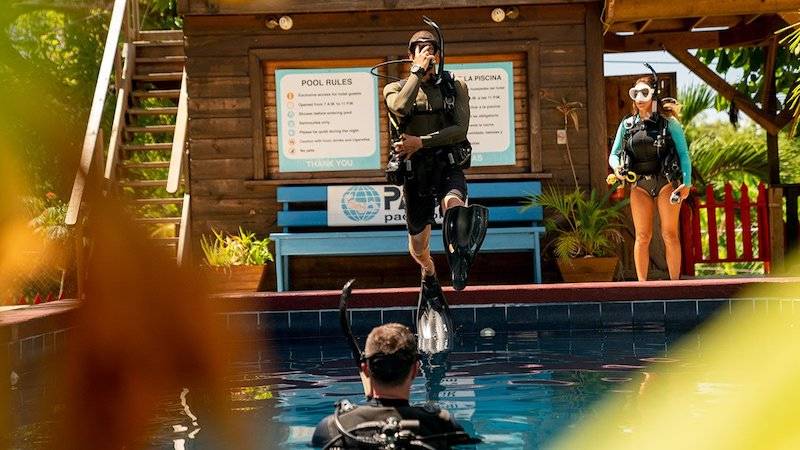
Training usually blends classroom or eLearning review, confined-water practice (pool or shallow, protected site), and open-water scenarios where you apply skills in context. Instructors often run exercises as short scenarios—missing diver, tired swimmer on the surface, unresponsive diver drills—so muscle memory develops alongside decision-making.
A common timeline spans about three days when Emergency First Response (EFR) is included: one segment for primary and secondary care knowledge and practical skills on land, then rescue-specific sessions in confined and open water. Exact scheduling varies by centre, weather, and how eLearning was completed beforehand, but the goal is always the same—safe repetition until responses feel automatic under mild stress.
Open-water sessions in Komodo typically take place at sites chosen for manageable conditionsfor training, not necessarily the park's most extreme drifts. Your instructor will match the site to the exercise: clear enough to observe, sheltered enough to debrief between runs.
Emergency First Response (EFR) requirement
PADI requires current training in CPR and first aid within the past 24 months before certification as a Rescue Diver. The standard way to meet that is the Emergency First Response (EFR) course, which covers scene assessment, CPR, bleeding control, spinal-injury awareness, and other foundational skills you might need on a boat or beach.
EFR is not “extra paperwork”—it aligns what you do on land with what you may need after an incident on the surface. Many students complete EFR immediately before or as part of the same trip as Rescue Diver, so both certifications stay in sync for future professional-level courses.
Core rescue skills you will practise

The syllabus is built around recognisable situations. You will work through tired-diver scenarios at the surface and underwater: approaching safely, offering support, and towing or escorting a diver who is fatigued but cooperative. Panicked-diver drills add urgency—you learn to maintain your own buoyancy and protect your airway while helping someone who may grab unpredictably.
Unresponsive-diver exercises cover search patterns, bringing an unresponsive diver up while managing regulators and buoyancy, and coordinating with surface help. These are practised repeatedly so that in a real event you fall back on training rather than improvisation alone.
You will also cover equipment-based problems (air-sharing, entanglement awareness),missing-diver procedures, and exit planning—linking each skill to clear communication with boat crew and other divers.
Prerequisites and what comes after Rescue Diver
Entry requirements are defined by PADI and your instructor: you need Advanced Open Water Diver or equivalent, EFR Primary and Secondary Care training (or qualifying CPR/first aid within 24 months), and a minimum age—typically 12 or older for Junior Rescue with limits, or 15+ for full Rescue Diver. A logged dive count within the past 12 months is often expected so that rescue skills build on recent experience.
After Rescue Diver, many divers pursue specialty courses that deepen related skills—such as Deep, Drift, or Peak Performance Buoyancy—or begin the path toward Divemaster if they want to work in diving. Rescue Diver is widely seen as the bridge between “certified vacation diver” and “diver who thinks like a leader,” even if you never go pro.
Preguntas Frecuentes
Explora mas en Komodo


Únete a más de
1,000+ huéspedes al mes
De todo el mundo nos visitan para buceo, cursos PADI, snorkel y apnea.