

Bali's southern coastline gets the crowds, the surf breaks, and the sunset cocktail bars. But for scuba divers who know where to look, the island's greatest treasure lies at its northwestern tip, hidden inside a national park where the jungle meets the Java Sea and the reefs have been growing undisturbed for decades. This is Menjangan Island, a small, uninhabited crescent of land surrounded by some of the healthiest coral walls and most spectacular dive sites in all of Indonesia.
Diving Menjangan is a different experience from anything else Bali offers. There are no crowds jostling for space on a dive boat, no construction cranes on the horizon, and no plastic bags drifting through the water column. What there is: sheer coral walls dropping into deep blue, shallow coral gardens so pristine they look like museum exhibits, turtles grazing on sponges in water so clear you can see your dive buddy 30 metres away, and a quietness, both above and below the surface, that reminds you why you learned to dive in the first place.
This guide covers everything you need to know about Menjangan Island diving: the dive sites, the marine life, the conditions, how to get there, what to expect, and why this marine protected area inside West Bali National Parkdeserves a place at the very top of your Bali dive itinerary.
Where Is Menjangan Island?
Menjangan Island sits approximately 1 kilometre off the northwestern coast of Bali, within the boundaries of West Bali National Park (Taman Nasional Bali Barat). The island is part of West Bali but is reached by boat from the mainland, with the primary departure points being Labuan Lalang harbour and the nearby dive hub of Pemuteran Bay.
The name "Menjangan" comes from the Javanese word for deer, the small Javan rusa deer that swim across the strait to graze on the island's grass during the dry season. The island itself is flat, low-lying, and covered in dry tropical forest. It has no permanent residents, no hotels, and no development beyond a small Hindu temple and a ranger station. This absence of human impact is precisely what makes the surrounding reefs so exceptional.
Geographically, Menjangan is part of North Bali, a region that feels worlds apart from the tourist centres of Kuta, Seminyak, and Ubud. The drive from southern Bali takes three to four hours, winding through mountain passes, rice terraces, and quiet villages. It is a journey, but every diver who makes it agrees: the reefs at the end of the road are worth every kilometre.
West Bali National Park: Why Protection Matters
Menjangan Island diving owes its extraordinary quality to one critical factor: legal protection. The island and its surrounding waters are part of West Bali National Park, established in 1941 and covering approximately 19,000 hectares of land and 7,000 hectares of coastal and marine habitat. The marine zone around Menjangan has been designated a marine protected area, meaning that fishing, anchoring on coral, and destructive practices like dynamite fishing are strictly prohibited.
This protection has allowed Menjangan's reefs to develop without the pressures that have degraded coral systems elsewhere in Bali and across Indonesia. While reefs in heavily fished and dived areas often show signs of blast damage, overfishing, and coral breakage, Menjangan's walls and gardens remain in remarkable condition, dense coral coverage, healthy fish populations, and the kind of structural complexity that takes decades of undisturbed growth to develop.
The national park charges an entrance fee for all visitors, including divers. This fee funds ranger patrols, mooring buoy maintenance, reef monitoring, and the enforcement of fishing restrictions that keep the reefs healthy. It is money well spent. When you descend on a Menjangan wall and see hard corals growing in unbroken terraces from the shallows to well beyond recreational diving depths, you are seeing the direct result of consistent, enforced protection.
Dive operators in the area, including responsible dive centres based in Pemuteran Bay, play an active role in conservation. Many participate in reef monitoring programmes, support mooring buoy systems (which prevent anchor damage), and educate guests about responsible diving practices. The relationship between dive tourism and reef protection at Menjangan is one of the best examples in Bali of how scuba diving can be a force for conservation rather than degradation.
What Makes Diving Menjangan Special?
Several factors combine to make diving Menjangan a truly exceptional experience:
World-Class Wall Diving
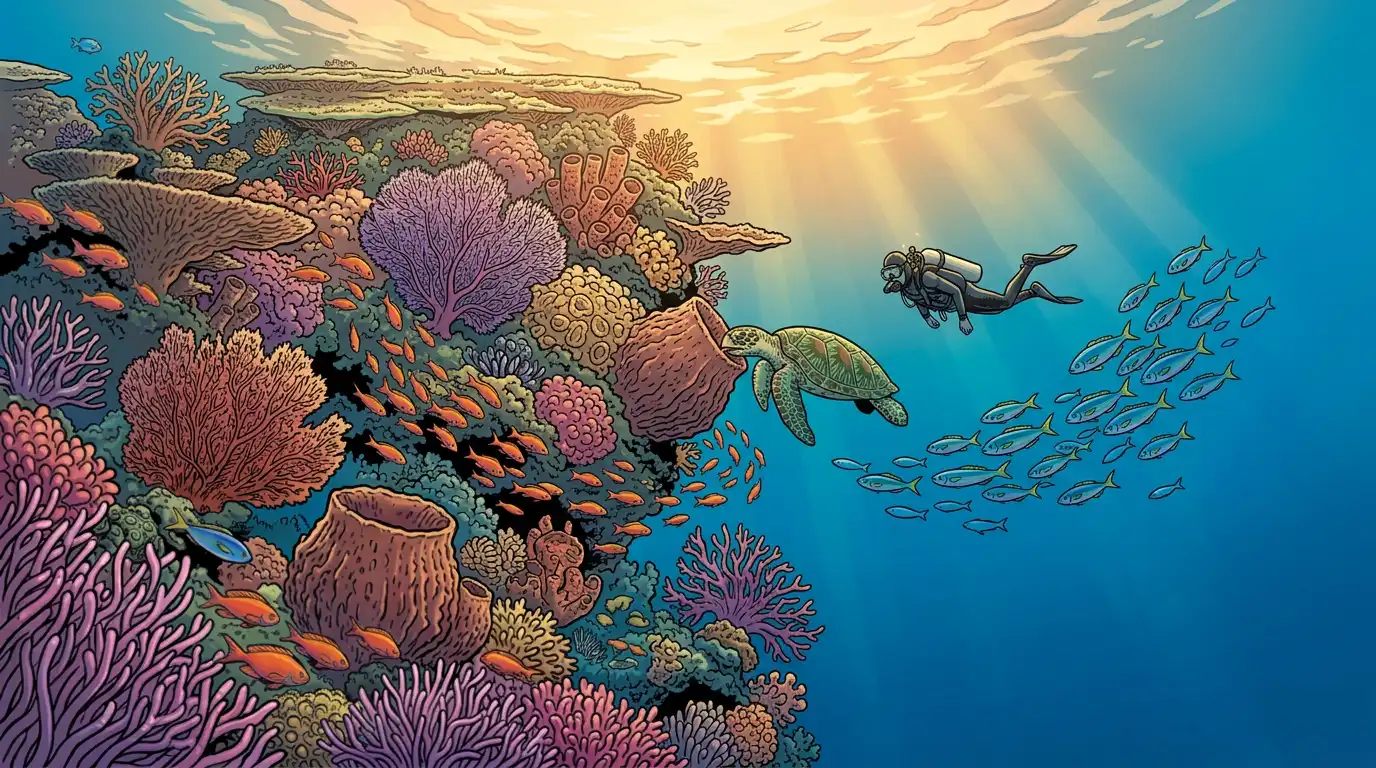
Menjangan is, first and foremost, a wall diving destination. The island's fringing reef drops away in dramatic vertical and near-vertical walls that plunge from shallow reef flats at 3 to 5 metres down to sandy slopes at 40 to 60 metres and beyond. These walls are carpeted with an astonishing variety of corals, massive barrel sponges, delicate sea fans, gorgonian fans in deep purples and reds, dense gardens of soft corals, and hard coral formations in every shape from branching staghorn to boulder like brain coral.
Wall diving here is not the stark, barren cliff-face experience you might encounter at some oceanic sites. Menjangan's walls are alive, every ledge, every crevice, every overhang is occupied. Moray eels peer from holes, lionfish hang motionless in the current shadow of gorgonians, nudibranchs crawl across sponge surfaces, and schools of fusiliers and anthias pulse in shimmering clouds along the wall face.
The walls also make Menjangan an incredibly accessible diving destination. Because the reef flat starts shallow and the walls begin close to shore, divers can spend significant time in the 5 to 18 metre range where light penetration is excellent and air consumption is efficient. There is no need to go deep to see the best of Menjangan, much of the most impressive coral growth and marine life activity happens in the upper section of the walls.
Gentle Currents
Unlike Bali's southern and eastern dive sites, Nusa Penida, Crystal Bay, Padang Bai, where currents can be fierce and unpredictable, Menjangan is known for its gentle currents. The island's position in the sheltered waters of the Bali Strait, protected by the national park's headlands, means that tidal flow is typically mild and predictable.
This makes Menjangan Island diving suitable for a wide range of experience levels. Beginners and newly certified divers can enjoy relaxed wall dives without the stress of fighting current, while advanced divers can focus on photography, critter hunting, and exploring deeper sections of the walls without being swept off course. The gentle currents also mean excellent visibility, 20 to 40 metres on a good day, since there is minimal sediment disturbance.
Pristine Coral Health
The coral coverage at Menjangan is among the best of Bali dive sites. The combination of protected status, minimal runoff (the national park's forested coastline prevents the agricultural and urban runoff that smothers reefs elsewhere), and low diver impact has produced reef systems of exceptional health.
Hard coral coverage on the reef flats and upper walls regularly exceeds 50 percent, with some areas approaching 80 percent, numbers that marine biologists consider outstanding. The diversity is equally impressive: over 100 species of hard coral have been recorded around the island, along with extensive soft coral gardens on the deeper wall sections. For divers who have spent time on damaged or degraded reefs, descending onto a Menjangan wall is a visceral reminder of what a healthy reef looks like.

Menjangan Dive Sites: A Complete Guide
The island's relatively compact size means that all Menjangan dive sites are accessible within a short boat dive from the mainland. Most dives are conducted as drift dives along the walls, with the boat dropping divers at one point and collecting them downcurrent. Here is a detailed guide to the popular dive sites around the island:
Pos Satu (Pos 1)
Pos Satu, "Post One", is one of the most frequently dived sites on Menjangan and for good reason. It features a spectacular wall that drops vertically from a shallow reef flat at around 3 metres to a sandy slope at approximately 40 metres. The wall is densely covered in hard and soft corals, with enormous barrel sponges punctuating the vertical face.
The shallow reef flat at the top of the wall is a coral garden in the truest sense, pristine table corals, branching acropora, and brain corals create a complex three-dimensional habitat buzzing with damselfish, wrasse, butterflyfish, and parrotfish. Hawksbill turtles are regular visitors, often seen feeding on sponges along the upper wall. In the blue off the wall, you may spot schools of trevally, barracuda, and the occasional reef shark cruising the deeper water.
Pos Satu is an excellent site for all levels. The shallow reef flat is perfect for less experienced divers or those finishing their air early, while the wall itself rewards exploration at any depth. Underwater photographers will find subjects at every turn, the combination of dense coral, varied marine life, and excellent visibility makes this one of the most photogenic dive sites in North Bali.
Pos Dua (Pos 2)
Adjacent to Pos Satu, Pos Dua continues the same wall system but with its own distinct character. The wall here is slightly less vertical in places, with dramatic overhangs and ledges that create sheltered zones where critters accumulate. Look under the overhangs for sleeping whitetip reef sharks, large groupers, and clusters of glassfish catching the light.
The coral garden on the reef flat at Pos Dua is particularly vibrant, with dense stands of staghorn coral providing shelter for juvenile fish, moray eels, and octopus. The diversity of hard coral species here is exceptional, a single slow pass across the reef flat can reveal dozens of species in every growth form.
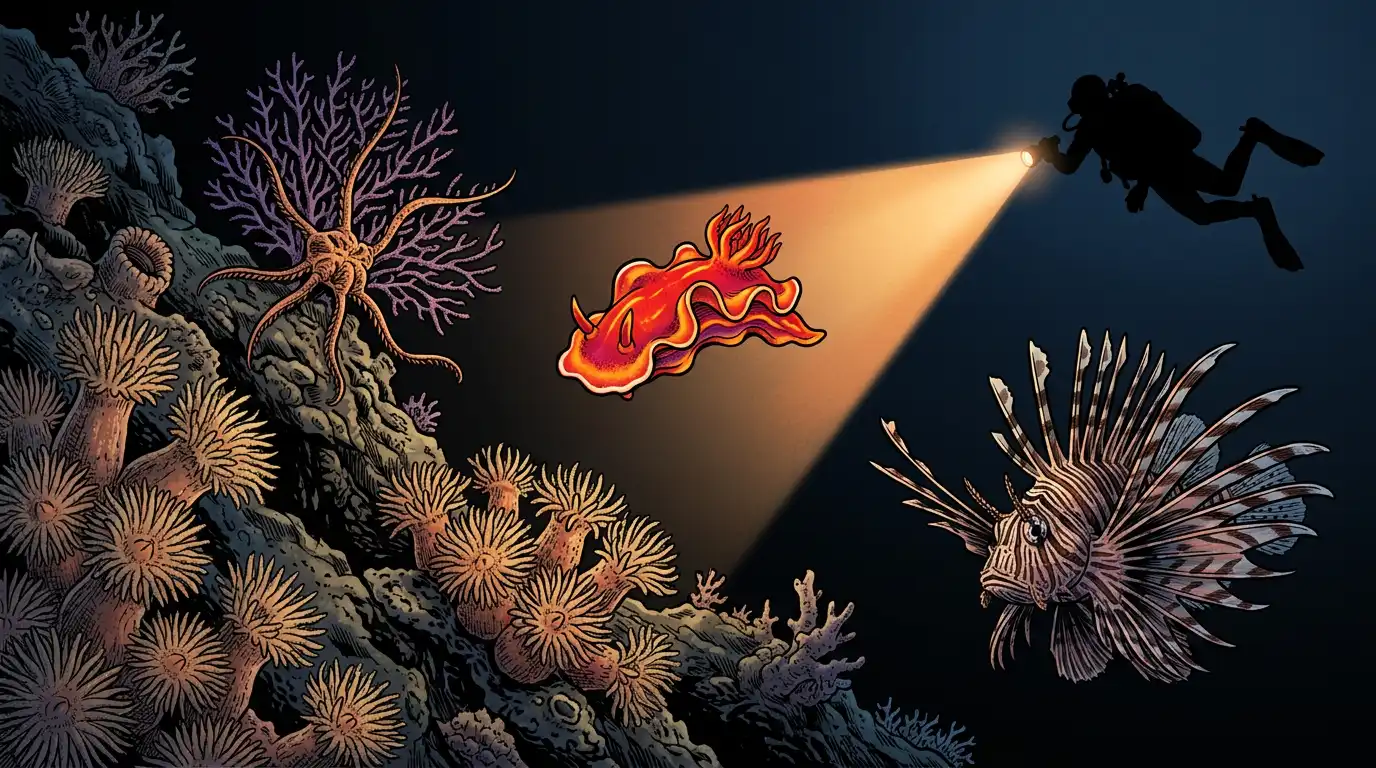
Pos Dua is also a rewarding site for a night dive. After dark, the wall comes alive with hunting lionfish, feeding basket stars that unfurl their arms into the current, foraging crabs and shrimp, and the hypnotic display of coral polyps extending to feed on plankton. A night dive at Pos Dua is one of the highlights of any diving Menjangan trip.
Bat Cave (Gua Kalong)
Named for the colony of fruit bats that roost in a cave above the waterline, Bat Cave is one of the most dramatic Menjangan dive sites. The wall here features a series of large caverns and swim-throughs at the base, where light filters through cracks and openings to create atmospheric blue-lit chambers.
The wall itself is heavily encrusted with gorgonian fans and soft corals in vivid purples, reds, and yellows. The deeper sections (below 25 metres) are particularly rich, with black coral trees and dense soft coral growth that gives the wall a lush, jungle-like texture. Nudibranchs are abundant here, keen-eyed divers and guides frequently spot species including Chromodoris, Phyllidia, and Nembrotha varieties.
Bat Cave is best suited to advanced divers comfortable with wall diving and overhead environments. The swim throughs are spacious and well lit, but they require good buoyancy control and awareness of depth. The site rewards slow, attentive diving, rush through and you will miss the macro treasures hiding on every surface.
Eel Garden
Eel Garden takes its name from the large colony of garden eels that inhabit the sandy slope at the base of the wall, typically at around 25 to 30 metres. Hundreds of these slender, swaying eels emerge from their burrows to feed on passing plankton, creating a mesmerising living carpet that retreats in a wave as divers approach.
The wall above the eel colony is excellent, with healthy hard coral growth and good populations of reef fish. But the headline act here is the eels themselves. Approaching the colony requires patience and good buoyancy, move slowly, stay low, and the eels will remain extended. Rush in and they disappear into the sand like a conjuring trick. Underwater photographers come specifically for the garden eels, and the best shots require a slow, methodical approach that rewards calm, experienced scuba divers.
Coral Garden
Aptly named, Coral Garden is a site on the island's northern side where the reef flat extends further from shore than at other sites, creating a wide, shallow expanse of extraordinary coral diversity. This is less about dramatic walls and more about the sheer beauty of a healthy, complex coral ecosystem in shallow water.
Depths at Coral Garden range from 2 to 15 metres, making it ideal for less experienced divers, snorkellers, and anyone interested in reef ecology. The variety of hard coral species is remarkable, tables, branches, pillars, encrusting forms, and massive boulders all coexist in a dense mosaic. Fish life is prolific: angelfish, butterflyfish, triggerfish, pufferfish, anemonefish, and dense schools of damselfish swarm over the reef.
Coral Garden is also an excellent site for Bali PADI courses. Its shallow, calm, current-free environment makes it a perfect classroom for Open Water students practising skills in confined water conditions, while the diversity and beauty of the reef provide the inspirational backdrop that turns nervous students into lifelong divers.
Sandy Slope
On the island's eastern side, Sandy Slope offers a completely different diving experience. Instead of walls, the terrain here is a gradual sandy incline dotted with coral bommies, rubble patches, and seagrass beds. This is Menjangan's answer to muck diving, a site where the treasure is in the details.
Patient divers will be rewarded with sightings of juvenile frogfish hiding in sponges, ornate ghost pipefish swaying among crinoids, various species of nudibranch, octopus hunting across the sand, and, for the truly sharp eyed, the possibility of a pygmy seahorse clinging to a gorgonian fan. The sandy habitat also attracts different fish species from the wall sites: jawfish hovering above their burrows, garden eels (a smaller colony than at Eel Garden), and various species of ray resting on the bottom.
Sandy Slope is an excellent second dive after a wall dive, offering a completely different character and pace. It is also a superb night dive site, where the sand comes alive with hunting cephalopods, dancing shrimp, and the alien-like display of free swimming flatworms.
Temple Wall (Pura Wall)
Located near the island's Hindu temple, Temple Wall is one of the most visually striking dives on Menjangan. A coral-covered wall drops from a shallow reef at 5 metres to beyond 40 metres, adorned with spectacular sea fans, massive sponges, and dense soft coral growth. The wall faces west, catching afternoon light that illuminates the corals in warm golden tones, making late afternoon dives here exceptionally photogenic.
The marine life at Temple Wall reflects the health of the broader Menjangan system: hawksbill and green turtles, schools of sweetlips and snappers, hunting cuttlefish, morays, and a resident population of banded sea snakes. The site's exposure to slightly more current than the sheltered southern sites can bring in pelagic visitors, trevally, mackerel, and occasionally larger predators passing through the deeper water off the wall.
Anchor Wreck
A small but historically interesting site, Anchor Wreck features the remains of an old wooden vessel at around 8 metres, now heavily encrusted with coral and serving as an artificial reef. The wreck is compact, more of a curiosity than a feature dive, but the surrounding reef is excellent, with dense hard coral coverage and good critter hunting on the sandy patches nearby.
The site is particularly popular for training dives and as a gentle introduction to wreck diving for students completing their PADI courses in advanced or specialty certifications. The shallow depth and calm conditions make it a stress free environment for practising wreck penetration skills on a small, manageable scale.
Marine Life at Menjangan
The marine life around Menjangan reflects the island's status as a protected diving environment within a functioning marine protected area. The diversity of habitats, walls, sand slopes, coral gardens, rubble zones, supports an impressive range of species:
Reef Fish
Menjangan's reefs host a rich community of tropical reef fish species. Butterflyfish, angelfish, surgeonfish, parrotfish, wrasse, damselfish, triggerfish, pufferfish, and anemonefish are all abundant. Schools of fusiliers and anthias are a constant presence along the walls, creating shimmering curtains of colour that shift and reform with the current.
Larger reef residents include Napoleon wrasse, bumphead parrotfish (occasionally seen on the reef flats), and several species of grouper. Moray eels, giant, honeycomb, and whitemouth, are common in holes and crevices along the walls.
Turtles
Both hawksbill and green turtles are regularly encountered at Menjangan. They are notably relaxed around divers, often allowing close approach as they feed on sponges or rest on ledges. The healthy reef system provides excellent foraging habitat, and sightings on most dives are more the norm than the exception.
Macro Life
For critter enthusiasts, Menjangan offers more than you might expect from a wall-diving destination. Nudibranchs are abundant and varied, with dozens of species recorded across the island's sites. Ghost pipefish, leaf scorpionfish, frogfish, and various shrimp species reward patient searching, particularly on the sandy slope sites. The prized pygmy seahorse, tiny, exquisitely camouflaged, and barely a centimetre long, has been found on gorgonian fans at several sites, though spotting one requires either exceptional eyesight or an experienced guide who knows exactly where to look.
Pelagics
While Menjangan is not primarily a pelagic destination, the deeper water off the walls does attract larger visitors. Reef sharks, blacktip and whitetip, are seen periodically, along with schools of trevally, barracuda, and mackerel. Eagle rays and mobula rays make occasional appearances, particularly during the cooler months when nutrient-rich water draws them closer to the reef.
Diving Conditions at Menjangan
Understanding conditions helps you plan the best possible diving in Menjangan experience:
Visibility
Visibility at Menjangan is generally excellent, 15 to 30 metres is typical, with occasional days exceeding 40 metres. The sheltered position, lack of river runoff, and gentle currents all contribute to consistently clear water. Visibility tends to be best during the dry season (April to November) and can drop slightly during the wet season when occasional rain stirs up sediment on the sandy sites.
Water Temperature
Surface temperatures range from 27 to 29°C during the warm months (October to April) and can dip to 24 to 26°C during the dry season when cooler water from the Java Sea influences the area. A 3mm wetsuit is sufficient for most of the year; a 5mm suit is advisable during the cooler months, particularly for multiple dives per day or deeper wall exploration.
Currents
As noted, gentle currents are the norm. Most dives are conducted as relaxed drift dives along the walls, with current speeds rarely exceeding mild. Occasionally, tidal shifts can create slightly stronger flow at certain sites, but nothing approaching the powerful currents found at Nusa Penida or the Lombok Strait. This makes Menjangan one of the most comfortable and stress-free diving environments in Bali.
Best Time to Dive
Menjangan Island diving is excellent year round, but conditions are generally optimal from April to November during the dry season. Seas are calmest, visibility is highest, and the boat crossing from the mainland is smooth. The wet season (December to March) can bring afternoon rain and slightly reduced visibility, but morning dives are often unaffected and the reefs remain beautiful regardless of season.
Getting to Menjangan and Logistics
From Southern Bali
The drive from Kuta, Seminyak, or the airport area to the Menjangan region takes approximately 3.5 to 4 hours via the northern coastal road through Lovina, or slightly longer via the scenic mountain route through Bedugul and the central highlands. The journey is part of the experience, particularly the mountain route, which passes through cloud forest, volcanic lakes, and terraced hillsides.
From Pemuteran Bay
Most divers base themselves in Pemuteran Bay, a quiet coastal village roughly 30 minutes' drive east of Labuan Lalang, the harbour from which Menjangan boats depart. Pemuteran has developed into the primary dive hub for the Menjangan area, with several dive centres, comfortable accommodation, and a relaxed village atmosphere that appeals to divers seeking substance over nightlife.
The boat dive from Labuan Lalang to Menjangan takes approximately 30 minutes across calm, sheltered water. Boats are traditional wooden jukung outriggers or fibreglass speedboats, depending on the operator. All divers must pay the West Bali National Park entrance fee at Labuan Lalang before boarding, have cash ready, as card facilities are limited.
Dive Centre Options
Pemuteran and the surrounding area host several established dive centres offering daily trips to Menjangan. When choosing an operator, look for:
- PADI or SSI certification and proper insurance
- Small group sizes (a maximum of four to six divers per guide is ideal for wall diving)
- Well-maintained equipment and boats
- Guides with deep knowledge of Menjangan dive sites and critter locations
- Active participation in reef conservation and responsible diving practices
A good dive centre will brief you thoroughly on each site, manage the drift dive logistics (boat positioning, pickup coordination), and critically know where the best critters are hiding on any given day.
PADI Courses at Menjangan
Menjangan's calm, clear, and beautiful conditions make it one of the finest locations in Bali for diver training. Several dive centres in the Pemuteran area offer the full range of PADI courses, from entry level to professional:
Open Water Diver
The crystal clear, current free waters of Coral Garden and the sheltered reef flats provide an ideal training environment for new divers. Students complete confined water skills in shallow areas where the reef is beautiful enough to inspire confidence and excitement, followed by open water dives on the gentler wall sites. Completing your Open Water certification at Menjangan means your first real dives happen on some of the healthiest reefs in Bali, a far cry from the murky training pools and uninspiring shore dives that many new divers experience elsewhere.
Advanced Open Water
For certified divers looking to develop their skills, the Advanced Open Water course at Menjangan is outstanding. The deep dive component takes place on the walls, where controlled descents beyond 18 metres reveal the spectacular soft coral growth and black coral trees of the deeper wall sections. Navigation, buoyancy, and underwater photography specialties all benefit from Menjangan's excellent visibility and varied terrain.
Specialty Courses
The variety of dive environments at Menjangan supports a wide range of specialty courses. Wall Diving, Night Dive, Deep Diving, Underwater Photography, and Fish Identification are all superbly suited to the conditions. For divers interested in marine ecology, the pristine state of the reefs makes Menjangan an exceptional classroom for Reef Conservation and Coral Reef Ecology specialties.
Beyond Menjangan: Diving Pemuteran Bay
While Menjangan steals the headlines, Pemuteran Bay itself offers excellent diving that complements the island experience perfectly. The bay's house reefs, accessible by shore dive from several dive centres, include the Biorock reef restoration project, one of the most successful coral rehabilitation programmes in Indonesia.
The Biorock structures use low voltage electrical currents passed through metal frames submerged on the seafloor, accelerating coral growth by up to five times the natural rate. The result is a series of artificial reef structures now heavily colonised by natural coral, sponges, and fish life. Diving the Biorock reefs offers a fascinating look at marine conservation in action and a surprisingly beautiful diving experience in its own right.
Pemuteran Bay also offers shore-based muck diving on its sandy and rubble slopes, where patient searching reveals frogfish, ghost pipefish, seahorses, blue ringed octopus, and a diverse nudibranch community. For divers spending several days in the area, combining Menjangan wall dives with Pemuteran house reef dives and night dives creates a varied and deeply satisfying itinerary.
Menjangan Versus Other Bali Dive Destinations
Bali offers diverse diving across the island, and Menjangan occupies a distinct niche:
Compared to Nusa Penida
Nusa Penida is Bali's big-animal destination, mantas, mola mola, and strong currents. Menjangan offers the opposite: pristine reef systems, gentle conditions, and a focus on coral health and reef life rather than pelagic encounters. Both are world-class; they simply serve different diving appetites.
Compared to Tulamben
Tulamben, on Bali's northeast coast, is famous for the USS Liberty wreck and excellent muck diving. Menjangan's strength is its walls and coral gardens rather than wrecks and sand slopes. Many divers combine both in a single trip, Tulamben for wreck and muck, Menjangan for walls and pristine reef.
Compared to Amed
Amed offers accessible shore diving on gentle slopes with good macro life. Menjangan surpasses it in coral health, wall diving quality, and the sheer drama of its underwater world. Amed is closer to the southern tourist centres, making it more convenient for short trips, but Menjangan rewards the extra travel with a markedly superior reef experience.
The Verdict
For divers who prioritise reef health, wall diving, coral diversity, and a peaceful, uncrowded protected divingenvironment, Menjangan Island diving is the best diving Bali has to offer. Full stop.
Tips for Getting the Most Out of Your Menjangan Diving
- Stay in Pemuteran. Basing yourself in Pemuteran Bay gives you easy access to Menjangan and the bay's own dive sites. Two to three nights is the minimum for a satisfying dive trip; four to five nights allows a more relaxed pace with time for night dives and Pemuteran shore diving.
- Start early. Morning conditions at Menjangan are typically the calmest and clearest. Most dive centres depart at 8:00 to 8:30 AM. The early boat catches the best visibility and avoids the slight afternoon chop that occasionally develops.
- Bring a camera. Menjangan's visibility, lighting, and coral density make it one of the most photogenic dive destinations in Bali. Whether you shoot wide angle walls or macro critters, you will not regret having a camera.
- Go slow on the walls. The temptation on a drift dive is to let the current carry you and enjoy the panoramic view. Resist. The best of Menjangan reveals itself to those who slow down, look closely, and peer into every crevice and under every overhang.
- Dive the sandy sites too. Most divers come for the walls, but Sandy Slope and the rubble areas offer a completely different character, muck diving critters, macro treasures, and species you will not encounter on the walls. Ask your guide about combining wall and sandy site dives for maximum variety.
- Book a night dive. A night dive at Pos Dua or Sandy Slope transforms familiar terrain into an entirely different underwater world. Hunting crustaceans, feeding corals, free swimming flatworms, and the chance of spotting Spanish dancers make it an unforgettable experience.
- Respect the reef. Menjangan is a marine protected area for a reason. Maintain excellent buoyancy, do not touch or stand on coral, keep equipment streamlined to avoid accidental contact, and follow your guide's instructions. The reefs have thrived because they are treated with respect, every diver has a responsibility to keep it that way.
Final Thoughts
In a world where healthy coral reefs are becoming rarer by the year, Menjangan Island stands as proof of what is possible when marine environments are genuinely protected. The walls are spectacular, the coral gardens are pristine, the marine life is diverse and abundant, and the conditions are welcoming to scuba divers of all levels.
Diving Menjangan is not the adrenaline-charged, current swept, big animal experience that some of Bali's other sites deliver. It is something quieter, deeper, and, many divers would argue, more meaningful. It is the experience of descending onto a reef that looks the way reefs are supposed to look: alive, complex, healthy, and teeming with life from the surface to the depths. It is a reminder of what we are trying to protect when we talk about marine conservation, and a glimpse of what the ocean offers when we get out of its way and let it thrive.
Whether you are a newly certified diver taking your first tentative breaths on a coral garden, an advanced diver hunting for pygmy seahorses on a gorgonian fan at 30 metres, or a seasoned underwater photographer chasing the perfect wall shot in afternoon light, Menjangan has something extraordinary waiting for you beneath the surface. Make the drive, pay the entrance fee, step onto the boat, and go see for yourself. The reefs of West Bali National Park will not disappoint.