Komodo diving guide
Discover Scuba Diving & Try Dive in Komodo
Discover Scuba Diving—often called a try dive—is a short, supervised introduction to scuba. In Komodo, that first breath underwater sits alongside reefs and wildlife that have made the national park famous, while the program itself stays deliberately gentle compared with the drift dives you may read about online.

What is Discover Scuba Diving (DSD / try dive)

Discover Scuba Diving is a program designed by training agencies such as PADI for people who are curious about scuba but not yet ready to enroll in a full certification course. It is not a replacement for Open Water Diver; instead, it compresses the very first steps—how equipment works, how pressure feels, how to breathe calmly from a regulator—into a structured experience led by a professional instructor.
“Try dive” is the everyday label for the same idea: a low-commitment taste of weightlessness before committing to a full course. Training agencies cap depth, mandate supervision, and list skills you must show in confined water first—so expectations stay clear for both sides.
Komodo is famous for current and iconic sites, but a DSD is not a tour of those dives. It stays conservative: comfort, communication, and confidence in water suited to a first-timer.
Who it is for — complete beginners, no certification needed
You do not need a diving certification to join a Discover Scuba Diving experience. The audience is almost entirely beginners: travelers who have snorkeled or only swam in a pool, people assessing whether they want to pursue Open Water Diver on a future trip, and occasionally certified divers from long ago who want a gentle refresher under direct supervision rather than booking a full review program.
Age and medical fitness still matter: follow agency minimum ages and disclose heart, lung, ear, or circulation issues on the forms. Comfort in the water and understanding the briefing matter more than gym stats.
A DSD can inform whether you want Open Water later, but it does not replace certification. Full courses teach self-rescue, buddy procedures, and planning for diving without an instructor on every dive.
What happens — pool session followed by one open water dive

A typical Discover Scuba Diving day begins with orientation: how a scuba unit is assembled, what each hose does, and how to communicate with hand signals. That classroom or beach-briefing segment answers the questions most first-timers carry—about equalizing ears, managing mask leaks, and what to do if they feel uncomfortable at any moment.
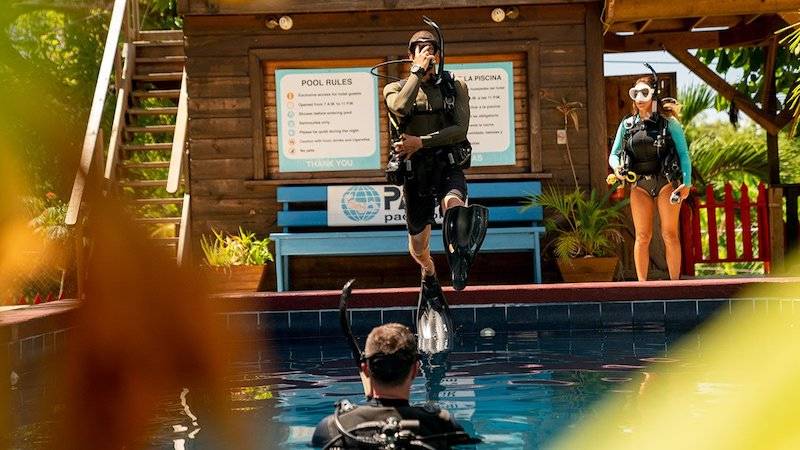
Confined water training comes next. In a pool or pool-like shallow area, you practice breathing continuously through the regulator, clearing a partially flooded mask, recovering the regulator if it slips from your mouth, and finning without touching the bottom. The instructor stays within arm’s reach, demonstrating skills and correcting posture before any open water exposure.
When those basics feel manageable, you join one shallow open water dive matched to beginner conditions. Time underwater follows your breathing rate and comfort—not a stopwatch.
Where you may dive — Seraya House Reef and calm Komodo sites
Komodo National Park ranges from gentle bays to ripping channels. A Discover Scuba Diving experience belongs on the gentle end: protected house reefs, sandy patches with easy entries, or shallow coral gardens where surge and current are manageable for someone still internalizing buoyancy basics.
Seraya House Reef is often cited as an example of that kind of setting—a place where beginners can focus on skills while still glimpsing reef fish and coral structure without being pushed into terrain meant for certified divers. Other operations may use similarly sheltered sites depending on season, tide, and daily conditions; flexibility is normal in any serious dive destination.
Viral “bucket list” sites with heavy current are poor fits for a first dive. Save those for after certification and more logged experience—the try dive is chapter one.
Safety and instructor supervision
Discover Scuba Diving is built around direct professional oversight. Instructors work within agency ratios and depth limits so that no beginner is treated as a miniature certified diver. You are not expected to solve complex emergencies alone; you are expected to signal discomfort early, stay with the team, and follow the plan discussed during the briefing.
Buoyancy control receives heavy attention because it keeps you off fragile coral and at a stable depth. Instructors also watch breathing rate, ear equalization, and situational awareness—how much light remains, how far the boat is, and whether another diver needs assistance. That culture of prevention is what separates recreational training from informal “try it once” stunts in uncontrolled environments.
Honest self-assessment matters. If you feel claustrophobic, chilled, or unable to equalize, surfacing together is always the correct choice. A reputable operation will not pressure you to continue; the goal is a positive memory that might lead to further training, not a single checkbox at any cost.
What comes next — upgrading to Open Water Diver
If you finish a try dive smiling, the natural next step is PADI Open Water Diver (or equivalent entry-level certification from another recognized agency). That course expands theory, adds more confined-water skills, and requires several open water dives so you can plan and execute dives with a certified buddy within your training limits.
Many travelers schedule Open Water Diver over several days in Komodo or combine eLearning at home with practical sessions on site. The skills you rehearsed during Discover Scuba Diving— mask work, regulator recovery, basic buoyancy—reappear in fuller form, alongside navigation, emergency procedures, and deeper understanding of decompression theory for recreational divers.
Some guests stop after one supervised dive; others use it as the first step toward advanced courses or specialties. Either path is fine if training limits and environmental care come first.