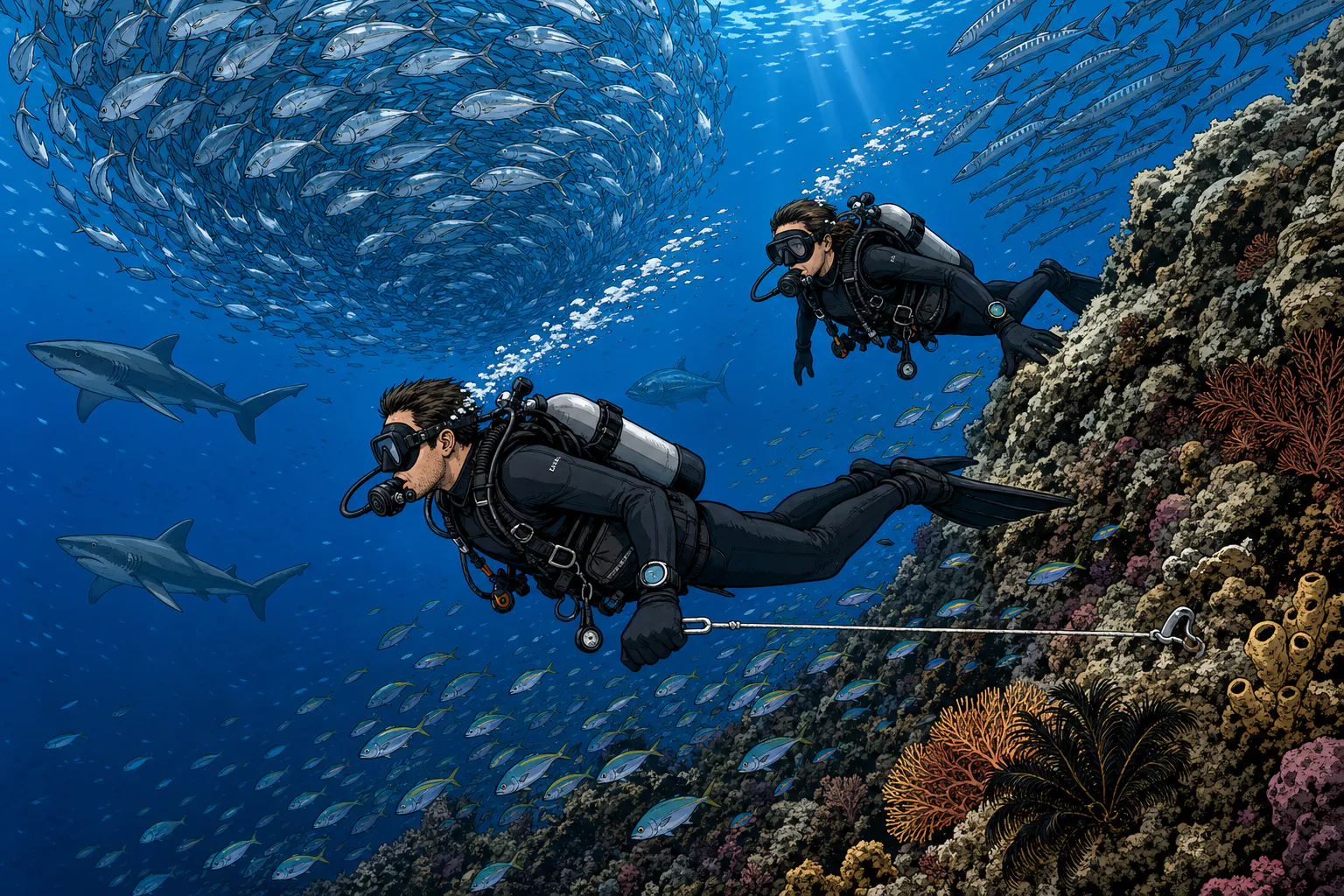
Two divers in horizontal trim drifting along the current-blown coral wall at Castle Rock in Komodo National Park, with a large school of trevally swirling around them and a reef shark patrolling in the foreground.

Komodo is the closest thing to a perfect dive destination in Asia. The dive sites inside Komodo National Park are not the prettiest in Indonesia (that title goes to Raja Ampat), they are not the easiest (almost every site has current), and they are not the cheapest (Komodo prices reflect the logistical complexity of running boats in a marine park). But for sheer concentration of big-animal action, schooling fish, reef sharks, mantas, and current-driven dives that feel like you are flying down a coral skyscraper, nothing in Southeast Asia compares.

We have run Komodo trips for years, both as tours from Bali and as fully resident operators on Sebayur Island with our own Komodo dive center. This article is the guide we wish we could send to every diver who asks "is Komodo really worth it?" before they book. The short answer is yes. The longer answer, with the trade-offs you will not find in tourism marketing, fills the rest of this page.

Where Komodo is and why these waters are different

Komodo National Park sits between the islands of Sumbawa and Flores in the Lesser Sunda Islands of eastern Indonesia, about 600 km east of Bali. The Park covers around 1,800 km² of land and sea, including the three main islands (Komodo, Rinca, Padar) plus dozens of smaller volcanic islets, and the warm Pacific waters of the Flores Sea funnelling through narrow passages between them.

The geography is the entire reason Komodo dives the way it dives. Twice a day, water moves between the Pacific Ocean (north) and the Indian Ocean (south) through these narrow island gaps. At peak tide, the volume of water shifting between the two oceans creates currents that can hit 6+ knots in the channels, with downwellings, upwellings and standing waves at the surface that look like rapids. That sounds intimidating, and on the wrong day it is. On the right day, with a good guide and the right site choice, those same currents are the reason Komodo's reefs are spectacularly alive. The constant nutrient flush feeds an obscene amount of marine life that you simply do not see in calmer water.

The Park sits on the line where Indonesian Pacific and Indian Ocean species mix, so you get pelagics that you would normally need a Coral Triangle and a Maldives trip combined to see. Manta rays, multiple shark species, schooling jacks and barracuda, dogtooth tuna, the occasional thresher and hammerhead in the cooler months, all overlapping in a region small enough to dive across a single weeklong trip.

How to actually get to Komodo (the logistics nobody talks about)

Komodo has one gateway town: Labuan Bajo (often abbreviated LBJ), on the western tip of Flores. There is no road network into the National Park; everything is by boat from Labuan Bajo. To get to Labuan Bajo, your options are:

From Bali: A 1-hour 15-minute domestic flight from Denpasar (DPS) to Labuan Bajo (LBJ). Multiple flights per day. This is what almost every international diver does.

From Jakarta or Surabaya: Direct flights several times per week, longer at 2 to 3 hours.

Direct international: A small number of seasonal direct flights from Singapore and Australia have started in 2025-2026, but check current schedules.

From Labuan Bajo, you choose between three operating models for diving Komodo: day-trip diving from town, a land-based dive resort inside or near the Park, or a liveaboard boat. They are three completely different experiences and each suits different divers.

Day-trip diving from Labuan Bajo

Most accessible option. You stay in Labuan Bajo (the town has everything from $20 backpacker rooms to $300+ boutique hotels), and join a dive boat each morning that runs out to 2 or 3 sites within 60 to 90 minutes of harbour. Standard package is 3 dives per day, returning to the harbour by late afternoon. The downside is you cannot reach the most remote northern sites (Castle Rock, Crystal Rock, Cauldron, Shotgun) on a single day from town, so you are limited to the central sites (Batu Bolong, Manta Point, Siaba Besar, Tatawa) which are excellent but not the full menu.

Land-based dive resort

The middle option. A handful of dive resorts sit on small islands inside or near the Park (Sebayur, Sebolan, Bidadari), accessible by 20 to 60 minute boat ride from Labuan Bajo. From a resort, you dive 2 to 3 sites per day with shorter transfers than day-tripping from town, and you can reach a wider radius of sites. You also get to sleep on a quiet island in the middle of one of Indonesia's most beautiful marine parks. Our own dive resort sits on Sebayur Island with accommodation options from ocean-view bungalows to grand beach rooms.

Liveaboard

The premium option. You sleep on the dive boat and follow the dives around the Park, typically 7 to 14 days. Liveaboards reach the remote northern sites (Castle Rock, Crystal Rock, Gili Lawa Laut) that day boats cannot, do 3 to 4 dives per day including night dives, and trade convenience for total immersion. Liveaboards range from $250 to $700+ per person per day depending on standard. See our Komodo liveaboard guide and the boats we operate including the King Neptune and Komodo Sea Dragon.

The dive sites of Komodo National Park

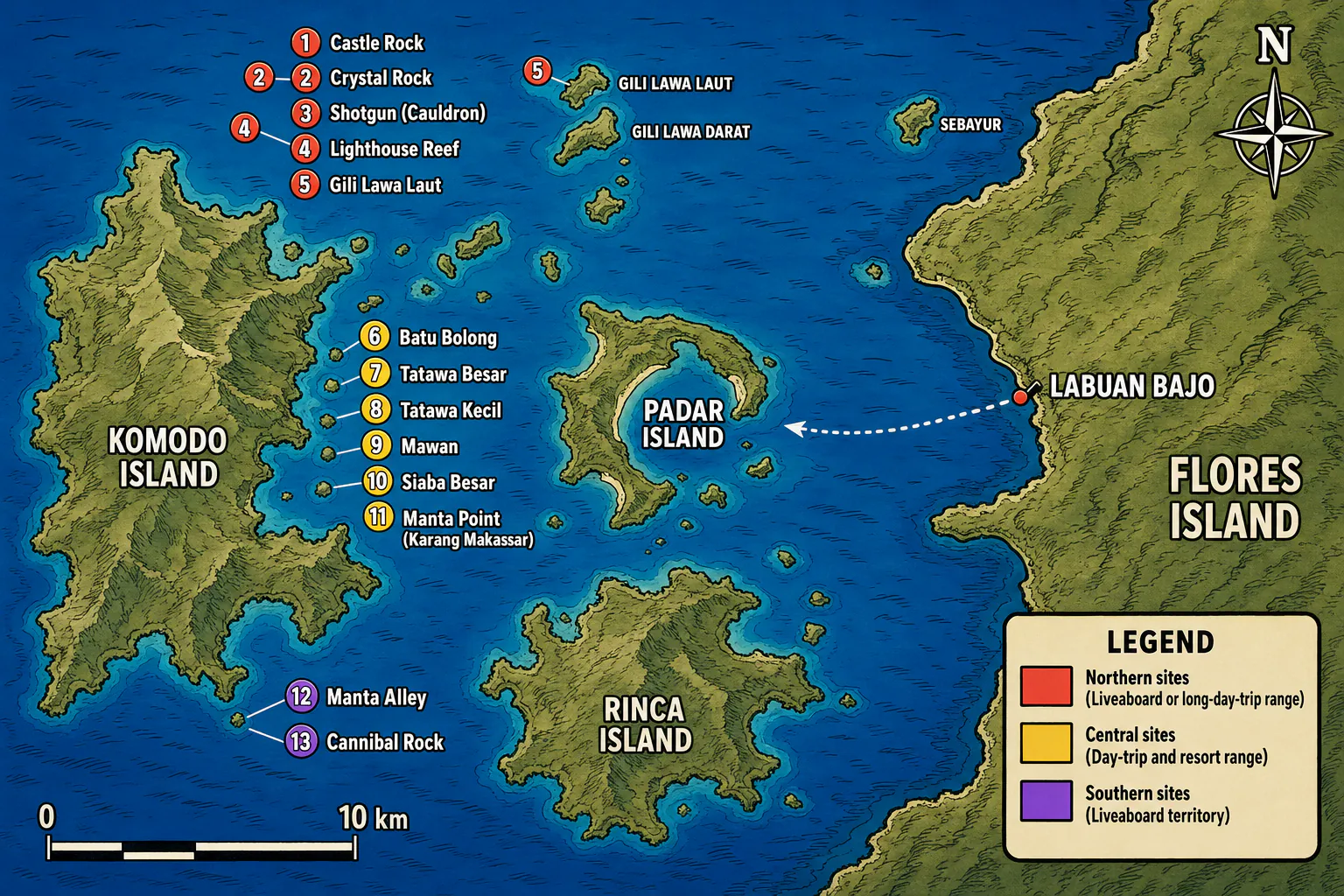
Map of Komodo National Park showing the main dive sites organised by region: northern Komodo (Castle Rock, Crystal Rock, Shotgun, Cauldron, Gili Lawa Laut), central (Batu Bolong, Tatawa Besar, Tatawa Kecil, Mawan, Siaba Besar), southern (Manta Alley, Three Sisters, Cannibal Rock), with Labuan Bajo marked as the gateway port on Flores.
Komodo National Park's main dive sites grouped by region. Day boats from Labuan Bajo typically reach the central sites only; northern and southern sites are liveaboard or land-based territory.

The Park has 50+ named dive sites. We have dived all of them and run regular operations at the 12 to 14 that consistently deliver. Here are the ones that matter, grouped by region.

Central Komodo (day-trip and resort range)

Batu Bolong

If Komodo has a flagship dive site, it is Batu Bolong. A single pinnacle in the middle of a fast-flowing channel, the rock breaks the surface with a small triangular peak and drops to 70+ metres on both sides. The walls are coated in soft coral, sponges and crinoids, with reef fish in such densities that the rock itself becomes hard to see. Trevally, snapper, sweetlips, surgeonfish, parrotfish, fusiliers, all swirling around the pinnacle in a single coral metropolis. Reef sharks patrol the deep ends. Hawksbill turtles graze the soft coral.

The challenge with Batu Bolong is the current. You can only dive the side that is sheltered from the prevailing tide, which means a competent guide reads the tide, the surface, and the marine life behaviour before deciding which side to drop you on. Get it right and it is one of the best dives in the world. Get it wrong and you are clinging to a reef hook in a 4-knot current trying not to be swept off. We do not let divers below Open Water try this site, and we strongly recommend at least Advanced certification.

Tatawa Besar and Tatawa Kecil

Tatawa Besar (Big Tatawa) is the easier of the pair, a gentle drift along a sloping coral wall with patches of soft coral that explode in colour mid-dive. Lower current, manageable for fresh AOW divers, classic Komodo "drift and enjoy" dive. Tatawa Kecil (Little Tatawa) is the smaller adjacent island and runs faster currents with more pelagic action. Both are standard day-trip stops.

Manta Point (Karang Makassar)

Manta Point in Komodo (also called Karang Makassar) is a long sandy ridge that serves as a manta cleaning station. Reef mantas (Mobula alfredi) hover over the cleaning stations being groomed by butterflyfish and wrasse. Sighting rate is similar to Nusa Penida's Manta Point at 90+ percent across the year. The dive is shallow (5 to 15 metres) with a moderate sweeping current. Beginner-friendly when conditions allow, and the encounter quality is consistently good. If you have done Nusa Penida's Manta Point, this is the same species in a different location, with usually fewer divers per boat.

Mawan

Mawan is a sandy slope on the west side of a small island, technically a "manta second-string" site that comes alive when Manta Point is too crowded or current is wrong. Mantas pass through regularly to feed, and the slope itself hosts garden eels, snake eels, and the occasional ornate ghost pipefish.

Siaba Besar

Siaba Besar is the easy-day "everyone gets in" site. Gentle current, sloping reef from 8 to 25 metres, and the largest concentration of green and hawksbill turtles we know of in the Park. We routinely log 6 to 12 turtles per dive here. Perfect for a relaxing third dive, a check-out dive for arriving guests, or for less experienced divers in a group.

Northern Komodo (liveaboard and long-day-trip range)

Castle Rock

Castle Rock is the dive that converts skeptics. A pinnacle submerged at 4 metres in open water far from any island, surrounded by strong upwelling currents that pull cold water and pelagic fish up the slopes. The marine life on a Castle Rock dive in current can be overwhelming: hundreds of jacks tornadoing around the peak, dogtooth tuna patrolling the edges, white tip and grey reef sharks hunting in packs through the fish balls, schools of barracuda forming wall-of-bodies columns above the dive group. This is the dive that ends up at the top of "best dive of my life" lists.

It is also the dive that requires the most respect for currents in the Park. The wrong tide, the wrong drop, the wrong drift, and Castle Rock turns into a stress test. Liveaboards plan an entire day around its tides, and even from a land-based resort it is a 90+ minute boat ride each way, so this is typically a long-day trip, not a casual one.

Crystal Rock

Crystal Rock is Castle Rock's calmer neighbour, a couple of pinnacles a kilometre away, easier to dive in moderate current but with a similar pelagic-action profile. Many trips do Castle in the morning when current is right, then drift over to Crystal for the second dive. Together they are the heart of "northern Komodo".

Shotgun (Cauldron)

Shotgun (also called The Cauldron) is the most theatrical dive in Komodo. You drop into a sheltered amphitheatre at one end of a narrow passage between two islands, drift through the underwater "bowl" where mantas often hover in the back-current, then approach the exit at the far side which is a narrow gap the entire ocean current squeezes through. Time it right and you get accelerated through the gap like a leaf in a fast river, then re-emerge into open water with a few minutes of safety-stop along a coral garden. Mistime it and the gap is closed (current pushing into the bowl, not out) and you abort. We only run Shotgun on tides we have specifically planned for.

Lighthouse Reef

Lighthouse Reef is a quieter northern site, a sloping coral reef with garden eels, schools of fusiliers, occasional reef sharks, and beautiful soft-coral coverage. Good middle-dive between two more demanding northern sites.

Southern Komodo (liveaboard territory)

Manta Alley

Manta Alley sits on the south side of the Park, fed by colder water from the Indian Ocean. Manta numbers here are sometimes higher than at Manta Point, but visibility drops (5 to 15 metres versus 15+ at the central manta sites) and the water is noticeably cooler (24 to 26 degrees). Only reachable by liveaboard on the way north or south.

Cannibal Rock and the southern macro sites

The far southern Komodo sites (Cannibal Rock, Yellow Wall, Pillarsteen) are the macro pillar of Komodo, comparable to Bali's Seraya for critter density. Rhinopias frogfish, multiple seahorse species, harlequin shrimp, ornate ghost pipefish. Cold (sometimes 22 degrees), often poor visibility, and only sensible on liveaboards that plan a 2 to 3 day southern loop. For most divers, this is a "second Komodo trip" destination, not a first-trip priority.

Currents and conditions: the must-know safety reality

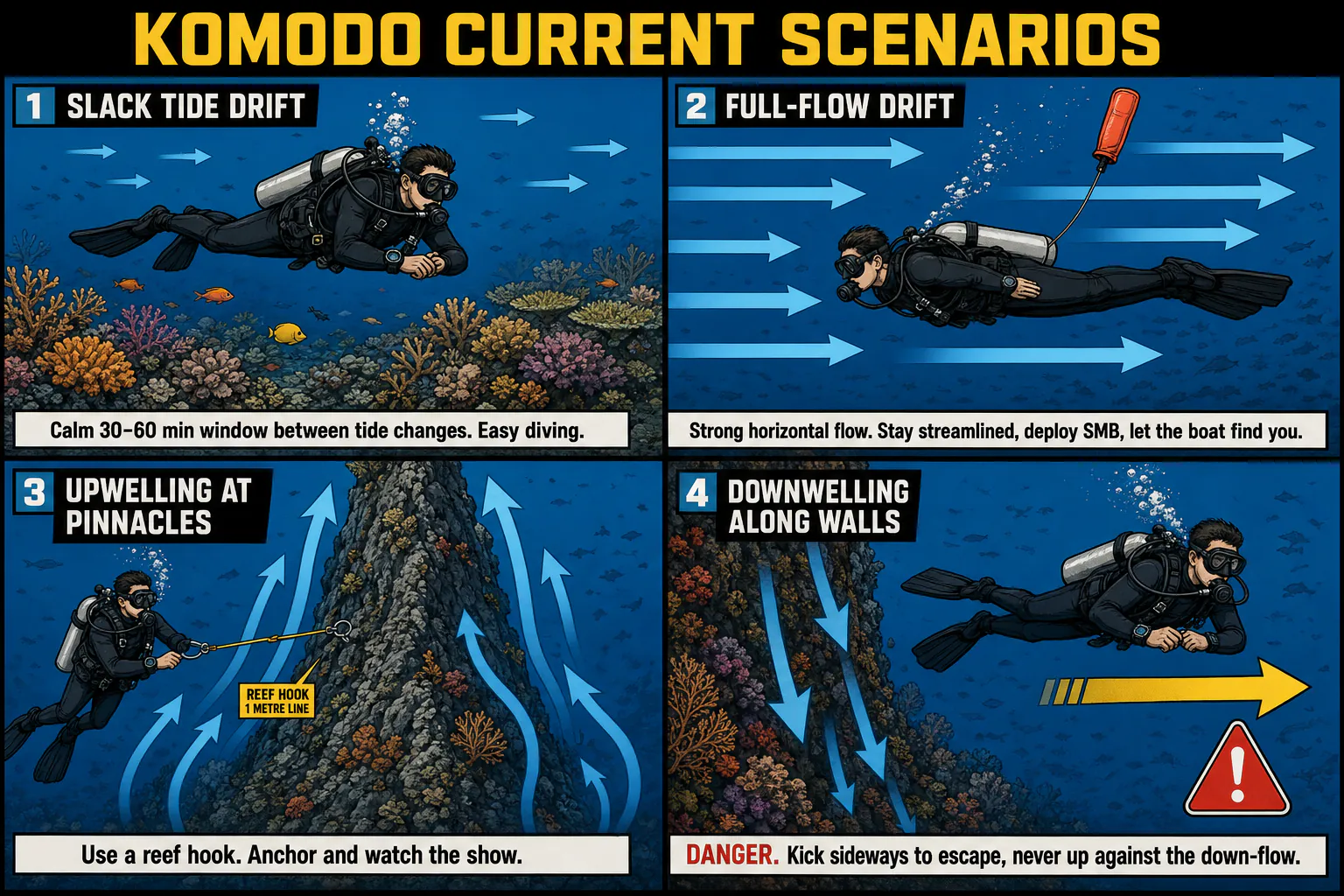
Educational infographic showing the four main current scenarios divers encounter in Komodo: slack tide drift, full-flow horizontal current, upwelling at pinnacles, and downwelling along walls, with safety techniques annotated for each.
The four current patterns that define Komodo diving. Knowing which one your guide is briefing you for, and what to do if it changes mid-dive, is the single biggest factor in whether you have a great day or a stressful one.

Komodo's currents are the source of both its magic and its bad reputation. There is no way to sugar-coat this: currents in Komodo can be strong, and divers who are not comfortable in current should not dive the more exposed sites until they are. Three things to understand:

1. Slack tide is short. The window of calm water between tide changes at most Komodo sites is 30 to 60 minutes. Operators schedule the dive around it. If your boat is late, you miss it.

2. Currents go horizontally AND vertically. The horizontal flow is the easy one to plan for (drift dives). The vertical currents (upwellings that push you up, downwellings that suck you down) are the dangerous ones because they catch divers by surprise. At pinnacle sites like Castle Rock, the current can switch from horizontal to vertical without warning. Standard technique: stay close to the reef contour, kick hard to escape a downwelling sideways (not against it), and never try to swim up through a downwelling, you will lose.

3. A reef hook is standard equipment. A small steel hook on a 1-metre line, clipped to your BCD, used to anchor yourself to a dead piece of reef during a fast-current "spectator" dive. We provide them to every guest on northern Komodo sites. If you have not used one, ask for a 5-minute briefing on day 1.

Honest assessment: any Open Water diver with 30 logged dives and a calm temperament can safely dive Komodo with a competent operator. Open Water divers with under 20 dives should stick to the central sites and skip Castle Rock until they have built experience. The operator's site selection on the day is what makes Komodo safe; an experienced guide will refuse to drop divers into the wrong current, period.

What you will actually see

Komodo's marine life by category:

CategoryWhere you see itRealistic odds (per trip)
Reef mantasManta Point, Mawan, Shotgun, Manta Alley95%+ on any 4-day trip that visits Manta Point
Reef sharks (white tip, black tip, grey)Castle Rock, Batu Bolong deep, Crystal Rock~85% on any northern site visited
Schooling trevally / jacksCastle Rock, Crystal Rock, Batu Bolong~90% on the right tide
Dogtooth tunaCastle Rock, Crystal Rock~70% on the right tide
Hawksbill and green turtlesSiaba Besar, Tatawa Besar, Manta PointEssentially every dive at these sites
Barracuda schoolsCrystal Rock, Castle Rock~75% in season (Apr-Oct)
HammerheadsCastle Rock cooler months only~10-20% (a bonus, never a target)
Macro (frogfish, ghost pipefish, harlequin)Cannibal Rock, southern sites; some at Mawan~60% on a southern liveaboard loop
Komodo dragons (above water!)Komodo Island, Rinca Island ranger-led walks100% on a guided national park excursion

Best time of year for diving Komodo

Komodo's dive season is essentially year round but split into two clear chapters:

April to October (dry season, "high season"). Calm seas, blue water, 25 to 35 metre visibility on northern sites, water 27 to 29 degrees on the surface dropping to 24 to 26 below the thermocline. This is the peak diving season and most international guests come now. Prices reflect demand. Castle Rock, Crystal Rock and the northern sites are at their best. Liveaboards are often booked out months in advance for July-September.

November to March (wet season, "low season"). Surface conditions can be rougher (Komodo straits get choppy), visibility drops slightly (15 to 25 metres typical), water warmer (29 to 31 degrees). Cannibal Rock and the southern sites become genuinely cold (22 to 24 degrees) due to the Indian Ocean upwelling pattern reversing. Fewer divers, lower prices, and the central sites (Batu Bolong, Manta Point, Tatawa) are still excellent. Some liveaboards relocate to Raja Ampat or other regions for these months.

Special timing notes: Hammerhead sightings are slightly more likely in July-September when water temperature is at its coolest. Mantas are year-round in the central sites but Manta Alley in the south is best from May to September. The full moon and new moon weeks bring the strongest currents (and the best pelagic action) every month.

Komodo from Bali: when does the combination make sense

The single most common question we get from Bali-based divers is "should I add Komodo to my Bali trip?" The honest answer depends on your dive count, your time, and your appetite for currents.

Yes, add Komodo if: you have 7+ days total in Indonesia, you have 30+ logged dives, you can handle moderate current, and you want big-animal action. Adding 4 days in Komodo to a 7-day Bali trip changes the trip entirely. The flight is 1 hour 15 minutes, the cost premium is modest, and the dive contrast (Bali macro and wreck, then Komodo currents and pelagics) is one of the best one-two punches in Indonesian diving.

No, skip Komodo this time if: you have under 20 logged dives, you have only 5 days total, or you are uncomfortable in moderate current. Stick with Nusa Penida day trips and Tulamben from Bali. Bali alone is plenty for a first trip, and Komodo will still be there next year when you have more dives and more time.

For divers who do choose to combine, our Komodo tour from Bali package handles all the logistics including the LBJ flight, the resort transfers, the diving and the return. See also our Komodo vs Bali diving comparison for the side-by-side decision framework.

Certification requirements and skills you need

Open Water Diver (minimum for most sites). Sufficient for Siaba Besar, Tatawa Besar, Manta Point, Mawan and the easier dives in the central Park. You should have 15+ logged dives before booking; less than that and you should plan a refresher dive before the trip.

Advanced Open Water (recommended). Required practically (not always formally) for Batu Bolong and any of the northern sites. Most operators including ours require Advanced for Castle Rock and Crystal Rock. If you are not Advanced yet and planning a Komodo trip, finish AOW before you fly: we run AOW courses in Bali in 3 days, and we also offer AOW completion on Sebayur at our Komodo dive center.

Drift Diver specialty. Not strictly required but enormously useful for confidence in Komodo currents. We run the Drift Diver specialty on Sebayur in 2 days.

Nitrox 32. Strongly recommended. Komodo dive profiles often involve 30 to 60 minutes at 18 to 25 metres, exactly where nitrox extends your no-deco limit. Get certified on Sebayur in two days if you have not already.

Physical fitness. Komodo dives are aerobic when current picks up. If you cannot comfortably swim 200 metres at the surface or 100 metres against mild flow, train before you come.

Honest 2026 costs

All prices in USD per person. Variation reflects operator quality, group size, and inclusions. The lower end is large-group budget operators; the upper end is small-group quality operators.

ItemTypical cost
Day-trip diving from Labuan Bajo (3 dives, central sites)$150 to $220
Land-based dive resort 4-day, 12-dive package (incl. accommodation)$1,200 to $1,800
Land-based dive resort 7-day, 20-dive package$2,100 to $2,900
Komodo liveaboard 4-day, 13-dive trip$1,800 to $3,200
Komodo liveaboard 8-day, 25-dive trip$3,200 to $5,800
National Park entry fee (per day)$15 to $25
Flight Denpasar to Labuan Bajo (one way)$70 to $150 depending on airline and notice
AOW course at our Komodo dive center (3 days)$520 to $620
Nitrox certification (2 days)$240 to $290
Komodo dragon excursion (full day with ranger, transfers)$80 to $140

These reflect small-group operations with 1 guide to 4 divers maximum (often 1 to 2 in our case for premium packages). Big-group liveaboards (24+ guests, 1 guide to 6+ divers) come in 30-40% cheaper, and the experience reflects the ratio in current management.

Sample 7-day Komodo itinerary (land-based)

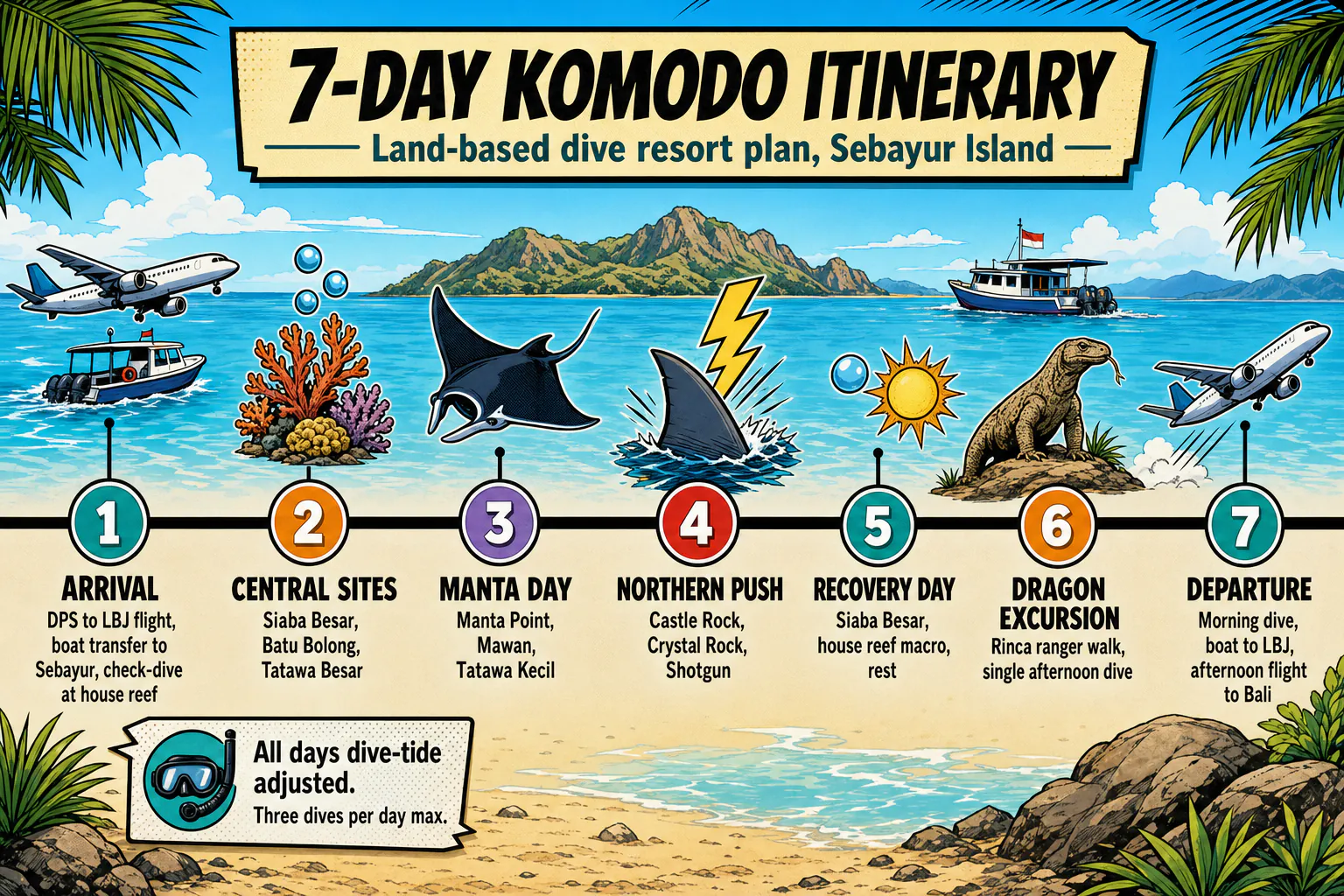
Stylised 7-day Komodo dive trip itinerary infographic showing day-by-day plan from arrival in Labuan Bajo, transfer to Sebayur Island, dives at central and northern Komodo sites, manta day, Castle Rock big-current day, Komodo dragon excursion and departure.
A typical 7-day Komodo itinerary balancing diving with rest days, the dragon excursion, and the northern long-day. The cadence is built around tides, not the calendar.

Day 1. Fly Denpasar to Labuan Bajo (morning flight), boat transfer to Sebayur Island (40 min), check in to resort, gear up, briefing. Afternoon check dive at the house reef to dial in buoyancy and weights.

Day 2. Central sites day: Siaba Besar (warm-up), Batu Bolong (the flagship), Tatawa Besar (easy drift). Three dives. Back to resort for sunset, dinner, sleep.

Day 3. Manta day: Manta Point at slack tide (peak conditions), Mawan as second dive, Tatawa Kecil as third. Mantas almost guaranteed.

Day 4. Long northern day: Castle Rock early on the tide window, Crystal Rock as second dive, Shotgun (Cauldron) at the right tide window in the afternoon. Tiring, exhilarating, the day people remember.

Day 5. Lighter day after the northern push. Siaba Besar (relaxed), an unnamed shallow reef, optional macro hunt at Sebayur house reef. Some divers take this as a single-dive recovery day.

Day 6. Komodo dragon excursion on Rinca Island (closer than Komodo Island itself, fewer tourists). Half-day ranger-led walk to see dragons, deer, monkeys, and the volcanic landscape. Afternoon single dive at Sebayur.

Day 7. Morning dive (whichever site conditions favour), late breakfast, boat back to Labuan Bajo, afternoon flight to Bali. Long day, but you arrive in Bali in the evening.

5-day version: cut days 5 and 7, do Komodo dragon on the morning of day 6 with afternoon flight. The compressed version is good for divers with limited time, but day 4 (northern push) becomes the back-to-back high point with no recovery day before flying.

What to pack for Komodo specifically

5 mm wetsuit recommended. Even in dry season the thermocline can hit 24 degrees. A 3 mm works but you will be cold by dive 3. For southern sites (Cannibal Rock) you genuinely need 5 mm and ideally a hood.

Reef hook and small SMB. A 1 m surface marker buoy with line and reel is mandatory equipment in the National Park (you must deploy it before surfacing on drift dives so the boat can find you). We rent them, but if you have your own, bring it.

Dive computer. Komodo profiles are repetitive and depth-varying enough that a borrowed table is not adequate. Bring your computer or rent one.

Long fins, stiff blade. Komodo is not a place for split fins. You will be finning hard against current at moments, and you need every bit of thrust.

Motion sickness tablets. The Komodo straits can get choppy, especially in transitional months. Take a tablet at breakfast on long-northern days even if you do not normally need one.

Reef-safe sunscreen. The Park rangers actively check for and may confiscate non-reef-safe brands at the entry checkpoints.

Cash for Park fees and tips. Park entry, ranger fees, dragon trekking fees and guide tips all run in cash. Plan for $200-300 in small notes per person for a week.

Common Komodo mistakes we still see

Underestimating the currents. Divers with 50 Caribbean dives sometimes show up over-confident, get caught in a Castle Rock downwelling on day 1, and need 24 hours of recovery before they trust their guide again. Listen to the dive briefing literally, every word.

Trying to do too many dives per day. Three Komodo dives in moderate current is more tiring than four Bali dives. Four-dive days in Komodo are for liveaboard photographers, not casual divers. Plan three quality dives, not four mediocre ones.

Skipping the Komodo dragon excursion. Yes, you came to dive. But the dragons are why this region became a National Park, and they are genuinely impressive in the wild. Half a day is enough; do not skip it because "we already saw them in a video".

Booking the cheapest liveaboard. Komodo liveaboards have the widest quality range in Indonesia, from $250 to $700+ per day. The cheaper end usually means worse guide ratios and older boats. For Komodo specifically, the guide ratio is the difference between a great trip and a frustrating one. Pay for the guide quality.

Flying out the day after the last dive without 24 hours surface interval. Komodo profiles are loaded; multi-day repetitive diving means you must respect the post-dive flight window. Build in a buffer.

How to book Komodo diving with us

Most Komodo trips we run are customised because the right itinerary depends on your dive count, time available, and whether you are combining with Bali. The fastest path:

1. Tell us your dates, certification level, and rough plan (land-based resort or liveaboard, with or without Bali).
2. We propose a draft itinerary including site selection, group ratio and accommodation.
3. We confirm pricing, flights guidance and pre-trip checklist.
4. You arrive, we dive, and you understand why Komodo gets included in nearly every "top 10 dive destinations in the world" list.

Get started via the Komodo dive center contact form or the main booking page. For Bali-Komodo combined trips, see our Komodo from Bali package. For a pure Komodo experience, browse the Komodo diving overview and the Sebayur dive resort.

The bottom line

Komodo is not the easiest destination to dive. It is more expensive than Bali, the logistics are more involved, and the diving requires more skill in current. None of that is changing. What is also not changing is that Komodo delivers an action density and big-animal encounter rate that very few places on the planet can match. Reef sharks, manta cleaning stations, schooling jacks, dogtooth tuna and the occasional hammerhead, all overlapping in a marine park you can dive comprehensively in a single week.

If you are an Open Water diver with 15 logged dives and a calm temperament, you can dive Komodo with the right operator. If you are Advanced with 50+ dives, you should be planning your trip already. If you are an experienced diver who has not been, this should be on the next 12 months calendar. Stop reading and start planning.

常见问题

For experienced divers seeking big-animal action, yes. Komodo's concentration of reef sharks, mantas, schooling pelagics and current-driven reef dives is matched in Indonesia only by Raja Ampat (which is harder and more expensive to reach). For pure reef beauty, Raja Ampat wins. For macro, Lembeh wins. For convenience and price, Bali wins. For the big-animal hit rate per dive day inside a manageable trip length, Komodo is the best value.
Open Water Diver is the minimum for the central, less-current sites (Siaba Besar, Tatawa Besar, Manta Point, Mawan). Advanced Open Water is strongly recommended (and required by most operators including us) for Batu Bolong and the northern sites (Castle Rock, Crystal Rock, Shotgun). If you have only Open Water, finish AOW before your trip or factor in 3 days of AOW completion on arrival at our Komodo dive center.
They can be strong, but danger is more about operator quality than the currents themselves. A competent operator reads the tides, picks the right side of every site, briefs you precisely, and refuses to drop divers in conditions that exceed their skill. With the right operator, an Open Water diver with 30 logged dives can safely dive Komodo. The horror stories you read online almost always trace back to under-briefed dives with overcrowded groups.
Different products for different divers. Land-based works for 4 to 10 day trips, comfortable land accommodation, easier on motion-sickness sufferers, and you only get out to the very far northern or southern sites on long days. Liveaboards reach every site in the Park, do 3 to 4 dives per day including night dives, and immerse you completely for 7+ days, but you sleep on a boat and pay 30 to 60 percent more per day. First-time Komodo divers usually love the land-based option; returning divers often shift to liveaboards.
April to October is the peak season: calm seas, blue water, visibility 25-35 metres on northern sites, and most operators at full schedule. November to March is the green season: sometimes choppy surface, slightly lower visibility, warmer surface water, and significantly fewer divers and lower prices. The central sites (Batu Bolong, Manta Point, Tatawa) are excellent year round; the northern sites are best in dry season.
One-hour-fifteen-minute domestic flight from Denpasar (DPS) to Labuan Bajo (LBJ) on Flores, then boat transfer to your resort or liveaboard. Multiple daily flights on Garuda, Citilink, Wings Air and others. Round-trip flights typically run $140 to $300 with reasonable notice. Combined trips from Bali are easy to arrange via our Komodo from Bali package.
No reputable operator guarantees wildlife, but the realistic sighting rate is excellent. Across our 2026 log books, Manta Point Komodo sees mantas on 92 percent of dives. On a 4-day trip that visits Manta Point at least twice, the cumulative sighting probability sits above 99 percent. Most divers see 2 to 6 mantas per dive at the cleaning stations, with occasional 10+ days at Manta Alley in the south.
Yes, on a guided ranger excursion to Rinca Island or Komodo Island included with most dive packages. Sighting rate is essentially 100 percent on the ranger-led walks (the dragons live around the ranger stations). Rinca is closer to Labuan Bajo and less crowded than Komodo Island itself. Allow half a day. Bring water, hat, hiking shoes, and listen carefully to the ranger briefing: dragons are genuinely dangerous and the guides take it seriously.
Same species (reef manta, Mobula alfredi), similar high sighting rates, different visual context. Nusa Penida is closer to a Sanur day trip from Bali, sees more divers per group, and the water is sometimes cooler. Komodo's Manta Point sits inside a remote National Park, sees fewer divers per encounter, and the surrounding dive itinerary is more remote and current-driven. If you can only do one, Nusa Penida is easier and cheaper. If you can do both, the contrast is genuinely worth it.
Yes, with the right operator and the right site selection. You should plan to dive only the central sites (Siaba Besar, Tatawa Besar, Manta Point, Mawan) on the first half of your trip, complete an Advanced Open Water specialty (or at least a drift refresher) on arrival, then upgrade to the northern sites once you have shown comfort in moderate current. We can structure this around a 5 to 7 day trip and most divers progress quickly.