Komodo Profi-Trainingsguide
PADI Divemaster in Komodo
The PADI Divemaster course is where recreational diving crosses into professional responsibility: you learn to assist instructors, lead certified divers, and think like a dive leader. Training in Komodo National Park adds real-world complexity—currents, varied topography, and busy boat days—that sharpens judgment faster than calmer, textbook environments alone. This guide explains what the rating means, how training is typically organized, what you must already hold on your certification record, and where the path can lead after you earn the credential.

What is the PADI Divemaster course — the first professional level

In the PADI system, Divemaster is the first professional rating: you are no longer only responsible for yourself—you are learning to support others, represent safe diving practices, and work alongside instructors during training and supervision. The course blends dive theory, leadership scenarios, practical skills at a demonstration level, and real-world application in open water.
Unlike shorter specialty or continuing-education programs, Divemaster is designed as a structured internship-style experience. You refine rescue-level readiness, map and brief sites, practice surface management, and rehearse how to respond when plans change underwater. The outcome is not merely a new card in your wallet but a shift in mindset toward professionalism, teamwork, and clear communication—qualities employers and students notice immediately.
Why train in Komodo — diverse conditions and real-world experience

Komodo is known for dramatic reefs, pinnacles, and passages where tidal exchange produces anything from gentle drifts to powerful currents. That range forces you to read water movement, adjust group positioning, and coordinate with boat crews—skills that transfer to almost any destination where diving is taken seriously.
Training here is less about repeating the same shallow profile on repeat and more about adapting to changing conditions while keeping divers oriented and calm. You gain exposure to mixed ability levels on liveaboards and day boats, varied entry styles, and the rhythm of multi-dive days. For someone aiming at a career in guiding or instruction, that breadth of experience is difficult to replicate in a single sheltered bay.
Course structure — about 30 days of training, theory, and assessments
A full Divemaster program is often planned across roughly thirty days, though pacing can vary with logistics and prior experience. The arc usually combines independent study of dive physics, physiology, equipment, and the PADI system; classroom or workshop sessions; confined-water skill refinement; and extensive open-water time where you assist, role-play leadership tasks, and complete practical assessments.
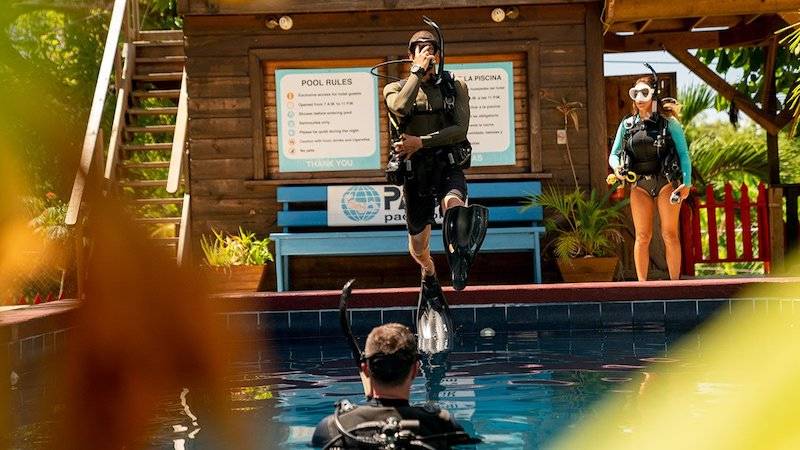
Expect to map dive sites, deliver briefings, supervise activities for certified divers under an instructor’s oversight, and participate in rescue simulations until responses feel automatic. Pool or confined sessions reinforce demonstration-quality skills—clear, slow, and repeatable—because as a professional you may one day be the model new divers copy. The schedule is demanding by design: it mirrors the long, active days common in working dive operations.
What you will learn — leadership, planning, risk management, and supervising students
Beyond personal diving polish, the curriculum emphasizes risk awareness: identifying stress in others, managing groups near current or depth changes, and knowing when to adjust or abort a dive. You practice coordinating with instructors during training exercises—handling equipment issues, positioning students for skills, and maintaining situational awareness while someone else teaches.
Dive planning becomes habitual: gas, time, environmental limits, and emergency options are discussed out loud until they are second nature. You also develop the soft skills of leadership—calm tone in briefings, inclusive language for nervous divers, and constructive feedback after dives. Together, these competencies form the foundation employers expect from someone wearing a professional tab on their suit.
Prerequisites — Rescue Diver, 60 logged dives, current EFR
PADI’s standard pathway requires Rescue Diver certification (or equivalent from another agency, subject to evaluation), documentation of at least 60 logged dives including experience in night diving, deep diving, and underwater navigation, and a current Emergency First Response (CPR and First Aid) credential within the prior twenty-four months—or completion of that training as part of your preparation.
Those thresholds exist because Divemaster assumes you already handle yourself reliably in open water and can step in during stress events. If your logbook is short of the dive count, most candidates extend their stay with fun dives and skill refreshers until the requirement is met. Medical fitness for diving remains mandatory; disclose conditions honestly and follow physician guidance before committing to an intensive professional program.
Career opportunities after Divemaster certification
A Divemaster certification is widely recognized as a ticket into guiding and assistant instruction roles worldwide. Many holders work on liveaboards, resort dive centers, or seasonal operations; others use the rating as a bridge toward the PADI Instructor Development Course while gaining paid or volunteer experience.
The credential also pairs with non-diving hospitality, marine science outreach, and conservation projects where credible in-water leadership matters. Compensation and lifestyle vary sharply by region and employer, so research visa rules, minimum wages, and insurance expectations before relocating. What remains constant is that Divemaster is the practical foundation: the habits you build in Komodo—judgment under current, clear briefings, and steady teamwork—are the same ones that define a sustainable career underwater.
Haeufig gestellte Fragen
Verwandte PADI-Kurse in Komodo



Schließen Sie sich mehr als
1,000+ monatliche Gäste
Aus aller Welt zu uns für Tauchen, PADI-Kurse, Schnorcheln und Freediving.