

The PADI open water course in Bali is a beginner scuba certification that lasts 3 to 4 days and is for persons who have never been diving before. Bali is one of the best places in the world to learn how to breathe underwater and explore a beautiful underwater world. The water is warm (27–30°C), the training bays are calm, and you can easily get to famous sites like Padang Bai, Amed, Tulamben's USAT Liberty Shipwreck, Menjangan Island, and Nusa Lembongan.
- Most courses have the same three parts: theory (either online through PADI eLearning or in a classroom), confined water practice in a pool or sheltered bay, and four open water dives over the course of two days.
- After finishing, students get a diving certification that is recognized across the world (PADI, SSI, or something similar). This lets them dive with a buddy or dive leader to a maximum depth of 18 meters around the world.
- If you finish your e-learning before you get to Bali, the standard length is three days. If you do the theory on-site, it is three and a half to four days.
- Depending on the agency, dive center location, party size, and logistics, realistic prices range from IDR 5,500,000 to 8,000,000 (around USD 350 to 520).
- We strongly suggest that people who have never been scuba diving before take a Discover Scuba Diving session before signing up for the full course.
At a Glance
Duration: 3–4 days | Max Depth: 18 meters | Typical Cost: IDR 5,500,000–8,000,000 (USD 350–520) | Popular Locations: Padang Bai, Amed, Tulamben, Menjangan, Nusa Lembongan

What Is the Open Water Course Bali?
The PADI open water course in Bali is the most common way for people who have never been scuba diving before to get their first certification. It gives you the basic diving knowledge and abilities you need to safely dive in open water anywhere in the world. Your certification as a diver is good for life and is accepted at dive sites in more than 180 countries.
The PADI open water course Bali takes advantage of Bali's unique natural circumstances to make learning easier and more fun than cold-water courses. The island is in the Coral Triangle, which is the most biodiverse marine area on Earth. Students may see colorful coral ecosystems right away when they get into the ocean.
- Certification level: The PADI Open Water Diver certification achieved through the open water course Bali (or equivalent SSI/RAID certification) allows independent dives to 18 meters with a buddy, without requiring supervision from a professional dive guide.
- Course structure: All agencies follow three pillars—knowledge development (dive theory), confined water sessions for skill practice, and four ocean dives to demonstrate competency.
- Why Bali works: Water temperatures stay at 27–30°C year-round, visibility often exceeds 20 meters, and sheltered bays like Blue Lagoon in Padang Bai and Jemeluk Bay in Amed provide calm conditions ideal for beginners.
- Marine life you’ll encounter: Even during training dives, expect to see reef fish, turtles, coral gardens, and potentially your first wreck dive at the famous Liberty shipwreck in Tulamben.
Course Duration & Typical Schedule (3–4 Days)
If you do the eLearning before you arrive, the regular Bali open water course takes three days. If you opt to do all of the theory at the dive center, it takes between three and a half to four days. Most people who travel choose eLearning so they can spend more time in the water and less time in a classroom.
Sample 3-Day Schedule (with eLearning completed beforehand)
- Day 1: You will arrive at the dive center in the morning to fill out paperwork, try on your gear, and go over your eLearning with your PADI instructor. In the morning, there will be a knowledge review and a final exam. Afternoon sessions in a pool or sheltered bay with limited access to water, where you can practice a variety of skills like clearing your mask, recovering your regulator, controlling your buoyancy, and communicating underwater.
- Day 2: Pick up at the hotel early in the morning (usually between 7:00 and 8:00). The first two dives in open water should be at a quiet place like Padang Bai's Blue Lagoon or Amed's Jemeluk Bay. Practice skills at a depth of 6 to 12 meters. Take a break on the surface to eat lunch, then go back to base to log your dive and talk about it.
- Day 3: You can go to a second place, like Tulamben for the USAT Liberty crash, or stay at your training bay. Do open water dives 3 and 4 all the way to depths of 18 meters. In the afternoon, you will sign the final certification paperwork, take pictures, and logbook.
Alternative 4-Day Schedule (all theory in Bali)
- Day 1: Full theory day with videos, dive theory discussions, and knowledge reviews.
- Day 2: Confined water skills only—mastering buoyancy, emergency procedures, and equipment handling.
- Day 3: Open Water Dives 1 & 2 with instructor supervision.
- Day 4: Open Water Dives 3 & 4, certification photos, and logbook completion.
The actual sequences may be different depending on where you choose to go. Because of the distance traveled, groups of divers on Menjangan Island trips may be varied. On the other hand, centers in Amed or Tulamben often do all four dives from the same base.
Important: Plan at least 18–24 hours between your final dive and any flights out of Bali. Never schedule a flight the same evening as your last dive.
Open Water Course Curriculum: What You’ll Learn
This part talks about the basic skills and theories you need to dive safely in Bali and anywhere else in the world of scuba diving. All PADI open water courses in Bali and other similar agencies have the same curriculum, so you can be sure that you will get the same training no matter which diving center you select.
Theory Topics (Knowledge Development)
- The basic mechanics of diving, like how pressure affects your body, how to equalize your ears and sinuses, and why you should never hold your breath while going up.
- Basic dive planning includes knowing no-decompression restrictions, how to read simple dive tables or computers, and how to figure out the longest period you can stay at the bottom.
- Understanding how weight, air in your BCD, and lung volume effect your position in the water is what buoyancy principles are all about.
- Basic physiology: regulations for breathing, how to avoid lung injuries from over-expansion, and how nitrogen affects the body at depth.
- Bali-specific environment: how to deal with currents, surges, boat traffic, and how to get in and out of traditional jukung boats and bigger dive boats.
Confined Water Skills (Pool Sessions)
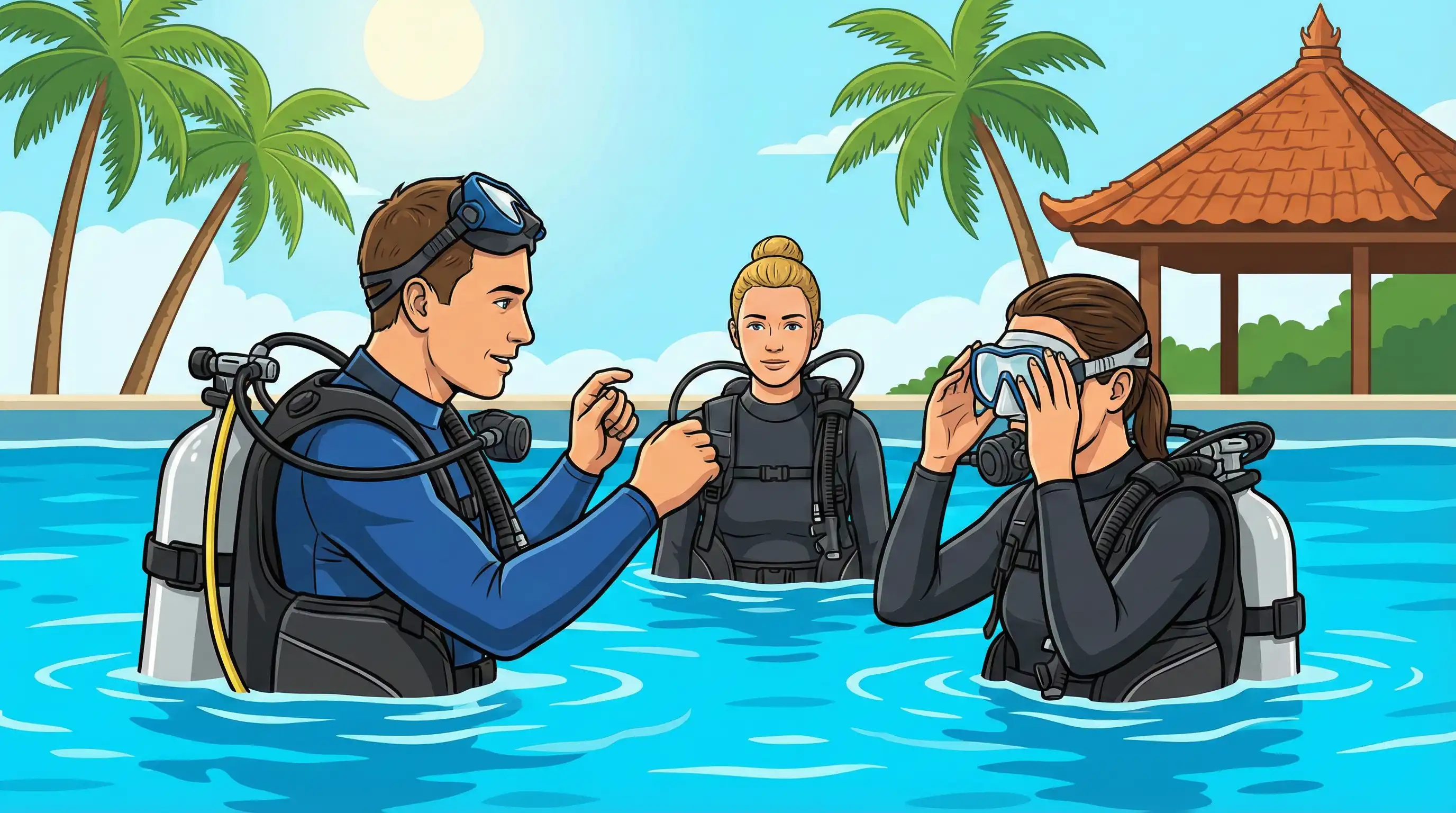
- Assembling and checking diving equipment: BCD, regulator, SPG, and cylinder.
- Mask clearing: both partial and full flood recovery.
- Regulator recovery and clearing using the sweep and reach methods.
- Neutral buoyancy practice: hovering, fin pivots, and maintaining horizontal trim.
- Controlled emergency swimming ascent (CESA) as per agency standards.
- Air-sharing drills using an alternate air source with a buddy.
Open Water Skills Progression
- Dives 1 & 2: Practice basic safety techniques at shallow depths (5–9 meters), demonstrating skills learned in confined water.
- Dives 3 & 4: Increase depth and gain confidence at up to 18 meters, with simple navigation exercises and buddy procedures.
- All dives include controlled ascent practice, safety stop procedures, and real-world application of theory concepts.
Most dive shops in Bali keep groups small, usually with 2 to 4 students per instructor. This gives apprehensive or slower learners more time to practice skills until they feel comfortable throughout the PADI open water course Bali.
Prerequisites, Health & Safety Requirements
The Bali open water course is for people who have never done it before, but there are some safety rules that everyone must follow.
Age Requirements
- Minimum 10 years old for Junior Open Water (with depth and supervision restrictions).
- From 14 years old, students receive the full Open Water certification with standard privileges.
Swimming Ability
- You must be able to swim 200 meters without stopping, using any stroke, without a time limit.
- Float or tread water for 10 minutes without any equipment.
- Some agencies accept 300 meters with mask, fins, and snorkel as an alternative.
Health and Medical Clearance
- All students must complete a standard dive medical questionnaire before beginning the course.
- If you have conditions such as asthma, heart issues, epilepsy, major surgery within 12 months, or are pregnant, you must obtain written clearance from a physician—ideally before traveling to Bali.
- Avoid diving with flu, sinus congestion, or ear infections (common in humid tropical climates). If symptoms develop, inform your instructor immediately.
Safety Standards in Bali
- Reputable dive centers such as Neptune Scuba Diving use well-maintained rental gear with regularly serviced regulators and modern dive computers.
- All instructors should be currently certified and insured with their agency.
- Student-to-instructor ratios should remain low—typically a maximum of 4:1 for beginner groups.
Why Take Your Open Water Course Bali?
Bali is known as one of the best places in Southeast Asia for beginner divers to start, because it has training circumstances that are easy for beginners and access to world-class dive locations that you may explore right after getting your certification.
Environmental Advantages
- Warm water (27–30°C) year-round means comfortable diving in thin 3mm wetsuits or rash guards.
- Visibility typically ranges from 10–30 meters depending on season and location.
- Sheltered training sites like Padang Bai’s Blue Lagoon and Amed’s gentle reef slopes provide ideal conditions for first-time divers.
Variety of Training Sites
- Tulamben: Home to the USAT Liberty shipwreck, with black sand slopes and easy shore entry—one of the world’s most accessible wreck dives for beginners.
- Amed: Coral gardens with gentle currents, excellent for buoyancy practice and fish identification.
- Menjangan Island: Part of a protected marine park with pristine reefs, calm clear water, and popular for multi-day training trips.
- Nusa Lembongan/Nusa Penida: Manta points and drift dives better suited for confident students and post-certification fun dives.
Cultural and Travel Benefits
- Easy to combine your PADI open water course Bali with a broader Bali holiday in Ubud, Canggu, or Uluwatu.
- Accommodation at all budgets available in Amed, Tulamben, Padang Bai, Pemuteran, and Nusa Lembongan.
- Bali dive centers are experienced with international guests, offering instruction in English, French, German, and other languages.
Discover Scuba Diving vs. Full Open Water Course
Beginners often have to choose between committing to the full 3–4 day open water certification or starting with a single-day Discover Scuba Diving (DSD) trip to see if they like it.
What Is Discover Scuba Diving in Bali?
- A half-day or full-day program that is not a certification—it’s a supervised introduction to scuba.
- Includes a short theory briefing, shallow water practice, then 1–2 guided dives to around 6–12 meters under direct instructor supervision.
- Often offered at sites like Padang Bai, or even the Liberty wreck in Tulamben (shallow sections).
- Typical cost: IDR 2,500,000–3,000,000 (approximately USD 150–180).
Who Should Choose DSD First?
- Anyone unsure about diving, anxious in water, or with no prior experience.
- Travelers who just arrived in Bali and need time to adjust to climate and jetlag.
- People who want to confirm they enjoy the sensation of breathing underwater before investing in the full PADI open water course Bali.
How DSD Connects to the Open Water Course
- Some skills and dives from DSD may be credited toward the Open Water course Bali depending on agency rules and timing.
- Even with credit, students should not rush—be comfortable repeating skills if needed.
- Many divers complete DSD one day, then start their full open water course Bali the next morning with significantly more confidence.
Our recommendation: A Discover Scuba Diving lesson the day before is a great way for people who have never been underwater before or who are concerned about doing a full course to try it out.
Types of Open Water Programs in Bali
The basic certification is the same for all agencies (PADI, SSI, RAID), however the way you finish it in Bali may be different depending on your schedule and how you want to learn.
eLearning + 3-Day Bali Program
- Complete 5 theory modules online at home using PADI eLearning or SSI’s MySSI app (5–8 hours of videos, quizzes, and final exam).
- Once in Bali, focus entirely on class and pool sessions plus 4 open water dives over 3 days.
- Ideal for travelers with limited time on the island who want to maximize underwater experience.
Full In-Person PADI Course in Bali
- Theory completed in the classroom over 1–1.5 days using manuals and instructor-led videos.
- Best for travelers who prefer learning with a PADI instructor in real-time and who have at least 4 free days.
- Allows immediate clarification of questions and more personalized pacing.
Referral Option
- Complete theory and confined water skills with a dive center in your home country.
- Then finish just the 4 open water dives in Bali over 2 days at sites like Tulamben, Amed, or Menjangan.
- Popular for divers from cold-water destinations who want warm tropical conditions for their certification dives.
- Typical referral cost: IDR 3,500,000–4,500,000 (approximately USD 220–280).
Combo Packages
A lot of Bali facilities provide packages that include the Open Water Course Bali and the Advanced Open Water Course in 5 to 6 days. This lets you dive as deep as 30 meters and do special dives like night dive training or wreck penetration. Combos are a great deal and give you a lot more logged dives if you have the time and money.
Typical Costs of the Open Water Course in Bali
Prices fluctuate based on season, agency, location, and what’s included, but here are realistic ranges based on multiple Bali dive centers.
Standard Pricing
| Course Type | Price Range (IDR) | Price Range (USD) |
|---|---|---|
| Standard 3-day Open Water (group) | 7,000,000–9,000,000 | 400–550 |
| Premium small-group/private | 9,000,000–10,000,000+ | 550–620 |
| Referral (dives only) | 3,500,000–4,500,000 | 220–280 |
| Discover Scuba Diving | 2,500,000–3,000,000 | 150–175 |
Common Inclusions
- Full set of rental diving equipment (BCD, regulators, wetsuit, mask, fins, weights, tanks)
- Instruction and course materials or eLearning code
- Transfers from nearby hotels (e.g., Sanur to Padang Bai, or local Amed hotels to dive center)
- Lunch, drinking water, and refreshments on dive days
- Certification processing and physical or digital certification card
Potential Extra Costs
- Marine park fees for Menjangan or Nusa Penida (IDR 50,000–100,000 per day)
- Accommodation in Amed, Tulamben, Padang Bai, Pemuteran, or Nusa Lembongan
- Underwater photos or professional video
- Optional refresher or Discover Scuba session beforehand
When you compare dive centers, don't only look at the price. Check the size of the groups (smaller is better for beginners), the quality of the equipment, the qualifications of the instructor, and the safety regulations. The cheapest choice isn't necessarily the best one.
What to Expect Each Day (Student Experience)
Understanding the daily routine helps you prepare mentally and logistically for your PADI diving course in Bali.
Typical Day 1 (Theory + Confined Water)
- 08:00–09:00: Arrival at dive center, paperwork completion, medical questionnaire review, and gear fitting.
- 09:00–12:00: Theory review session covering knowledge reviews, quizzes, and final exam (especially if eLearning was completed beforehand).
- 13:00–16:00: Pool or sheltered bay session practicing basic skills—mask clearing, regulator recovery, buoyancy exercises, and emergency procedures. Session ends with debrief and equipment rinsing.
Typical Day 2 (Open Water Dives 1 & 2)
- 07:00: Early pickup from hotel if traveling (e.g., from Sanur to Padang Bai—approximately 1 hour drive).
- 08:30–09:00: Boat briefing, gear setup with instructor guidance, and dive site orientation.
- 09:30–12:30: Open Water Dive 1 and 2 with surface interval. Skills demonstration at 6–12 meters.
- 12:30–13:30: Simple lunch on the boat or at a local warung near the beach.
- 14:00–16:00: Return to base for logging dives, feedback session, and rest.
Typical Day 3 (Open Water Dives 3 & 4 + Certification)
- Similar early start, potentially traveling to a second location (e.g., Tulamben for the Liberty wreck) or continuing at the same bay.
- Open Water Dive 3 and 4 at slightly deeper areas (up to 18 meters), with more complex skill demonstrations.
- Afternoon: Final debrief, certification photo, logbook signing, and celebration of becoming a certified Open Water Diver.
Physical Expectations
Get ready for early mornings, time on boats (which can be bumpy on the way to places like Nusa Lembongan), and carrying some gear. Crew members usually help with heavy gear, though, and the labor is doable for anyone who is in decent shape. Drink plenty of water because the heat in Bali is really strong.
What to Bring & How to Prepare for Your PADI Course
A bit of preparation makes the experience smoother and safer in Bali’s tropical conditions.
Essential Items to Bring
- Swimwear, towel, reef-safe sunscreen, hat, and sunglasses
- Reusable water bottle to stay hydrated in the heat
- Completed medical questionnaire and doctor’s clearance if required
- Copy of your eLearning certification code or confirmation
Optional but Recommended
- Personal mask and snorkel for better comfort and hygiene (high-quality masks are also available at Bali dive shops)
- Lightweight rash guard or dive skin for sun protection during surface intervals
- Motion sickness medication for boat days around Padang Bai or Nusa Lembongan
- Waterproof bag for phone and valuables
Preparation Tips
- Complete eLearning 2–3 weeks before arrival to reduce classroom time and allow concepts to settle.
- Avoid heavy alcohol the night before diving—dehydration increases decompression risk and impairs judgment.
- Get adequate sleep, especially if adjusting to a new time zone.
- Ensure your travel insurance explicitly covers scuba diving to the depth you are training to (at least 18 meters).
Tips for First-Time Open Water Diver Course in Bali
These advice deal with problems that first-time divers often have in Bali, such as the heat, the sun, being tired from traveling, and being in a place they don't know.
Comfort & Pacing
- Choose a dive center with small groups so the instructor can adapt to your pace.
- Don’t hesitate to ask to repeat skills in the pool if you’re not comfortable—better to master them before going to 10–18 meters.
- Relax your breathing and focus on slow, deep inhalations and exhalations. Rushed breathing depletes air faster and increases anxiety.
Health & Safety
- Notify your instructor immediately of ear discomfort, equalization problems, or anxiety during descent.
- Stick strictly to minimum surface intervals and no-flying-after-diving guidelines.
- If you feel unwell on any dive day, speak up—pushing through illness is dangerous underwater.
Environmental Responsibility
- Practice good buoyancy early to avoid touching coral, especially in shallow coral gardens in Amed and Menjangan.
- Use reef-safe sunscreen and avoid standing on the seabed or wreck structures for photos.
- Never chase, touch, or harass marine life—observe turtles and fish from a respectful distance.
Travel Planning
- Avoid scheduling your PADI Open Water Diver course on your very first day in Bali—allow at least one day to rest and hydrate.
- Plan onward travel (flights from Denpasar, fast boats to the Gili Islands) at least one full day after your final dive.
Our Top Recommendation
A Discover Scuba Diving lesson in a tranquil place like Padang Bai or Amed the day before the full PADI Open Water Diver course can make people who have never been underwater before or who are anxious about committing feel much more comfortable and enjoy the course more. This modest amount of time and money can frequently mean the difference between a difficult diving certification course and an excursion that changes your life.
After Certification: Next Steps and Continuing Your Dive Journey
Completing your open water certification in Bali is the beginning of a lifelong adventure—not the end goal.
Immediate Next Options
- Join fun dives around Bali’s iconic sites: Nusa Penida’s manta points (conditions permitting), Menjangan’s dramatic walls, and the deeper sections of the Liberty wreck.
- Consider an Advanced Open Water course (2 additional days, 5 dives) to extend your maximum depth to 30 meters and explore specialties like deep diving, navigation, or night dive training.
Skill Development Path
- Log dives regularly and practice buoyancy, air consumption control, and basic navigation on easy reef dives before attempting challenging drift dives or deep specialties.
- Aim for at least 20–30 logged dives before tackling advanced sites like Nusa Penida’s strong currents.
- Consider specialties that match your interests: wreck diving (perfect for Tulamben), underwater photography, or nitrox for extended bottom times.
Equipment Decisions
- Start by purchasing personal items like a mask, fins, and dive computer before investing in a full set of gear.
- Bali has several well-stocked dive retail shops in Sanur, Seminyak, and Canggu for post-course equipment purchases.
- A personal mask that fits your face properly makes every dive more comfortable—rental masks rarely fit as well.
Explore Beyond Bali
Your new world of diving extends far beyond the island. Indonesia offers some of the planet’s best diving:
- Komodo National Park: Manta rays, reef sharks, and dramatic current-swept pinnacles.
- Raja Ampat: The crown jewel of global biodiversity with unmatched coral coverage.
- Lombok and the Gili Islands: Easy day-trip distance from Bali with excellent reef diving and turtle encounters.
Welcome to the world of scuba divers. Your Bali certification lets you tour 71% of the Earth's surface.
Your Bali open water course lets you explore a whole new world below the surface. The skills you learn in these 3–4 days will last a lifetime, whether you're floating weightlessly above the coral gardens of Amed, exploring the historic USAT Liberty wreck in Tulamben, or seeing your first sea turtle in Padang Bai.
If you're not sure, start with Discover Scuba. Pick a diving facility that is well-known, has small groups, and takes good care of its gear. Finish your eLearning before you get there. And most importantly, take your time, breathe deeply, and enjoy every second of learning how to explore the underwater world.
Bali is waiting. It's time for the ocean. Now is the time for your trip.