Komodo diving guide
PADI Open Water Diver in Komodo
The PADI Open Water Diver course is the world’s most widely recognized entry-level scuba certification. In Komodo, new divers pair structured training with access to one of Indonesia’s most famous marine parks—clear water, dramatic reefs, and unforgettable wildlife—while they build the habits that keep diving safe for a lifetime.
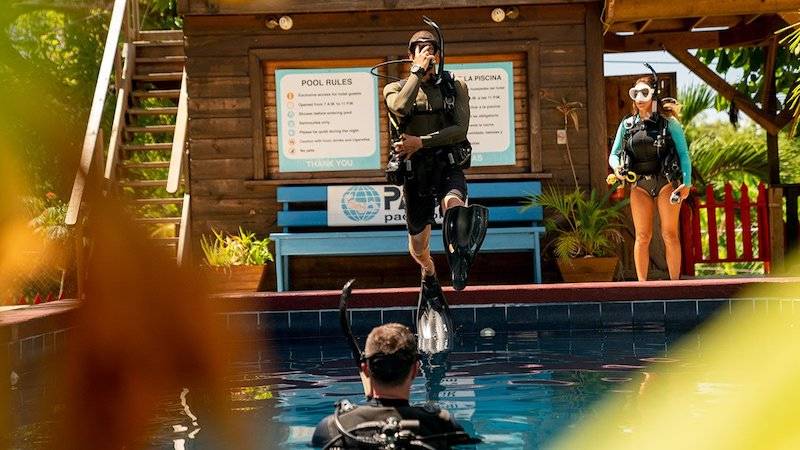
What is the PADI Open Water Diver course

PADI Open Water Diver is designed for people who have never held a certification—or who are returning after a long break—and want to dive independently with a buddy, within the limits of their training, in conditions similar to those where they learned. The course blends knowledge development, confined-water (pool or pool-like) practice, and a minimum of four open water dives that apply those skills in the real ocean.
Successful completion earns a plastic or digital certification card that reflects a single global training standard: you understand how pressure affects your body, how to plan dives within no-decompression limits for recreational divers, how to manage your buoyancy and air supply, and how to respond to common problems such as a leaking mask or an out-of-air situation using established protocols.
The emphasis is not on “extreme” diving but on repeatable, conservative habits: good communication with a buddy, respect for the environment, and knowing when to call a dive. That foundation is the same whether you train in a quarry in Europe or along the walls of Komodo National Park—the difference in Komodo is simply the setting where you rehearse those skills.
Why learn to dive in Komodo

Komodo National Park sits in the heart of the Coral Triangle, where the Indian and Pacific oceans mix. Strong currents bring nutrients; reefs support dense fish life, from tiny anthias to reef sharks and passing pelagic species on the right day. For a student diver, that means open water sessions are visually rich—you are not only ticking skill requirements but seeing why people fall in love with the sport.
Geography also teaches real-world lessons. You learn to read water movement, stay close to your instructor or guide, and use the reef sensibly for shelter when surge or current appears. Those experiences complement classroom theory: tides, waves, and boat procedures are easier to remember when you have felt them in a controlled training context.
Many travelers combine learning to dive with land-based exploration—viewpoints over arid islands, walks to see Komodo dragons, and sunsets over Labuan Bajo. The region has grown into a well-known dive hub, so infrastructure for divers (equipment standards, emergency planning culture, and multilingual briefings) is relatively mature compared with remote corners of the archipelago.
Course structure — eLearning, pool, and open water dives (three days)

Most PADI Open Water programs today begin with digital learning: interactive chapters and quizzes you complete at your own pace before arrival or between training days. That front-loads physics, physiology, equipment assembly, and dive planning so face-to-face time focuses on demonstration, correction, and repetition in water.
Confined water sessions introduce the core skill set in a protected environment: breathing continuously from a regulator, clearing a flooded mask, recovering a regulator, sharing air in an emergency, and achieving neutral buoyancy so you neither crash into the bottom nor rocket to the surface. Instructors typically progress in small steps, adding only what you are ready to integrate.
Open water dives translate those skills into open ocean or sea conditions. A common schedule spreads training across roughly three days: first day often emphasizes equipment comfort and fundamental skills; later dives add navigation patterns, deeper work within training limits, and more autonomy as you demonstrate mastery. The exact sequence depends on logistics, weather, and how quickly you absorb each skill—flexibility is normal.
Prerequisites and requirements

PADI sets a minimum age of ten years for Junior Open Water Diver; many students qualify for full Open Water Diver without junior restrictions from age fifteen onward (always confirm the latest agency standards and local law). Medical fitness matters: chronic conditions affecting heart, lungs, ears, or circulation may require a physician’s written clearance on a diving medical form before in-water activities begin.
You should be able to swim and stay afloat. Training organizations usually ask for a swim test and a tread or float—exact distances and times vary, but the intent is to ensure you can handle yourself on the surface if separated from the group briefly. Being comfortable in the water reduces anxiety and makes skill practice faster.
Honest disclosure of medications, recent surgeries, pregnancy, or equalization problems protects both you and your instructor. If something does not feel right during a skill, signaling “problem” and ascending together is always preferable to pushing through pain or panic. The course is built around that kind of communication from day one.
What you will learn — skills, safety, and equipment

Beyond the list of individual skills, Open Water Diver teaches a mindset: plan the dive, dive the plan, monitor your gauges, and stay aware of your buddy and surroundings. You learn to assemble and inspect a standard recreational kit—BCD, regulator with alternate air source, weights suited to exposure protection, and a dive computer or tables as your training dictates.
Safety skills include controlled descents and ascents, minimum safety stops where appropriate, emergency swimming ascents without a regulator, and assisting a tired diver at the surface. Buoyancy control receives heavy attention because it protects fragile marine life, reduces air consumption, and prevents uncontrolled changes in depth.
Environmental awareness is part of the curriculum: avoiding contact with coral, managing fin kicks in tight spaces, and understanding why certain animals should never be chased or touched. In Komodo, where biodiversity is high, those habits help preserve the very ecosystems that drew you underwater in the first place.
After certification — what comes next
With Open Water Diver on your card, you are qualified to dive with another certified diver in environments similar to your training, typically to eighteen meters (sixty feet) for adults—sometimes shallower for younger divers. Your next trips might include easy reef profiles, drift dives within your comfort zone, and gradually building experience before adding depth or specialty training.
Common follow-on courses include Advanced Open Water Diver (broader experience dives), Enriched Air Nitrox (longer no-decompression times within certain plans), Peak Performance Buoyancy (refinement), Deep Diver or Drift Diver specialties, and eventually Rescue Diver, which shifts the focus toward preventing problems and managing stress in others.
Some divers later consider professional tracks such as Divemaster, while many simply travel the world logging recreational dives. Wherever you go, the same principles apply: stay within your limits, keep learning from every dive, and treat the ocean as a privilege rather than a playground without rules.
Haeufig gestellte Fragen
Mehr Training und Tauchen in Komodo


Schließen Sie sich mehr als
1,000+ monatliche Gäste
Aus aller Welt zu uns für Tauchen, PADI-Kurse, Schnorcheln und Freediving.