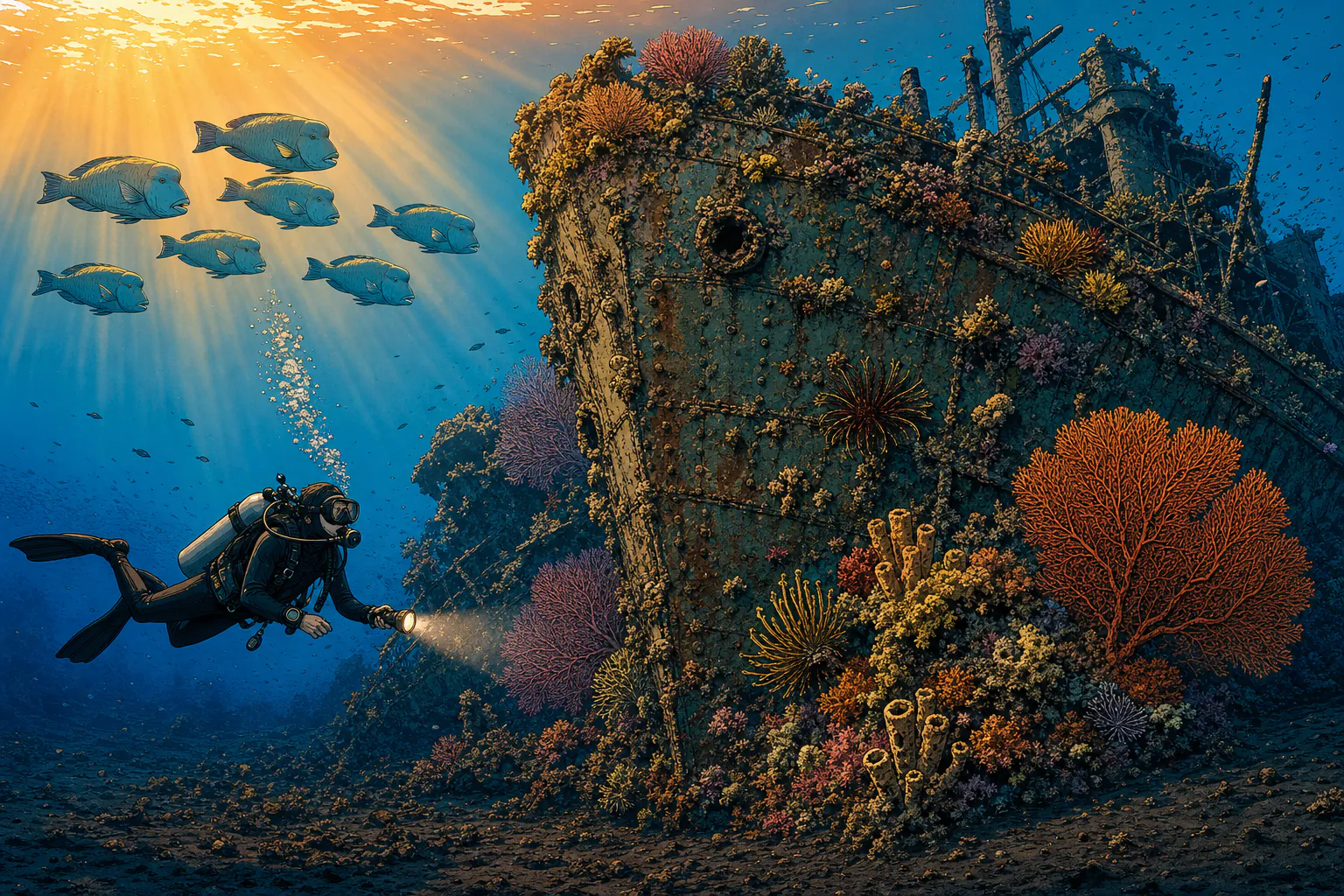
A diver in horizontal trim swimming alongside the coral-encrusted bow section of the USAT Liberty wreck at Tulamben Bali at dawn, with a large school of bumphead parrotfish passing overhead and warm sunrise light filtering down through the blue water.

The USAT Liberty is the dive site that put Bali on the diving map. A 120-metre cargo ship sitting in 5 to 30 metres of water, completely accessible from the beach at Tulamben, hosting one of the densest fish populations on any wreck dive on the planet, and visited by every certification level from first-time bubble breathers to technical divers with rebreathers. For volume of divers, accessibility, and sheer marine-life payoff, no other shipwreck dive in Indonesia, and few anywhere, comes close.

This is the guide we wish existed when we started running Liberty trips for our customers. Most online articles on the Liberty are 1500-word marketing pieces that confuse the ship's name (it was USAT, not USS) and miss the operational details that make the difference between a good dive and a great one. We have run Liberty dives daily from our Sanur base for years, both as day trips and as part of multi-day Tulamben stays. What follows is the operator-side view: history accurately told, wreck layout with the parts you actually see, three completely different dives the same wreck offers, currents and visibility realities, the gear and certifications you need, and how to actually plan your trip.

The history: USAT, not USS, and why it matters

Naming first, because nearly every article online gets this wrong. The wreck is the USAT Liberty, not the USS Liberty. USAT stands for "United States Army Transport". She was operated by the US Army's transport service, not commissioned into the US Navy. The "USS" prefix is reserved for commissioned Navy vessels. This matters not for SEO snobbery but because if you dive the Liberty and want to read her actual story, searching "USAT Liberty" gets you Navy archives and accurate records; searching "USS Liberty" gets you confused with a completely different ship (the USS Liberty AGTR-5 that was attacked off Israel in 1967).

The Liberty herself was a 7,200-ton steel cargo ship, 120 metres long, built in 1918 at the Federal Shipbuilding yard in Kearny, New Jersey, originally for civilian commercial use. She was acquired by the US Army Transport Service for the Pacific theatre of World War II.

On 11 January 1942, while transporting railway parts and rubber from Australia to the Philippines, she was torpedoed by the Japanese submarine I-166 in the Lombok Strait, the narrow body of water between Bali and Lombok. The torpedo struck her starboard side. She did not sink immediately. Two American destroyers (USS Paul Jones and the Dutch HNLMS Van Ghent) attempted to tow her to the closest port (Singaraja, north Bali) but the damage was too severe. They beached her on the volcanic black sand at Tulamben, on the northeast coast of Bali, and salvage teams stripped her cargo over the following weeks. She lay on the beach, partially out of the water, for 21 years.

Then on 17 March 1963, Mount Agung erupted. Bali's most sacred volcano, dormant for over a century, produced one of the largest eruptions of the 20th century, killing more than 1,500 people and reshaping the entire northeast coast. The seismic activity and subsequent lahar flows shifted the Liberty off the beach and into deeper water. She broke apart in the process and now lies on a sand slope parallel to the shore, with her bow in 30 metres and her stern in just 5 metres. The break in her hull, roughly amidships, created the swim-through structure that makes the modern dive what it is.

In the six decades since she was pushed into the sea, the wreck has been completely colonised by Indo-Pacific marine life. The hull is unrecognisable as metal in most places, covered in hard and soft corals, gorgonian sea fans, anemones, sponges, and crinoids. She is functionally a coral reef now, with the original ship's silhouette visible only through the consistency of the structure beneath the growth.

Wreck specs and layout

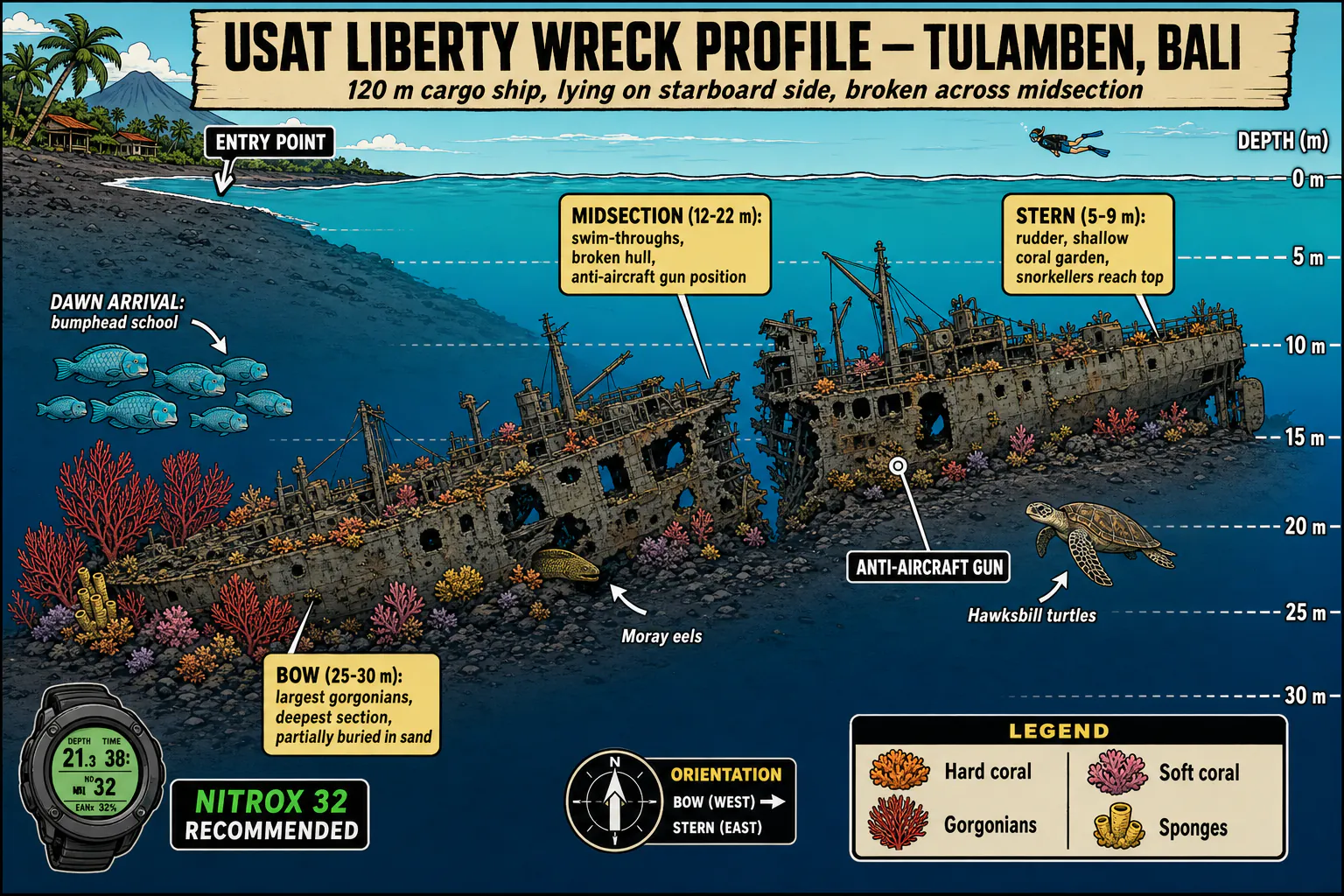
Side-view technical diagram of the USAT Liberty wreck at Tulamben showing the full 120-metre length, depth profile from 5 metres at the stern to 30 metres at the bow, the broken midsection swim-through area, the anti-aircraft gun position, the bow section with the most coral growth, and the shore-entry point on the black sand beach.
The USAT Liberty wreck profile, broken across the middle, lying on a sand slope parallel to the Tulamben beach. The depth gradient from stern (5m) to bow (30m) makes her divable across every certification level.

The Liberty wreck lies on her starboard side (right side down) on a black volcanic sand slope, roughly 30 metres offshore, parallel to the beach. Her orientation is approximately:

Stern (rear) at 5 to 9 metres. The shallowest point. The rudder and stern-section deck plates are still recognisable. Coral growth is densest here because of the light. Snorkellers from the beach can actually see the top of the stern section on a calm day.

Midsection from 12 to 22 metres. The broken hull section, where the ship snapped during the 1963 eruption. This is the part of the dive most divers remember: a series of vertical and horizontal swim-throughs through the broken structure, with shafts of light coming through the gaps and the entire wreck visibly cleaved apart. The famous "anti-aircraft gun" (actually a piece of stern winch machinery that resembles a gun mount) sits in this section at around 20 metres.

Bow (front) at 25 to 30 metres. The deepest section. The bow is the most photogenic part of the wreck, with the largest coral growth (some gorgonian sea fans over 2 metres across) and the highest concentration of pelagic fish that hold off the deep end of the wreck. The bow itself points roughly north-northwest and is partially buried in sand.

The full wreck swim, from bow to stern at depth, takes about 25 to 35 minutes at a relaxed pace. Most dive guides will not swim the entire length on a single dive unless conditions are perfect; instead, a typical dive plan covers a third to half of the wreck per dive, allowing for time at the marine-life hotspots.

The three Liberty dives: dawn, day, and night

This is the most important practical point for anyone planning a Liberty trip: the Liberty offers three completely different dives at the same site at different times of day. Most casual divers do only the midday dive and miss what makes the wreck genuinely world-class. If you have time for only one, do the dawn dive. If you have time for three, do all of them.

1. Dawn dive (the signature experience)

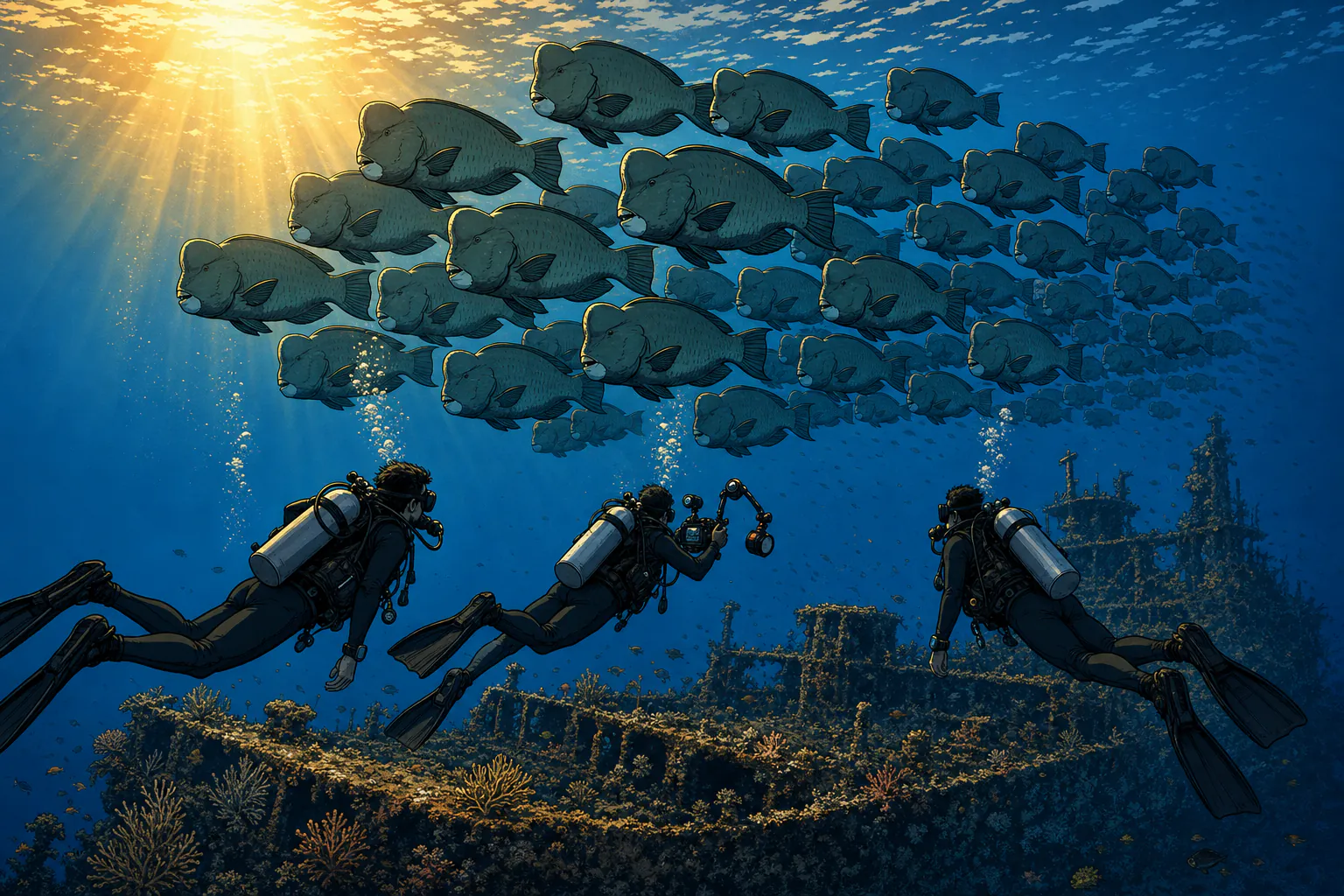
A scuba diver in horizontal trim watching a large school of bumphead parrotfish, dozens of them, slowly passing over the coral-covered USAT Liberty wreck at first light, with low warm sunrise rays piercing the surface and silhouetting the fish above the wreck.
The Liberty dawn dive. From May through October, schools of 25 to 60+ bumphead parrotfish move over the wreck at first light, the single most memorable wildlife encounter in Bali diving.

From roughly May through October, a resident school of bumphead parrotfish (Bolbometopon muricatum) sleeps in the deeper sand and reef structure off the bow at night and migrates over the wreck at first light to begin feeding. The school numbers vary year to year between 25 and 60+ adult fish. Adults are massive (up to 1.3 metres long, 50+ kilos), with the unmistakable bulbous forehead and large beak, and they school in tight formation.

The dive: meet at the dive shop around 5:00 AM, kit up in the dark, walk to the beach, descend as the sun is rising. You position yourself on the sand near the bow at around 18 to 22 metres and wait. Within 15 minutes of dawn light reaching the wreck, the school appears. They move slowly, in a tight school, passing directly overhead, completely uninterested in divers. The experience lasts 5 to 15 minutes before they disperse into feeding mode along the reef.

It is the most reliable big-fish-school encounter in Bali diving, and arguably the most photographed dive moment in Indonesia outside of Komodo and Raja Ampat. If you arrive at the Liberty without doing the dawn dive, you have missed the dive's headline experience.

2. Day dive (the comprehensive wreck tour)

The classic Liberty dive most operators run by default. Entry from the beach between 8:00 AM and 3:00 PM, depending on tide and group schedule. Visibility is at its best (typically 15 to 25 metres in dry season, sometimes pushing 30 in calm conditions). Light is at its strongest, which makes wide-angle photography of the wreck structure and the coral growth optimal.

The day dive is what people mean when they say "Liberty wreck dive". A guided tour covering one third to one half of the wreck, with stops at the iconic features (the swim-throughs, the anti-aircraft gun, the coral-covered bow gorgonians), exploring the marine life living on the structure. Bumpheads are sometimes still in the area in the morning if they did not move off after the dawn arrival, but expect them to be feeding along the reef rather than in formation.

You will see resident species: blackspotted moray eels, giant moray eels, banded sea snakes (yes, venomous, but only dangerous if mishandled), large bumphead parrotfish that did not leave with the school, hawksbill turtles, schools of fusiliers, batfish hovering in the shadows of the swim-throughs, lionfish in every crevice, and trumpetfish hanging vertically along coral pinnacles.

3. Night dive (the macro and predator dive)

Same wreck, completely different cast of characters. Entry just after sunset (around 6:30 PM in the dry season). The wreck becomes a stage for hunting and macro behaviour you do not see in daylight.

What you see: Spanish dancers (large red nudibranchs that swim by undulating, sometimes visible in mid-water at night), Liberty's resident population of decorator crabs and harlequin shrimp coming out from cracks, giant cuttlefish in courtship displays, bobtail squid in the sand near the wreck, hunting lionfish using your dive light to ambush prey (a fact-of-life on every Indonesian night dive), and the wreck's resident scorpionfish coming into the open. The signature night creature here is the Spanish dancer, which is reliably found on the deep half of the wreck.

The night dive also gives you the wreck itself as a different visual: torch beams crossing through the swim-throughs, hard coral fluorescing in some lights (try a UV light if your guide has one), and the eerie quiet of the wreck without the day-time fish activity.

Conditions, currents, and visibility

The Liberty is one of the few major dive sites in Indonesia where currents are almost a non-issue. The wreck sits in a sheltered bay protected from the main Lombok Strait flow, and the depth profile means even when there is some current, you can adjust depth to avoid it. Current scenarios:

ConditionFrequencyImplication
Slack / no currentMost days, especially dry seasonEffortless dive at any depth
Mild current (less than 1 knot)~30% of daysPlan dive as a drift along the wreck length (the PADI Drift Diver specialty covers the technique)
Moderate current (1-2 knots)~10% of days, mostly wet seasonStay close to wreck, use it for shelter
Strong current (2+ knots)Very rare, mostly during full/new moon big tides in wet seasonOperator usually delays or relocates to nearby Coral Garden site

Visibility is excellent by Indonesian standards: 15 to 25 metres on most days, 25 to 30+ metres on the best days. Wet season (November to March) drops it occasionally to 10 to 15 metres after heavy rain or rough seas, but Liberty's location is sheltered enough that it rarely closes due to visibility.

Water temperature: 27 to 29 degrees Celsius on the surface, 25 to 27 below the thermocline (which usually sits around 18 to 22 metres). A 3 mm wetsuit is enough for most divers; if you tend to feel cold or are diving repetitively, a 5 mm is more comfortable.

Certification and skill requirements

Open Water Diver (basic minimum). The shallow stern and midsection (5 to 18 metres) are within Open Water depth limits. An Open Water diver (see our 3-day Open Water course in Bali) with reasonable comfort can dive Liberty's shallow half and still see the swim-throughs and the bumphead area at the dawn dive (the bumpheads pass over the wreck regardless of which depth you are at). Many of our customers' first deep-ish dives are on the Liberty's shallow sections. For complete beginners, our first-time diving Bali guide covers what to expect on your first underwater experience before stepping up to a wreck dive.

Advanced Open Water (strongly recommended). AOW unlocks the bow section (down to 30 metres) where the largest coral growth, the gorgonian sea fans, and the deepest swim-through features sit. Most divers find the bow the most photogenic part of the wreck, so AOW pays off here. We run 3-day AOW courses from our Sanur dive center with deep dives often performed on the Liberty itself.

Wreck Diver specialty (optional but useful). The Liberty's swim-throughs are technically "wreck penetration" and benefit from the Wreck Diver specialty's penetration training, though the swim-throughs are wide and open enough that any AOW diver with reasonable trim can safely transit them. The specialty is more important for divers who plan to keep wreck-diving as a focus.

Nitrox 32 (strongly recommended). Liberty profiles often involve 40 to 60 minutes at 18 to 25 metres with surface intervals doing 2 to 4 dives a day. Exactly where nitrox extends no-deco limits. Our Enriched Air specialty takes two days and pays for itself in extra Liberty bottom time across a 2-day trip.

Physical and skill prerequisites. Beach entry over volcanic black gravel (which is rolling, ankle-twisting gravel, not soft sand) with a full kit is the hardest physical part of Liberty diving. Most operators use porters who carry tanks and BCDs from the dive shop to the entry point so you walk in only with mask, fins, regulator and weight. Comfortable swimming, good buoyancy control inside the wreck's structure, and basic navigation comfort are all useful. Liberty has killed divers in the past, almost all of them during the wet season when conditions became unexpectedly difficult or during attempts to penetrate parts of the wreck deeper than the swim-through structure was designed to support.

Marine life on the Liberty

The Liberty's marine life is divided into resident species (live on the wreck), seasonal species (visit at predictable times), and transient species (cruise through). A realistic 2-day Liberty visit's sighting list:

Species / groupWhere on the wreckSighting likelihood
Bumphead parrotfish school (dawn arrival)Over the deep bow at first light~95% in dry season, ~75% wet season
Resident bumphead parrotfish (individuals)Anywhere on the wreck day-longEssentially every dive
Hawksbill turtlesCoral growth on the bow and midsection~80% per dive
Schools of yellowtail fusiliersAbove the wreckEssentially every dive
Giant moray eelsInside the wreck structure, mostly the midsection~90% per dive
Blackspotted moraysThroughout the wreck~85% per dive
Banded sea snakesCoral garden area near entry point~60% per dive
Garden eels (in sand beyond the bow)Bow sand patch~75% on bow dives
Lionfish (multiple species)Every crevice on the wreck~100%
BatfishHovering inside the swim-throughs~85% per dive
Ghost pipefish (ornate, robust)Coral patches near bow and stern~40% during macro season Apr-Sep
Frogfish (giant and painted)Bow area gorgonians~30% but always exciting
Spanish dancers (night dives only)Deep half of wreck~70% on night dives
Whitetip reef sharksCruising past the bow~25% per trip

For seasonal sunfish sightings near Tulamben in the August-October window, see our Mola Mola Bali season guide. For a full breakdown of Bali's small-creature scene, see our Macro & Muck Diving in Bali guide. The Liberty is not primarily a macro dive, but it has consistent enough small-life that wide-angle photographers always carry a macro option in case the gorgonians produce a pygmy seahorse hit.

Photography on the Liberty

The Liberty rewards both wide-angle and macro setups, often on the same dive.

Wide-angle. For the wreck structure itself, the swim-throughs, the bumphead schools at dawn, and the gorgonians at the bow. A fisheye or 16-35mm equivalent with strobes is standard. The swim-through shots with light shafts coming through the broken hull are the iconic Liberty image. Position yourself low and shoot up through the structure with the sun above for the cleanest light rays. For the bumphead school at dawn, you have to be in the right place at the right depth (around 18 metres above the wreck near the bow) and let the school come to you; chasing them ruins the shot for everyone.

Macro. For the gorgonian-inhabiting critters: pygmy seahorses (more on the bow gorgonians), ornate ghost pipefish, harlequin shrimp, decorator crabs, and the night-dive nudibranch and Spanish dancer scene. A 60mm to 105mm macro lens with focus light is the standard.

Specifically Liberty quirks. The wreck is in just 5 to 30 metres so even compact cameras get reasonable colour without strobes on the shallow stern. Black volcanic sand means careful with strobe placement (it absorbs light and creates dark backgrounds quickly). The bumphead dive happens in low pre-dawn light so your camera ISO will run high; modern mirrorless setups handle this much better than DSLRs from a few years back. Bring extra batteries for cold pre-dawn starts.

Where to dive from: Sanur day trip vs Tulamben overnight

Two ways to dive the Liberty, each with trade-offs.

Day trip from Sanur (or southern Bali)

The standard option for divers based in Bali for a multi-day trip and not solely focused on Tulamben. You leave Sanur (or wherever you are staying in south Bali) at around 6:30 AM, drive 2.5 to 3 hours to Tulamben, dive 2 to 3 dives across the day, and return to Sanur by late afternoon. Costs include transfers, lunch, dive guide, tanks, and weights. Total day cost typically $130 to $190.

The day trip does not give you the dawn dive (5 AM start from Sanur means you would arrive at Tulamben too late). For dawn dives, you must stay in Tulamben overnight.

From our base in Sanur, our Sanur dive center runs daily Liberty day trips with small groups (max 4 divers per guide).

Tulamben overnight (the recommended approach for serious Liberty divers)

Stay in Tulamben for 1 to 3 nights, dive the Liberty multiple times across dawn, day, and night, and explore the other excellent Tulamben dive sites (Coral Garden, Drop Off, Seraya Secrets for macro) on the same trip. This is the only way to do the dawn dive, and it gives you the wreck in fundamentally different conditions you cannot fit into a single day.

Tulamben has accommodation ranging from $25/night dive resorts to $200/night boutique villas. The dive resorts (Liberty Dive Resort, Tauch Terminal, Bali Diving Academy Tulamben) are positioned within 5 minutes' walk of the Liberty entry point and include tank and weight rental in their dive packages.

For the full Tulamben region context, our Tulamben Diving Bali guide covers accommodation, the other sites, costs, and itineraries.

Sample 2-day Tulamben + Liberty itinerary

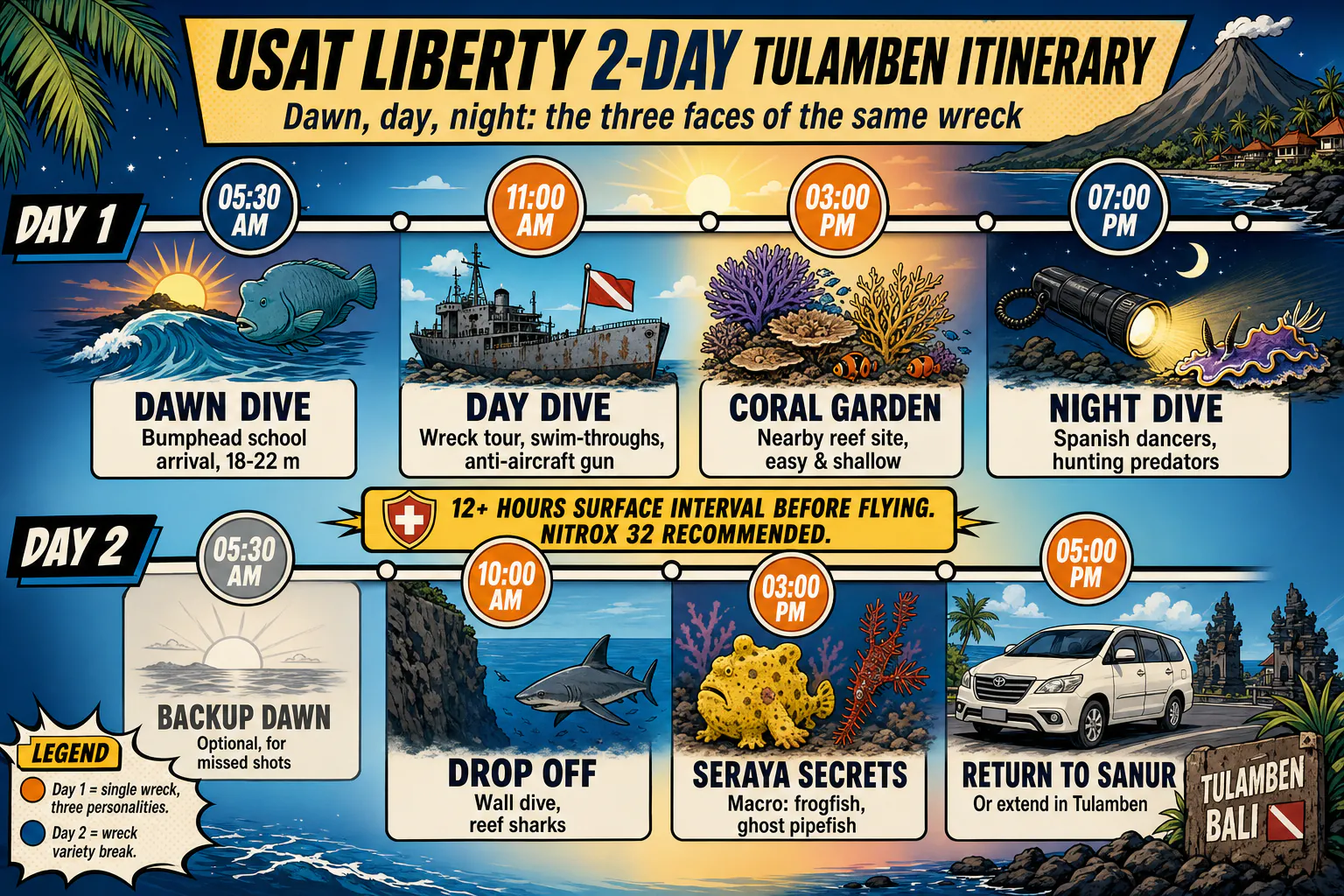
Educational infographic showing the three Liberty dive variants over a 2-day Tulamben itinerary: Day 1 dawn dive at 5:30 AM with bumphead school, day 1 second dive at 11:00 AM for the comprehensive wreck tour, day 1 night dive at 7:00 PM for Spanish dancers and hunting predators, Day 2 dawn re-dive for missed shots, day 2 morning shift to nearby Coral Garden and Drop Off sites, with marine life icons for each dive.
A 2-day Tulamben itinerary built around the Liberty wreck's three signature dive variants, with the second day reserved for nearby sites and a backup dawn dive.

Day 1, Tuesday.

05:00 AM. Wake-up call at the dive resort. Quick coffee, into wetsuit, kit check.
05:30 AM. Dawn dive briefing on the beach.
05:45 AM. Descent. Position at 18-22 metres near the bow.
06:00 AM. Bumphead school arrives. 5 to 15 minutes of close encounter.
06:30 AM. Surface, breakfast at the dive resort.
11:00 AM. Second Liberty dive: classic wreck tour, midsection swim-throughs, anti-aircraft gun, bow gorgonians.
12:30 PM. Lunch, surface interval, rest.
03:00 PM. Optional third dive: Coral Garden (the slope reef next to the Liberty), easier and shallower, good for marine-life browsing.
07:00 PM. Night dive on the Liberty: Spanish dancers, hunting predators, sleeping turtles.
09:00 PM. Dinner, sleep.

Day 2, Wednesday.

05:30 AM. Optional second dawn dive (for divers who missed key shots or want to re-experience).
10:00 AM. Shift to nearby Drop Off site (5-minute boat ride): a wall dive from 5 to 70+ metres, completely different from the Liberty, with reef sharks and pelagic action.
01:00 PM. Lunch, surface interval (mandatory if flying within 24 hours).
03:00 PM. Final dive: Seraya Secrets for macro (frogfish, harlequin shrimp, ghost pipefish), if your trip's marine-life focus warrants it.
05:00 PM. Return drive to Sanur (or extend in Tulamben for day 3).

For divers on a single-day visit from Sanur, drop the dawn and night dives and do two day-time Liberty dives plus the Coral Garden. You will miss the wreck's headline experiences but the day dives alone are still memorable.

What it costs (honest 2026 numbers)

ItemTypical cost (USD)
Sanur day trip, 2 Liberty dives, transfers and lunch$130 to $170
Sanur day trip, 3 Liberty/Coral Garden dives$160 to $200
Tulamben dive resort accommodation, per night (dorm to mid-range)$25 to $80
Tulamben boutique accommodation per night$100 to $250
Tulamben-based 2-tank Liberty dive (just diving, no accommodation)$70 to $100
Tulamben-based 4-dive day (2 Liberty + Coral Garden + night)$140 to $190
Dawn dive supplement (early start, often counted as a separate dive)$40 to $60
Full gear rental (BCD, regulator, computer)$20 to $30 per day
AOW course (Sanur-based, includes Liberty dives)$430 to $530
Nitrox specialty (2 days)$220 to $290
Underwater photographer hire (for guided dive with pro)$60 to $120 per dive

Compare these to our broader Bali scuba diving prices guide for context across all Bali sites.

How the Liberty compares to other Indonesian wrecks

Indonesia has many wreck dives. The Liberty stands out for a specific combination, not for being the deepest, the most intact, or the most historic.

WreckDepthAccessMarine lifeVerdict vs Liberty
USAT Liberty (Tulamben Bali)5-30 mBeach entry, daily accessExcellent: dense, varied, includes the bumphead schoolReference standard. Best access + best marine life combination in Indonesia.
Japanese Wreck (Amed Bali)2-12 mBeach entry, daily accessGood: smaller scale, snorkeller-friendlyEasier and smaller. Worth a visit on an Amed trip but not in Liberty's league.
SS Sankisan Maru (Truk Lagoon, Micronesia)20-40+ mBoat, multi-day liveaboard onlyExcellent but cooler waterMore historical (WWII fleet wreck) but much harder to reach and more demanding.
HMAS Perth (Sunda Strait Indonesia)30-40+ mTechnical diving onlyDeep, dark, current-drivenTech divers only.
P-38 Lightning (Manado area)40+ mTechnical depthAircraft wreck, intactDifferent category entirely (aircraft, not ship).

For divers who want to compare Bali to Indonesia's other top wreck-and-pelagic destination, see our Komodo vs Bali diving comparison. For broader context on Bali's wreck and dive site landscape, see our best places to scuba dive in Bali roundup.

Common mistakes that ruin Liberty dives

Skipping the dawn dive because of the early wake-up. The dawn dive is what separates "did the Liberty" from "experienced the Liberty". Sleep early, set two alarms, drink coffee on the way to the beach. You can sleep on the day-2 dive day or back in Sanur. You cannot do this dive at any other time.

Diving the Liberty as a single-day rush from Sanur. A Sanur day trip gets you 2 to 3 day-time dives, ~3 hours of driving, and you miss the dawn and night dives entirely. If the Liberty is your main goal, stay in Tulamben for at least 1 night.

Going on a big-group dive with 6+ divers per guide. The Liberty's swim-throughs and macro features do not work well with large groups. You can rarely see what your guide is pointing at, photography is impossible, and the bumphead school dawn experience is ruined if the school encounters a crowd. Pay extra for a small group operator (1 guide to 2-4 divers).

Chasing the bumphead school. Bumpheads are notoriously skittish around aggressive divers. Park yourself in a low position above the wreck, stay still, and let the school come to and over you. Divers who chase them with cameras break the experience for everyone in the water and never get the shot.

Skipping nitrox. 2 to 4 dives per day at 18 to 25 metre profiles is exactly where nitrox doubles your bottom time across a 2-day trip. The extra $30 to $50 per day for nitrox fills is the single best money spent on a Liberty trip.

Buying coral as souvenirs from the village shops near the dive site. Possession of coral (alive or dead) is illegal under Indonesian law. The shops sell it because of demand. Do not create the demand.

Not budgeting for porters. The walk from the dive shop to the entry point is over loose black gravel. Porters carry tanks and BCDs for around 50,000 IDR per setup ($3-4). Always tip them. They prevent twisted ankles and have been working this beach for decades.

How to book a Liberty trip with us

From our Sanur dive center, we run two Liberty trip formats:

Sanur day trip. Pickup from your south Bali hotel at 6:30 AM, 2 to 3 Liberty/Coral Garden dives, lunch, return by 5 PM. Best for divers on a multi-site Bali trip who want to tick the Liberty.

Tulamben 2 or 3-day package. Includes accommodation at a partner Tulamben dive resort, dawn dive on day 1, multiple day dives, optional night dive, and transfers from anywhere in Bali. This is the proper way to experience the Liberty.

Both are bookable via our main booking page or directly through our Bali contact form. We run small groups (max 4 divers per guide), use nitrox-equipped tanks at no surcharge, and our guides have logged thousands of Liberty dives.

The bottom line

The USAT Liberty wreck is the dive site that proves you do not need to be deep, remote, or technical to have a world-class wreck experience. She sits in 5 to 30 metres, accessible from a Bali beach, hosting one of the densest marine-life communities of any wreck on the planet, with the bumphead parrotfish dawn dive ranking among the most memorable wildlife encounters in Asian diving. Open Water divers can dive her shallow half on their second-ever wreck dive; Advanced divers can spend 3 days here without repeating an experience.

The mistake most travellers make is treating the Liberty as a tick-box on a multi-site Bali trip. Treat it as the centrepiece: stay in Tulamben for at least one night, do the dawn dive, do the night dive, dive small-group, and you will understand why this wreck has been at the top of "best dives in Asia" lists for two decades.

Start planning at our Sanur dive center, browse the Tulamben dive site page or browse our other Bali dive site service pages including Amed, Padang Bai, and Nusa Penida.

常见问题

USAT Liberty. USAT stands for United States Army Transport, meaning she was operated by the US Army's transport service. The USS prefix is reserved for commissioned US Navy vessels and is historically inaccurate for this wreck. The confusion comes from search-popular variants. Both terms now coexist in dive culture, but technically and historically, USAT is correct.
Yes. The wreck spans from 5 metres at the stern to 30 metres at the bow, so Open Water divers can comfortably explore the shallower half (5 to 18 metres), which includes the stern section, the broken midsection swim-throughs, and the iconic anti-aircraft gun area. The bumphead parrotfish dawn dive can be done at any depth above the bow, so Open Water divers do not miss the headline experience either. The deeper bow section requires Advanced Open Water.
April to October (Bali's dry season) is peak: visibility 20 to 30 metres, mild current, bumphead schools most reliable at dawn (90%+ sighting rate), and accommodation in Tulamben at high availability. November to March (wet season) still has good Liberty diving but visibility drops occasionally to 10 to 15 metres after heavy rain, and the bumphead sighting rate drops to around 75%. Mola Mola (sunfish) sightings near the Liberty are an August to September seasonal bonus.
Yes. The bumphead parrotfish school passes over the wreck within 15 to 20 minutes of dawn light reaching the seafloor. To be in position at depth before they arrive, you need to begin descent before sunrise. Pre-dawn alarm is roughly 4:45 to 5:15 AM depending on the season. It is worth it. The dawn dive is the single most photographed dive in Bali for a reason.
The drive from Sanur is approximately 2.5 to 3 hours by road, depending on traffic, via the eastern coast route. Most dive operators include round-trip transfers in their day-trip packages. Private taxi is around 700,000 to 1,000,000 IDR each way ($45-65). If you are staying in Tulamben overnight, the dive resort often arranges transfers from anywhere in Bali (Ubud, Seminyak, Canggu, Sanur) for a fee.
Partially. The stern section sits in just 5 to 9 metres of water, and on calm days strong swimmers can free-dive to the top of the structure and see the upper portions of the coral-covered hull. However, you cannot meaningfully experience the swim-throughs, the midsection, or the bow at snorkelling depths. For a proper Liberty experience, scuba is required. Our Tulamben snorkeling page covers the snorkeller's experience in more detail.
The Liberty has been involved in diver fatalities, almost all of which trace to specific risk patterns: divers attempting to penetrate sections of the wreck beyond the open swim-throughs (which can collapse), divers exceeding their certification depth limits to chase the bow, and divers who lose buoyancy and ascend through the wreck structure causing rapid uncontrolled ascents. Diving with a competent operator who respects your certification, with a guide ratio of 4-or-fewer-divers-per-guide, on a planned profile, the Liberty is one of the safest wreck dives in Indonesia. The risks come from over-confidence and inadequate supervision, not from the wreck itself.
Completely different scale and experience. The Liberty is a 120-metre transport ship in 5 to 30 metres of water with dense marine life and three signature dives (dawn, day, night). The Japanese Wreck near Amed (also called Kuburan Kapal Jepang) is a 20-metre Japanese patrol boat in 2 to 12 metres of water, smaller in every dimension, easier to dive (snorkeller-friendly), and with less marine-life density. Both are worth diving, but if you have to choose one, the Liberty wins decisively. Our Amed diving guide covers the Japanese Wreck in context.
Yes, practically. The Liberty's varied-depth profile (5 to 30 metres over the same dive) and the repetitive multi-dive days mean tables are not adequate. Every reputable operator either requires you to bring your own computer or rents one. Plan to rent ($5 to $10 per dive) if you do not own one, but ideally bring your own and know how to use it.
Most divers feel satisfied with 3 to 5 Liberty dives across a 2-day visit (dawn, day, night, plus 1 or 2 additional day dives). Underwater photographers and marine-biology-focused divers often do 8 to 12 dives across 3 to 4 days without exhausting the wreck (different times of day, different sections, different macro hunts). After 12 to 15 dives the wreck starts to feel familiar; that is the point to combine with the other Tulamben sites (Coral Garden, Drop Off, Seraya Secrets) for variety.