
Bali is known for its vibrant temples, crashing surf, and nights that pulse with music and firelight. Yet once every year, the entire island pauses. Streets empty, lights go dark, the airport shuts down, and roughly four million residents, locals and visitors alike, observe a full 24 hours of stillness. This is Nyepi, the Balinese New Year, and there is nothing quite like it anywhere else on Earth.
Whether you are planning to visit Bali specifically for the experience or you simply happen to be on the island when it falls, understanding Nyepi transforms what could feel like an inconvenience into one of the most profound cultural encounters of your life. In this guide we cover everything you need to know: the history, the rituals that lead up to the day, what actually happens during those silent hours, and how to prepare so you can embrace the moment rather than be caught off guard.
What Is Nyepi?
Nyepi, pronounced "nyeh-pee", is the sacred Hindu holiday that marks the start of the Balinese Saka calendar year. The word itself comes from the root sepi, meaning quiet or silent, which tells you everything about the spirit of the occasion. While Western New Year celebrations erupt with fireworks and champagne, the Balinese New Year is welcomed in total darkness and complete silence.
The holiday falls on the day after the new moon of the ninth month in the Balinese calendar, which means it shifts each year on the Gregorian calendar, typically landing somewhere between March and April. In 2026, Nyepi falls on March 19.
For Balinese Hindus, the day serves a deeply spiritual purpose. The silence is not simply ceremonial, it is believed that by making the island appear uninhabited, evil spirits (known as Bhuta Kala) will be tricked into thinking Bali is empty and will pass it by, leaving the land cleansed and spiritually renewed for the year ahead.
Nyepi and Balinese Hinduism
To appreciate Nyepi fully, it helps to understand the religion from which it springs. Balinese Hinduism, known locally as Agama Hindu Dharma, is a unique blend of Indian Hinduism, Buddhism, and ancient Javanese and Balinese animist traditions. It is practised by around 87 percent of Bali's population and is central to every aspect of daily life, from the offerings placed on doorsteps each morning to the elaborate temple ceremonies that fill the calendar year-round.
Within this tradition, balance between good and evil, light and darkness, noise and silence is everything. Nyepi sits at the pivotal hinge of that balance. The days before it are deliberately loud, fiery, and chaotic. The day itself is the exact opposite. Together, they form a cycle of purification and renewal that has been observed for centuries.
The earliest known inscription referencing Nyepi dates back to 914 AD, found on the Bangli pillar in eastern Bali. That makes the Nyepi festival over a thousand years old, a continuous thread of tradition that the Balinese people have maintained through colonisation, war, and the modern tourism boom without ever diluting its meaning.
The Days Before Nyepi: Rituals of Purification
Nyepi is not a single-day event. It is the climax of a sequence of Nyepi rituals that begin days, sometimes weeks, in advance. Each ritual builds on the last, gradually intensifying until the final descent into silence.
Melasti: Purification at the Sea
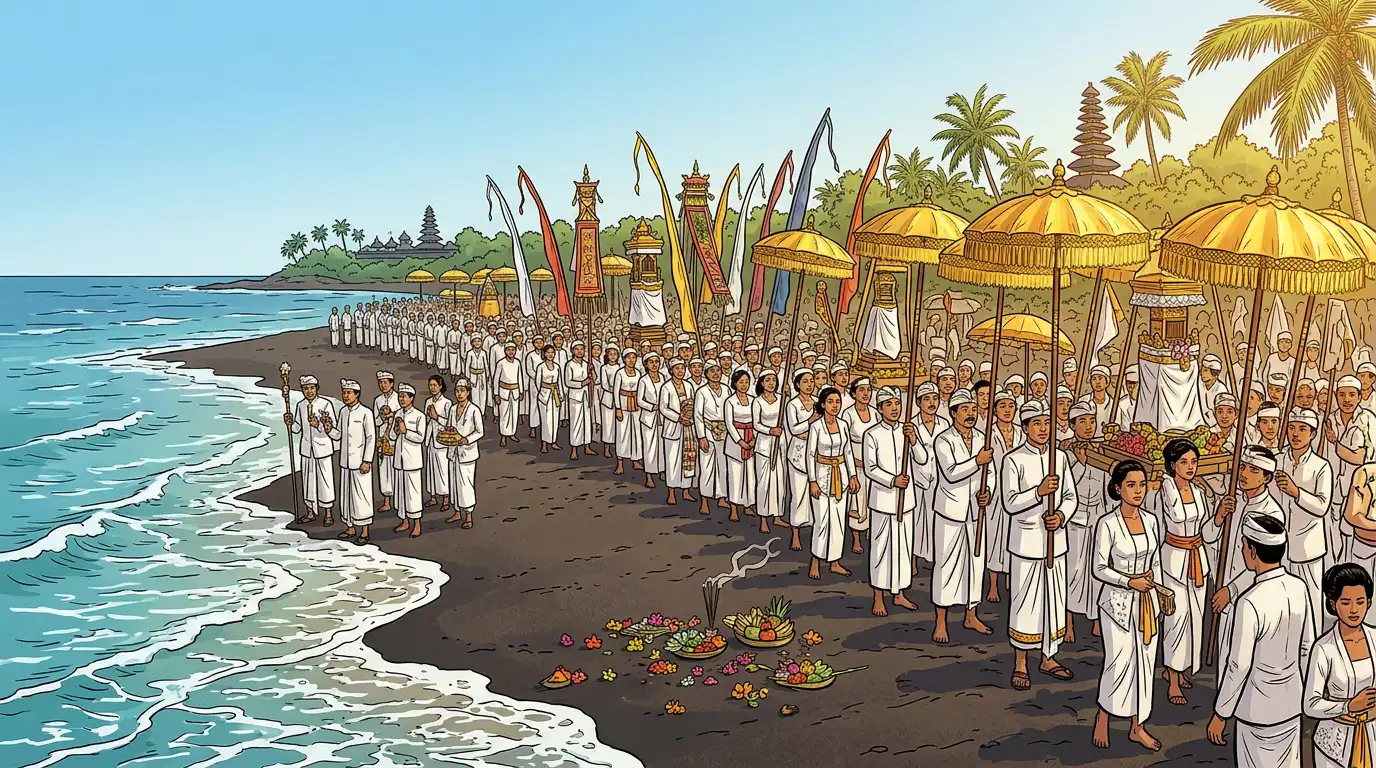
Three to four days before Nyepi Day, the ceremony of Melasti takes place. Villagers across the island dress in white and form long processions to the nearest beach, lake, or sacred spring. They carry pratima, sacred effigies and temple relics, to be symbolically cleansed in the water.
The purpose is straightforward: purify the soul and the sacred objects before the new year begins. Watching a Melasti procession is breathtaking. Hundreds, sometimes thousands of people walk in solemn lines through rice fields and down coastal roads, gamelan music ringing out, parasols and banners catching the equatorial sun. The beaches become carpets of white fabric and marigold offerings.
For visitors, Melasti provides an extraordinary photographic and cultural opportunity, and because it takes place on open roads and public beaches, respectful observation is welcomed.
Tawur Kesanga: The Great Offering
On the eve of Nyepi, known as Pengerupukan, the ritual of Tawur Kesanga takes place at major crossroads across the island. This is a large-scale exorcism ceremony intended to appease and expel evil spirits from the village.
Priests lead prayers and present elaborate offerings called caru, which can include everything from rice and flowers to, in the grandest ceremonies, a full sacrificial animal offering arranged in symbolic formations. The crossroads are chosen deliberately: in Balinese cosmology, intersections are where demons gather, making them the ideal place to confront and banish negative forces.
Ogoh-Ogoh Parade: Monsters in the Streets
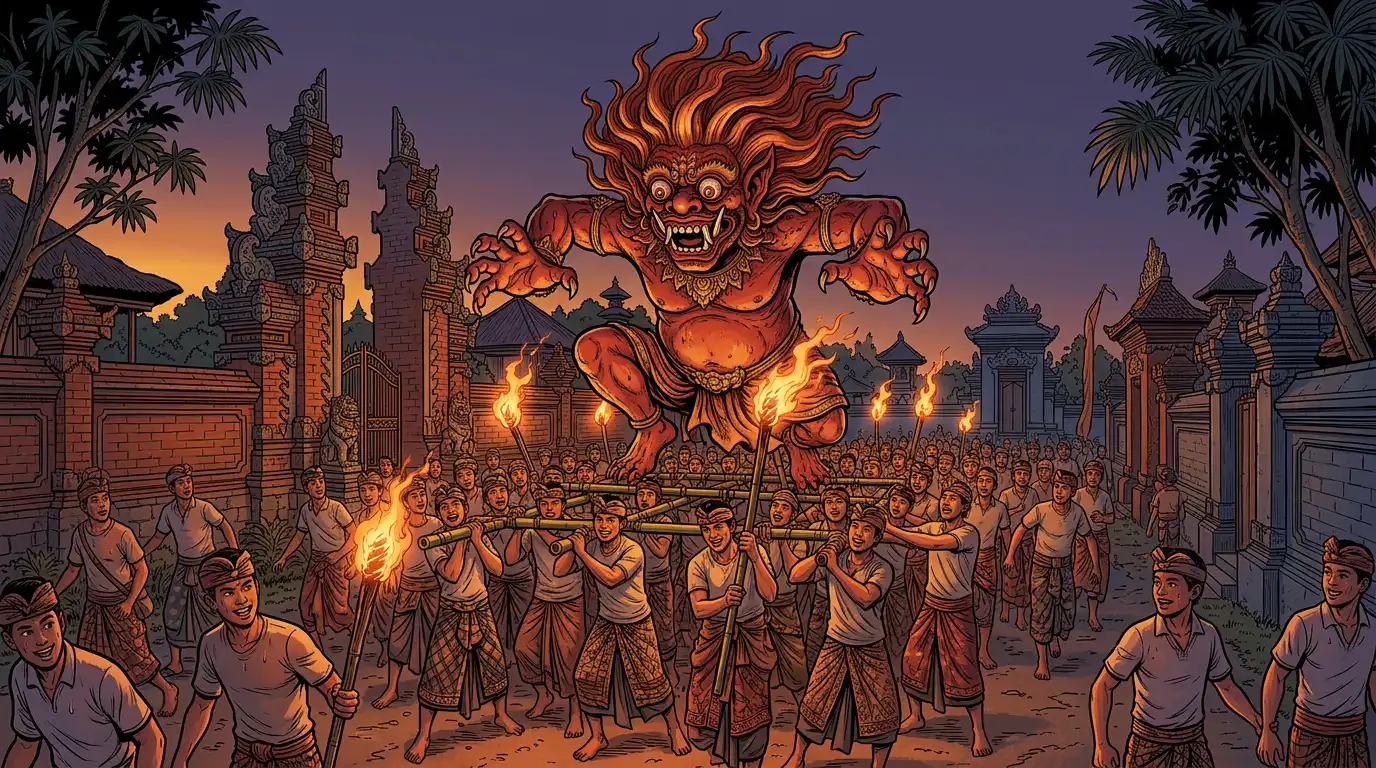
Without question, the most visually spectacular of all the Nyepi rituals is the Ogoh-Ogoh parade, held on the evening before Nyepi Day Bali falls silent. Ogoh-Ogoh are enormous papier-mâché and bamboo-framed statues depicting demons, mythological creatures, and malevolent spirits. They can stand three to five metres tall, with bulging eyes, fanged mouths, wild hair, and clawed hands, deliberately as terrifying as Balinese artists can make them.
Each banjar (community ward) spends weeks, sometimes months, designing and building their Ogoh-Ogoh. The construction process itself is a community affair, with teenagers and young men doing much of the physical work under the guidance of village elders and artists. Friendly rivalry between banjars drives the creativity higher each year, producing increasingly elaborate and technically ambitious creations.
When night falls on Pengerupukan, the Ogoh-Ogoh are hoisted onto bamboo platforms and carried through the streets by teams of young men, spun at intersections, tilted, and shaken in a deliberately chaotic procession accompanied by torch-bearing crowds, crashing cymbals, and deafening cheers. The noise and commotion serve a spiritual purpose: to attract the evil spirits and lure them into the Ogoh-Ogoh.
At the end of the parade, many of the statues are burned in a symbolic act of destroying the demons they represent. The fire consumes the evil, leaving the community spiritually clean and ready for the silence to come.
For spectators, the Ogoh-Ogoh parade is an unforgettable experience, part Mardi Gras, part Halloween, part sacred ritual. The main parades happen in Denpasar, Kuta, Ubud, and Seminyak, but almost every village on the island has its own procession. Smaller village events often feel more intimate and authentic, with the community spirit on full display.
Nyepi Day: 24 Hours of Complete Silence
After the fire and fury of the Ogoh-Ogoh, Bali wakes, or rather, does not wake, to the most extraordinary day of its calendar.
Nyepi Day begins at 6:00 AM and lasts a full 24 hours until 6:00 AM the following morning. During this period, four prohibitions, known as Catur Brata Penyepian, are observed across the entire island:
- Amati Geni — No fire or light. This includes electric lights, candles, and even phone or laptop screens (though enforcement of personal device use inside hotels has relaxed in recent years).
- Amati Karya — No work. All commercial activity ceases. Shops, restaurants, and businesses close without exception.
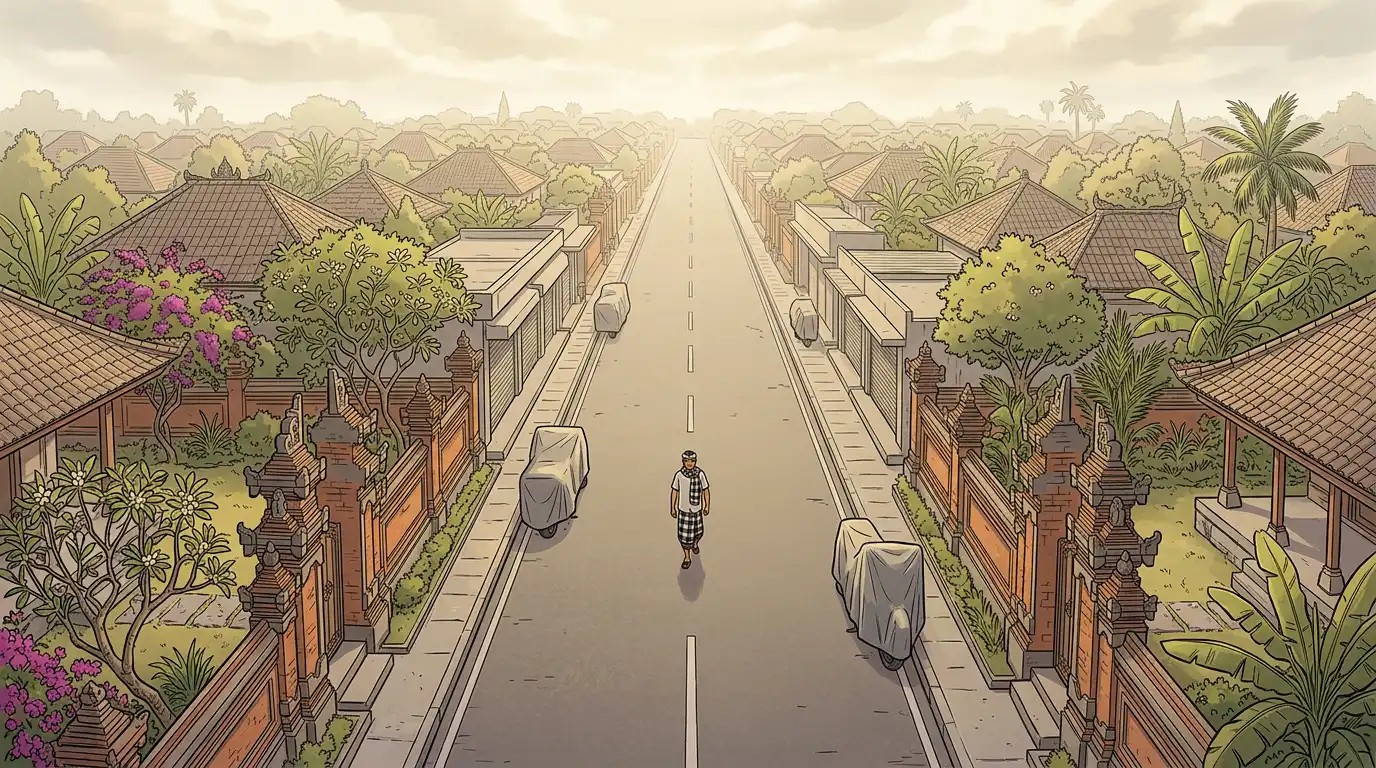
- Amati Lelungan — No travel. Nobody is permitted on the streets, roads, or beaches. This applies to everyone — Balinese, expats, and tourists alike.
- Amati Lelanguan — No entertainment or pleasure. No music, no television, no festivities.
The enforcement is real. Village security patrols called pecalang, traditional Balinese community guards, walk the streets to ensure compliance. They are identifiable by their black-and-white checked poleng scarves and carry a quiet authority. If you are found outside your accommodation, they will politely but firmly escort you back.
The Airport Closes
Perhaps the most striking proof of how seriously Bali takes Nyepi is this: Ngurah Rai International Airport, one of the busiest airports in Southeast Asia, handling over 20 million passengers a year, shuts down completely for 24 hours. No incoming or outgoing flights operate during Nyepi. Not a single plane takes off or lands.
This is the only airport in the world that closes annually for a religious observance. Airlines adjust their schedules weeks in advance, and any passenger booked on a flight during Nyepi is rerouted. If you are arriving or departing Bali around Nyepi, check your flight details carefully and build in a buffer day on either side.
What Stays Open
Despite the blanket shutdown, there are essential exceptions. Hospitals remain open and fully staffed throughout Nyepi Day, as do emergency services. Ambulances are permitted on the roads if needed, and anyone requiring urgent medical attention will receive it. Hotels continue to operate internally, kitchens prepare meals, housekeeping functions quietly, but guests are required to stay within the hotel grounds and keep lights dimmed or curtained.
What Nyepi Feels Like
Describing Nyepi to someone who has never experienced it is like trying to describe true darkness to someone who has always lived in a city. The absence of stimulus is so total that it becomes its own kind of experience.
By midmorning, the silence is absolute. No motorbikes, no construction, no barking dogs chasing delivery trucks, no temple music drifting over compound walls. The air, usually thick with exhaust and incense, tastes clean. Without light pollution, the night sky over Bali during Nyepi is staggering, the Milky Way stretches in an unbroken arc, stars emerge that you never knew existed, and the sheer canopy of the universe feels close enough to touch.
Many visitors who initially dread the enforced stillness describe it afterward as one of the most restorative experiences of their lives. There is something powerful about an entire society collectively agreeing to stop, be quiet, and look inward. It resets something that the relentless pace of modern life rarely allows.
For the Balinese people, Nyepi is a day of meditation, self-reflection, and fasting (though fasting is optional and many families prepare simple meals). It is a time to reflect on the year past, set intentions for the year ahead, and reconnect with the spiritual stillness at the centre of Balinese Hinduism.
The Day After Nyepi: Ngembak Geni
When 6:00 AM arrives and Nyepi officially ends, Bali does not simply snap back to life, it blooms. The day after Nyepi is called Ngembak Geni, and it is a joyous occasion. Families visit one another, ask for forgiveness for past wrongs, share meals, and celebrate the fresh start that the new year represents.
The streets fill with motorbikes and laughter, temples host morning prayers, and there is a palpable lightness in the air. Having spent 24 hours in enforced quiet, the return of everyday sound and motion feels like a gift. Many Balinese describe Ngembak Geni as the day they feel most grateful, for family, community, and the rhythms of life that they normally take for granted.
How Nyepi Affects Visitors
If you visit Bali during Nyepi, your experience will depend largely on your mindset and preparation. Here is what to expect:
Before Nyepi
The days leading up to Nyepi are vibrant and exciting. Melasti processions wind through towns, Ogoh-Ogoh statues appear at every street corner as communities put finishing touches on their creations, and the evening parades are electric. This is one of the best times to experience Balinese culture at its most expressive.
During Nyepi
You will be confined to your hotel or villa for 24 hours. You cannot go to the beach, visit restaurants, use the pool (in most cases, some resorts with fully enclosed pool areas make exceptions), or leave the property for any reason. Room service or in-house dining will be available, but expect a limited menu.
Most hotels ask guests to keep curtains drawn after dark to avoid light escaping. Wi-Fi typically remains available, and many visitors use the day to read, write, sleep, practise yoga, or simply decompress. Some upscale resorts organise special Nyepi wellness programmes, meditation sessions, or cultural talks to help guests engage with the spirit of the day.
After Nyepi
Life returns to normal quickly. By the afternoon of Ngembak Geni, shops and restaurants reopen, transport resumes, and the island is fully operational. The airport resumes flights from 6:00 AM.
Practical Tips for Experiencing Nyepi in Bali
Planning Your Trip
- Check the date. Nyepi follows the Balinese Saka calendar, so it shifts each year. Confirm the exact date before booking.
- Arrive early. The Ogoh-Ogoh parades the night before are not to be missed. Arrive at least two days before Nyepi to enjoy the full build-up.
- Book your flights carefully. Remember that Ngurah Rai International Airport closes for 24 hours. Do not book incoming or outgoing flights on Nyepi Day. Build a buffer day before and after.
Preparing for the Day
- Stock up. Buy snacks, water, books, and anything else you might want the day before. All shops close on Nyepi and most close early on the eve as well.
- Charge your devices. While you should respect the spirit of Nyepi, having a charged phone is practical for emergencies and quiet entertainment.
- Choose your accommodation wisely. Larger resorts tend to handle Nyepi better, with internal dining options and activities. If you are staying in a small guesthouse, ask in advance what arrangements they make.
During the Day
- Respect the silence. Even if you are not Hindu, you are a guest on the island during its most sacred day. Keep noise to a minimum, do not try to sneak outside, and draw your curtains at night.
- Embrace it. Disconnect from social media, put the laptop away, and let yourself experience genuine stillness. Read a book, journal, meditate, or simply sit and listen to the extraordinary quiet.
- Be prepared for emergencies. If you have a medical condition, ensure your hotel knows and that you have any necessary medications with you. Hospitals remain open, and emergency transport is permitted.
Nyepi and Scuba Diving: What Divers Need to Know
For anyone visiting Bali to dive, Nyepi requires some schedule adjustment. No dive operators run trips on Nyepi Day, boats stay moored and dive shops close like every other business. The day before Nyepi, many operators run a morning trip only and return early to allow staff to participate in the evening ceremonies.
The good news is that diving resumes immediately the day after Nyepi, and conditions are often excellent. The enforced 24-hour break means zero boat traffic across Bali's dive sites, giving marine life a brief but welcome respite. Anecdotally, many divemasters report that the first dives after Nyepi feel especially calm and productive, with marine life behaving as though the sea belongs entirely to them again.
If your dive itinerary is tight, simply plan around the day. Use Nyepi as a rest day, your body and your nitrogen levels will thank you, and hit the water fresh on Ngembak Geni.
The Deeper Meaning of Nyepi in a Modern World
In an age of perpetual connectivity, 24-hour news cycles, and the relentless pressure to be productive, Nyepi offers something radical: permission to stop. Not just individually, but collectively. The entire island agrees to be still at the same time, and in doing so, creates a space that no personal retreat or digital detox can replicate.
There is a growing interest globally in what Nyepi represents. Environmental scientists have noted measurable drops in air pollution and carbon emissions during the Bali Day of Silence. The enforced darkness reveals a night sky that modern Bali rarely sees. Sea turtles have been observed nesting on beaches they normally avoid due to light and noise. The island breathes.
For the Balinese people, none of this is surprising. The purpose of Nyepi has always been to restore balance, between humans and nature, between activity and rest, between noise and silence. That these benefits are now being quantified by science simply confirms what Balinese Hinduism has taught for over a millennium.
Nyepi Compared to Other Celebrations
Visitors sometimes compare Nyepi to other new year celebrations, but the differences are stark. Chinese New Year, Diwali, Western New Year's Eve, and Songkran in Thailand are all marked by noise, light, socialising, and outward celebration. Nyepi inverts all of it. The celebration happens in the days before, the exorcisms, the parades, the fire, and the new year itself is greeted with introspection and quiet.
This inversion makes the Nyepi festival unique not just in Indonesia but in the world. No other culture shuts down an entire island, grounds all flights, clears every road, and turns off every light to welcome a new year in darkness and silence. It is, in the most literal sense, a reset.
The Cultural Significance of Ogoh-Ogoh
While the Ogoh-Ogoh parade is the most visible and photogenic element of the pre-Nyepi festivities, its cultural importance goes far beyond spectacle. The tradition of building Ogoh-Ogoh in its current form is relatively modern, it gained widespread popularity in the 1980s, but it draws on centuries-old Balinese beliefs about the physical manifestation of evil.
Each Ogoh-Ogoh tells a story. Some depict characters from Hindu epics like the Ramayana and Mahabharata. Others represent contemporary social ills, corruption, environmental destruction, greed, given monstrous form. In recent years, some banjars have used their Ogoh-Ogoh to make pointed social commentary, blending tradition with modern relevance in a way that keeps the art form vital and evolving.
The construction process also serves an important social function. Young men who might otherwise drift apart are brought together for weeks of collaborative work, learning carpentry, sculpture, and painting from elders. The intergenerational transfer of skills and values that happens in an Ogoh-Ogoh workshop is as important to the community as the finished statue paraded through the streets.
Frequently Overlooked Details About Nyepi
- Pecalang have real authority. The traditional village guards who patrol during Nyepi are not ceremonial. They have the community-sanctioned power to enforce the prohibitions, and their instructions should be followed without argument.
- Not just for Hindus. While Nyepi is a sacred Hindu holiday, its observance is mandated island-wide regardless of religion. Bali's Muslim, Christian, and Buddhist communities also stay indoors and respect the silence.
- Births and deaths don't pause. Babies born on Nyepi are considered especially blessed. Funerals, however, are postponed until the following day.
- The internet stays on. Despite the restrictions on light and activity, internet service is not cut. Most visitors quietly browse their phones under blankets or behind blackout curtains.
- It only applies to Bali. Nyepi is a Balinese observance, not a national Indonesian holiday. The rest of Indonesia operates normally, and flights to other Indonesian destinations from non-Bali airports are unaffected.
Should You Visit Bali During Nyepi?
Absolutely, with preparation. Experiencing the full arc of Nyepi, from the Melasti processions through the Ogoh-Ogoh madness to the profound silence of the day itself and the joyful release of Ngembak Geni, is one of the most complete cultural experiences available to travellers anywhere.
The key is to plan for it rather than be surprised by it. Know the date, book your flights around the airport closure, stock your room with provisions, and approach the day with openness. What you receive in return is rare: a full day of genuine stillness on a tropical island, the most spectacular night sky you may ever see, and the knowledge that you participated, however briefly, in a tradition that has been renewing Bali for more than a thousand years.