
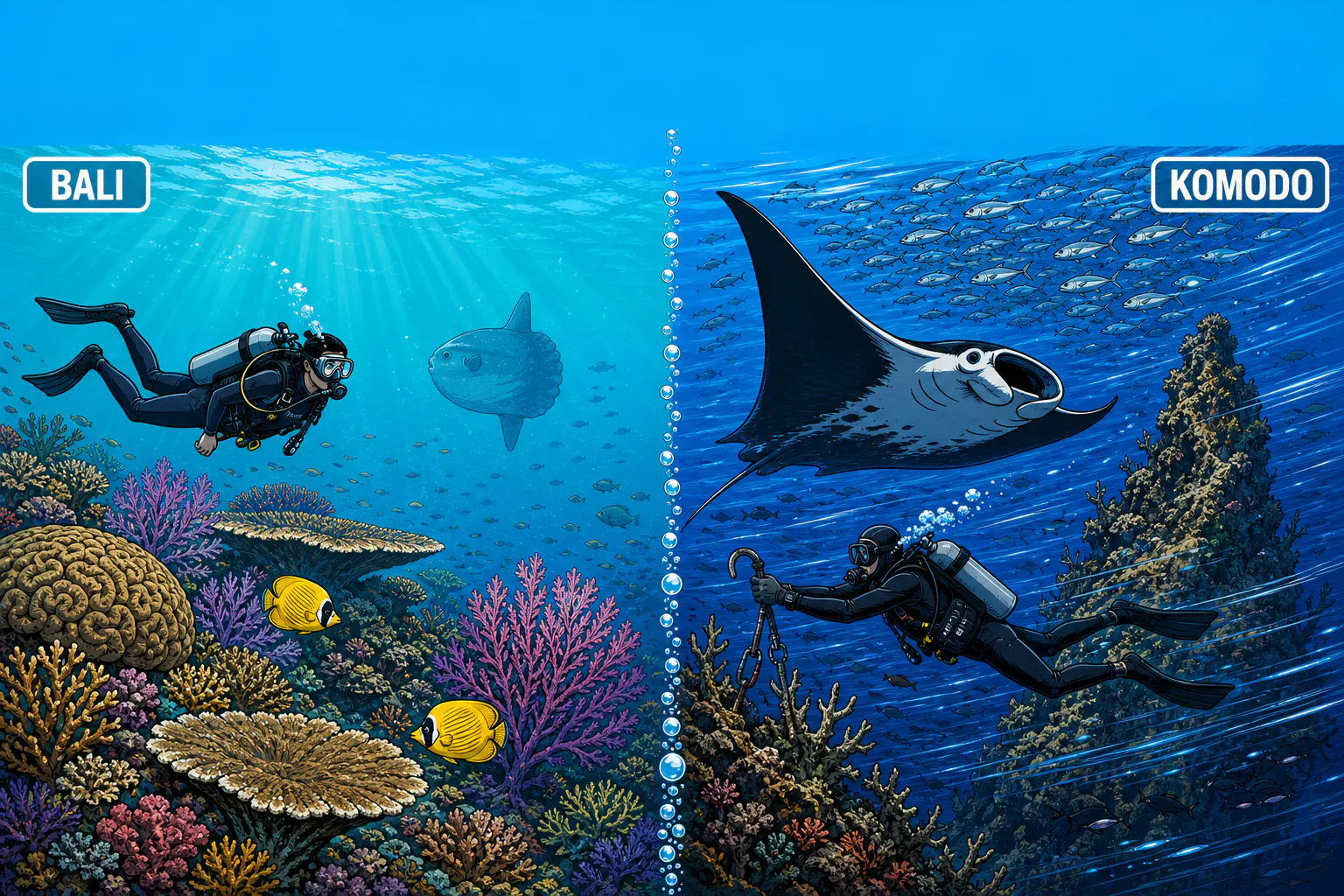
Komodo or Bali? It is one of the most common questions we get from divers planning an Indonesia trip, and most articles online answer it like a tourism brochure. We thought we would do it differently. We run dive operations in both regions, our boats sail in Komodo, our centre teaches in Bali, and the people writing this guide have logged thousands of dives across both. So this is the honest answer, written for divers who want to make a real decision, not just read a list of pretty adjectives.
Short version: Bali is the easier, cheaper, more flexible diving trip with surprising variety. Komodo is the wilder, more advanced, more expensive trip where you stack up "best dive of my life" moments faster than you can write them in your logbook. They are not really competitors. They are two very different chapters of the same Indonesian dive story, and the right answer for many divers is to read both.
This guide breaks down how they actually compare on marine life, conditions, logistics, money, seasons, and who each one suits. By the end you will know which one fits your trip, and probably also why you should be planning to do both at some point.
The TL;DR for divers in a hurry
If you only have 30 seconds:
- Pick Bali if you are new to diving, travelling with non-divers, on a tighter budget, want to certify, want variety beyond diving (food, culture, surf), or only have 4 to 6 days.
- Pick Komodo if you are an Advanced Open Water diver (or comfortable in current), have 7 days or more, your top priority is reliable big-animal encounters, and you want a full-immersion liveaboard experience.
- Pick both if you have 10+ days. Sequencing 4 to 5 days in Bali with a 4 to 7 night Komodo liveaboard is, in our experience, the single best diving holiday you can do in Indonesia.
The big differences at a glance
| Aspect | Bali | Komodo |
|---|---|---|
| Best for | Beginners, certifications, easy logistics | Experienced divers, big animals, drift diving |
| Trip style | Day trips from a hotel base | Liveaboard, or day trips from Labuan Bajo |
| Signature marine life | Mola mola, reef mantas, macro, healthy reefs, USS Liberty wreck | Mantas in numbers, reef sharks, schooling pelagics, dragons on land |
| Currents | Gentle at most sites, moderate to strong at Nusa Penida | Moderate to ripping, currents define the diving |
| Visibility | 15 to 25 m typical, up to 30 m on great days | 15 to 30 m typical, 5 to 10 m on the wrong tide at manta sites |
| Water temperature | 26 to 30 °C, can drop to 18 to 22 °C in mola season at Nusa Penida | 27 to 29 °C in warm months, 23 to 26 °C from June to September |
| Cost (5 dive days) | From IDR 12,600,000–27,000,000 (≈ 700–1500 USD) per person all in | From IDR 32,500,000–81,000,000 (≈ 1800–4500 USD) per person all in |
| Season | Year-round, peak April to October | March to November, peak July to September |
| Getting there | Direct international flights to Denpasar (DPS) | Bali transfer plus 1 hour flight to Labuan Bajo (LBJ) |
| Pace | 2 dives a day, real beds, real restaurants | 3 to 4 dives a day, life on a boat |
Marine life: what you actually see underwater
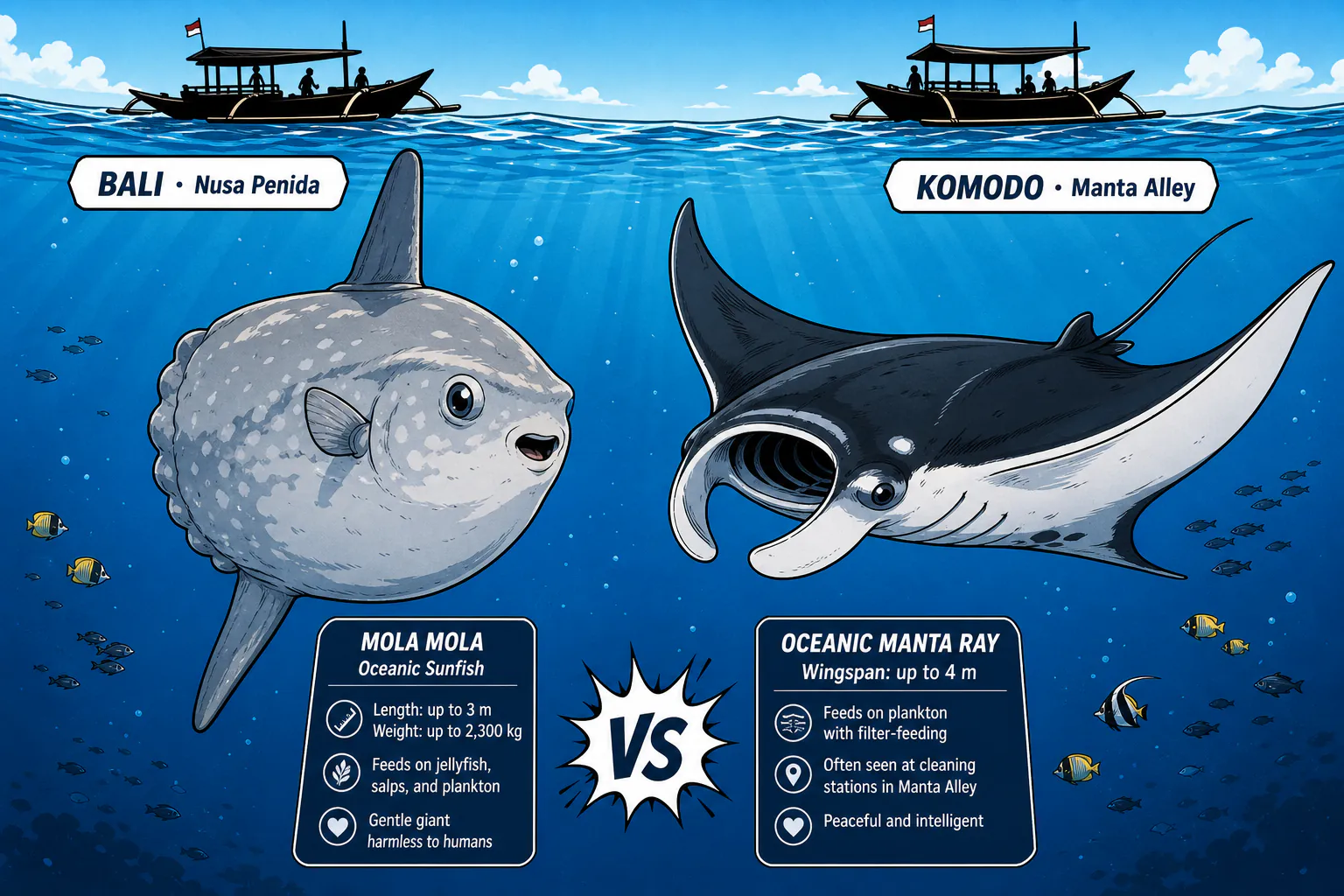
This is the section everyone reads first, so let us be specific. Indonesia sits inside the Coral Triangle, the most biodiverse stretch of ocean on the planet, and both Bali and Komodo are right in the middle of it. The difference is what the local conditions concentrate.
Bali, where you can see almost anything (in the right place)
Bali's diving is surprisingly varied because the island sits on the edge of two very different bodies of water. The north and east coasts (Tulamben, Amed, Menjangan) face calmer water and are coral and macro country. The southeast islands (Nusa Penida, Nusa Lembongan, Nusa Ceningan) are washed by cold Indian Ocean currents that bring in the big stuff.
The headline acts you actually have a good chance of seeing in Bali:
- Mola mola (the southern ocean sunfish, Mola alexandrini) at Nusa Penida from roughly July to October. We have written a full piece on timing it right in our mola mola Bali season guide.
- Reef manta rays at Manta Point in Nusa Penida, year-round, with most cleaning-station encounters between June and October.
- The USS Liberty wreck at Tulamben, a 120 m armed cargo ship sunk in 1942. It is a shore dive, accessible from 5 m to 30 m, and ideal for both Open Water divers and underwater photographers. Read our USS Liberty guide if you want the history and the dive plan.
- Macro paradise at Seraya Secrets, Amed, and Padang Bai: pygmy seahorses, harlequin shrimp, ribbon eels, mimic octopus, and around 200 species of nudibranch.
- Hawksbill and green turtles, almost daily encounters at Nusa Penida, Menjangan, and Tulamben.
- Bumphead parrotfish at sunrise dives at Tulamben in season, a noisy and unforgettable spectacle.
What Bali does not really deliver, in honest terms, is the constant pelagic action you get further east. You will see reef sharks occasionally, but you are not going to spend a whole dive watching a stream of grey reefs cruise past. For that, you board a plane.
Komodo, where the big animals are the baseline
Komodo's diving is famous for one main reason: the volume of marine life. The strong tidal currents that rip through the channels between Komodo, Rinca, Padar, and the smaller islands pump nutrients up from deep water, which feeds plankton, which feeds everything else. The result is a food chain that is not just present, it is loud.
Realistic Komodo highlights:
- Reef mantas, often in numbers. The cleaning stations at Manta Point, Mawan, and Karang Makassar regularly produce sightings of 5 to 20+ mantas in a single dive during peak season. A serious answer to the common question "are manta rays dangerous?" is "no, and after Komodo you will love them".
- Castle Rock and Crystal Rock, two submerged pinnacles in the north of the park. Expect swirling schools of jacks and fusiliers, dogtooth tuna, white-tip and grey reef sharks, eagle rays, and the occasional napoleon wrasse. These are advanced sites where reef hooks are standard kit.
- Batu Bolong, a tiny coral-encrusted pinnacle in the middle of a strait. The coral cover is some of the most pristine in Indonesia.
- The Cauldron (Shotgun), a drift dive through a narrow channel where you ride the current at full speed through a bowl-shaped seamount. It is exhilarating, slightly daft, and immensely fun.
- Cannibal Rock and Yellow Wall in the south, technicolour soft coral walls that are arguably the prettiest single-frame underwater landscapes in the country.
- The dragons on land. Komodo dragons, the largest lizards on earth, on Rinca and Komodo Islands. Most liveaboard itineraries include a short ranger-led hike to see them.
You will see all of this in a single 7-night trip if you go in season. Not "if you are lucky", just "if the weather behaves".
Conditions: currents, visibility, temperature, difficulty
Currents
This is the single biggest practical difference between the two destinations.
Bali has gentle conditions at most sites. Tulamben, Amed, Menjangan, and the Sanur shore are typically still or slow drift. Nusa Penida is the exception: Manta Point can be moderate, Crystal Bay can throw thermoclines and surge, and Blue Corner is a serious advanced drift that we only run with experienced divers and the right tide table.
Komodo is defined by current. Sites can switch from glass-flat to washing-machine within an hour as the tide turns, and the briefings on a Komodo dive boat are noticeably longer and more serious than the ones in Sanur. Reef hooks, surface marker buoys (SMBs), and an honest assessment of your gas consumption are all part of the standard kit. Most of the famous sites are advanced, and your guide will likely refuse to dive them if you do not have the experience.
Visibility
Bali typically gives you 15 to 25 m. The dry season (April to October) is the best window for water clarity, while the rainy season (November to March) can drop nearshore visibility to 8 to 12 m at a few sites, mostly the river-mouth dives. Nusa Penida is usually clearer than mainland sites.
Komodo gives you 15 to 30 m on most days at most sites. The exception is Karang Makassar and the other northern manta cleaning stations, which can drop to 5 to 10 m on the wrong tide because they sit in plankton-rich green water. That is, of course, exactly why the mantas are there feeding, so it is a fair trade.
Water temperature
Bali sits between 28 and 30 °C in the wet season and 26 to 28 °C in the dry. The Nusa Penida mola season (July to October) brings cold thermoclines down to 18 to 22 °C in the deeper parts of Crystal Bay and along the southern wall. A 5 mm full suit with a hooded vest is not overkill, it is sensible.
Komodo is 27 to 29 °C in the warm months (October to May), and a chillier 23 to 26 °C from June to September when southern upwellings drop the temperature. A 3 mm suit is fine for the north, a 5 mm for the south, and most liveaboards stock both.
Difficulty
Bali has something for every level. Open Water divers can comfortably enjoy 80 percent of the available sites with a guide. Try dives, refreshers, and full Open Water courses are easy to book at short notice.
Komodo has plenty of mellow sites (Siaba Besar, Tatawa Kecil, Mawan in slack tide) that are fine for Open Water divers. But the famous sites that put Komodo on the dive map (Castle Rock, Crystal Rock, Cauldron, Manta Alley, Cannibal Rock) are firmly advanced. As a rule we recommend at least 30 logged dives, Advanced Open Water certification, and recent diving experience before booking a Komodo liveaboard. Komodo is not where you want to do dive 11.
Logistics: getting there and getting around
Getting there
Bali has direct international flights from most major hubs into Denpasar (DPS). From the airport you can be in your dive hotel within 30 minutes (Sanur, Seminyak) to 3 hours (Tulamben, Menjangan). If you are arriving from outside ASEAN, double-check the Bali e-Visa requirements for 2026 before you fly. From a logistical standpoint, Bali is one of the easiest dive destinations on earth.
Komodo requires an extra hop. Almost everyone flies into Bali first, spends a night in or near Denpasar or Sanur, and then takes one of the 5 to 7 daily 1-hour flights from DPS to Labuan Bajo (LBJ) on Flores. From Labuan Bajo, you either walk to the harbour and board your liveaboard, or you check into a hotel and dive on day boats from there.
Day trips vs liveaboard

Bali is built for day-trip diving. You stay in a hotel in Sanur, Padang Bai, Amed, or Tulamben. A van or boat picks you up in the morning, takes you to 2 (sometimes 3) dives, and drops you back for lunch. Evenings are yours, in real restaurants, with real cocktails, and a real bed that is not rocking on a swell. If you have a non-diving partner this matters enormously. They can do a yoga class or a temple tour while you dive, and you all meet for dinner.
Komodo can be done as day trips from Labuan Bajo, and our local team runs them. Day-trip diving covers the central park reliably (Batu Bolong, Manta Point, Tatawa Besar, Siaba Besar) and is the cheapest way to sample Komodo. But the best sites of all, particularly Manta Alley, Cannibal Rock, and the whole southern section, are simply too far from Labuan Bajo for day boats to reach. To dive Komodo properly, you need a liveaboard.
A Komodo liveaboard trip runs from 3 to 12 nights. You eat, sleep, and dive on the boat, you do 3 to 4 dives a day, and you watch the sun set over Padar Island from the upper deck with a beer in hand. We run two of our own boats: the King Neptune for excellent value, and the Komodo Sea Dragon for premium comfort. Our full Indonesia liveaboard page lists all current itineraries.
How much does it actually cost?
This is the question we wish more guides answered honestly. So here are the real numbers we see at our centres in 2026.
Bali pricing in 2026
- Single dive with guide, tank, weights, and transport: IDR 900,000–1,350,000 (≈ 50–75 USD)
- Two-dive Nusa Penida day trip: IDR 2,350,000–3,250,000 (≈ 130–180 USD)
- Three-dive Amed or Tulamben day: IDR 2,350,000–2,900,000 (≈ 130–160 USD)
- Open Water course (3 to 4 days, all included): IDR 8,600,000–10,400,000 (≈ 480–580 USD)
- Advanced Open Water course (2 days): IDR 6,500,000–7,900,000 (≈ 360–440 USD)
- Full equipment rental: IDR 360,000–550,000 (≈ 20–30 USD) per day
- Budget hotel: IDR 450,000–700,000 (≈ 25–40 USD) per night
- Mid-range hotel near the dive sites: IDR 1,100,000–1,800,000 (≈ 60–100 USD) per night
A realistic 7-night Bali diving holiday (hotel, 5 dive days with 11 dives, gear rental, meals, airport transfers, local transport) lands somewhere between IDR 19,800,000 (≈ 1100 USD) and IDR 30,500,000 (≈ 1700 USD) per person, sharing a twin room. We have a more detailed cost breakdown in our scuba diving Bali price guide and on our Bali dive pricing page.
Komodo pricing in 2026
- Day-trip diving from Labuan Bajo (2 to 3 dives): IDR 2,350,000–3,250,000 (≈ 130–180 USD) per person
- Budget liveaboard, 3 to 4 nights: IDR 16,200,000–27,000,000 (≈ 900–1500 USD) per person
- Mid-range liveaboard, 6 to 7 nights: IDR 32,500,000–50,500,000 (≈ 1800–2800 USD) per person
- Premium liveaboard, 7 to 10 nights: IDR 54,000,000–81,000,000 (≈ 3000–4500 USD)+ per person
- Flight DPS to LBJ return: IDR 2,900,000–5,400,000 (≈ 160–300 USD) per person
- One night in Labuan Bajo before or after the trip: IDR 900,000–2,150,000 (≈ 50–120 USD) per night
A typical 7-night Komodo liveaboard trip starting from Bali costs IDR 45,000,000–81,000,000 (≈ 2500–4500 USD) per person, all in. So as a rough rule of thumb, Komodo is 2 to 3 times the cost of an equivalent number of Bali dive days. You also get more dives per day, included food and accommodation, more remote sites, and a fundamentally different (and slightly addictive) lifestyle for the duration of the trip.
The best time to dive each
Bali, year-round with a sweet spot
Bali is technically a year-round destination. The dry season (April to October) is the safest bet for visibility, surface conditions, and dive site access. Mola mola sightings peak July to October at Nusa Penida. Reef mantas appear at Manta Point all year, with the most reliable cleaning-station activity from June to October.
The rainy season (November to March) is genuinely fine for diving most of the time, especially around Nusa Penida and the east coast. You just need to be flexible with site choice and build a backup activity day into your itinerary in case of a bad weather window. Our Bali rainy season guide goes into detail on what to expect.
Komodo, March to November
The Komodo dive season is March to November. The absolute peak is July to September, which is also the best window for big-animal congregations and the coldest water. Shoulder months (April to June and October) are warmer, the crossings are calmer, and the boats are quieter, which is why a lot of repeat divers actually prefer them.
From December to February the weather turns. Crossings get rougher, and most premium liveaboards reposition out of Komodo entirely to Raja Ampat or the Banda Sea. Some day-trip operators in Labuan Bajo run year-round, but with significant weather-cancellation risk. As a rule, do not plan a serious Komodo trip in January.
Who should choose Bali
Pick Bali if you tick one or more of these boxes:
- You are a first-time diver, or you want to do an Open Water course on holiday.
- You are travelling with non-divers and need a destination that works for everyone.
- You have less than 7 days, or you have a flexible schedule with short notice.
- You want a real holiday with food, culture, beaches, and surfing on top of the diving.
- You are on a tighter budget but still want world-class marine life.
- You are chasing the mola mola or a specific seasonal animal, and timing is your top priority.
- You love macro photography or wreck diving (the USS Liberty alone is worth the trip).
- You sleep better in a bed that does not rock.
Most divers who come to Indonesia for the first time end up in Bali, and almost all of them have a brilliant time. If you want a wider sampler of where to dive on the island, our list of the best places to scuba dive in Bali is a good starting point, and our Nusa Penida diving guide is the one most people read second.
Who should choose Komodo
Pick Komodo if most of these are true:
- You are Advanced Open Water certified (or comfortable in current with 30+ logged dives).
- Your top priority is reliable encounters with big stuff, especially mantas, sharks, and schooling pelagics.
- You actively enjoy drift diving, and a brisk current does not stress you out.
- You have 7 days or more, and you can commit to a single block of dive-focused time.
- You like the idea of switching off completely on a boat, with no daily logistics or town errands.
- You are a photographer chasing wide-angle pelagic action.
- You have the budget for a liveaboard, or at least a longer day-trip stay.
- You want to see Komodo dragons, hike Padar Island, and watch sunrise from a deck in the middle of a marine park.
If you fit that profile, almost nothing in Indonesia tops a well-run Komodo liveaboard. Our Komodo island diving overview and the Castle Rock, Batu Bolong, and Manta Point site pages will give you a feel for what is actually on the dive plan.
The honest answer for most divers: do both
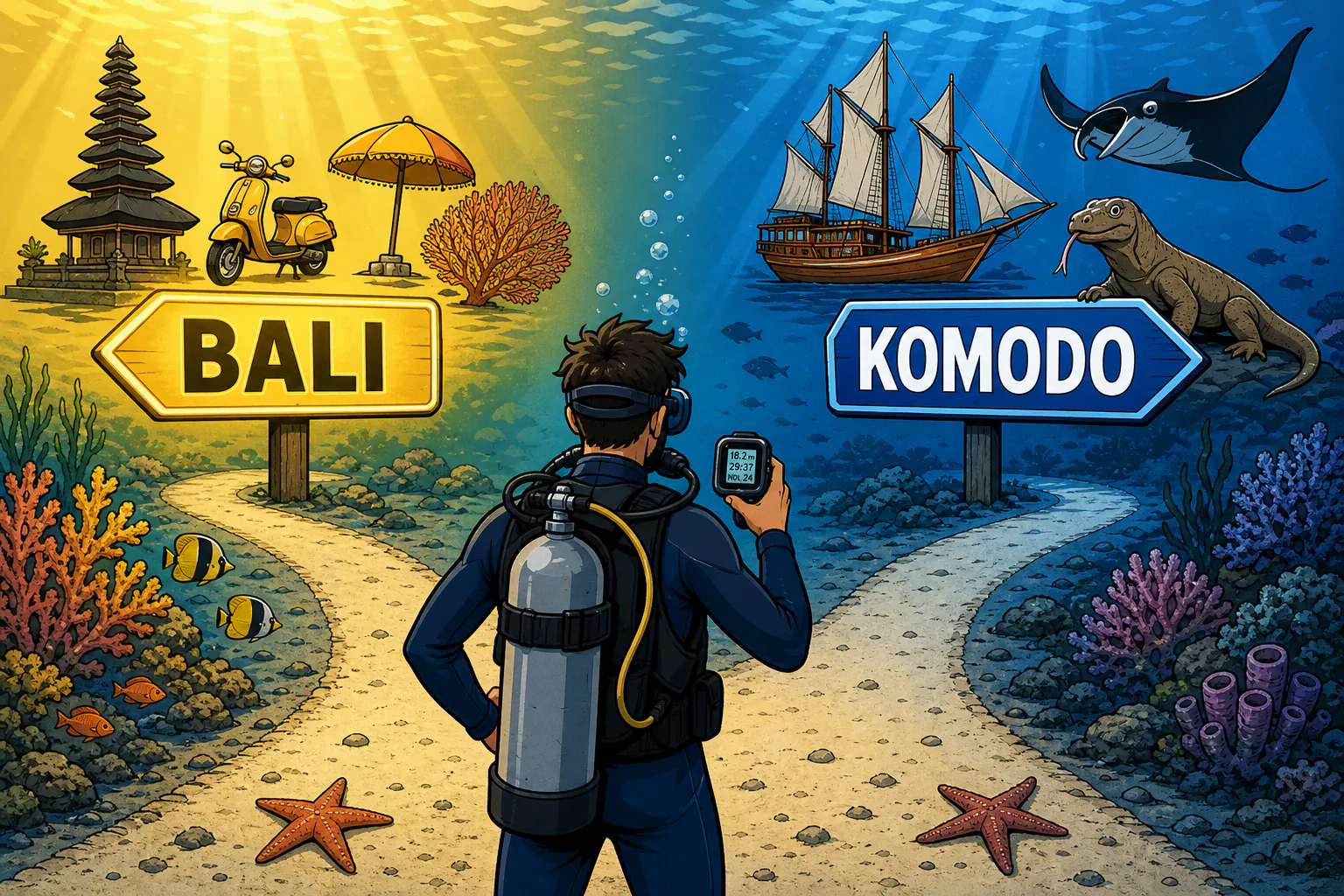
Now we get to the recommendation we give most of our guests when they ask this question on the boat. If you have 10 or more days of holiday, please do not try to pick one. Do both. They complement each other so well that doing just one feels like reading half a book.
Here is why the combination works so well in practice. Bali gives you a soft landing: easy logistics, gentle reefs to shake the rust off, and time to recondition your ears and skills. Then you fly an hour east to Komodo, where you spend a week on a boat doing 3 to 4 dives a day at world-class big-animal sites, eating great food, and not thinking about anything else. You end the trip with a couple of nights back in Bali for a beach, a massage, and a flight home that does not feel like a punishment.
The classic 12-day itinerary
This is the trip we plan most often for clients who want the full Indonesia experience:
- Day 1: Arrive Denpasar, transfer to Sanur, refresher dive in the afternoon if needed.
- Days 2 to 5: Bali base (Sanur or Padang Bai). Two days of Nusa Penida (Manta Point, Crystal Bay, Toyapakeh, Blue Corner if you are advanced), two days of east-coast diving (USS Liberty wreck, Seraya macro, optional Menjangan).
- Day 6: Morning flight DPS to LBJ. Board liveaboard in the afternoon, check dive, sunset briefing.
- Days 7 to 11: 5 nights on a Komodo liveaboard, hitting Castle Rock, Crystal Rock, Batu Bolong, Tatawa, Manta Alley, Cauldron, Padar viewpoint hike, and the Komodo dragons.
- Day 12: Return liveaboard to LBJ in the morning, fly back to DPS, last night in Sanur or Seminyak.
- Day 13: Departure.
The 10-day fast version
If you only have 10 days, this also works:
- Days 1 to 3: Sanur base, 2 days Nusa Penida + 1 day USS Liberty.
- Day 4: Fly to LBJ, board boat.
- Days 5 to 8: 4-night Komodo liveaboard covering the central and northern park.
- Day 9: Fly back to Bali, buffer day in Sanur or Seminyak.
- Day 10: Departure.
Both itineraries combine our Bali scuba diving service with our Komodo tour from Bali bridge package. We can put the whole thing together for you, including domestic flights and Labuan Bajo hotel, on a single booking, which most divers find significantly easier than buying the pieces separately.
Final word from the boat
If you read this far and you are still on the fence, here is the practical filter we use when guests ask us face to face. How many dives do you have, what is your budget, and how many days are you planning?
Under 20 dives, under IDR 27,000,000 (≈ 1500 USD), under 7 days: Bali. No question.
30+ dives, IDR 45,000,000 (≈ 2500 USD)+, 7+ days, big animals are your priority: Komodo liveaboard, ideally between April and October.
10+ days and you can stretch the budget: do both, in that order (Bali first, Komodo second), and tell us when you are coming so we can save you a spot on the boat. The diving in this part of the world genuinely is the best on the planet, and you only really get to see why once you have stood at the rail of a Komodo liveaboard watching the sun go down behind Padar, the day after you spent the morning with a mola mola at Crystal Bay. That trip is a real thing, we run it every month, and it is the trip that turns casual divers into serious ones.
If you want help shaping yours, drop us a message. We will not sell you the trip you do not want, we will sell you the trip you should actually be doing.