
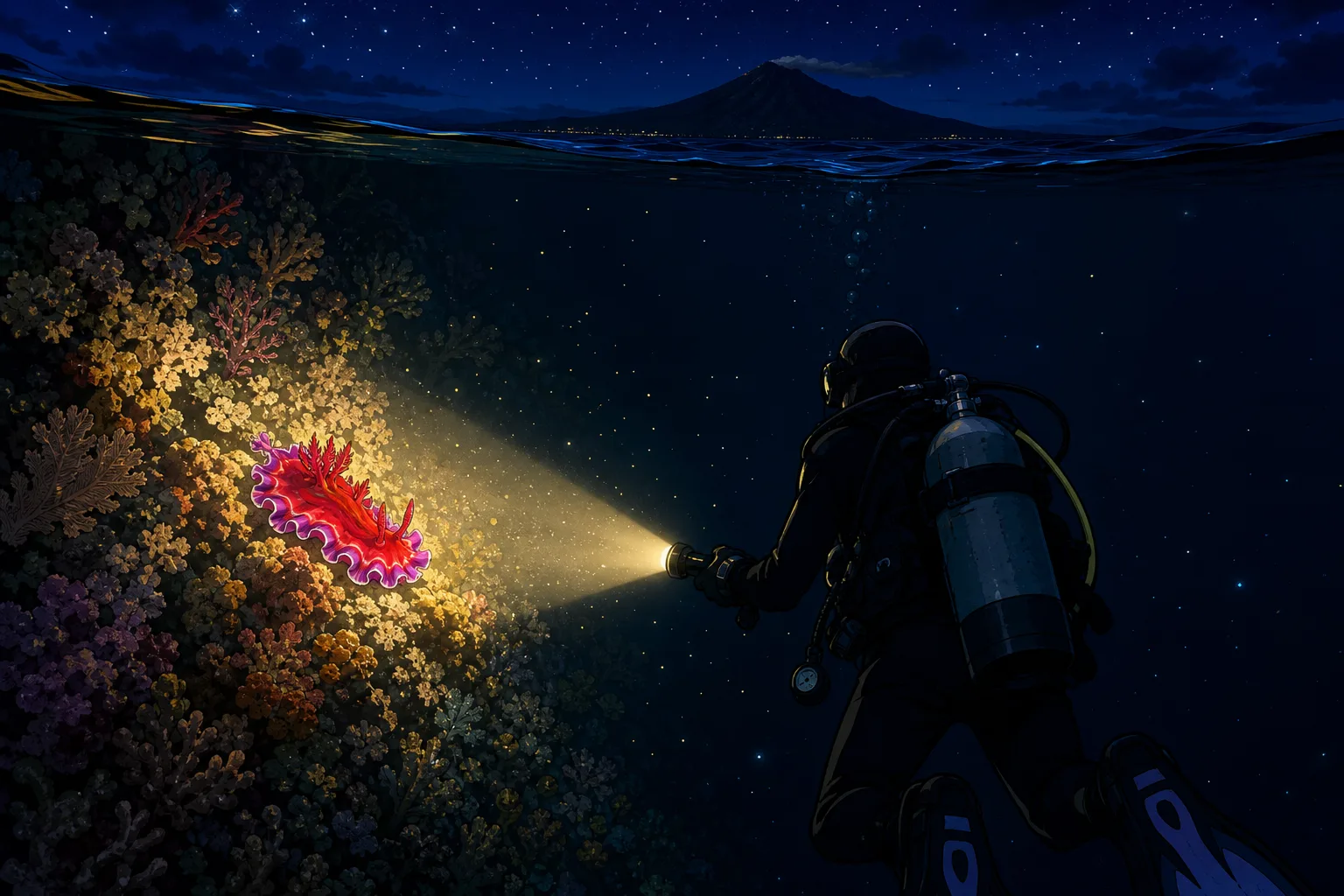
The first night dive most people remember is not the marine life. It is the moment they switch their torch off, hover ten metres under, and realise the dark is not actually dark. There is a faint blue glow from the surface, sparks of plankton at every hand wave, and the suddenly enormous sound of their own breathing. Then they switch the torch back on, the reef explodes into colour, and they spend the next forty minutes grinning around a regulator. That is the moment we sell every time someone signs up for the PADI Night Diver specialty at our Sanur dive centre, and it is why we keep running these dives even when the boat schedule is already full of fun day dives.
This guide is the version we wish every guest had read before walking into the shop. It comes from a working Sanur operator that runs roughly 180 to 220 night dives per year, mostly off Tulamben, Padang Bai, Amed and our own house reef in Sanur. We will tell you which sites are worth the petrol money, which marine life genuinely shows up after dark (versus what brochures promise), what gear we hand out for free and what you should pack yourself, how the PADI Night Diver speciality course works in practice, and the honest cancellation rate when the wind is up. No glossy brochure phrasing. If a site is overrated we say so.
Why Night Diving in Bali Is Worth the Hassle
Night diving is more work than a day dive. You arrive at the shop later, you wait for full dark before splash, you fiddle with torch lanyards in the dark, and you usually drive home around 21:30 with damp hair. That is the honest cost side. The benefit side is that you see a different reef. About 70 percent of reef fish behaviour happens at dawn, dusk or in the first three hours of full darkness. Day divers miss almost all of it. We have repeat guests who book a PADI Advanced Open Water course with us specifically because the adventure dive on day two is a night dive, and they want it as part of a structured progression.
The other reason it works so well in Bali is geography. Most of our best sites are shore dives entered from a calm beach, in 27 to 29 degree water, with a maximum depth that almost never exceeds 18 metres. That combination, easy entry, warm water and shallow profiles, takes a lot of the stress out of diving in the dark. Compare that with a night dive off the Pembrokeshire coast in 11 degree water and a six metre rib ride home. Bali makes the experience accessible to anyone with an Open Water certification and twenty logged dives.
One more thing worth saying out loud: night diving rewards patience. The first ten minutes you will see almost nothing, because the fish are still adjusting to your torch and you are still adjusting to your own narrowed field of view. We tell every guest at the briefing, if you have nothing exciting in fifteen minutes, do not panic, keep finning slowly, the reef is just waking up around you. By minute twenty the show usually starts.
What You Will Actually See After Dark
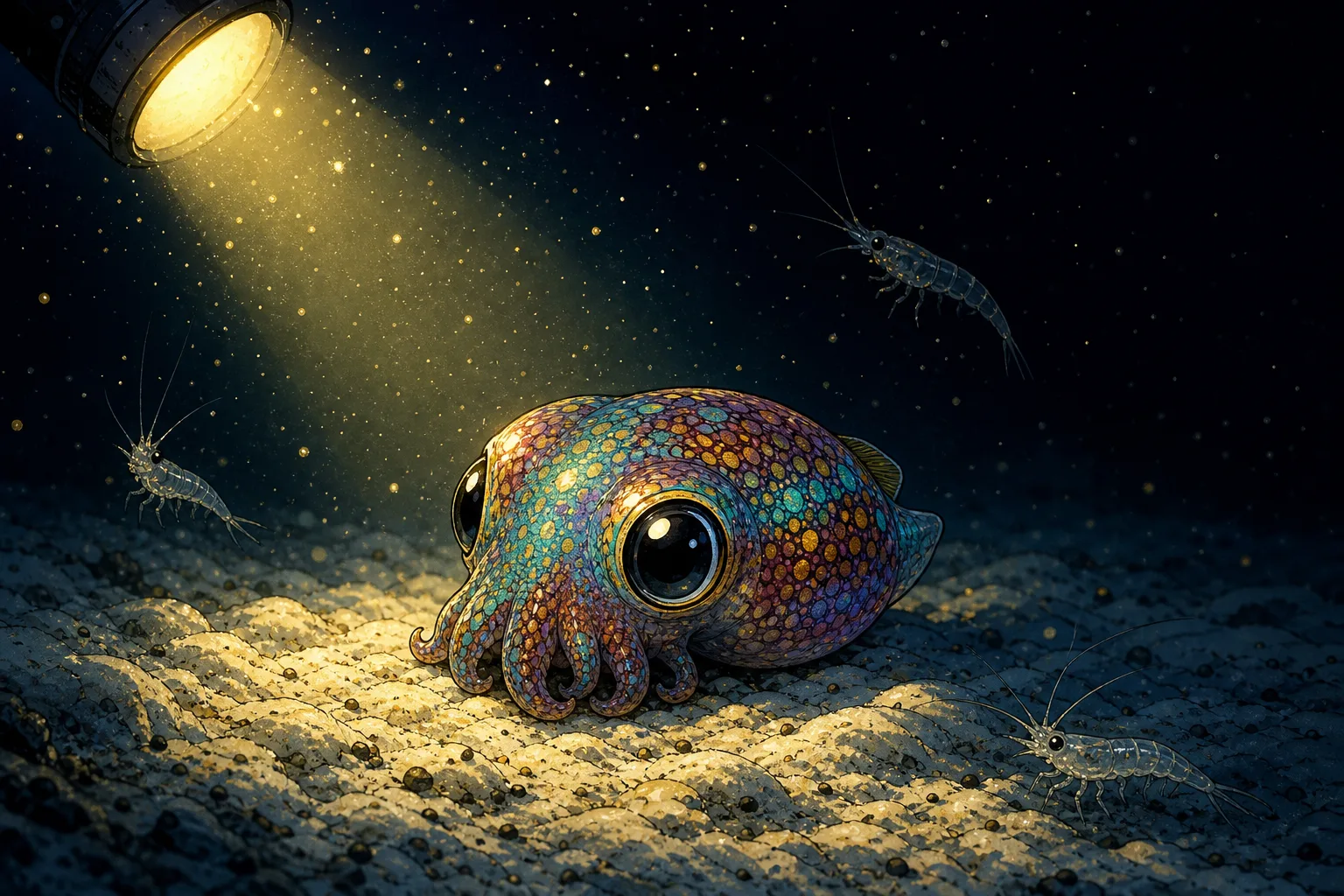
The Bali reef at night is a different cast of characters. The bright reef fish you spend a daytime dive photographing, butterflyfish, anthias, fusiliers, are mostly asleep or hiding. In their place come the night shift: hunting moray eels out cruising for sleeping prey, decorator crabs walking around the sand in their borrowed sponge hats, and the species we get asked about most, the Spanish dancer nudibranch. These are big, sometimes 30 centimetres long, deep red and they actually swim by undulating their mantle. You can watch one swim for two or three minutes if you keep your light off the body and only the edge.
The macro side is what most photographers come for. We see bobtail squid on the sand at Seraya Secrets almost every dive, tiny things the size of a thumb, with iridescent skin patterns that no day dive ever shows you because they bury themselves at sunrise. Bobbit worms, ambush predators that live in burrows in the sand, sometimes show themselves between 19:30 and 21:00, jaws open ready to grab a passing fish. Octopus are out hunting in the open instead of squeezed into a hole. There is more variety of nudibranchs at night than during the day, and they are easier to find because they move slowly across coral.
The big fish surprises happen at Tulamben specifically. Sleeping bumphead parrotfish lie nose-to-tail along the USAT Liberty wreck like a row of grey pillows, and you can hover thirty centimetres from one without it stirring. We tell guests, look but do not touch, no flash on the eye, because hammering them with strobe ruins their rest and irritates other divers behind you. Bigger fish like Napoleon wrasse and the resident green turtles occasionally swim past, and once or twice per season we get the bioluminescent plankton showing well enough that switching off your torch produces visible sparkles on every hand movement. It is worth doing at least twice every night dive.
One thing we will not promise: mantas. The Nusa Penida manta ray cleaning stations are day dives only because the boats stop running at sunset and the current at Manta Point makes night ops genuinely unsafe. If someone offers you a manta night dive in Bali, that is not us, and we have questions about the operator. If you want a manta day trip from Sanur as part of the same Bali trip, see our Nusa Penida day trip guide.
Bali's Six Best Night Dive Sites
We rate sites by three things: how reliably the marine life shows up, how easy the night entry and exit is, and how often we can actually run it in a given week. Here are the six we book regularly. We have ordered them rough best-to-still-good.
1. USAT Liberty wreck, Tulamben
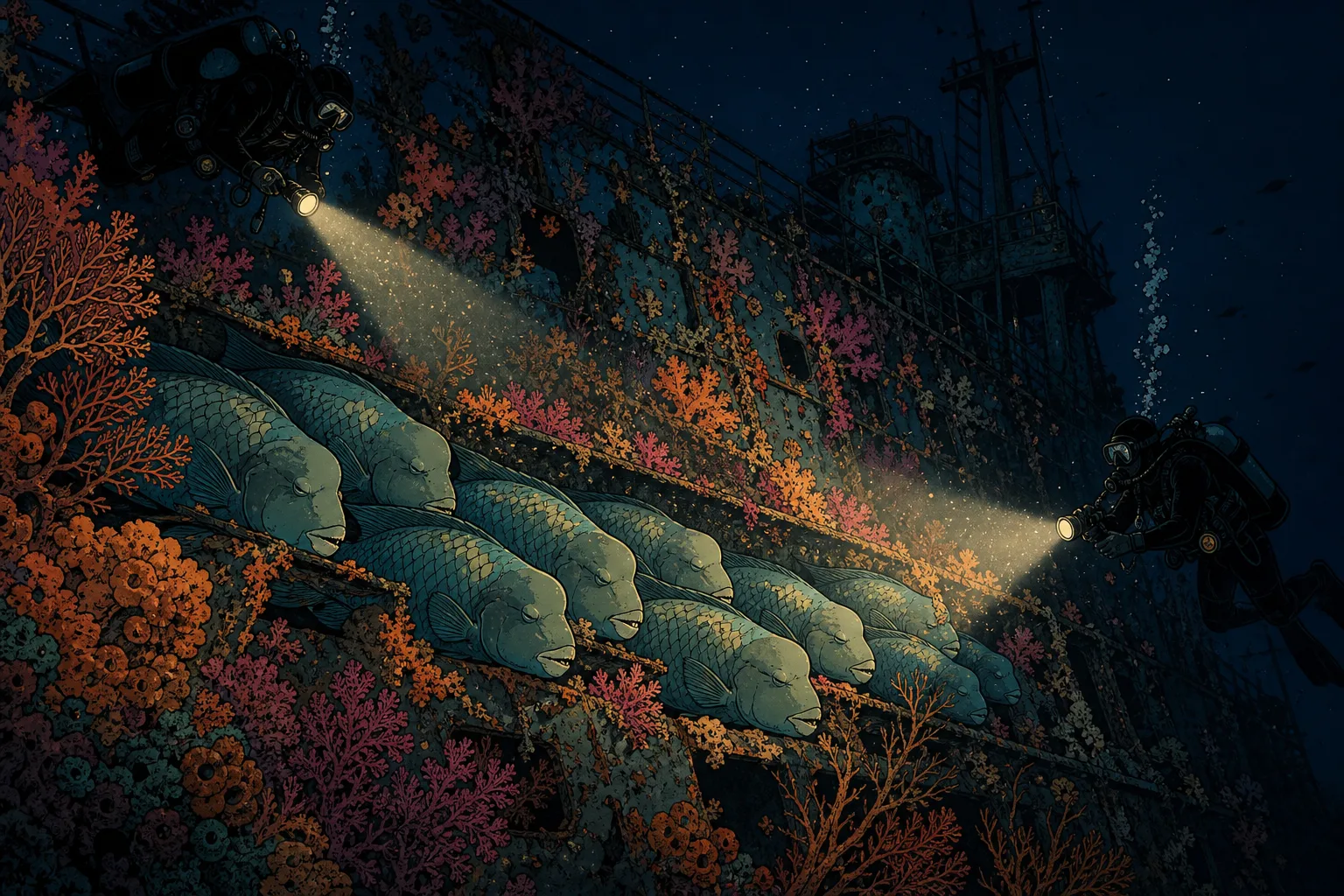
This is the famous one. The USAT Liberty shipwreck at Tulamben is a 120 metre cargo ship lying parallel to the beach in 5 to 30 metres of water. Direct beach entry from the black sand, almost no current, and a structure already encrusted with thirty plus years of coral growth that goes a little crazy when lit by torch. Bumphead parrotfish sleep on the deck at night, around 30 to 50 of them, and they are the headline. Add in basket stars opening out across the railings, slipper lobsters out walking, and the regular suite of nudibranchs, hunting morays and the occasional white-tip reef shark patrolling at depth. We run this site as a half-day trip from Sanur, two dives, with the second dive after dark. If you want the long version, read our dedicated USAT Liberty wreck guide, or you can pair it with our PADI Wreck Diver specialty course which uses this same wreck for the four certification dives.
2. Seraya Secrets, near Tulamben
If macro and muck diving is your thing, Seraya is the better choice than the Liberty. Seven minute drive south of Tulamben, black sand slope from 5 to 25 metres, almost zero structure but a constant supply of weird stuff. We log harlequin shrimp, hairy frogfish, bobtail squid, mototi octopus, juvenile painted frogfish and roughly eight species of nudibranch every dive. The night version cranks the strangeness up further: the bobbit worms come out, you see hunting cone snails, and the sand becomes a parade of little crustaceans. If you are into muck diving in Bali, this is the one to ask for. We do not run it as a single-dive shore trip from Sanur because of the drive time; it is usually a dive 3 of a Tulamben package or an overnight stay.
3. Padang Bai Blue Lagoon
Closer to Sanur, only one hour drive, and one of our most reliable night dive spots when Tulamben is logistically out of reach. Easy beach entry into a small sandy bay with a healthy hard coral reef on three sides, max depth 18 metres. Nice variety: cuttlefish at depth, lots of moray eels, hunting lionfish, regular sightings of small reef sharks, and the bonus of the occasional spotted eagle ray cruising through. Blue Lagoon is also one of the sites we use for the speciality course because the bay is enclosed and gives the new night divers a comfortable zero-stress environment for skill demonstrations.
4. Amed, Jemeluk Bay
Diving in Amed at night has a different feel from Tulamben. Less famous, fewer boats, much smaller crowd. Jemeluk Bay sits inside a calm cove with a 40 metre wall on the outside edge, and the wall is where the action is after dark. We see octopus hunting almost every dive, plus pyjama cardinalfish in the cracks, and the local nudibranch population is genuinely impressive. Two and a half hour drive from Sanur each way is the real cost, so we usually attach it to a two-night stay in Amed itself. If you are basing yourself there for a few nights, our broader Amed diving guide runs through the day sites too.
5. Sanur house reef
This is the one no one outside Sanur tells you about. Right in front of our Sanur dive centre, between the lifeguard tower and the breakwater, there is a small reef with a couple of artificial structures dropped in years ago. Daytime it is OK. Nighttime it is excellent for blue-spotted stingrays foraging on the sand, sleeping turtles tucked into ledges, and unexpectedly good macro. We use it for the Night Diver speciality pool-substitute confined work and for refresher students who want their first night dive in shallow forgiving water before committing to a Tulamben trip. The shore entry is at the beach right outside the shop, and our brief is roughly: enter at 18:45, surface at 19:50, towel and a Bintang on the beach by 20:10. Hard to beat for convenience.
6. Nusa Lembongan Mangroves
The honest assessment: we do this less often than the others because the logistics from Sanur are heavier and the dive is genuinely conditions-dependent. The Mangrove site at the north tip of Lembongan turns into a hunting ground at night for crustaceans and small reef fish, with the bonus that you sometimes get phytoplankton blooms that make the water sparkle on every kick. When it works it is one of the most magical dives in Bali. When the current is up, it stops working entirely and we cancel. Booking it requires committing to an overnight stay on Lembongan, which is why we usually offer it as part of a multi-day Bali diving package rather than a one-off.
Skills and Certifications You Actually Need
The minimum certification to do a night dive with us is PADI Open Water Diver or equivalent (SSI, SDI, BSAC etc.) and at least ten logged dives. We will accept fewer dives if you completed the course recently and you are doing the night dive as part of a structured multi-day package with us where we have already taken you on a day dive. We do not certify someone in the morning and put them in the water at night the same week. We have learned that lesson the slow way.
If you want the formal PADI Night Diver speciality, the course is three dives over one or two days. Dive one focuses on torch protocol, communication and buoyancy in low visibility. Dive two introduces underwater navigation by compass at night, which sounds obvious but is genuinely a different skill set. Dive three is more of a fun dive with a fish identification element. The whole course can be added on for around IDR 6,300,000 (≈ 350 USD), includes the certification fee and digital materials, and counts as one of the five specialties needed for PADI Master Scuba Diver. If you are pairing it with Advanced Open Water, the AOW night adventure dive credits straight into the specialty so you only need two more dives, not three.
Two skills we drill harder for night divers, even certified ones: hover with no movement for sixty seconds without losing depth, and reliable mask clearing in the dark by feel. Most certified divers can do both in good visibility, but the dark version is sloppier than they think. The five minutes we spend on the boat or beach reminding people how to do these properly saves about half the buoyancy issues we used to see on first night dives. If your buoyancy is genuinely a weak point, do the PADI Peak Performance Buoyancy speciality first. Night diving punishes bad buoyancy because you cannot see how close your fin is to the coral.
If you want to extend bottom time, the PADI Enriched Air (Nitrox) speciality pairs nicely with night diving. The 32 percent mix we typically use buys you roughly 30 to 40 percent more time at 18 metres before the no-decompression limit kicks in, which matters more on a night dive because you usually want to stay shallow and stretch the time rather than chase depth.
Gear Setup: Torches, Markers and Why You Want Two of Everything
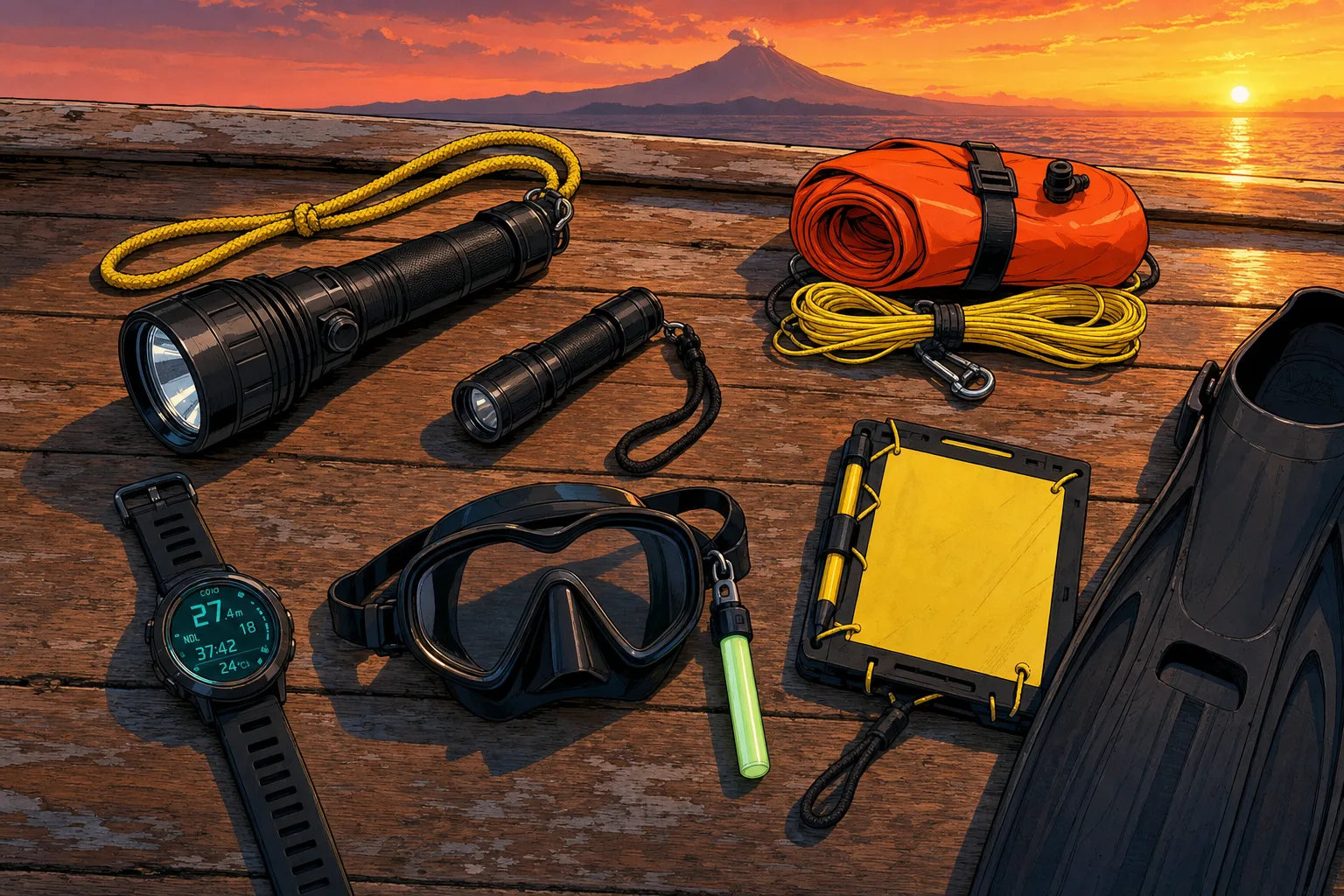
Every night dive at our shop is run with a strict gear protocol. We provide all of it as part of the dive fee, but if you have your own kit you are welcome to use it. Here is what we hand out and why.
Primary torch. Ours are 1200 lumen LED canister-style with a tight 8 degree beam. The tight beam is the choice here, not the wide flood lamps you see on boat decks. A tight beam reaches further, makes signalling clearer, and forces a more disciplined viewing habit, you actually look at one piece of reef at a time instead of strobing the whole wall. We brief everyone on signal etiquette: do not shine the beam in another diver's face, do not strobe across other divers' lines of sight, and use the wrist-circling "look here" signal rather than just pointing the beam.
Backup torch. Smaller, around 300 lumen, clipped to your BCD D-ring on the chest. PADI requires it for the speciality and we require it for every night dive regardless of certification. The day you genuinely need it is the day your primary floods, and that does happen, maybe twice a year for us. Without a backup the dive ends right there in the dark, which is unsettling at best.
Marker lights. Each diver gets a small chemical glow-stick clipped to the rear of their tank valve. We use green for guests, yellow for the dive guide, red for the instructor on a course dive. This makes diver identification at distance trivial and helps with buddy contact in low visibility. Some shops use battery-powered strobe markers; we have tested both, the chemical glow-sticks are quieter, do not strobe distractingly, and reliably last the dive.
Surface marker buoy with reel. Mandatory on every dive we run, day or night, but at night the orange high-vis SMB matters more because the boat or shore lookout needs to find you reliably. We include the deployment in the predive brief and re-test the skill on the first night dive of any visitor's trip. If you do not own one, ours come pre-packed in your BCD pocket.
Computer with a good backlight. The cheap dive computers without a backlight are genuinely a hazard on a night dive because you cannot read depth or no-decompression limit without firing your primary torch at the screen, which kills your eye adjustment. Any decent modern computer with a single backlight button is fine, our shop rentals are Suunto Zoop Novos which are not pretty but they have a sensible backlight. If you are buying your first dive computer with night diving in mind, prioritise screen contrast over feature count.
One thing we do not lend out: GoPros with bright video lights. Bring your own if you must, but understand that a 5000 lumen video light blasted at a sleeping turtle ruins the experience for the diver behind you and stresses the animal. We will ask you to keep it off unless you are actively recording, and to point it down rather than across.
How a Night Dive Actually Runs at Our Shop
This is the part nobody writes about in the marketing copy. Here is the actual timeline of a typical Tulamben night dive day from our Sanur centre.
13:30: We pick you up from your villa or hotel in Sanur, Denpasar or Seminyak in our van. The drive to Tulamben is about two hours and forty minutes on a normal traffic day, slightly longer on Galungan or Saraswati. Bring sunglasses for the drive; the late afternoon sun hits you hard along the east coast. We hand out water and a small banana cake snack pack in the van, but we usually stop for a proper food break around Candidasa where the views are nice.
16:30: Arrive at our Tulamben partner shop on the beach. Gear up, log book check, computer check, and a first day dive at the USAT Liberty wreck while there is still natural light. This dive is roughly 45 to 55 minutes long, easy profile to 18 metres maximum. We surface, swap tanks, get out of wet exposure suits, eat a hot meal in the warung next door (nasi goreng, mie goreng or a chicken sate plate; included in the trip price).
18:45: Briefing for the night dive, on the beach, in fading light. We cover the dive plan, the exact path along the reef, the maximum depth, the air pressure turn-around point, the lost-buddy procedure (one minute search, then surface), the lost-torch procedure (signal the guide, you ascend on the guide's torch). We hand out torches, check the backup is on every BCD, confirm everyone has tested their SMB. The brief takes 15 to 18 minutes and we do not rush it.
19:10: Entry. We give the reef five minutes after full dark before we splash, because the transition window is when reef fish are most disturbed. Surface swim of two minutes to the descent point, descend together, regroup at 6 metres, then move into the dive plan.
19:55: Surface. The dive is usually 40 to 45 minutes. We exit to the same beach we entered, do the log book, return torches and SMBs, and load the van.
20:30: Leave Tulamben. Stop at a beachside warung in Padang Bai or Candidasa for cold Bintang and a longer dinner if the group wants it. Back at your Sanur accommodation around 23:00, sometimes a little later. We will not pretend it is an early night. It is a full and slightly tiring day. We schedule one full rest day after a Tulamben night trip before the next dive on the booking.
Seasonality, Visibility and the Cancellation Reality
Bali is a year-round diving destination, but night diving has a slightly narrower sweet spot than day diving. Our most reliable months are April through November, the dry season, where Tulamben and Padang Bai have visibility consistently 15 to 25 metres, water temperatures 27 to 29 degrees, and surface conditions calm enough for shore entries after dark. The wet season, December through March, is still divable but we cancel more often, mostly because of rain run-off muddying the shallow entry points and because of unpredictable evening squalls. Read our Bali rainy season diving guide for the full breakdown.
The mola mola (sunfish) season at Nusa Penida is July to October. The manta season is year-round but stronger in the dry months. Neither of these are night dives, but they affect booking because guests often want to stack their multi-day trip around mola or manta day trips. We will happily build a five-night Sanur package that combines a Penida manta day trip, a Tulamben night dive day, a Sanur house-reef refresher and a couple of Padang Bai day dives; that is a popular itinerary.
Honest cancellation rate: we cancel roughly 12 to 15 percent of night dives across the full year, with the rate climbing to nearly 25 percent in January and February. The reasons in order are: too much rain in the prior 24 hours (kills visibility), evening thunderstorms (boat or van travel becomes unsafe), and unusual swell on the east coast (Tulamben beach entry becomes a churn of rocks). We do not run a night dive if our guide says no, even if you have travelled for it. If we cancel from our side, we either reschedule for the next clear evening at no extra cost or refund the night dive portion of your booking in full.
Sea conditions worth knowing: even on a perfect day, water temperature at depth in Bali drops 2 to 3 degrees from the surface. A 3 mm full wetsuit is the minimum we recommend for night diving, and if you tend to get cold, a 5 mm or a 3 mm with a hooded vest is more comfortable. We rent both. Surface temperatures after a night dive are sometimes 22 to 24 degrees in the cool dry season; bring a thin fleece or a towel poncho for the boat or van ride home, you will be glad of it.
Cost, What Is Included, and How to Book
Pricing is the question we get more than any other, so here it is plainly. As of 2026, our standard pricing for a guest with their own certification is:
Sanur house-reef night dive (single dive, brief, gear, guide, beach entry from our shop): IDR 1,150,000 (≈ 65 USD) per diver. This is the easiest entry point and the one we recommend if you have never done a night dive.
Padang Bai night dive day trip (1 day dive + 1 night dive, transport from Sanur, lunch, dinner-stop, gear): IDR 2,350,000 (≈ 130 USD) per diver. Six hours total. Home by 22:00.
Tulamben night dive day trip (USAT Liberty day dive + night dive, transport from Sanur, all meals, gear): IDR 2,950,000 (≈ 165 USD) per diver. Nine to ten hours total. Home by 23:00.
PADI Night Diver speciality course (three dives over one or two days, certification fee, digital materials, gear): IDR 6,300,000 (≈ 350 USD). Usually sold as a one-day intensive at Padang Bai or split across two evenings at our house reef.
Multi-day diver: every night dive added to a three-day or longer package is IDR 270,000 (≈ 15 USD) cheaper than the prices above, because we already have your gear set up and your paperwork done. Our full price list, including a comparison with other Bali shops we trust, is on the pricing page.
What is included in every booking: all hard gear (tank, BCD, regulator, fins, mask, wetsuit, computer), all soft gear (torches, SMB, marker lights, weights), transport in our van, all meals and water, the marine park fee at Tulamben (35,000 IDR per diver), and a logged certification card stamp where applicable. Tips for the dive guide are not included and not expected, but if you genuinely had a great dive, 50,000 to 100,000 IDR to the guide is appreciated and shared with the crew.
What is not included: alcoholic drinks at the dinner stop (around 35,000 IDR per Bintang), GoPro or camera rental (we do not currently rent cameras), and your travel insurance, which should specifically cover diving to 30 metres. DAN World membership at around IDR 1,350,000 (≈ 75 USD) per year covers this in the cleanest way; we recommend it but we do not sell it.
To book, the simplest path is to email or WhatsApp our Sanur centre with the date, the experience level of each diver, and whether you have your own gear. We will reply within 12 hours, usually faster. If you are still planning your wider Bali trip and want to package this with day diving at Tulamben, Amed, Padang Bai or Penida, see our Bali dive trips overview and the multi-day packages page, or just write to us with your dates and we will build the schedule. Direct booking is available online for our day dives; we currently take night-dive bookings by email so we can confirm conditions for the specific evening.
If you are still on the fence, the best advice we can give is this: book your night dive for the second or third evening of your Bali trip, not the first. You will be jet-lagged on day one, you will be more comfortable in the water with us by day two or three, and the night dive will be a highlight rather than an ordeal. And if it is your first night dive, the Sanur house-reef option is genuinely the right starting point. The Tulamben experience is more memorable, but the house reef is more forgiving. Pick the one your buoyancy is ready for.