
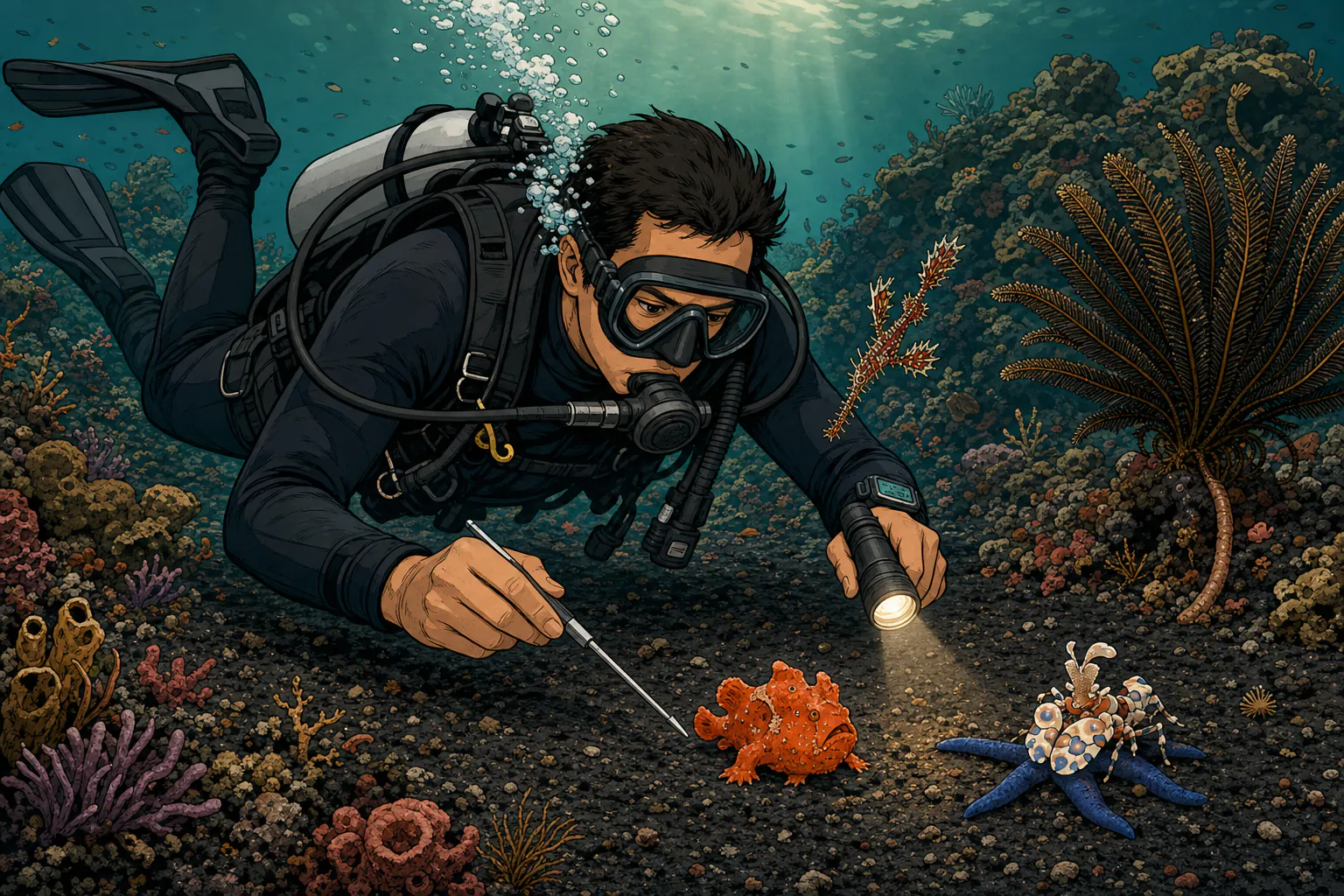
If your idea of great diving is sweeping reefs full of fish, you can stop reading now and book a Nusa Penida day trip instead. But if you find yourself slowing down on dives, getting closer to the sand, and noticing the weird and the small before the big and the obvious, then welcome home. Bali is one of the best places in the world to dive for macro and muck, and almost nobody talks about it.
This is the article we wish we could send to every photographer, every Advanced Open Water diver looking for their next progression, and every diver who quietly admits the giant trevally on the wreck was less interesting than the orangutan crab on a single sea pen. We run macro and muck trips out of Sanur year round, mostly out of Tulamben, Padang Bai and the far west, and this is what we tell guests at the night briefing.
What is macro and muck diving, and why is it Bali's hidden superpower
"Macro" just means small. Macro diving is dives where the subject of interest fits on a thumbnail rather than across a panorama: nudibranchs, pygmy seahorses, blue-ringed octopus, frogfish, ghost pipefish, harlequin shrimp. "Muck" is the cousin, and the word puts most people off when they hear it. Muck diving is diving over what looks like featureless sand or volcanic rubble, often dark, often with very little reef. It looks like nothing, which is precisely why almost every weird, rare, alien-looking critter on the planet lives there.
Bali's geography is freakishly good for this. The east coast at Tulamben sits on steeply shelved black volcanic sand straight off the cone of Mount Agung. The far west at Gilimanuk has Secret Bay, a silty estuary with brackish runoff that produces critters you usually only see in Lembeh. Pemuteran has Puri Jati, a wide-open sand plain that is basically an outdoor laboratory for nudibranch obsessives. And in the south, Padang Bai's Jepun and Tanjung Sari sand fringes hide most of what Lembeh is famous for, just a 90-minute drive from Sanur.
The pitch is simple: you do not need to fly to Lembeh, Anilao or Ambon to see the critters that put muck diving on the map. They are here in Bali, on most of our standard dive trips, you just need to know where to look and how to dive slowly.
Bali's top 5 macro and muck dive sites
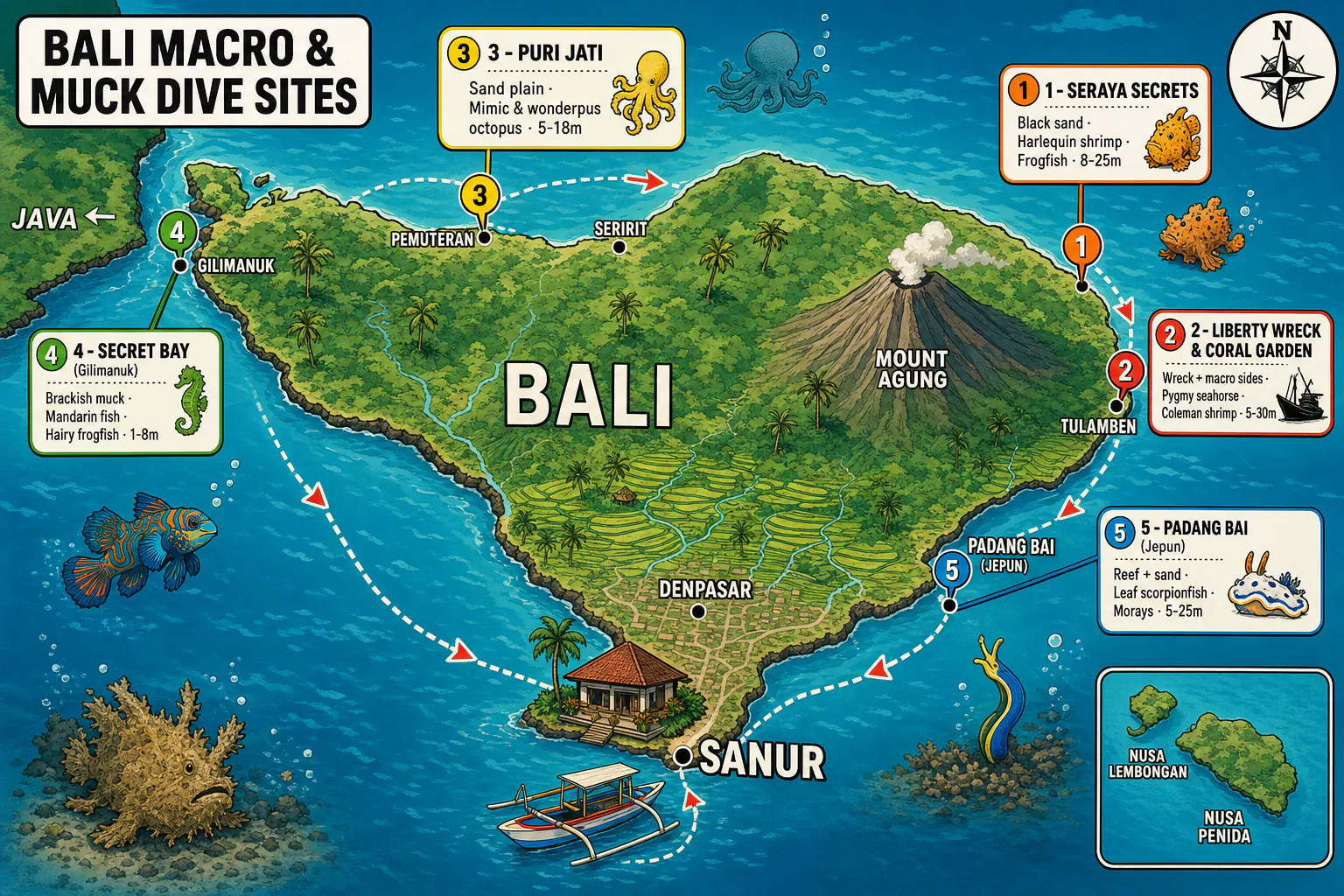
1. Seraya Secrets (Tulamben)
If Bali macro had a flagship, Seraya is it. The site sits about ten minutes north of the USAT Liberty wreck, along the same black sand bottom, and you do a beach entry straight off the rubble. The slope is gentle, profile sits between 8 and 25 metres, and the sand is dotted with a few isolated coral bommies that act as critter magnets.
What we find here on an average dive: harlequin shrimp on starfish, several species of frogfish (painted, giant, hairy on a good week), ornate ghost pipefish drifting near crinoids, juvenile sweetlips doing their wobble dance, mimic and wonderpus octopus on dusk dives, and so many nudibranchs your slate will run out before the dive does. Best dive of the day is the late afternoon dive when the light goes warm and the critters start moving for the night.
Conditions: easy. Almost no current, visibility 10 to 20 metres, and the deepest you ever need to go is 25 metres. This is a site even a fresh Open Water diver can handle, but the average diver here is much more experienced because critter hunting is the whole point.
2. Liberty Wreck sand sides and Coral Garden (Tulamben)
Yes, the Liberty is a wreck dive, and yes, the wreck itself is what brings most divers to Tulamben. But the sand sloping away on either side of the wreck, and the shallow Coral Garden 100 metres north, are arguably better macro hunting grounds than Seraya. The reason is simple: the wreck pulls divers like a magnet, so the sand around it is barely fished by other groups while everyone clusters on the gun turret.
What we see on the sides: pygmy seahorses on dedicated gorgonian fans (Bargibanti and Denise), Coleman shrimp on fire urchins, leaf scorpionfish, harlequin shrimp, robust ghost pipefish, and the resident school of bumphead parrotfish that come in at dawn and somehow always count as the macro highlight despite being two metres long. Coral Garden's shallows hide multiple frogfish species, juvenile rockmover wrasse, and one of the highest nudibranch counts per square metre we have ever surveyed.
If you are after both wreck history and critters in the same week, base out of Tulamben for at least three days. Most divers regret only doing one.
3. Puri Jati (north coast, near Pemuteran)
Puri Jati is the site that converts reef divers into macro divers. It is a wide flat sand plain at 5 to 18 metres, two hours drive from Tulamben on the north coast, near the village of Seririt. There is almost no structure. There are almost no fish. There is just sand, a few sea pens, the occasional patch of broken coral, and a parade of strange life that comes out of nowhere when you slow down.
Our guides log: mimic octopus in the open (one of the only sites in Bali where you can reliably find them), wonderpus, blue-ringed octopus, several seahorse species, snake eels, devilfish, juvenile lionfish hiding in dead leaves, and entire colonies of orangutan crabs on the sea pens. Algae octopus put on a show in the shallows on the safety stop most dives.
Two important notes. First, Puri Jati is a half-day commitment from anywhere in south Bali, so we usually combine it with Menjangan or a Pemuteran overnight. Second, the bottom is silt, so trim and finning matter more here than at any other Bali site. If you kick up the bottom on the first ten minutes of the dive, the dive is over for everyone behind you.
4. Secret Bay (Gilimanuk, far west)
Secret Bay earns its name twice. It is at the far western tip of Bali, three and a half hours from Sanur by car, so almost no day-trip diver gets there. And once you are in, the dive itself feels secret: shallow (rarely past 8 metres), brackish from a freshwater inflow, often with poor visibility (3 to 8 metres on a typical day, occasionally less), and an opaque pea-green colour that screams "go home" to anyone expecting reef diving.
Push past that and Secret Bay is one of the most productive critter sites in Indonesia. The list reads like a Lembeh greatest hits: mandarin fish during the dusk mating window, hairy frogfish, several flamboyant cuttlefish, multiple shrimp gobies sharing burrows with snapping shrimp, robust ghost pipefish, ornate ghost pipefish, banggai cardinalfish, juvenile pinnate batfish, multiple seahorse species and so many nudibranch eggs you can practically time the moon by them.
This is not a beginner site, not because it is dangerous but because conditions disorient new divers and the critters are easy to miss if you do not have eyes calibrated for muck. We only run Secret Bay on dedicated 2 or 3 day macro trips with experienced divers, and we always do the dusk dive for the mandarin fish.
5. Jepun and Tanjung Sari (Padang Bai)
Padang Bai is mostly known to day-trip divers for Blue Lagoon and the Mimpang shark dive, but the sandy fringes either side, Jepun to the west and the sand bed at Tanjung Sari, are sleeper macro sites. The bonus: you can dive these from Sanur as a regular day trip with no overnight needed, which is why we recommend Padang Bai as the entry point for anyone curious about macro before they commit to a Tulamben or Pemuteran week.
What you find here: leaf scorpionfish, several frogfish, multiple species of moray (zebra, snowflake, ribbon), Tozeuma shrimp on whip corals, juvenile harlequin sweetlips, and on the right days a healthy population of nudibranchs grazing on encrusting sponges. The visibility is generally better than Secret Bay, the water is warmer than Tulamben in rainy season, and the boat ride from Padang Bai harbour is five minutes.
What you will actually see: Bali's macro all-stars
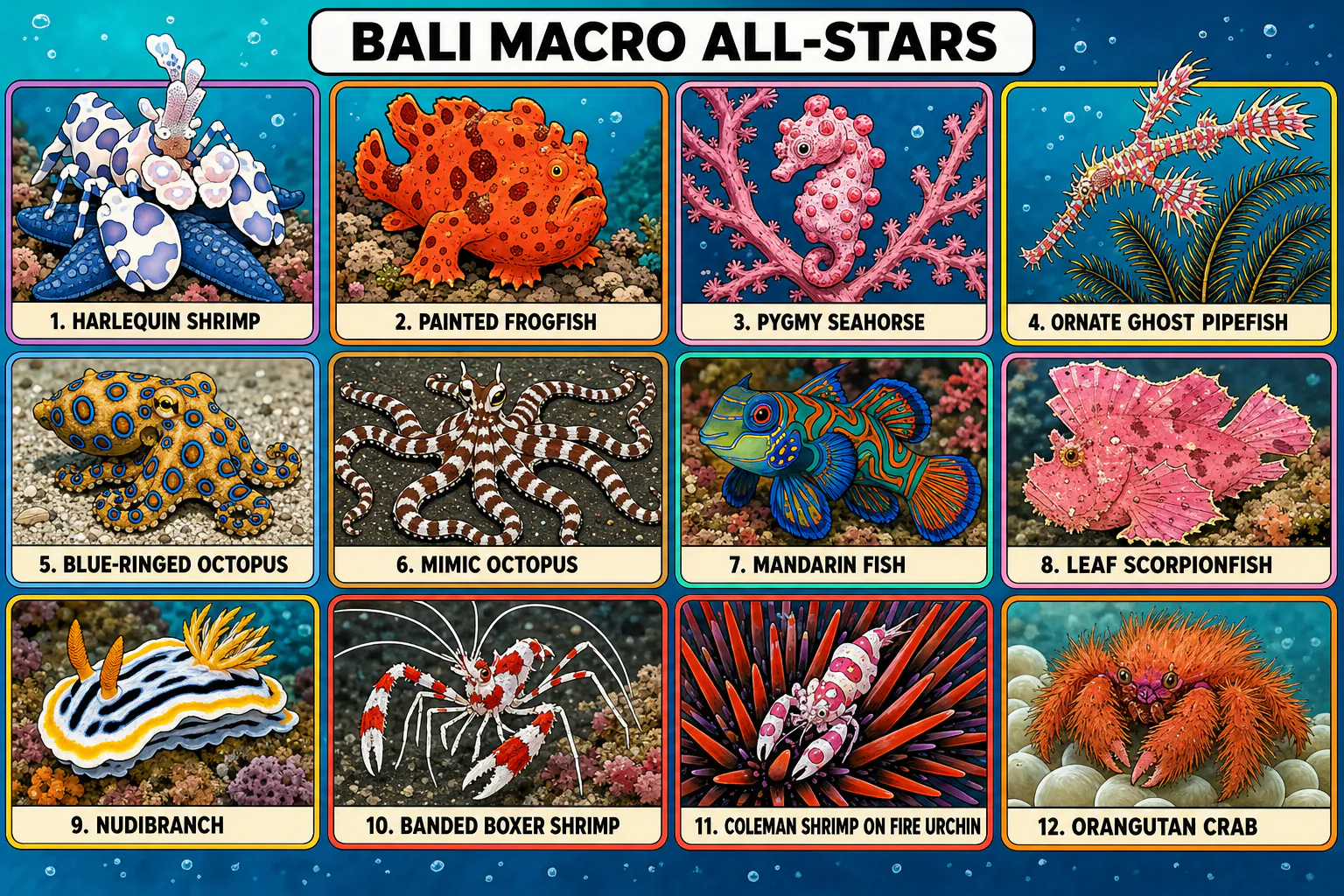
The headliners
Harlequin shrimp. Bright white with purple and blue patches, almost always found in pairs on a starfish (their only food). Tulamben Seraya is the most reliable spot. Photographs as if they were painted by a child who only had three crayons.
Frogfish (painted, giant, hairy, warty). Bali has all four common Indonesian frogfish species. Painted and giant are easy and resident. Hairy is the holy grail and shows up at Secret Bay and Seraya in waves, often a few weeks at a time. Look on dead sponges and rubble piles, not on living coral.
Pygmy seahorse (Bargibanti and Denise). Tiny, the size of a fingernail, on specific gorgonian fans. The Liberty wreck and a few specific bommies at Seraya have known fans. Always use a guide for these, the fans are easy to damage and the seahorses harder to find than first-time divers expect.
Mandarin fish. Secret Bay at dusk. The males come out for about 20 minutes after sunset, do their slow vertical mating dance, and disappear again. One of the most photogenic moments in diving.
Mimic and wonderpus octopus. Puri Jati's specialty. Watching a mimic flatten itself into a flounder, then a sole, then a lionfish over the course of five minutes is one of the great pleasures of muck diving.
Blue-ringed octopus. Small, deadly, beautiful. The rings only flash when threatened, so a calm encounter is also a duller-looking one. Multiple sites have them, Puri Jati and Secret Bay most reliably. Never touch, never crowd.
The macro greatest hits in one paragraph
On any given seven-day Bali macro itinerary we tend to log: 30 to 60 nudibranch species, 3 to 6 frogfish, multiple ghost pipefish, several seahorse species, all the common shrimps (Coleman, harlequin, banded boxer, anemone, Tozeuma, peacock mantis if you get lucky), most of the common octopus including mimic and wonderpus at Puri Jati, leaf scorpionfish, snake eels, devilfish, mandarin fish at Secret Bay, and dozens of unidentified juveniles that will eat up an hour of post-dive critter-ID searching. We always keep a logbook page open for "what was that".
Best time of year for Bali macro diving
Macro diving in Bali is genuinely year round. Unlike mantas at Nusa Penida or mola mola, macro critters do not follow a strong seasonal cycle. The biomass is the constant, what changes is the comfort of the dive.
| Period | What is good | What is harder |
|---|---|---|
| April to October (dry) | Best visibility (15-25m at Tulamben, 8-15m at Secret Bay), calmest seas, easiest north and west coast logistics. Peak macro photographer season. | Crowded at Tulamben Liberty wreck (book Seraya first, Liberty as the second dive after the day boats leave). |
| November to March (wet) | Almost zero crowds at Seraya, Puri Jati, Secret Bay. Excellent critter productivity, often more frogfish and ghost pipefish. Water warmer. | Visibility drops at Secret Bay (it gets greener). Occasional rough seas on the north coast can cancel Puri Jati for a day or two. Read our rainy season guide. |
| Special: full moon weeks | Mandarin fish at Secret Bay are reliably active across the lunar cycle, but full moon weeks bring more nudibranch egg ribbons and bigger crustacean activity. | Tides are stronger so plan dives for slack water. |
The honest answer to "when should I come" is: build the trip around your schedule, not the calendar. We have run brilliant macro weeks in February and quiet ones in August. The site, the guide and your patience matter more than the month.
Gear and camera setup we recommend
Dive gear
Suit. 3 mm wetsuit for the east coast year round. 5 mm if you feel the cold or do back-to-back long dives. The Tulamben thermocline drops to 24 degrees at 25 metres in dry season, surface is usually 28 to 30 degrees.
Fins. Split fins are not your friend for macro. You want stiff blade fins for controlled back-kick and frog-kick, both of which keep you off the bottom in tight spaces. A skilled diver with bad fins is still better than a clumsy diver with good fins, but good fins amplify what you already do well.
Pointer stick. Yes, get one. A 30 cm aluminium pointer (sometimes called a "muck stick") is the difference between hovering 50 centimetres off the sand or constantly touching down. It is also the only ethical way to ask a critter to move slightly so you can compose a photo. Never touch a critter directly.
Torches. A 1000 lumen primary focus light is enough for most macro photography. A small backup torch helps spot eyes inside crinoids and sponges. If you are doing a Secret Bay dusk dive for mandarin fish, a red filter is appreciated by the fish and recommended by your guide.
Nitrox. Macro divers spend a lot of time at 15 to 20 metres for 70 minute dives. Nitrox 32 turns that into a comfortable 80 minute dive with shorter surface intervals. If you are not certified yet, pick it up while you are here. It is two days, one dive, and the highest single-skill return on investment in recreational diving for macro divers.
Camera setup
You do not need a professional rig for great Bali macro photos. The two upgrades that matter most:
True macro lens, not zoom. A 60 mm macro on a mirrorless or DSLR, a 60 mm or 100 mm equivalent. For compacts, a strong wet diopter (CMC-1, SubSee +10) screwed onto the front of a 28 mm equivalent housing port produces results that beat a lot of higher-end rigs.
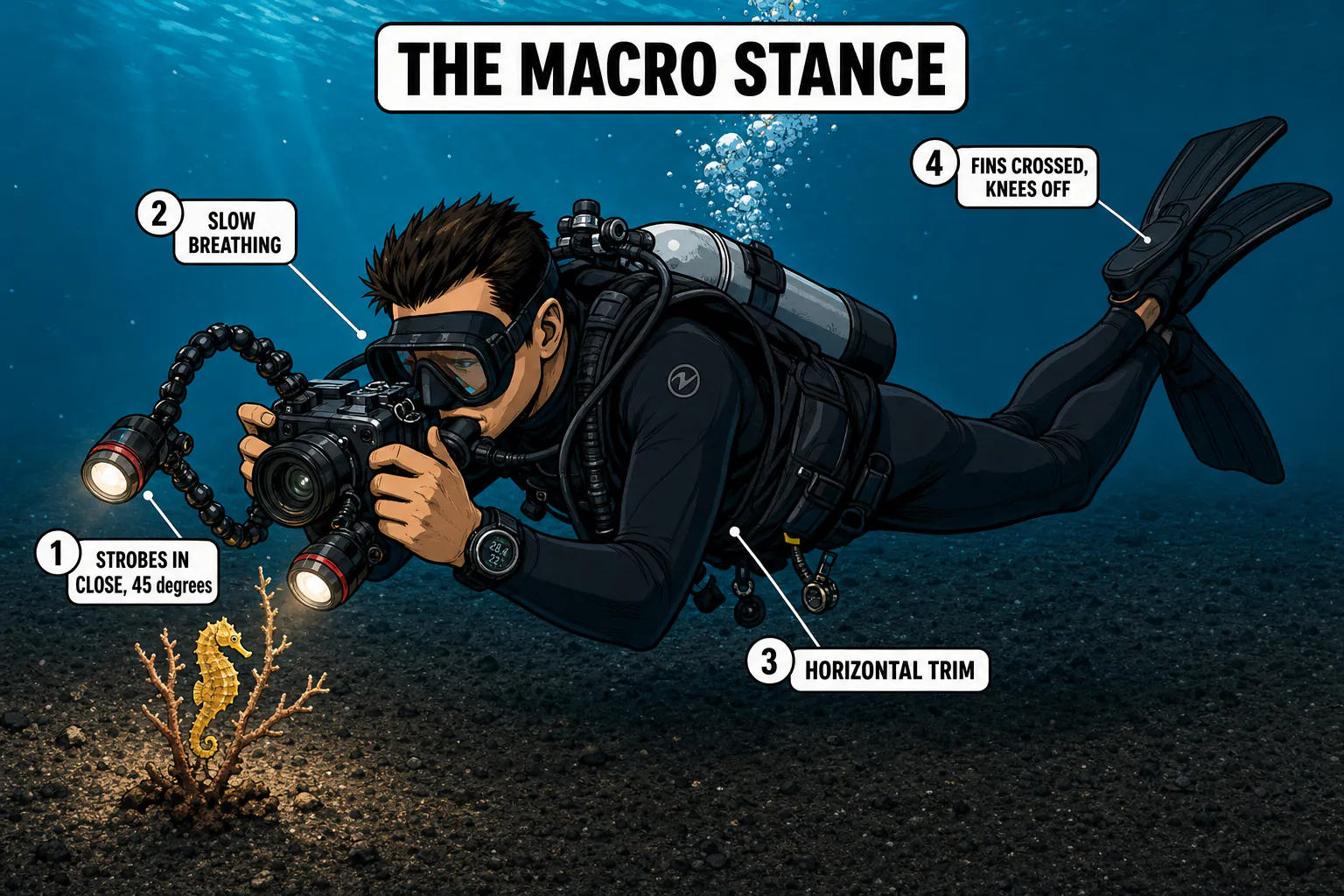
Two small strobes pulled in close. The number one mistake we see is strobes wide and far. For macro, you want them within 20 to 30 cm of the subject, angled in at 45 degrees, with diffusers on. Snoot if you have one, especially for skittish subjects like mandarin fish.
You will see brilliant photos from divers using only their dive torch and a phone in a housing. The gear ceiling is high but the gear floor is much lower than most people assume. What separates good from great is buoyancy and patience, not glass.
The skills that actually matter for macro
You can buy your way into a great camera. You cannot buy your way into great buoyancy. If you take one thing from this article, it is this: the single biggest upgrade you can make to your macro diving is your own trim and finning. Not the lens, not the strobes.
Horizontal trim. Lying flat in the water, body parallel to the bottom, fins lifted slightly. Knees off the sand. This is the position you stay in for 90 percent of every macro dive. If you cannot hold it for five minutes without finning, work on it before you spend money on a camera.
Back kick and helicopter turn. When you are 30 cm from a frogfish on a tiny rubble pile, you need to back away and turn without touching anything. Both are taught in Peak Performance Buoyancy and developed across Advanced Open Water. We strongly recommend both if you are getting serious about macro.
Slow breathing. Macro divers breathe slowly, deeply and rarely. We routinely surface from 70 minute dives with 80 bar still in the tank. The slower you breathe, the steadier your buoyancy, the closer you can hold a position, the sharper your photos. The connection between calm divers and good macro is direct.
Critter etiquette. Never touch. Never crowd. Never block the exit of an octopus den. Never blast a subject with three strobe pops in five seconds, you ruin the next group's encounter as much as your own. If a critter visibly stresses (changes colour, retracts, swims off), back away. We follow the basic principle: leave the site indistinguishable from how we found it, except for our photos.
Suggested 5 to 7 day Bali macro trip itinerary
This is the itinerary we run for repeat macro guests who want to see the country systematically. It assumes you arrive in Sanur and use us as the base.
Day 1. Arrival, briefing, gear check. Optional check dive on the Sanur house reef in the afternoon to dial in buoyancy. Easy night.
Day 2. Padang Bai 2 dives (Jepun + Tanjung Sari sand bed). Warm up the eye for muck. Back to Sanur for the night.
Day 3. Transfer to Tulamben (about 3 hours by car). Dive Liberty sand sides + Coral Garden in the afternoon. Stay in Tulamben.
Day 4. Tulamben full day, 3 dives: Seraya morning, Liberty wreck and macro mid-day, Seraya again at dusk. Long, productive, exhausting in the best way.
Day 5. Transfer to Pemuteran (about 3 hours). Two dives at Puri Jati. Optional Menjangan reef break in between if you want a visual reset.
Day 6. Puri Jati dawn dive for octopus + a Pemuteran biorock reef dive for contrast. Optional transfer back to Sanur after lunch, or continue west.
Day 7. Secret Bay 2 dives (mid-morning + dusk for mandarin fish). Long transfer back to Sanur in the evening. This is the day repeat divers say "next time we add two more days for Secret Bay alone".
5-day version: drop day 1 check dive, drop the Pemuteran break dive on day 6. The compressed version is intense but doable for fit divers with current skills.
Costs (honest 2026 numbers)
All prices in USD, inclusive of tanks, weights, guide, lunch and transfers from Sanur unless noted.
| Item | Typical cost |
|---|---|
| Padang Bai 2 dives day trip from Sanur | IDR 2,150,000–2,700,000 (≈ 120–150 USD) |
| Tulamben day trip (2 dives, return same day) | IDR 2,900,000–3,400,000 (≈ 160–190 USD) |
| Tulamben 2 day, 4 dive package with overnight | IDR 7,600,000–9,300,000 (≈ 420–520 USD) |
| Puri Jati / Pemuteran 2 day, 4 dive package | IDR 8,600,000–10,400,000 (≈ 480–580 USD) |
| Secret Bay (Gilimanuk) 2 day, 3 dive macro package | IDR 9,300,000–11,100,000 (≈ 520–620 USD) |
| Full 7 day macro trip (private guide, all transfers, overnights, around 13 dives) | IDR 35,000,000–43,000,000 (≈ 1,950–2,400 USD) |
| Nitrox certification add-on | IDR 3,950,000–4,650,000 (≈ 220–260 USD) |
| Peak Performance Buoyancy specialty (1 day) | IDR 3,050,000–3,600,000 (≈ 170–200 USD) |
These prices reflect a private or near-private guide ratio (1 guide to 2 divers maximum, often 1 to 1 for serious photographers). You can dive Bali for less, the saving comes off the guide ratio and almost nothing else, and the guide ratio is exactly what determines whether you find pygmy seahorses or just hear other people talking about them at the surface.
Common macro diving mistakes we still see (and how to fix them)
We have run macro guests for the better part of two decades and the same handful of mistakes come up almost every trip. None of these are character flaws, they are just things experienced divers do not get told often enough.
Looking for what you want to find, not what is there. Most divers fixate on the headline critter (pygmy seahorse, mandarin fish) and look right past three nudibranchs and a robust ghost pipefish on the way. The guides who consistently find the rare stuff are the ones who scan everything. Re-train your eye to notice texture, asymmetry and movement first, identification second.
Spending too long on a single subject. A frogfish does not get more photogenic on the eighteenth attempt. If your first three frames are bad, the lighting is wrong, the angle is wrong or the subject is uncooperative. Back off, breathe, change one variable, come back. Two minutes per critter is plenty.
Strobe blast without thinking. Repeated high-power flashes stress the subject, ruin the next group's encounter, and produce blown-out photos. Aim for two well-placed pops, then move on.
Ignoring the guide's stick. If your guide is pointing, look exactly where the stick is pointing, not roughly. Macro critters are often the size of a grain of rice. "Roughly there" is the difference between seeing it and missing it.
Skipping the dusk window. A lot of macro behaviour happens in the 30 minutes around sunset, especially mandarin fish, octopus and crustacean activity. Divers who only do daylight dives miss roughly a third of the show. Plan at least one dusk dive per trip.
Burning through air. A nervous, unweighted diver on a critter hunt runs through 200 bar in 35 minutes and never finds anything. A relaxed diver gets 70+ minute dives, sees three times as much, and is breathing slowly enough to hold position for a clean photograph. Macro diving rewards calm above everything else.
Travel and logistics for a Bali macro trip
You can fly direct to Denpasar (DPS) from most of Asia, Australia, Europe (some seasonal direct, otherwise via Singapore, Doha or Dubai) and a few cities in North America. The airport is in the south of Bali, about 30 minutes from Sanur. We almost always base macro trips out of Sanur for three reasons: it is on the right side of the island for Padang Bai, Tulamben, Puri Jati and Secret Bay; it has a calm, family-friendly atmosphere that suits early dive starts; and our dive centre is here so logistics are simple.
Visa. Most nationalities can get a visa on arrival or use the new eVOA, see our 2026 e-visa guide for divers for the current process. Plan for 30 days unless you are doing a 2 week or longer trip, in which case extend on arrival.
Driving times to know. Sanur to Padang Bai 90 minutes. Sanur to Tulamben 3 hours. Tulamben to Pemuteran 3 hours. Pemuteran to Gilimanuk (Secret Bay) 45 minutes. Gilimanuk back to Sanur 4 hours, or 5 with traffic. Always build in buffer for the late afternoon return after a Secret Bay dusk dive.
Accommodation. Tulamben has half a dozen good dive resorts within walking distance of the Liberty wreck. Pemuteran is a calmer base with rooms from IDR 550,000 (≈ 30 USD) to IDR 3,600,000 (≈ 200 USD) depending on standard. Gilimanuk is a port town and accommodation is basic, most macro guests stay in Pemuteran and drive out for Secret Bay dives.
Surface intervals. Use the surface interval for image review, not for chatting. We have noticed a strong correlation between divers who download and review their images at lunch and divers who come back from the second dive with significantly better photos. The guides know this. You learn faster than you think.
How to book a Bali macro trip with us
Almost every macro guest we run is custom-tailored. There is no menu page that captures "I have ten days, I want pygmy seahorses, mandarin fish and at least three frogfish species, please". The fastest path is:
1. Tell us your dates, certification level and rough wish list. A short email is enough.
2. We propose a draft itinerary based on which sites match your time and skill level.
3. We confirm dive guide, transfers, overnights and pricing.
4. You arrive, we dive, you eat well between dives and sleep happily.
Start with the booking page for a structured request, or browse our standard packages for ideas. If you already know exactly what you want, message us directly and we will quote within 24 hours.
The bottom line
Bali quietly sits in the top tier of macro and muck diving destinations in the world. Most divers come for the reef and the wreck and miss it. The ones who do find it tend to come back every year because the combination of accessible logistics, year round availability, low prices compared to Lembeh and Anilao, and the species diversity is genuinely hard to match anywhere in Indonesia.
If you are still on the fence, start with two days at Tulamben. If you are not converted by sunset on day two, the rest of the article does not apply to you, and you have learned something useful about your own diving. If you are, you now know how to plan the next ten years of trips.