
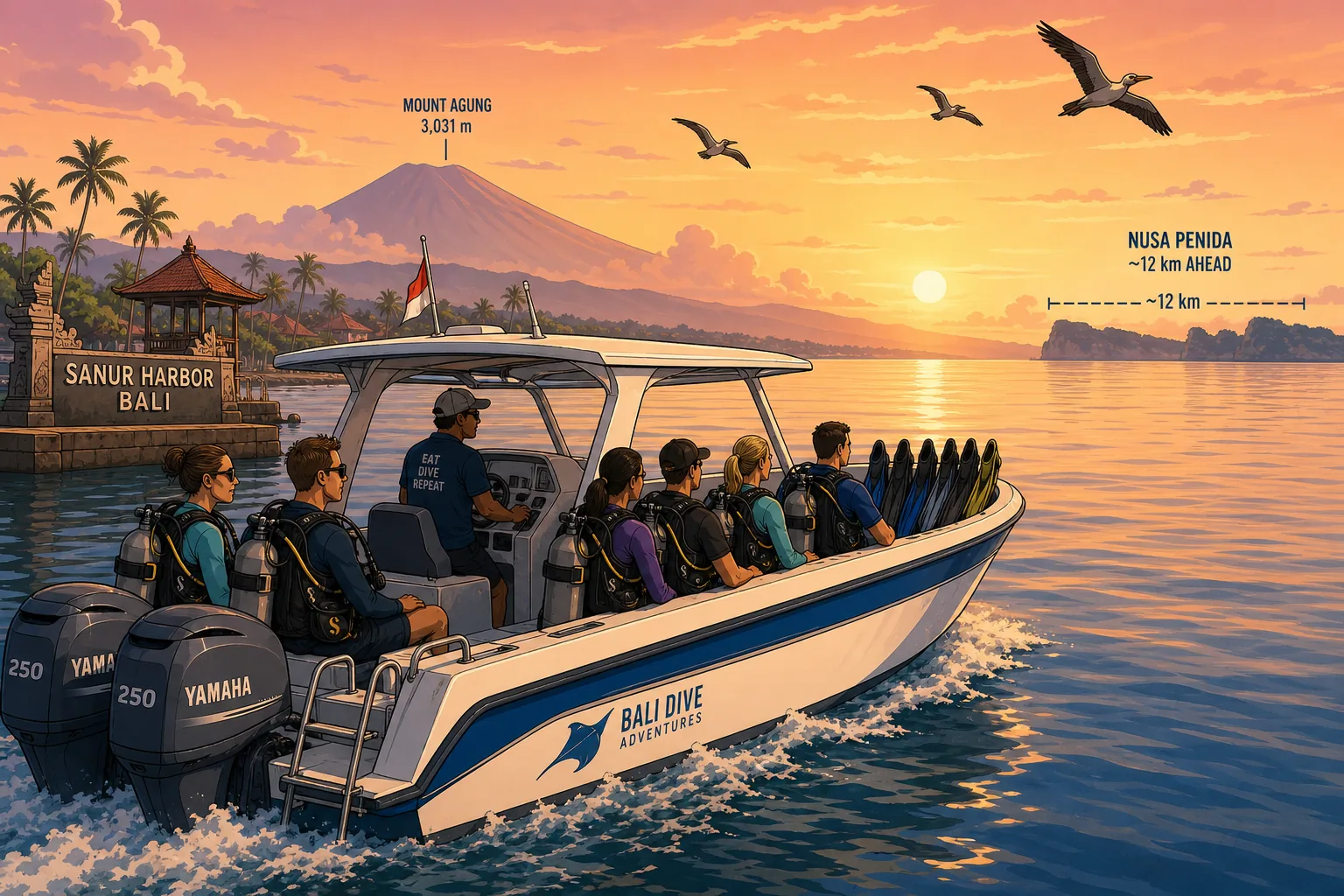
Every morning at our Sanur dive centre, the question we hear most often before 8 AM is some version of: "Are we going to see the mantas today?" Followed almost immediately by: "How does the boat ride actually go?" Diving Nusa Penida from Sanur is the single most-booked day trip in Bali, and for good reason: it is the closest take-off point to one of the most biodiverse reef systems in Indonesia, the cliff-lined island sits just 12 km offshore, and the morning logistics are tighter than from anywhere else in Bali.
This guide is the operator-honest version of what an actual Nusa Penida day trip from Sanur looks like in 2026. Pickup times, what the speedboat ride is really like, which two dive sites your trip is most likely to visit and why, the marine park fee, what to pack, the exact cost breakdown, and the questions we wish more guests asked us at check-in. It is the same conversation we have at the shop with first-timers and certified divers alike, only in writing and with the bits people usually forget about (the fee, the wind direction, the lunch problem) called out where they belong.
Travelling with non-divers? Our Nusa Penida snorkeling tour guide compares the snorkel options on the island, from shared open trips to private boats, with typical prices for each.
Why Sanur is the natural base for a Penida day trip
Sanur is the closest major beach town on the Bali mainland to Nusa Penida. The Sanur harbour-to-Penida boat ride is 35-45 minutes on a fast dive speedboat, and 50-90 minutes on the public passenger fast boats that everyone else uses to cross. Diving from a dive operator's own speedboat (rather than the public fast boat plus a day-charter on Penida itself) is meaningfully faster, more flexible on dive site choice, and removes the dreaded second transfer once you arrive on the island. Most Sanur dive shops can pick you up from your hotel between 6:30 and 7:30 AM, get you back by mid-afternoon, and leave your evening completely free for dinner on the beach.
If you are staying somewhere else, the calculus changes quickly. From Canggu or Seminyak you are looking at 60-90 minutes of pre-dawn road transfer before the boat ride even starts. From Ubud it is 90-120 minutes. From Nusa Lembongan you can start a Penida day trip almost as easily as from Sanur (the two islands are 7 minutes apart by speedboat), but the dive shop selection is much smaller. We cover the broader trade-offs in our complete diving Nusa Penida guide. For a relaxed family-friendly base that is also close to the dive day logistics, see our notes on Sanur in the family diving in Bali guide.
The other reason Sanur wins for a Penida day trip: the harbour faces east, so the morning departure is into calm water on the lee side of the island. Even when the southern swell is up and the rest of Bali looks rough, Sanur usually has glassy departure conditions. We come back to this in the seasonal section below.
The hour-by-hour timeline: what a Sanur to Penida day actually looks like
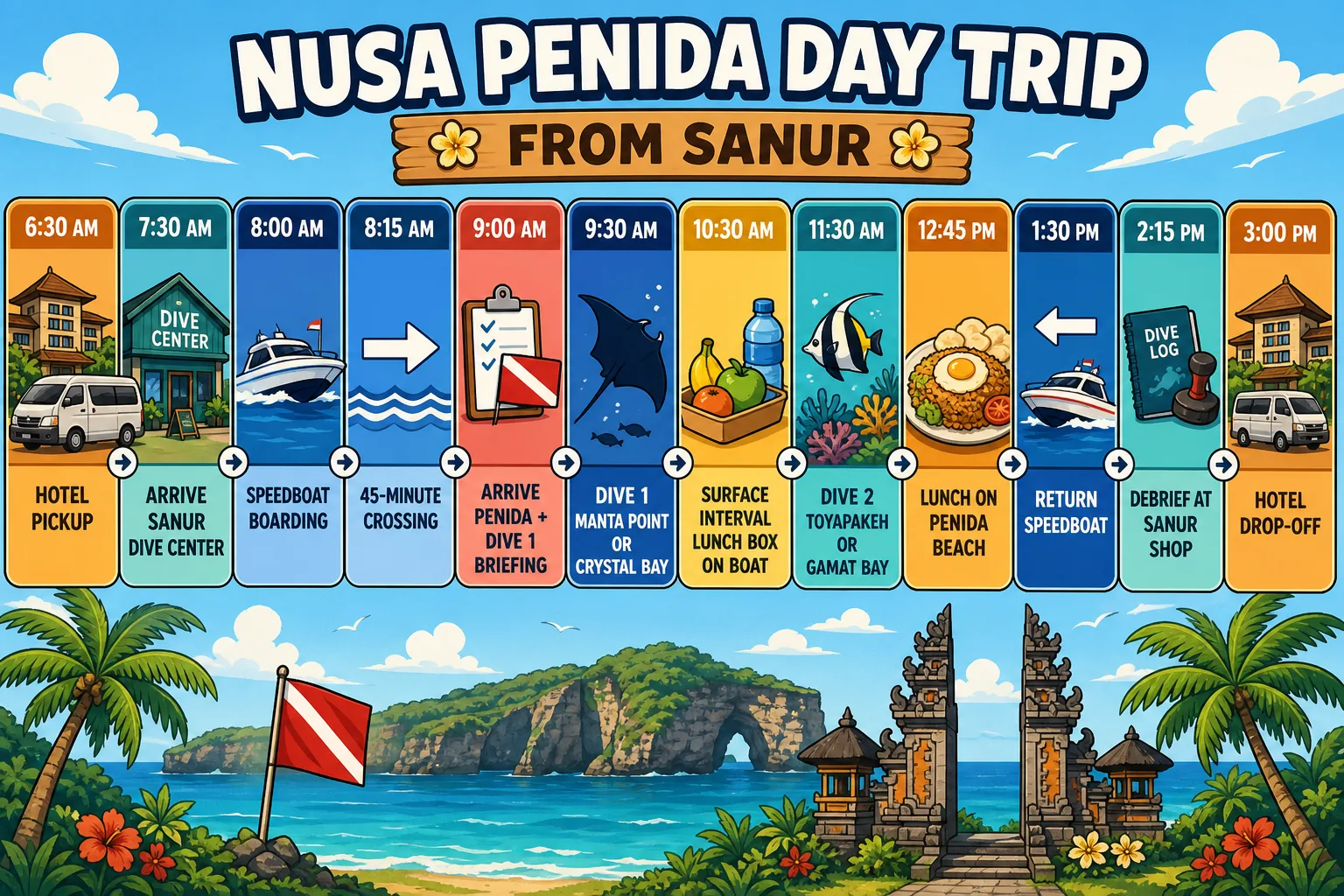
Here is the standard timeline most Sanur dive shops (ours included) run for a 2-tank Penida day trip. Yours will vary by 15-30 minutes either way depending on hotel location, group size and conditions, but the structure is almost universal.
6:30 AM – Hotel pickup. Air-conditioned minivan from your Sanur hotel. We use a single rolling pickup loop that covers most Sanur hotels and a few outliers in Denpasar east. Outside Sanur (Seminyak, Canggu, Ubud) we shift pickups to 5:30-6:00 AM to make the same departure window.
7:00 AM – Arrive at the dive centre. Quick paperwork (medical questionnaire if you have not filled it in already), gear assignment, briefing on the day's plan, a small breakfast snack with coffee. If you are doing a refresher dive (more than a year out of the water) we handle that here before the boat ride. See our PADI ReActivate refresher guide for details.
7:45 AM – Walk to Sanur harbour. Our shop is 5 minutes from the public harbour; some shops further inland will drive you. You will see four to six dive speedboats lined up alongside the public passenger fast boats. The dive boats are the ones with tank racks on the gunwales and a freshwater rinse basin on the stern.
8:00 AM – Boat boarding and departure. Tanks are already on board (the crew loaded them at 6 AM). Wetsuits get distributed. The boat captain runs the safety briefing in 90 seconds: lifejackets under the bench, emergency O2 in the dry box, please do not put your fins on until we are stopped at the dive site.
8:15-9:00 AM – The crossing. 35-45 minutes depending on swell direction. The boat runs at 25-30 knots, with the engines noticeably loud (bring earplugs if you are sensitive). The first 10 minutes is in protected Sanur lagoon water; the middle 20 minutes crosses the Badung Strait, which can have some swell; the last 5-10 minutes is calm in the lee of Nusa Penida.
9:00 AM – Dive 1 briefing. The divemaster runs a full site-specific briefing once we are anchored or moored at the first site. Topography, depth profile, expected current, what to look for, hand signals refresher, buddy assignments.
9:30 AM – Dive 1. 45-50 minute dive. Maximum depth depends on the site (typically 15-22 m for Open Water divers, 22-30 m for Advanced). For most first-time day-trippers this is Manta Point or Crystal Bay, depending on the season and your certification level. See the site selection section below.
10:30 AM – Surface interval on the boat. 60-75 minutes drifting in a calm bay, snacking on tropical fruit, drinking water and tea, swapping stories from dive 1. The crew swaps your empty tank for a fresh one and rinses your mask. This is the part where everyone realises how hungry they are.
11:30 AM – Dive 2. 45-50 minute dive at the second site, chosen to complement dive 1 (if dive 1 was deep, dive 2 will be shallower; if dive 1 was a current dive, dive 2 will be relaxed). Often Toyapakeh or Gamat Bay for the relaxed second-dive option, or a second pass at Manta Point if the morning manta count was good.
12:45 PM – Lunch on Penida. Boat drops you at a small beach restaurant on Penida (Toyapakeh or Crystal Bay), where you have a buffet Indonesian lunch (nasi goreng, mie goreng, gado-gado, fresh fruit) and freshwater showers. 45 minutes ashore.
1:30 PM – Return crossing. 35-45 minutes back to Sanur, usually with a smoother sea than the morning thanks to lighter winds. Most divers nap.
2:15 PM – Back at the dive shop. Hot shower, debrief, signed logbook entries, and the all-important question: are you doing it again tomorrow? About 60 percent of day-trippers come back for a second day or upgrade to a 3-day Penida package.
3:00 PM – Hotel drop-off. Back at the hotel in time for sunset. Most divers go for an early dinner and an early night.
The Sanur to Nusa Penida speedboat ride, honestly
This is the part of the day trip that surprises first-timers the most. The crossing is short (12 km) but it crosses the Badung Strait, which is one of the strongest tidal current channels in Indonesia. The same powerful currents that make Penida world-class diving make the surface crossing occasionally bumpy.
What it usually feels like. On a calm morning (which is most mornings, May through October) the crossing is smooth and uneventful. The boat sits at 25-30 knots, you feel some hull slap from small chop, and the wind on your face. Most people enjoy it.
What it occasionally feels like. When the southeast wind picks up (typically June-August afternoons, and any day with a strong south swell) the crossing gets bouncy. Not dangerous, just uncomfortable for 15-20 of the 45 minutes. The captain will slow down through the worst of it. About 1 in 15 first-time crossers gets mildly seasick. We have ginger sweets and motion sickness tablets on every boat.
What helps. Sit near the back of the boat (less hull slap), keep your eyes on the horizon, eat a small breakfast (not a big one and not nothing), and take a non-drowsy antihistamine like cinnarizine or meclizine 60 minutes before pickup if you know you get motion-sick. Scopolamine patches work but make you drowsy underwater, so skip them. Ginger sweets help mildly. Reading a phone is the fastest way to feel queasy.
What we will never do. Push through dangerous conditions. If the morning forecast shows 2+ metre swell or 25+ knot winds, we cancel and reschedule (or refund) instead of forcing a miserable crossing. About 5-10 days per year, almost always in January-February rainy season, we cancel Penida trips and offer guests Tulamben or Padang Bai instead.
Top 5 Penida sites for a day trip (and how we choose the two yours will visit)
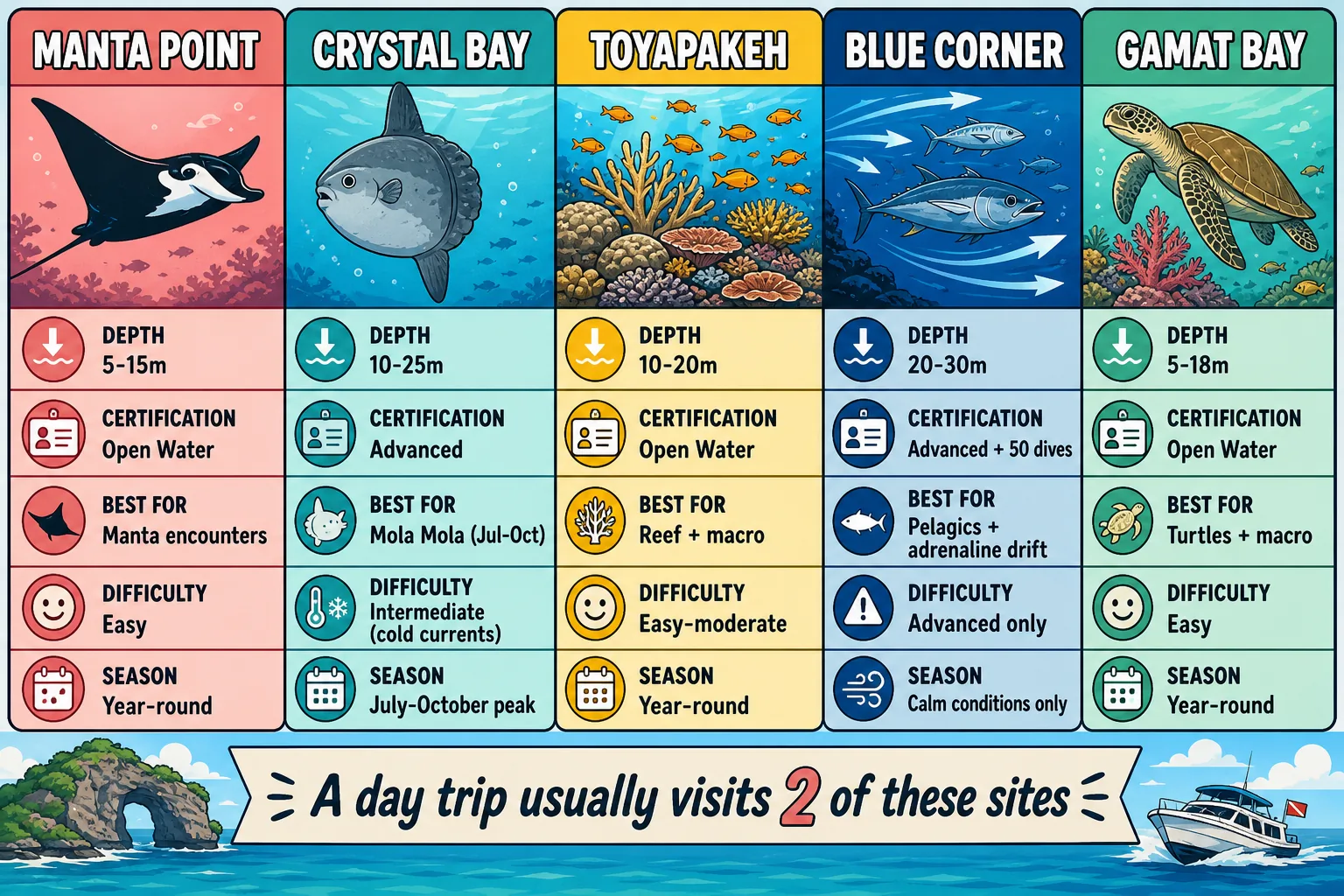
A 2-tank day trip from Sanur will visit two dive sites, almost always chosen from the same five-site rotation. The choice depends on three things: your certification level, the time of year, and that morning's current and visibility forecast. Here is the honest matrix we use at check-in. The full deep dive is in our top 5 Nusa Penida dive sites guide.
Manta Point (the headline act)
The reason most people come. A shallow (5-15 m) cleaning station on Penida's south coast where reef mantas hover over coral bommies while cleaner wrasse pick parasites off them. Encounters are year-round but most reliable November through April when the mantas are most active. Open Water certification minimum, no special experience needed. Surge can be moderate, and on big swell days we substitute another site. More in our complete manta ray diving guide and Manta Point page.
Crystal Bay (the mola mola lottery)
A sheltered bay on the northwest of Penida that gets cold (16-22°C) upwellings from July to October. Those cold upwellings bring the legendary mola mola (oceanic sunfish) up from depth. The dive is 10-25 m on a sloping wall and sandy bottom. Encounters are not guaranteed (the mola is a moody fish), and the cold is genuinely cold by Indonesian standards (a 5 mm wetsuit is recommended, not a 3 mm). Advanced certification preferred for the deeper second pass. See our mola mola Bali season guide and the Crystal Bay page for the full picture.
Toyapakeh (the easy crowd-pleaser)
A drift dive along a healthy slope between Penida and the smaller Ceningan island. 10-20 m depth, mild to moderate current, and one of the most colourful soft and hard coral gardens in the area. Schooling fish, frequent turtle sightings, occasional reef shark. Open Water minimum, comfortable for newer divers. Almost always the choice for dive 2 after Manta Point.
Blue Corner (the adrenaline option)
The wild card. A steep drop-off on the northwest with strong upwelling currents and a pelagic plate of tuna, jacks, the occasional eagle ray, and rare hammerheads. Depth 20-30 m. Currents can be very strong (drift dive with negative entry, divemaster-led only, sometimes with reef hooks). Advanced certification plus 50+ logged dives required; we are strict on this. The full conditions briefing is in our Blue Corner Nusa Penida guide. Day-trippers usually do not dive Blue Corner on their first Penida day; we save it for divers who book a 2 or 3-day Penida package and have proven themselves on dive 1.
Gamat Bay (the underrated favourite)
A small bay just east of Crystal Bay with a beautiful soft coral garden, frequent turtle sightings, macro life (nudibranchs, leaf scorpionfish, frogfish if you are lucky) and almost no current. Depth 5-18 m. Open Water minimum. We use Gamat Bay as the relaxed second dive when dive 1 was deep or current-heavy. Underrated and quieter than Manta Point.
How we actually pair them
For first-time Penida day-trippers in season (April-November) the standard pairing is Manta Point + Toyapakeh. In mola season (July-October) Advanced divers often get Crystal Bay + Manta Point. Newer Open Water divers in mola season do Manta Point + Gamat Bay (skipping the cold depth of Crystal Bay). Advanced repeat customers with 50+ dives sometimes get Blue Corner + Manta Point, but only on calm-current mornings.
The Nusa Penida marine park fee (the bit nobody warns you about)
Nusa Penida is a Marine Protected Area, and every diver pays a Penida MPA conservation fee. As of 2026 the fee is IDR 100,000 per diver per day (roughly IDR 140,000–180,000 (≈ 8–10 USD) depending on exchange rate), or IDR 200,000 for a 3-day pass if you are diving multiple days. The fee is paid at the Penida harbour or in some cases collected by the dive shop on your behalf at check-in. It is almost never included in the headline day trip price, so expect to add IDR 140,000–180,000 (≈ 8–10 USD) to the quoted price on the day.
For snorkelers the same fee applies. Children under 12 are exempt for the diving fee but pay a smaller snorkeling fee if they are joining a snorkel tour. The fee funds reef monitoring, mooring buoy maintenance and the manta cleaning station protection programme. Pay it without complaint; this is one of the better-run MPAs in Indonesia and the fee is what keeps it that way.
Separately, there is a smaller park entry charge if your boat lands on Penida itself (the dock and beach lunch fee, IDR 25,000-50,000 per person). Some operators bundle this into the day trip price, some collect it separately. Ask up-front. The total of all fees rarely exceeds IDR 220,000–270,000 (≈ 12–15 USD) per diver per day.
What to pack for a Penida day trip (gap nobody covers)
The general Bali scuba diving packing list applies, but a day trip to Penida from Sanur has a few specifics. Pack a small day bag with the following:
Swimsuit and rashguard on under your clothes. You change at the shop, not on the boat. Wear your swimwear from the hotel and skip the boat-changing-room shuffle.
Mask (your own if you have one). Rentals are fine but well-fitting personal mask is the single biggest upgrade to your dive experience. Bring it.
Light long-sleeve top and a sarong. The wind on the boat at 30 knots is colder than it sounds in the tropics. A thin long-sleeve sun-protective top makes the crossings way more pleasant.
Reef-safe sunscreen. The Penida MPA enforces a ban on oxybenzone-containing sunscreens. Bring Stream2Sea, Thinkbaby, or Badger. Sunscreen the back of your neck (the most-forgotten spot for divers).
Cash IDR for the marine park fee and lunch tips. Some shops accept card for the trip but the on-island fees are cash-only. IDR 200,000-300,000 in small notes is enough.
Refillable water bottle. We provide drinking water on the boat but a refillable bottle saves single-use plastic and the MPA appreciates it.
Motion sickness aid (cinnarizine, meclizine, or ginger sweets) if you are prone. Take 60 minutes before pickup. Skip scopolamine patches (drowsy underwater).
Towel. Most shops provide one but a personal microfibre is better.
Camera + spare battery. The morning crossing photo of Penida cliffs appearing through the dawn haze is one of Bali's iconic shots. Charge your GoPro overnight.
Earplugs (the silicone ones, not foam). Optional but life-changing for the boat ride if you have sensitive ears.
Do NOT pack: heavy backpack (no room on the boat), valuables (leave at the hotel safe), books (you will be too active or too tired to read), restrictive shoes (flip-flops only).
Best season for a Penida day trip from Sanur
Penida is divable year-round but the season meaningfully shifts what you will see and what the crossing will feel like.
April-June (shoulder, recommended). Calm seas, water 27-29°C, manta encounters reliable, mola season just starting. Smaller crowds than peak. Best month-of-the-year for a first Penida day if you have flexible dates.
July-October (peak mola, busy). The famous mola mola season at Crystal Bay. Water drops to 18-22°C at the cold upwellings, surface 27°C. Manta encounters still excellent. Sea conditions calm in the mornings, can get windy by afternoon. Book 2-4 weeks ahead in August and September.
November-March (rainy season, fewer crowds). Sea is warm (28-30°C), manta encounters at their peak (the mantas love this water), and the famous Penida reefs are largely uncrowded because most tourists are scared off by the rainy season. The downside: 5-10 trip cancellations per month due to wind/swell. We cover the full trade-off in our Bali rainy season diving guide. Honestly the best value diving of the year if your dates are flexible.
Certification and experience requirements
The minimum for any Penida day trip is Open Water Diver certification. With Open Water you can dive Manta Point, Toyapakeh and Gamat Bay (the three easier sites) at up to 18 m. You will not get to dive the depth or current of Crystal Bay or Blue Corner without Advanced.
For Crystal Bay (mola mola depth), we strongly recommend PADI Advanced Open Water because the best mola encounters happen at 22-30 m, and Open Water is depth-limited to 18. If you are visiting in mola season and want a realistic chance at a sunfish encounter, do the AOW course in Bali in the 2 days before your Penida trip. The course in Bali runs IDR 6,300,000–8,100,000 (≈ 350–450 USD) and pays for itself in dive site access for the rest of your trip.
For Blue Corner, the requirement is Advanced plus 50 logged dives plus comfort with strong current. We check logbooks; do not be offended. The site is unforgiving for under-experienced divers.
If you are completely new to diving, you cannot do a normal Penida dive on your first day in Bali. We strongly recommend either: (a) doing a Discover Scuba in Sanur first, then booking Penida for day 3-5 of your trip; or (b) doing the full PADI Open Water course in Bali in days 1-3, then Penida on day 4-5. The Penida currents are not the place to learn the basics. We can also run a PADI Drift Diver specialty in 2 dives if you want to add drift-specific skills before tackling Blue Corner. For families with kids, see our diving with kids in Bali guide.
Two-tank vs three-tank: which day trip option to book
Most Sanur shops offer two day trip options: the standard 2-tank day (2 dives, lunch, back by 3 PM) and the longer 3-tank day (3 dives, longer lunch, back by 5 PM). Which one is right for you depends on certification, fitness and ambition.
2-tank day (most popular, ~85% of bookings). Comfortable for everyone, including first-time Penida divers and anyone newly certified. You will see 2 of the headline sites with a relaxed surface interval. Cost IDR 2,350,000–2,900,000 (≈ 130–160 USD) per certified diver.
3-tank day (for experienced divers). Adds a third dive in the late morning before lunch. Requires Advanced certification, 30+ logged dives, and good physical fitness (3 dives in 6 hours is real work). You will get extra bottom time at the harder sites (Blue Corner is often the dive 1 of a 3-tank day). Cost IDR 2,950,000–3,500,000 (≈ 165–195 USD). Skip if you are jet-lagged or if this is your first day in Bali.
What we recommend. Do the 2-tank day on day 1. If you loved it, book another 2-tank or upgrade to 3-tank on day 2 with us. Pacing yourself across the first day prevents the dreaded "dive 3 mistake" (a sloppy third dive with low gas, fatigue, and reduced situational awareness).
Transparent 2026 cost breakdown
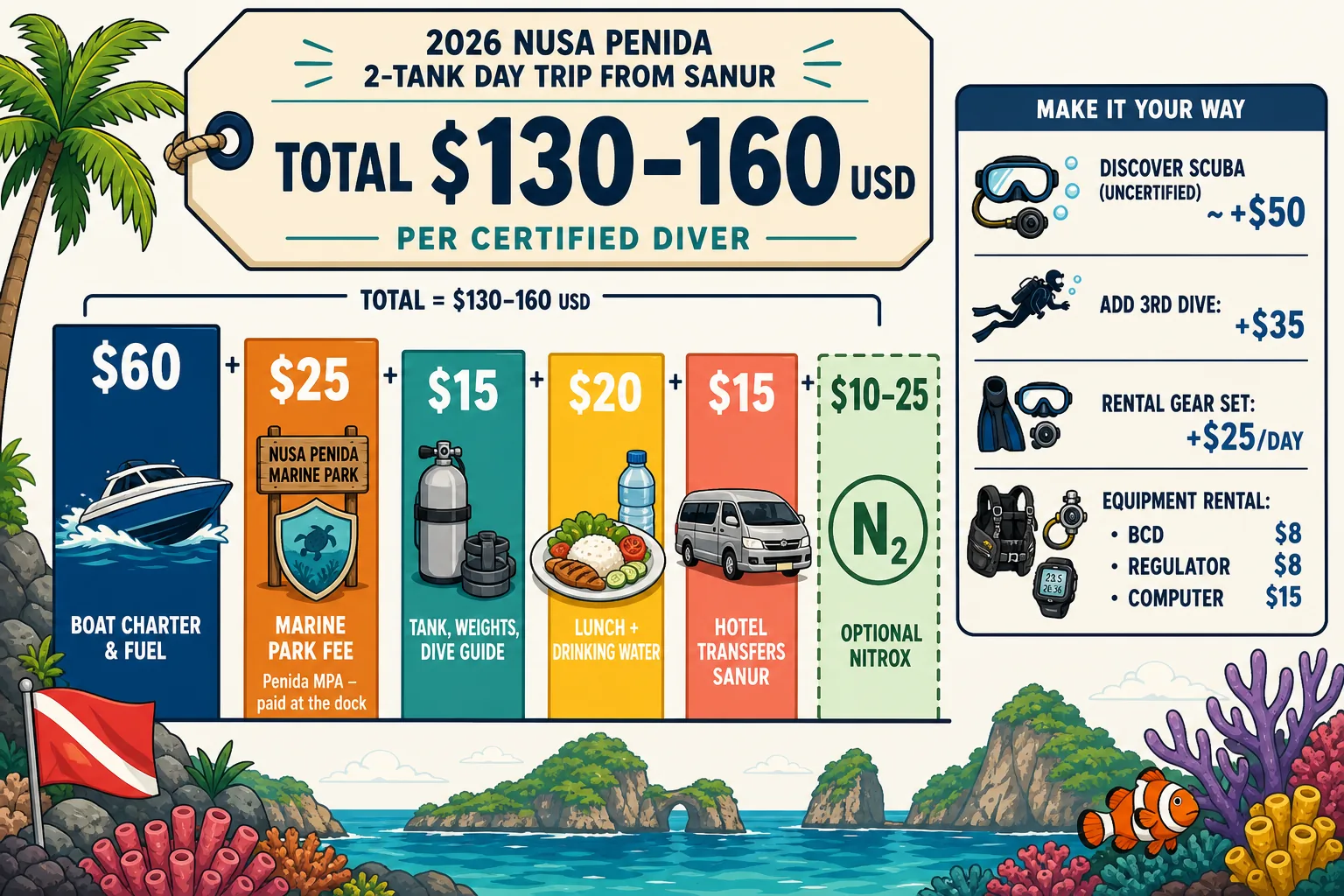
Here is what you are actually paying for on a standard 2-tank Sanur to Penida day trip. We list our own current 2026 numbers; other Sanur shops vary by ±15% but the structure is the same. Full pricing for adult and family packages is in our Bali diving price guide.
| Item | IDR 36,500,000 (≈ 2026 USD) | Notes |
|---|---|---|
| Boat charter share + fuel | IDR 1,100,000 (≈ 60 USD) | Per-diver share of the speedboat day rate |
| Marine park fee | IDR 140,000–180,000 (≈ 8–10 USD) | Penida MPA conservation fee, paid at dock (IDR cash) |
| Tank, weights, dive guide | IDR 270,000 (≈ 15 USD) | Two 12L aluminium tanks, weight belt, certified divemaster |
| Lunch + drinking water | IDR 360,000 (≈ 20 USD) | Indonesian buffet at Toyapakeh or Crystal Bay restaurant |
| Hotel transfers (Sanur) | IDR 270,000 (≈ 15 USD) | Door-to-door minivan, included in Sanur trips |
| Subtotal certified diver (2-tank) | IDR 2,350,000–2,900,000 (≈ 130–160 USD) | Standard package, gear rental separate if needed |
Optional add-ons.
- Rental gear set (BCD + regulator + dive computer): +IDR 450,000 (≈ 25 USD)/day
- Individual rentals: BCD IDR 140,000 (≈ 8 USD), regulator IDR 140,000 (≈ 8 USD), dive computer IDR 270,000 (≈ 15 USD), 5 mm wetsuit IDR 90,000 (≈ 5 USD)
- Nitrox 32% fill (one tank): +IDR 180,000–270,000 (≈ 10–15 USD)
- Third dive upgrade: +IDR 650,000 (≈ 35 USD)
- Private dive guide (1:1 or 2:1 ratio): +IDR 900,000–1,800,000 (≈ 50–100 USD)/day
- Discover Scuba (uncertified diver) on Penida: not allowed; do it in Sanur first
Pickups outside Sanur. +IDR 180,000–450,000 (≈ 10–25 USD) depending on distance. Canggu/Seminyak: +IDR 270,000 (≈ 15 USD). Ubud: +IDR 450,000 (≈ 25 USD).
What is NOT extra in our quote. No booking fee. No fuel surcharge. No "tip jar" pressure. The crew tip at the end of the day is at your discretion (IDR 90,000–180,000 (≈ 5–10 USD) per diver is normal and appreciated).
Snorkelers in a diving family: the parallel option
A common scenario: one parent dives, the other parent + kids want to be in the water but not scuba. Penida is one of the best snorkel destinations in Bali for this. Our Penida snorkeling tour runs in parallel with the dive day, same boat or a buddy boat, same lunch stop. Snorkelers see mantas at Manta Point from the surface (mantas come up to within 1-2 m of the surface, totally visible with mask and snorkel), and visit a couple of shallow reef snorkel sites. Cost IDR 1,100,000–1,550,000 (≈ 60–85 USD) per snorkeler depending on inclusions. Kids under 6 free if accompanied. For families travelling together, this is the way to do Penida without splitting up.
Common questions we get at check-in
How likely am I to see a manta?
Year-round at Manta Point our encounter rate is roughly 90% (i.e., 9 out of 10 trips see at least one manta). Peak months November-April it is 95%+. Worst months July-August it is still around 80%. The mantas are wild; we cannot guarantee them, but the cleaning station is a reliable enough magnet that almost every Penida day visits it.
What is the chance of a mola mola sighting?
Much more variable than mantas. July through October our Crystal Bay encounter rate is roughly 35-50% per trip (so over a 3-day Penida package, your odds approach 80-90%). The mola is a moody, depth-loving fish that comes shallow only when the cold upwelling pulls it up. You will know in the first 10 minutes of the dive whether the cold water is at depth that day. If your one Bali trip is in mola season and you really want to see one, book 3 days of Penida diving, not just one.
Can I do Penida with only an Open Water certification?
Yes, with site restrictions. Manta Point, Toyapakeh and Gamat Bay are all comfortable Open Water sites. Crystal Bay and Blue Corner are Advanced-only (depth and current). Most first-time Penida day-trippers from Sanur are Open Water and they have great trips.
Will I get a refresher dive before going to Penida?
If your last dive was more than 12 months ago, yes (and we will not skip it). It is a 20-minute pool refresher at the shop before the Penida day, included in your trip. If your last dive was 6-12 months ago, we do an in-water buddy check at the first site instead. If your last dive was within 6 months and you have 25+ logged dives, no refresher needed.
Is Nusa Penida dangerous?
"Dangerous" is the wrong word. "Demanding" is the right one. Penida currents can be strong, the water is colder than the rest of Bali, and some of the sites are unforgiving for under-experienced divers. With a competent dive operator (the kind that briefs current direction, uses reef hooks at Blue Corner, briefs negative-entry technique, and matches divers to appropriate sites), Penida has a great safety record. The most dangerous part of the day is the speedboat ride, statistically speaking, and that is very safe too.
Can I dive Penida if I am pregnant, have a cold, or recently flew?
Pregnancy: no, diving is not recommended at any stage of pregnancy. Cold: not that day, period. Recent flying: wait 24 hours after a flight before your first dive (we ask about flight times at check-in). Fly-after-dive: 18 hours after a single dive, 24 hours after multiple dives (so your last Penida dive should be at least 18-24 hours before your flight home).
What if I cancel last minute?
If you cancel within 24 hours of pickup, full price applies (we have already provisioned the boat, fuel, crew, and your spot). If you cancel due to a real medical issue with a doctor's note, we move your booking. If we cancel due to weather, full refund or rebook. This is standard across Sanur shops.
What is the best Penida day trip option for first-timers?
A 2-tank day on day 3-5 of your Bali trip (after 1-2 acclimatisation dives in Sanur house reef or Padang Bai). This gives you time to get used to the Bali heat, time-zone, and dive gear before adding the Penida boat ride and currents to the mix. Day 1 of your trip is the worst day to attempt Penida; you are jet-lagged and not yet dive-fit.
When NOT to book a Penida day trip
A short list of times we will steer you toward a different dive destination instead:
Your first day of diving in Bali. Do Sanur house reef or Tulamben to shake the dust off first. Penida deserves your best diving day, not your jet-lagged one.
You are new to diving (under 10 dives) and visiting in July-August. Surface conditions and Crystal Bay cold can make for a hard day. Do Manta Point + Toyapakeh only, skip Crystal Bay.
You are pregnant or have an active ear infection. Diving is contraindicated. We can offer the Penida snorkeling tour instead.
You only have 1 dive day in Bali and want a guaranteed great experience. Counterintuitive but worth saying: Tulamben Liberty wreck is a more guaranteed great single-day experience than Penida. Wreck, healthy reef, easy logistics, no surprises. Penida is the more spectacular destination over multiple days but has more day-to-day variance.
Sea is forecast to be 2+ metres swell. We will cancel proactively. Trust the call.
Booking your Penida day trip with us
Email or use the Bali booking form with: your dates, certification level, last dive date, any medical considerations, and your accommodation. We will quote a 2-tank or 3-tank day, send a confirmation with the pickup time, and add you to the next available departure (we run daily April-November, 5-6 days/week November-March depending on conditions). For full Bali pricing across all our trips, see our Bali dive price guide.
If you are turning a Penida day into a longer trip with us, common packages: 3-day Penida-focused trip (mola season), 5-day "best of Bali" trip (Penida + Tulamben + Sanur reef), or 7-day learn-to-dive trip ending with a Penida day. We can also combine Penida with a Komodo tour from Bali or a Komodo liveaboard if you want both reef systems in one Indonesia trip.
One last honest note. The thing that makes Penida special is not just the mantas or the mola or the cliffs (though those are real and they are spectacular). It is the moment, about 25 minutes into the morning crossing, when the Penida coastline first appears clearly through the dawn haze and you realise you are about to dive a place that the rest of the diving world has heard of and dreamed about. Bali is a big island with many great dive sites. Penida is the day that gets photographed and remembered.