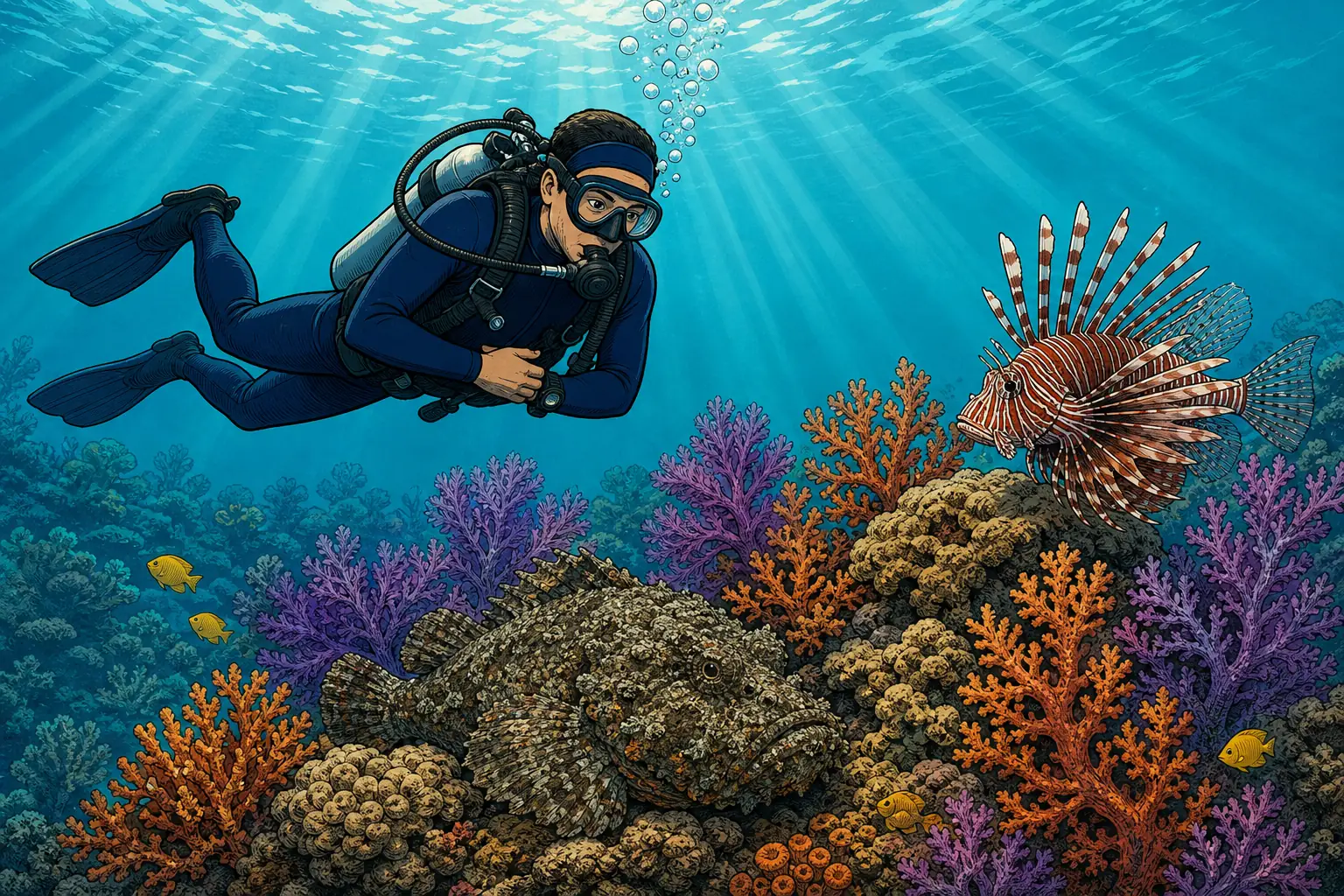
Cel-shaded illustration of a scuba diver hovering in good trim above a Bali reef with hands tucked in, keeping clear of a camouflaged stonefish on the bottom and a lionfish with fanned venomous spines beside a coral head.

Search for dangerous sea creatures in Bali and you get a parade of nightmare fuel: blue-ringed octopus venom that could kill twenty-six adults, stonefish described as the most venomous fish alive, sea snakes ten times deadlier than a rattlesnake. All technically true. All close to useless if what you actually want to know is whether you should worry before your first dive in Bali. We have been running boats out of Sanur for years, several thousand guests a year, and the honest answer is that the list of things that hurt people here looks nothing like the list of things people search for.

What we treat, over and over, is coral scrapes and urchin spines. What we have never once treated is a blue-ringed octopus bite. This guide is the real ranking, in the order things actually happen, with the first aid that matters and the bits people get wrong. It covers snorkelling in Bali as much as diving, because the shallow water is where nearly all of it happens. Where it touches on medicine we follow published clinical guidance rather than our own opinion, and we say clearly when something needs a hospital rather than a dive guide.

Dangerous Sea Creatures in Bali, Ranked by What Actually Happens

Here is our incident book, roughly ranked. Not the internet's version. Ours.

Common enough that we carry supplies for it: coral cuts and grazes, sea urchin spines in the foot or hand, fire coral and hydroid stings, small jellyfish welts, and the itchy rash people call sea lice. That is the overwhelming majority. It is unglamorous, it is rarely serious, and it accounts for perhaps nineteen out of twenty things we deal with.

Rare but real: a stonefish or scorpionfish sting, almost always to a foot, almost always from someone standing up in shallow water at a shore entry. Also the occasional titan triggerfish that decides your fins are a threat to its nest, and a moray bite in the very few places where somebody has been feeding them.

Essentially theoretical for a supervised diver: blue-ringed octopus, cone snail, sea snake. These are the three the scare articles are built on. Between them they cause almost no injuries to recreational divers anywhere, for the simple reason that all three require you to pick the animal up or corner it.

Sharks belong in a fourth category, which is not a category at all. We cover why in our guide to sharks in Bali, and the short version is that the reef sharks here run away from you. If your worry is broader than marine life, our piece on whether Bali is safe generally and the statistics in is scuba diving dangerous cover the rest.

The Real Top Three: Coral, Urchins and Fire Coral

Nobody writes listicles about these. They are the ones that end holidays.

Coral cuts

A coral graze is not just a scratch. Coral leaves behind protein, tiny calcium fragments and a mixed bag of bacteria, and in 29 degree water a shallow cut on a shin can turn into a genuinely nasty infection in about two days. We have seen guests fly home on antibiotics because of a scrape they did not bother mentioning on the boat.

Scrub it properly, and we mean scrub, with clean fresh water and soap on the same day. Get the fragments out. Antiseptic, keep it covered, and watch it. If the edges go red and hot, or it starts weeping after 48 hours, see a doctor rather than waiting it out. The fix is almost always a cheap course of antibiotics from a clinic, and the mistake is always leaving it three days.

Sea urchins

Black long-spined urchins sit in exactly the places people put their hands: rocky shore entries, the boulders at Padang Bai, the shallow edges at Amed. The spines are brittle, they snap off under the skin, and they hurt out of all proportion to the size of the puncture.

Most spine fragments work their way out on their own over one to three weeks, and digging at them with a needle usually does more damage than the urchin did. Soaking in hot water helps the pain. What needs a doctor is a spine in a joint or in the palm near a tendon, anything that stays swollen after a few days, or fragments in a face or eye, which is a straight-to-hospital situation.

Fire coral and hydroids

Fire coral is not coral. It is a hydroid, related to jellyfish, and it delivers the same kind of sting from a mustard-brown surface that looks like harmless rock. You brush it with a bare forearm, feel nothing much for thirty seconds, and then get an hour of burning and a raised welt that itches for days.

Do not rinse with fresh water, which fires off any stinging cells still on the skin. Rinse with seawater, do not rub, and treat the pain with hot water or a cold pack, whichever the person prefers. Vinegar is worth having on the boat and we carry it. A mild steroid cream sorts out the itch afterwards.

Stonefish and Other Venomous Spines

If you take one thing from this article, take this section. The stonefish is the only animal on the list that is both genuinely dangerous and genuinely likely to be underfoot where tourists walk.

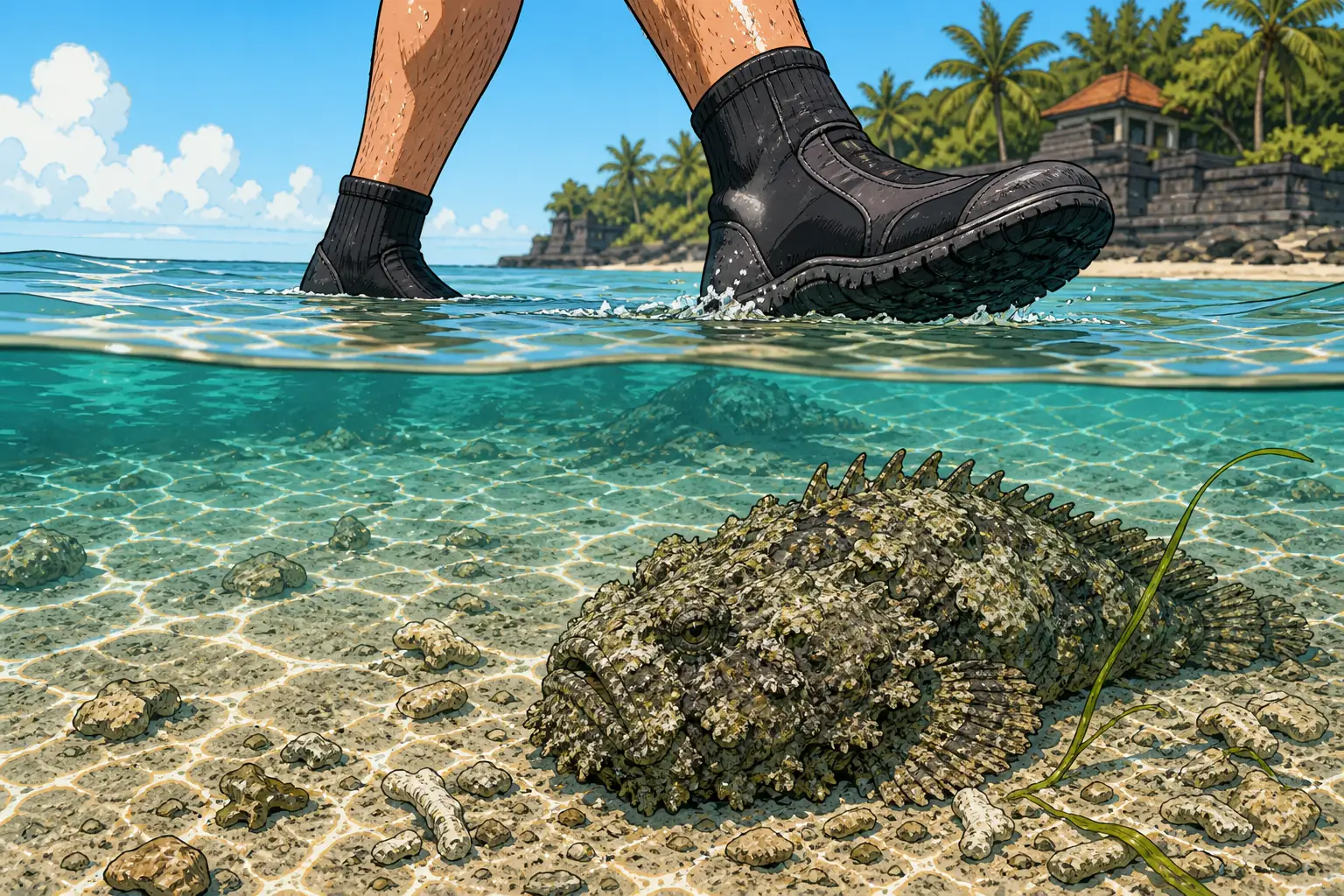
Cel-shaded split-level illustration of a person wearing neoprene reef boots shuffling through knee-deep turquoise shallows in Bali, with a superbly camouflaged stonefish lying motionless on the sandy rubble bottom just ahead of their feet.

The problem is not aggression. A stonefish has never chased anybody. The problem is that it is the best camouflage in the ocean sitting perfectly still in ankle to knee deep water, and it does not move when you approach, because its entire survival strategy is being invisible. It has around thirteen stout dorsal spines connected to venom glands. Standing on one drives the spines in and pumps venom into the wound under your own body weight.

Where it happens in Bali is shore entries and exits, not on the reef at depth. The black sand at Tulamben and the rubble at various shore entries are the classic spots. It happens to people wading barefoot, and it happens on the way out more than the way in, because everybody is tired and stops looking.

What it feels like, honestly

Divers who have had it describe pain that arrives instantly and then keeps climbing for an hour, spreading up the whole limb, well past anything a normal injury produces. People become irrational with it, and the clinical guidance actually lists that as a sign. There is swelling, sometimes a grey or blue tinge around the puncture. It is a medical emergency, not a tough-it-out situation, and antivenom exists for severe cases.

First aid: hot water, and the mistake people make

Stonefish venom is a protein, and protein breaks down with heat. That single fact drives the whole protocol. Per the ANZCOR guideline on fish stings and Australian government health guidance on sea creature stings, the treatment is to immerse the limb in hot water at around 45 degrees for up to 90 minutes, removing it briefly and repeating if the pain returns.

Three details matter and get missed. Test the water on an uninjured limb first, because a person in that much pain cannot judge temperature and scalding on top of envenomation is a real outcome. Do not apply a pressure immobilisation bandage: the guidance says explicitly not to for fish stings, because it increases pain and tissue damage. And if a spine is embedded, leave it, pad around it, because it may be plugging the wound.

Then get to a hospital regardless of how much the hot water helped. This is the point where you call, not the point where you decide it is fine.

Lionfish, scorpionfish and stingrays

Same venom chemistry, same treatment, much less drama.

Lionfish are all over Bali and are frankly one of the nicer things to photograph. They are slow, they hold their position, and they will let you get close, which is exactly why people occasionally back into one or put a hand down beside one. The sting is intensely painful for a few hours and very rarely dangerous. Hot water again.

Scorpionfish are the stonefish's less committed cousin and turn up on almost every muck dive we run. If you enjoy that kind of diving, our guide to macro and muck diving in Bali is worth a read, and the honest safety advice for it is simply to know where your knees and your camera housing are at all times.

Stingrays deserve one specific warning. The injury is not really an envenomation, it is a stab wound with venom attached, and a barb can break off inside. Do not pull it out. Pad around it, control the bleeding, hospital. Rays on sand at places like the shallows around Menjangan will move long before you reach them, and again the risk is standing rather than swimming.

The Blue-Ringed Octopus: Famous, Tiny, Almost Never a Problem

This is the animal that drives most of the searches, so let us be precise about it rather than either dismissive or dramatic.

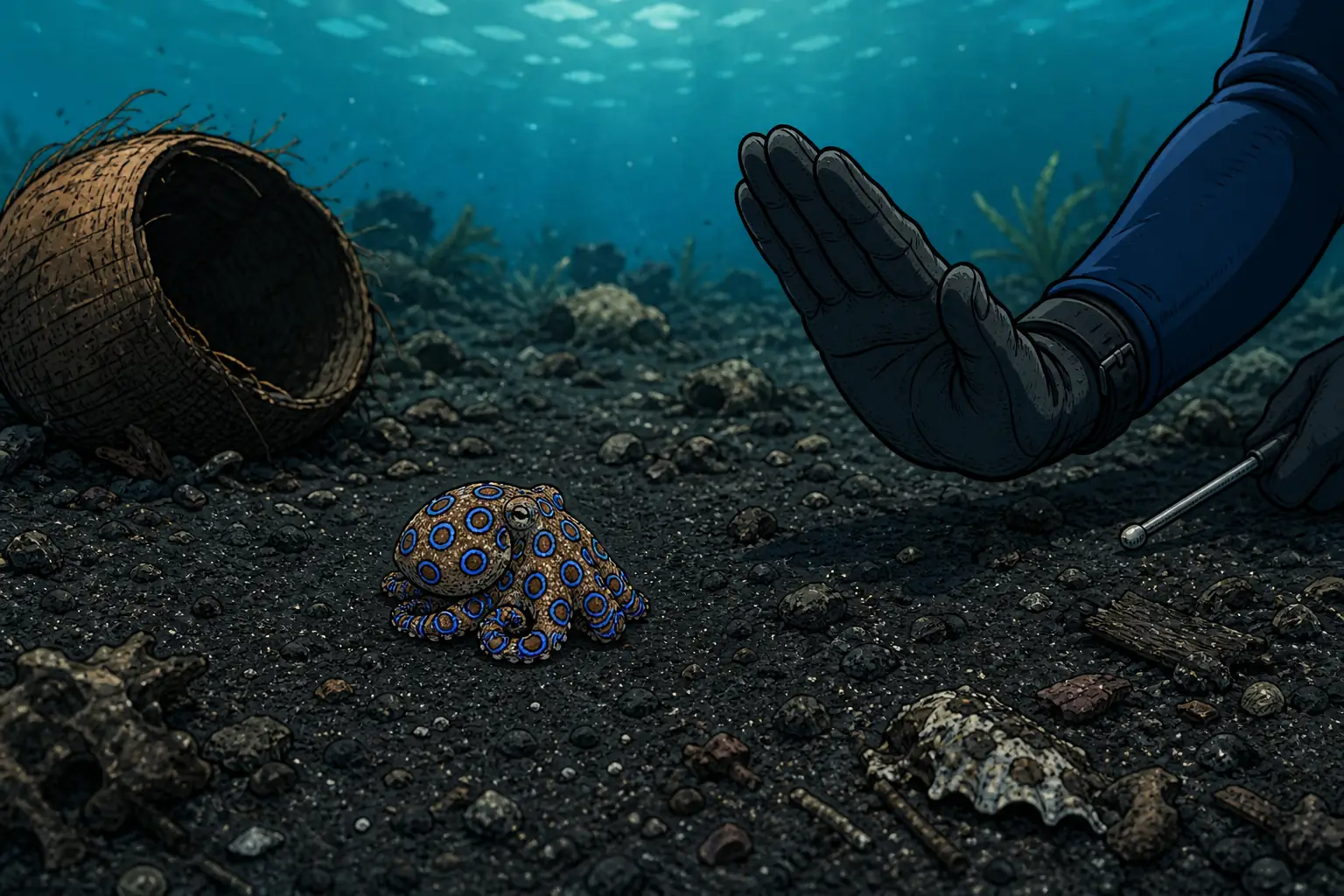
Cel-shaded underwater illustration of a small blue-ringed octopus displaying its electric blue warning rings on dark volcanic sand at a Bali muck diving site, with a diver's gloved hand held back at a respectful distance in a deliberate do-not-touch gesture.

The facts are genuinely alarming. It is about the size of a golf ball. Its saliva contains tetrodotoxin, the same toxin as pufferfish, produced by bacteria living in its salivary glands. The bite is often painless. There is no antivenom, anywhere. Symptoms can start within five to thirty minutes as tingling around the lips, then progressive muscle weakness, then respiratory paralysis.

And now the part the scare articles leave out. It bites when it is handled. That is essentially the whole risk profile. It is a shy animal that hides, and the electric blue rings are not a threat display aimed at you, they are a warning that appears when it is already frightened. Bites overwhelmingly happen to people who picked one up, usually out of the water, often having no idea what it was. Divers who keep their hands to themselves do not get bitten.

We do see them, mostly on the black sand sites, and it is a highlight when we do. Our guides will point one out and hold the group back. Nobody touches it, nobody herds it into the open for a photo, and that is the end of the story.

If somebody is bitten, the protocol is not the stonefish one, and confusing the two is the most dangerous mistake in this whole article. Hot water immersion breaks down fish spine venom and will do nothing to a neurotoxin. What matters here is a pressure immobilisation bandage: a broad elasticised bandage firmly over the bite and then along the entire limb, plus a splint to stop it moving. Keep the person still and calm. Call emergency services immediately. Because the toxin paralyses the breathing muscles while the person often stays aware, rescue breathing can keep somebody alive for hours until the venom wears off, and people do make full recoveries when ventilation is maintained. Cone snails, which nobody should be picking up either, follow the same protocol.

Sea Snakes and Banded Sea Kraits

You will see them. Banded sea kraits are common around the Gili Mimpang and Tepekong pinnacles and along plenty of reef, and they are one of the more startling things to meet at fifteen metres if nobody warned you.

They are very venomous and very uninterested in you. Kraits have small mouths, mild temperaments and no reason to spend venom on something they cannot eat. They come to the surface to breathe, which is when most people see them swimming past, and they poke into crevices hunting eels. Recorded bites are almost entirely fishermen untangling them from nets. Divers, essentially never.

The rule is the boring one: watch, do not touch, do not block its route to the surface. If a bite ever did happen, it is treated like a land snake bite, which means pressure immobilisation and complete stillness, same as the blue-ring, not hot water.

Jellyfish, Hydroids and the Rash Nobody Warns You About

Jellyfish in Bali are seasonal, patchy and mostly a nuisance rather than a threat. Some weeks there is nothing at all. Other weeks, usually when the wind swings and pushes surface water in, you get a run of small stings on exposed necks and wrists.

The general first aid, and we keep this simple deliberately: get out of the water, rinse with seawater rather than fresh, do not rub with a towel, and lift off any visible tentacle with a gloved hand or the edge of a card instead of your fingers. Vinegar is the standard first response for tropical box jellyfish stings and is worth having on any boat in Indonesia. After the tentacles are dealt with, hot water helps the pain for most tropical stings. Anything involving breathing difficulty, chest pain, cramping across the body or a very large sting area is an ambulance call, not a first aid kit.

Then there is the one that catches people out completely. Seabather's eruption, which everyone in Bali calls sea lice, is not lice at all. It is the larvae of jellyfish and anemones trapped under your swimwear or rash guard, stinging in exactly the pattern of the fabric. You feel nothing in the water. Four hours later you have an itchy red rash precisely where your wetsuit was tight. The prevention is annoying but effective: rinse and change out of your swimwear promptly rather than sitting in it through lunch, and rinse the swimsuit itself in fresh water. Do not shower in fresh water with the suit still on, which sets the remaining cells off.

The Animals That Actually Bite Divers

Ask any guide in Indonesia which animal has genuinely gone for them and you will not hear shark, stonefish or octopus. You will hear titan triggerfish.

During nesting season a titan triggerfish digs a crater in the sand and defends the water column above it, and the territory is cone-shaped, widening as it goes up. So the instinctive reaction, which is to swim upwards away from the fish, takes you further into the zone it is defending. Swim horizontally instead, keep your fins between you and the fish, and leave. They have serious teeth and they will take a chunk out of a fin, a mask strap or occasionally a leg. It is the one animal we brief on specifically before certain dives.

Moray eels bite for one reason, which is hands near holes, and the problem is almost always a history of somebody feeding them. We do not feed anything, and neither should any operator you dive with. Our guides carry a pointer and use it to indicate, not to poke.

Everything else worth mentioning is defensive and avoidable. Damselfish will headbutt you off their patch of algae and it is comical rather than dangerous. Turtles are harmless unless cornered, which is covered in our guide to sea turtles in Bali. And the manta rays at Nusa Penida have no barb and no interest in you, which we get asked about so often we wrote a whole article on whether mantas are dangerous.

What We Carry, and Who to Call

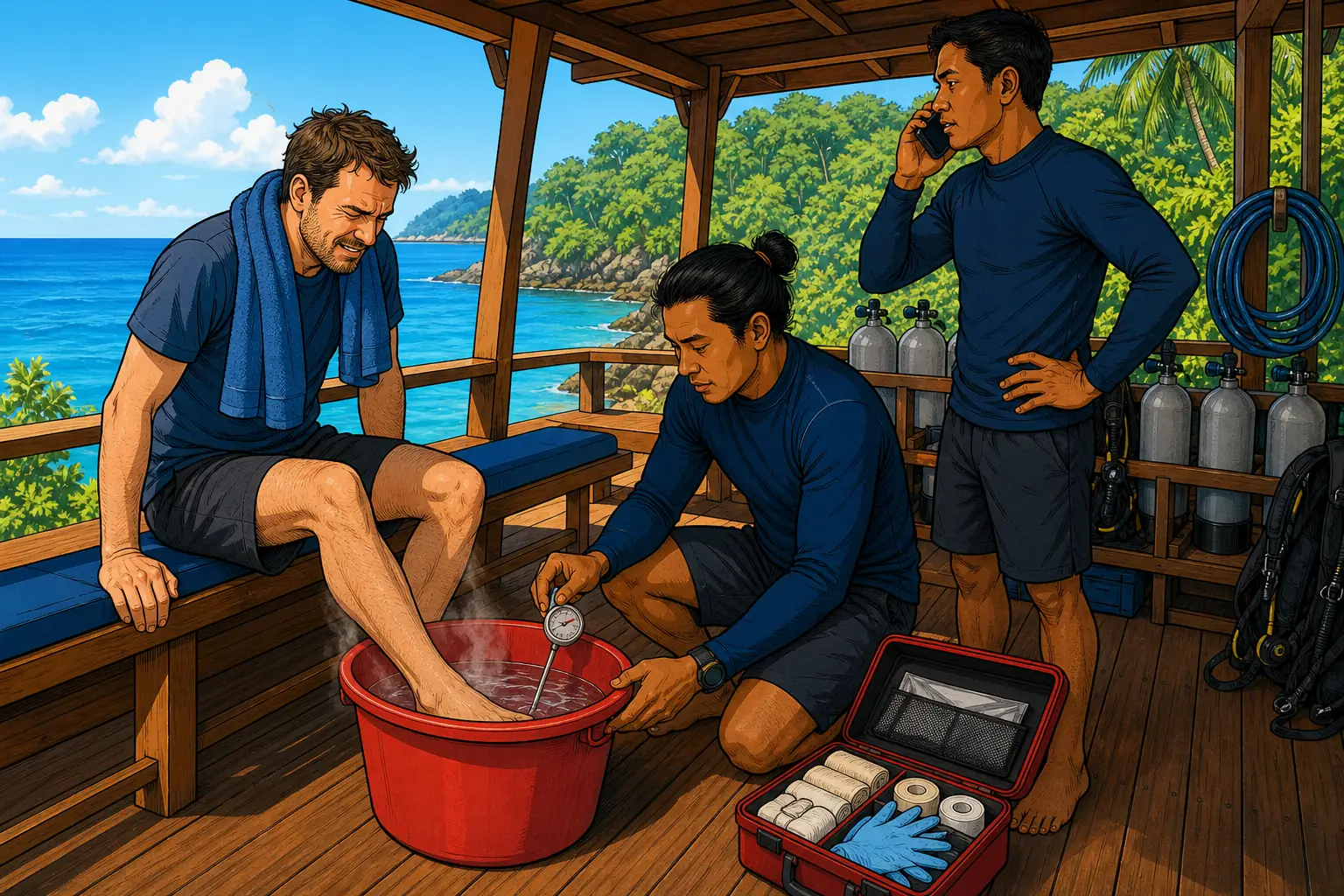
Cel-shaded illustration of first aid on a Bali dive boat deck, with a guest soaking a stung foot in a bucket of hot water while a divemaster checks the temperature with a thermometer and a colleague phones for medical advice beside an open first aid kit.

Every boat we run carries a first aid kit, oxygen, fresh water, vinegar, and a bucket plus a way to heat water. The thermometer is not for show. Forty five degrees is hot enough to break down venom and cool enough not to burn, and guessing that by hand while somebody is screaming is how people end up with a scald on top of a sting.

Useful numbers to have in your phone before you get in the water anywhere in Indonesia:

  • 112 is the general emergency number in Indonesia and works from any local phone.
  • DAN emergency hotline: +1-919-684-9111 internationally, and DAN now runs an Indonesian-language line on 021-5085-8719. It is free to call and you do not have to be a member. Details on the Divers Alert Network hotline page.
  • Hyperbaric chamber: Prof. Ngoerah Hospital in Denpasar, still widely known as Sanglah, on +62 361 227911.
  • International-standard hospitals: BIMC in Kuta and Nusa Dua, and Siloam in Denpasar, all with English-speaking staff.

The order matters. Stabilise the person and get them to the nearest medical facility first, then call DAN for consultation with whoever is treating them. Travel insurance that explicitly covers diving is the other half of this, and we go through what to look for in our health and vaccinations guide for divers in Bali.

If you want to be the person who knows what to do rather than the person filming it, the Emergency First Response course takes a day and the Rescue Diver course is the single best course in recreational diving. We are not being coy about selling those. They genuinely change how useful you are on a bad day.

How We Actually Avoid All of This

Almost every injury in this article traces back to one of three things: touching something, standing on something, or being out of control in the water. Fix those and the risk approaches zero.

Buy reef boots. Not flip flops, not bare feet. A pair costs IDR 150,000 to 250,000 in any Sanur dive shop and they solve urchins and stonefish in one purchase. Wear them for every shore entry, and shuffle your feet rather than stepping down, which pushes anything hidden out of the way instead of onto a spine. This is on our Bali diving packing list for a reason.

Do not touch anything, at all, ever. Not to steady yourself, not for a photo, not the pretty shell. This is also why we discourage gloves on most of our reef dives: gloves make people feel entitled to grab things, and the reef comes off worse than the diver. Guides carry a pointer, guests carry nothing.

Get your buoyancy sorted. The diver who is crashing into the reef is the diver who gets stung, and it is the same diver who breaks coral. If you are hovering a metre off the bottom, nothing on this list can reach you. Two dives of Peak Performance Buoyancy will do more for your safety than any amount of reading about venom, and the same skills come up throughout the Advanced Open Water course.

Dive with a guide who knows the site. Ours know which crevice holds the moray, which season the triggerfish get territorial at each site, and where the urchins carpet the entry at low tide. That is worth more than any checklist. It applies just as much to snorkelling at Sanur and Nusa Penida, where people are in shallow water without fins on and paying no attention to what is underneath them.

So Should You Worry

No, and we say that having run the trips and filled in the incident forms. Bali's water is warm, the visibility is good, and the animals here have no interest in you whatsoever. In a normal year the worst thing that happens on our boats is a scraped shin and a bruised ego.

Worry about the boring stuff instead, because the boring stuff is what actually gets people. Wear boots on shore entries. Keep your hands off the reef. Wash a coral cut properly on the day you get it rather than three days later. Learn where your fins are. Do those four things and the blue-ringed octopus stays what it should be, which is a rare and beautiful animal you will be delighted to see from a metre away.

If you are still nervous, that is completely normal and it is not a reason to skip the water. Most of our guests on a first dive in Bali arrive with some version of this worry, including the ones who cannot swim well, which we covered in whether you need to swim to scuba dive. Families ask us about it constantly and we go through the specifics in our family diving guide. Tell us what is worrying you when you book, or just send us a message, and we will give you the same straight answer we have given here.

常见问题

By venom potency it is the blue-ringed octopus, whose tetrodotoxin has no antivenom. By actual risk to visitors it is the stonefish, because it sits camouflaged in ankle-deep water at shore entries and people stand on it. The blue-ring only bites when handled, so divers who keep their hands to themselves are effectively not exposed to it.
The shallows are where nearly all injuries happen, but they are minor ones: coral cuts, sea urchin spines, fire coral stings and small jellyfish welts. The one serious risk in shallow water is stepping on a stonefish, which reef boots and shuffling your feet almost entirely prevent.
Immerse the limb in hot water at around 45°C for up to 90 minutes, testing the temperature on an uninjured limb first so you do not scald the person. Do not apply a pressure immobilisation bandage, which clinical guidance advises against for fish stings. Leave any embedded spine in place and pad around it, then get to a hospital, because antivenom exists for severe cases.
They are present, mostly on the black sand muck diving sites, and seeing one is considered a highlight rather than an emergency. Bites are extraordinarily rare and happen almost exclusively when someone picks the animal up. In years of running dives we have never had one.
It is not the same as a stonefish sting, and confusing the two is dangerous. Hot water immersion breaks down fish spine venom and does nothing to a neurotoxin. Apply a pressure immobilisation bandage firmly over the bite and along the whole limb with a splint, keep the person still, and call emergency services. The toxin paralyses the breathing muscles, so rescue breathing can keep someone alive until it wears off, and full recovery is normal when ventilation is maintained.
Banded sea kraits are highly venomous and almost completely harmless in practice. They have small mouths, placid temperaments and no reason to bite a diver. Recorded bites are overwhelmingly fishermen handling them in nets. Watch them, do not touch them, and do not block their path to the surface, since they breathe air.
Yes, seasonally and patchily rather than constantly. Most stings are minor welts on exposed skin. Rinse with seawater rather than fresh water, do not rub, lift tentacles off without using bare fingers, and use vinegar if available. Seek urgent help for breathing difficulty, chest pain or widespread cramping.
Not lice. It is seabather's eruption, caused by tiny jellyfish and anemone larvae trapped under swimwear that sting in the exact pattern of the fabric. The rash appears hours later. Change out of your swimwear promptly instead of sitting in it, and rinse the swimsuit in fresh water separately rather than showering with it on.
For shore entries, yes, and they are the single best value safety purchase you can make here at IDR 150,000 to 250,000. They prevent both sea urchin spines and stonefish stings, which together account for most of the injuries anyone sees. Shuffle your feet rather than stepping down.
Dial 112 for general emergencies in Indonesia, get the person to the nearest medical facility, then call the DAN emergency hotline on +1-919-684-9111 or the Indonesian line on 021-5085-8719 for consultation. The hyperbaric chamber is at Prof. Ngoerah Hospital in Denpasar, still commonly called Sanglah. DAN is free to call and you do not need to be a member.