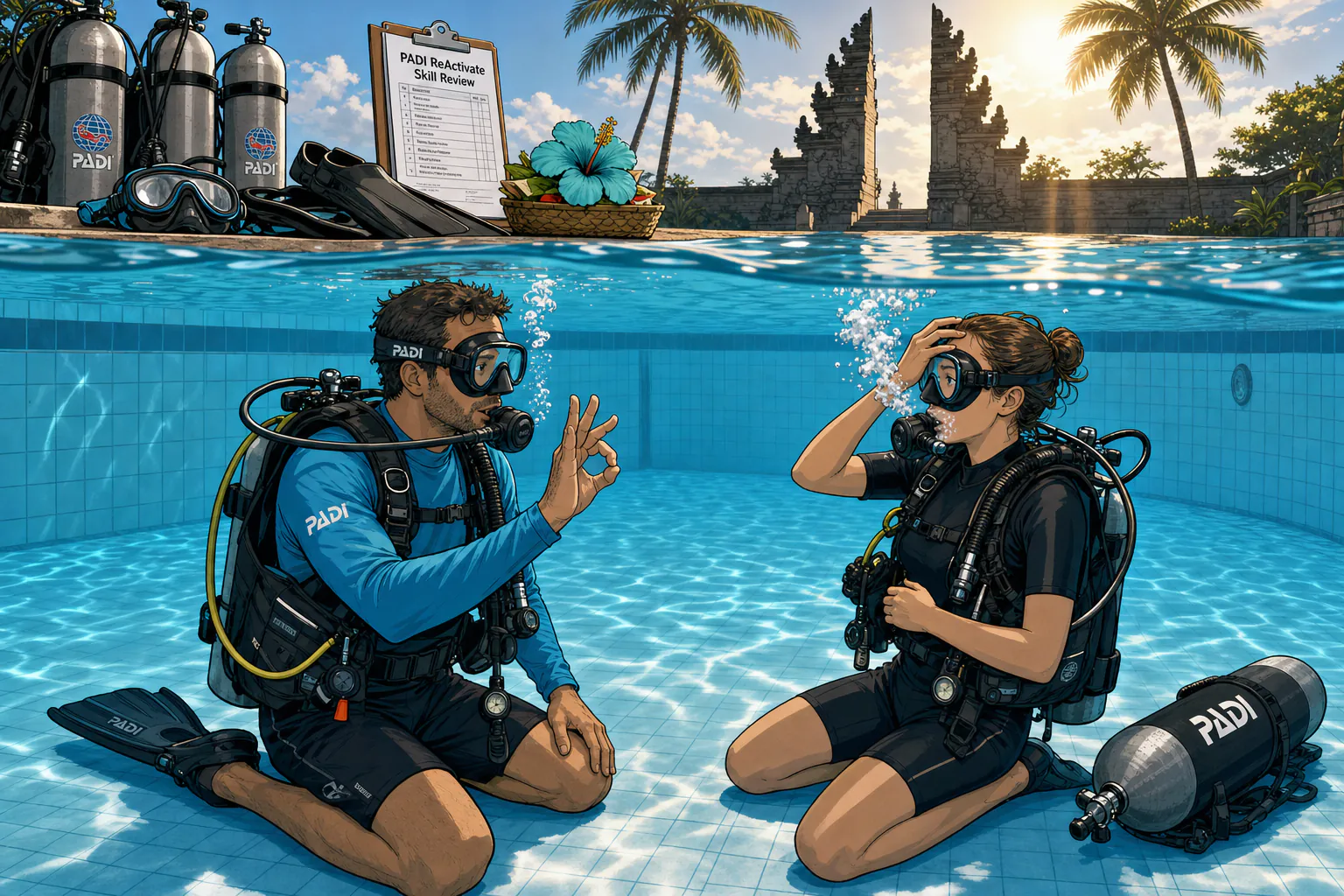
Cel-shaded illustration of a PADI instructor in turquoise blue rashguard kneeling on the bottom of a tropical resort swimming pool next to a returning diver in black wetsuit and full scuba kit, both calmly running through a mask-clearing and regulator-recovery skill review. Palm trees and a Bali Hindu temple gate visible through the pool fence in the background, with scuba tanks, fins, and a clipboard with the PADI ReActivate checklist lined up on the pool deck. Warm afternoon sunlight, clear blue pool water, friendly reassuring atmosphere.

Every week we sit across from a diver who hesitates before signing the booking form. The same sentence comes up: "It has been a while, I might be rusty." Sometimes "a while" is 18 months. Sometimes it is 15 years. Sometimes the diver just had a baby, or a knee surgery, or a bad ear-equalisation experience in Bali itself ten years ago and never went back. Whatever the gap, the question is the same: do I need a refresher before I dive in Bali, and if so, what kind?

This guide answers that honestly from the operator side, drawing on years of running Bali scuba diving trips with returning divers as a routine part of our weekly intake. It walks through the actual options (PADI ReActivate, the brand-neutral Scuba Review, Discover Local Diving, and full re-certification), what each one includes, what each one costs in Bali in 2026, and how we decide who is ready to dive Tulamben on day one versus who needs a half-day in the pool first. Most importantly, it tells you what your skills are honestly going to look like after a long break, and why that is almost never the disaster you fear.

The 5-minute version: do you need a refresher?

Use this matrix. It is the same one we apply at check-in in our Sanur dive center.

Time since last diveDives logged totalOur recommendation
0 to 6 monthsAnyNo refresher needed. Easy first dive, normal trip.
6 to 12 months20+ dives lifetimeOptional. We do a 10-minute skill review on the boat, then a relaxed first dive.
6 to 12 monthsUnder 20 dives lifetimePADI ReActivate or half-day pool Scuba Review recommended.
1 to 3 yearsAnyRefresher strongly recommended (ReActivate or Scuba Review).
3 to 10 yearsAnyFull PADI ReActivate (online + in-water) required by us.
10+ yearsAnyFull ReActivate with extended pool session, plus instructor-led shallow first dive.
Never dived since OW course4-9 lifetimeFull ReActivate, often paired with the Advanced Open Water course to rebuild range and confidence in one trip.
Card expired (SSI / NAUI / older agencies)AnyBring a logbook; we cross-recognise (see scuba diving certification types for agency equivalences). Same matrix applies.

Two notes on this matrix:

1. Insurance and operator rules. Most reputable Bali operators (including us) require some form of refresher after 12+ months on paper for our own insurance, even if you feel ready. The question is not "do I need it" but "which format". That is what the rest of this article unpacks.

2. Honest self-assessment beats the matrix. If you logged 200 dives, took a 2-year break, and still feel comfortable, you probably are. If you logged 8 dives, took an 8-month break, and feel anxious just thinking about it, the matrix should not override that. We tilt longer or shorter based on your honest answer at check-in.

How dive skills actually decay (the rust curve)

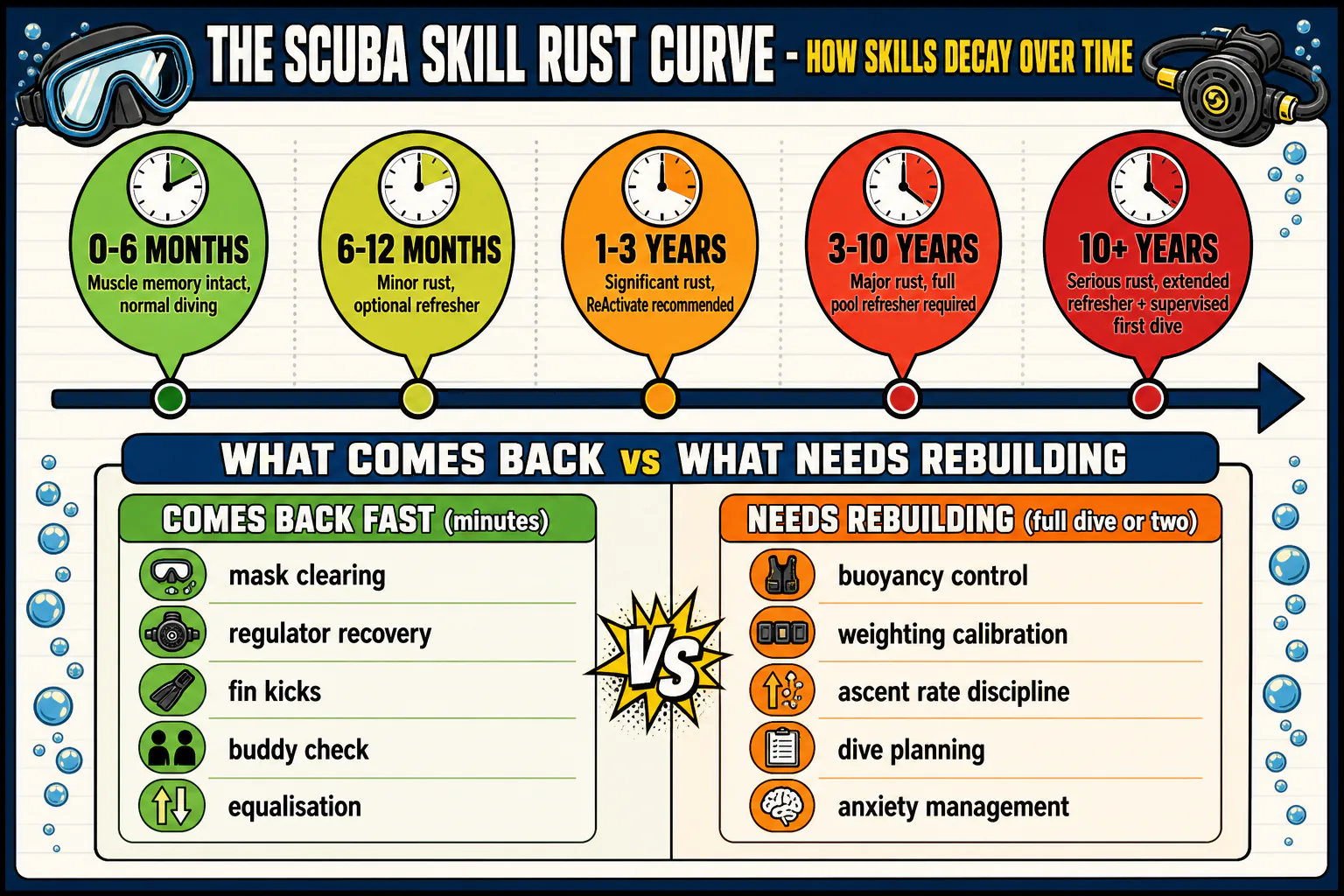
Cel-shaded infographic showing a horizontal timeline of how scuba diving skills decay over time without practice. From left to right: 0-6 months (green: muscle memory intact, normal diving), 6-12 months (yellow: minor rust, optional refresher), 1-3 years (orange: significant rust, ReActivate recommended), 3-10 years (red: major rust, full pool refresher required), 10+ years (deep red: serious rust, extended refresher + shallow guided dive). Below the timeline a comparison panel showing which skills come back quickly (mask clear, regulator recovery, fin kick, buddy check) versus which need more rebuild time (buoyancy control, weighting, ascent rate, dive planning, anxiety management).
The "rust curve" is asymmetric. Mechanical skills (mask clear, regulator recovery) come back in minutes. Judgement skills (buoyancy, ascent rate, anxiety management) take longer to fully restore.

The most useful thing we can tell you, before you decide which refresher to book, is this: not all dive skills rust at the same rate. Some come back almost instantly. Others take a full dive or two to fully restore. Knowing the difference helps set realistic expectations.

Skills that come back fast (10 to 60 minutes in the pool)

Mask clearing. Pure muscle memory. Inhale, tilt head back, press top of mask, exhale through nose. Even a 15-year gap diver usually nails it on attempt two.

Regulator recovery and clearing. Same story. Sweep arm, find the hose, breathe through, purge. Body remembers.

Buddy check / pre-dive setup. The mnemonics fade but the muscle memory of assembling a kit returns within one full setup cycle. By dive 2 you are doing it without thinking.

Fin kicks and basic propulsion. Once you are weighted correctly and underwater, this is automatic within minutes.

Equalisation technique. The "pinch and blow" Valsalva reflex is fully automatic for most divers. Even after long gaps, divers who never had ear trouble previously usually do not have it now.

Skills that need a full dive or two to come back

Buoyancy control. This is the big one. Neutral buoyancy is fine motor control plus lung-volume management plus weight calibration (the PADI Peak Performance Buoyancy specialty is the formal fix if you want to invest a half day in rebuilding it properly), and it is the first thing that goes. Returning divers almost always feel "heavy" or "fighting the BCD" on dive 1 and "neutral and quiet" by dive 3.

Weighting calibration. Body composition changes over years (most of us put on a kilo or two after kids, after 40, after stress periods). Your old weight count is probably wrong. We re-check weighting at the start of every refresher.

Ascent rate discipline. The "do not exceed 9 metres per minute" habit fades fast. Returning divers tend to ascend too fast on dive 1 from sheer enthusiasm. We slow you down with a fixed visual rate from the divemaster.

Dive planning and gas management. Reading your SPG, doing the math on remaining bottom time, planning your turn-around pressure. These come back over a few dives once the dive computer becomes a "second skin" again.

Anxiety management. Not really a skill, more a state. The first dive after a long break carries some adrenaline (similar to but milder than the first-ever dive nerves we cover in first-time diving in Bali). Knowing this is normal helps reduce it. We deliberately make refresher dives shallow, slow, and surrounded by easy life (parrotfish, sweetlips, the occasional turtle).

Skills that need conscious re-learning

Emergency procedures. Out-of-air, sharing air, controlled emergency swimming ascent. These are not muscle memory because (hopefully) you never used them in real life. We rehearse them in the pool because you forget exactly how to signal, find the alternate, and breathe smoothly while sharing.

Compass navigation. If you took the Open Water course years ago and never dived with a compass since, this is genuinely a fresh learn. Most refresher students skip it; we cover it again later in the Advanced Open Water if useful.

Dive computer operation. Today's dive computers are different from what you used 15 years ago. If you bought a new computer for the trip, plan 20 minutes with us before the first dive to learn its menus.

Your refresher options in Bali (the full menu)

Bali operators offer four real options for a rusty diver. They differ in cost, time, depth of skill review, and what documentation they leave you with. Pick based on your gap length, your confidence, and what you plan to dive next.

OptionDurationCost (Bali, 2026)What it includesBest for
PADI ReActivateHalf-day to full day$120 to $180Online knowledge review + in-water skills session + updated PADI card and digital stickerAnyone with a 1+ year gap who wants the formal PADI record updated
Scuba Review (brand-neutral refresher dive)Half-day (3-4 hours)$80 to $120Pool or shallow confined-water skills review only, no online module, no updated cardReturning divers who want the in-water reset without paperwork
Discover Local Diving / Guided shallow dive1 dive (2-3 hours)$60 to $90One easy shallow open-water dive with a divemaster watching closely, no formal skill reviewDivers with under 12 month gap who feel confident and just want supervised re-entry
Full Open Water re-certification3-4 days$400 to $600Compressed version of the full PADI Open Water course (academics + pool + 4 OW dives)Divers with 15+ year gap and very low dive count, or those whose certification was never properly issued

In practice, 70% of our returning divers go with PADI ReActivate, 20% with a Scuba Review, 8% with a Discover Local Dive (short gap, high confidence), and about 2% genuinely need the full re-certification path.

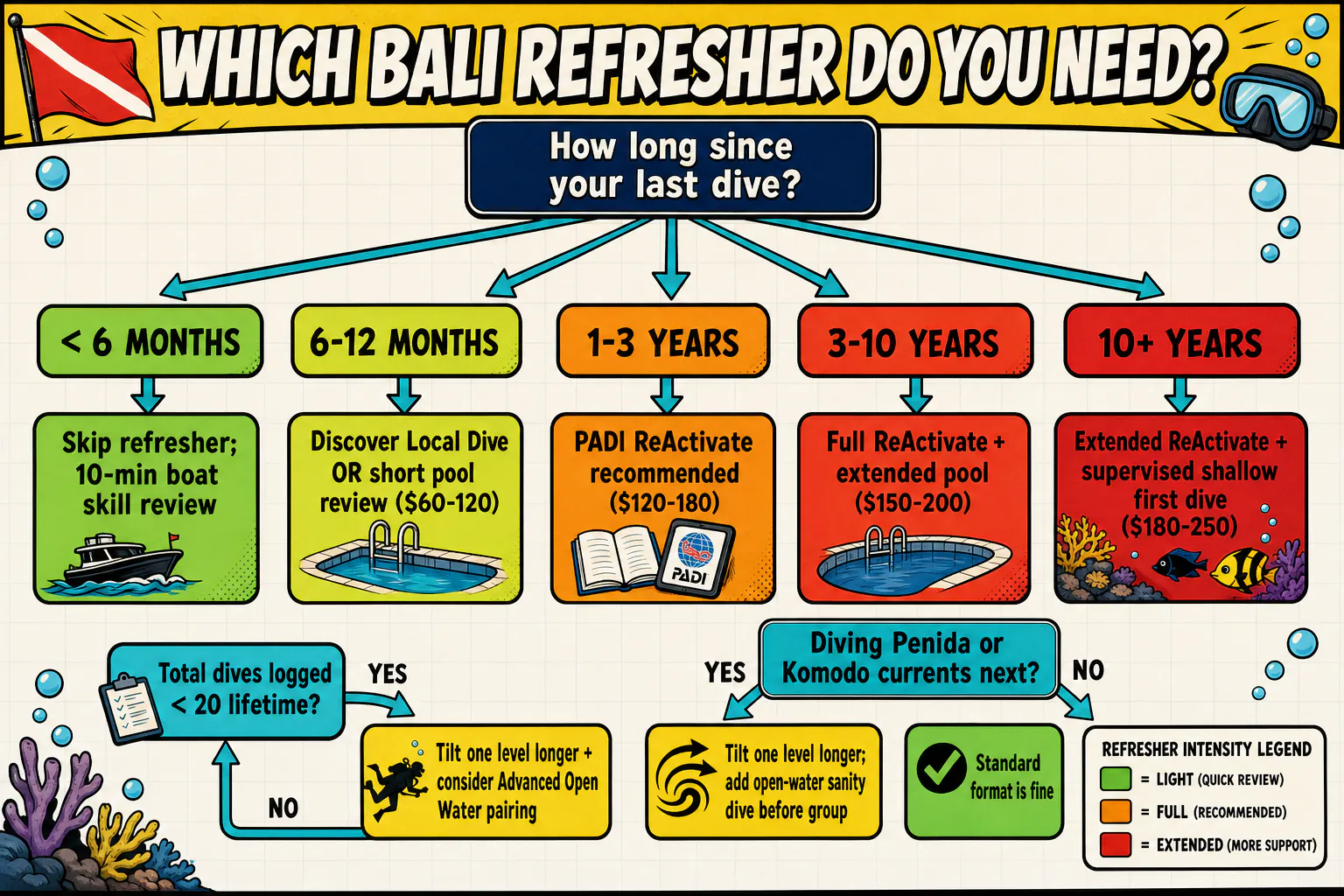
Cel-shaded decision flowchart helping a returning scuba diver in Bali choose the right refresher path. Starting from the top: 'How long since your last dive?' Branches into '< 6 months' (Skip refresher, optional 10-min boat review), '6-12 months' (Discover Local Dive or short pool review), '1-3 years' (PADI ReActivate recommended), '3-10 years' (Full PADI ReActivate with extended pool session), '10+ years' (ReActivate + shallow instructor-led first dive). A side branch asks 'Total dives logged?' with low-experience answers tilting toward more thorough refreshers. Another branch asks 'Diving Penida/Komodo currents next?' tilting yes toward longer pool prep. Color-coded with green (light refresher), orange (full ReActivate), red (extended program), turquoise arrows linking decisions.
The full decision tree we walk new arrivals through at check-in. Gap length is the main factor; total dive count and the type of diving you plan next adjust it.

PADI ReActivate explained (the formal option)

PADI ReActivate is the official PADI refresher program designed exactly for this situation: certified divers with a meaningful gap who want to re-enter the sport with a formal record. It has two components.

Component 1: Online knowledge review

You log into the PADI Touch or eLearning portal (the system PADI rolled out in 2014 and updated again in 2024) and work through 5 short interactive modules covering: dive physics, dive equipment, dive environment, dive planning, and dive skills. The modules take about 2-3 hours total and end with a short quiz. You can do this from your hotel before arriving at the dive shop, or in our shop's air-conditioned classroom on the morning of your refresher.

The interface is genuinely good. It is mostly video and interactive scenarios, with a few multiple-choice questions per module. There is no academic pressure, no pass/fail anxiety. You can retake any quiz. It exists to refresh your knowledge, not to test you.

Component 2: In-water skill review

In Bali, we run this in either a 2-metre confined-water pool (at our partner resort in Sanur, 5 minutes from the dive shop) or in a sheltered confined-water area at Tulamben beach in 1-3 metres of water. Pool is the default for most students because it is calmer, warmer, and easier to focus.

The instructor runs you through the same skill set as the original PADI Open Water course, but compressed:

- Equipment assembly and pre-dive check (your old buddy-check rhythm comes back here)

- Mask flood, clear, and removal

- Regulator recovery and clearing (both methods)

- Out-of-air drill with alternate air source (you receive AND share)

- Buoyancy: fin pivot, hover, and weight check

- Controlled ascent rate

- Surface dive entries, surface swimming, surface rescue tow (briefly)

- Cramp release, tired-diver tow (if time allows)

Total in-water time: 60-90 minutes. We finish with a relaxed surface chat about what felt easy, what felt rusty, and what to focus on during the next day's open-water dive. If a particular skill is still shaky, we rehearse it again before signing you off.

What you get at the end

Your PADI digital certification card is updated with a "ReActivated" sticker showing the current year. PADI also sends you a new physical card by post if you request one (extra $10 USD). The instructor signs your logbook with the refresher entry. Your diver status with PADI is reset, which matters when you book future operators globally because their first question is "when did you last dive".

Scuba Review (the brand-neutral refresher)

Some divers do not want the formal PADI record updated either because they are SSI/NAUI/CMAS divers who do not maintain a PADI account, or because they simply want the in-water reset without the eLearning hours. For these divers, we offer a Scuba Review: a half-day in-pool or confined-water skill session, identical to the in-water component of ReActivate, but without the online module or the updated card.

The session is the same: 60-90 minutes of skill review with an instructor in shallow water. Cost is $80-120 depending on whether we use the pool or Tulamben confined entry. No logbook stamp from PADI, but we sign your logbook with a "refresher dive" entry that any reasonable operator globally will accept.

The downside is record-keeping. If you dive with another operator next year and they ask "when did you last formally refresh", a logbook entry is good but the PADI-recorded ReActivate sticker is better. For occasional travelers who only dive in Bali, that does not matter. For divers planning multiple destinations in the next few years, the formal ReActivate is the better long-term investment.

What we actually do in the pool (the skill checklist)

For full transparency, here is the exact checklist our instructors work through in a refresher session. We share this in advance so returning divers can mentally rehearse on the flight in.

Surface skills:

- Equipment setup from boxes (we hand you a BCD, regulator, tank, weights and watch you assemble)

- Buddy check using BWRAF or SEABAG (whichever mnemonic you learned)

- Pre-dive safety check verbalised

- Controlled descent with reference

Confined water skills:

- Regulator recovery (sweep method + reach method)

- Regulator clearing (purge + exhale)

- Mask partial flood and clear

- Mask full flood and clear

- Mask removal, replacement, and clear (the one most students dread; we make it easy)

- Alternate air source breathing (you breathe from your buddy's octopus)

- Alternate air source donating (you give air to your buddy)

- Cramp release

- Tired diver push and tow

- Controlled emergency swimming ascent (CESA) - mental rehearsal, not always performed

- Hover for 60 seconds at neutral buoyancy

- Weight check at the surface

If time allows (often does):

- BCD removal and replacement underwater

- Weight system removal and replacement underwater

- Compass navigation (out-and-back 30 metres)

- Underwater communication review (a quick recap from our diving hand signals guide; signal sets vary subtly between agencies and operators)

This list looks long. In practice, with an experienced returning diver, the whole thing takes 60-75 minutes because the muscle memory comes back fast. With a more anxious returning diver, we slow down and may split it across two pool sessions.

The first dive after a long break: what it actually feels like

This is the part nobody tells you honestly. Here is what your first open-water dive after a multi-year gap feels like, in order.

The first 5 minutes: Slight adrenaline. Your breath rate is higher than it should be. You are checking every gauge twice. Your buoyancy is fighting you a little. You feel "heavy" or "fin-up". This is universal and expected. Do not panic; it passes.

5-15 minutes: The body remembers. Your breath rate slows. Buoyancy starts to settle (we adjust your weights at this point if needed). You start noticing fish instead of gauges. The dive feels familiar again. This is the magic moment most returning divers describe.

15-30 minutes: Full re-immersion. You stop thinking about technique and start enjoying the dive. You are reading your computer naturally. You are signalling your buddy. You are pacing yourself and breathing slowly. You feel like a diver again.

30+ minutes: If you have anything left in the tank (most refreshers run a slow first dive with low air consumption from the slow breathing), you finish the dive ready for a second one. The second dive will feel 60-70% closer to your old level. The third dive will feel essentially normal.

Most of our returning divers tell us, between dives 2 and 3, some version of "I do not know why I was worried, this is exactly like before". That is by design. We plan the first dive to make this happen.

Refresher cost in Bali (transparent 2026 prices)

Bali is one of the most cost-competitive markets globally for dive training, and refreshers are no exception. Here is what to expect.

ProgramCost range in BaliComparison: cost in Europe or North America
PADI ReActivate (online + in-water)$120 - $180$200 - $350
Scuba Review (in-water only)$80 - $120$150 - $250
Discover Local Diving (1 supervised dive)$60 - $90$100 - $150
Full Open Water re-certification$400 - $600$600 - $900
Equipment rental for refresher sessionUsually includedOften extra ($25-50)
PADI online ReActivate eLearning code (if booking direct from PADI)$45 globally$45 globally

Our specific prices at our Sanur dive center sit toward the lower end of those ranges, with gear, eLearning code, certified instructor, pool fee, and digital card update all included. The full price list including dive packages, courses, and add-ons is on the Bali diving price guide.

The economic logic of refreshing in Bali. If you are planning to dive on your Bali trip anyway, doing the refresher here saves significantly versus doing it in your home country, and rolls it into the same trip. The only reason to refresh at home first is if you are deeply anxious and want the familiarity of a local pool with an instructor who speaks your native language; that is a real consideration for some divers and we respect it.

Half-day vs full-day refresher: which to pick

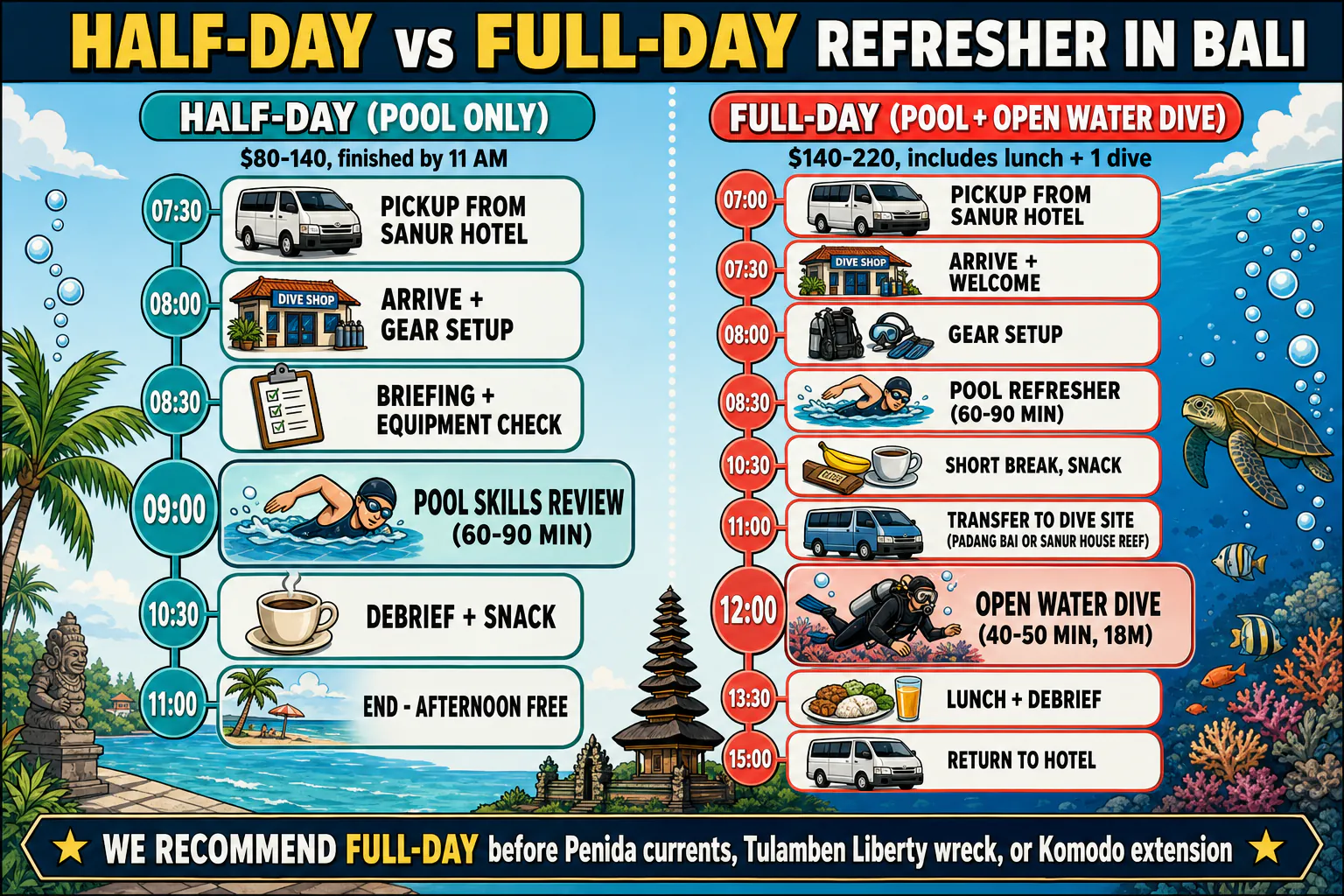
Cel-shaded side-by-side comparison infographic showing two refresher day timelines. Left column 'HALF-DAY REFRESHER' shows: 7:30 AM pickup from Sanur hotel, 8:00 AM arrive dive shop and gear setup, 8:30 AM short briefing and equipment check, 9:00 AM pool/confined water skills review (60-90 min), 10:30 AM debrief and snack break, 11:00 AM end of program, afternoon free. Right column 'FULL-DAY REFRESHER + 1 OPEN WATER DIVE' shows: 7:00 AM pickup, 7:30 AM arrive, 8:00 AM gear setup, 8:30 AM pool refresher (60-90 min), 10:30 AM short break and snack, 11:00 AM transfer to easy shallow Sanur house reef or Padang Bai, 12:00 PM first open water refresher dive (40-50 min), 1:30 PM lunch and debrief, 3:00 PM return to hotel. Color coded turquoise (half-day) and coral (full-day), with Balinese palm trees and temple silhouettes framing each column.
Half-day is the minimum. Full-day adds one supervised easy open-water dive, which is what we strongly recommend before joining a regular Penida or Tulamben group the next day.

Half-day (pool only). Pickup at 7:30, done by 11:00. Pool/confined water skills review only. Suitable for returning divers with under 2 years gap who feel confident, or for divers planning to do their first open-water dive the next morning as part of their regular dive package. Lighter on the wallet but does not include an open-water sanity check.

Full-day (pool + one supervised open-water dive). Pickup at 7:00, done by 15:00. Includes the pool refresher in the morning, then a transfer to a calm shallow site (Sanur house reef or Padang Bai's sheltered Blue Lagoon) for one easy 18 metre dive with a 1:1 or 1:2 divemaster ratio. Lunch and surface interval included. This is what we recommend for anyone with 3+ year gap, or anyone joining a more demanding dive the next day (especially Nusa Penida manta diving or Komodo trip preparation).

Our default recommendation: full-day. The extra few hours and dollars buy you a real-world dive in tropical conditions, a chance to fine-tune your weighting before the "main event" dive package, and a definitive instructor sign-off that we can rely on when assigning you to dive groups for the rest of the week.

Refreshing before specific Bali dives (operator advice)

Before Nusa Penida (Manta Point, Crystal Bay, drift sites)

For divers who want to invest a half-day in the specific current-handling skill set, the PADI Drift Diver specialty pairs neatly with the refresher and gets you cleared for Penida sites with formal credentials rather than just an instructor's verbal sign-off.

Penida is current diving. Even on calm days, the drift can push you faster than you expect, and Manta Point sometimes runs 1-2 knot current with cleaning station chop on the surface. We do not put rusty divers straight onto Penida. The refresher protocol is: full-day refresher with an open-water dive on day 1, then a relaxed Padang Bai or Tulamben morning on day 2, then Penida on day 3 once we have seen you in two dive environments. The article on diving with manta rays at Nusa Penida covers what to expect once you are cleared.

Before Tulamben (USAT Liberty, Coral Garden)

Tulamben is shore-entry over volcanic gravel, then easy 5-30 metre diving. Less current than Penida, but the entry is physical and the wreck is large enough that buoyancy control matters for not banging into delicate coral encrusted on the hull. A half-day pool refresher is fine for most returning divers, then dive the USAT Liberty wreck the next morning with the divemaster watching closely on the first descent. We pair it with the slightly easier Coral Garden site for dive 2.

Before Komodo extension

Komodo is the most demanding dive environment in Indonesia for current handling. We require all guests joining a Komodo trip to have refreshed within the previous 12 months and ideally to have done at least 3-4 Bali dives in the days before flying to Labuan Bajo. The full-day refresher plus a Bali dive package is the minimum. The Komodo vs Bali diving comparison explains why this gap matters.

Before Bali macro photography or muck diving

Macro and muck diving are forgiving in terms of current and depth (mostly 8-18 metres), but unforgiving in terms of buoyancy control. Hovering 5 cm above a stonefish to photograph it without disturbing the sand is not a "first dive after 5 years" skill. Plan a full-day refresher and a routine reef dive before joining a macro and muck diving day. The same buoyancy logic applies if you plan to add the PADI Night Diver specialty later in the trip; coral house reef night dives demand calm hovering above delicate species and are not a "first dive after a long break" environment.

How long can you go between dives before this becomes an issue?

The honest answer changes with your dive count.

Very experienced divers (200+ dives lifetime, 50+ dives in the last 3 years before the break): Skills are deeply automatic. You can take 2-3 year breaks and return with a single guided shallow dive to recalibrate, no formal refresher needed. We see this pattern with former dive professionals taking work or family breaks.

Moderately experienced divers (50-200 dives lifetime): A 12-18 month gap is the boundary. Below 12 months you are fine. Beyond 18 months we strongly recommend ReActivate or Scuba Review. Beyond 5 years we require it.

Less experienced divers (10-50 dives lifetime): The boundary tightens. A 6-12 month gap warrants at least a Discover Local Dive with close supervision. Beyond 12 months, a formal refresher is essential. Beyond 5 years, we often recommend pairing the refresher with an Advanced Open Water course to genuinely rebuild competence.

Newly certified divers (under 10 dives lifetime since OW course): A 6-month gap already justifies a refresher. The 4 training dives of Open Water do not build deep muscle memory on their own. The first 20 dives are where the skill set really cements.

None of this is a hard rule. We see 25-year break divers come back smoothly because they were highly competent originally, and we see 14-month break divers struggle because they never logged more than 4 dives. The matrix is a starting point. The honest conversation at check-in is the real test.

What to bring to your refresher

Light list, most of it from the standard Bali scuba diving packing list:

- Your dive certification card (physical or PADI eCard screenshot). If your card is lost, request a digital replacement from PADI before you leave home; it is free and instant in the PADI app.

- Your dive logbook if you have one. Even old paper logbooks are useful for us to gauge your dive history.

- Your prescription medication including anything for ear equalisation (Sudafed with documentation; restricted in Indonesia, see the packing list for rules).

- A swimsuit and a small towel.

- Reef-safe sunscreen (you will be in the sun briefly between sessions).

- Your dive computer if you own one (we provide rentals otherwise).

- Mask if you own one (personal fit matters more for refresher dives than rented masks).

- Optimism. You are about to remember why you loved this in the first place.

One important reminder: dive insurance

Lapsed divers often forget about diving-specific insurance. If your previous DAN or similar policy lapsed during your time away, renew it before you arrive. A standard travel insurance policy almost never covers recreational scuba diving below 18 metres, and Bali sites routinely exceed that. DAN America and DAN Europe both offer annual policies in the $40-90 range that cover chamber treatment, medical evacuation, and decompression incidents. We require all dive guests to have either DAN or an explicitly scuba-inclusive equivalent. The refresher itself is also covered under most of these policies; check your specific terms.

Common refresher scenarios (real cases we run weekly)

"I did my Open Water in Thailand 8 years ago and never dived again"

Classic. Run full PADI ReActivate (online + extended pool session), then a full-day with an easy open-water dive in the afternoon, then a normal Bali dive package starting day 2 with relaxed sites (Coral Garden, Sanur house reef, Padang Bai). By day 4 you are doing Tulamben Liberty wreck or a relaxed Penida dive (the best places to scuba dive in Bali article maps out a logical site progression for returning divers across a 5-7 day trip). Total trip plan: 6-7 day diving holiday with the first day fully dedicated to refresh.

"I was diving every weekend until my baby was born 2 years ago"

Standard PADI ReActivate with normal pool session. You are highly experienced and your skills come back fast. Single full-day refresher, then dive the rest of your trip normally including Penida and Liberty if you want.

"My last dive was a panicked Liberty wreck dive 10 years ago that put me off"

Different approach: we focus on anxiety management as much as skills. Extended pool session in the morning, no time pressure, instructor in the water with you the whole time. We deliberately avoid the Liberty wreck on the first open-water dive and instead pick a calm shallow reef. Conversation matters here as much as drills. Most of these divers tell us by dive 3 that they wish they had come back sooner.

"I have done 4 dives ever, all in my Open Water course 18 months ago"

This is the case where we steer you toward the Open Water re-do or, more commonly, the Advanced Open Water course. The course format rebuilds your dive count in a structured way (5 specialty dives over 2-3 days) and gives you a meaningful new certification at the end. You return home a stronger diver, not just a "refreshed" one.

"My PADI Open Water certification card expired" (it does not)

Quick clarification: PADI certifications do not expire. Your card is valid for life regardless of how long it has been. What "expires" is your readiness to dive safely, which the refresher addresses. There is no legal or PADI requirement to recertify ever. Operator policy is what drives the refresher requirement.

"I am SSI / NAUI / CMAS / BSAC certified, can I refresh with you?"

Yes. The Scuba Review option is brand-neutral and we run it the same way for any agency certification. Bring your card, bring your logbook. The skills are the same across agencies; only the documentation and online module differ. We can also run a PADI Crossover for divers who want to switch to PADI for future certifications.

Booking your refresher with us

Email or use the Bali contact form, or book directly through the main booking page. Mention in your message: your certification agency and level, the year of your last dive, your approximate total dive count, and what you plan to dive after the refresher (relaxed Bali reef diving, Penida, Tulamben, or Komodo extension). We will recommend the format (half-day, full-day, or pairing with the Advanced Open Water course) and confirm timing.

Refreshers run almost any day of the year. The pool is always available. The Sanur house reef and Padang Bai are accessible year round including rainy season (see the Bali rainy season diving guide for what changes November to March). The only consideration is that during peak Mola Mola season (July-October) the schedule fills up, so book 2-3 weeks ahead if you want a specific date.

The single best thing we can tell a rusty diver: the gap matters less than the willingness to come back. Skills rebuild in hours. Confidence rebuilds in dives. Diving rewards returning divers more generously than almost any other sport, because the underwater world is the reward, and it has not changed in your absence. The mantas are still circling Manta Point. The Liberty wreck is still there. We have been waiting for you to remember why you started.

常见问题

No. PADI, SSI, NAUI, CMAS, and most major agency certifications are valid for life. Your card never expires. What does change over time is your in-water readiness; that is what a refresher addresses. There is no legal or agency-mandated re-certification, but reputable operators will ask for a refresher after extended breaks based on their own insurance and safety policy.
Our threshold is 12 months for most divers, longer for highly experienced divers (200+ dives lifetime), shorter for divers with fewer than 20 dives logged. Beyond 12 months we strongly recommend PADI ReActivate or a Scuba Review. Beyond 3 years it is required at our shop. Beyond 10 years we add an extended pool session and a supervised first dive.
Between $120 and $180 in 2026, including the online eLearning code, certified PADI instructor time, full equipment rental, pool fee, and the updated digital certification card. Our prices sit toward the lower end of that range and include hotel pickup in the Sanur area. This is significantly less than the same program in Europe or North America, which typically runs $200 to $350.
PADI ReActivate is the formal PADI program with two parts: an online knowledge review (2-3 hours of interactive eLearning) and an in-water skills session (60-90 minutes), followed by an updated PADI digital card with a current-year sticker. A Scuba Review is the in-water portion only, brand-neutral (suitable for SSI, NAUI, CMAS divers), with a logbook entry but no updated PADI card. ReActivate costs $40-60 more and provides better long-term record-keeping for divers who plan future trips.
Most refreshers in Bali use a pool or sheltered confined-water area (we use a 2-metre pool at a partner resort in Sanur, or a 1-3 metre confined area at Tulamben beach). Pool is the default for most students because it is calmer, warmer, and easier to focus. For divers with longer gaps or anxiety, we strongly recommend adding a supervised easy open-water dive after the pool session, which is what our full-day refresher format includes.
Yes, if you have not dived in the previous 12 months. Penida involves current diving (sometimes 1-2 knots at Manta Point, faster on drift sites), which is unforgiving of rusty buoyancy control. Our standard protocol is: refresher on day 1 with an open-water dive in the afternoon, easier Tulamben or Padang Bai dives on day 2, then Penida on day 3 once we have seen your in-water competence in two environments.
Yes. The Scuba Review option is brand-neutral and works identically for any agency certification. The in-water skills are the same; only the documentation differs. You will receive a logbook stamp from us, which any operator globally will accept. If you want to switch agencies, we also offer a PADI Crossover for divers planning future PADI certifications.
A half-day refresher (pool/confined water only) runs from about 7:30 AM to 11:00 AM, freeing your afternoon for the beach, Ubud, or rest. A full-day refresher (pool plus one supervised open-water dive) runs from 7:00 AM to about 3:00 PM, including lunch and surface interval. The full-day is our default recommendation because it includes a real-world dive sanity check before you join the rest of your dive package.
Request a digital replacement from your training agency before you travel; PADI issues digital eCards instantly through the PADI app. If you are SSI or another agency, similar digital replacements exist through their respective apps and websites. We can also look up your certification record electronically at the shop if you have your full name and approximate year of certification, though this takes longer than arriving with the card ready.
Usually no. Bali refreshers are significantly cheaper, equipment is provided, water is warm year-round, and you can roll the refresher directly into your existing dive trip rather than spending a separate weekend on it at home. The only reasons to refresh at home first are: severe diving anxiety where you want the familiarity of a local pool and a native-language instructor, or if you specifically want to dive in Bali on day 1 of your trip (refreshing on day 1 in Bali is slightly cheaper but uses a day of your trip).