
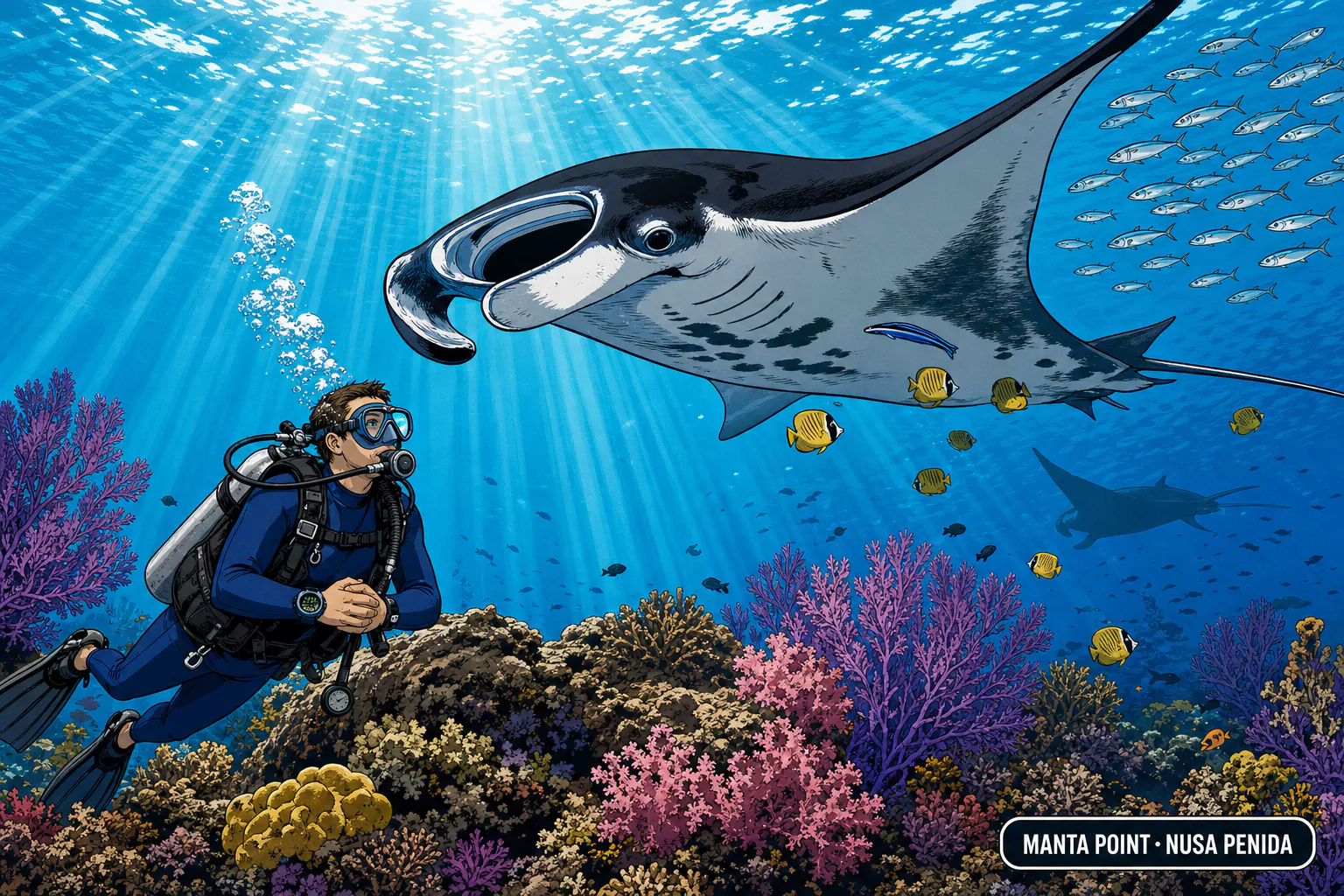
If you have any picture of "Bali diving" in your head, there is a decent chance it includes a manta ray. The reef mantas that hang out around the south coast of Nusa Penida are one of the most reliable big-animal encounters in Indonesia, and they are the single most-requested dive on every trip we run. This is the article we wish we could send to every diver who messages us asking about mantas in Bali, because most of what is online either undersells the experience or oversells the certainty of seeing them.
We run dives at both Manta Point and Manta Bay four to five times a week, year-round, with a sighting rate above 95 percent across a calendar year. This guide covers what we tell every guest the night before the trip: the difference between the two sites, when to come for the best behaviour, what actually happens on the dive, the seven etiquette rules that matter, how to photograph mantas without scaring them off, what conditions to expect, and how to plan it into a Bali trip alongside mola mola season and the rest of the Penida sites.
If you are choosing between this and a Komodo manta trip, we wrote a separate Komodo vs Bali diving comparison that covers the bigger picture. This article focuses on the Bali manta experience specifically.
Mantas at Manta Point and Manta Bay can also be seen from the surface. The Nusa Penida snorkeling tour guide covers how snorkel tours approach them, which spots they visit and what they cost.
Manta Point vs Manta Bay: which one to dive
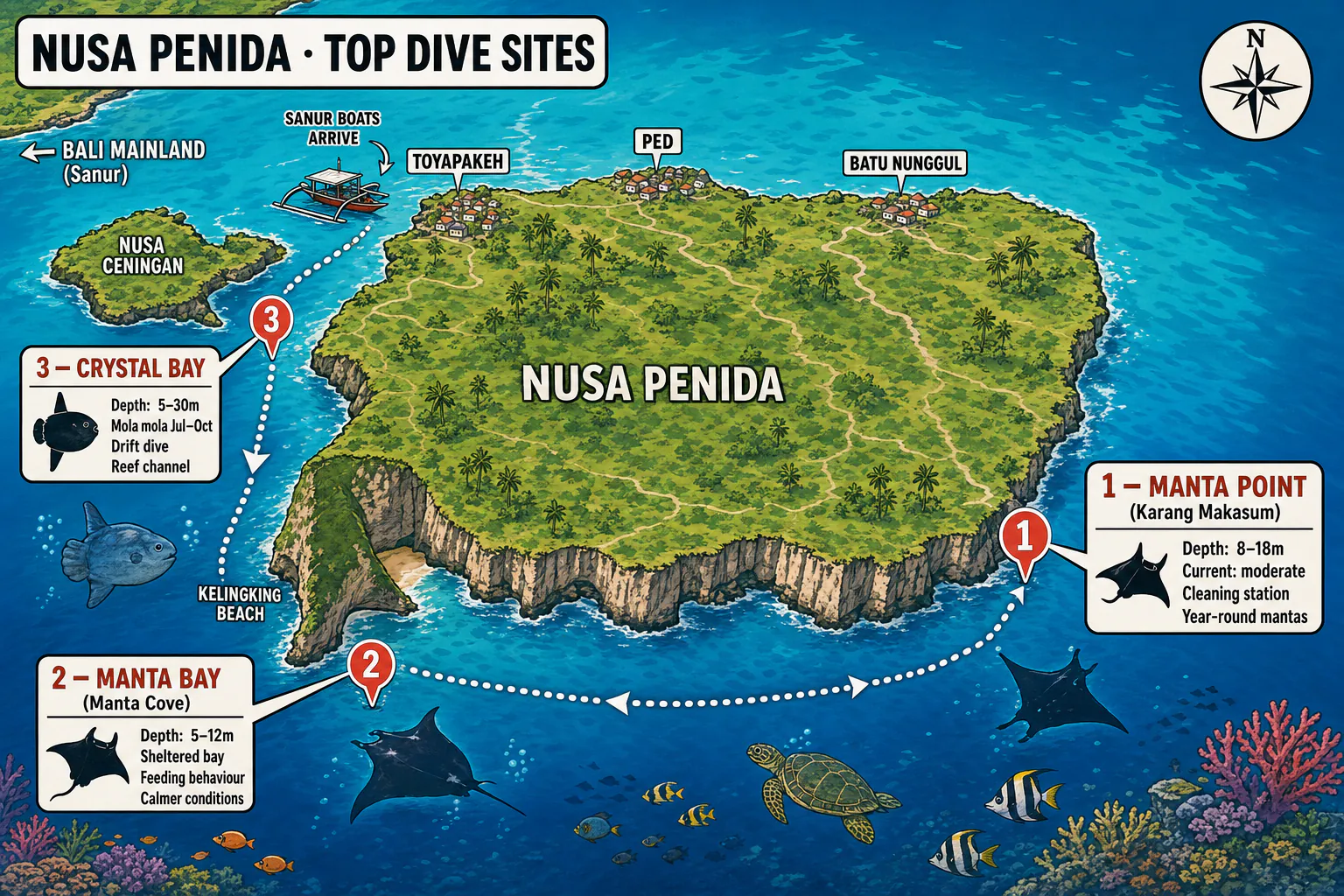
Nusa Penida has two main manta sites, both on the south-facing coast. Same species (reef manta, Mobula alfredi), but very different dive experiences. Most reputable operators offer both, and most divers will end up diving at least one of them on a standard Sanur day trip.
Manta Point (Karang Makasum)
The classic. A horseshoe-shaped rocky outcrop and reef on the open south-east coast, around 60 minutes by boat from the Penida moorings. The site has a permanent cleaning station where reef mantas come almost daily to be cleaned by bluestreak cleaner wrasse. Depth ranges from 8 to 18 metres on the cleaning station itself, with the reef sloping deeper around it.
- Why divers love it: The cleaning-station behaviour is genuinely special. Mantas hover almost motionless above the rock for 10 to 20 minutes at a time while cleaner wrasse work their gills, mouths, and undersides. As a diver hovering nearby, you can spend the entire dive watching one or two mantas at very close range.
- Conditions: Open-ocean swell, often moderate current (washing-machine surge near the cleaning station), water on the cooler side at 24 to 26 °C for most of the year.
- When the mantas are most reliable: Year-round, but peak cleaning-station activity is the slack-tide windows around dawn and late afternoon. Operators time the trip to hit the morning slack.
- Skill level: Open Water minimum, Advanced Open Water strongly recommended because of the current and surge.
Manta Bay (Manta Cove)
A smaller, more sheltered bay tucked under the famous Kelingking Beach cliffs on the south-west coast. The mantas here use the bay primarily for feeding rather than cleaning, swimming in slow loops through plankton concentrations close to the surface.
- Why divers love it: Shallower (5 to 12 metres), almost always calmer, and the mantas glide right at the surface with their cephalic fins unfurled in feeding pose. It is the easier of the two sites and the right pick for less-experienced divers, snorkellers, or rough-sea days.
- Conditions: Sheltered bay, usually little to no current, viz can drop when plankton is dense (which is exactly when the mantas show up).
- When the mantas are most reliable: Year-round, with feeding peaks tied to plankton blooms. The wetter months tend to produce more plankton and more feeding activity.
- Skill level: Open Water with any experience is fine. Snorkellers can also see mantas here from the surface on a good day.
Quick comparison
| Aspect | Manta Point | Manta Bay |
|---|---|---|
| Coast | South-east (open ocean) | South-west (sheltered bay) |
| Depth | 8 to 18 m | 5 to 12 m |
| Current | Moderate, occasional surge | Calm to mild |
| Manta behaviour | Cleaning station (close, slow, repeatable) | Feeding (surface, mouth-open, in motion) |
| Best season | Year-round, peak Apr-Oct conditions | Year-round, feeding peaks in plankton-rich months |
| Recommended cert | AOW preferred | OW fine |
| Sighting rate (our 2026 stats) | ~92% | ~96% |
| Best for | Photographers, repeat divers | First-timers, families, rougher days |
The honest answer to "which one should I dive": if conditions allow, do Manta Point. The cleaning-station behaviour is the iconic experience and produces the best photos and longest sightings. Default to Manta Bay if the south coast is too rough that day, you are inexperienced, you are travelling with snorkellers, or you specifically want the dramatic surface-feeding photos.
Best months to dive with mantas in Nusa Penida
Mantas live in the Nusa Penida region year-round. They do not migrate out, and there is no "manta season" in the way there is a mola mola season. What changes month to month is dive conditions, manta behaviour, and the kinds of secondary marine life you also get to see.
| Month | Conditions | Manta behaviour | Bonus species |
|---|---|---|---|
| Jan-Feb | Rainy season, plankton-rich, occasional rough seas | Heavy feeding at Manta Bay | Macro life thrives |
| Mar-Apr | Transition, generally calming | Mix of feeding and cleaning | First mobula schools |
| May-Jun | Dry season starts, clearer water | Cleaning behaviour dominates | Reef sharks more active |
| Jul-Oct | Peak dry season, cooler water, best viz | Daily cleaning-station activity, plus surface feeding | Mola mola season |
| Nov-Dec | Wet season begins, plankton returns | Feeding activity increases | Macro returns |
The sweet spot if you have flexibility: August to October, when you get reliably good Manta Point conditions, plus a real chance at mola mola at the same sites. Visibility is usually 15 to 25 metres on the south coast. The downside is the water is cooler (down to 22 °C in spots) and a 5mm wetsuit is comfortable.
The wet-season pick if you prefer warmer water and feeding-mode mantas: December to March. Conditions can be choppy on the south coast and the day boat may divert to Manta Bay (sheltered), but the manta show is still excellent. See our diving Bali in rainy season guide for the full conditions picture.
The dive: what actually happens, minute by minute
A standard manta-focused day trip from Sanur looks like this. We use this exact schedule almost every day we run the trip.
06:30 to 07:30, Sanur pickup and harbour
Pickup from your Sanur hotel, drive to the Sanur dive harbour, sign the day's dive paperwork. Coffee, breakfast pastry, board the speedboat.
07:30 to 08:15, crossing
Fast crossing to Nusa Penida (around 30 to 45 minutes depending on swell). On the way the boat captain checks current and swell on the south coast and decides Manta Point vs Manta Bay for the first dive.
08:30, briefing
Full briefing at the dive site mooring. We cover: dive plan, target depth, surface-interval timing, current direction, the manta etiquette rules (more below), what to do if a manta swims directly at you (the answer is: stay still and let it pass), buddy pairings, and how to ascend if you get pushed off the cleaning station by current.
09:00, descent
Negative entry, descent in a guided group to the cleaning station (Manta Point) or the bay floor (Manta Bay). At Manta Point we descend to the seaward side of the cleaning rock so we are positioned downstream of the mantas as they fly in. At Manta Bay we descend to a sandy patch near the back of the bay.
09:05 to 09:50, the encounter
This is what you came for. At Manta Point you will typically see your first manta within 60 seconds. The mantas circle the cleaning station in slow loops, descending to hover almost motionless 2 to 4 metres above the rock while cleaner wrasse work. Stay low (more on this below). Watch them. Do not move. They will come closer. We typically see 2 to 6 mantas per dive at Manta Point in normal conditions, occasionally 10+ on the busy days.
At Manta Bay the experience is different: the mantas swim in feeding loops 1 to 4 metres below the surface, mouths open, plankton streaming through their gills. You will spend the dive in mid-water below them, watching the silhouettes against the bright surface. Sometimes a manta loops down to 8 or 10 metres and you get a close pass.
10:00, ascent and surface interval
3-minute safety stop. Surface. Boat ride to the surface interval spot (usually Crystal Bay or Toyapakeh). Hot tea, snacks, debrief, dry off in the sun, get ready for the second dive.
11:30, second dive
The day usually includes a second non-manta dive at one of the other Penida sites: Crystal Bay (the mola mola site in season, otherwise a beautiful drift along the reef), Toyapakeh (drift dive through a school of fusiliers), or Blue Corner for very experienced divers only (see our Blue Corner Nusa Penida warning piece).
14:00 to 15:00, return
Lunch at a Penida warung, then the boat back to Sanur. Back at your hotel by mid-afternoon. Long day, brilliant memories.
Manta etiquette: the 7 rules that matter
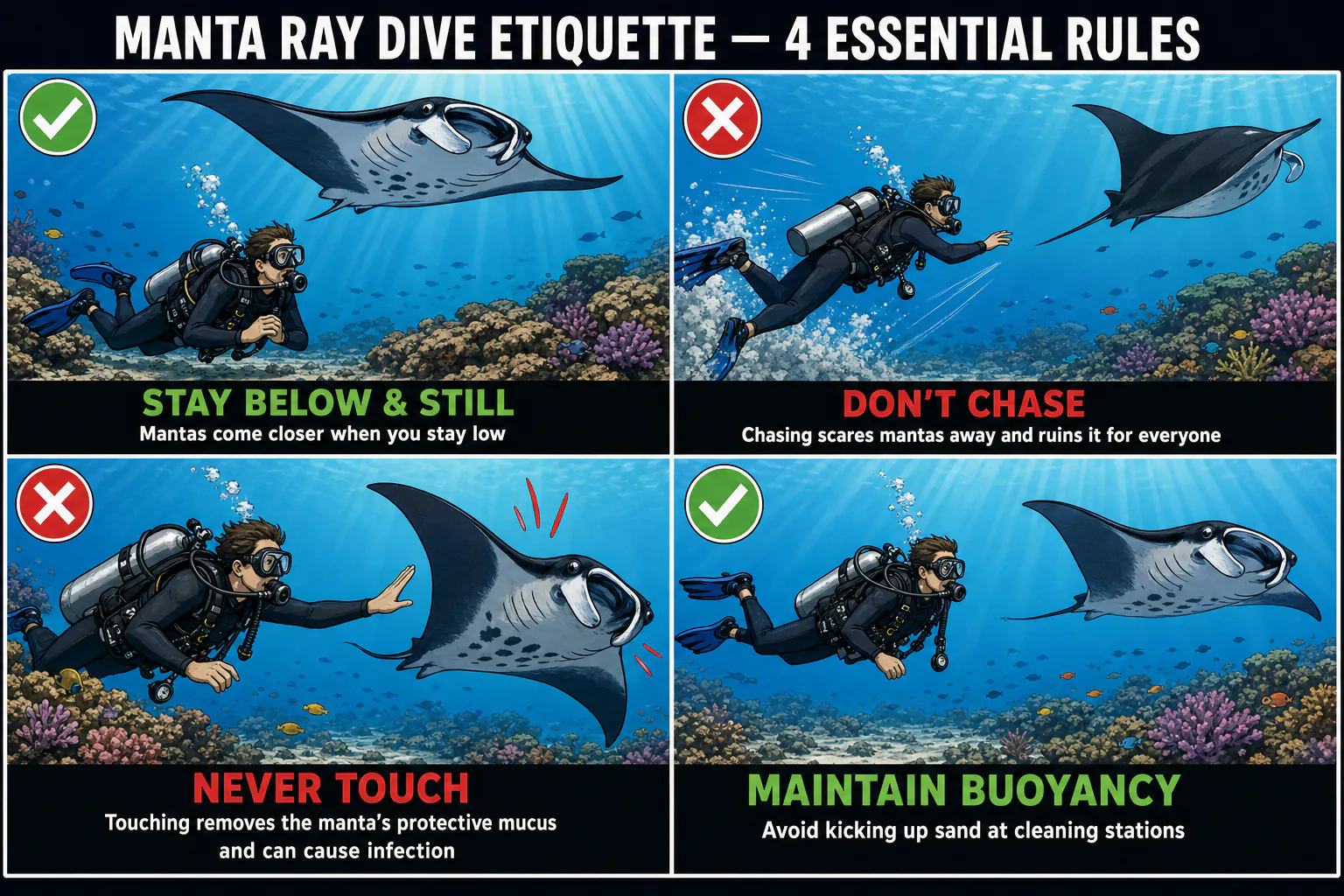
Manta sightings are protected partly because the local operators (us included) take etiquette seriously. The rules below are not arbitrary: they are based on years of observing what makes mantas stay (or leave) and what damages their skin and stress levels.
1. Stay below
Mantas are vertical animals: they want airspace above them. If you swim above a manta, you have effectively trapped it in its mental airspace and it will leave. Always keep your head below the manta's belly. This is the single most important rule.
2. Do not touch, ever
Mantas have a protective mucus layer on their skin. Touching them strips this mucus and creates open sites for bacterial infection. Any operator who lets divers touch mantas should lose their licence. Do not even reach out, even if a manta passes within arm's length. Tuck your hands in.
3. Do not chase
If a manta swims away from you, it is telling you something. Chasing burns your air, ruins the dive for everyone else, and trains the manta to associate humans with stress, which over time reduces sightings at that site. Hold position. Mantas at cleaning stations always come back if you give them space.
4. Hold position with perfect buoyancy
This is a hovering dive. You will spend 30+ minutes motionless in one spot. Practise your hover and trim before this dive. Bumping the reef, kicking up sand, or fin-flailing scares mantas and damages the cleaning station habitat. If you finished your Open Water last week and your buoyancy is not solid yet, your guide will position you in a sandy area away from the cleaning rock.
5. No flash photography on cleaning stations
Strobe flashes startle mantas mid-cleaning and the manta will leave. Use natural-light photography only at Manta Point. Strobes are fine in mid-water at Manta Bay if the manta is not actively feeding nearby.
6. Stay below the surface (no bubble curtain)
Do not free-dive down from the surface above a manta. Free-divers cause more disturbance than scuba divers because the manta sees them as a large predator coming from above. Pick scuba OR snorkel for the day, do not switch mid-dive.
7. Spread out, do not crowd
If three boats arrive at Manta Point at once (it happens), spread your group across the cleaning station rather than bunching up. Mantas tolerate maybe 8 to 12 divers around a single cleaning area. Once it gets to 20+ they leave.
What you can realistically expect to see
Honest numbers from our log books across the last 12 months at Manta Point (the more famous of the two sites):
- Sighting rate: 92% of dives, at least one manta. 100% across any 2-dive day at Manta Point + Manta Bay combined.
- Typical group size: 2 to 6 mantas at the cleaning station, with occasional days of 10+ when the station is especially busy.
- Typical encounter duration: 30 to 45 minutes of constant manta activity per dive.
- Typical manta size: 3 to 4 metres wingspan. Occasional 5m+ individuals, including a known large female we have been seeing for 4 years now.
- Closest approach: Without you moving, mantas regularly pass within 1 to 2 metres. They have come down close enough to feel the displaced water from their wings.
What else you will see at Manta Point besides mantas:
- Hawksbill and green turtles (common, almost every dive)
- Whitetip reef sharks (often, especially in deeper portions)
- Schooling fusiliers, sweetlips, batfish
- Bluestreak cleaner wrasse (the small fish doing all the work)
- Bumphead parrotfish in groups (occasional, mostly mornings)
- Mola mola from July to October (possible but rare at Manta Point, more reliable at Crystal Bay)
For a fuller marine-life rundown, see our types of fish in Bali guide. And if you are wondering whether mantas are safe, the short answer is they are completely harmless, but we wrote a longer piece in are manta rays dangerous.
Conditions, currents, and prerequisites
Honest expectations help everyone. Nusa Penida diving is amazing, but it is not the easiest diving in Bali.
Currents
Manta Point can have moderate-to-strong currents, including a surge near the cleaning station that pushes you back and forth. Manta Bay is usually calm. The crossings between sites can be bumpy in wet season. If you have done a drift dive before (Komodo, Maldives, the Philippines) you are well prepared. If your only dives are calm-water reefs from Thailand or the Red Sea, expect this to be more dynamic.
Water temperature
The south coast of Penida sits in a cold-water upwelling zone, especially July to October. Expect 22 to 26 °C in dry season, 26 to 28 °C in wet season. A 5mm wetsuit is the right call in dry season, a 3mm is fine in wet season. Most operators (us included) include the wetsuit in the day-trip rate.
Visibility
20 to 30 metres on a good day, 8 to 15 metres on a plankton-rich day. Plankton-rich days are often the best manta days, so dropped viz is sometimes good news.
Prerequisites
- Manta Point: Open Water Diver minimum, AOW strongly preferred, at least 10 logged dives, comfortable in current.
- Manta Bay: Open Water Diver, any experience level. Suitable for newer divers and snorkellers.
- You should be able to hover motionless for 5+ minutes. If you are not there yet, your guide can take a few minutes before the dive to coach you, or recommend the Peak Performance Buoyancy elective on the Advanced Open Water course before you do the manta dive.
- A current dive medical (the standard PADI/RSTC form) and signed liability release.
Photography tips for manta encounters
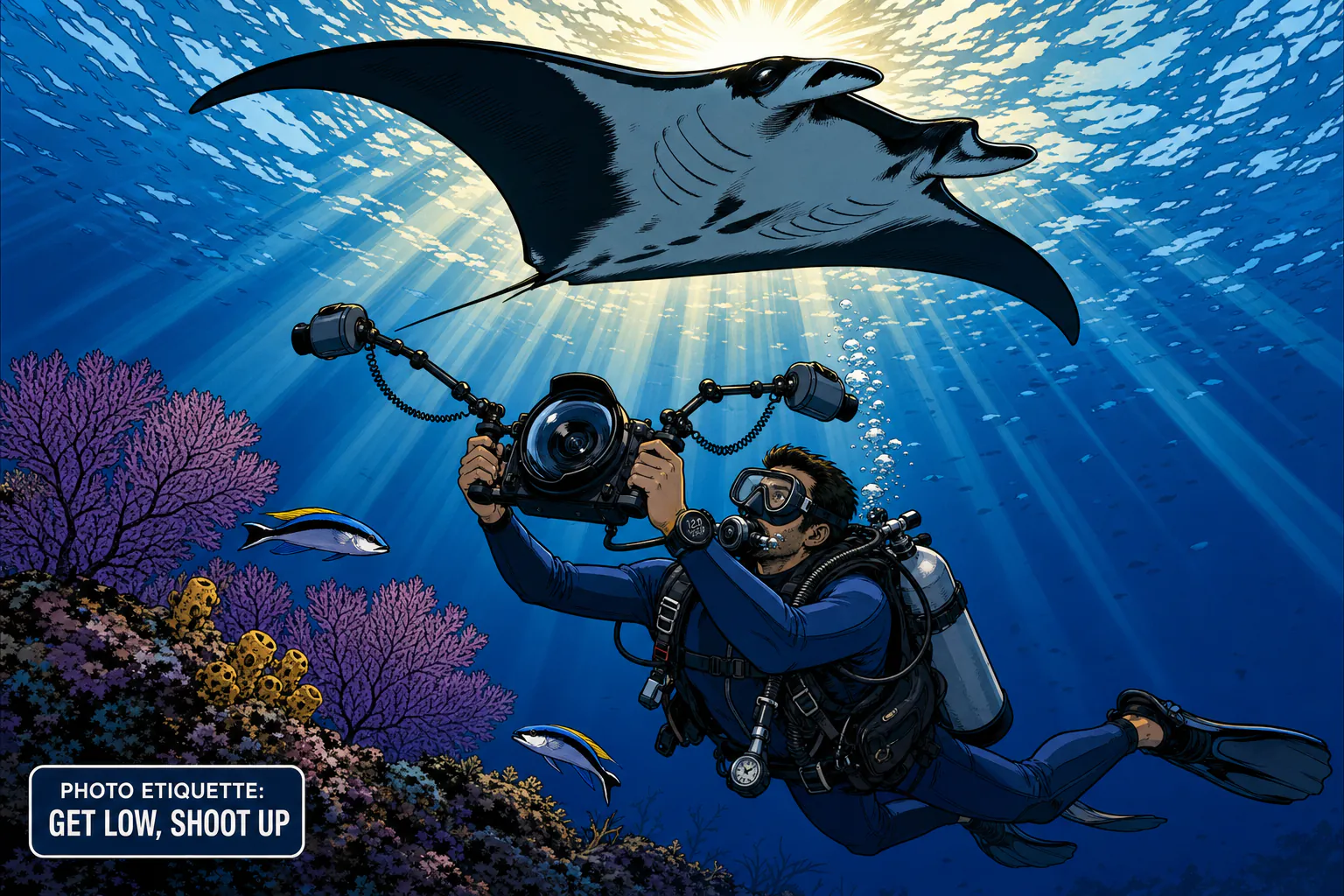
Mantas at Penida photograph beautifully if you respect the etiquette and use the right approach. Some operator-tested tips:
Lens choice
Wide-angle only. Mantas are large and you will be close. A 24mm fullframe equivalent or a fisheye on a mirrorless body works best. Macro lenses are useless here.
Lighting
Natural light at Manta Point. The cleaning-station depth (10 to 15m) is well-lit by the sun and your photos will look better without strobes. Crank your ISO, expose for the manta belly, embrace the silhouette look. At Manta Bay strobes are fine in mid-water.
Position
Get low and shoot up. Manta bellies against the bright water surface make iconic shots. Lying on your back on the cleaning station rock (after checking there is no coral) and shooting straight up as a manta passes overhead is the classic Penida composition.
Settings
Manual mode. Fast shutter (1/250 minimum to freeze the wings), aperture around f/8, ISO 400 to 1600 depending on depth and light. Take many frames. Mantas glide in long predictable lines but the precise moment a wing tip enters your frame is luck.
Etiquette
Camera does not change the rules: do not chase, do not block the manta's path to the cleaning station, do not get above. If you want the perfect silhouette shot you may need to wait 20 minutes for the right pass. That is the dive.
Cost, booking, and what is included in 2026
Real numbers in line with the 2026 Bali market.
Standard Nusa Penida manta day trip from Sanur
- 2 dives (Manta Point + Crystal Bay/Toyapakeh): IDR 2,350,000–3,050,000 (≈ 130–170 USD) per diver
- 3 dives (with extra Penida site): IDR 3,050,000–3,800,000 (≈ 170–210 USD) per diver
- Snorkel day at Manta Bay only: IDR 1,100,000–1,600,000 (≈ 60–90 USD) per snorkeller
What is normally included
- Hotel pickup from Sanur, Kuta, Seminyak or Ubud (Ubud usually +IDR 20,000 (≈ 1 USD)0)
- Speedboat transfers Sanur, Penida, Sanur
- All scuba equipment (mask, fins, BCD, regulator, weights, tanks, 3mm or 5mm wetsuit)
- Certified dive guide
- Lunch at a Penida warung
- Water, tea, snacks on the boat
- Marine park / harbour fees
What to ask before booking
- What is your guide-to-diver ratio? (Ours is max 1:4 at manta sites for safety and etiquette.)
- Will the boat divert to Manta Bay if Manta Point is rough? (It should.)
- Do you brief manta etiquette before the dive? (Should be yes, in detail.)
- What is your refund policy if mantas are a no-show? (We offer a free return dive for any zero-sighting day, which has only happened twice in 2026 across 200+ trips.)
Compare against the wider trip cost in our scuba diving Bali price guide. Or jump straight to booking on our Manta Point Nusa Penida page.
Honest expectations: what can go wrong, and what we do about it
We do not get to control mantas, weather, or current, and pretending otherwise would be dishonest. Here is what occasionally goes wrong and how a good operator handles it.
Manta no-show
Rare but real. About 1 in 50 days at Manta Point sees no mantas, usually because of unusual current direction or temporary plankton displacement. We offer a free return dive on any zero-sighting day. Manta Bay sees mantas more reliably (96% rate in our logs), so if the boat does the standard "Manta Point + Crystal Bay" itinerary and the first site is empty, we usually divert the second dive to Manta Bay.
Bad visibility
Plankton blooms can drop viz to 5 to 8 metres. Counter-intuitively, these are often the best manta days because that is what they are feeding on. You will see mantas, just at shorter range.
Rough sea, trip cancelled
In wet season the speedboat occasionally cannot make the south-coast crossing safely. We cancel and refund or reschedule. Always build a buffer day into your Bali trip if mantas are essential.
Crowded sites
Manta Point gets busy at peak season (July to October mornings). Best mitigation: book with an operator that uses Sanur early-departure slots (06:30) to arrive at the cleaning station before the late-morning groups. Or pick Manta Bay where it stays quieter.
Boat seasickness
The Sanur-Penida crossing can be rough. If you are prone, take seasickness medication 30 minutes before the boat ride and pick a calmer day. Crystal Bay-only itineraries also work if you want to skip the south-coast crossing entirely.
Combining mantas with mola mola, Crystal Bay, and Blue Corner
Most people fly to Bali to see one specific animal. The smart move is to plan 2 to 3 Penida days and combine the encounters.
2-day Penida itinerary (peak season, July to October)
- Day 1: Manta Point + Crystal Bay (try for mola mola at Crystal Bay)
- Day 2: Manta Bay + Toyapakeh (chilled drift, easy day)
2-day Penida itinerary (wet season, November to March)
- Day 1: Manta Bay + Toyapakeh (sheltered, mantas in feeding mode)
- Day 2: Manta Point + Crystal Bay (if conditions allow)
3-day Penida itinerary (the full menu)
- Day 1: Manta Point + Crystal Bay (mantas + mola in season)
- Day 2: Manta Bay + Toyapakeh (feeding mantas + drift)
- Day 3: Blue Corner (advanced only, see warning) + Sekolah Dasar
Want the full Nusa Penida picture beyond just mantas? Read our diving Nusa Penida overview and Nusa Penida when, where and how guides. For mola mola specifically, the mola mola Bali season guide has the month-by-month odds.
Final word from the dive shop
If you fly to Bali to dive, the manta day at Nusa Penida is the dive you will tell people about for years afterward. It is a genuine close-encounter with a 4-metre filter-feeding ray that has no fear of you and no interest in eating you, and the experience of hovering on a sand patch while one of them slowly circles past at arm's length is the kind of thing scuba diving was invented for.
Two things will make your dive better than 90 percent of guests': do your Advanced Open Water first (or work on buoyancy), and read the etiquette section above twice. The mantas will reward both.
To plan your manta day or to combine it with a wider Bali or Nusa Penida itinerary, see our Manta Point Nusa Penida page or message our team. We will walk you through dates, conditions, what to add on, and how to slot it into a 7 to 10 day trip. If you are newer to diving and not sure where to start, the first-time diving in Bali pillar covers the whole planning process.
See you in the water.