
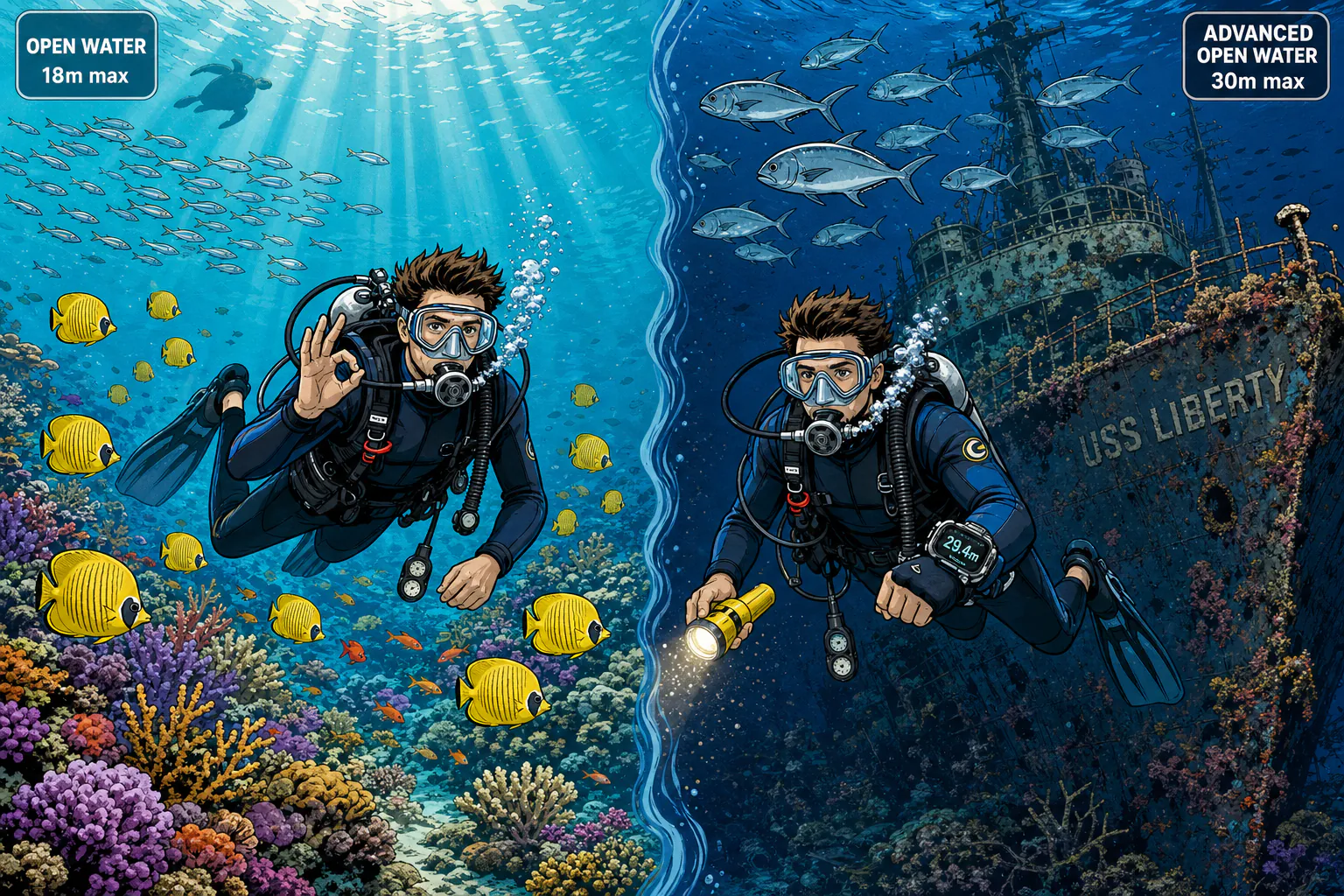
So you have your Open Water card and you are wondering whether to do the PADI Advanced Open Water in Bali, or wait until your next trip, or skip it entirely and just keep fun-diving. This is the article we wish every OW grad read before that decision. We are a Bali dive centre that runs AOW courses almost every week, and our honest take is this: if you have any intention of diving more than five times a year, do the AOW now, and do it in Bali. The reasons are below.
The PADI Advanced Open Water course in Bali is two days, five dives, no written exam, and it bumps your depth limit from 18 to 30 metres. More importantly it unlocks 80 percent of the world's best dive sites, including the deeper parts of the USS Liberty wreck, most of Nusa Penida, and almost everything in Komodo. It is the qualification that turns "I did a course on holiday once" into "I am a diver". We will walk you through what AOW actually involves, where you will dive your training dives in Bali, what it costs, who should and should not do it, and how to slot it into a 7 to 10 day Bali trip.
If you have already booked your OW and you are wondering whether to add AOW to the same trip, jump to the last section. Otherwise read top to bottom.
What the PADI Advanced Open Water course actually is
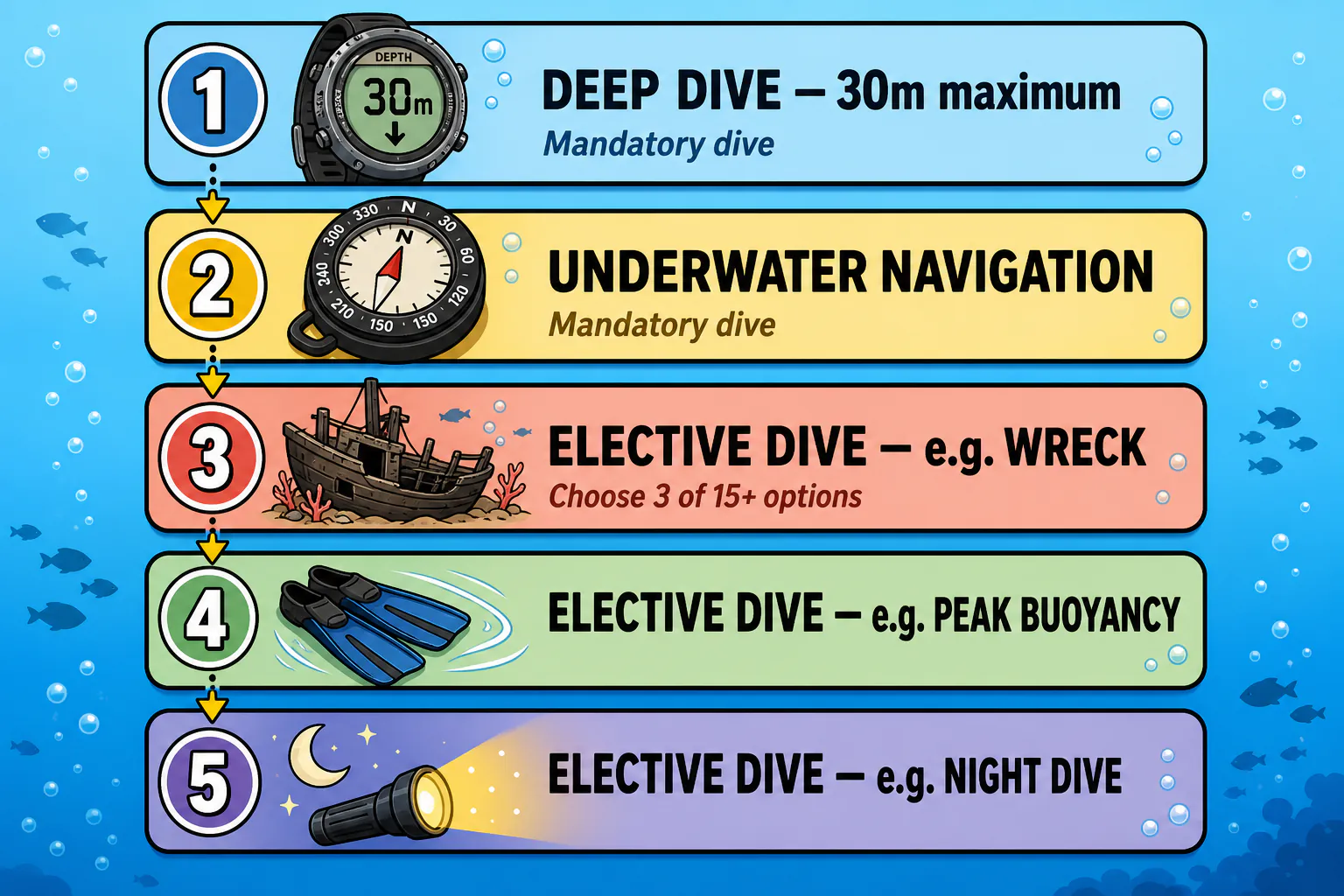
The PADI Advanced Open Water (AOW) is the next certification after Open Water in the PADI recreational ladder. It is structured as five Adventure Dives over two consecutive days, with no swimming test and no formal written exam. The certification card raises your depth limit from 18 to 30 metres and signals to dive operators worldwide that you have logged real experience beyond your initial training.
The five dives are made up of:
- Deep Adventure Dive (mandatory). A guided descent to a maximum of 30 metres, with skills focused on monitoring depth and gas, recognising nitrogen narcosis (more on that in our piece on scuba diving and alcohol), and surface-interval planning.
- Underwater Navigation Adventure Dive (mandatory). Compass headings, natural navigation, kick-cycle counting, and how to find your way back to the boat without becoming a story.
- Three elective Adventure Dives chosen from a menu of 15+ options. Common choices in Bali are Wreck (USS Liberty), Peak Performance Buoyancy, Underwater Naturalist, Night Diving, Drift Diving, Underwater Photography, Fish Identification, Search and Recovery, and Enriched Air (Nitrox).
Each Adventure Dive is the first dive of the corresponding PADI Specialty Course. If you go on to do a full specialty later, your AOW dive in that subject counts as dive 1 of that specialty.
What AOW is not: it is not a "deep" course (that is a separate Deep Diver Specialty going to 40m), it is not a rescue qualification (that is the PADI Rescue Diver), and it does not make you an instructor or a divemaster (see our PADI Divemaster Course Bali guide for the professional path). It is a structured way to build real-world experience in five dives, supervised by an instructor, with formal sign-off in your logbook.
What changes between Open Water and Advanced Open Water
This is the practical comparison divers actually want.
| Aspect | Open Water | Advanced Open Water |
|---|---|---|
| Maximum depth | 18 metres | 30 metres |
| Course length | 3 to 4 days | 2 days |
| Theory exam | Yes (online + final) | No exam, brief knowledge reviews only |
| Dives included | 4 training dives | 5 Adventure Dives |
| Swimming test | 200m swim + 10min float | None |
| Prerequisites | None | OW certified, 4+ logged dives |
| Sites you unlock in Bali | Most reef sites, shallow wreck | Full USS Liberty, most Nusa Penida sites, most Komodo sites |
| Cost in Bali (2026) | IDR 8,600,000–10,400,000 (≈ 480–580 USD) | IDR 6,500,000–8,600,000 (≈ 360–480 USD) |
The difference that matters in practice is the depth. A lot of the most interesting structure on Bali wrecks and walls sits between 18 and 30 metres, and as an OW diver you can see them only from above. AOW gets you into them. You also typically get faster, smaller buddy groups on AOW-required boat trips because operators run them as advanced divers only.
Where you will actually dive your AOW in Bali
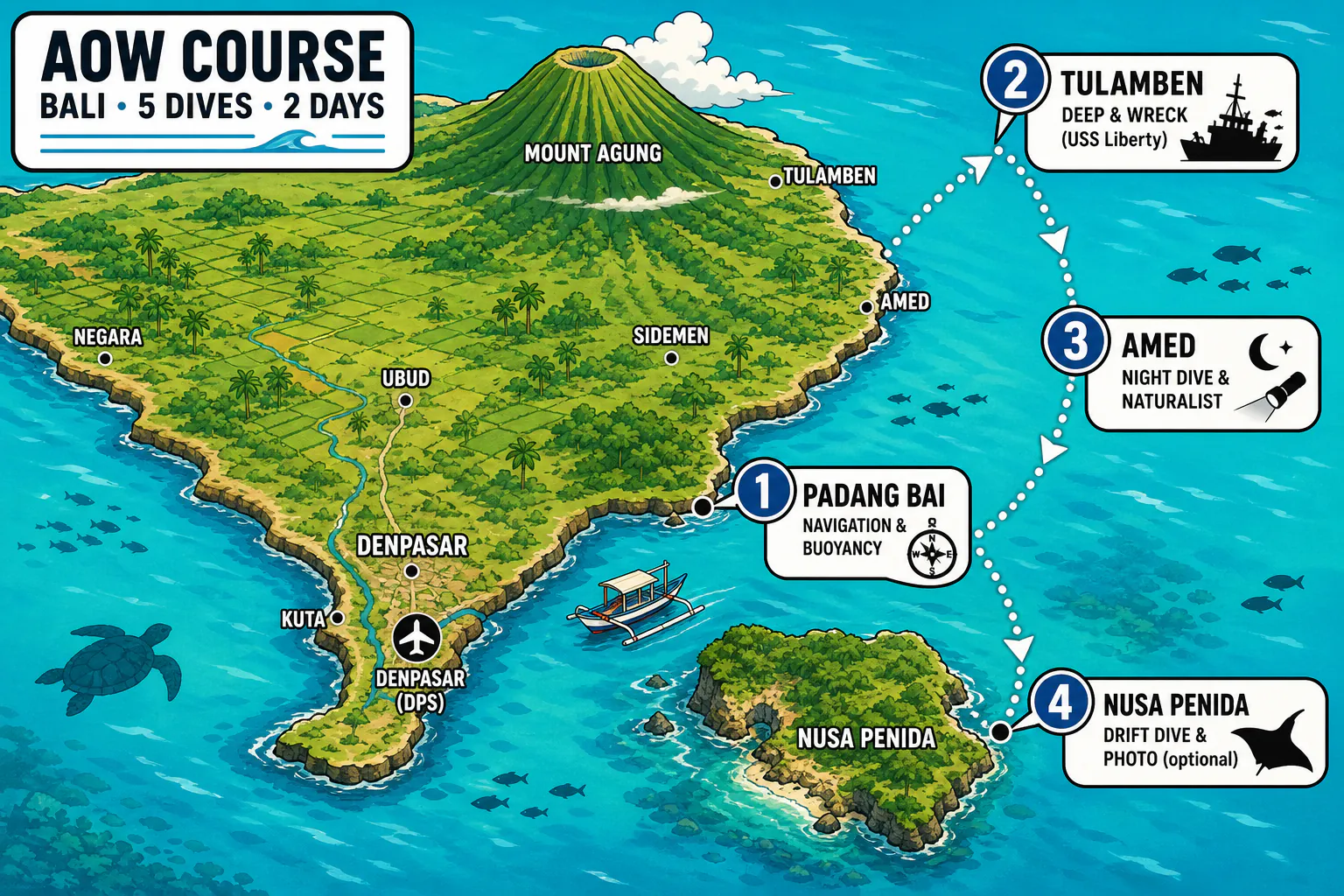
Bali is one of the best places in the world to do the AOW course because all five dives can be done at genuinely world-class sites, all within a 2 to 3 hour drive of the same hotel base. The typical 2-day schedule that we and most reputable operators run looks like this:
Day 1: Padang Bai
Padang Bai is a quiet east-coast port town, around 90 minutes from Sanur. The site combination here is ideal for course dives 1 and 2.
- Navigation Adventure Dive at Blue Lagoon or Tanjung Sari. Calm, sandy, 12 to 18 metres, perfect for compass triangles without current interference.
- Peak Performance Buoyancy at Jepun. Easy reef and the old artificial reef pyramids let your instructor coach you through hovering motionless next to a soft coral without flapping a fin.
Day 2: Tulamben
Tulamben on the north-east coast is home to the USS Liberty shipwreck, one of the most accessible deep dive sites in Asia. This is where the rest of the course happens.
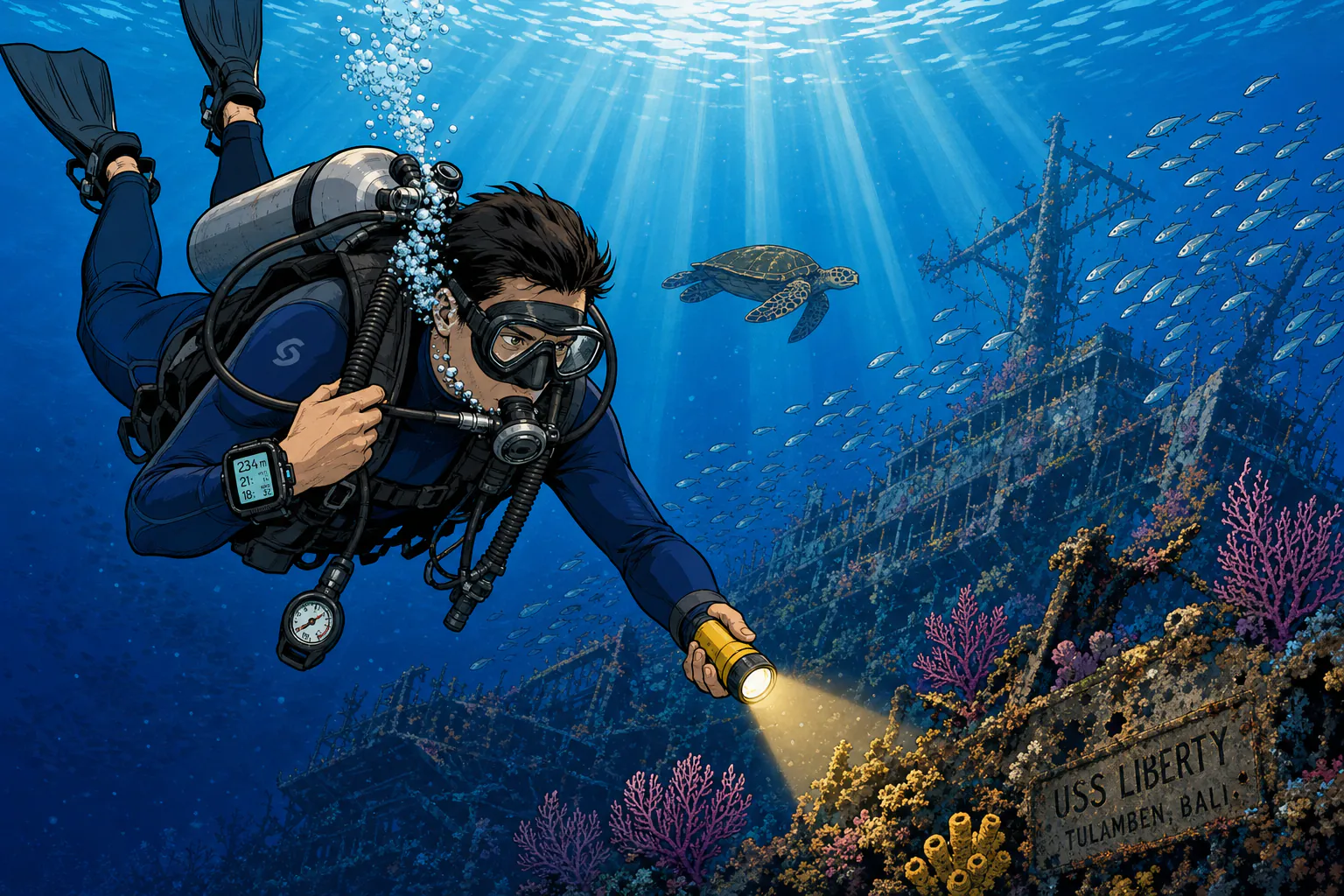
- Deep Adventure Dive on the stern of the Liberty wreck, to a maximum of 30 metres. You will see the propeller shaft, the cargo holds, and the bigger soft-coral growth at depth that you simply cannot see as an Open Water diver.
- Wreck Adventure Dive on the Liberty mid-section. No penetration on an AOW elective, but you will swim along the ship and learn how to plan a wreck dive properly.
- Underwater Naturalist or Night Dive as the fifth elective. Naturalist is a daylight macro-focused dive on Coral Garden or Drop Off, with your instructor pointing out species. Night dive is the Liberty after dark, with torches, where Spanish dancers, octopuses, and lobsters appear from nowhere.
Optional: Nusa Penida add-on
If you have an extra day and are diving in the right season (April to October for general conditions, July to October for mola mola), you can swap one elective for a Drift Adventure Dive at Toyapakeh or Manta Point in Nusa Penida. Drift diving as an Adventure Dive is one of the more useful electives if you have any plans to dive Komodo later (see our Komodo vs Bali comparison).
The rest of Bali's first-class sites become unlocked the moment your AOW card is issued. Amed and the east coast open up to deeper macro sites like Seraya Secrets, and our broader best places to scuba dive in Bali list becomes a real menu rather than a window display.
The five most-chosen electives, and which to pick
You only do three electives (the other two are Deep and Navigation, both mandatory). Choose them based on the diving you actually plan to do afterwards. Our honest pick from running these courses every week:
1. Wreck
If you are doing AOW in Bali, do the Wreck elective. You are diving the Liberty anyway and the Wreck dive is genuinely useful, lays the groundwork for wreck-penetration training later, and is what most divers remember years later. Almost every guest picks this one.
2. Peak Performance Buoyancy
The single elective that will improve your diving the most for the rest of your career. If you are still bumping into coral, blowing air to descend, or yo-yoing during safety stops, this is the dive that quietly fixes all of it. Highly recommended for divers with fewer than 25 dives.
3. Drift
Pick this if you plan to dive Nusa Penida properly, Komodo, Bunaken, or anywhere with currents. It is also the elective that prepares you mentally for the next big-diving destinations you will visit.
4. Night
The Liberty wreck at night is one of the best night dives in Asia. Octopus, decorator crabs, hunting moray eels, bioluminescent plankton on your hand. If you have ever wondered what it is like to dive in the dark, the Liberty is the place to find out.
5. Underwater Naturalist or Fish ID
The right pick if you are travelling with a photographer partner, you love marine biology, or you want to actually identify what you saw rather than just say "the little colourful one". Less adrenaline, more knowledge. Pairs well with our piece on types of fish in Bali.
Other electives worth knowing about: Enriched Air (Nitrox) is technically a knowledge-only specialty, not an Adventure Dive, so it does not count toward AOW. Search and Recovery is fun but rarely used recreationally. Underwater Photography is great if you are bringing a camera, less useful if you are renting.
Cost in 2026, what is included, and what is not
Real numbers from our centre, in line with the rest of the Bali market. Honest costs to set expectations.
Course price
- Standard 2-day PADI Advanced Open Water Course in Bali: IDR 6,500,000–8,600,000 (≈ 360–480 USD)
- With Nusa Penida day boat add-on for the drift elective: add IDR 900,000–1,450,000 (≈ 50–80 USD)
- With private instructor (1:1 instead of 1:4 group): add IDR 2,700,000–4,500,000 (≈ 150–250 USD)
What is normally included
- PADI eLearning materials (the digital knowledge reviews you complete before or during the course)
- Instructor for all 5 dives over 2 days
- All scuba equipment (mask, fins, BCD, regulator, tanks, weights, wetsuit, computer)
- Transport from Sanur or your Bali hotel to the dive sites and back
- Lunch and water on diving days
- Boat fees and site fees at Padang Bai
- PADI Advanced Open Water certification card (digital, with optional plastic card extra)
What is not always included (ask before booking)
- Accommodation (we recommend staying in Sanur, see our Bali diving in Sanur page for hotel options)
- Nusa Penida boat charter if you add the optional Drift elective
- Underwater photography rental cameras or torches for the Night dive
- Marine park / National Park entrance fees if relevant
- Optional dive insurance (separate, see our advice below)
Compare this to the rest of the trip in our scuba diving Bali price guide and live numbers on our Bali dive pricing page.
Prerequisites and who can take the course
You can sign up if you tick these four boxes:
- PADI Open Water Diver certification (or a recognised equivalent: SSI Open Water, NAUI Scuba Diver, BSAC Ocean Diver, CMAS One Star). The system is cross-recognised across the main agencies.
- 4 logged dives minimum. Your 4 OW training dives count. If your OW was many years ago, your instructor may recommend a refresher dive before the course starts.
- Minimum age 12 for PADI Junior Advanced Open Water (12 to 14 year-olds, with reduced depth limit and parental sign-off), or 15+ for full Advanced Open Water.
- Medically fit to dive, meaning you can answer "no" to every question on the standard PADI/RSTC medical questionnaire, or you have a signed dive medical from a doctor for any "yes" answers. The same form you signed for your Open Water applies here.
You do not need to be a strong swimmer (there is no swim test on AOW), you do not need to be young or fit, and you do not need any dive experience beyond the 4 training dives. If you certified OW yesterday and you have 4 logged dives, you can start AOW today.
How long it takes and how to fit it into a Bali trip
The standard PADI Advanced Open Water in Bali runs as a 2-day intensive, with all 5 dives scheduled across consecutive days. The theory is delivered as PADI eLearning, which you can complete on your laptop or phone before you arrive (usually 4 to 6 hours total over a week or two) so that all of your in-Bali time is spent diving.
If you prefer a slower pace, we can split the course over 3 days with a rest day in the middle. Some divers prefer this if they have just finished OW and want their bodies and ears to recover. The price stays the same.
Common ways guests slot AOW into a Bali holiday:
- Roll AOW directly onto your OW. Finish your Open Water Course in Bali on day 4, take a rest day, then start AOW on day 6. Out the door with both cards in 7 days. This is the most popular path for first-time Bali divers.
- AOW only. If you certified OW elsewhere and you are here for fun diving, book the AOW in 2 days at the start of your trip and spend the rest of the week diving the deeper sites you have just unlocked.
- AOW plus Komodo. Do the AOW in Bali in days 2 to 4, then fly to Labuan Bajo for a 4 to 7 night Komodo liveaboard. Komodo's most famous sites are advanced and your fresh AOW card opens them up. See our Komodo vs Bali guide for the combined-trip itinerary.
Day-by-day, what your AOW course actually looks like
Day 1, Padang Bai (early start)
06:30 to 07:00 pickup from your Sanur hotel. 90-minute drive east to Padang Bai, with a coffee and breakfast stop on the way.
08:30 briefing. Your instructor goes over the day's two Adventure Dives (Navigation and one elective, often Peak Performance Buoyancy), checks your eLearning knowledge reviews, and signs you off for the water.
09:30 first dive (Navigation). A 40-to-45-minute dive at Blue Lagoon or Tanjung Sari. You will run compass headings out-and-back, swim a square pattern, count kick cycles, and do natural-navigation exercises.
11:00 surface interval, snacks, debrief. Hot tea and a quick logbook update.
12:00 second dive (elective). Peak Performance Buoyancy at Jepun is the typical choice. 40 minutes of hovering, fin-pivoting, and trim adjustments. You will end the dive aware of every breath in a way you were not at the start.
13:30 lunch in Padang Bai at a local warung, then the drive back to Sanur. Home by mid-afternoon. Rest, hydrate.
Day 2, Tulamben (a longer day)
05:30 pickup from your Sanur hotel for the 3-hour drive to Tulamben. Sunrise on the road, brilliant.
08:30 briefing at the dive centre on Tulamben beach. Three dives planned: Deep, Wreck, and your final elective (Naturalist or Night).
09:30 Deep Adventure Dive on the Liberty wreck stern. You walk in from the beach. Descend in a guided buddy group to 28 to 30 metres on the deeper section of the wreck. Skills include monitoring depth, recognising narcosis if present, monitoring gas consumption.
11:00 surface interval at the beach warung. Coconut and grilled fish.
12:00 Wreck Adventure Dive on the Liberty mid-section. No penetration but a long swim along the structure with your instructor pointing out the cargo holds, the broken superstructure, and the resident bumphead parrotfish if they are around.
13:30 lunch and a long surface interval while you outgas before the third dive.
17:30 Night Adventure Dive on the Liberty. (Or earlier afternoon if you chose Naturalist instead.) Torches, slow descents, octopus, sleeping turtles, hunting moray eels, the wreck transformed into something completely different from what you saw earlier. Your logbook gets signed, you are now AOW certified.
20:00 back to Sanur by van. Long day, brilliant memories. You sleep well.
Should you do your AOW in Bali, or wait?
If you are not based in Bali, the obvious question is whether to do your AOW where you live or wait for a trip to Bali, Komodo, or wherever. Our honest take:
Do it in Bali if you:
- Want the course done at world-class sites (USS Liberty for Deep + Wreck + Night is a top-five life experience for many divers)
- Want intensive 2-day delivery rather than spread-out weekends
- Are already coming to Bali to dive anyway
- Want warm-water comfort at 27 to 29 °C in a 3mm wetsuit
- Have plans to dive Indonesia further (Komodo, Raja Ampat) where AOW is essentially required
Do it at home if you:
- Have access to a local dive centre with quarry, lake, or coastal sites and you want to dive there year-round
- Want to spread the course over multiple weekends rather than burn 2 of your Bali days
- Already have a relationship with an instructor at home
For most divers travelling internationally, the answer leans Bali. The dives are simply better, and you finish certified at sites you might never see again otherwise.
How AOW fits into the PADI ladder
For context, here is the recreational PADI progression. (Full breakdown in our scuba diving certification types guide.)
- PADI Discover Scuba Diving (Try Dive), no certification, instructor-led only, max 12m
- PADI Open Water Diver, the first real certification, max 18m
- PADI Advanced Open Water Diver, max 30m (this article)
- PADI Rescue Diver, focuses on diver safety and emergency response
- PADI Master Scuba Diver, the highest non-professional recreational rating, requires Rescue + 5 specialties
- PADI Divemaster, the first professional rating
- PADI Open Water Scuba Instructor, the qualification to teach
Most divers stop at AOW and dive recreationally for life. About 20 percent go on to Rescue. The progression beyond Rescue is for people who want to dive professionally or seriously.
Final word from the dive shop
If we had a euro for every diver who came back to us six months after their OW saying "I wish I had just done the AOW while I was there", we could buy another boat. The course is short, the price is reasonable, the sites are spectacular, and the qualification is the single most useful upgrade you will make in your recreational diving life. It opens up the entire world of "advanced" dive sites and it puts you on the standard footing that most dive operators expect for anything beyond a beginner reef.
If you are reading this from home and planning a Bali trip, add 2 days for AOW and ideally another 2 to 3 days of fun diving at the sites it unlocks. If you are already in Bali finishing your OW, stop reading and ask your instructor to add AOW to the schedule. You will not regret it.
To book directly or to ask any question about the course, see our PADI Advanced Open Water Diver page or message our team. We will help you plan around your dive history, your travel dates, and whether to combine it with a Komodo extension. The boats run all year.
See you in the water.