
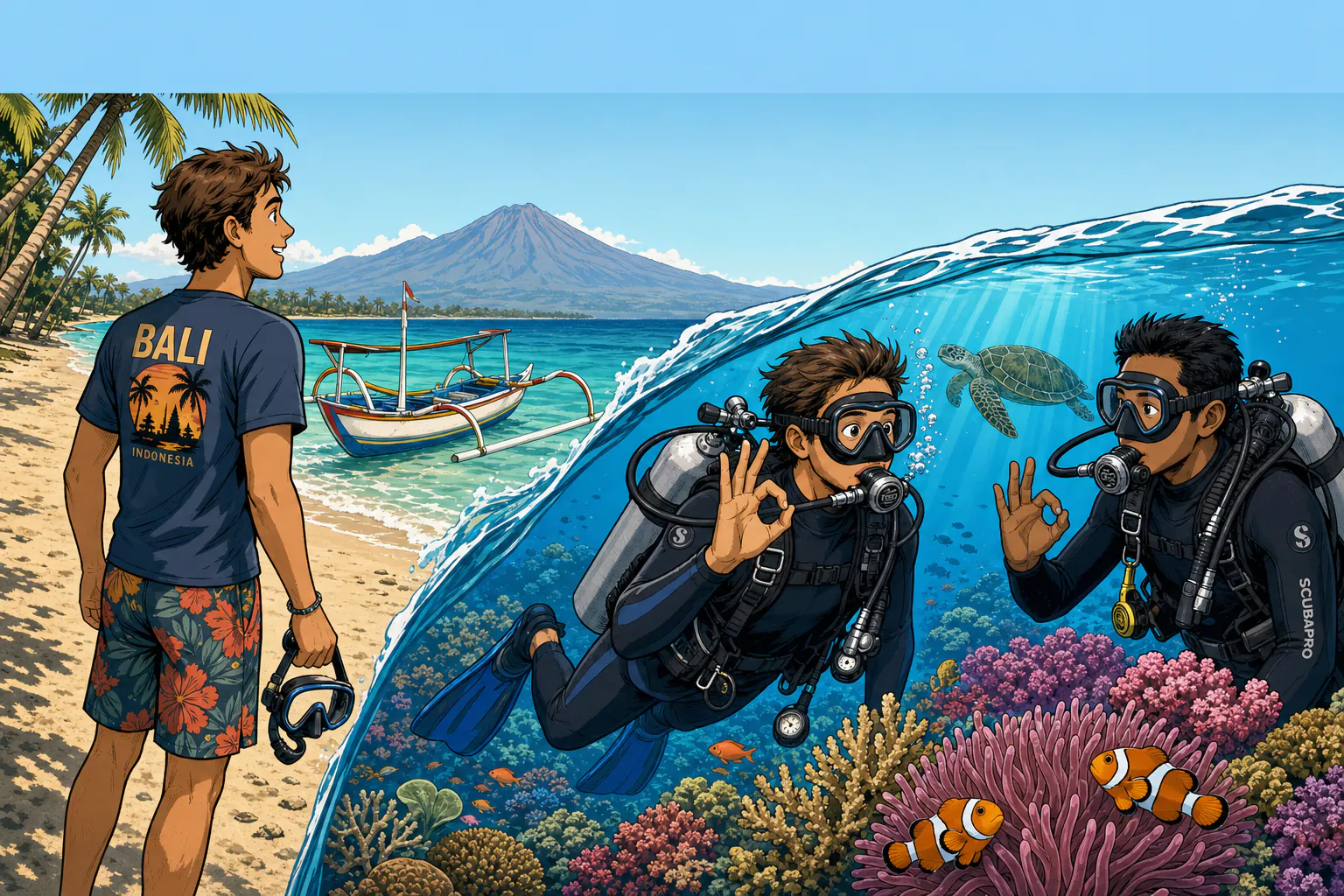
So you are thinking about going diving in Bali for the first time. Good call. Of all the places in the world to take your first breath underwater, Bali has one of the easiest learning curves, one of the friendliest local industries, and a marine life list that will spoil you for life. We say this as a dive centre that has been here for years and trained more first-timers than we can count. This guide is everything we wish every guest knew before they emailed us, written in the order you will actually need to think about it.
The short version: most travellers do not need scuba experience, certification, or any special fitness to dive in Bali. You need to be able to swim, you need to not have a small list of medical conditions, and you need to be patient enough to spend a few minutes learning how to breathe through a regulator. That is it. The rest of this article walks you through every real decision: try dive or full course, when to come, where to base yourself, what dive sites are actually beginner-friendly, what it costs in 2026, what to pack, what your first day at the dive shop will feel like, and a sample week-long itinerary we run for first-timers every month.
If you are short on time, jump to the section that matches your current question. If you are at the very start of planning, just read top to bottom, it is meant to be read in order.
Try dive or full Open Water course: which one is right for you?
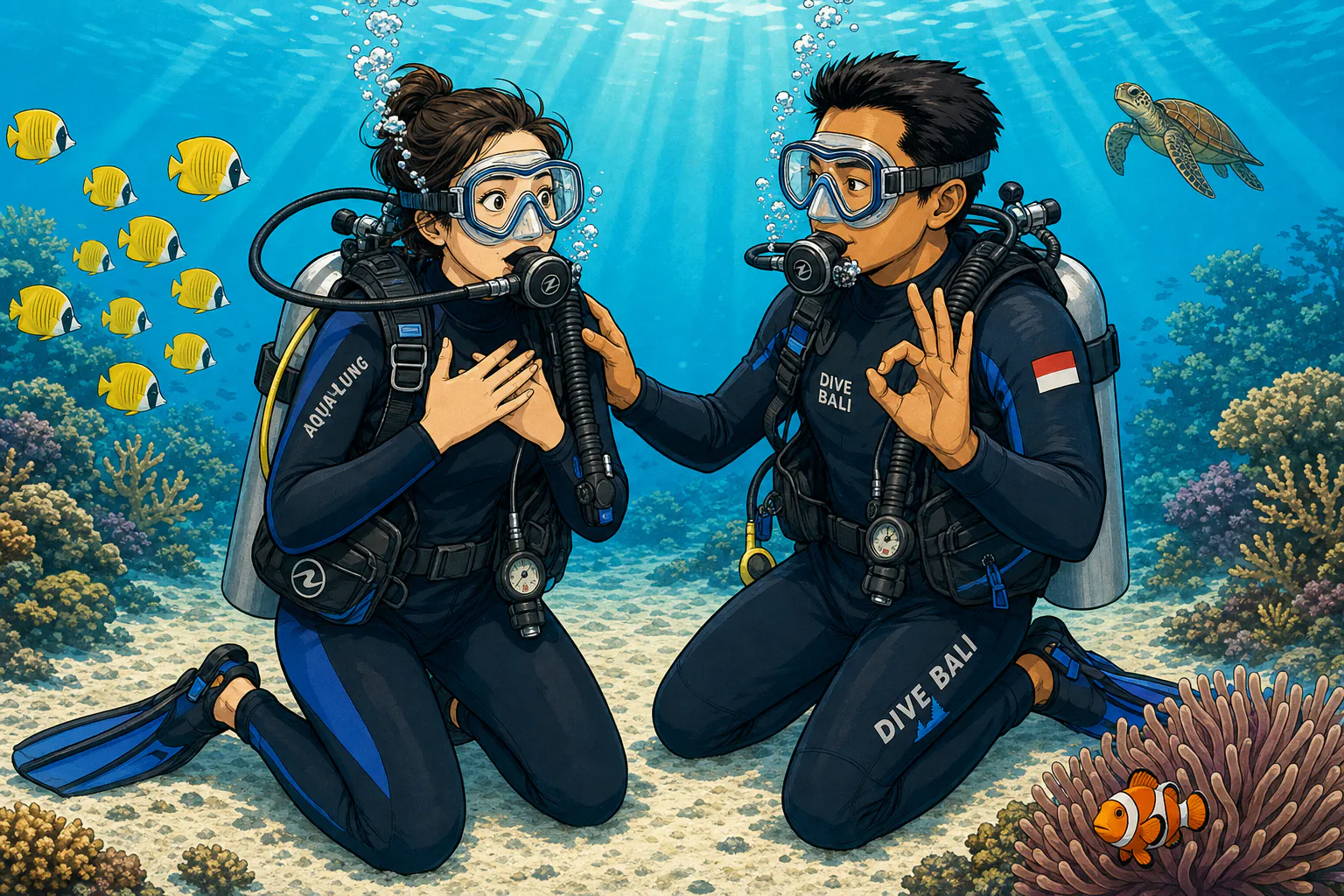
This is the first real fork in the road. Both options are designed for someone who has never breathed underwater. The difference is whether you walk away with a lifetime certification or just a "wow, I did that" memory.
The Try Dive (Discover Scuba Diving)
A one-day, no-prior-experience introduction. You do a quick briefing, learn three or four essential skills in shallow water, then go on two real shallow dives back to back, normally 6 to 12 metres, with an instructor right next to you the entire time. You do not get a certification card, you cannot dive without an instructor afterwards, and the maximum depth is 12 metres. But you absolutely get to dive, twice. Cost: around IDR 2,000,000–2,700,000 (≈ 110–150 USD) (two dives included). Time commitment: a full day. We have a full breakdown in our Try Diving Bali guide.
The PADI Open Water Course
The entry-level scuba certification recognised worldwide. Three to four days, ending with a card that lets you dive anywhere in the world, with any buddy, to 18 metres. It includes some theory (online or in classroom), confined-water skills, and four open-water training dives at real dive sites. We run this all year, almost every day. Cost: IDR 8,600,000–10,400,000 (≈ 480–580 USD) in 2026. Time: 3 to 4 days. See our full Open Water Course Bali article for the day-by-day breakdown.
How to decide between the two
Honestly? If you have 4 days available and any suspicion that you might want to dive again later in life, do the Open Water. The course itself is the most rewarding way to learn, you get more underwater time, more sites, more skills, and you leave with a real qualification. We have lost count of guests who started with a try dive on Tuesday and came back Wednesday morning asking to convert to the full course (we do let you credit it, by the way).
Pick the try dive only if (a) you have less than 2 free days, (b) you are travelling with a non-diving partner whose patience is finite, or (c) you genuinely just want to test the water before committing the time. Both options are explained side by side in our guide to certification types, and if you have not yet made up your mind on whether to dive at all, our snorkeling vs diving comparison is worth a read.
Is diving safe? Will I actually be able to do it?
Short, honest answer: yes to both, for the vast majority of people. Recreational scuba within the limits we teach (no deeper than 18m for Open Water, 30m for Advanced, no decompression stops, daylight, with a guide or buddy) is statistically very safe. Safer than skiing, safer than riding a scooter in Bali, safer than several other things you will probably do on holiday. The real risks come from going beyond your training, ignoring depth and time limits, or diving with the wrong medical conditions, none of which happens on a first-timer course with a competent instructor next to you.
The medical questionnaire
Before any first dive, you fill out a short medical questionnaire (the standard PADI/RSTC form). Most people tick "no" to every question and go diving 10 minutes later. If you tick "yes" to anything, particularly heart conditions, lung conditions, recent ear surgery, asthma, epilepsy, or pregnancy, you will need a signed diving medical from a doctor before you can dive. The form is honest and it exists to keep you safe. If you have a medical condition you are not sure about, get the medical done before you fly out, not on arrival.
Physical requirements
You need to be able to swim 200 metres (any stroke, no time limit) and float comfortably for 10 minutes for the full Open Water course. The try dive has no swim test. You do not need to be athletic, you do not need to be young, you do not need to be lean. We have certified divers from 10 years old to 75, and the most common type of student is just a normal traveller who said yes.
The other "what about" questions
Most fears divers ask about are statistically negligible. Sharks in Bali are mostly small reef sharks and shy, see our piece on sharks in Bali for the species list. Manta rays look enormous but are completely harmless filter-feeders, the full story is in are manta rays dangerous. And one final practical rule: no alcohol the night before your first dive day, and definitely not between dives. Our scuba diving and alcohol article explains why this is non-negotiable.
When to come: best time of year for first-time diving in Bali
Bali is a year-round dive destination. There is no month where diving simply does not happen. That said, there are clear sweet spots, and as a first-timer you will probably want to maximise visibility and surface comfort.
April to October (dry season) is the easy answer. Calm seas, blue skies, 20 to 30 metres of visibility on most sites, and water temperatures of 26 to 28 °C. If you have flexibility, aim for May, June, or September, you get the dry-season conditions without peak-season crowds and prices.
July to October is also mola mola season at Nusa Penida, when the oceanic sunfish surfaces from deep cool water and can be sighted on dives. As a brand-new diver this is more of a bonus than a guarantee (you need to be Open Water certified to dive Crystal Bay where most molas are seen), but it is worth knowing about. The complete timing breakdown is in our mola mola Bali season guide.
November to March (rainy season) is fine for diving, contrary to what the name suggests. It rains in short tropical bursts, often at night, and most of the diving is unaffected. Nusa Penida actually has its best manta ray sightings in this window. We dive year-round and so do all serious operators. The full story is in our diving Bali in rainy season honest guide.
For broader Bali weather and travel timing, our good time to visit Bali article puts the diving seasons into the wider trip-planning context.
Where to base yourself for a first diving trip
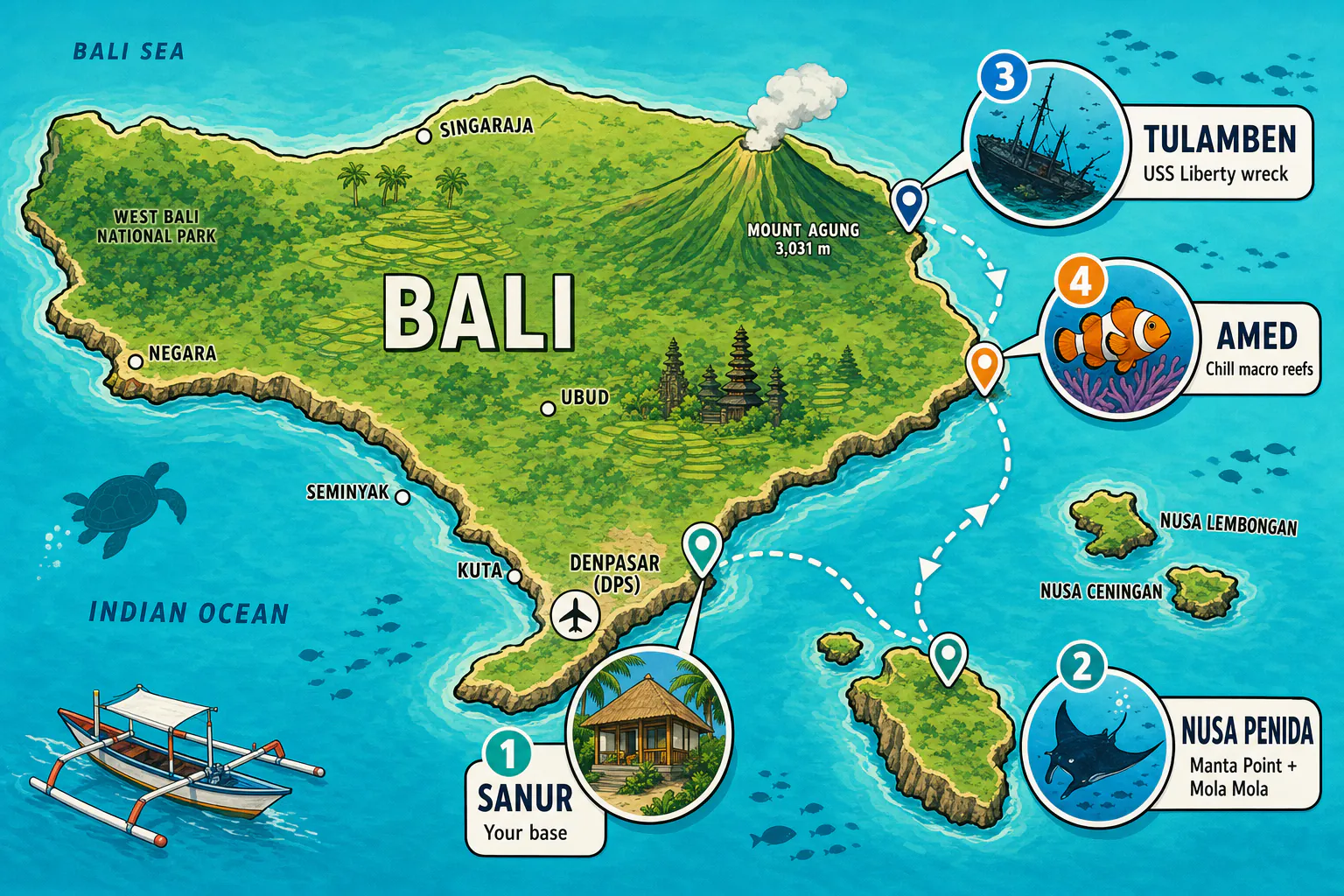
Bali is bigger than most first-time visitors expect. From the airport in the south to the dive sites in the north-east is a 3-hour drive. As a first-time diver, where you stay matters more than you think, because every morning is a transfer to and from the boat. Here is the honest pick of bases, in priority order for first-timers.
Sanur (our default recommendation)
Sanur is on the south-east coast, 30 minutes from Denpasar airport (DPS), and it is where we recommend first-timers stay. The reasons: it is a calm beach town (not the party chaos of Kuta), it has decent restaurants and cafes, it has a flat beachfront promenade for evening walks, it is the launch point for Nusa Penida day trips (45-minute boat), and it has its own gentle shore-diving reef which is ideal for try dives and Open Water training. Sanur is also where our centre is based, full details on our Bali diving in Sanur page.
Padang Bai
A smaller, more local fishing-port town about 90 minutes north-east of the airport. Closer to the great east-coast sites (Blue Lagoon, Jepun, Tulamben) but more limited in restaurants and nightlife. Good choice if you want a quieter trip and you are happy with simpler accommodation.
Tulamben or Amed
The far north-east coast, around 3 hours from the airport. Best for divers who want to wake up 50 metres from the USS Liberty wreck and dive it before breakfast. The trade-off is that you are a long way from Nusa Penida, so you would not base yourself here for a manta trip. Full picture in our diving Amed Bali guide.
Where not to base a dive trip
Avoid Seminyak, Canggu, Kuta, and Ubud as a dive base. They are 1.5 to 3 hours from any usable dive site, and you will burn most of your dive day in a van. They are great Bali destinations, just terrible dive bases. Use them as a buffer day before or after your diving block.
What dive sites you will actually dive on a first trip
Here is the realistic site shortlist for a first-timer week, in roughly the order you would do them. (We have a deeper-dive overview in our best places to scuba dive in Bali article.)
- Sanur house reef. Gentle, sandy, 5 to 18 metres. Where most try dives, PADI ReActivate refresher sessions for returning divers, and Open Water training dives happen. Reef fish, occasional turtles, no current to worry about. The perfect "first time underwater" environment.
- Padang Bai (Blue Lagoon, Jepun, Tanjung Sari). Easy boat dives, 5 to 22 metres, macro life and small reef fish. Ideal for OW training dive 3 and 4.
- USS Liberty wreck, Tulamben. A 120-metre armed cargo ship sunk in 1942, lying on its side from 5 to 30 metres. You can dive it from the beach. The shallowest sections (5 to 12m) are easily accessible to brand-new Open Water divers. Hawksbill turtles patrol it, schools of bumphead parrotfish visit at sunrise. See our full USS Liberty Bali piece for the history and dive plan.
- Nusa Penida, Manta Point and Toyapakeh. Reachable on a day trip from Sanur. Manta Point is the cleaning station where reef mantas show up year-round, and Toyapakeh is a healthy reef site with gentle drift. Both are within reach of a brand-new Open Water diver in calm conditions, with the right guide. Read our diving Nusa Penida guide for the full site list, and a note on which Penida sites are NOT for first-timers (Crystal Bay in mola season has cold thermoclines and surge, Blue Corner is advanced drift, both come later in your diving life).
- Menjangan Island (optional extension). West Bali, calm wall diving on a small offshore island. Quieter than the rest of Bali. A worthwhile add-on if you have an extra day, see our diving Menjangan Island guide.
That short list will keep a first-time diver busy for a full week, and the variety (reef, wreck, manta) is a fairer sample of what makes Bali special than any one site alone.
How much does a first Bali diving trip cost in 2026?
Real numbers from our centre. Sharing these openly because the internet is full of vague answers.
The diving itself
- Try dive (2 dives, full day): IDR 2,000,000–2,700,000 (≈ 110–150 USD)
- PADI Open Water Course (3 to 4 days, certification, all equipment): IDR 8,600,000–10,400,000 (≈ 480–580 USD)
- Single fun dive after certification (with guide, gear, transport): IDR 1,250,000–1,900,000 (≈ 70–105 USD)
- Two-tank Nusa Penida day trip: IDR 2,350,000–3,250,000 (≈ 130–180 USD)
- Three-tank Tulamben/Amed day: IDR 2,350,000–2,900,000 (≈ 130–160 USD)
- Equipment rental if you want a separate package: IDR 360,000–550,000 (≈ 20–30 USD) per day
The rest of your trip
- Budget hotel in Sanur: IDR 650,000–1,150,000 (≈ 35–65 USD) per night
- Mid-range hotel near the dive sites: IDR 1,550,000–3,050,000 (≈ 85–170 USD) per night
- Meals: IDR 90,000–270,000 (≈ 5–15 USD) per meal in local restaurants, IDR 550,000–1,100,000 (≈ 30–60 USD) in fancier places
- Scooter rental (do not ride without a proper licence): IDR 130,000–270,000 (≈ 7–15 USD) per day
- Driver for the day: IDR 1,000,000–1,550,000 (≈ 55–85 USD)
- Bali tourist levy (one-off): IDR 150,000 (~IDR 20,000 (≈ 1 USD)0) per person on arrival
A realistic 7-night first diving trip to Bali (Sanur hotel, Open Water course + 2 day-trip fun-dive days, meals, transport) lands somewhere between IDR 23,500,000 (≈ 1,300 USD) and IDR 38,000,000 (≈ 2,100 USD) per person, sharing a twin room, excluding flights. We have a full transparent breakdown in our scuba diving Bali price article and current pricing on our Bali dive pricing page.
What to pack (and what not to bother with)
You do not need to own scuba gear. Every dive centre on the island, ours included, provides masks, BCDs, regulators, tanks, weights, and fins as part of the dive fee or as a small extra rental. Bring scuba kit only if you already own it and prefer your own.
Worth packing (our full Bali scuba diving packing list covers documents, gear bring-vs-rent, and Bali-specific essentials)
- Your own dive mask if you have a sensitive face or prescription lenses (rental masks fit most people, but a known-good mask is a confidence boost on your first dive)
- A swimsuit you can wear under a wetsuit (avoid bulky bikini knots that dig in)
- A microfibre quick-dry towel
- A small dry bag for phone and wallet on the boat
- Reef-safe sunscreen (Bali is enforcing reef-friendly products at several sites)
- A hat and a long-sleeve UV shirt for boat rides
- Anti-seasickness tablets if you are even slightly prone (we keep some on board, but bring your own backup)
- A logbook if you already have one (we issue temporary ones for new divers)
- A copy of your dive insurance card (DAN, DiveAssure, or your travel insurance dive cover)
- Passport, your Bali e-Visa printout, and proof of onward travel
Do not bother packing
- Tanks, weights, BCDs (rental, included or cheap extra)
- Heavy regulators if you are only doing a few dives (rental gear is well maintained at any reputable centre)
- Spearguns (illegal to bring into Indonesia without permits)
- Drones (legal but heavily restricted, and not relevant to your first dive trip)
- Multiple wetsuits (one rental is fine for the whole trip, water is warm)
The 5-step planning order, end to end
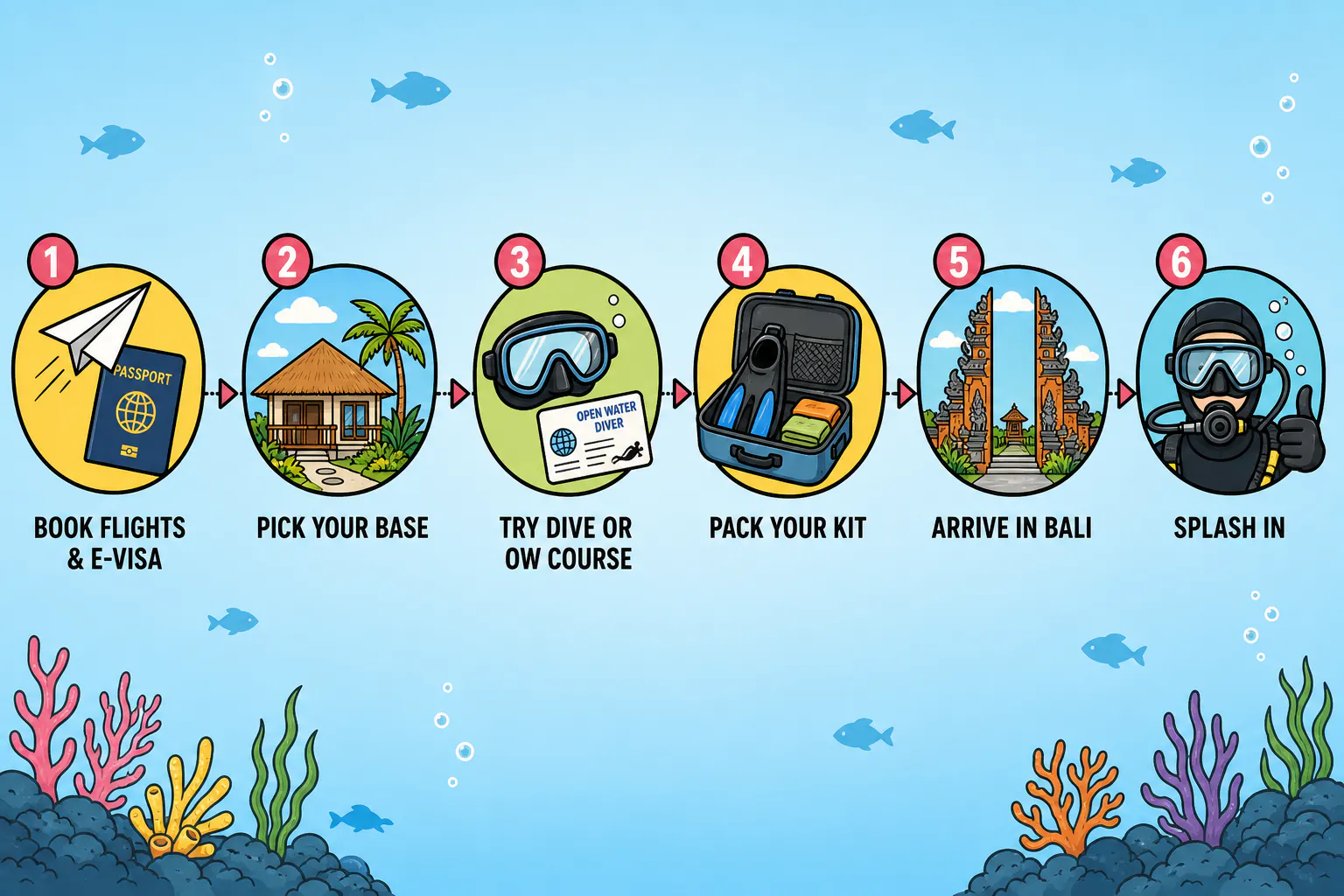
Here is the order we recommend booking things in, so nothing falls through the cracks:
- Book your international flights and check your e-visa. Bali sits on Indonesian soil, almost everyone needs a tourist visa on arrival or an e-visa applied for online before you fly. The 2026 process is covered step-by-step in our Bali e-Visa 2026 divers guide.
- Pick your dive base and book accommodation. For most first-timers we recommend Sanur for the reasons in the section above. Book 4 to 8 nights at the same hotel so you are not packing up between dive days.
- Choose try dive vs Open Water course and book the diving. Email your dive centre (us, if you want) with your dates. Most operators can hold a slot with no deposit. Book at least 2 to 4 weeks in advance during peak season (July to August, Christmas to New Year), 1 week is fine the rest of the year.
- Pack the short list above. Most of what you need is gear you already own. Skip the heavy stuff, rent it locally.
- Arrive, settle, dive. Land at Denpasar, get a transfer to Sanur, sleep, eat, swim, then dive the next morning. Do not dive on arrival day, you will be jet-lagged and probably dehydrated.
If you want a single point of contact for the whole thing, our Bali scuba diving page packages flights-to-dives planning on request, including hotel suggestions.
Your first day at the dive shop: what actually happens
The minute-by-minute, so nothing is a surprise:
Morning paperwork (15 minutes). You sign a liability waiver and fill out the medical questionnaire. Total time, less than the queue at airport immigration.
Briefing (20 minutes). Your instructor walks you through the basics: how the gear works, how to breathe slowly through the regulator, the three or four hand signals you actually need to know (OK, stop, up, down, problem, see our diving hand signals article if you want to read ahead), how to equalise your ears as you descend.
Gear fitting (15 minutes). Wetsuit, BCD, regulator, mask, fins. The instructor double-checks everything.
Confined-water session (45 to 60 minutes). In a pool or in waist-deep calm water, you put the regulator in your mouth for the first time, breathe underwater for the first time, and practise three or four basic safety skills (clearing a mask of water, recovering a regulator if it gets knocked from your mouth, signalling out of air). This is the moment most first-timers actually relax, the second your brain accepts that yes, breathing underwater works.
First open-water dive (40 to 50 minutes total, 30 to 40 minutes underwater). You walk or boat to the dive site, do a final buddy check, and descend slowly hand-in-hand with the instructor. Depth on a first dive is usually 6 to 12 metres. You will see reef fish, possibly turtles, and you will hear yourself breathe in a way that no description does justice to.
Surface and debrief. You ascend slowly, with a 3-minute safety stop at 5 metres. Back on the boat or beach, your instructor logs your dive and asks how you felt. This is normally the point where you ask when the next dive is.
Sample 7-day first-timer Bali itinerary
The trip we plan most often for guests who say "I want to learn to dive in Bali on holiday":
- Day 1, arrival. Fly into Denpasar, transfer to Sanur, check in to your hotel, walk on the beach, eat, sleep. No diving.
- Day 2, theory and pool. PADI Open Water knowledge review (we can let you do this online before you fly to save a day) plus confined-water skills in our pool.
- Days 3 and 4, open-water training dives. Four 30-to-40-minute training dives at Sanur reef and Padang Bai. By the end of day 4 you are a certified Open Water diver.
- Day 5, rest day or culture day. No diving (your body wants a recovery day). Many guests go up to Ubud for the day, see the rice terraces, eat well, get a massage. Plenty of options in our things to do in Bali list or the more curated Bali bucket list.
- Day 6, USS Liberty day. Day trip to Tulamben, two dives on the USS Liberty wreck. Easy depth, hawksbill turtles guaranteed, your first taste of "real" diving.
- Day 7, Nusa Penida day. Day boat from Sanur, two dives at Manta Point and Toyapakeh. If conditions and the calendar align, you may also see the mola mola.
- Day 8, departure. Late morning massage, lunch in Sanur, transfer to airport. (Remember the 18-to-24-hour no-fly-after-diving window, so your last dive should end by mid-afternoon the day before your flight.)
If you only have 4 days available, do the Open Water Course only, on consecutive days. If you have 10+ days, add 3 to 4 days in Komodo at the end (see our Komodo vs Bali diving comparison for why that combo works so well).
The common first-time worries, answered briefly
"I can't equalise my ears." Almost everyone can, you just need to learn the technique (pinch nose, gentle blow against closed nostrils, do it early and often). Severe equalisation problems are rare and your instructor will guide you through it.
"I'm not a strong swimmer." You only need to swim 200 metres at any pace, with any stroke, no time limit, for the Open Water course. The try dive has no swim test. Diving itself does not require strong swimming, your BCD inflates and you float.
"I get seasick." Take seasickness medication the night before and the morning of any boat dive. Sit at the back of the boat, look at the horizon, stay hydrated. Plenty of strong divers are mild seasickness sufferers, it does not stop them.
"I'm claustrophobic." Most divers expecting to feel claustrophobic underwater report the exact opposite once they descend, water is open, blue, three-dimensional. If you have severe claustrophobia, talk to your instructor first and consider a try dive before committing to the course.
"I'm scared of sharks." The Bali shark species you might see are small, shy, and have zero interest in humans. Read the full picture in our are there sharks in Bali piece. Most divers leave wishing they had seen more.
Final word from the dive shop
Here is the thing about your first dive trip to Bali: the planning is harder than the diving. The diving itself, you will figure out in 45 minutes underwater on day one. The trip-planning, choosing dates, picking a base, packing the right stuff, booking the right course, deciding between a try dive and a certification, that is the bit most first-timers actually need help with. That is what this article is for.
If you have read this far and you are still on the fence, just book the trip. Pick a week between April and October, fly into Denpasar, stay 7 nights in Sanur, do the Open Water course, and finish with a Nusa Penida day trip. You will come home a certified diver with a bucket-list manta encounter and a permanent new hobby. If you want help shaping the trip, email our team. We will tell you honestly whether your dates work, what is realistic to fit in, and what you can safely skip.
See you in the water.
Related guides from Neptune Scuba Diving
- Bali Scuba Diving Packing List (2026): Complete Pre-Trip Checklist from Local Operators
- PADI ReActivate & Scuba Refresher in Bali (2026): The Honest Guide for Rusty Divers
- PADI Advanced Open Water Course in Bali (2026): Honest Guide from Instructors
- Bali e-Visa 2026: Complete Guide for Divers and Travelers
- Can You Scuba Dive on Your Period? A Straight Answer, and What Else Matters
- Bali Belly: How to Avoid It, Treat It and Dive Again
- What Is Scuba Diving? How It Works, Explained by a Dive Shop