
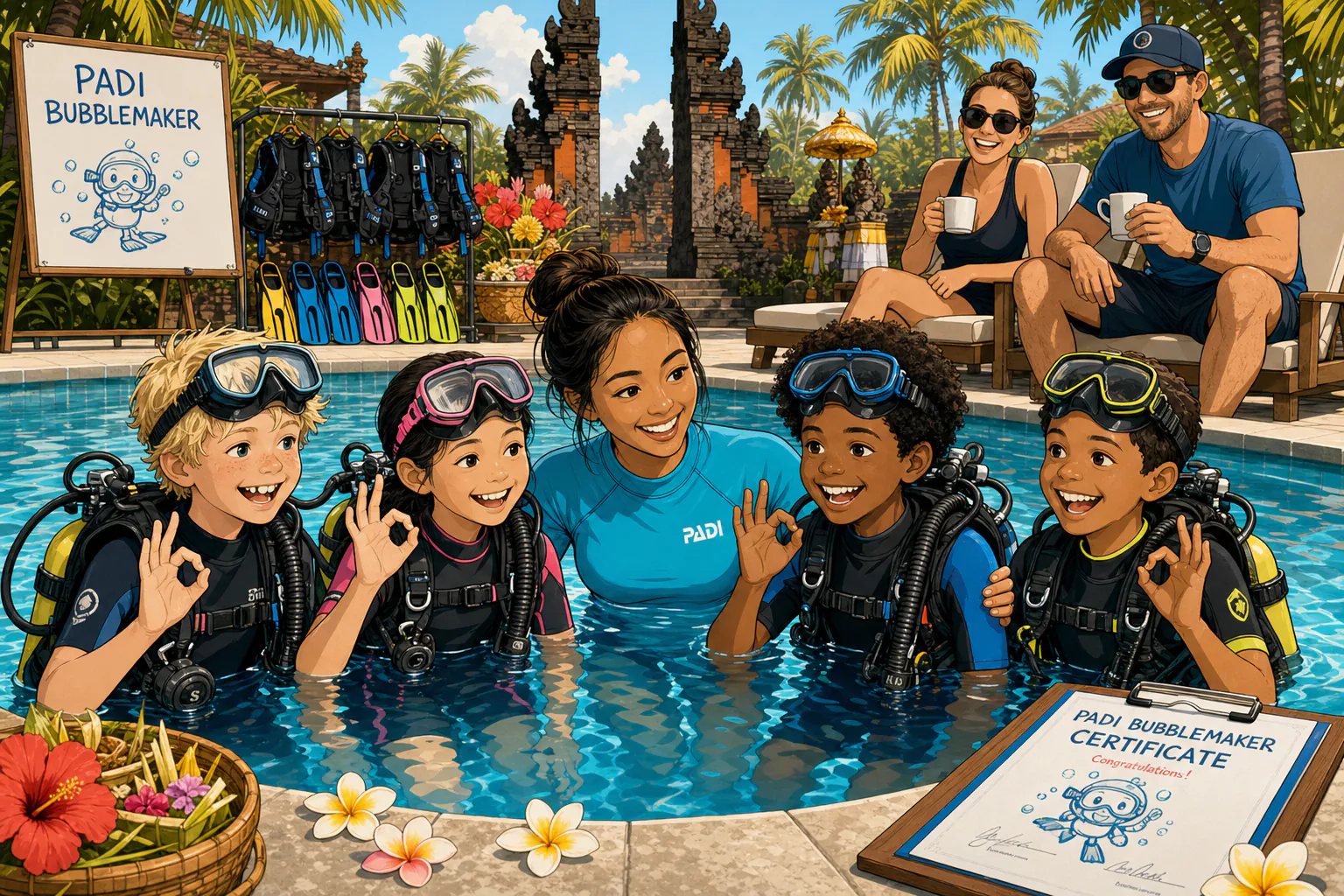
Every week at our Sanur dive center, a family walks in with the same question, just phrased differently: "Can our kids dive here too?" Sometimes it is a couple celebrating their tenth anniversary who finally have kids old enough to share what they love. Sometimes it is a family of four where one parent dives and the other does not, and they want to find something every kid can do. Sometimes it is a homeschool family on a six-month Asia trip looking for a real activity their 11-year-old can talk about for years.
The honest answer is yes, almost always. Many of the considerations we cover in our first-time diving in Bali guide for adults apply to children too, only with tighter age-specific protocols. Bali is one of the most family-friendly scuba diving destinations in the world, and PADI offers a complete progression of programs for children from age 8 upward. The harder question is which program fits which kid, and that depends on age, swimming confidence, attention span, ear health, and whether the kid actually wants to do it (the last one matters more than parents expect). This guide walks through every option in plain operator language, with the kind of honest assessment we share with parents in person on the day they arrive.
The 5-minute version: what can my kid actually do?
Here is the matrix we use at check-in. It maps a child's age to the PADI programs they are eligible for. Eligibility does not equal readiness; we cover the readiness question separately below, because the two often differ.
| Age | What they can do in Bali | Where it happens |
|---|---|---|
| Under 8 | Snorkeling with parent supervision (kid-sized mask + fins); PADI Discover Mermaid from age 6 | Sanur house reef, shallow pool intro |
| 8 to 9 | PADI Bubblemaker (pool only, max 2 metres); PADI Seal Team (5 AquaMissions, pool); PADI Basic Mermaid course | Pool only, no open water |
| 10 to 11 | All of the above PLUS Junior Discover Scuba (1-2 supervised dives to max 12 metres); PADI Junior Open Water (certified to max 12 metres) | Pool + protected shallow Sanur or Padang Bai sites |
| 12 to 14 | Full Junior Open Water (certified to max 18 metres); Junior Advanced Open Water (max 21 metres); most PADI specialties with junior depth restrictions | Most easy Bali sites including parts of Tulamben and Padang Bai |
| 15+ | Adult Open Water (max 30 metres with AOW), AOW, Rescue, Divemaster path, all specialties without depth restrictions | All Bali sites, all conditions |
The big takeaway: from age 8 onward, your child can take their first real breath underwater in a pool with a PADI instructor and a certificate to bring home. From 10 onward they can dive in the actual ocean. From 12 onward they can hold a real diving certification valid for life (with depth restrictions until they turn 15).
The full PADI junior program lineup, explained honestly
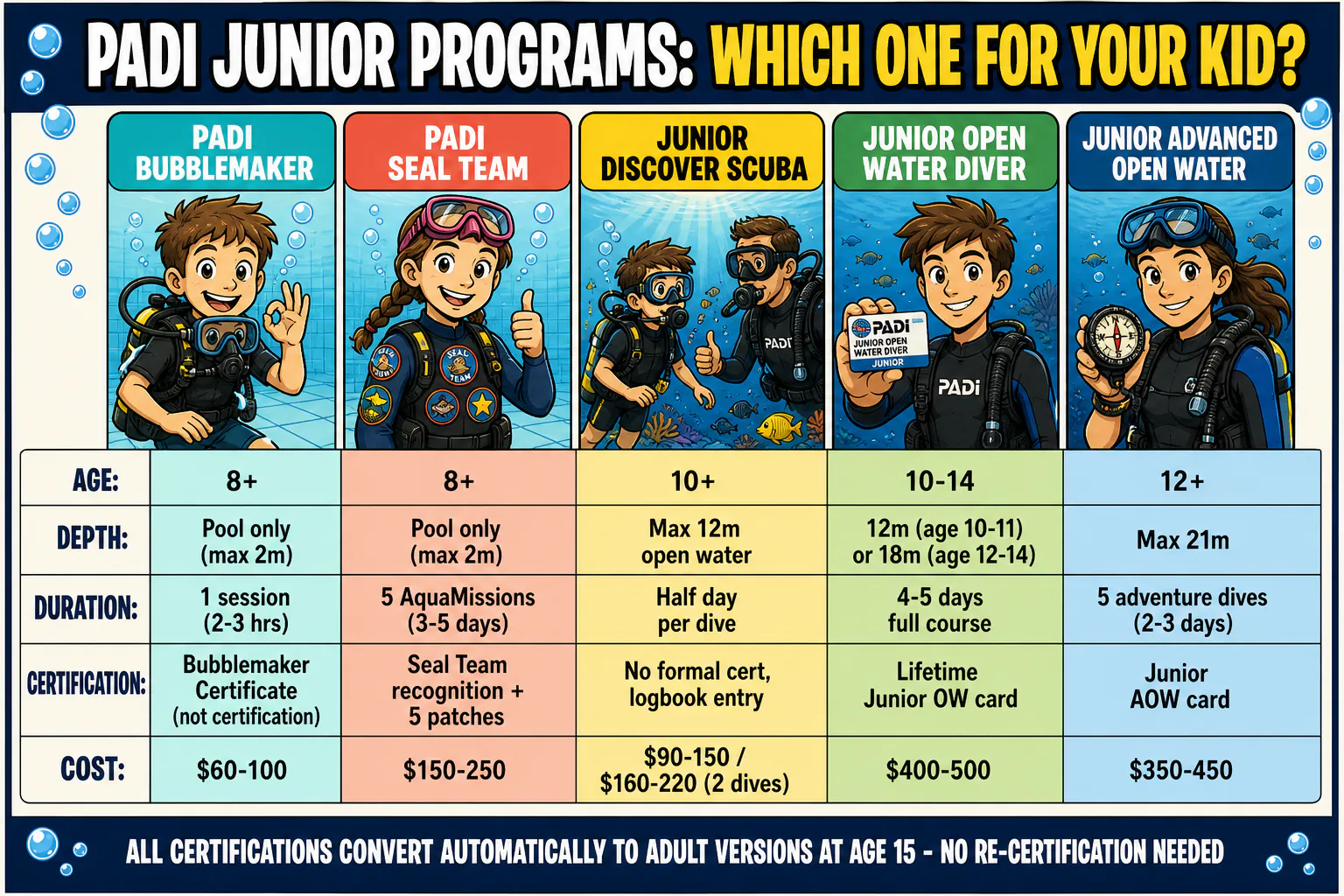
PADI Bubblemaker (age 8+, pool, single session)
This is the most popular kid program in Bali, and the one we recommend for almost every first-time young diver. It is a half-day experience where children breathe from a regulator for the first time, swim in 1 to 2 metres of pool water, learn three basic skills (clearing the regulator, recovering it if it falls out, equalising ears), and surface beaming from ear to ear. They leave with a PADI Bubblemaker certificate (not a certification, important distinction) and almost always with the question: "Can we do this again tomorrow?"
Duration: 2 to 3 hours including pool time, snack break, and the bit where they show their certificate to the parents. Cost: IDR 1,100,000–1,800,000 (≈ 60–100 USD) per child. Maximum depth: 2 metres. Pool only, no open water. Instructor-to-child ratio: 1:2 or 1:4 depending on age mix.
Equipment for Bubblemaker is kid-sized: smaller BCD (we keep XXS sizes for this program), smaller regulator with a softer mouthpiece, smaller mask, mini fins. A 12-litre adult tank is too heavy for an 8-year-old, so we use 6-litre or 7-litre tanks with reduced fill pressure. Wetsuits are a 3 mm shorty in child sizes 6 to 14.
What we tell parents: book this even if your kid is hesitant. The pool environment is calm, the instructor is right next to them, the depth is shallow enough to stand up at any moment, and refusal does not waste much money. About 95 percent of Bubblemaker students leave grinning. The remaining 5 percent either decide once is enough (totally fine, the curiosity is satisfied) or come back the next day asking for more.
PADI Seal Team (age 8+, 5 AquaMissions, pool)
If your child loved Bubblemaker and you have more time on the trip, Seal Team is the natural next step. It is a series of 5 pool sessions called "AquaMissions", each focused on a different skill set: navigation, buoyancy, environment, search and recovery, and creature identification (kids also learn the basic scuba hand signals we use across all our programs). Each AquaMission earns a PADI patch and a stamp in the Seal Team logbook.
The genius of Seal Team is that it feels like a game. Kids are not "doing dive training", they are completing missions and earning patches. The skills are real PADI skills (the same ones adults learn in their Open Water course, just adapted for shallower pool depth and shorter attention spans), but the framing is age-appropriate. Most kids complete all 5 AquaMissions over 3 to 5 days at the pool, spread across a Bali holiday in 60 to 75 minute sessions.
Duration: 5 sessions of about 75 minutes each, typically spread across 3 to 5 days. Cost: IDR 2,700,000–4,500,000 (≈ 150–250 USD) for the full series (or IDR 700,000–1,100,000 (≈ 40–60 USD) per AquaMission booked individually). Maximum depth: 2 metres. Pool only. After completing all 5, the child receives the full PADI Seal Team recognition.
Practical note for families: Seal Team works best when one parent is also diving each day. The kid does an hour of AquaMissions in the morning while one parent does a Sanur house reef dive nearby. They reconvene for lunch and the rest of the day is beach, temple, or pool family time. We can split groups across the same days; you do not all have to be doing the same thing at the same hour.
Junior Discover Scuba Diving (age 10+, 1-2 supervised open-water dives)
From age 10, a child can do their first real ocean dive. Discover Scuba is the same program we offer adults (and is detailed in our try diving in Bali guide) with one critical modification: junior depth limit of 12 metres instead of the adult 12 metres for first-time DSD (the adult limit is the same; the supervision and ratio change).
The junior version is run with a 1:1 or 1:2 instructor-to-child ratio (versus 1:4 for adults). The instructor maintains physical contact for the first part of the dive, then transitions to within-arms-reach swimming. We pick the calmest sites: Sanur house reef in protected lagoon water, or the sheltered Blue Lagoon at Padang Bai. Currents are minimal, depths stay under 8 metres on the first dive, and the bottom is sandy and forgiving.
Duration: half day per DSD dive, including pool refresher beforehand (mandatory for 10-11 year olds, optional for older kids who already did Bubblemaker). Cost: IDR 1,600,000–2,700,000 (≈ 90–150 USD) per dive, or IDR 2,900,000–3,950,000 (≈ 160–220 USD) for a 2-dive package. No certification, but a memorable first-real-ocean-dive experience and a log book entry.
Junior Open Water Diver (age 10-12 restricted, 12-14 with depth limits)
This is the real one: a full PADI Open Water certification (we explain how it fits in the broader agency landscape in our scuba diving certification types guide), the same theory and skills as the adult course, with age-based depth restrictions. The same course is covered in detail for adults in our PADI Open Water course in Bali guide; the junior version differs in three key ways:
Depth limits. Junior Open Water at age 10 or 11 is certified to a maximum of 12 metres and must dive with a certified adult parent or PADI professional. At age 12 to 14, the limit moves to 18 metres, still with adult supervision. At 15, the limit lifts entirely and the certification converts automatically to adult Open Water (no re-certification needed).
Course duration. Slightly longer than the adult Open Water Diver course because kids need more breaks, more repetition, and shorter sessions. We typically run Junior Open Water across 4 to 5 days (versus 3 to 4 for adults) with shorter daily sessions and a "rest afternoon" in the middle.
Course structure. The PADI eLearning is the same digital content as the adult course but the in-water portion uses kid-sized equipment, shallower training depths, and more time spent on buoyancy and equalisation (the two skills kids find hardest).
Cost in Bali: IDR 7,200,000–9,000,000 (≈ 400–500 USD) for Junior Open Water, including all gear, pool time, 4 open water dives, eLearning code, and the digital and physical PADI card. This is excellent value, the same course in Europe or North America runs IDR 12,600,000–16,200,000 (≈ 700–900 USD). Most families combine this with parent dives on the same days, which we can coordinate across our schedule.
Junior Advanced Open Water (age 12+)
Once your child has Junior Open Water and at least a few logged dives, the natural next step is Junior Advanced Open Water (covered for adults in our PADI Advanced Open Water in Bali article). The Junior AOW maximum depth is 21 metres (versus 30 for adult AOW). The course covers 5 adventure dives: Deep, Navigation, plus three electives the child chooses (typical favourites: Fish Identification, Underwater Naturalist, Boat Diver, Peak Performance Buoyancy).
This works well as a "second trip" certification, often booked 6-12 months after Junior Open Water when the child has had time to log a few more dives and confirm scuba is something they want to keep pursuing. Cost: IDR 6,300,000–8,100,000 (≈ 350–450 USD) in Bali.
Is your kid actually ready? Operator honesty
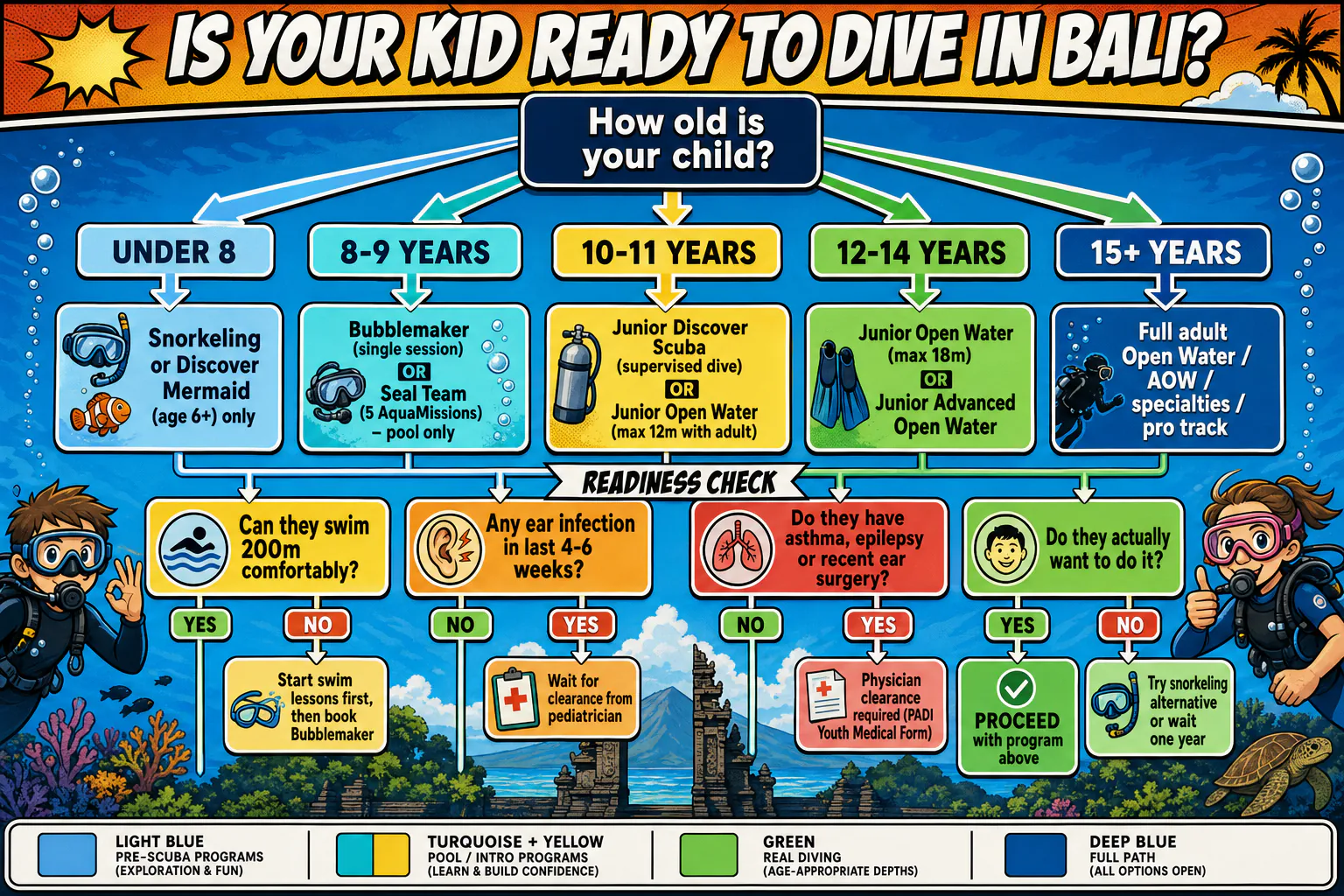
PADI sets minimum ages but parents and operators decide actual readiness. Here is what we actually look for, in order of importance.
1. The child wants to do it
This is the single most important factor. A 10-year-old who is enthusiastic about diving will outperform a 14-year-old who is doing it to please mum and dad. We can teach skills. We cannot teach wanting to be there. If your kid is on the fence, start with a Bubblemaker session and see how they react. If they come out of the pool asking when they can do it again, proceed. If they come out saying it was fine and they would prefer the beach, that is a clear signal to stop there.
2. Swimming confidence
PADI requires the child to be able to swim 200 metres (any stroke, no time limit) and tread water or float for 10 minutes for the Junior Open Water course. Bubblemaker has no formal swim test but practically a child should be comfortable putting their face in water. If your child does not yet swim independently, the path is: swim lessons first at home, then start with Bubblemaker on a later trip. A non-swimmer is not safe in even shallow open water.
3. Ear health
This is the biggest physical limiter for child divers. Children's eustachian tubes are smaller and more horizontal than adults, which makes equalisation slightly harder and ear infections more disruptive. We will not put a child in the water who has had an active ear infection in the previous 4-6 weeks. If your child has chronic ear problems, a tympanostomy tube (grommet), or recently had ear surgery, get a pediatric ear-nose-throat clearance before booking. The standard PADI Youth Medical Statement covers this; if any question is answered "yes" a physician must sign off.
4. Frustration tolerance
Diving involves things that frustrate kids: a mask that fogs, water going up the nose during a skill, fins that are slightly too big. A child who melts down at minor frustration will have a hard time with the skill repetition. The Bubblemaker session is a perfect low-stakes test of this. If your child gets visibly upset when their mask leaks and refuses to try again, that is important data; the Seal Team or Open Water path may be premature. Come back next year.
5. Attention span and following instructions
A 75-minute pool session requires being able to listen to a briefing, follow specific instructions, and try a skill repeatedly. If your child genuinely struggles with this (not just in our pool but in school, home, etc.), pick a shorter format. A single Bubblemaker session works for almost any 8-year-old. Seal Team's 5 AquaMissions need more attention stamina. Junior Open Water needs the most.
6. Physical size
This rarely matters but occasionally a very small 8-year-old struggles with even our smallest BCD or finds the regulator too heavy. We check sizing at the start and have backup smaller options. If your child is at the extreme small end of the size range (under 25 kg for an 8-year-old), let us know in advance so we can have the smallest gear ready.
The equalisation conversation (the one that matters most)
Equalisation, or "popping your ears", is the single biggest challenge for child divers. Adult divers learn this fast; children sometimes need extra coaching. Here is what we cover with every kid in their first pool session, and what parents can usefully reinforce.
The basic technique: pinch the nose, gently blow against the closed nostrils, repeat every 30 to 50 centimetres of descent. Kids find "gently" hard at first. They want to blow hard, which can damage delicate eardrums. We teach them the "swallow trick" as an alternative (swallow while looking up) and the "wiggle" (gentle jaw movement). Most kids find one method that clicks.
The 90-percent rule: if a child cannot equalise on the surface (we test this in shallow standing-depth water before any descent), we do not descend. Period. There is no benefit to forcing the issue. We try again in 15 minutes after warming up the eustachian tubes with a few swallows and yawns. If still not clearing, we try a different position (head down, head up) or even reschedule to the next day.
Cold-related blocked ears: kids with a current cold, allergies, or recent sinus inflammation should not dive that day. The risk of reverse-block (ear pressure trapped during ascent) is too high. Reschedule to a clear day.
Decongestants for kids: we do not recommend pseudoephedrine (Sudafed) for child divers under 12 unless prescribed by a pediatrician for that specific purpose. Adult equalisation strategies are not safe for children. If congestion is the issue, the answer is to skip the dive that day.
What if my kid panics underwater?
The honest answer: it happens occasionally, and we are trained for it. About 1 in 30 first-time kid divers has a moment underwater where they realise where they are, briefly tense up, and signal "up" to the instructor. The instructor responds in seconds: makes eye contact, gives a calm OK signal, ascends slowly with the child while keeping them breathing through the regulator. We surface together, talk for 5 to 10 minutes, often the child wants to go straight back down and try again. Sometimes they want to call it a day.
What we never do: force a child to stay underwater if they are clearly upset. There is no situation where the lesson is "push through it". Our instructors are trained to read the signals and respond instantly. If your child has a wobble and chooses to stop, we respect that and reschedule (or refund a portion if the trip is ending). The goal is for them to leave wanting more, not to traumatize them into never trying again.
The parent role here is important. If your child surfaces and says "I do not want to do this anymore", believe them in that moment and support the decision. Do not push. Many kids who stop on day 1 come back on day 3 ready to try again because nobody made them feel bad about stopping. Pressure backfires for years.
Health and medical: the PADI Youth Medical Statement
Every diver, child or adult, fills out a medical questionnaire before any in-water training. The youth version (under 18) is slightly different from the adult version and is the one we use for our junior programs. It asks 14 questions covering ear health, breathing conditions (asthma is the big one), neurological conditions (epilepsy, seizures), cardiac history, surgical history, diabetes, mental health, and current medications.
If any question is answered "yes", a physician's clearance is required before in-water training. This applies most commonly to:
Asthma: mild well-controlled childhood asthma is often cleared by a pediatrician. Brittle or exercise-induced asthma usually is not. Get the clearance before flying.
Recent ear surgery (grommets, tympanoplasty): needs ENT clearance, usually a 6-12 month waiting period.
Epilepsy or seizure disorder: diving is generally contraindicated; consult a diving medicine specialist (DAN has a global referral network).
ADHD on medication: usually fine, mention the medication on the form, our instructors adapt teaching pace if attention is an issue.
Type 1 diabetes: diveable with proper management, requires endocrinologist clearance, additional pre-dive blood sugar checks.
The youth form is freely downloadable from PADI's website (search "PADI Youth Medical Statement"). Fill it out at home with your pediatrician's input rather than discovering an issue on the morning of the dive. We accept clearance signed by any qualified physician globally.
Sibling and family logistics (the practical part)
Most families that come to us have multiple children of different ages, plus parents at different diving levels. Coordinating "everyone doing something they enjoy at the same time" is what we do every day. Here is how the math typically works.
Scenario 1: parents both dive, two kids age 9 and 12
Day 1 morning: parents do a 2-tank dive at Sanur house reef (8 AM to 12 PM). Both kids do a Bubblemaker pool session at the same partner pool (9 AM to 12 PM) with our dedicated kids instructor. Everyone reconvenes for lunch.
Day 2: 12-year-old starts Junior Open Water (3-4 day course). 9-year-old does Seal Team AquaMission 1. Parents do a Penida day trip while kids are with us (we provide hotel-to-shop transfers for both groups).
Day 3-5: 12-year-old continues Junior OW. 9-year-old continues Seal Team. Parents alternate between Tulamben Liberty wreck trips and Sanur reef dives, sometimes joining the 12-year-old's pool sessions to watch.
Scenario 2: one parent dives, other does not, three kids age 6, 10, 14
Day 1: diving parent does Sanur house reef dive. Non-diving parent + 6-year-old do a 2-hour Sanur snorkeling tour. 10-year-old does Junior Discover Scuba (1 supervised shallow dive). 14-year-old does Bubblemaker as a first taste (yes, age 14 still does Bubblemaker if it is their first time, the program is age-flexible upward, just optimised for 8-10).
Day 2: 10 and 14 year olds both start Junior Open Water together (good age range to share a class). Non-diving parent and 6-year-old do beach + temple day. Diving parent joins us for adult Open Water dives.
This works because Bali's calm Sanur lagoon is genuinely safe for a 6-year-old snorkeler with parent supervision, while older siblings can do real diving at the same time.
Scenario 3: solo parent travelling with one kid
Most flexible. We bundle the parent's dive day with the kid's program at the same site or same pool. Parent does a 2-tank dive in the morning, kid does Bubblemaker. Both finish around the same time and have lunch together. Repeat the next day with a different site for the parent and AquaMission 2 for the kid. Easy logistics, the same vehicle for transfers, the same lunch spot.
The family dive day, hour by hour
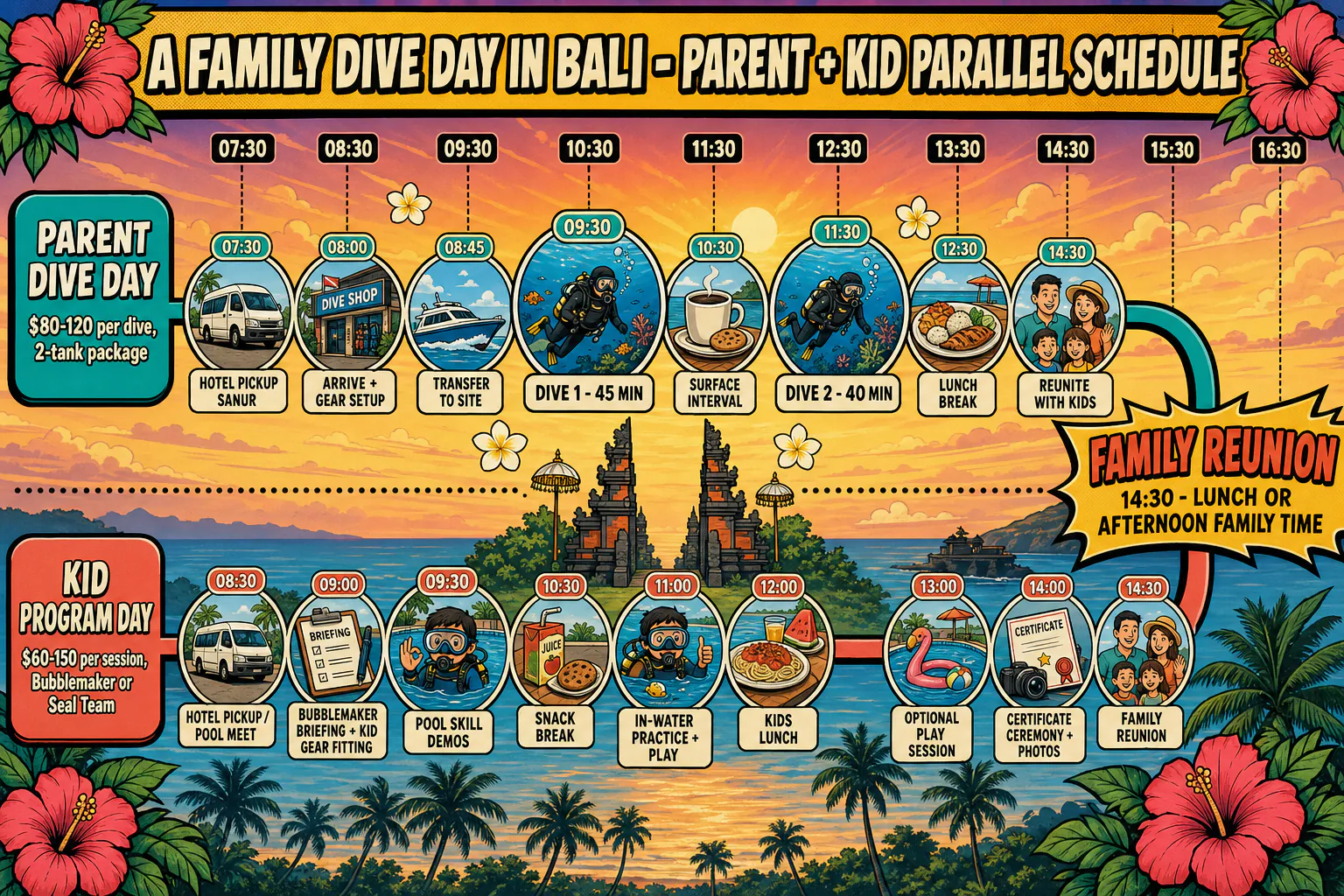
This is the rhythm most families settle into. Pickups and drop-offs are coordinated. Lunches overlap. The non-diving parent has a quiet morning (Ubud day trip, spa, beach). By 4 PM everyone is back at the hotel with stories.
Bali sites suitable for junior divers
Not every site that adults dive is appropriate for an 11-year-old. We restrict junior divers to specific sites based on depth, current, entry difficulty, and what they will encounter underwater. Sites that work well:
Sanur house reef: protected lagoon, max depth 8 metres, sandy bottom, virtually no current. Reef fish, occasional turtle, the perfect first ocean dive site for a 10-12 year old. This is where we run most Junior DSD and Junior Open Water training dives.
Blue Lagoon, Padang Bai: sheltered bay, 5-15 metres, gentle current most days, sandy bottom. Bumphead parrotfish in season, healthy hard coral, frequent turtle sightings. Excellent for junior divers from 10 upward.
Tulamben (Coral Garden and Drop Off only): the easier Tulamben sites work for junior divers from 12 years up. Coral Garden is shallow (5-12m) with the famous Pyramids artificial reef. The USAT Liberty wreck is doable from 12 years up at the shallow bow section (5-10m) under close supervision, but we steer junior divers away from the deeper stern section (28-30m, beyond junior depth limit).
Manta Point, Nusa Penida (with conditions): the manta rays at Nusa Penida are an unforgettable experience for a young diver, but the trip is not always suitable. We require: minimum age 12, calm-day forecast, Junior Open Water certification with at least 10 logged dives, and direct adult supervision in the water. On rough days we reschedule to Sanur or Tulamben.
Sites we generally avoid for junior divers: anywhere with serious current (most other Penida sites, all of Komodo), deep walls beyond the junior depth limit, and any night diving (PADI requires age 12+ and adult supervision; we generally suggest waiting until 14+ for night).
The Mermaid course (popular sibling alternative)
For kids who are interested in being in the water but not yet ready for scuba, or who simply love the idea of swimming with a mermaid tail, we run the PADI Mermaid program. It has three levels:
Discover Mermaid (age 6+): 2-hour pool session, kids try a monofin (mermaid tail), learn safe technique, and have a magical-feeling first experience. Most popular with girls 6-10, increasingly popular with boys 8+ too. Cost: IDR 1,450,000–2,150,000 (≈ 80–120 USD).
Basic Mermaid (age 8+): 1-day course, more technique work, basic freediving breath control, mermaid-specific safety skills. Cost: IDR 2,700,000–3,950,000 (≈ 150–220 USD).
Mermaid certification course (age 12+): 2-3 day course, full PADI Mermaid certification, more advanced freediving technique, ability to perform in open water. Cost: IDR 5,400,000–8,100,000 (≈ 300–450 USD).
This works brilliantly as a sibling alternative when one kid wants to dive and another wants something different but equally cool. Families often book it for two siblings simultaneously: 11-year-old does Junior DSD, 8-year-old sister does Basic Mermaid, both finish their session at the same pool with photos and bragging rights.
Snorkeling alternatives for kids under 8
Children under 8 cannot do any PADI scuba program (the broader trade-offs are covered in our snorkeling vs diving comparison). Their option is snorkeling (or Discover Mermaid from age 6). Bali has excellent kid-friendly snorkeling:
Sanur house reef: at low tide a 5-year-old can snorkel from the beach over the protected reef and see clownfish, parrotfish, the occasional turtle. Always with parent supervision and a life vest for under-7s.
Sanur snorkel tours: guided 2-3 hour tours from the beach, with mask-fit help, swim noodles for floating, and a snorkel guide. Covered in our Sanur snorkeling guide.
Padang Bai Blue Lagoon: very shallow, very protected, kid-friendly entry from a sandy beach.
What to bring: full-face snorkel mask for very young kids (easier than traditional mask+snorkel separately), a kid-sized life vest for under-7s (rentals available locally), kid reef-safe sunscreen (the Penida MPA ban on oxybenzone covers all visitors, kids included).
Where to base your family in Bali
Our strong recommendation: Sanur. It is the most family-friendly base on the island for divers and non-divers alike.
Sanur has: a calm protected beach lagoon (perfect for non-swimmers and kids), a flat seaside promenade for walking with strollers, a kid-friendly food scene (warungs that genuinely welcome children, not just tolerate them), good local hospitals and pediatric clinics, lower crime than the south, and our dive center is here so morning pickups are short.
Avoid for families: Canggu (party scene, no kid food, expensive), Seminyak (busy roads, no real beach, beach club vibe), Kuta (crowded, sketchy after dark). Ubud is wonderful for families but adds 60-90 minutes of vehicle time for every dive day; consider splitting your trip 50/50 between Sanur and Ubud rather than basing entirely in Ubud.
Costs (transparent 2026 family bundle pricing)
| Program | Cost in Bali 2026 | What it includes |
|---|---|---|
| PADI Bubblemaker (single session) | IDR 1,100,000–1,800,000 (≈ 60–100 USD) | Pool fee, kid-sized gear, instructor, certificate |
| PADI Seal Team (5 AquaMissions) | IDR 2,700,000–4,500,000 (≈ 150–250 USD) full bundle | 5 pool sessions, all gear, patches, recognition |
| Junior Discover Scuba (1 supervised dive) | IDR 1,600,000–2,700,000 (≈ 90–150 USD) | Pool refresher + 1 ocean dive, all gear, 1:1-2 supervision |
| Junior Discover Scuba (2-dive package) | IDR 2,900,000–3,950,000 (≈ 160–220 USD) | As above plus second dive at another site |
| Junior Open Water Diver course (3-5 days) | IDR 7,200,000–9,000,000 (≈ 400–500 USD) | eLearning + pool + 4 OW dives + PADI card + gear rental |
| Junior Advanced Open Water (5 adventure dives) | IDR 6,300,000–8,100,000 (≈ 350–450 USD) | 5 adventure dives, all gear, PADI card |
| Family bundle: 2 parents + 2 kids (5-day trip) | From IDR 32,500,000 (≈ 1,800 USD) | Parents do dive package, kids do age-appropriate program, transfers |
| Mermaid Discover (single session) | IDR 1,450,000–2,150,000 (≈ 80–120 USD) | Pool, monofin rental, instructor |
Specific bundles drawing on our standard Bali dive packages are quoted on request via the Bali contact form or main booking page. The full price guide including adult dive packages is in our Bali diving price guide.
What to bring for a diving kid
The general Bali scuba diving packing list applies, with these kid-specific additions:
Mask (own one if possible). Kid faces are smaller than rental masks designed for adults. A well-fitting kid mask is a IDR 450,000–700,000 (≈ 25–40 USD) investment that meaningfully improves the experience. Brands that make good child masks: Cressi, Scubapro, Aqualung Junior series.
Swimming kit. Two swimsuits (one dries while the other is worn), a rashguard for sun protection on the boat or pool deck, a kid sized cap or beanie for after-dive warmth (kids cool down faster than adults).
Snacks they will actually eat. Bali food is amazing but unfamiliar to kids on day 1. Bring familiar protein bars or crackers for between-dive snacks; their energy needs in the water are real and they cannot subsist on dragonfruit alone.
Reef-safe sunscreen (kid formulation). Stream2Sea Kids, Thinkbaby, Badger Kids. The Nusa Penida MPA ban on oxybenzone applies to all visitors.
Comfort item. A small stuffed animal or familiar toy for the dive shop wait between sessions. Sounds silly, works wonders for a tired 8-year-old.
Ear drops. Pediatric alcohol-based swimmer's ear prevention drops. After every in-water session. Children's ears are infection-prone with repeated water exposure.
Their own dive logbook. A kid-specific PADI logbook (IDR 20,000 (≈ 1 USD)5) makes the experience real and gives them something to show off at school. We sign each session's entry.
Common questions parents ask us at check-in
"My kid is 7 and asks every day. Can we sneak them into Bubblemaker?"
No. PADI sets the minimum age at 8 for insurance and safety reasons (small lung capacity, attention span, eustachian tube development). What we can do for a 7-year-old: a Discover Mermaid session (age 6+), a guided snorkel tour, or a "junior assistant" experience where the 7-year-old comes to the dive shop, watches the older sibling's program, helps with the gear setup under supervision, and earns a small "future diver" certificate. They will turn 8 eventually; the wait is worth it for their safety.
"How do I know if my kid will love it or hate it?"
You do not, until they try. Bubblemaker is the cheapest, lowest-commitment way to find out. About 70 percent of first-time Bubblemaker kids ask to do more. About 25 percent are satisfied with the one session and prefer beach/temple/pool the rest of the trip. About 5 percent do not enjoy it at all and that is fine. The signal you want: did they come out of the pool smiling? If yes, they will love it. If neutral, they had a fine time but it is not "their thing". If upset, stop and try again in a year or two.
"Can my 11-year-old dive with the manta rays at Nusa Penida?"
Possibly. We require: age 12 minimum, Junior Open Water certified with 10+ logged dives, calm-day forecast, direct adult supervision in the water. At age 11 we recommend building up with Sanur and Tulamben dives first and saving Penida for next year's trip. The mantas will still be there.
"My kid did the Open Water course at home and we want to dive in Bali."
Perfect. Bring the digital or physical certification card, the logbook, and the kid's certification level (Junior Open Water Diver at age 10-14 implies 12m or 18m depth limit depending on age at certification). We will integrate them into an appropriate dive group with the correct depth restrictions. If the previous certification was issued over 12 months ago, plan a refresher dive on day 1, same as we would for adults (see our PADI ReActivate refresher guide).
When to bring the family to dive Bali
Bali's water is warm year-round (27-30 degrees Celsius), so weather is not a hard constraint. The practical considerations are: dry season (May to October) gives the most predictable conditions, lower rainfall, and easier logistics for families with young children who do not enjoy long wet vehicle rides. The shoulder months (April, November) are excellent compromises with fewer crowds and good conditions. The rainy season (November to March) is still divable, just with more flexible plans; see our Bali rainy season diving guide for the honest seasonal trade-offs.
Travel logistics for families: most nationalities can get the Indonesian e-Visa online before flying (covered for divers in our Bali e-Visa 2026 guide); each family member needs their own visa including infants. Children under 12 do not pay the Penida marine park entry fee (relevant if your older children dive there). Indonesian immigration is generally smooth for families; bring printouts of return tickets and accommodation confirmation just in case.
Booking your family with us
Email or use the Bali contact form with: each child's age, swimming confidence (independent swimmer or learning), any medical considerations, parents' diving levels and goals, and your dates. We will recommend programs per child and quote a bundle that maximises shared logistics (same pickup, same lunch break, coordinated finish times).
Peak family seasons are the European summer holidays (mid-July to end of August), Australian school holidays (April, July, September-October, December-January), and Christmas/New Year. During peak we recommend booking 4-6 weeks ahead so we can hold instructor capacity for your dates. Off-peak you can book 1-2 weeks ahead.
One last thing. The single best thing about teaching kids to dive in Bali is the moment, somewhere between dive 2 and dive 4, when a child stops thinking about technique and starts noticing the fish, the turtle, the curious cleaner shrimp on their finger. They go from "I am scuba diving" to "I am in another world". That switch happens for almost every child who completes a program here. We get to witness it dozens of times every year. It does not get old.