
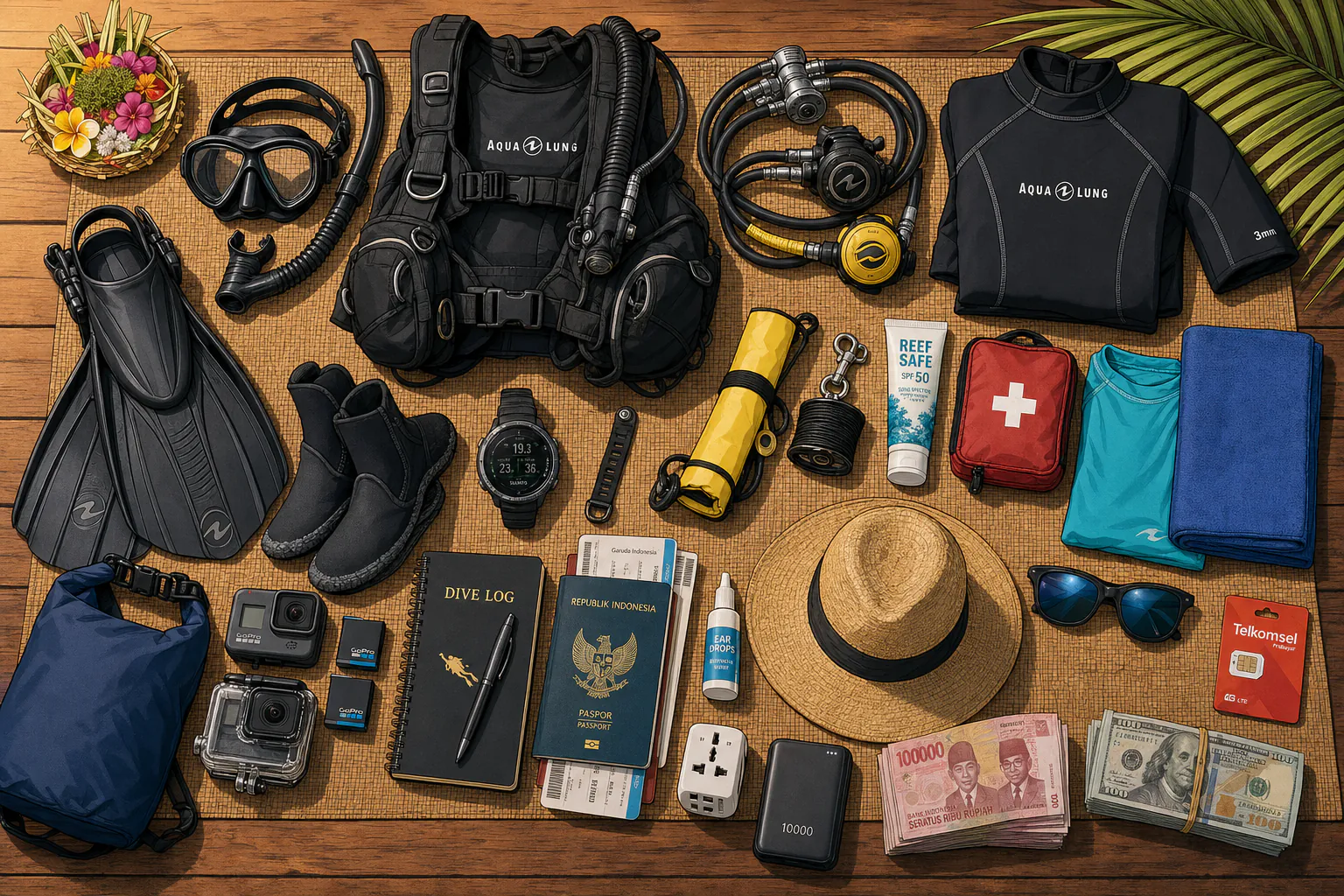
Every week we welcome divers in Sanur who arrive with regrets about what they packed. The same three or four conversations happen on every check-in: "I should have brought a thicker wetsuit", "I had no idea I needed reef boots", "I packed dress shoes and a blazer for a beach holiday", or the painful one, "I brought all my dive gear and now I find out you rent better gear for IDR 360,000 (≈ 20 USD) a day". This article exists so the next time, those conversations do not happen to you.
This is the packing list we wish we could send every diver before they leave home, based on years of running Bali scuba diving trips across every site type from beach entries to current drift dives. It is written from the operator side, after years of running Bali day trips, Tulamben overnights and Komodo extensions out of our Sanur dive center. It is Bali-specific (not the generic dive-gear list you read on a North American dive shop blog), opinionated where opinion matters, and complete enough to take to the airport as your checklist.
The 5-minute version: the must-haves
If you read nothing else, do not leave home without these:
Documents: passport (6+ months validity), Indonesian e-Visa or IDR 650,000 (≈ 35 USD) USD cash for visa-on-arrival, dive certification card (digital + physical), dive insurance policy details (DAN or equivalent), printed return-flight confirmation.
Personal dive minimums: mask (one that fits your face), dive computer (or budget to rent), reef-safe sunscreen (legally required in Nusa Penida MPA), 3 mm wetsuit or rental booking, plus prescription medication for ear/sinus health.
Bali-specific essentials: reef-safe sunscreen, motion-sickness tablets (Penida and Komodo crossings can be choppy), one set of conservative clothing for temple visits, an unlocked phone (eSIM or local SIM), 220V plug adapter (type C/F), USD or IDR cash for tips and porter fees.
The longer version follows. Print it, tick through it, and pack with confidence.
Documents and money: what cannot be replaced in Bali
Passport. Indonesian immigration requires 6 months remaining validity at the time of arrival and 2 blank pages. If your passport expires in 5 months and 28 days, you will be turned away at check-in by your airline. Check this 8 weeks before departure if you have any doubt.
Visa. Most nationalities (US, EU, UK, Canada, Australia, NZ, Japan, plus 86 others) can either pay IDR 650,000 (≈ 35 USD) USD cash on arrival for a Visa on Arrival (VoA) good for 30 days, or pay the same fee online for an e-Visa B1 in advance. The e-Visa is much faster on arrival (skip the VoA payment queue). Full breakdown in our Bali e-Visa 2026 guide for divers.
Dive certification card. Bring the physical card. PADI's eCard is technically accepted but a small number of operators in Bali (and almost all of them in Komodo) still want to physically see it. Take a phone photo as backup. If you cannot find your card, request a replacement from your training agency at least 3 weeks before departure.
Dive logbook. Optional but useful, especially for Penida and Komodo where the operator will ask about your recent dive experience for site assignment. A digital log on your computer is fine.
Dive insurance. Strongly recommended. A DAN Dive Accident insurance policy (IDR 700,000–1,600,000 (≈ 40–90 USD)/year) covers chamber treatment, medical evacuation and many incidentals. We require all guests to have either DAN or an equivalent policy with explicit scuba diving and emergency evacuation coverage. Print the policy summary and bring it; your operator and any chamber will ask.
Travel insurance. Separate from dive insurance, this covers trip cancellation, lost luggage and non-diving medical issues. Combine with dive insurance for full coverage.
Cash. Bali runs on cash much more than tourism marketing suggests. ATMs are everywhere in Seminyak/Sanur/Ubud but disappear north toward Tulamben. Plan to arrive with IDR 3,600,000–7,200,000 (≈ 200–400 USD) equivalent in IDR (the Indonesian Rupiah, IDR 20,000 (≈ 1 USD) ≈ 16,000 IDR in 2026), with smaller bills for tips and porters. Use airport ATMs sparingly (high fees) and prefer Bali bank ATMs in town (BCA, Mandiri, BNI) which give the best rates.
Credit cards. Visa and Mastercard are widely accepted in higher-end restaurants and most dive operators. Amex is hit-and-miss. Bring two different cards from two different networks in case one is blocked. Notify your bank of travel.
Dive gear: bring vs rent in Bali
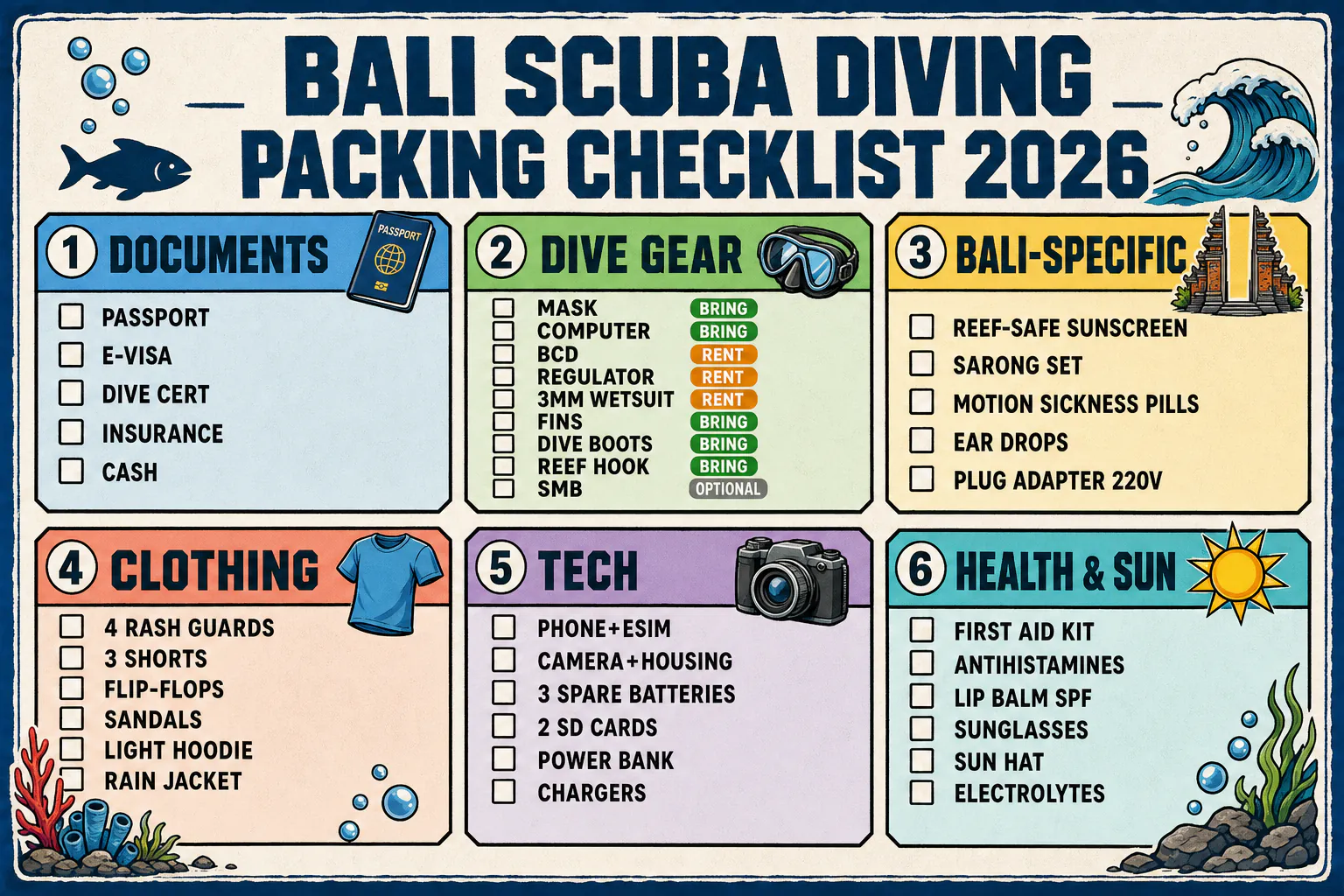
This is the question every traveling diver wrestles with. The honest framework: Bali has excellent rental gear at competitive prices, so the bring-vs-rent decision should be driven by personal-fit comfort and cost-per-trip, not by "I always bring my gear".
| Item | Recommendation | Why |
|---|---|---|
| Mask | BRING | Personal fit is everything; a rental that leaks ruins every dive |
| Snorkel | Optional | Most dive operators don't require it; bring if you like to surface-swim |
| Dive computer | BRING | Tracks your nitrogen across dives; rental computers vary in quality |
| Regulator | Rent (unless you own quality) | Heavy in luggage; quality rental at IDR 270,000–450,000 (≈ 15–25 USD) per day |
| BCD | Rent | Bulky; quality rental at IDR 270,000–450,000 (≈ 15–25 USD) per day |
| Wetsuit (3mm) | Rent | IDR 180,000–270,000 (≈ 10–15 USD) per day; saves luggage space |
| Wetsuit (5mm) | Rent (specific request) | Needed for Komodo or extended Penida; ask in advance |
| Fins | BRING if you have good ones | Personal fit matters; rentals can have worn-out straps |
| Dive boots | BRING | Tulamben's volcanic black sand (see our Tulamben diving guide) is rough on bare feet; few operators rent |
| Reef hook | BRING (or buy in Bali) | Required for Komodo and recommended for Penida; we rent them but better to own |
| Surface marker buoy + reel | Optional but recommended | Many operators provide; bring if you do solo or buddy-team navigation |
| Dive knife | Optional | Most Bali sites don't require; consider for entanglement risk |
| Underwater torch | BRING small one | Useful for night dives and lighting up shadows on day dives |
| Tank and weights | RENT (always provided) | Never travel with tanks |
Specific to our operation in Sanur: we rent SCUBAPRO MK2 regulators, Aqua Lung BCDs, 3mm Cressi wetsuits, all serviced annually. Full gear rental runs IDR 650,000 (≈ 35 USD) per day. If you are diving with us for 5+ days and are torn on bringing your own kit, the savings on luggage (most international airlines now charge IDR 1,450,000–2,700,000 (≈ 80–150 USD) per checked dive bag each way) often exceeds the rental cost.
The exception is mask, computer, and dive boots, which are always worth bringing because they are small, personal-fit critical, and the cost difference is minor.
This rental-vs-bring math also depends on which sites you are diving. A trip centred on the USAT Liberty wreck in Tulamben needs different gear than a Penida-focused week or a course-heavy trip with us. If you are still deciding which dive operator and sites suit your trip, the best places to scuba dive in Bali article walks through the major site clusters; the Bali diving price guide shows full operator rates including gear rental.
Pre-booking gear rentals: how it works with us
If you decide to rent, please reserve your kit at least 7 days in advance for trips between June and October, and 3-5 days in advance for the rest of the year. Our peak-season rental fleet is sized for our courses and packaged trips first; walk-in availability for full kits is usually fine in the shoulder season but tight in peak weeks. To pre-book, mention the gear list (BCD size, wetsuit thickness, fin size, dive computer model preference if any, dive boots size) when you confirm your booking or send a separate note via the booking page. We will confirm in writing and adjust if anything changes closer to the trip.
Specific to nitrox: if you are nitrox-certified and want enriched air for your trip, mention it at booking. We fill nitrox on demand and the surcharge is small (typically IDR 140,000–220,000 (≈ 8–12 USD) per cylinder), but advance notice keeps the workflow smooth on busy days.
The Bali-specific gear additions nobody mentions
Standard packing lists from non-Bali sources miss these.
Reef hook (mandatory for Komodo, recommended for Penida). A small steel hook on a 1-metre line, clipped to your BCD, used to anchor yourself to a dead piece of reef during current dives (especially essential when diving with manta rays at Manta Point in choppy season). We provide them in our equipment rental, but if you plan multiple Penida or Komodo days, owning your own is worth IDR 450,000 (≈ 25 USD) from any dive shop globally. The technique matters more than the hook brand.
Reef boots / dive boots. Tulamben's beach entry over loose volcanic black gravel is the hardest physical part of any Bali dive trip. Open-heel fins with reef boots are vastly more comfortable than bare-foot in full-foot fins for shore entries. Even most local divers use them. Boots from IDR 450,000–900,000 (≈ 25–50 USD) globally; bring them.
Surface marker buoy (SMB) + reel. Indonesia legally requires every dive group to deploy an SMB before surfacing on drift dives. We carry them, but many experienced divers prefer their own. A 1.5 m closed-cell SMB with a 30 m finger reel is the standard kit.
If your trip is in the Mola Mola season (July to October), the upwelling cold water at Crystal Bay and Blue Corner pushes 23-degree thermoclines up to 18 m. A 5 mm wetsuit is the comfortable choice for repetitive deep diving in those months.
Dive computer with nitrox capability. Many Bali sites are 18-25 m repetitive dives, exactly where nitrox extends bottom time. If your computer doesn't support nitrox display, plan to use air or rent a nitrox-capable computer. (Refresh on diving hand signals if it has been a while; current dives leave no margin for missed communication.)
Tank banger or shaker. Useful for getting attention underwater when current is dispersing the group; not standard but increasingly common on Penida and Komodo dives.
Clothing: tropical with cultural considerations
Bali is hot (28-32 degrees Celsius), humid, and culturally Hindu. Pack accordingly.
Dive base layer (3-4 sets). Quick-dry shorts or board shorts, long-sleeve rash guards (sun protection on the boat), swimsuits. Avoid cotton for in-water layers; it never dries between dives.
Casual day clothing (4-5 sets). Light cotton T-shirts, shorts, breathable trousers for warmer evenings. Bali is informal; you do not need anything dressy for restaurants in Sanur, Canggu or Seminyak.
Temple-appropriate clothing (1 set). Almost every Bali traveler visits at least one Hindu temple. You will be required to wear a sarong (loaned at the entrance, free) and a shirt covering your shoulders. Bring one set of conservative clothing: long pants or long skirt, t-shirt or blouse with sleeves. Avoid white if you have alternatives (Balinese ceremony attire is white and tourists in white are sometimes mistaken for participating).
Footwear. One pair of flip-flops (you will live in them), one pair of waterproof sandals (Tevas or similar) for waterfall walks and boat transfers, optional one pair of light running shoes for sunrise volcano hikes or jungle treks.
Outerwear. One light fleece or hoodie for the few cooler evenings, especially if you stay in Ubud which sits at higher elevation. A light rain jacket if your trip includes November to March.
Underwear and socks. Quick-dry travel underwear (Ex Officio, Patagonia) is excellent for tropical climate; cotton stays wet. Socks only for shoes; skip dress socks entirely.
What NOT to pack: dress shoes, blazers, formal dresses (no Bali restaurant requires them), heavy sweaters, jeans for evening wear (too hot), white sneakers (they will be filthy in two days), heavy makeup or hair products (humidity ruins everything).
Tech and electronics
Phone. Bring an unlocked phone. An Indonesian eSIM is the easiest connectivity option: 10 GB for IDR 270,000–450,000 (≈ 15–25 USD), active immediately on arrival, no SIM swap needed. Check which Indonesian network the plan actually runs on before you pay, because travel eSIM brands resell capacity and the carrier varies by brand and by month. Telkomsel has the widest reach and is the one worth having for Menjangan or Nusa Penida, while plans routed through Indosat or Tri are fine in the tourist belt. Alternative: buy a physical Telkomsel SIM from an official operator counter in Ngurah Rai arrivals or a GraPARI store in town, around IDR 150,000 for 25 GB, which also gets your handset cleared for local networks. Avoid convenience store SIMs, because cards are now distributed inactive and only switch on after a verified passport check. Our Bali SIM card and eSIM guide has the detail.
Plug adapter. Indonesia uses 220V at 50Hz with Type C or Type F sockets (two round pins, EU-style). US/UK/AU travelers need an adapter; EU travelers do not. A universal adapter with USB-C ports replaces both adapter and chargers. IDR 270,000–450,000 (≈ 15–25 USD) from any Apple/electronics store.
Camera. Three honest tiers:
Budget tier (IDR 5,400,000–10,800,000 (≈ 300–600 USD)): GoPro Hero 13 or DJI Osmo Action 5 Pro with one underwater housing. Excellent video; the most-used camera in Bali by far.
Mid tier (IDR 27,000,000–54,000,000 (≈ 1,500–3,000 USD)): Sony ZV-1F or RX100 VII in a Sea Frogs housing, or Olympus TG-7 which has a native depth rating to 15 m without housing. Big jump in still-image quality.
Serious tier (IDR 72,000,000 (≈ 4,000 USD)+): Sony A7C II or A7 IV in a Marelux or Nauticam housing, with strobes. The Liberty wreck, Manta Point, and Seraya macro and muck sites are world-class photography destinations; serious systems are worth the trip.
Whatever tier, bring 2-3 spare batteries and 2-3 SD cards. Bali is humid and salt-water hard on electronics; charge fully every night, rinse housings religiously, never open a housing on the boat where spray can land on the camera.
Backup external charger. A 10,000 mAh battery pack covers a 12-hour day if power on a boat fails. Useful for Komodo boat trips and Tulamben overnight stays.
Laptop. Skip unless you genuinely need it for work. Bali villas and dive resorts have Wi-Fi adequate for streaming and messaging; phone is sufficient.
Dive computer with download capability. If you want to keep digital logs, bring a USB or Bluetooth-compatible computer (Garmin Descent, Suunto D5, Shearwater Peregrine all sync via Bluetooth to phone apps).
Health and medications: what works and what is illegal
Motion sickness. Bring tablets even if you do not normally need them. The Bali to Nusa Penida crossing (30 minutes by fast boat) can be rough in transitional months. The Sanur to Komodo flight is fine but the Labuan Bajo to dive site boat transfers (30-90 min) range from glassy to washing-machine. Take a tablet at breakfast, not when you start feeling sick. Bonine (meclizine) and Stugeron (cinnarizine, EU/UK only) are non-drowsy and effective; Dramamine works but causes drowsiness.
Ear care. Sudafed (pseudoephedrine) is restricted in Indonesia; bring a small supply with your prescription if you use it. Avoid taking it the morning of a dive (reverse-block risk if it wears off underwater). For prevention, alcohol-based ear drops (Swim-Ear, EarShield) used after every dive prevent swimmer's ear, the most common Bali-trip medical issue we see.
Personal medications. Bring your full course in original-pharmacy packaging with prescriptions if asked. Indonesian customs is strict on controlled substances: anything benzodiazepine, opioid, or schedule narcotic requires advance permission from BPOM (the Indonesian FDA equivalent) and risks confiscation or worse without documentation.
What is illegal to bring into Indonesia (do not pack): CBD products (illegal regardless of source country), any cannabis-derived product, vapes and vape liquid in commercial quantities (personal use of one device is generally tolerated but legally grey), prescription opioids without explicit documentation, any quantity of MDMA/ketamine/cocaine (severe penalties including death penalty for trafficking quantities).
Basic first aid kit. Plasters, antiseptic wipes, blister patches (you will walk a lot in flip-flops), Imodium for the inevitable digestive adjustment, paracetamol/acetaminophen, an antihistamine (Benadryl or Zyrtec) for jellyfish stings.
What NOT to worry about. You do not need antimalarials for Bali (no malaria in tourist areas). You do not need yellow fever vaccination unless traveling from a yellow-fever country. Dengue exists but is mosquito-borne; use repellent in the evening rather than vaccines.
DAN emergency hotline. Save +1 919 684 9111 (DAN America) or +39 06 4211 5685 (DAN Europe) in your phone. Knowing the number matters more than memorizing chamber locations; DAN routes you to the closest chamber.
Sun protection: reef-safe is not optional in Penida
Bali sits 8 degrees south of the equator. The sun is intense year-round, intensified by water reflection on a dive boat. Sunburn ruins the trip.
Reef-safe sunscreen. The Nusa Penida Marine Protected Area legally requires reef-safe sunscreen (banned: oxybenzone, octinoxate, parabens, microbeads). Park rangers do not actively spot-check, but the rule is real and increasingly enforced. Brands we recommend: Stream2Sea, Thinksport, Sun Bum Mineral, Badger Reef-Safe. SPF 30 minimum for water-immersed activities; SPF 50 for boat days.
Long-sleeve rash guard. Better than sunscreen for in-water sun protection. Lasts a week of daily diving without reapplication. UPF 50+ rated.
Hat. A wide-brim sun hat for boat days. Indonesian markets sell good cheap ones for IDR 55,000–90,000 (≈ 3–5 USD) if you forget.
Polarized sunglasses. Reduce glare on the water and protect from UV. Bring a strap; one set will inevitably take a dive.
Lip balm with SPF. Sunburned lips on day 3 means no smiling for the rest of the trip.
Variations for specific Bali trip types
If you are extending to Komodo (the most common variation)
A Komodo extension adds 4-7 days of bigger-current, often-cooler diving and 1-3 dragon excursions (the Komodo vs Bali diving comparison covers when the extension makes sense versus more Bali days). Our Komodo diving guide covers the trip. Packing additions:
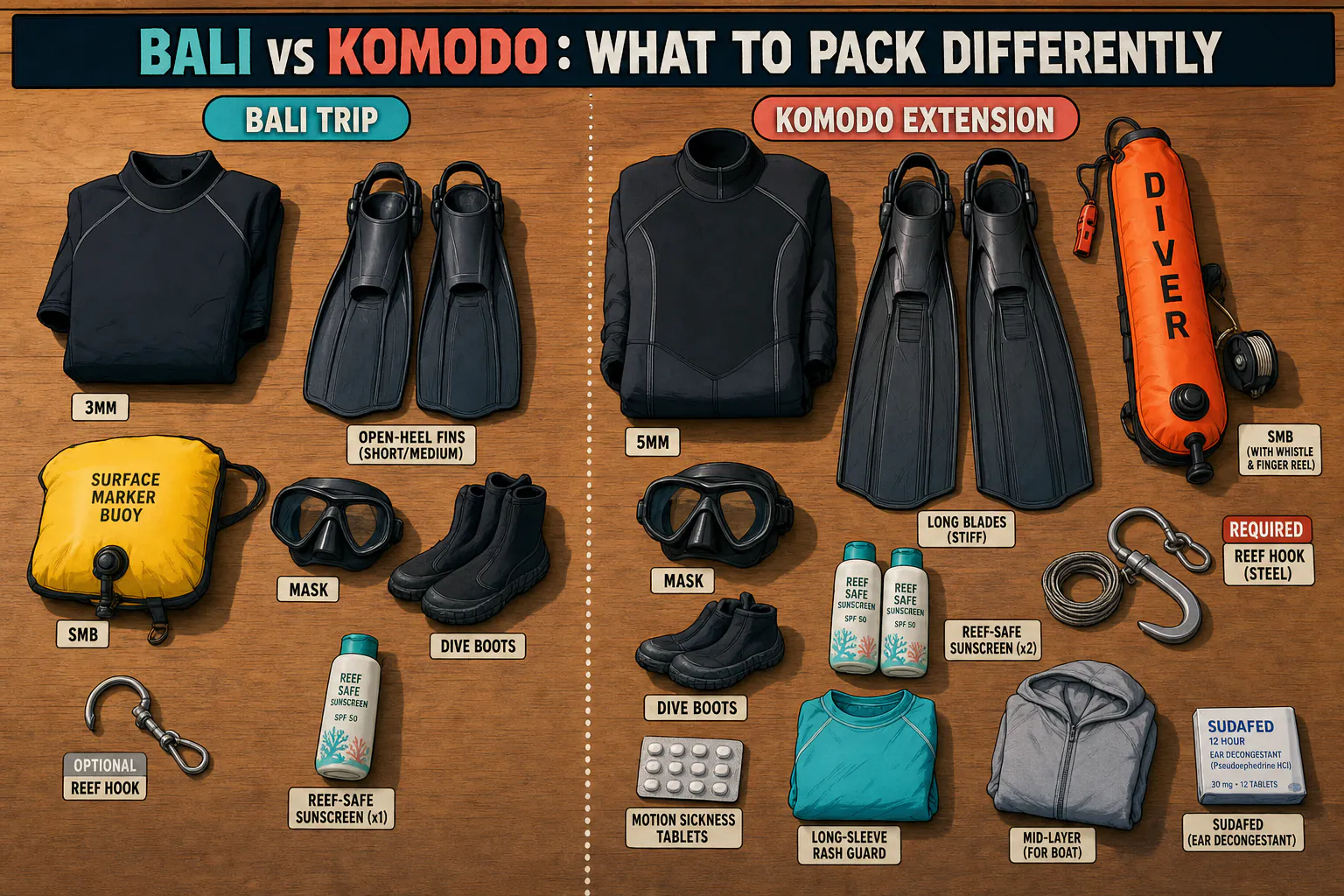
Wetsuit upgrade. 3 mm is borderline cold in Komodo's deeper sites (especially northern Komodo); 5 mm is the comfortable standard. Bring or pre-book a rental 5 mm. We stock them but they go quickly in peak season (June-August), reserve in advance.
Reef hook. Required, not optional. We require every Komodo guest to dive with a reef hook clipped to their BCD on northern Komodo sites (Castle Rock, Crystal Rock, Shotgun). Our rental hooks are sufficient but if you have your own, bring it.
Stiff long-blade fins. Komodo currents demand power. Split fins or short travel fins struggle in 2+ knot current. Bring quality stiff-blade fins (Apeks RK3, ScubaPro Jet, Cressi Reaction) or budget rentals.
Larger SMB with whistle and reflective panel. Komodo boats are tracking divers in fast current across long distances; a high-visibility SMB with sound signal is safer than a basic buoy.
Mid-layer for boat dives. Komodo dive boats run 6 AM departures and divers between dives can get cold even at 28 degrees. A long-sleeve rash guard plus a thin hoodie for surface interval is comfort gold.
Sturdier travel medication kit. Add Sudafed (with prescription), additional motion sickness tablets, and consider a doctor's note for any prescription medications. Labuan Bajo (Komodo's gateway) has very limited pharmacy options compared to Bali.
If you are doing an Indonesia liveaboard
Liveaboards limit you to a small dry-bag of cabin storage. Pack ruthlessly:
One soft duffel bag, no hard shells. Cabin storage on most liveaboards is shelves and underbed space, not closets.
Same dive gear list as above plus: a fan if you sleep hot (some cabins have weak AC), reef-safe sunscreen in larger quantity (you will be diving 4 times a day, 7 days), Sudafed with documentation (no pharmacy at sea), extra batteries for everything (charging power is limited and shared).
Cabin clothing: just enough to rotate. Most liveaboard divers live in a swimsuit and rash guard, with one set of dry casual clothes for dinner and one for the return day.
Cash for the kitty. Liveaboards typically run a shared cash kitty for crew tips at trip end. Plan IDR 1,450,000–2,700,000 (≈ 80–150 USD) per person depending on trip length and boat standard.
If you are diving Bali in rainy season (November to March)
Pack the additions from our rainy season diving guide: light rain jacket, quick-dry towel for between-dive drying, waterproof phone pouch, extra plastic bags for separating wet from dry, and consider a hood for your wetsuit if you are sensitive to cooler surface temperatures. Visibility drops, prices drop, mantas remain reliable.
If this is your first ever dive trip
Lighter list: no need to bring full gear (we rent everything for new divers), bring just mask, computer (or plan to rent), reef-safe sunscreen, and the documents/clothing kit. Our first-time diving Bali guide covers what to expect on the dives themselves. If you plan to take a course on this trip, the Open Water course in Bali and Advanced Open Water course in Bali articles cover what is included and what to bring specifically for course students.
Luggage strategy: cabin vs hold
Most international airlines now allow one cabin bag (7-10 kg) plus one hold bag (23 kg). Two strategies for divers:
Single hold bag + carry-on (most efficient). Everything in a 23 kg roller. Cabin bag for laptop, dive computer, masks (mask in carry-on prevents lens damage), camera, valuables, one change of clothes (in case checked luggage is delayed).
Renting most gear (lightest). Cabin bag only. Possible if you rent BCD, regulator, wetsuit, fins from us and bring only mask, computer, dive boots, and personal items. Saves IDR 1,450,000–2,700,000 (≈ 80–150 USD) per direction in checked-bag fees.
The "everything is precious" carry-on. Always in your cabin bag, regardless of strategy: passport, dive computer, mask, prescription medication, one change of dive-day clothes, phone, chargers, dive logbook, dive insurance documents. If your hold luggage is delayed 48 hours (we have seen this happen), you can still dive.
Bag tags. Use proper luggage tags with your phone number, NOT your home address (security risk and irrelevant to airline routing). Add a colored ribbon to distinguish your bag at the carousel.
Lithium battery rules. Lithium-ion batteries (camera, dive light, dive computer) MUST go in carry-on. Spare batteries must be individually protected (case or original packaging, terminals covered). Airline rules tighten regularly; check your specific carrier 1 week before departure.
What we see divers wish they had brought
After thousands of check-ins, the same items appear in the "I should have packed this" conversation:
Earplugs and eye mask. Dive boats are loud, dive resort rooms have thin walls, and dawn dive starts at 5 AM. Sleep is a priority.
A small thermos or insulated water bottle. Indonesia is hot and surface intervals are dehydrating; refill stations exist at every dive shop. A 750 ml insulated bottle keeps cold water cold for the boat.
Personal towel. Dive operators provide towels but they are basic. A microfibre quick-dry towel (IDR 270,000–550,000 (≈ 15–30 USD)) is faster and easier to manage.
Dive computer manual or quick-reference card. If you have a new computer, bring the documentation. Operators do not have your specific model's manual.
Replacement mask strap and o-rings. A snapped mask strap on day 2 of a 7-day trip is a real annoyance. IDR 90,000 (≈ 5 USD) spare kit.
Powdered or pre-portioned electrolytes (LMNT, Liquid IV). Replacing salts after sweat plus sea-water exposure makes a real difference in energy across a multi-day dive trip.
If your trip includes a slower Amed or Menjangan day
Some itineraries include a quieter day at Amed or a Menjangan day trip on the Bali to Komodo route. These trips need slightly different prep: an earlier departure (4-5 AM van pickup from Sanur for Menjangan), more cash for the longer day (lunch and snacks not always included), and motion sickness tablets for the longer road or jukung transfers. The dive itself is easier than a Penida current dive but the day is longer. Pack one full day's worth of water, sunscreen reapplication, and an extra layer for the air-conditioned van rides each way.
The departure day: 24 hours before flying
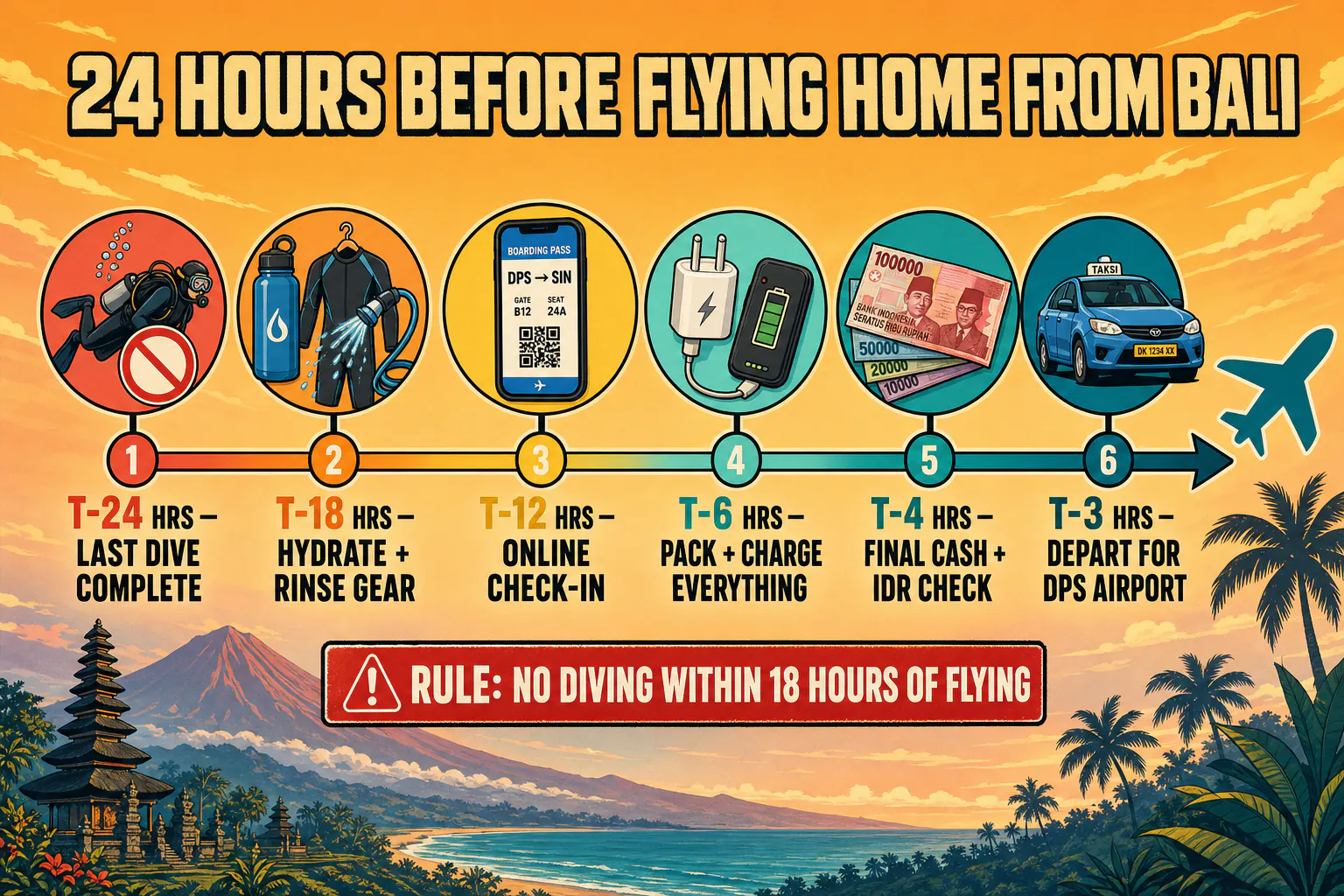
T-24 hours: Last dive completed. The no-fly window for repetitive diving is 18 hours minimum, 24 hours preferred. Most international flights leave Bali in the evening; if your flight is 22:00 Tuesday, your last dive must complete by 04:00 Tuesday. Plan the last dive day as a shallow easy dive done first thing in the morning, not the afternoon.
T-18 to T-12 hours: Hydrate aggressively. Rinse and dry all dive gear (most dive shops provide a rinse tank; do this before checking out). Pack damp items in plastic bags to keep them separate.
T-12 hours: Confirm flight check-in. Most airlines open online check-in 24 hours pre-departure. Use it.
T-6 hours: Final pack. Charge all devices fully. Pack chargers from outlets (the most-forgotten item). Camera cards backed up to phone or cloud.
T-4 hours: Final cash check. Convert IDR to your home currency only what you cannot spend on the way to the airport (Denpasar airport food and shopping accept IDR and cards).
T-3 hours: Depart for the airport. Denpasar (DPS) international check-in opens 3 hours before departure; arrive then for a buffer in case of slow check-in queues. Sanur to airport is 25-40 minutes depending on traffic; Ubud is 60-90 minutes; Tulamben is 3 hours and you should already be back in south Bali by now.
At the airport: The Indonesian airport departure tax is now bundled into ticket prices (no separate cash payment required). Customs check on departure is light; the bigger queue is the security and immigration scan. Allow extra time if you are checking a dive bag.
Common packing mistakes our customers make
Bringing too much "in case" clothing. Bali is informal and laundry is cheap (IDR 55,000–90,000 (≈ 3–5 USD) for a full load, same-day at most dive resorts and villas). Pack 4-5 days of clothing maximum; rotate.
Bringing dive gear they rarely use. Many divers travel with full kit out of habit. The honest math: 7-day Bali trip with IDR 1,450,000 (≈ 80 USD)/direction checked-bag fee = IDR 2,900,000 (≈ 160 USD) in luggage costs. Rental at IDR 650,000 (≈ 35 USD)/day for 5 dive days = IDR 3,150,000 (≈ 175 USD). Break-even. If you are diving 8+ days, bringing gear pays. If 5 or fewer, renting wins.
Forgetting prescription medication. Indonesian pharmacies cannot fulfill foreign prescriptions; bring full courses with documentation.
Packing valuables in checked luggage. Cameras, watches, jewelry, cash, passports: ALL in carry-on. Indonesian baggage handling is reliable but airline-international-route luggage delays still happen.
Underpacking sunscreen. A 7-day diver burns through 200 ml of reef-safe sunscreen easily. Bring 2 tubes; Bali sunscreen options are limited and often non-reef-safe imports.
Bringing too much cash. ATMs work; carrying IDR 18,000,000 (≈ 1,000 USD)+ in cash creates unnecessary risk. Plan IDR 3,600,000–7,200,000 (≈ 200–400 USD) cash on arrival, refill at ATMs as needed.
Underestimating Bali's intensity. Bali is hot, humid, and 8-9 hours ahead of European time. Energy management matters; pack electrolytes, accept that the first 2 days are jet-lag recovery, schedule your big dives for days 3-7.
The minimalist packing list: if you forgot everything
If you are reading this on the way to the airport with an empty suitcase, here is the priority order. Bring or buy at the airport:
Cannot skip: passport, dive certification card, prescription medication, credit card, phone, mask (if you own one).
Buy on arrival at Bali (everything is cheap and easy to find): reef-safe sunscreen (Sanur and Seminyak pharmacies stock Stream2Sea and similar), motion-sickness tablets, basic clothing, flip-flops, towel, ear drops, plug adapter, sun hat, a Telkomsel-backed eSIM (digital, set up at the gate).
We rent at our dive center: BCD, regulator, wetsuit, fins, tank, weights, dive computer, dive boots, reef hook, surface marker buoy.
This minimalist scenario is real. We have welcomed divers who landed with literally just their dive card and credit card, kitted them up locally, and they had a great trip. Bali makes this possible in ways that more remote destinations (Komodo, Raja Ampat) do not.
How to plan with us
If you have questions about gear rental, what to pre-book, or anything trip-specific, contact us through the Bali contact form or via the main booking page. We will confirm what to bring vs rent based on your trip dates, dive plans, and certification level. For Komodo extensions, the Komodo from Bali tour page handles the full logistics including the added gear we provide on the Komodo side. For multi-day Bali itineraries, the Bali dive packages page lays out what is included (gear, transfers, lunches) and what to bring on top.
Packing for diving is one of the few trip decisions that pays back every day you are here. A diver who arrives with the right gear, the right documents, and the right expectations spends day one in the water; a diver who arrived without dive boots, reef-safe sunscreen, or motion sickness tablets spends day one in a Sanur pharmacy. We see both, every week. This list is built so you are the first kind.
The right packing list is the one you do not have to think about during the trip. Pack once, properly, and spend your Bali days diving instead of running back to the dive shop for forgotten items.