

This Bali travel guide sets out what a first trip actually involves: the entry rules and tourist levy, the best months, which area to stay in, how to get around, what a day costs and how to behave at a temple. Bali is a single Indonesian province of about 5,780 square kilometres, yet the beach towns of the south, the rice terraces around Ubud and the volcanic coast of the east feel like separate destinations, and many visitors also spend time in the water, from diving and snorkelling in Bali to surfing.
Most first-time visitors stay 7 to 14 days and split them between two or three bases. A common pattern is a few days in the south near the airport, a few in Ubud, and a day or two on the coast or the islands, often including snorkelling trips in Bali or Bali dive trips to see manta rays and reefs. The sections below answer each planning question in a few lines and link to a deeper guide where one exists.
Prices are in Indonesian rupiah (IDR), quoted from operators, official sources or published price pages as of 2026. Rules on visas and levies change, so the official sources named in each section are the place to confirm them just before travel.
How to plan your first trip
Planning a first trip to Bali comes down to six decisions, made in this order.
- Choose the season: April to October is dry, November to March is wet but greener and cheaper.
- Check entry: a passport valid for six months, the visa on arrival or e-VOA, and the IDR 150,000 tourist levy.
- Pick two or three bases rather than moving every night, because traffic makes short distances slow.
- Book transport: a private driver for day trips, Grab or Gojek for short hops, fast boats for the islands.
- Budget per day: about IDR 600,000 for backpackers, IDR 1.5 to 3 million mid-range, far more for villas.
- Add one or two water days, such as snorkelling with mantas or a first dive.
The bases are the decision that shapes the trip most, so the area shortlist further down compares them by who they suit.
Water days are usually arranged through:
- A try dive in Bali for people who have never dived
- A Nusa Penida diving day trip for certified divers
- The dive centres in Sanur, the main departure point for the islands
In short: pick the season, sort the entry paperwork, choose two or three bases and leave room for a day on the water.
What you need to enter Bali
Most visitors need a passport valid for at least six months, an onward or return ticket, a visa on arrival or e-VOA costing IDR 500,000, and the one-time Bali tourist levy of IDR 150,000.
Visa on arrival and e-VOA
Citizens of more than 90 countries, including the United States, the United Kingdom, Australia and most of the European Union, can enter Indonesia on a visa on arrival, according to the Directorate General of Immigration. It costs IDR 500,000, lasts 30 days and can be extended once for another 30 days. The same visa can be bought online in advance as an e-VOA through the official immigration website, which saves time in the airport queue.
Bali tourist levy
Since 14 February 2024, the Bali provincial government has charged every foreign visitor a one-time tourist levy of IDR 150,000 per entry, under Bali Regional Regulation No. 6 of 2023. It is paid online through the official Love Bali website or app, and the QR code may be checked on arrival. It is a provincial charge and separate from the national visa.
Arrival declaration
Indonesia uses an online arrival declaration that combines customs, health and immigration questions, submitted shortly before landing through the official All Indonesia service. Unofficial websites charge fees for the same forms, so the government domain is the one to use. The step-by-step Bali e-visa guide walks through the e-VOA, the levy, extensions and the overstay fine of IDR 1,000,000 per day.
When is the best time to visit Bali?
The best time to visit Bali for dry, sunny weather is April to October, with the most reliable conditions in July and August. November to March is the wet season, with short heavy downpours, higher humidity and lower prices.
Temperatures barely change through the year. Daytime highs on the coast and in Ubud sit between about 29 and 32°C, and the sea stays around 26 to 29°C at the surface. The bigger differences are rain, crowds and price, which the month-by-month guide to the best time to visit Bali covers in detail.
| Period | Weather | Crowds and prices | Good for |
|---|---|---|---|
| April to June | Dry, warm, green after the rains | Moderate | Most travellers, couples, diving |
| July and August | Driest, slightly cooler nights | Peak, book early | Beaches, mola mola season, families on holiday |
| September and October | Dry, warm | Moderate | Diving, hiking Mount Batur, quieter beaches |
| November to March | Wet, humid, afternoon storms | Low, except Christmas and New Year | Budget trips, spas, surfing the east coast |
Two dates matter more than the weather. Christmas to New Year is as busy as August, with prices to match. Nyepi, the Balinese Day of Silence, falls in March in most years (19 March in 2026): for 24 hours the airport closes, nobody may leave their hotel, and lights stay low. The guide to Nyepi in Bali explains the rules and the night-before parades.
Divers have their own calendar. Ocean sunfish, or mola mola, rise to cleaning stations around Nusa Penida from July to October, while visibility at Tulamben and Amed is usually best in the dry season. Manta rays are present all year.
Where to stay in Bali: the best areas in 2026
The best area depends on the trip: Sanur and Nusa Dua for calm and families, Ubud for culture, Seminyak and Canggu for food and nightlife, Uluwatu for cliffs and surf, and Amed, Tulamben or Nusa Penida for the sea. The map shows where each sits.
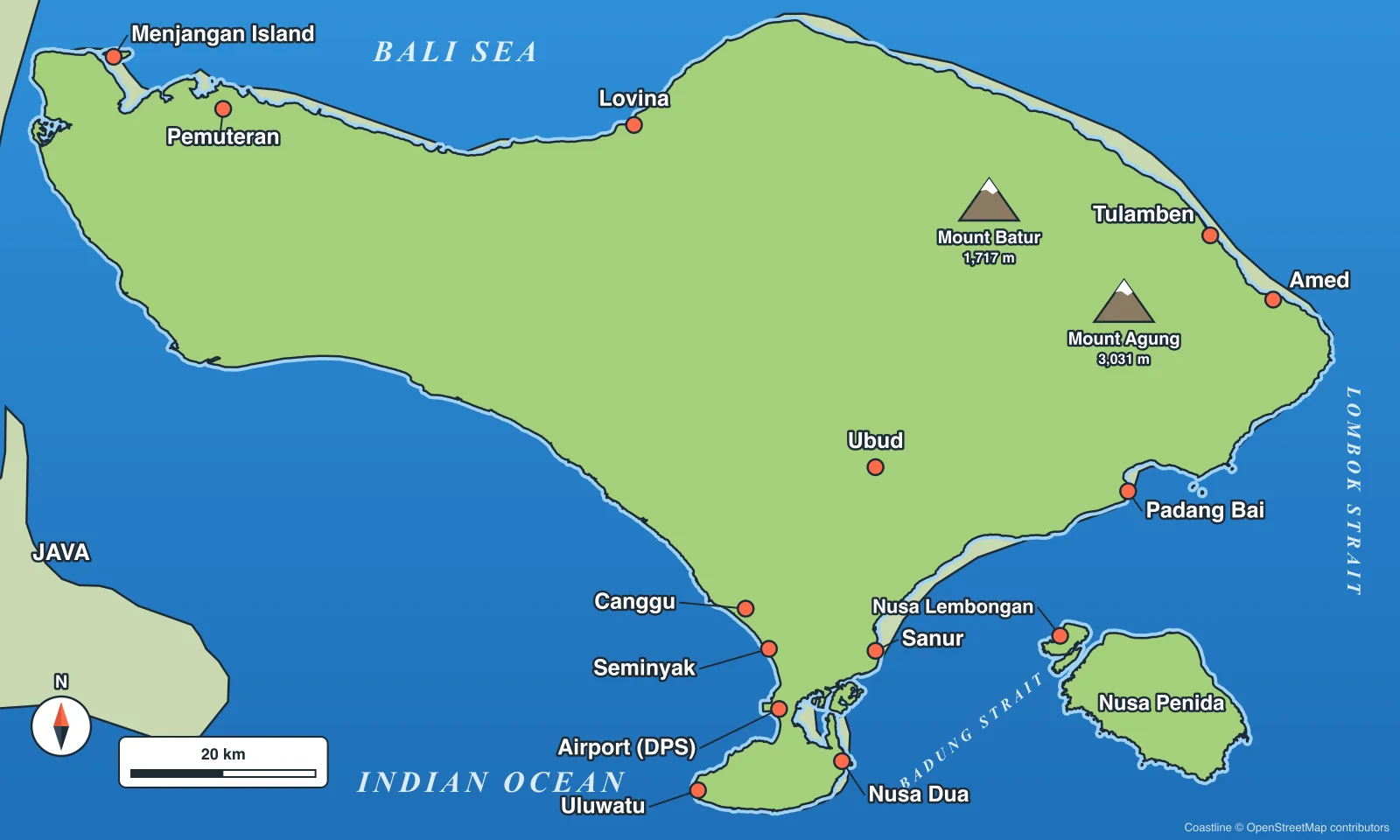
Sanur
Sanur is a low-rise beach town on the south-east coast, about 30 to 45 minutes from the airport, with a paved beachfront path, a reef-protected lagoon and gentle water that suits families, older travellers and couples who want quiet evenings. It is also the departure point for fast boats to Nusa Penida and Nusa Lembongan, and home to many of the island's scuba diving centres. Guesthouses start around IDR 300,000 a night and beachfront resorts from about IDR 2,000,000. The limitation: nightlife is limited, and the beach is tidal and shallow, so swimming is best at high tide.
Ubud
Ubud sits in the hills about 1.5 to 2 hours from the airport and is the cultural centre of Bali, with rice terraces, temples, dance performances every evening, yoga schools and the Sacred Monkey Forest Sanctuary. It suits first-time visitors who want to see Balinese life, couples and anyone happy without a beach. Accommodation runs from simple homestays to jungle villas. The limitation: central Ubud traffic is heavy in the afternoon, there is no beach, and the long-tailed macaques at the forest will grab sunglasses and food.
Seminyak and Canggu
Seminyak and Canggu, on the south-west coast, are where most of the island's cafés, beach clubs, boutiques and coworking spaces are. Seminyak is more polished and Canggu more casual and surf-focused, with long black-sand beaches and big sunsets. They suit younger travellers, groups of friends and digital nomads. The limitation: the roads between them are some of the most congested on the island, the surf is strong for swimming, and Canggu can take 60 to 90 minutes to reach from the airport.
Uluwatu and the Bukit Peninsula
The Bukit Peninsula at the southern tip has limestone cliffs, small white-sand coves and world-class surf breaks such as Uluwatu, Padang Padang and Bingin. The clifftop Uluwatu Temple hosts a Kecak fire dance at sunset. It suits surfers and couples looking for views and luxury cliff hotels. The limitation: many beaches are reached by long staircases, places are spread out, so a scooter or driver is needed, and the reef breaks are not for beginner surfers.
Nusa Dua
Nusa Dua is a gated resort enclave on the east side of the Bukit with large international hotels, calm swimming beaches protected by an outer reef and a tidy promenade. It suits families with young children and travellers who want an all-inclusive style stay close to the airport, about 20 to 30 minutes away. The limitation: it feels separate from Balinese life, and eating outside the resorts takes a taxi.
Amed and Tulamben
Amed and Tulamben are quiet villages on the north-east coast, about three hours from the airport, with black-sand beaches, fishing boats and Mount Agung behind. The reefs start a few metres from shore, which makes Amed diving and snorkelling easy, and Tulamben diving is built around the USAT Liberty wreck, a Second World War cargo ship lying 30 metres from the beach. Homestays start around IDR 200,000. The limitation: the drive is long, and there is little nightlife or shopping.
Nusa Penida and Nusa Lembongan
The Nusa islands lie 30 to 45 minutes by fast boat from Sanur. Lembongan is small and relaxed with beach bars and mangroves; Penida is larger, rugged and famous for Kelingking Beach, Diamond Beach and manta ray sites. They suit travellers who want dramatic scenery and snorkelling with mantas, and divers. The limitation: Penida's roads are steep and rough, crossings can be choppy, and the water around Penida is colder and has strong currents, so in-water trips need an experienced operator.
Lovina, Pemuteran and the north
The north coast is calmer and much less developed. Lovina is known for dawn dolphin-watching boats, and Pemuteran is the base for Menjangan Island diving in West Bali National Park, with clear water and coral walls. It suits repeat visitors, divers and travellers looking for quiet. The limitation: it takes three to four hours from the airport over the mountains, and the choice of restaurants is small.
The guide to where to stay in Bali compares these bases in more detail, including prices and distances to dive sites.
How do you get around Bali?
Most visitors use ride-hailing apps such as Grab and Gojek for short trips, a private driver for full-day tours, and fast boats to the Nusa islands, the Gilis and Lombok. Renting a scooter is common but legally requires a motorcycle licence.

| Option | Typical 2026 cost | Best for | Watch out for |
|---|---|---|---|
| Grab or Gojek car | About IDR 50,000 to 150,000 for a short trip | Restaurants, airport runs, nearby towns | Pickup restrictions in some villages |
| Private driver | About IDR 600,000 to 900,000 for 8 to 10 hours | Day trips to Ubud, temples, the east | Agree fuel, parking and hours upfront |
| Scooter rental | About IDR 70,000 to 120,000 per day | Experienced riders in quieter areas | Licence, helmet, insurance, traffic |
| Fast boat | About IDR 150,000 to 400,000 one way to the Nusa islands | Nusa Penida, Lembongan, Gili, Lombok | Swell, wet boarding from the beach |
Driving distances look short on the map but take time. Outside rush hour, the airport is about 30 to 45 minutes from Sanur or Seminyak, 1.5 to 2 hours from Ubud and around 3 hours from Amed. Local drivers plan day trips so the long stretches happen early in the morning.
Scooters need care. Indonesian law requires a motorcycle licence, which for tourists means an International Driving Permit with a motorcycle category alongside the home licence, and police checkpoints in the south do fine riders without one. Many travel insurance policies also refuse claims for scooter accidents when the rider was unlicensed or not wearing a helmet. The Bali safety guide covers road safety and other risks in more depth.
Phone data makes all of this easier. A local SIM or eSIM with 25 to 30 GB costs roughly IDR 100,000 to 150,000 for a month, and the Bali SIM card and eSIM guide compares the providers and where to buy.
How much does a trip to Bali cost per day?
A day in Bali costs about IDR 600,000 (roughly USD 37) on a backpacker budget, IDR 1.5 to 3 million (USD 90 to 185) mid-range, and from IDR 5 million (about USD 300) for luxury villas and resorts, excluding flights.
| Item | Budget | Mid-range | Luxury |
|---|---|---|---|
| Room per night | IDR 200,000 to 500,000 | IDR 700,000 to 1,500,000 | From IDR 3,000,000 |
| Meals per day | IDR 100,000 at warungs | IDR 300,000 to 500,000 | From IDR 1,000,000 |
| Transport per day | IDR 100,000 (scooter, apps) | IDR 300,000 (apps, shared driver) | IDR 900,000 (private driver) |
| Activities | Temples, beaches, hikes | One paid tour every few days | Spa, private tours, diving |
| Typical day total | About IDR 600,000 | IDR 1.5 to 3 million | From IDR 5 million |
The rupiah trades at roughly IDR 16,000 to 16,500 to the US dollar in 2026, so prices have many zeros: IDR 100,000 is about USD 6. A local meal at a warung costs about IDR 25,000 to 50,000, a large local beer IDR 50,000 to 70,000 in a restaurant, and a 1.5-litre bottle of water under IDR 10,000 in a minimarket. Many restaurants add government tax and service of about 15 to 21 percent, shown as "++" on the menu.
Money tips that save real amounts: use ATMs attached to bank branches, change cash only at authorised money changers with a PT company name and printed rates, and pay by card in larger shops and hotels, where it is widely accepted. Tipping is not expected in warungs; rounding up for drivers and guides is appreciated.
Water activities sit at the top of most budgets. Published prices in 2026 put shared snorkelling trips from about IDR 1,350,000 per person and a two-dive Nusa Penida trip for certified divers from about IDR 2,700,000, with multi-day dive packages lowering the cost per dive.
What should you know about temples, customs and safety?
Visitors to any Balinese temple must cover their legs with a sarong and tie a sash at the waist, and shoulders should be covered. Small daily offerings called canang sari appear everywhere, on steps, pavements and dashboards, and should not be stepped on.

About 87 percent of Bali's population is Hindu, according to Statistics Indonesia, which makes the island a Hindu enclave in the world's largest Muslim-majority country. Religious life is visible every day: families make offerings three times a day, villages hold temple festivals, and ceremonies can close roads for an hour or two.
- Wear a sarong and sash inside temple grounds; major temples lend or rent them at the gate.
- Do not climb on shrines or stand higher than a priest or an offering during a ceremony.
- Signs at many temples ask women who are menstruating not to enter, and visitors are expected to respect them.
- Use the right hand to give and receive things, and do not touch anyone on the head.
- Dress modestly away from the beach, especially in villages and markets.
- Ask before photographing ceremonies and people praying, and never use a flash.
The best-known temples, such as Tanah Lot, Uluwatu, Tirta Empul and Besakih, all appear in the guide to things to do in Bali, along with waterfalls, rice terraces and the sunrise hike up Mount Batur.
Is Bali safe?
Bali is generally safe for tourists, with low violent crime. The most common problems are traffic accidents, stomach upsets, sunburn, petty theft from scooters and monkeys, and a small number of scams.
Food and water
Tap water in Bali is not safe to drink, so visitors use bottled or refill-station water, including for brushing teeth. Traveller's diarrhoea, known locally as Bali belly, affects many first-time visitors in the first week. The guide to Bali belly covers prevention, oral rehydration salts sold as oralit for about IDR 1,000 to 3,000 a sachet, and when to see a doctor.
Animals and insects
Rabies has been present in Bali since 2008, so any bite or scratch from a dog, cat or monkey needs washing for 15 minutes and same-day medical care. Dengue fever is spread by daytime mosquitoes, particularly in the wet season, so repellent matters. A travel clinic can advise on vaccines several weeks before departure.
Drinks, scams and theft
Cases of methanol poisoning from counterfeit spirits and unbranded arak have been reported over the years, so travellers are advised to stick to sealed, branded bottles and reputable bars. Bags are best worn across the body, away from the road, because snatch thefts from passing scooters happen in the busy south. Travel insurance that covers medical evacuation and, for divers, recompression treatment is worth having.
Bali travel guide for first timers: sample itineraries
A first trip works best with two or three bases and one long day of travel at most. The examples below fit 7 and 10 days and can be shifted to suit the season.
7 days: south, Ubud and the islands
| Day | Base | Plan |
|---|---|---|
| 1 | Sanur | Arrive, beach walk, early dinner |
| 2 | Sanur | Snorkelling or a first dive at Nusa Penida, back by mid-afternoon |
| 3 | Sanur | Rest, spa, sunset at a beachfront warung |
| 4 | Ubud | Drive up via Tegallalang rice terraces, evening dance performance |
| 5 | Ubud | Tirta Empul water temple, Campuhan Ridge walk, cooking class |
| 6 | Uluwatu | Drive south, beaches, Kecak dance at Uluwatu Temple at sunset |
| 7 | Uluwatu | Beach morning and airport, about 30 to 45 minutes away |
10 days: add the east coast
| Days | Base | Plan |
|---|---|---|
| 1 to 3 | Sanur | Arrival, beaches, a manta snorkelling or diving day at Nusa Penida |
| 4 to 6 | Ubud | Rice terraces, temples, Mount Batur sunrise hike from about 2 am |
| 7 to 8 | Amed | Snorkelling off the beach, the USAT Liberty wreck at Tulamben, Lempuyang temple |
| 9 to 10 | Seminyak or Uluwatu | Sunsets, shopping, a last swim, then the airport |
Divers flying home should leave at least 18 hours between their last dive and the flight, as recommended by Divers Alert Network for repetitive diving, which usually means making the final full day a dry one. Travellers with more time can add a week further east, such as a Komodo trip from Bali or a liveaboard cruise from Bali.
Diving and snorkelling in Bali: what are the options?
Bali has world-class diving and snorkelling within a day trip of the south: manta rays and mola mola at Nusa Penida, the USAT Liberty wreck at Tulamben, coral reefs at Amed, Padang Bai and Menjangan, and macro life on black sand. Non-divers can try it in one day, and a full certification takes three.
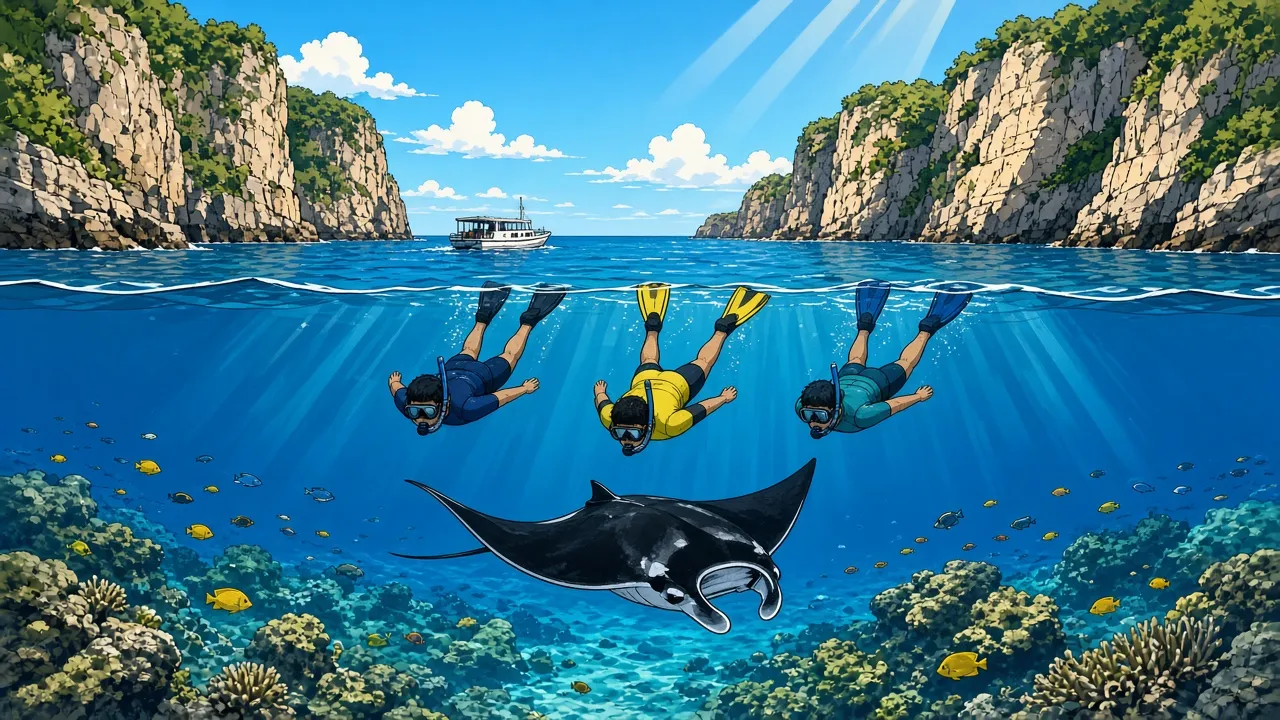
- Snorkelling: half-day and full-day boat trips to Nusa Penida's manta sites and Crystal Bay, or from the beach at Amed and Padang Bai, with a boat trip on Nusa Penida snorkelling tours the most popular.
- First dive: a Discover Scuba Diving session starts with pool training and goes no deeper than 12 metres with an instructor, with no certification needed.
- Certification: the PADI Open Water course takes about three days and qualifies divers to 18 metres anywhere in the world.
- Certified divers: day trips to Nusa Penida, Tulamben, Amed and Padang Bai, or Crystal Bay in the mola mola season.
Sea conditions vary a lot by site. Sanur, Padang Bai and Amed are usually calm, while Nusa Penida has strong currents and thermoclines where the water can drop below 20°C, especially from July to October. That is why most operators take newer divers to Penida's sheltered sites and keep the drift dives for experienced ones.
Example: a Nusa Penida water day from Sanur with Neptune Scuba Diving
Neptune Scuba Diving runs courses, dive trips and snorkelling trips from Sanur. The example below shows how one water day fits into a Bali itinerary; many operators run similar trips.
- Departure from the Sanur dive center is around 08:30 to 09:00, with hotel pickup in selected areas, and the speed boat to Nusa Penida takes about 45 minutes.
- Certified divers make two dives with bottom times of 45 to 60 minutes and a surface interval of 45 to 60 minutes; the Nusa Penida trip page lists the day from IDR 2,700,000 per person.
- Non-divers can join a snorkelling trip listed from IDR 1,350,000, or a first try dive with a pool session, limited to 12 metres.
- The day finishes in the afternoon, which leaves the evening free in Sanur.
This day is not for everyone. The deeper Nusa Penida drift sites are not suited to divers on their first dives after certification, and the cold thermoclines in the mola season call for a thicker wetsuit. It does not fit the day before a flight, and children under 10 cannot join open-water scuba programmes under PADI standards. Travellers who prefer calm water can choose the shallow reefs off Sanur or the east coast instead.
Key takeaways
- A first Bali trip works best with 7 to 14 days and two or three bases, such as Sanur, Ubud and the coast.
- April to October is the dry season; July and August are the busiest months, and Nyepi closes the airport for a day each March.
- Entry needs a six-month passport, the IDR 500,000 visa on arrival or e-VOA, and the IDR 150,000 Bali tourist levy.
- Use Grab or Gojek for short trips, a private driver for day tours and fast boats for the Nusa islands; scooters need a valid licence.
- Budget roughly IDR 600,000 a day as a backpacker, IDR 1.5 to 3 million mid-range, and much more for villas.
- Cover legs and shoulders at temples, drink only bottled water, and treat any animal bite as urgent.