

Where to stay in Bali for diving is the one trip decision that quietly outranks all the others, and the short answer has not changed in twenty years: base yourself in Sanur, on the island's east-facing coast, and the whole underwater map opens up. Nearly every Bali diving day trip worth doing, Nusa Penida's mantas, the Tulamben wreck, the channel sites, leaves from or through the east coast, and Sanur sits at the hub of that network like a train-station town. Stay there and your dive mornings start with a stroll to the beach; stay in Canggu and they start with a 4:45 alarm and ninety minutes of traffic. This guide gives you the full accommodation strategy: what makes a base good for divers, an honest profile of every option, Sanur, the east-coast dive towns, Nusa Penida itself, the quiet northwest, and the famous south, plus split-stay blueprints for 5, 7 and 10-day trips and a checklist of what actually matters in a dive-trip hotel (hint: it is not the infinity pool).
One thing this guide will not do is pretend geography away. Bali's surf coast and its dive coast are on opposite sides of the island, and no villa, however beautiful, relocates a reef. The island's booking sites will happily sell you a gorgeous week in the wrong hemisphere of the island, and by the time the first pickup message arrives, "we'll collect you at 05:15", the lesson has been learned the expensive way. Choose your bed for the diving you came to do, and the island rewards you with more time underwater and less time in a minivan.
Why your base matters more than your hotel
Bali's dive sites cluster along the east and northeast coasts and around Nusa Penida, for reasons of ocean plumbing explained in our Bali diving conditions guide: the Lombok Strait and its currents feed that side of the island, so that is where the boats, the wrecks and the mantas are. The tourist accommodation, meanwhile, concentrates in the south and west, Kuta, Seminyak, Canggu, Uluwatu, plus inland Ubud, a legacy of surf breaks and sunset bars rather than reefs.
The result is a simple equation divers discover on day one: every kilometre you sleep away from the east coast is paid back in pre-dawn alarms. Dive boats leave early, because mornings bring the calmest seas and clearest water, so a base with a 5-minute transfer versus a 90-minute one is the difference between a holiday and a commute. It also compounds: over a five-dive-day trip, basing west instead of east costs you roughly a full waking day of holiday sitting in a vehicle. We run daily dive trips with hotel pickup across the south, so it is never impossible, merely expensive in sleep. The full pickup-time arithmetic for each western area lives in our Seminyak-Canggu-Ubud-Kuta diving guide; this article is for the smarter move: choosing the right base before you book.
How this guide is organised
We will start with the quick-reference table for the impatient, then walk each base in depth: Sanur first, because it is the default answer and deserves its full case; the three east-coast dive towns for divers who want to live at the waterline; Nusa Penida for those tempted to sleep beside the mantas; Pemuteran for the northwest's walls; and a candid word on the south and west. After the geography come the practical layers most guides skip: split-stay blueprints sized to real trip lengths, the diver's hotel checklist, arrival and departure day strategy, the booking mistakes we watch guests make every season, and the money and timing maths. By the end you should be able to book beds for any Bali dive trip in one sitting, with no 4:45 alarms you did not choose deliberately.
The short answer, by diver type
| Your trip | Best base | Why |
|---|---|---|
| First Bali dive trip, mixed sites | Sanur | Hub for Penida, Padang Bai, Tulamben day trips; proper town comforts |
| Wreck and macro obsession | Tulamben or Amed | Sleep 200 m from the Liberty wreck; shore dive on your own schedule |
| Manta-and-mola maximalist | Sanur (or Nusa Penida) | Shortest reliable crossings to the channel sites |
| Learning to dive | Sanur or Padang Bai | Calm training sites, course logistics, evening life that isn't a party district |
| Diving + partner who doesn't dive | Sanur, split with Ubud | Beach town amenities; culture fix added mid-trip |
| Menjangan walls and quiet | Pemuteran | The northwest is its own world; 30 minutes from the park |
| Surf mornings, dive occasionally | Seminyak/Canggu | Accept the long pickups; see the west-side guide |

Sanur: the diver's capital of Bali
Sanur is where Bali's dive industry actually lives, and once you spend a trip there the reasons stack up fast. The boats to Nusa Penida leave from Sanur's beach and harbour, thirty to forty-five minutes to the manta and mola sites, no other mainland base comes close for the channel. The road network puts Padang Bai about an hour away and Tulamben around two, which is why operators based here, ourselves included at our Sanur dive centre, can serve the whole east-coast menu with civilised pickup times. And the airport is a flat forty-five minutes away, which matters more than people think on arrival and departure days.
Topside, Sanur is the grown-up among Bali's beach towns: a ten-kilometre paved beachfront path, calm swimmable water inside the reef (with genuinely good snorkelling at high tide), restaurants that range from warung nasi goreng to serious seafood, and a bedtime measured in reasonable hours rather than club closings. It is popular with families and older travellers for the same reasons it suits divers: easy, walkable, unhurried.
Where in Sanur, and what it costs
The town divides into three useful bands. North Sanur (around Jalan Hang Tuah and the harbour) is closest to the fast-boat bustle, handy but busier. Central Sanur, along Jalan Danau Tamblingan, is the sweet spot: guesthouses, mid-range hotels and restaurants within a short walk of the beach path. South Sanur (toward Mertasari beach) is quietest, resort-heavy and a touch removed. Budget guesthouses run roughly Rp 300,000-500,000 a night, solid mid-range hotels with pools Rp 700,000-1,500,000, and beachfront resorts from Rp 2,000,000 upward; even in high season Sanur undercuts Seminyak for equivalent comfort. For divers the practical advice is simple: stay anywhere within walking distance of Danau Tamblingan and your pickup, breakfast and dinner logistics all solve themselves.
The dive towns: Tulamben, Amed and Padang Bai
If your trip is about volume, waking up, walking into the water, logging four dives, repeating, then skip the resort scene entirely and sleep where the reefs are. Tulamben puts you two hundred metres from the USAT Liberty wreck, which means dawn wreck dives before the day-trip crowds arrive, and evenings among a village whose entire economy is scuba. Amed offers the same immersion with more restaurants and a longer string of bays, plus Bali's best muck and macro diving on its doorstep. Padang Bai is the compact harbour-town compromise: sheltered training bays, boat access to Gili Mimpang, and the shortest hop back toward Sanur's comforts.
Accommodation in all three runs cheaper than Sanur, homestays from Rp 200,000, lovely small dive resorts from Rp 600,000, with the trade-off that nightlife is a beer at a beach warung and the nearest big supermarket is a drive away. The full personality test between the three towns, which suits wreck lovers, which suits couples, which suits budget backpackers, is in our Tulamben vs Amed vs Padang Bai comparison. The one honest caveat: from the dive towns, Nusa Penida's mantas are a long day. Most divers pair a dive-town stay with Sanur nights for the channel sites, which is exactly what the split-stay blueprints below are for.
Staying on Nusa Penida itself
Sleeping on Penida sounds like the power move, wake up next to the manta sites, and for a certain trip it is. The island has grown a real accommodation scene, from Rp 250,000 guesthouses in Toyapakeh and Ped to genuinely stylish clifftop stays, and morning boats reach the dive sites in minutes. Penida also earns its keep topside: Kelingking, Broken Beach and the western viewpoints fill surface intervals gloriously.
The caveats are real, though. The island's roads remain an adventure sport, restaurant and medical infrastructure is thinner than the mainland's, and, the detail divers forget, if you plan to fly soon after your last dive, you must budget the crossing back plus the no-fly interval with more margin than a mainland base requires. Our honest take: two or three Penida nights inside a longer trip is superb; a whole week based there suits topside explorers more than divers, because the mainland sites (Tulamben, Padang Bai, Menjangan) become impractical. Many guests get the best of it by day-tripping first, our Nusa Penida day trip guide covers that pattern, then adding island nights on a return visit.
Pemuteran and the quiet northwest
The northwest corner is Bali running at half speed: black-sand bays, no traffic, and Menjangan Island's wall dives thirty minutes offshore, some of the clearest, calmest water in Bali, as our Menjangan guide details. Pemuteran village has grown a lovely cluster of low-key resorts and the famous Biorock reef-restoration project right off the beach. Stay here if your trip is walls, turtles and silence, and treat it as a destination in itself: it is a solid four hours from Sanur, so it anchors the front or back of an itinerary rather than serving as a day-trip base. Combine three northwest nights with an east-coast stint and you will have dived a remarkable range of Bali without ever rushing.
The south and west: Seminyak, Canggu, Kuta, Ubud, Uluwatu
Here is the diplomatic version: these are wonderful places to be a tourist and inefficient places to be a diver. They exist on the wrong side of the island's dive geography, so every dive day starts with a long pickup, 60 to 100 minutes depending on area and traffic, and ends with the same in reverse. If your group has already committed, do not despair: we collect divers from all of them daily, the van naps are legendary, and the full area-by-area logistics (including the case for relocating two or three nights to Sanur mid-trip) are covered in the west-side diving guide. Ubud deserves its special mention: it is inland, culture-rich and jungle-green, and it makes a beautiful non-diving chapter of a split stay, just not a dive base. Uluwatu and the Bukit are furthest of all from the boats; surf there, dive from elsewhere.
Split-stay blueprints that actually work
The best Bali dive trips usually sleep in two places. Moving mid-trip costs half a morning; basing wrong costs every morning. Three field-tested templates, all assuming our boats and pickups, and all compatible with the site-by-site planning in the Bali dive itinerary guide:
5 days, first-timer friendly: all five nights in Sanur. Day-trip Penida for mantas, Padang Bai for reefs (or an Open Water course), Tulamben for the wreck, and keep a buffer day for the pool, the beach path and the no-fly interval. Zero packing-cube stress, maximum water time.
7 days, the classic split: four nights Sanur (Penida channel sites, Padang Bai, a rest day), then three nights Tulamben or Amed (dawn Liberty dives, muck sites, night dive). The transfer between them is a scenic 2-hour coastal drive that doubles as your surface interval. This is the itinerary we recommend most often, and it pairs the two best sleeping locations in Bali diving.
10 days, the full island: four nights Sanur, three nights Amed/Tulamben, three nights Pemuteran for Menjangan's walls, or swap the northwest leg for two nights on Nusa Penida plus an Ubud finale if your group mixes divers and non-divers. Ten days covers every ecosystem Bali offers, mantas to muck to walls, with no single day feeling like a logistics exercise. Time it against the seasons using our best time to visit guide and the mola season calendar if the sunfish is on your list.

What makes accommodation diver-friendly (the checklist)
After fifteen years of collecting guests from every kind of lodging, we can report that the features that matter to divers are rarely the ones on the booking-site filters. What to actually look for:
Early breakfast, or a kitchen that packs one. Dive pickups commonly run 07:00-08:00 from Sanur (earlier from the west). A hotel whose breakfast starts at 08:00 quietly costs you a meal every dive day; the good ones hand you a banana-pancake parcel at dawn without being asked twice.
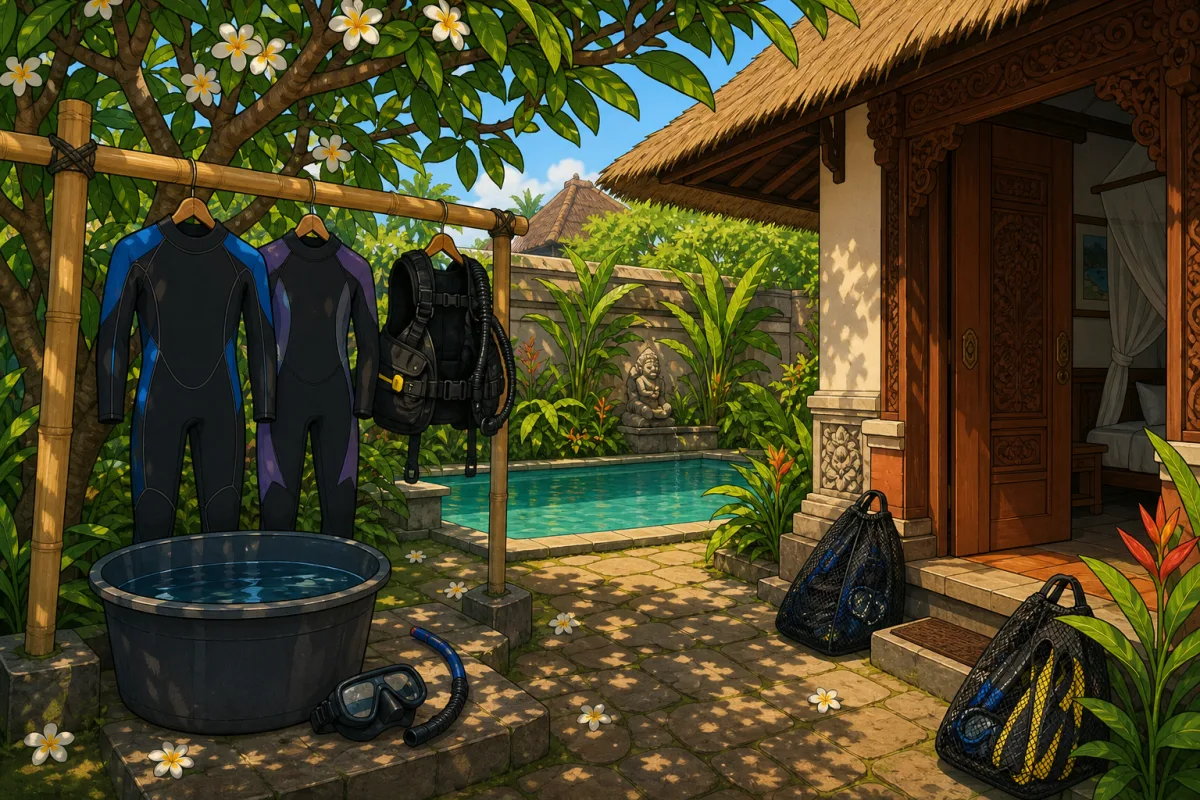
Somewhere to rinse and dry gear. If you travel with your own equipment, a courtyard tap, a shaded rail and a hotel that does not mind salty neoprene are worth more than a spa. Dive-oriented stays advertise rinse tanks; elsewhere, a polite question at check-in works wonders. (Travelling light instead? Our packing list sorts what is worth bringing versus renting.)
A real bathtub of hot water is optional; laundry service is not. Five dive days generate a startling volume of damp towels and rashguards. Same-day laundry is a Bali superpower, roughly Rp 15,000-25,000 per kilo, and every good dive base has it within a block.
Walking-distance dinner. After four dives you will not want to ride a scooter twenty minutes for food. Sanur's Danau Tamblingan, Amed's beach road and Padang Bai's harbour strip all pass this test; isolated villas often fail it.
Flexible checkout on departure day. The 18-24 hour no-fly window means your last day is often dive-free with an evening flight; a hotel that grants a late checkout or luggage room plus pool access turns that dead time into holiday.
Arrival and departure days: the bookend strategy
Two days of every trip are decided by the airport, and planning them well buys you an extra dive day at no cost. On arrival, resist the urge to sleep near the airport "just for one night": Sanur is only 45 minutes away, so land, transfer, and wake up already at your dive base with nothing to repack. If you land late at night, an arrival-day Sanur hotel still beats a Kuta one, same drive time, better morning. Divers coming off long-haul flights should also plan the first morning gently; jet lag and diving fitness mix poorly, and an easy first dive at Padang Bai beats an ambitious channel day.
Departure day is where the no-fly interval becomes an accommodation question. If your flight leaves in the evening, your final 24 hours are dive-free, so spend them where dead time is pleasant: Sanur's beach path, a massage on Danau Tamblingan, a slow seafood lunch. This is also the argument for running any split stay east-to-west-of-nothing, finish in Sanur rather than a remote corner, so the airport run is short and the buffer day has infrastructure. Divers finishing in Pemuteran or on Penida should build in a full travel day before flying; the four-hour drive or the boat crossing plus traffic eats exactly the margin the no-fly rule needs.
Five booking mistakes divers make in Bali
Booking the villa before the diving. The classic. A group locks in seven nights in Canggu because the photos were beautiful, then discovers every dive day starts at 05:00. Decide the diving first, then the bed; the reverse order costs sleep all week.
Assuming distances from a map. Bali kilometres and Bali minutes are different currencies, thirty map-kilometres through Denpasar is ninety real minutes. Trust transfer times from people who drive them daily, not the map app's optimism.
Overrating beachfront. On the dive coast you leave at 07:30 and return at 16:00; you will enjoy the beach for an hour a day at most. A quieter room two streets back, with the savings spent on an extra Penida trip, is almost always the better trade.
Booking non-refundable in mola season without margin. July-October fills fast, but weather and swell occasionally reshuffle dive days. Refundable rates, or at least a flexible final night, keep the itinerary breathing.
Forgetting the non-diver. If half your party does not dive, Sanur (calm swimming, cafés, day spas) and a split with Ubud keep everyone happy; a dive village delights divers and bores everyone else by day two. Our things to do in Bali guide is the peacekeeping resource.
Booking timing, seasons and budget maths
Bali's accommodation runs on two calendars. High season, July-August plus the Christmas-New Year fortnight, books out weeks ahead in Sanur's mid-range (the sweet spot fills first) and prices rise 20-40%; if your dates are fixed, book beds before flights are even cheap. Shoulder months, April-June and September-October, are the connoisseur's window: dry-season diving, mola season in the later half, and rooms both cheaper and available, the same months our seasonal guides flag as the diving sweet spot. The wet season discounts everything further and, as we keep saying, barely dents the diving.
Budget-wise, a comfortable diver's week in Sanur, mid-range hotel, breakfasts included, dinners out, runs far less than most first-timers expect, and the accommodation saving of a dive town can fund an extra dive day. For the full trip arithmetic, dives, courses, gear, tips, see the Bali diving cost guide. One budgeting rule of thumb we stand behind: spend your marginal rupiah on more dives rather than more thread count. The reef does not know what your pillow cost.
The bottom line
Sleep east, dive everything. Sanur remains the single best answer for most divers, the whole menu within day-trip range, a genuinely pleasant town, and our boats at the end of the street. Add a dive-town chapter (Tulamben or Amed) if you want dawn wrecks and shore-diving freedom, a Pemuteran or Penida leg if your trip has room for a second act, and leave the west side to your surfing friends, or at least read the pickup guide before committing. Wherever you book, the diving itself is solved: day trips, courses from first try dives upward, and honest advice about whether your hotel choice will cost you sleep, we have collected divers from all of it, and we will tell you straight. Book the bed near the boats; future-you, un-alarmed at 4:45 am, sends thanks.
Frequently Asked Questions
Sanur, on Bali's southeast coast, is the best base for most divers. The boats to Nusa Penida's manta and mola sites leave directly from Sanur, Padang Bai is about an hour away and Tulamben two, so the island's whole dive menu works as day trips. It is also a pleasant, walkable beach town with the airport only 45 minutes away.
They serve different trips. Sanur is the flexible hub: every major site reachable as a day trip, especially Nusa Penida. Tulamben is the immersion play: you sleep 200 metres from the USAT Liberty wreck and shore dive on your own schedule, but Penida's mantas become a long day. The classic solution is a split stay, roughly four nights in Sanur plus three in Tulamben or Amed.
Yes, dive operators (ourselves included) run daily hotel pickups from Seminyak, Canggu, Kuta and Ubud. The cost is time: expect 60-100 minutes each way and pre-dawn alarms, since the dive sites are on the opposite coast. If diving is the main event of your trip, base in Sanur or a dive town instead, or relocate east for two or three nights mid-trip.
Two or three nights on Penida is excellent: minutes from the manta sites, plus world-class viewpoints for surface intervals. A whole dive trip based there is less ideal, roads and infrastructure are rougher, mainland sites become impractical, and you need extra margin between your last dive, the boat crossing and any flight. Many divers day-trip from Sanur first and add island nights on a later visit.
Pemuteran, the small resort village on the northwest coast, is the natural base: Menjangan's wall dives are about 30 minutes away by boat, and the village has a lovely range of quiet, low-key resorts plus the Biorock reef-restoration project off its own beach. It is roughly four hours from Sanur, so treat it as its own itinerary chapter rather than a day trip.
Central Sanur, along and around Jalan Danau Tamblingan, is the sweet spot: guesthouses, mid-range hotels and dozens of restaurants within a short walk of the beach path and dive pickups. North Sanur is handy for the harbour but busier; south Sanur near Mertasari beach is the quietest and most resort-dominated.
In Sanur, budget guesthouses run roughly Rp 300,000-500,000 per night, good mid-range hotels with pools Rp 700,000-1,500,000, and beachfront resorts from Rp 2,000,000. Dive towns like Tulamben, Amed and Padang Bai are cheaper still, homestays from about Rp 200,000 and small dive resorts from Rp 600,000. High season (July-August, Christmas) adds 20-40% and books out early.
The unglamorous essentials: breakfast served (or packed) before a 07:00-08:00 pickup, somewhere to rinse and dry gear if you bring your own, same-day laundry nearby, restaurants within walking distance for post-dive evenings, and flexible checkout for the no-fly day before an evening flight. These beat pool size and thread count every time.
No, Ubud is inland and roughly 90 minutes from the dive coast on a good morning, so every dive day means very early pickups. It is, however, a wonderful non-diving chapter: many divers split their stay, diving from Sanur or a dive town first, then finishing with two or three Ubud nights for the culture, rice terraces and restaurants once the diving (and the no-fly window) is done.
Yes, hotel pickup is standard for Bali day trips, and we collect divers everywhere from Sanur guesthouses to Uluwatu clifftop villas. Pickup times scale with distance from the east coast: around 07:00-08:00 in Sanur, earlier the further south or west you stay. Booking accommodation near the dive coast keeps those alarms civilised, which is the core argument of this guide.