
Two guests ask us the same question at the Sanur counter most weeks, in completely opposite tones. The diver wants to know whether there is signal on the boat, and is quietly hoping we say no. Whoever is travelling with them wants to know whether the office can still reach them, and is hoping we say yes. A Bali SIM card settles both, and the answer is stranger than it sounds, because Bali has some of the cheapest mobile data in Asia while the specific places we take you diving are among the few corners of the island where it quits. Ten minutes of admin before your first Bali dive trip saves a week of small irritations.
The practical side of this matters more than the technology side. Your e-visa, your boarding pass, the car you order at the airport, your bank's confirmation code and the WhatsApp thread with our office all live on one handset, and around our shop in Sanur every one of them works perfectly. Forty minutes later, halfway across the channel to Nusa Penida, several of them do not. This guide is about what to buy before you fly, where the bars actually go, and the one day each year when Bali switches mobile data off deliberately.

The short version
If you read nothing else on this page: buy data that runs on Telkomsel, register it properly with your passport, and accept that a dive day includes hours offline whatever you paid.
- The network matters more than the brand. An eSIM that rides on the wrong Indonesian carrier is excellent in Seminyak and thin at Menjangan.
- Buy from an official counter or a reputable reseller. That is what gets your handset cleared as well as your SIM registered.
- Bali is not Komodo. Coverage here is genuinely good, and the exceptions are almost exactly the places divers go.
- Keep your home SIM in the phone with data roaming switched off. Your bank still texts that number.
- Give us a number that works, because our driver calls it at 06:30.
- On Nyepi, mobile data stops island wide for 24 hours. Hotel WiFi does not.
Bali is well covered, and then suddenly it is not
Let us set expectations properly, because most articles about Indonesian connectivity are really about the remote east and then get applied to Bali by accident. Bali is a small, densely populated, heavily developed island with about four and a half million residents and a tourism industry that demands bandwidth. Denpasar, Sanur, Kuta, Seminyak, Canggu and Ubud all have solid 4G and patches of 5G. You can work from a warung table in Sanur for a month and never think about it.
That is the baseline, and it is why the Komodo comparison is misleading. Our sister operation wrote a good guide to how Komodo diving compares to Bali, and out there the story is simple: the national park has almost no towers, so you are offline for hours by default. Bali inverts that. Here you are connected nearly everywhere, which lulls people into assuming they always will be, and then the assumption breaks on a boat in the Badung Strait or on a headland north of Amed.
So the useful question for a diver is not "does Bali have coverage". It does. The useful question is which parts of your dive week fall into the gaps, and that is a much shorter and more specific list.
One network matters more than the others
Indonesia has three operator groups worth knowing about in 2026. Telkomsel is the giant, a Telkom Indonesia subsidiary that claims coverage of roughly 98 per cent of populated areas and has repeatedly taken Opensignal's Indonesian award for 5G availability. Indosat Ooredoo Hutchison runs the IM3 and Tri brands. XL Axiata merged with Smartfren during 2025 to form XLSmart, which is why product pages that nobody has updated still list all three of those names as though they were separate companies.
| Operator | In central Bali | At our dive sites |
|---|---|---|
| Telkomsel | Excellent, 5G in the main towns | Best of the three, and often the only one showing anything |
| Indosat, as IM3 or Tri | Very good and usually cheaper | Fine in the dive villages, drops off faster on the coast and at Penida |
| XLSmart | Very good in the tourist belt | Workable in towns, thin in West Bali |
Inside the Sanur to Ubud to Canggu triangle, honestly, take whichever is cheapest. All three are good and you will not notice the difference. The gap only opens where towers get sparse, and for a diving trip that means the north east coast road, the far west of the island and the water around Nusa Penida. In those places Telkomsel is the one our guides and boat crews carry, not out of loyalty but because it is the one that works. If your whole trip is Sanur hotels and Penida day boats you can get away with any of them. If you are heading to Menjangan in the far north west, do not experiment.
eSIM or a physical SIM, and what each costs
Both are fine. They fail in different ways, which is the only reason to think about it.
A physical tourist SIM is cheaper per gigabyte, gives you an Indonesian number that local apps and delivery drivers like, and gets your handset cleared for local networks at the counter while you stand there. The cost is a queue on arrival and a fiddle with the SIM tray. Telkomsel's own pages are faintly comic about the price: its foreigner registration page advertises a pre-order SIMPATI card at IDR 100,000 with 25GB plus 25 minutes of local and 25 minutes of international calls over 30 days, with pickup in Bali and Mandalika Lombok, while its support FAQ quotes IDR 150,000 for 25GB and 25 minutes. Both are Telkomsel pages. Third party sellers go up towards IDR 250,000 for around 50GB, and Indosat's IM3 Travel On range starts near IDR 100,000 for 30GB. Treat all of those as indicative and check the counter price, but understand the scale: twenty five gigabytes costs less than a two tank dive costs in tips.
An eSIM is the easier option for most of our guests. You install it at home over your own WiFi, land with data already live, and keep your home SIM in the phone. Reckon on ten to fourteen US dollars for 5GB over 30 days, nineteen to twenty five for 10GB to 20GB, and around twenty seven dollars a week for the unlimited plans, which all carry fair use throttling that providers describe vaguely and sometimes cap hotspot use separately. Read that last detail if you plan to tether a laptop.
| Physical tourist SIM | Travel eSIM | |
|---|---|---|
| Cost per GB | Lower | Higher, often two to three times |
| Ready on landing | After a counter visit | Yes, if installed at home |
| Indonesian number | Yes | Usually data only |
| Handset cleared for local networks | Yes, done at the counter | Not applicable, it roams |
| Home number stays reachable | Only with a second slot | Yes |
There is a third route worth knowing, and plenty of our guests use it. Several Bali based resellers sell genuine Telkomsel eSIMs, handle the passport and IMEI paperwork for you before you arrive, send a QR code by email or WhatsApp, and let you install the profile at home so the plan wakes up when your phone finds an Indonesian tower. That gets you Telkomsel's coverage with an eSIM's convenience, which is the combination most people actually want. Buying an eSIM direct from Telkomsel tends to push you back into in person verification, which is why those resellers exist.
The brand on the app is not the network on the tower
This is the trap, and it catches experienced travellers because it is invisible at the point of sale.
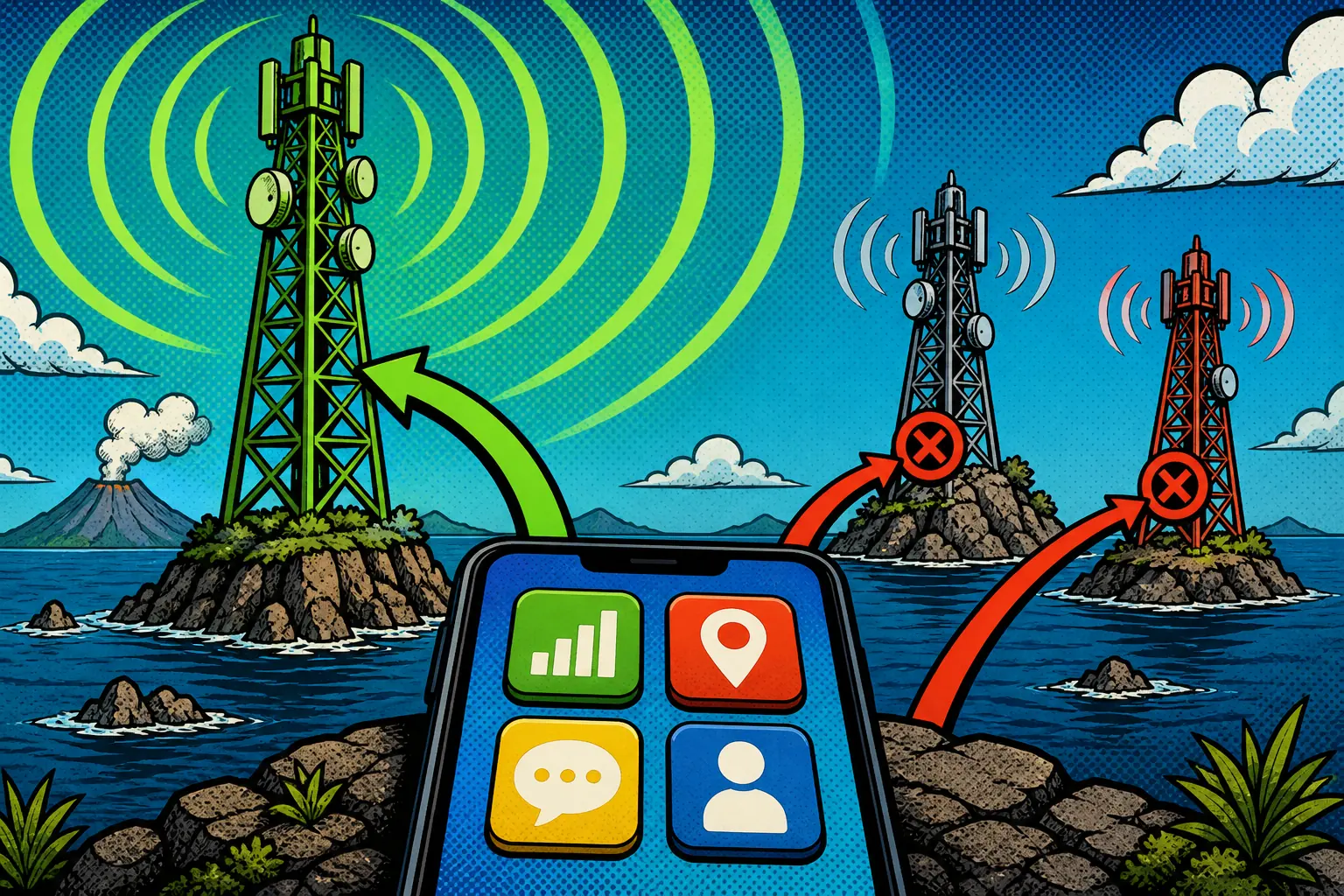
Travel eSIM companies do not own towers. They resell capacity on local networks, and which local network they use varies by brand, by plan and by month. As of August 2026, independent comparisons put Airalo's Indonesian plans on Tri and Indosat, while Nomad, Holafly and Travelsim connect through Telkomsel, or Telkomsel paired with XL. A plan running on Indosat or Tri is perfectly good for Sanur, Kuta and Ubud. Take it to Menjangan or hold it up on the south coast of Penida and you have paid for a phone that works at your hotel and nowhere that matters.
We are not going to name a winner, because these partnerships change without notice and any article that crowns one is wrong inside a year. We have been caught by exactly this ourselves, in an old packing note that named a provider as a route to Telkomsel before that provider quietly rerouted its Indonesian plans, so treat every brand recommendation, ours included, as perishable. The durable rule is the one we would give you at the counter: before you pay, find the sentence on the product page that names the Indonesian carrier, and buy the one that says Telkomsel. If a provider will not tell you which network its plan uses, that is an answer too.
The IMEI rule, where people actually get caught
Indonesia has required imported handsets to be known to its networks since 2020, and enforcement is real rather than theoretical. An unregistered phone can accept a local SIM, work happily for a few days, then quietly stop connecting. It is the single most common version of the "my phone died in Indonesia" story, and it has nothing to do with the phone.
For a normal dive holiday, the good news is that the short stay path is designed to be painless. Customs guidance separates visitors staying up to 90 days, whose network access can be arranged through the operators' own service channels, from longer stays that go through formal registration. That first path is exactly what the official counter is doing when it asks for your IMEI alongside your passport. It adds two to five minutes and you never see the machinery, which is the strongest argument there is for buying from an operator counter rather than a shop that just hands you a card.
Staying longer than 90 days and wanting to keep an Indonesian SIM means registering the handset with Bea Cukai, the customs authority, either at the airport on arrival or through their website. Import duties apply above a declared value of roughly 500 US dollars, and the allowance covers a limited number of devices per person. If you are only using your home SIM on international roaming, none of this touches you at all.
Registration tightened again during 2026, and the direction is consistent: cards are distributed inactive and switch on only after a verified identity check, with biometric verification for Indonesian citizens and a passport or residence permit for everyone else. Bring the passport you entered on, your entry stamp or e-VOA, and your IMEI, which you get by dialling *#06#. One passport can generally register up to three numbers. Keep the receipt, because if a number is ever blocked that paperwork is what unblocks it. If the visa side is still on your list, our e-visa guide for divers covers the arrival paperwork it sits next to.
Where the signal dies on a Bali dive day
Here is the part no eSIM comparison page can tell you, because it requires driving these roads and running these boats. Roughly, and with the honest caveat that any given phone on any given afternoon is entitled to its own opinion.
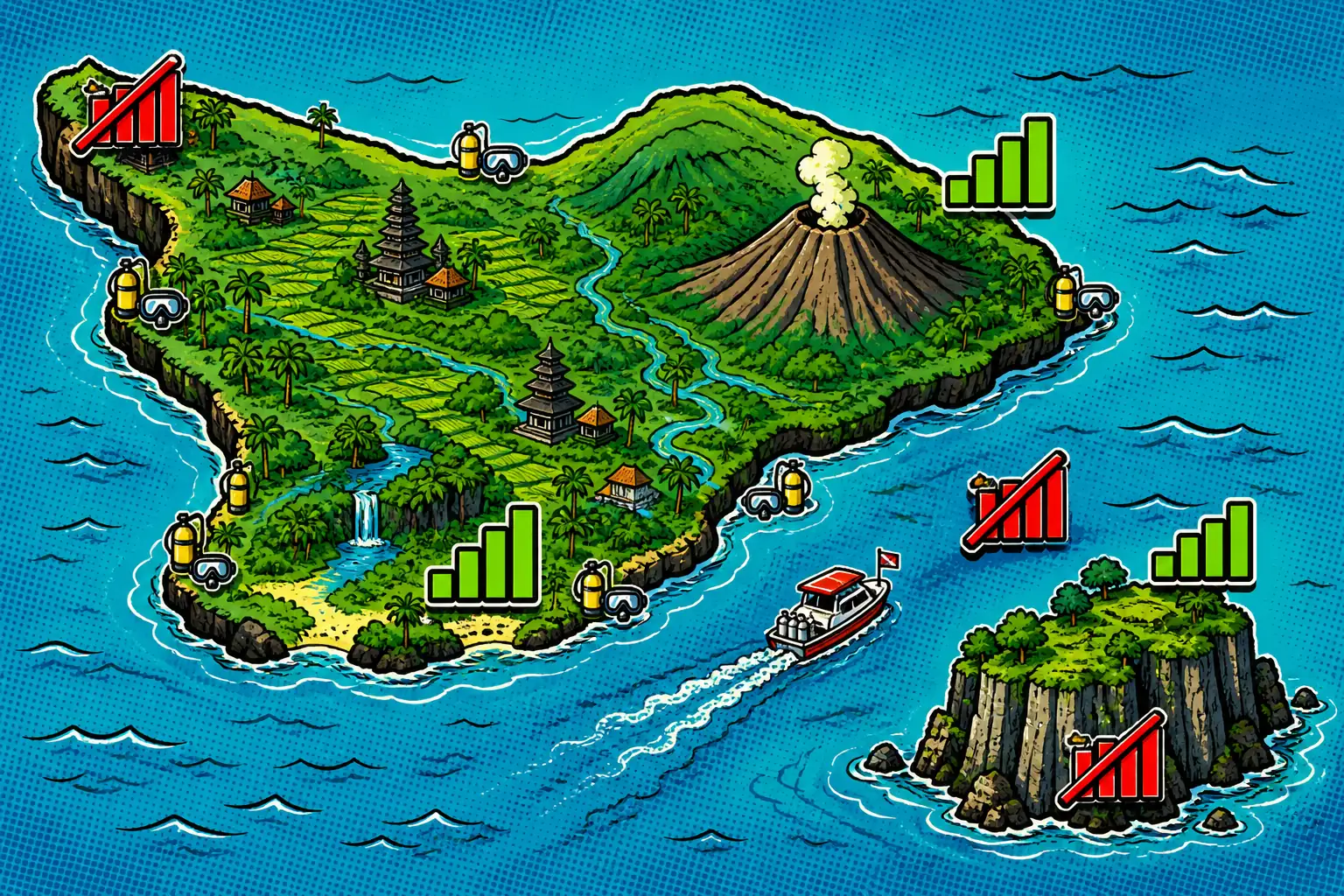
| Where you are | What to expect |
|---|---|
| Sanur, our beach and the drive out | Solid 4G, 5G in patches, no thought required |
| The channel to Nusa Penida | Bars fade mid crossing, both shores are in range but the middle is not always |
| Toyapakeh and the north Penida coast | Workable, Telkomsel most reliably |
| Crystal Bay | Usually something, not always enough to load anything |
| Manta Point and the Penida south coast | Thin to nothing, exposed cliffs and no reason for a tower |
| Padang Bai | Good, the ferry port keeps the town properly connected |
| Tulamben village | 4G works, WiFi reaches the dive shops more reliably than the homestays |
| Amed, the further bays | Patchy, and the more scenic the bay the worse it gets |
| Menjangan and West Bali National Park | The thinnest on the island, a protected area with little infrastructure |
| Underwater, anywhere | No |
A few of those deserve a sentence. The Nusa Penida crossing is 30 to 45 minutes in a fast boat from our beach, and it is the one that surprises people, because you can see both islands the whole way and still watch your data die. The Manta Point end of the island is the real dead zone: exposed south coast, big swell, cliffs, nobody living there. We see mantas on roughly nine out of ten trips across the year and you will not be posting any of it until you are back on the north shore. Crystal Bay is better, and if you are chasing mola mola between July and October you will have a bar or two between dives, along with a thermocline that drops to 20 degrees and occasionally 18.
The northern run matters more than people expect because of how long it is. Tulamben is about two and a quarter hours from Sanur, and the coast road past the lava fields and headlands below Mount Agung drops in and out. Tulamben village itself is fine, which is a relief given how many of our guests dive the Liberty four times in two days. Amed is a string of small bays and the signal thins the further round you go, a point our comparison of the three east coast dive towns makes about the WiFi too. Padang Bai is the easy one, connected because the ferries demand it.
Menjangan is the outlier, and worth planning around. It is in the far north west inside a national park, it is a long drive or an overnight, and it has the least infrastructure of anywhere we dive. Tell people at home you will be quiet that day rather than discovering it at the dive site.
Nyepi, the one day Bali switches mobile data off
This is the Bali specific fact that catches almost every visitor, and no amount of buying the right network protects you from it.
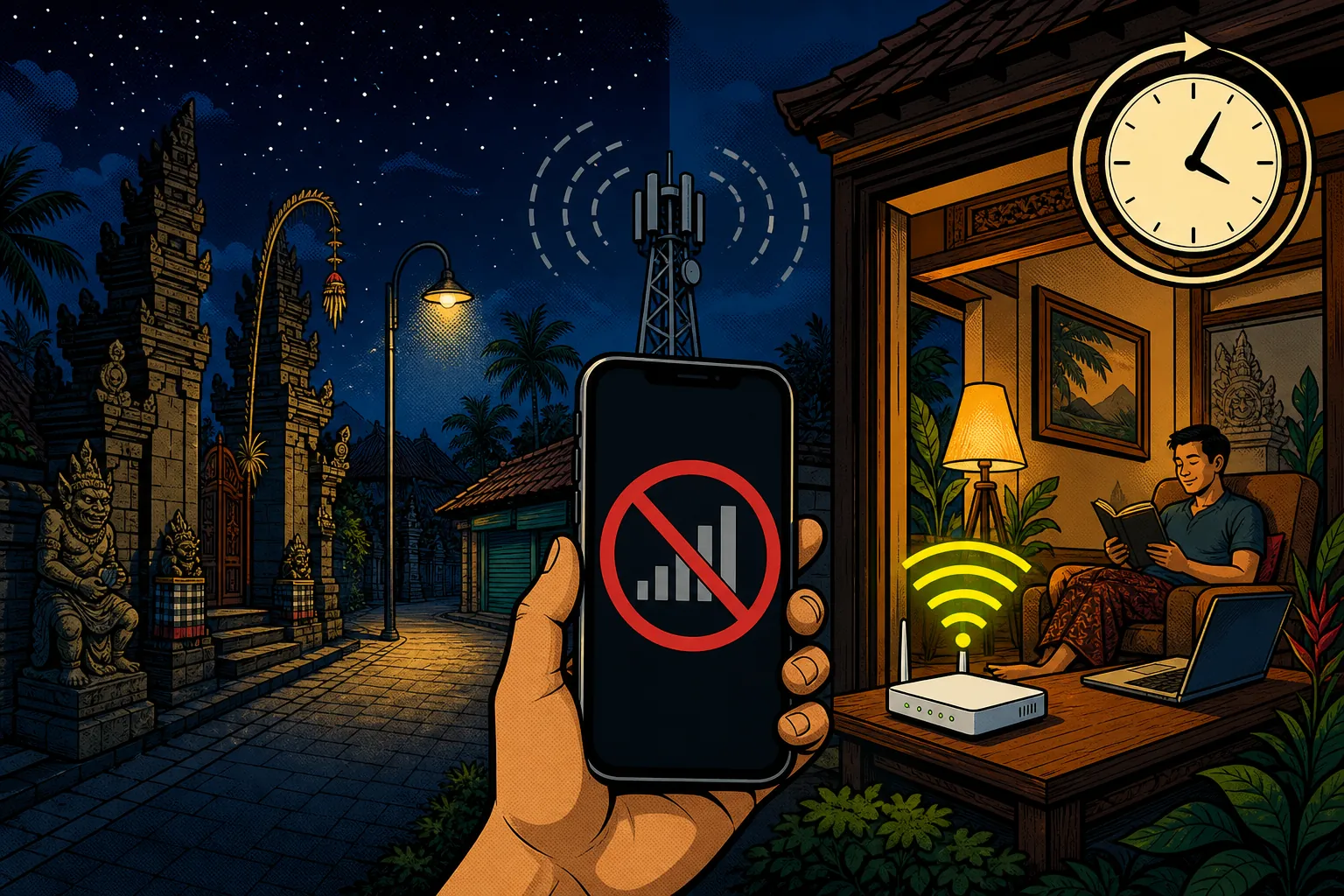
Nyepi is the Balinese Day of Silence, the Saka new year, and the island genuinely stops. No travel, no work, no entertainment, no lights. The airport closes. The ferries stop, including Padang Bai to Lembar and Ketapang to Gilimanuk. Nobody dives, ourselves included, and the beach is empty in a way you will not see any other day of the year.
Mobile data stops with everything else. In 2026 the shutdown ran under Ministerial Circular No. 2 of 2026, from 06:00 WITA on 19 March until 06:00 the following morning, and it is applied consistently year to year. The distinction that matters, in the words of the provincial communications office, is that it is not the signal being switched off but the mobile data packages: calls and SMS keep working. Local television and radio go quiet as well.
What survives is WiFi over fibre. Hotels, villas and homes keep their fixed connections precisely so that hospitals, police posts and emergency services stay online, so if you are sitting in a Sanur hotel on Nyepi you will have working WiFi, working calls and no mobile data at all. Plan for that, particularly if your only connection is an eSIM. Nyepi 2027 falls on 9 March, and our guide to Nyepi covers what the day is actually like, which is far more interesting than the logistics.
Why we care what number you give us
Here is the operator side of this, which no travel article covers because most people writing them are not the ones making the call.
When you book with us, the number you leave is the number our driver rings at 06:30 when he is outside your hotel and cannot find reception. Pickups run between 06:30 and 07:15 depending on where you are staying and which site you are diving, and Bali hotel lobbies at that hour are not always staffed by anyone who knows which of the four buildings you are in. If the number you gave us is a home mobile with roaming switched off, or an eSIM with no voice line, we cannot reach you, and the whole car waits.
So the practical request: give us a WhatsApp number that will actually be live and awake in Bali, and reply to the confirmation message the evening before. WhatsApp is how Indonesia communicates, it needs data rather than a local number, and it is how our office confirms your pickup, tells you a boat has been moved for swell, or lets you know the driver is five minutes out. A data only eSIM is completely fine for that, so long as the number attached to your booking is one you will see. If you are still choosing what to bring, our notes on a first dive trip in Bali and the practical questions on our FAQ page cover the rest of the pre trip admin.
One honest admission while we are on it. We cancel Nusa Penida trips somewhere between five and ten days a year when the swell on the south coast gets up, and we move those guests to Tulamben instead. That decision gets made early, sometimes at 05:30, and it reaches you as a message. A phone that is not receiving messages turns a solved problem into a confusing morning.
Emergencies, and the number that has to work
The unglamorous reason to sort your connectivity out properly. Diving emergencies are rare and we would rather bore you now than improvise later.
Bali has a functioning hyperbaric chamber, and knowing where it is and how a call to it happens is worth more than any data plan. We wrote the whole process up in our guide to the hyperbaric chamber in Bali, including the numbers. Read it once before you dive and never think about it again.
Three things to have arranged before your first dive. Your insurance policy details saved offline rather than sitting in an email inbox you cannot open, because we require every guest to hold DAN or an equivalent policy with explicit scuba diving and emergency evacuation cover. An emergency contact who knows you are diving and knows which days. And a phone that can make a call, not just carry data, which is a real argument for either a physical SIM with a voice line or keeping your home SIM live alongside a data eSIM.
Our office number is the one to save. On a dive day our guides carry phones in dry bags on the boat, and when there is coverage that is the chain that works. When there is not, the boat and the shop have their own arrangements and the surface marker buoy in your BCD pocket matters more than any of this. If you are diving with us for the first time you will hear all of it in the briefing.
Two factor authentication is the real trap
This one ruins afternoons, and almost nobody thinks about it before leaving home.
Your bank sends confirmation codes by SMS to your home number. Your airline may do the same. WhatsApp verifies a new device that way too. Take your home SIM out to make space for an Indonesian one and you have quietly disconnected yourself from all of them, usually discovering it at the moment you are trying to approve a payment for a course you just decided to add.
The fixes are easy and all of them happen before you fly. Use an eSIM for data and leave your home SIM in the phone with data roaming switched off, so texts arrive and the roaming bill does not. Move your bank to app based authentication if it offers it. Save your recovery codes somewhere offline. Tell your bank you are travelling, which still prevents more blocked cards than anything else. Carry enough cash for the first day, because card payments need data and data runs out before cash does, and our Bali diving price list will tell you what to budget in rupiah before you arrive.
Your phone on a dive boat
Practical, mildly boring, and the source of more ruined phones than anything else in Bali.
Salt water kills phones, and a fast boat to Penida throws spray over everyone in the first five minutes. Our boats have dry storage and our guides use dry bags, and we still see a phone a season die because someone wanted a photo of the crossing. If you bring it on the boat, bring it in something sealed. If you do not need it, leave it in the car on the Tulamben and Padang Bai days, which is the safest place it will be all week.
Heat is the other one. A black phone on a white boat deck in Bali will hit thermal shutdown quickly, and the ones that overheat are always the ones filming. Keep it shaded, keep the brightness down, and carry a power bank between 10,000 and 20,000 mAh, because a day of photos, maps and WhatsApp on a bumpy signal drains a battery faster than the same day at home. Weak signal is itself a battery killer, since the phone keeps hunting for a tower.
Charging is straightforward: 230 volts, 50 hertz, two round pin type C and F sockets. Bring a small multi plug, because divers travel with cameras, torches, computers, dive computers and phones, and the sockets in the room never add up. Our packing list has the rest of it.
What we would do
Buy a Telkomsel backed eSIM before flying, install it at home, and leave your home SIM in the phone with data roaming off. Land at Ngurah Rai, confirm the eSIM works before you leave the terminal, and if it does not, walk to an operator counter in arrivals with your passport and buy the physical card instead. Download offline maps of Bali and screenshots of every booking. Save our number and reply to the confirmation message the night before. Then let the signal go where it goes.
That is roughly ten dollars and one hour of admin, against a dive week that costs a great deal more. The guests who enjoy Bali most are usually the ones who arranged their connectivity properly and then did not need it, which is also true of the ones who did their Open Water course with a bit of time in hand rather than on the last three days of the holiday.
If you want to check anything specific before you book, whether that is coverage on a Menjangan overnight, whether a try dive morning leaves you time for a work call, or how the pickups work from where you are staying, get in touch. We would rather answer honestly in advance than have you find out on the boat. And if you are heading further east afterwards, on a Komodo liveaboard or aboard King Neptune, everything above still applies with sharper edges, and the honest answer out there is that you will be offline for most of the week.