
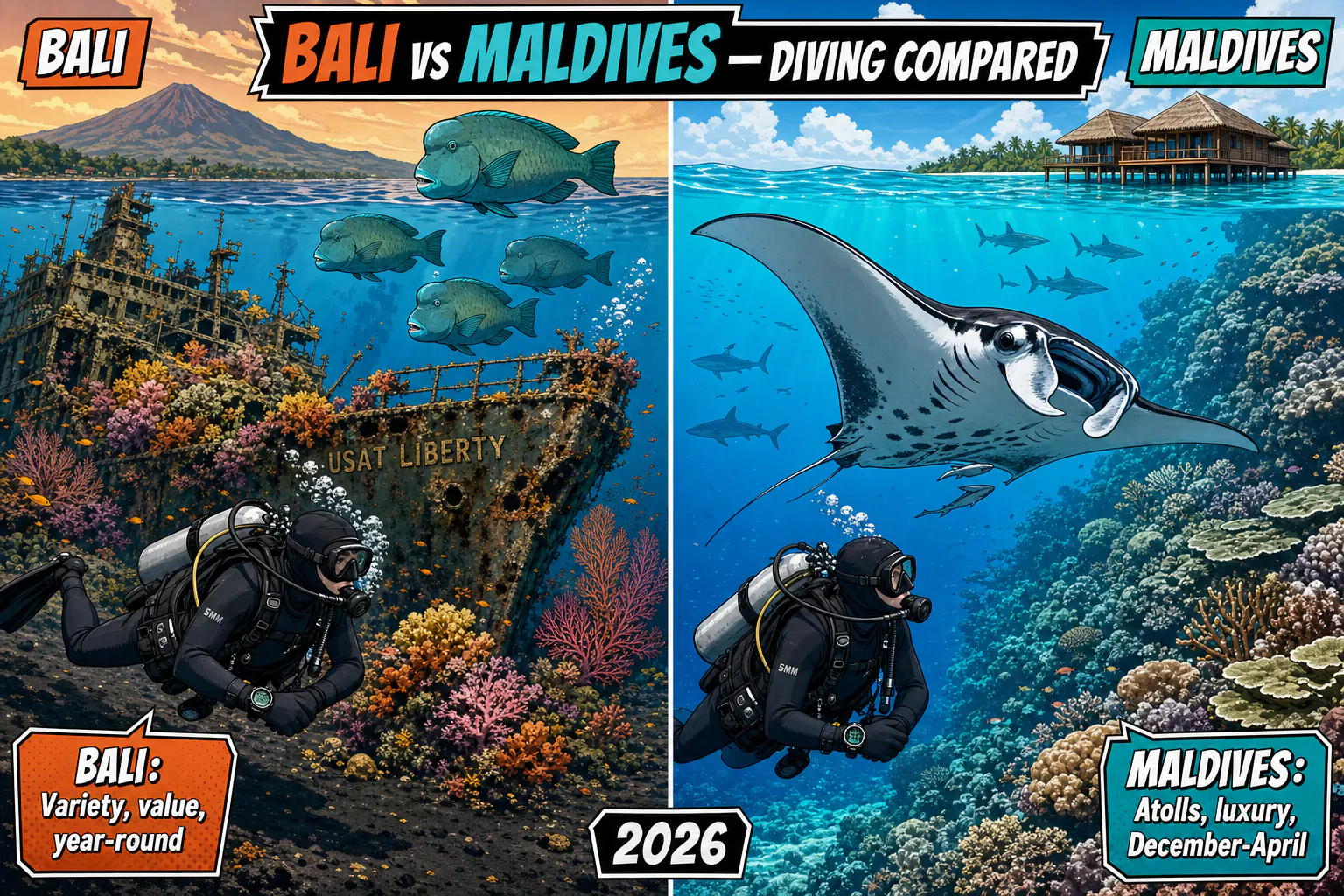
If you are reading this, you are probably comparing two of the most-Googled tropical dive destinations on the planet and trying to figure out which one deserves your two weeks and somewhere between three and ten thousand US dollars. Good news: both deliver world-class diving and you will not have a bad trip. Better news: the two are very different products, and the honest version of "which is right for you" can be answered in about five questions. We will go through them properly.
We are biased. We operate dive centers in Bali and Komodo, not in the Maldives, so anything we tell you about the Maldives comes from a lot of years of taking Maldives-experienced divers around Bali, hearing their honest comparisons, plus the trips our own staff take on their off-seasons. What follows is the comparison we wish someone would give straight: the cost reality, the marine-life reality, the certification reality, the "vibe" reality, and the genuine answer to who should go where.
At a glance: which side wins what
| Category | Winner | Why |
|---|---|---|
| Pure cost (trip total) | Bali | Roughly 40-60 percent cheaper for a comparable dive trip |
| Diving variety (site types) | Bali | Wrecks, walls, drift, macro, pelagics, all in one island |
| Dive site visual perfection | Maldives | Atoll reefs in 30+ m visibility set the visual gold standard |
| Big-animal hit rate per dive | Maldives (just) | Manta + whale shark + grey reef rates per dive day are slightly higher in season |
| Big-animal variety | Bali | Mantas + mola + bumpheads + reef sharks + wreck life all available, plus Komodo extension |
| Beginner-friendliness | Maldives | Calmer overall conditions for fresh certifications |
| Conditions reliability year-round | Bali | Divable 12 months a year; Maldives has clear wet/dry seasons |
| Non-diving experience | Bali (decisively) | Culture, food, surf, yoga, jungle, temples, volcanoes |
| Luxury / pure honeymoon vibe | Maldives | Overwater bungalows are unmatched |
| Family / multigenerational | Bali | Non-divers have entire holidays available; Maldives is dive-or-beach only |
| Group of dive buddies | Tied | Liveaboard works for either; land-based works for both |
That table is honest, and it summarises the 4,500 words below. Keep reading if you want the reasoning, the numbers and the operator-side details that change which side wins for your specific trip.
Geography and how you actually get there
Bali. An Indonesian island the size of Connecticut sitting 8 degrees south of the equator. International airport (Denpasar, DPS) with direct flights from every major Asian, Australian, and European hub plus seasonal direct flights from the US west coast. Once you land you are 20 to 45 minutes by taxi from any major dive base (Sanur, Seminyak, Tulamben is a 2.5 to 3 hour drive north). Internal travel by road, no inter-island connections needed for any major Bali dive site.
Maldives. A nation of 1,200 islands across 26 atolls strung along a 870-km line in the central Indian Ocean. One international airport (Malé / Velana International, MLE) on a single 1.5 km island, with direct flights from a smaller set of hubs (Dubai, Doha, Singapore, Colombo, Frankfurt). Once you land, you face a second leg: 15 minute speedboat to a near-Malé resort, 45 to 90 minute speedboat to a mid-range atoll resort, or 30 to 50 minute seaplane to a far-flung resort. The seaplane is the iconic Maldives moment and costs IDR 7,200,000–12,600,000 (≈ 400–700 USD) per person round trip.
Access verdict. Bali is easier and cheaper to reach for most divers outside of the Middle East. From Western Europe and the Americas, the actual flight time is similar (15-20 hours), but the Bali side avoids the second-leg seaplane transfer. From the Middle East or central Asia, the Maldives wins on access.
Cost: the comparison nobody else lays out honestly
This is the question every comparison shopper actually wants answered, and most comparison articles dodge with vague phrases. Here are real 2026 numbers for a comparable 8-day diving trip with 5 to 6 diving days, mid-range accommodation, all transfers, and standard dive packages. Per person, USD.
| Item | Bali (mid-range) | Maldives (mid-range resort) | Maldives (liveaboard) |
|---|---|---|---|
| Flights from London/NYC/SYD | IDR 16,200,000–25,000,000 (≈ 900–1,400 USD) | IDR 16,200,000–27,000,000 (≈ 900–1,500 USD) | IDR 16,200,000–27,000,000 (≈ 900–1,500 USD) |
| Airport transfers | IDR 450,000–900,000 (≈ 25–50 USD) total | IDR 3,600,000–10,800,000 (≈ 200–600 USD) (speedboat) or IDR 7,200,000–12,600,000 (≈ 400–700 USD) (seaplane) | IDR 1,800,000–5,400,000 (≈ 100–300 USD) |
| Accommodation 7 nights | IDR 5,400,000–18,000,000 (≈ 300–1,000 USD) (boutique villa) | IDR 32,500,000–81,000,000 (≈ 1,800–4,500 USD) (mid resort) | Included in package |
| Diving (5-6 days, 2-3 dives/day) | IDR 10,800,000–17,100,000 (≈ 600–950 USD) | IDR 16,200,000–27,000,000 (≈ 900–1,500 USD) (resort house reef + boat dives) | IDR 32,500,000–57,500,000 (≈ 1,800–3,200 USD) (entire trip) |
| Food and drinks (off-resort) | IDR 3,800,000–7,600,000 (≈ 210–420 USD) (Bali restaurants) | IDR 12,600,000–25,000,000 (≈ 700–1,400 USD) (Maldives resort half-board supplement) | Included |
| Non-diving activities | IDR 1,800,000–5,400,000 (≈ 100–300 USD) | IDR 0–3,600,000 (≈ 0–200 USD) (limited options) | IDR 0 (≈ 0 USD) (you are on a boat) |
| Per-person total estimate | IDR 38,500,000–74,000,000 (≈ 2,135–4,120 USD) | IDR 81,000,000–169,000,000 (≈ 4,500–9,400 USD) | IDR 50,500,000–90,000,000 (≈ 2,800–5,000 USD) |
The honest summary: a comparable mid-range Bali trip runs roughly 50 to 60 percent of a comparable Maldives resort trip. A Maldives liveaboard closes the gap somewhat because it cuts out the resort food premium and the seaplane transfer, but a liveaboard is a different product (you sleep on a boat for a week).
For Bali-specific cost detail across all categories, see our full scuba diving Bali price guide. The "diving in Bali is cheap" reputation is real but worth understanding in context, the cheapness comes from the accommodation, food and ground transport, not from cutting corners on the diving operation itself.
Dive site variety: what you actually see underwater
This is where the two destinations diverge most clearly. They are not the same product.
Bali: variety in a single island
Bali sits at the western edge of the Coral Triangle, the most biodiverse marine region on Earth. Within a 3-hour drive across one island you can dive:
The USAT Liberty Wreck at Tulamben: a 120-metre WWII transport ship lying in 5 to 30 metres, accessible from the beach, with a resident bumphead parrotfish school that arrives at dawn. See our definitive Liberty guide.
Manta Point at Nusa Penida: manta cleaning station with 90+ percent sighting rate year-round. See our Manta Point Nusa Penida guide.
Mola Mola at Crystal Bay seasonally (July-October): the world's largest bony fish, 2 to 3 metres long, visits Bali's southern channels.
Macro and muck diving at Tulamben/Seraya/Padang Bai: critter-rich black volcanic sand sites with ghost pipefish, harlequin shrimp, frogfish, ornate octopus, and the entire small-creature reference list of the Coral Triangle.
Wall diving at Tulamben Drop Off and Menjangan Island: vertical walls from 5 to 70+ metres draped in gorgonians.
Drift diving with current at Penida and Komodo (extension): full-on big-current channels with reef sharks, pelagic schools, and the dive style that defines Indonesia.
Five completely different dive experiences in one island. Add a Komodo extension (1-hour flight from Bali) and you add a sixth: drift-pelagic action on the Komodo scale. See our Komodo diving guide for what that adds.
Maldives: atoll perfection, but a narrower palette
The Maldives dive offering is almost entirely atoll reef diving in three formats:
Channel dives (thila and kandu): the iconic Maldives dive. Tide flows water through the natural channels between atolls, creating drift-diving with cleaning stations (mantas), pelagic action (grey reef sharks, eagle rays, tuna), and big-fish schooling. This is what Maldives diving is famous for.
Reef wall diving: the outer atoll walls drop from 10 to 50+ metres with healthy coral. Visibility is consistently 25 to 40 metres. Some of the cleanest reef-wall diving on the planet.
Pinnacle dives (giri): isolated pinnacles inside the atoll lagoons that act as cleaning stations and aggregation points.
Wreck diving: a small handful of sites (Maldive Victory, British Loyalty), all relatively shallow and small. Not a Maldives strength.
Macro and muck: essentially absent in commercial dive operations. Maldives is reef country.
Whale sharks: reliably seen in South Ari Atoll year-round, with peak in October and the new-moon phases. This is a Maldives signature experience.
The Maldives delivers the visual platonic ideal of "tropical reef diving" with consistency that few places match. But it delivers the same product across most sites, atoll reef in 30 metre visibility with manta and shark sightings. If you want variety, this is not the destination.
Variety verdict
Bali wins decisively on variety; Maldives wins on visual perfection per dive. A serious diver doing 5+ days will see more different kinds of dives in Bali. A diver doing a 4-day mini-trip looking for "the prettiest water possible" will get it in Maldives.
Marine life: what each destination is famous for
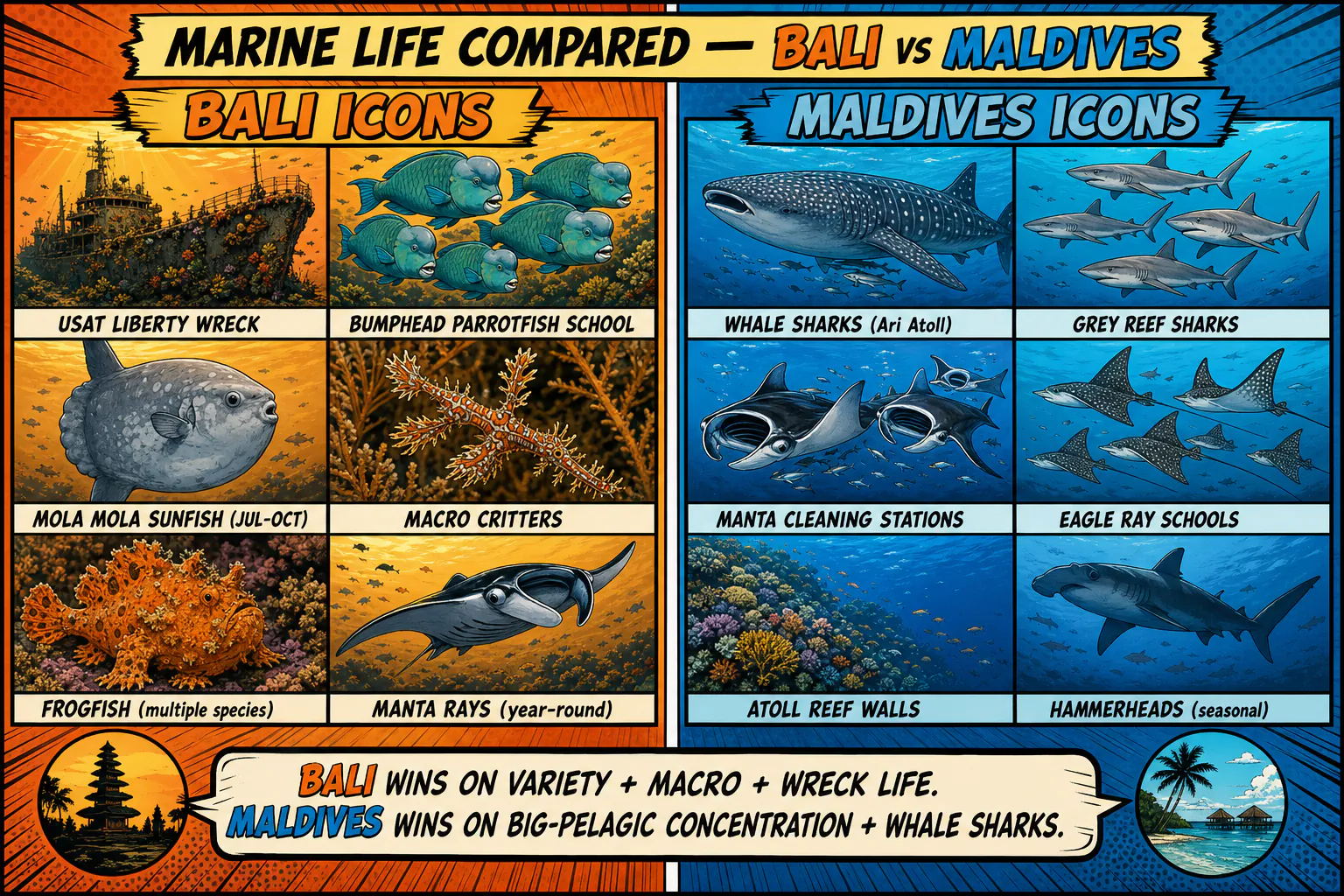
Honest realistic sighting odds on a comparable 5-day trip:
| Species | Bali | Maldives |
|---|---|---|
| Reef mantas | ~95% (Nusa Penida Manta Point year-round) | ~90% in season Dec-Apr, 60% off-season |
| Whale sharks | Rare (~5% off Nusa Penida) | ~70% on dedicated South Ari trips |
| Mola mola (ocean sunfish) | ~60% in Jul-Oct season at Crystal Bay | Essentially zero |
| Grey reef sharks | ~50% (mostly Komodo extension) | ~90% on any channel dive |
| White-tip / black-tip reef sharks | ~70% at Tulamben/Komodo | ~95% on reef dives |
| Hammerheads | ~5% (Komodo, cooler months) | ~5-15% (Rasdhoo Madivaru in season) |
| Eagle rays | ~60% during drift dives | ~85% on channel dives |
| Bumphead parrotfish (school) | ~95% at Liberty wreck dawn dive | ~30%, usually solo individuals |
| Hawksbill / green turtles | Essentially every dive | Essentially every dive |
| Ornate ghost pipefish / harlequin shrimp / macro | ~70% on macro dives (Tulamben, Seraya) | ~10%, not a Maldives focus |
| Frogfish (multiple species) | ~80% on macro days | ~5% |
| Spanish dancers (night) | ~70% at Liberty night dive | ~50% on offered night dives |
| Ornate octopus / blue-ring | ~40% (Tulamben muck) | ~5% |
Pattern: Bali wins decisively on macro, wreck-fish concentrations, and seasonal mola. Maldives wins on big-pelagic-per-dive (grey reef sharks, whale sharks) and on consistency of manta sightings during the peak season.
Diving conditions: what it's actually like in the water
Bali conditions
Visibility: 15 to 30 metres at most sites in dry season (May-October), dropping to 10 to 20 metres during wet season at exposed sites. See our Bali rainy season diving guide for monthly conditions.
Water temperature: 27 to 29 degrees surface; thermoclines at 20 metres can drop to 23 to 25 degrees, occasionally lower at Penida.
Currents: highly variable. Tulamben is benign; Penida can hit 2 to 3 knots; Komodo can hit 6 knots. Operators choose sites and tides to match diver level.
Surge: low at most sites, occasional at exposed walls during wet season.
Wetsuit: 3 mm minimum; 5 mm comfortable, especially for Penida and Komodo.
Maldives conditions
Visibility: 25 to 40+ metres on channel and outer-atoll sites year-round, with stunning consistency.
Water temperature: 28 to 30 degrees surface, mostly homogeneous; some thermocline cooling at 30+ metres.
Currents: moderate to strong on channel dives (tidal flows are the entire dive); benign on inside-atoll sites. Tidal predictability is the operator's main planning input.
Surge: generally low.
Wetsuit: 3 mm comfortable, many divers use shorty or skin only.
Conditions verdict
Maldives is more uniformly pleasant: warmer, clearer, less variable. Bali offers more challenge and more reward, with currents that take experience to dive safely (in exchange for the most rewarding pelagic encounters in Indonesia).
Certification and skill requirements
Bali. Open Water with 10-15 dives can do most central sites comfortably. Advanced is recommended for Nusa Penida currents and Liberty wreck deep section. We recommend dive insurance and our AOW course in Bali as the upgrade most divers benefit from. Nitrox is offered everywhere; Enriched Air specialty available.
Maldives. Open Water is sufficient for many sites; AOW is required for the deeper channel dives. Drift Diver specialty is highly useful given the channel-dive style. Nitrox is standard on most liveaboards and many resorts. Most Maldives operators are PADI-affiliated and accept any major agency certification.
Beginner verdict
Maldives is slightly more beginner-forgiving overall due to the calmer baseline conditions. Bali's central sites (Tulamben house reef, Sanur shore dives, Menjangan) are also beginner-perfect, but Penida sites should be earned through experience. For complete beginners considering the journey, see our first-time diving Bali guide for what to expect.
Best time of year: dive season comparison
Bali dives year-round.
Peak season (May-October): visibility at its best, calm seas, mola mola season, easier conditions. Higher prices and busier sites.
Shoulder season (November, April): good diving, lower prices.
Green season (December-March): visibility drops slightly, occasional storms, but manta sightings remain reliable. Significantly lower prices and fewer divers.
Maldives has two clear seasons.
Dry/northeast monsoon (December-April): peak season. Calm seas, 30+ metre visibility, predictable channel dives. Manta and whale shark season in many atolls. Highest prices.
Wet/southwest monsoon (May-November): rougher surface conditions, slightly reduced visibility (still 20-30 metres), but lower prices and fewer divers. Some western atolls become difficult to access by speedboat. Manta aggregations relocate seasonally between atolls.
Verdict: Bali is dive-able 12 months a year with no major closures. Maldives has a strong seasonal pattern; off-season trips work but you compromise on conditions.
The non-diving experience: when you're not in the water
This is the comparison that surprises many divers who haven't been to either destination. Bali wins decisively on non-diving experience, and for most travelers this is the deciding factor.
Bali non-diving
Bali is an island with 4 million people, ancient Hindu culture overlaid on a volcanic landscape. Non-diving activities easily fill a 2-week trip without repetition:
Culture and temples: Tirta Empul, Besakih (Mother Temple), Tanah Lot, the rice terraces of Tegallalang, the artist village of Ubud.
Food: world-class restaurants (Locavore, Mosaic, Mauri), local warungs serving IDR 55,000 (≈ 3 USD) meals, every cuisine internationally represented.
Surfing: Uluwatu (advanced), Canggu (intermediate), Kuta (beginner). World-class surf school infrastructure.
Yoga and wellness: Ubud is one of the world's yoga capitals. Spas everywhere.
Nature: volcano hikes (Mount Batur sunrise, Mount Agung), jungle trekking, waterfalls (Sekumpul, Tegenungan), rice terraces.
Nightlife: Seminyak/Canggu beach clubs, jazz bars, restaurants open until late.
See our 35+ best things to do in Bali for the full menu.
Maldives non-diving
The Maldives is a series of small resort islands, most under 1 km long. Non-diving options are intentionally limited to maintain the "private paradise" feel:
Beach time: the white sand and turquoise water are spectacular and the resort beaches are essentially private.
Snorkeling: often excellent right off the house reef, no boat needed.
Spa: world-class resort spas at world-class prices.
Water sports: kayaking, paddleboarding, jet ski, sailing.
Dolphin / sunset cruises: resort-operated, included or sold add-on.
Local island visits: a half-day excursion to a populated Maldivian island for cultural experience (limited but real).
Notably absent: cultural depth, food variety beyond resort buffets, alcohol (only at resort islands, not local islands), and any sense of being in a "country" rather than a "resort". The Maldives is intentionally a luxury bubble.
Non-diving verdict
If you are traveling with non-divers, family with kids, or you want a trip that's "diving plus everything else", Bali is the only logical choice. If you want a trip that's "luxury diving plus pure beach relaxation", Maldives delivers that more cleanly than anywhere else on earth.
Accommodation: the experience styles compared
Bali: entire range from IDR 270,000 (≈ 15 USD)/night hostel dorms in Canggu to IDR 36,000,000 (≈ 2,000 USD)/night private cliff villas in Uluwatu. Boutique villas in the IDR 1,450,000–3,600,000 (≈ 80–200 USD)/night range are exceptional value, with private pools, full kitchens, and walk-to-restaurants neighborhoods. Dive resorts in Tulamben from IDR 550,000–5,400,000 (≈ 30–300 USD)/night. Diversity of experience is essentially unlimited.
Maldives: the resort model dominates. Each resort occupies one island; you stay on that island for the trip. Range from IDR 3,600,000 (≈ 200 USD)/night guesthouses on local islands (Maafushi, Thulusdhoo) to IDR 90,000,000 (≈ 5,000 USD)+/night overwater bungalows at top resorts (Soneva, Cheval Blanc, Velaa). The overwater bungalow is the iconic Maldives experience and is unmatched anywhere; expect IDR 10,800,000–36,000,000 (≈ 600–2,000 USD)/night for a quality version. Liveaboards from IDR 3,600,000–12,600,000 (≈ 200–700 USD)/night per person.
The combined trip: yes, you can do both
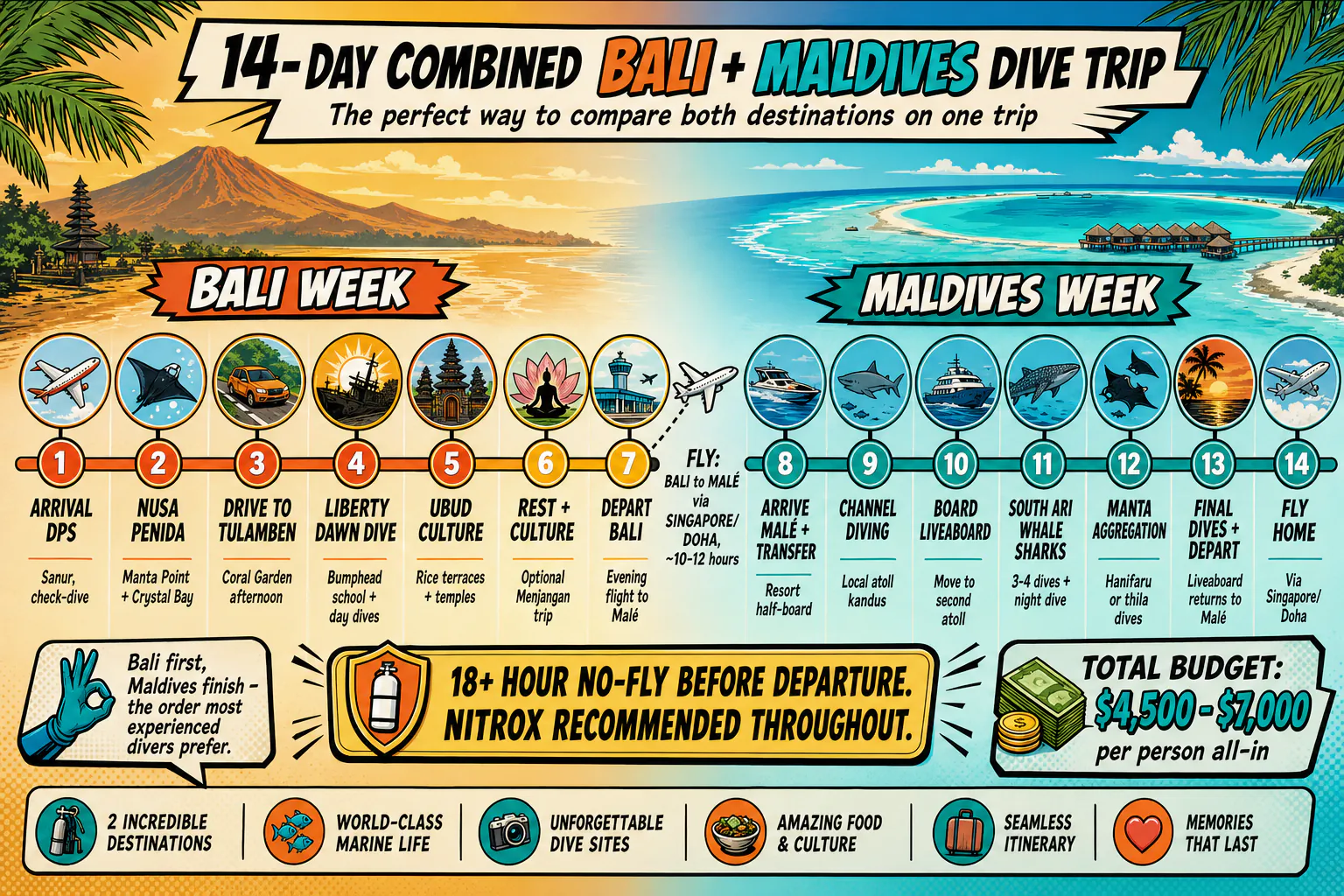
If your budget supports it and you have 14+ days, a combined Bali + Maldives trip is genuinely excellent. Indonesia and the Maldives are both serviced by Singapore Airlines, Emirates and Qatar via Singapore or Doha, so the routing works. A typical plan:
Days 1-7: Bali (variety, culture, cost-effective half of the trip)
Days 8-13: Maldives liveaboard or resort (visual gold standard, big-pelagic dives, luxury)
Day 14: return home via Singapore or Doha
This combination plays each destination's strengths and avoids each's weakness. Bali gives you the wreck, the macro, the culture, the food, and the cost-effective accommodation. Maldives gives you the manta channels, whale sharks, atoll perfection, and the luxury closer. Most divers who do both prefer them in this order (Bali first, then Maldives) because Bali's intensity primes you for the slower-paced Maldives second half.
Sample 7-day Bali trip (if Bali wins your decision)
The "Bali wins so what do I actually book" question deserves a concrete answer. Here is the trip plan we recommend most often for a 7-day diver who picks Bali over Maldives. This is what we actually deliver to customers, not a generic web itinerary.
Day 1. Arrival into Denpasar. Transfer to your Sanur boutique villa (40 minutes). Recovery dive late afternoon at Sanur house reef to dial in buoyancy after the flight. Dinner at a local warung.
Day 2. Nusa Penida day trip from Sanur. Two dives at Manta Point (mantas at the cleaning station) and Crystal Bay or SD Point. Return to Sanur by 4pm. Massage, dinner, sleep.
Day 3. Drive north to Tulamben (3 hours), arrive late morning. Check into a Tulamben dive resort. Two afternoon dives: Coral Garden (warmup) and the day-time Liberty wreck. Early dinner and early sleep, you have an alarm tomorrow.
Day 4. Dawn dive at the Liberty wreck (the bumphead parrotfish school is the single most memorable underwater experience in Bali, see our Liberty wreck guide). Breakfast, surface interval. Mid-morning macro dive at Seraya Secrets. Afternoon Liberty re-dive or Drop Off wall. Optional night dive at the Liberty if you want the third Liberty variant.
Day 5. Morning macro dive in Tulamben. Drive back south to Ubud (3 hours). Spend the afternoon at the rice terraces, a temple visit, and dinner at one of Ubud's standout restaurants. Ubud is the cultural counterweight to the dive-trip intensity.
Day 6. Either a non-diving day in Ubud (yoga, temples, jungle waterfall, cooking class), or drive to Menjangan in the northwest for a wall-dive day with eagle ray sightings. The non-diving option is usually the smarter call after Tulamben.
Day 7. Return to Sanur or Seminyak for a final beach-club lunch. Mandatory 18+ hour surface interval before flying. Evening flight home.
This trip covers four of Bali's five distinct dive types (wreck, macro, drift/manta, wall), gives you the iconic Liberty dawn dive, and includes a culture and rest day. Total all-in budget runs IDR 43,000,000–68,500,000 (≈ 2,400–3,800 USD) per person depending on accommodation choice. For a Komodo extension that pushes the trip to 11 days and adds Indonesia's premier big-current diving, see our Komodo vs Bali comparison.
Sample 7-day Maldives trip (if Maldives wins your decision)
For symmetry, the Maldives equivalent plan we would recommend if a customer told us they were picking Maldives:
Days 1-3. Resort half-board on a near-Malé atoll (15-45 minute speedboat). 2-3 dives per day on the local atoll: house reef, channel dive at the closest kandu, and a thila pinnacle. Acclimation and dialing in to Maldives drift-diving style.
Days 4-7. Transfer to a liveaboard for 3-4 nights covering a different atoll. 3-4 dives per day including night dives. South Ari Atoll for whale sharks, or Baa Atoll if your dates overlap with Hanifaru Bay manta aggregation season (June-October).
This split (resort base + liveaboard finish) is what most experienced Maldives divers eventually settle on: avoids the same-atoll repetition of a pure resort trip while giving you the comfort of a land base on either end of a liveaboard week. Total all-in budget IDR 99,000,000–162,000,000 (≈ 5,500–9,000 USD) per person.
Decision flowchart: which is right for you
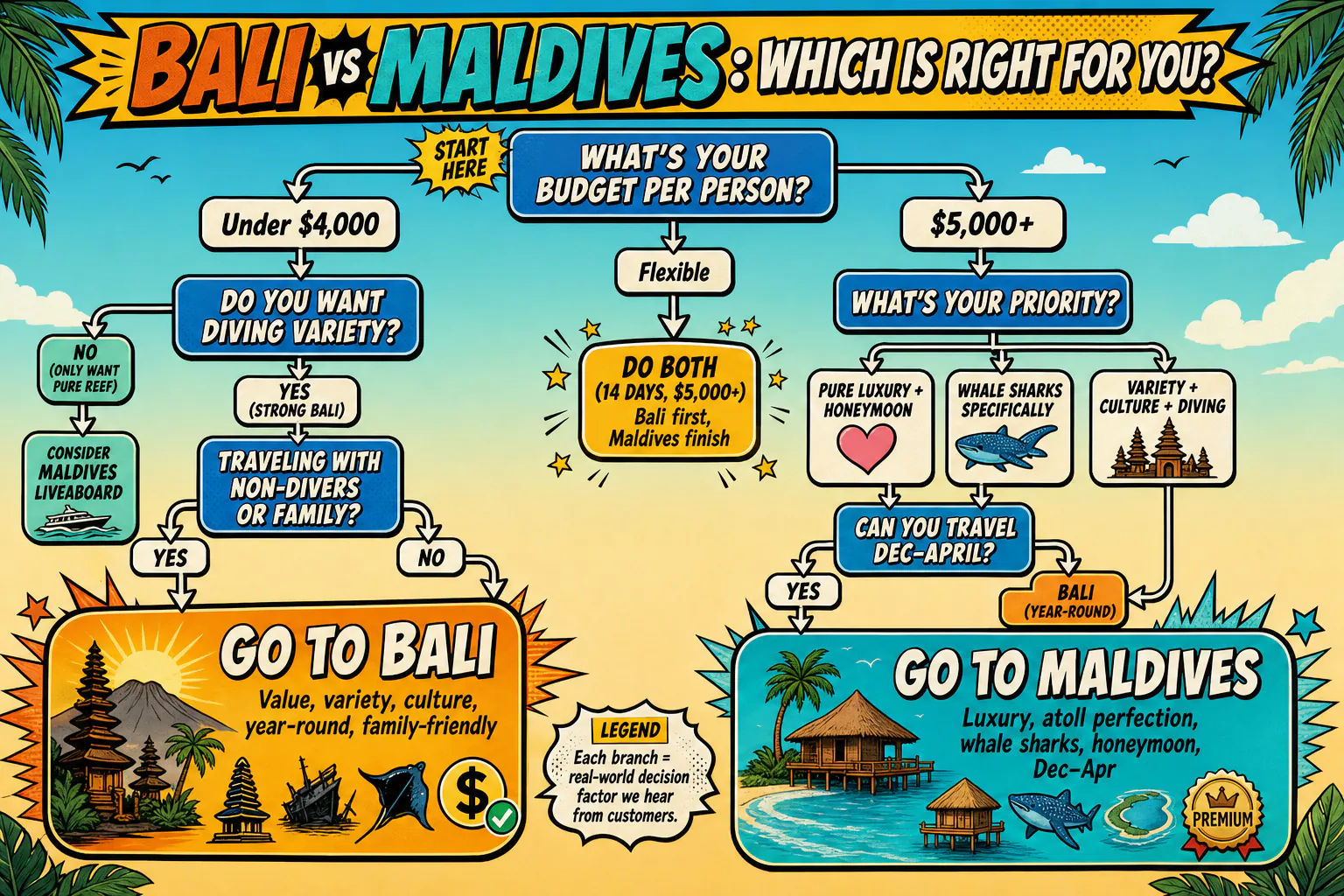
Pick the description that fits you closest.
Go to Bali if:
- Your budget is under IDR 72,000,000 (≈ 4,000 USD) per person all-in
- You want variety (wrecks, macro, pelagics, walls all on one trip)
- You are traveling with non-divers, kids or family
- You want a cultural/culinary trip with diving on top
- You want flexibility on dates (year-round diving)
- You want to combine the trip with Komodo or other Indonesian destinations
- You are still building dive experience and want a destination that scales with you over many trips
Go to the Maldives if:
- Your budget is IDR 90,000,000 (≈ 5,000 USD)+ per person all-in and money is not the constraint
- You want the visual ideal of "tropical reef diving" in 30+ metre water
- You specifically want whale sharks or want maximum manta/grey reef shark concentration
- You want a pure honeymoon/luxury escape with diving
- You can travel December-April
- You do not need cultural depth or food variety outside the resort
- A liveaboard appeals (sleep on boat, dive 3-4 times a day)
Go to both if:
- You have 14+ days and a IDR 90,000,000 (≈ 5,000 USD)+ budget
- You have not been to either and want to compare them properly
- You will probably never combine them again, so optimise this trip's contrast
Common myths busted
"Maldives is too expensive to consider". Not strictly true. Maldives liveaboards in the IDR 3,600,000–5,400,000 (≈ 200–300 USD)/night range are within reach of mid-budget divers; the resort model is what makes Maldives expensive, not the diving itself. A 7-night liveaboard at IDR 32,500,000 (≈ 1,800 USD) all-in is a real product.
"Bali diving is dangerous because of currents". Specific sites (Penida, Komodo) are current-driven, but the majority of Bali diving (Tulamben, Menjangan, Sanur, Padang Bai) is benign. Operator quality and site choice make the difference. Bali is one of the world's safest dive destinations with competent operators.
"Maldives has better visibility than Bali always". True in season at most Maldives sites. False in Bali's June-September period when Tulamben routinely sees 25-30 metres and Menjangan can push 35.
"You can't see mantas reliably in Bali". Wrong. Manta Point Nusa Penida has 90+ percent year-round sighting rates. The Maldives advantage is on certain mass-aggregation events (Hanifaru Bay in season), not on baseline manta encounters.
"Maldives is the only place to see whale sharks". Wrong. Whale sharks are reliably found in Indonesia (Cendrawasih Bay, Triton Bay, Saleh Bay), the Philippines (Oslob, controversially), Mexico (Isla Holbox), and elsewhere. Maldives is one of the most reliable single-trip options but not the only one.
"Bali is just for backpackers, Maldives is for honeymoons". Both stereotypes are 15 years out of date. Bali has world-class luxury (Uluwatu cliff villas, Soori, Aman Villas) and Maldives has accessible budget options (local-island guesthouses). The destinations have converged.
Operator-side observations after running both kinds of divers
Divers who arrive in Bali after a Maldives trip almost always say the same things: "I forgot how much variety diving could have", "the macro alone is worth the trip", "the wreck was incredible and I didn't realise what I was missing", and "I can't believe what dinner costs here". They tend to extend their Bali trips by 2-3 days.
Divers who go from Bali to the Maldives say: "the visibility is on another level", "the channels are absolutely worth the trip", "the resort spoils you in a way Bali can't", and "we wish we could have eaten somewhere outside the resort even once". They almost always say "I'm glad we did both".
Divers who go to Maldives and skip Bali but have done other Asian diving (Philippines, Thailand) often say: "Maldives is the prettiest single dive destination but the most narrow". This is consistent.
Divers who go to Bali and skip Maldives over years of repeated trips often say: "I keep wanting to add Maldives but Bali keeps revealing new corners". This is also consistent.
Costs, in plain summary
For the same diving days, with comparable accommodation quality, a Bali trip runs 50 to 60 percent of a Maldives resort trip. A Maldives liveaboard trip can be cost-comparable to a mid-range Bali trip per day but you're sleeping on a boat and have no land-based experience. There is no "Bali equivalent to a Maldives overwater bungalow"; that experience does not exist in Bali, and that is fine because Bali doesn't try to be the same product.
The hidden costs nobody mentions
The headline cost numbers above are accurate but every comparison article skips the second-order costs that change the actual trip-total. Worth understanding before you book.
Maldives hidden costs. Alcohol is heavily marked up at resorts (a beer can be IDR 180,000–270,000 (≈ 10–15 USD); a wine bottle IDR 1,450,000–3,600,000 (≈ 80–200 USD)). Non-resort transfer for off-island excursions is IDR 900,000–2,700,000 (≈ 50–150 USD) each way. Tips are expected at every service interaction. Spa is IDR 3,600,000–9,000,000 (≈ 200–500 USD) per treatment. Marine park fees on certain atolls are IDR 90,000–180,000 (≈ 5–10 USD) per dive. Bring a credit card with no foreign-transaction fees; resort billing always includes service plus government tax (16-22 percent combined) added at checkout, which surprises divers who only looked at base rates.
Bali hidden costs. Dive insurance (recommended; DAN annual at IDR 700,000–1,600,000 (≈ 40–90 USD) per year) is not included in dive packages. Equipment rental (IDR 360,000–550,000 (≈ 20–30 USD) per day) adds up across a week if you do not bring your own. National park entry fees for Nusa Penida and Menjangan (IDR 90,000–270,000 (≈ 5–15 USD) per visit) are usually included by quality operators but worth confirming. Tipping divemasters is expected and appreciated (IDR 90,000–360,000 (≈ 5–20 USD) per dive day). Visa-on-arrival is IDR 650,000 (≈ 35 USD) USD for most nationalities (or use the e-Visa system). Bali airport departure tax (IDR 20,000 (≈ 1 USD)5) is sometimes not included in flight bookings.
Net result: the headline cost difference holds, but Maldives' hidden costs add 15-25 percent on top of the visible price, while Bali's hidden costs add 5-10 percent. The actual gap can be slightly larger than the table above suggests.
What about scuba diving certification differences?
Both Bali and Maldives offer the full menu of recreational dive courses (Open Water, Advanced, Rescue, Divemaster) through PADI, SSI and SDI agencies. Course quality is comparable in both destinations when you pick reputable operators. Two practical differences:
Course pricing: Bali is significantly cheaper. Open Water Diver costs IDR 6,300,000–9,000,000 (≈ 350–500 USD) in Bali versus IDR 12,600,000–21,500,000 (≈ 700–1,200 USD) in the Maldives. Advanced Open Water costs IDR 5,400,000–8,100,000 (≈ 300–450 USD) in Bali versus IDR 9,000,000–16,200,000 (≈ 500–900 USD) in the Maldives. If you are budgeting for both a certification and a dive trip, do the certification in Bali. See our certification types guide for choosing between levels.
Course conditions: Maldives' calmer water can make the actual learning easier for some students; Bali's variety means you finish certified with broader skills. Most divers who completed Open Water in either destination feel well-prepared for global diving.
Verdict
Bali wins on value, variety, cultural depth and year-round reliability. Maldives wins on visual perfection, peak luxury and channel-style pelagic spectacle. If forced to recommend one for the median diver, we recommend Bali, because the variety means you will discover more about diving across a single trip, and the cost difference frees budget for non-diving experiences that change how the trip feels. If forced to recommend Maldives, the case is: high budget, peak honeymoon, December-April dates, and the channel-shark-and-manta spectacle as the primary trip motivator.
The best advice we give is the unsatisfying one: do both, eventually. They are different products and a serious diver eventually wants both stories told.
How to plan your Bali trip with us
If you have read this far and Bali wins your decision, the next step depends on certification:
Not certified yet: see our 3-day Open Water course in Bali or our Try Diving Bali guide for the no-certification first-experience option.
Open Water certified: consider upgrading to Advanced before or on arrival; our Advanced Open Water Bali course unlocks the deeper Liberty sections and Penida sites.
Advanced and ready to dive: browse our Sanur dive center for daily trips, plan a Tulamben overnight for the Liberty dawn dive, and add a Nusa Penida day trip for the mantas. The main booking page or our Bali contact form handles everything.
Want to extend to Komodo: see our Komodo from Bali tour or the full Komodo diving guide for what adding 4 days in Komodo adds to the trip.