
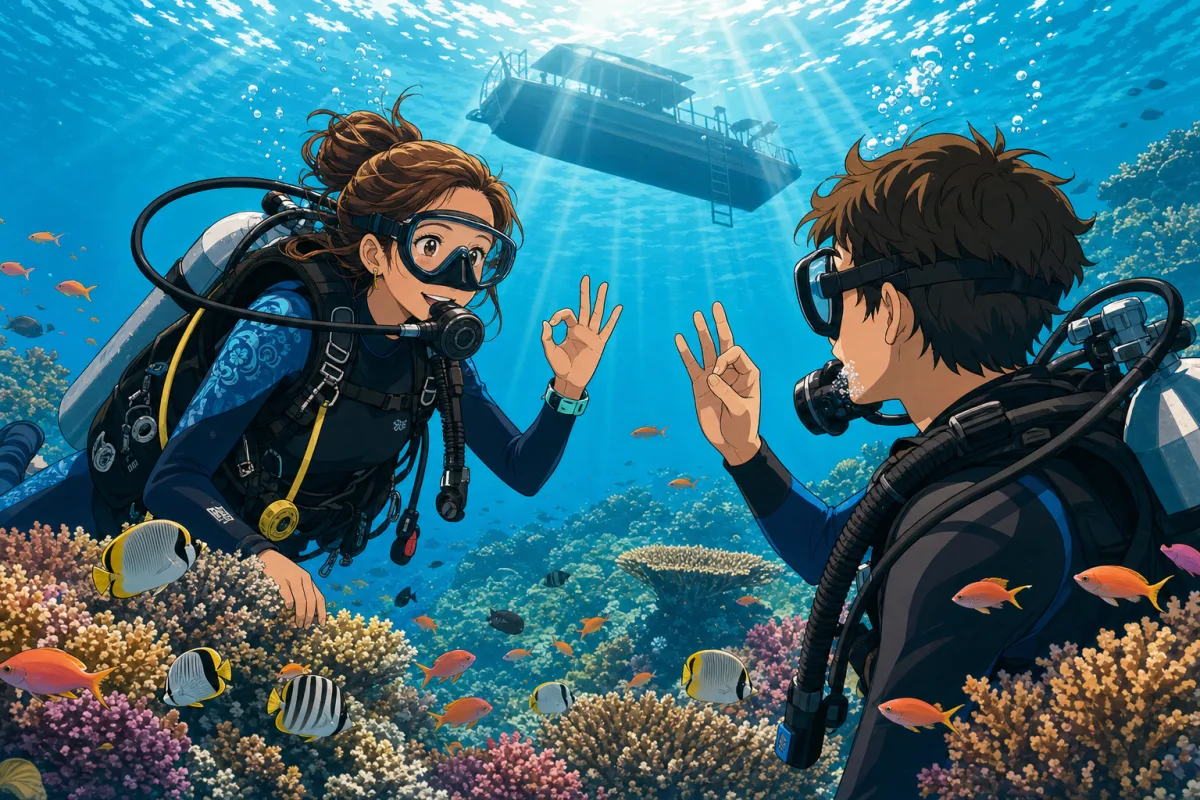
Is scuba diving dangerous? Here is the honest, numbers-first answer: recreational scuba diving has a fatality rate of roughly 2 per 100,000 participants per year, which puts it in the same statistical neighbourhood as jogging and far below horse riding, and the overwhelming majority of what goes wrong is both predictable and preventable. Diving is not risk-free, nothing involving the ocean is, but it is a managed-risk activity in the same sense as driving a car: the rules are well understood, the equipment is mature, and the accident reports read less like lightning strikes and more like checklists of skipped steps.
We have been running dive trips and PADI courses from Sanur for over fifteen years, and the question behind the question, when a nervous first-timer asks it at the shop counter, is usually more specific: will something eat me, will my ears explode, will I run out of air, am I too old, too unfit, too claustrophobic? Those deserve real answers rather than a brochure smile, so this guide goes through the actual statistics, the things that genuinely go wrong and why, the marine-life fears versus the marine-life reality, the specific conditions in Bali worth respecting, and the short list of habits that make your personal risk dramatically smaller than the averages. No marketing gloss: where diving deserves respect, we will say so plainly.
The statistics: how dangerous is scuba diving really?
The best data comes from Divers Alert Network (DAN), which has tracked diving injuries and fatalities for four decades. The consistent picture across their annual reports:
| Measure | Figure | Context |
|---|---|---|
| Fatalities | ≈ 2 per 100,000 divers per year | Jogging ≈ 13 per 100,000 runners; horse riding is several times riskier than diving |
| Fatalities per dive | ≈ 1 per 500,000 to 1,000,000 dives | Comparable to a long car journey |
| Decompression sickness | ≈ 1-3 cases per 10,000 dives | Most cases mild and fully treatable with recompression |
| Injuries requiring any medical attention | Low single digits per 10,000 dives | Dominated by ear barotrauma, cuts and scrapes |
Two honest caveats. First, per-participant statistics flatter occasional divers and understate risk for people doing hundreds of dives a year; per-dive figures are the fairer lens, and they still come out reassuring. Second, averages hide distribution: the fatality statistics are heavily weighted towards a specific profile, older male divers with pre-existing cardiac conditions, diving beyond their fitness or training, often alone or in demanding conditions. A healthy, honest-with-the-medical-form diver following basic rules with a professional operator occupies a much safer corner of the statistics than the headline number suggests.

What actually goes wrong (it is not what beginners fear)
Ask a first-timer what scares them and you hear sharks, running out of air, and getting "crushed" by depth. Ask DAN's fatality database what actually kills divers and you get a completely different list. In rough order of real-world importance:
1. Cardiac events
The single largest identifiable factor in diving fatalities, implicated in roughly a quarter to a third of cases, is a heart problem that would have been dangerous on a tennis court too. Diving adds exertion, cool water, and pressure on the chest from immersion; for someone with undiagnosed or downplayed cardiovascular disease, that combination can be the trigger. This is why the medical questionnaire exists and why "I didn't want to bother the doctor" is the most dangerous sentence in diving. If you are over 45 or have any cardiac history, a dive medical is cheap insurance, and we will genuinely respect you more for getting one.
2. Drowning secondary to panic or task overload
"Drowning" appears on certificates as a cause of death, but it is almost always the end of a chain that started with something manageable: a flooded mask, a lost regulator, buoyancy trouble at the surface, separation from the group. An untrained or out-of-practice diver meets a small problem, panics, and makes it a big one, most fatally by bolting for the surface while holding their breath. Every skill in the Open Water course exists to break exactly this chain, which is why certified training matters more than any piece of equipment, and why coming back after years away warrants a refresher rather than bravado.
3. Decompression sickness and barotrauma
The pressure-related injuries. DCS, nitrogen bubbles forming after ascent, is the famous one, covered in depth in our guides to depth limits and flying after diving; it is rare (1-3 per 10,000 dives), usually mild, and usually the product of ignored computers, rapid ascents, dehydration or flying too soon. Barotrauma, pressure injury to air spaces, is far more common and far less serious: mostly ear squeezes from lazy equalising, which hurt, occasionally perforate an eardrum, and are almost entirely avoidable by equalising early and often and never diving with a head cold. The catastrophic version, lung overexpansion from breath-holding on ascent, is the one genuinely unforgiving mistake in diving, and it is drilled from your first pool session: never hold your breath.
4. Running out of air
Genuinely rare as a primary cause and essentially always a monitoring failure: gauges exist, computers beep, guides check. On our boats the guides ask for your pressure at intervals precisely so that nobody discovers 20 bar as a surprise. Modern regulators are astonishingly reliable; out-of-air emergencies in recreational diving are almost never equipment failures and almost always attention failures, which is comforting, because attention is free.
5. Marine life, at the bottom where it belongs
Wildlife injuries barely register in the fatality data, and the ones that occur are overwhelmingly self-inflicted: touching, cornering, standing on things. Sharks, the number-one fear at the counter, are statistically a rounding error, and in Bali specifically the species you will meet are shy reef dwellers, as our sharks in Bali guide explains. The actual marine hazards worth briefing, scorpionfish and stonefish you should not kneel on, titan triggerfish nests in season you should not hover over, fire coral and hydroids you should not brush, all share one prevention: good buoyancy and hands to yourself. The Peak Performance Buoyancy specialty is, quietly, a safety course.
Is scuba diving dangerous for beginners?
Statistically, supervised beginners are among the safest people in the water. A try dive puts you at a maximum of 12 metres with an instructor within arm's reach whose entire job is watching you, in a site chosen for calm conditions; DAN's data shows introductory experiences have very low incident rates precisely because of that supervision. The course pathway is equally deliberate: pool before ocean, shallow before deep, every skill rehearsed before it is ever needed, as we describe in our first-time diving guide and try diving guide. The riskier profile is not the nervous beginner, who follows instructions beautifully; it is the overconfident returner who last dived eight years ago and declines the checkout dive. Nerves, channelled properly, are a safety feature.
Claustrophobia and anxiety deserve a specific word, because they are the most common private worry. Open water is not a cave; most people who feel confined in elevators feel nothing but space at 10 metres over a Bali reef. The mask and regulator take an hour of pool time to stop noticing. And a calm instructor who briefs everything before it happens removes the fear of surprise, which is most of the fear. If anxiety is your obstacle, tell us; pacing a nervous guest is a skill our instructors practise weekly, and the conversion rate from trembling-at-the-briefing to booking-a-course is one of the joys of the job.
Bali-specific risks: an operator's honest list
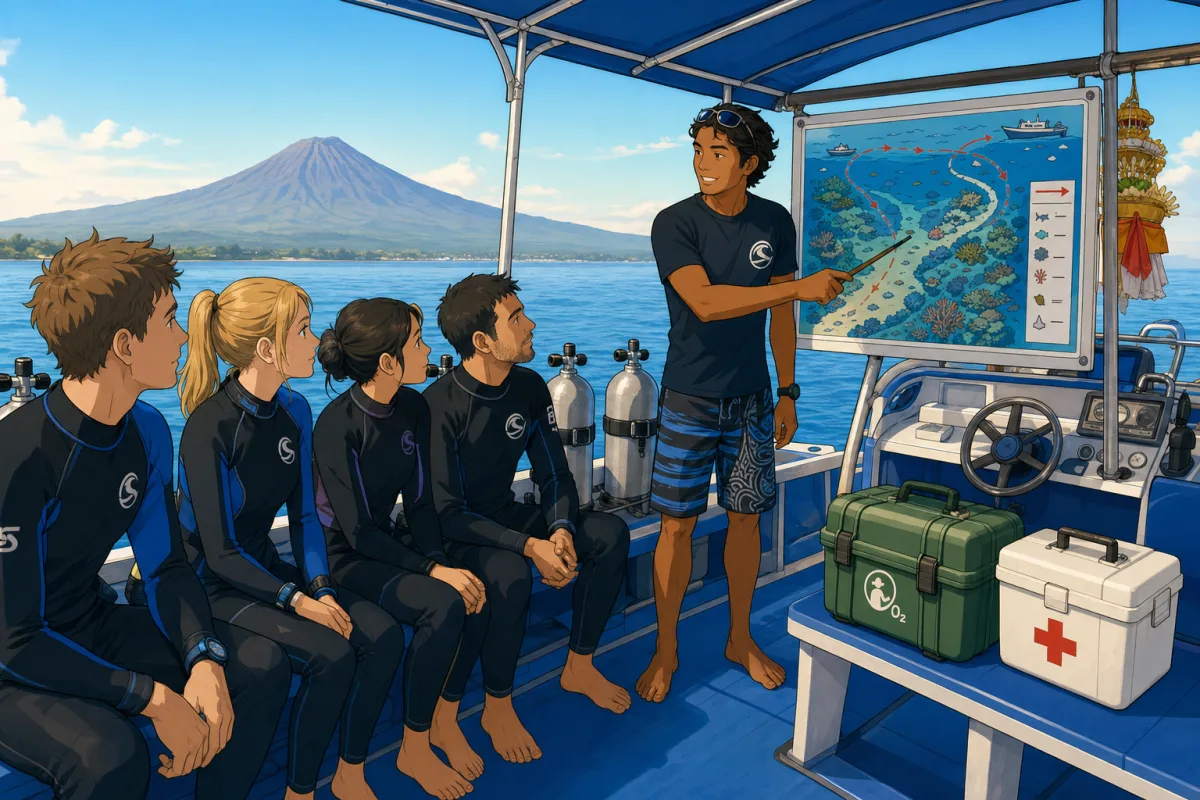
Bali is one of the safer places on earth to learn and dive, warm water, no meaningful surge at the training sites, short boat rides, but it has real conditions that deserve respect, and pretending otherwise would make this article useless. Here is what we actually manage day to day:
Currents, especially around Nusa Penida
The Lombok Strait moves enormous volumes of water, and Nusa Penida's famous sites are drift dives by design. Most of the time that means a pleasant conveyor-belt ride along the reef. At specific sites and tide states, most notoriously Blue Corner and the channel corners, currents can accelerate, switch, or push down, which is why those sites carry experience minimums and why local knowledge is non-negotiable. Our guides dive these sites hundreds of times a year, plan around tide tables, and cancel or move dives when the water says no. The rule for guests is simple: stay with the guide, and if a site is refused for conditions, that refusal is the service you are paying for.
Cold thermoclines in mola season
July to October brings upwellings that can drop temperatures from 28°C to 18°C in metres, detailed in our mola mola season guide. Cold is a comfort issue and, at the margins, a DCS risk multiplier; we brief it, provide appropriate wetsuits, and shorten profiles accordingly.
Boat traffic and surface protocol
The waters off Sanur and the Penida channel carry fast boats. Surface marker buoys, staying with the group on ascent, and listening for engines before surfacing are standard practice on our trips; the SMB in your guide's pocket is a piece of safety equipment exactly as important as the oxygen kit on the boat.
The infrastructure question
Worth knowing and reassuring: Bali has hyperbaric chambers (Sanglah General Hospital in Denpasar), evacuation is measured in hours not days, our boats carry oxygen and first-aid kits, and our staff hold current Emergency First Response training. We also strongly recommend dive insurance (DAN membership costs less than one nice dinner in Seminyak) and covering the basics the night before: sleep, hydration, and going easy on the Bintang, per our diving and alcohol guide.
Ten habits that make diving as safe as it can be
The gap between diving's headline statistics and the near-zero risk of a well-run dive is mostly behavioural. The list, from fifteen years of boat briefings:
1. Be honest on the medical form. It is screening, not bureaucracy; the questions map directly onto the fatality data. 2. Dive trained, and dive current. Certification for the dive you are doing, and a refresher after long gaps. 3. Never hold your breath. The first rule, and the only unforgiving one. 4. Equalise early and often. And never dive congested. 5. Watch your gauge. Know your turn pressure; surface with 50 bar. 6. Ascend slowly and do the safety stop. Your computer's ascent alarm is not decoration. 7. Stay with your buddy and your guide. Most emergencies are survivable with company and grim alone; the buddy check before the dive (BWRAF, or our hand signals guide for the underwater vocabulary) is thirty seconds that has saved actual lives. 8. Keep your hands off the reef. Protects you and it equally. 9. Respect the no-fly and no-altitude windows. Twenty-four hours, including the Batur trek. 10. Cancel when it is wrong. Sick, hungover, exhausted, or unhappy with conditions: the ocean will be there next week. Any operator who pressures you to dive anyway has told you everything you need to know about them.
Why diving keeps getting safer: fifty years of boring progress
A piece of context that rarely makes it into the scary-headline conversation: recreational diving today is dramatically safer than the sport your parents' generation tried. In the early 1970s, before standardised training and modern equipment, US diving fatality estimates ran several times higher per participant than today's figures. Three unglamorous revolutions did the work.
Training standardisation. The agency system, PADI, SSI, NAUI and peers, took diving instruction from "an experienced friend shows you" to a fixed curriculum where every diver on earth learns the same responses to the same problems in the same order, pool before ocean, with performance requirements rather than vibes. Whatever one thinks of certification-card marketing, the safety effect was enormous, and it is why we insist course shortcuts are false economy; the syllabus is the safety system. Our overview of certification types shows how the ladder builds competence step by step.
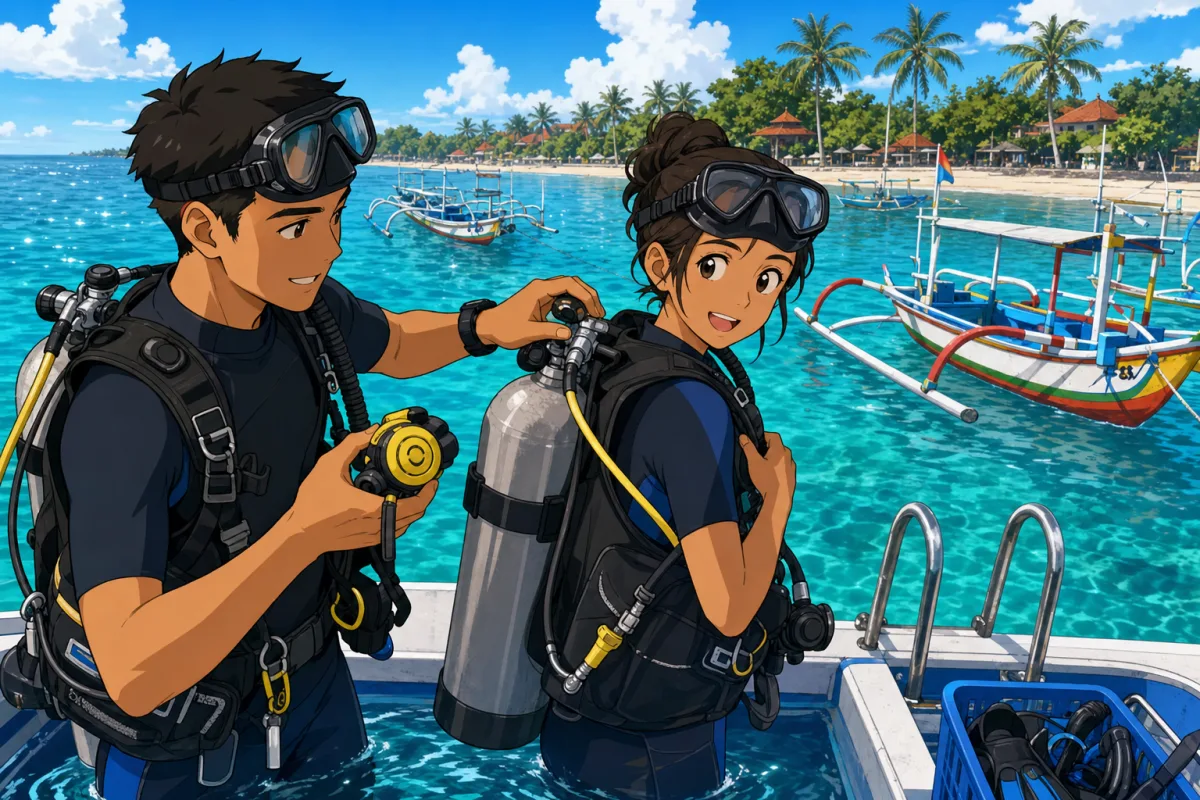
Equipment maturity. The kit you rent from a reputable Bali shop today, balanced regulators with an alternate air source, buoyancy compensators with reliable inflators, submersible pressure gauges, is the product of decades of failure analysis. The octopus regulator alone, standard only since the 1980s, converted the era's most feared emergency into a briefing item. Servicing discipline is the operator's half of the bargain, which is why "when was this regulator last serviced?" is a fair question to ask any shop, ours included; the answer should be specific and recent.
The dive computer. Before computers, divers tracked nitrogen with tables, memory and optimism. The wrist computer, now universal, watches depth, time, ascent rate and tissue loading continuously, beeps before problems become injuries, and removed an entire category of honest arithmetic mistakes from the accident statistics. It is the single best piece of safety equipment in the sport, which is why every guest on our boats dives with one, no exceptions.
The residue, the risk that fifty years of engineering could not remove, is the human factor: health honesty, currency of skills, and rule-following. That is the actual answer to "is diving dangerous": the sport industrialised away most of its dangers and left the remainder in the diver's hands.
What an emergency actually looks like, start to finish
Fear thrives on vagueness, so here is the concrete version. Take the classic beginner nightmare, "something goes wrong at 15 metres", and walk it through as it actually unfolds on a guided Bali dive.
A guest's mask floods badly at Crystal Bay. Untrained, this is the panic trigger; trained, it is a skill from confined-water session one: exhale through the nose, look up, clear. Suppose instead the regulator free-flows, rarer and noisier. The training response is to breathe from the free-flowing reg (it gives too much air, not too little) while signalling the guide, who is, by ratio and by briefing, seconds away. The guide supplies their alternate, the pair make a normal ascent with a safety stop, and the story becomes boat-ride conversation. Total elapsed drama: under two minutes, and at no point was improvisation required, because every branch of the tree has a rehearsed response and a second person attached.
Now the serious version: a diver surfaces from a deep Penida dive and thirty minutes later reports tingling fingers and unusual fatigue, textbook mild DCS symptoms. On our boats that triggers a fixed sequence, not a debate: the diver goes on 100 percent oxygen from the kit that every boat carries, drinks water, and stays horizontal; the shop calls ahead; and evacuation to the recompression chamber at Sanglah in Denpasar is a two-hour drive we have rehearsed, during which oxygen alone frequently resolves mild symptoms. Recompression treats properly reported DCS with excellent outcomes; the poor outcomes in the case literature belong overwhelmingly to divers who spent a day insisting they were fine. Hence the last habit we brief: report weird symptoms immediately, however minor, and let professionals make the boring phone calls. Embarrassment is not a medical condition; untreated DCS is.
That is what "dangerous" reduces to in a well-run operation: short chains of trained responses, redundant people and equipment, and a known road to definitive care. The ocean supplies the surprises; the system's job is to make sure none of them are novel.
Myths versus reality, quickly
"Sharks are a real danger to divers." Worldwide, unprovoked shark incidents involving divers are a handful per year against tens of millions of dives; in Bali, the resident species are timid reef sharks that mostly flee. You are in more danger from your own untied fin strap.
"If my equipment fails I will die." Modern regulators fail towards giving you air, not withholding it; you carry a complete backup air source (your octopus, and your buddy's); and every failure mode has a trained response. Equipment failure features in accident statistics mostly as a footnote to poor maintenance, which is why we service ours on schedule and why rental gear from a reputable shop is safer than a bargain regulator from an online marketplace serviced never.
"Depth will crush me." Bodies are mostly water and do not compress; air spaces equalise. Covered fully in our depth guide.
"I'm too old for it." There is no upper age limit; there is only health. We certify guests in their sixties and seventies every season. The honest requirement is cardiovascular fitness appropriate to a brisk walk with a backpack, and the honesty to verify it.
"Diving with kids is reckless." Junior programmes carry shallower limits and tighter supervision, and family diving in Bali's calm sites has an excellent record, as our family diving guide details. The programme design does the risk management; the parents mostly need to manage the excitement.
"More gear means more safety." Skills beat gadgets. A diver with excellent buoyancy, a working computer and an SMB is safer than a Christmas tree of accessories with a lapsed certification. Spend on training, our Rescue Diver course is the single biggest safety upgrade in recreational diving and routinely the course graduates call their favourite, before spending on titanium anything.
How we manage risk on a Neptune trip, concretely
Because "dive with a reputable operator" is empty advice unless someone tells you what reputable looks like, here is the checklist we run and the one you should hold any shop in the world to: guides with current professional and first-aid credentials, guest-to-guide ratios of four to one or better on standard sites and tighter where conditions demand it, a site-specific briefing before every dive covering entry, profile, current plan, hazards and lost-buddy procedure, working oxygen and first aid on every boat, radio or phone contact ashore, tide-table planning for the channel sites, checkout dives for guests with long gaps, honest condition calls including cancellations, equipment on a documented service schedule, and insurance details requested at booking rather than after an incident. None of this is heroic; it is just the boring machinery of safety, applied every day. When you are comparing operators anywhere, in Bali or beyond, ask about ratios, oxygen and briefings, and listen for whether the answer is specific. Specificity is what competence sounds like.
The bottom line
So, is scuba diving dangerous? It carries real, well-mapped risks that reward respect: a fatality rate around 2 per 100,000 participants a year, concentrated heavily among divers with health issues they ignored, training they skipped, or rules they knew and broke. Remove those factors, be honest about your health, train properly, follow the five or six rules that matter, dive with professionals in conditions chosen for you, and recreational diving sits comfortably among the safer adventurous things a human can do with a holiday, safer than the scooter you rented to get to our shop, by a margin that is not close.
The fears that stop most people, sharks, depth, equipment, claustrophobia, are the wrong fears, and the right ones, heart health and complacency, are entirely in your control. If you want to feel the difference between reading about it and doing it, a try dive with an instructor beside you is the gentlest possible test, and the Open Water course is three days that replace fear with competence permanently. Come ask us the nervous questions at the counter in Sanur; we have heard them all, and we like answering them.
Frequently Asked Questions
Recreational diving has a fatality rate of roughly 2 per 100,000 participants per year, similar to jogging (about 13 per 100,000 by some measures) and well below horse riding or motorcycling. Per dive, the risk is roughly 1 in 500,000 to 1,000,000. Injuries needing medical attention run in the low single digits per 10,000 dives, dominated by minor ear barotrauma. The risk is real but managed, comparable to everyday activities people do without a second thought.
Cardiac events are the largest identifiable factor, implicated in roughly a quarter to a third of fatalities, typically in older divers with pre-existing cardiovascular conditions. The next major pattern is drowning at the end of a panic chain that began with a small, manageable problem. Equipment failure and marine life barely feature. This is why the medical questionnaire and proper training matter far more than any gear purchase.
Supervised beginners are statistically among the safest divers in the water. Try dives are capped at 12 metres with an instructor within arm's reach in sites chosen for calm conditions, and courses progress from pool to shallow ocean with every skill rehearsed in advance. The riskier profile is actually the long-lapsed certified diver who skips the refresher, not the careful first-timer.
No. Unprovoked shark incidents involving divers are a handful per year worldwide against tens of millions of dives, and Bali's resident species, whitetip and blacktip reef sharks and the occasional wobbegong, are shy animals that usually flee from divers. The marine life worth actual caution in Bali is the small stuff you should not touch or kneel on: scorpionfish, stonefish, titan triggerfish during nesting, and fire coral. Good buoyancy and keeping your hands off the reef prevent essentially all of it.
First, it is very rare and almost always a monitoring failure rather than equipment failure, and guides check your pressure through the dive. If it happens, you have layered options trained from day one: your buddy's alternate air source (octopus), a controlled emergency swimming ascent from shallow depths, and in a guided group, a professional within reach. Modern regulators are designed to fail towards delivering air rather than cutting it off.
Very often, yes. Open water feels spacious rather than confined, and most anxiety attaches to the unfamiliar mask and regulator, which an hour of calm pool time usually resolves. Tell your instructor beforehand; pacing nervous guests is a core professional skill, briefings remove the fear of surprise, and a private or semi-private try dive is a gentle way to test the water. Many of our most enthusiastic certified divers arrived terrified.
Children can start pool experiences at 8 and junior certifications at 10, with depth and supervision restrictions that relax with age. There is no upper age limit: health, not birthdays, is the criterion. Divers in their sixties, seventies and beyond dive safely every day. The honest requirements are cardiovascular fitness roughly equivalent to brisk walking with a backpack, and truthful answers on the medical questionnaire, with a dive medical for anyone with cardiac history.
Nusa Penida's sites are drift dives in a strait that moves serious water, which is exactly why they are dived with experienced local guides who plan around tides, carry surface marker buoys, and match sites to guest experience. Most dives are relaxed drifts; the handful of advanced corners like Blue Corner carry experience minimums and get cancelled or relocated when conditions are wrong. With a professional operator following those practices, Penida's safety record across thousands of dives per season is excellent.
We strongly recommend it. DAN membership and similar dive-specific policies are inexpensive and cover recompression treatment and evacuation, which general travel policies often exclude or dispute, especially if you dived outside your certification or flew too soon after diving. Bali has hyperbaric chambers at Sanglah General Hospital in Denpasar, so treatment is accessible, but insurance turns a serious bill into a phone call.
Train properly and stay current: certification appropriate to the dive, a refresher after long breaks, and ideally the Rescue Diver course, which transforms how you anticipate and handle problems. After that, the basics carry the load: honest medical disclosure, never holding your breath, watching your gauge, slow ascents with a safety stop, staying with your buddy and guide, and respecting the 24-hour no-fly window. Every one of those is free.