

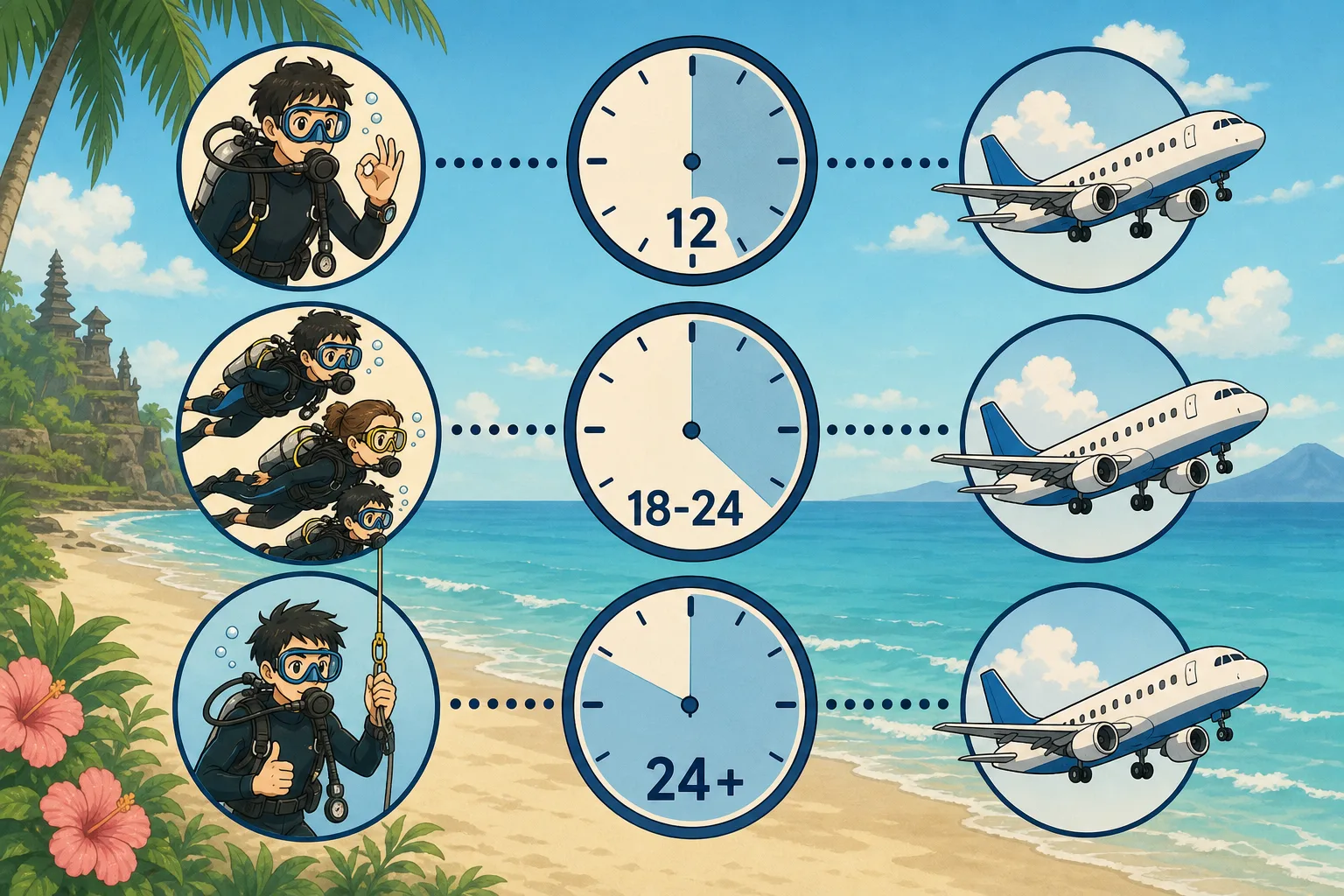
Can you fly after scuba diving? Yes, but not straight away, and the waiting time is one of the few rules in recreational diving with no wiggle room. The guidelines used worldwide, based on Divers Alert Network (DAN) research: wait at least 12 hours after a single no-decompression dive, at least 18 hours after multiple dives or multiple days of diving, and substantially longer than 18 hours (most operators say 24) after any dive requiring decompression stops. Most divers, and most dive computers, simply round everything up to 24 hours, and that is the number we recommend you plan your Bali trip around.
We run daily dive trips out of Sanur, which means we spend a surprising amount of time doing flight arithmetic with guests: last dive Thursday afternoon, flight Friday night, does that work? (Yes, comfortably.) And every season we have the harder conversations: the guest who wants to dive Nusa Penida in the morning and climb Mount Batur for sunrise the next day, the family squeezing a final try dive in before an afternoon airport run, the backpacker who assumes the fast boat to the Gili Islands counts as flying. This guide is the complete answer: the science of why the rule exists, the exact waiting times by dive type, and the Bali-specific traps, because on this island the thing most likely to violate your no-fly time is not a plane at all. It is a volcano road.
The short answer: no-fly times at a glance
| What you did | Minimum wait before flying | What we recommend |
|---|---|---|
| Single no-decompression dive | 12 hours | 18-24 hours |
| Multiple dives in a day, or multiple days of diving | 18 hours | 24 hours |
| Any dive with required decompression stops | "substantially longer than 18 hours" | 24-48 hours |
| Snorkelling (no tank) | No wait | No wait |
| A try dive / Discover Scuba (typically 1-2 shallow dives) | 12-18 hours | 24 hours |
These numbers come from DAN's flying-after-diving workshop guidelines and apply to flights in commercial aircraft pressurised to a cabin altitude of roughly 2,000 to 2,400 metres. They also apply, and this is the part almost everyone misses, to any ascent to altitude above about 300 metres by road, trail or cable car. Keep that in mind; we will come back to it, because in Bali it matters more than the flight itself.
Why you cannot fly straight after diving
The rule exists because of the same nitrogen that sets the depth and time limits we covered in our guide to how deep you can scuba dive. Every minute you spend breathing compressed air underwater, your blood and tissues absorb nitrogen. When you surface, that nitrogen does not vanish; it leaves your body slowly, over hours, exhaled breath by breath. Divers call this off-gassing, and while it is happening you are walking around mildly carbonated, like a bottle of sparkling water with the cap just loosened.
At sea level, the surrounding air pressure keeps that dissolved nitrogen politely in solution. But a commercial aircraft cabin is pressurised not to sea level but to the equivalent of roughly 2,000 to 2,400 metres of altitude, about 25 percent less pressure than the beach you just left. Take a nitrogen-loaded body to that lower pressure too soon and the gas can come out of solution as bubbles in your joints, tissues and bloodstream. That is decompression sickness (DCS), the bends, and getting it at 11,000 metres over the Java Sea is dramatically worse than getting it at the dive site, because the nearest recompression chamber is hours away in the wrong direction and the cabin pressure keeps making you worse.
The waiting period is nothing more mysterious than giving your body time to quietly exhale the excess nitrogen at sea level, where pressure is on your side. Twelve to twenty-four hours brings virtually everyone back to a tissue load where the cabin-altitude pressure drop is harmless. It is a boring cure, and it works.
The official guidelines, dive by dive
After a single dive: 12 hours minimum
One no-decompression dive, for example a single morning reef dive at Padang Bai, requires a minimum 12-hour surface interval before flying. In practice this scenario is rare in Bali because almost nobody does just one dive; day trips are two or three dives, which pushes you into the next category.
After multiple dives or multiple days: 18 hours minimum
This is the category nearly every Bali visitor is actually in. Two dives at Nusa Penida, three days of diving in Tulamben, a week-long dive package: all of it means at least 18 hours between your final ascent and wheels-up. DAN's data shows DCS risk after multiple dives drops to background levels somewhere between 17 and 18 hours, which is why the guideline sits there. We tell guests 24, partly for margin and partly because it makes the arithmetic idiot-proof at the end of a long holiday.
After decompression diving: substantially longer
If a dive required staged decompression stops, planned or accidental, the guideline says "substantially longer than 18 hours", which the industry reads as 24 to 48. Recreational divers in Bali should never be in this category; if your computer went into deco at Blue Corner, something already went wrong with the plan. Treat it as a minimum 24-hour lockout and mention it to your operator.
What your dive computer says
Every modern dive computer runs a no-fly countdown after each dive, usually shown as a little airplane icon. Most are conservative and simply count 24 hours from your last dive; some compute it from your actual tissue loading. Follow whichever is longer, your computer or the guidelines. Two things your computer knows that you might forget: repetitive dives stack (the countdown resets with every dive), and the countdown assumes you stay at sea level in between. It does not know you are planning to drive to Kintamani for lunch.
The Bali trap: it is not the flight, it is the altitude
Here is the section that makes this guide different from the hundred generic ones, because Bali has a geography problem that almost no visiting diver thinks about. The no-fly rule is really a no-altitude rule. DAN's guidance covers any ascent above roughly 300 metres after diving, and central Bali is a stack of volcanoes with tourist attractions scattered all the way up them.
Mount Batur sunrise trek: 1,717 metres
The single most common way Bali divers break the rule without knowing it. The sunrise trek is on every itinerary, pickups run at 2 a.m., and the summit is over 1,700 metres, comfortably inside the altitude band where post-dive DCS becomes a real risk. Diving Nusa Penida in the afternoon and standing on Batur's crater rim twelve hours later is, physiologically, close to boarding a flight early. Do the trek before your diving days, or leave a full 24 hours after your last dive. The same applies doubly to Mount Agung (3,031 metres), whose trek routes start high and go higher.
The volcano roads: Kintamani, Bedugul, Munduk
Kintamani's crater-rim restaurants sit at about 1,500 metres. The Bedugul lake temples (the famous Ulun Danu Beratan on the postcard) are at 1,200. The Munduk waterfall region is 800 to 1,000. Even the road to Besakih temple climbs past 900. None of these are exotic mountaineering; they are ordinary day-trip stops that a driver will happily take you to two hours after your third dive, and every one of them exceeds the 300-metre threshold. Our rule of thumb for guests: on diving days and the day after your last dive, stay on the coast. Bali's lowlands, Sanur, Ubud (about 300 metres, right at the line but fine for the town itself), Uluwatu, Seminyak, Canggu, the entire east-coast dive strip, contain more than enough to fill the gap. Our guide to things to do in Bali is full of sea-level options.

What does not count: boats, and everything at sea level
The flip side, and a happy myth to kill: boats do not count. The fast boat to the Gili Islands or Lombok, the ferry to Nusa Penida, the public boat from Sanur, all of it happens at sea level and none of it involves your no-fly time. You can surface from your second dive at Manta Point and ride a boat somewhere else that same afternoon with zero DCS implications from the transport itself. Snorkelling after diving is also fine, since you are breathing surface air. The one aquatic activity to avoid is deep, repetitive freediving after scuba, which adds nitrogen load and, worse, involves rapid ascents; leave the 20-metre breath-hold heroics for another day.
Planning a Bali dive trip around the 24 hours
The good news: Bali is one of the easiest places on earth to plan around no-fly time, because the diving is concentrated in day trips and the island is full of world-class ways to spend a final day at sea level. The pattern we recommend, and the one built into our Bali dive trip itinerary planner:
Front-load the altitude, back-load the beach. Do Batur, Kintamani and the highland temples in your first days, before any diving. Then dive. Then spend your last full day at sea level and fly out on day final+1. A typical week: arrive and acclimatise (day 1), Batur sunrise and Ubud (day 2), dive Nusa Penida (day 3), dive Tulamben and the Liberty wreck (day 4), dive Amed (day 5), beach, spa and shopping in Sanur (day 6, this is your 24 hours), fly (day 7). Nothing is squeezed, nothing is risked, and the last day feels like a holiday instead of a countdown.
Evening flights are your friend. A huge share of international departures from Denpasar leave between 6 p.m. and midnight. If your last dive ends at 3 p.m. on Thursday, a Friday 8 p.m. flight gives you 29 hours, comfortably clear even by the strictest reading. A Friday 7 a.m. flight gives you 16, which fails the 18-hour multi-dive guideline. Same "next day" flight on paper; very different numbers.
Courses need the same arithmetic. The Open Water course finishes with two ocean dives on its final day, so the 18-to-24-hour clock starts at the end of your last certification dive, not at the classroom session. Build the buffer into the booking; we flag it during scheduling, and our first-time diving guide covers the other planning basics.
What about nitrox? Diving enriched air genuinely reduces your nitrogen load when you dive it on air tables or air computer settings, and it is one of the reasons we recommend the course for multi-day packages. But no agency shortens the official no-fly time for nitrox divers, so treat the benefit as extra safety margin, not as a discount on the waiting period.
What to do with your no-fly day (the sea-level bucket list)
Nobody should feel like the last 24 hours are quarantine. At sea level Bali offers: the Uluwatu cliff temples and the kecak fire dance at sunset, Tanah Lot, the beach clubs of Canggu and Seminyak, a massage marathon in Sanur (our neighbourhood, and yes we have opinions about which spas), surfing lessons, the Ubud rice terraces and monkey forest, cooking classes, and the gentle art of doing absolutely nothing beside a pool. Snorkelling is allowed, so a lazy morning floating over the Sanur house reef is a legitimate way to say goodbye to the ocean. If your trip timing is flexible, our guide to the best time to visit Bali helps you pick a window where that last beach day is guaranteed sunshine.

Where the numbers come from: a short history of the rule
The waiting times are not folklore; they are among the best-researched numbers in recreational diving. Through the 1990s and early 2000s, DAN ran hundreds of controlled chamber trials at Duke University in which volunteer divers completed real dive profiles, waited a measured surface interval, and were then taken to a simulated cabin altitude of 2,400 metres while researchers watched for DCS. The pattern was unambiguous: after single no-deco dives, DCS at altitude essentially disappeared once the surface interval passed 11 to 12 hours; after repetitive multi-day diving, cases kept appearing until around 17 hours and stopped by 18. The 2002 Flying After Diving workshop turned those results into the 12/18/"substantially longer" guidelines that PADI, SSI and every major agency have taught since.
Two details from that research are worth knowing because they explain the safety margins. First, the trials used dry, resting divers in a chamber; real divers who were cold, tired, dehydrated or working hard underwater off-gas less predictably, which is one reason operators pad the numbers to 24 hours. Second, the trials tested cabin altitude at the high end of the certified range, 2,400 metres, so the guidelines already assume a worst-case commercial flight. They do not, however, cover anything above that: small unpressurised aircraft, some island-hopper routes in Indonesia among them, can cruise at 3,000 metres or higher, where even a cleared no-fly countdown may not protect you. If your onward travel involves a small propeller aircraft, add margin and tell the operator you have been diving.
Why do tissues take so long in the first place? Nitrogen leaves different parts of the body at wildly different speeds. Blood-rich tissues like muscle clear in an hour or two; cartilage, joints and fat, the slow compartments, have half-times of six hours and more, meaning a quarter of their excess nitrogen can still be aboard 12 hours after a dive week. It is precisely those slow, poorly-perfused tissues, joints above all, where altitude DCS classically presents. The 18-to-24-hour window exists to let the slowest passengers off the ship.
Myths we hear on the boat, corrected
"I flew after 10 hours once and nothing happened." Correct, and meaningless. DCS after marginal surface intervals is a probability game measured in low single-digit percentages; most people win most rolls. The guideline is not the line where DCS becomes certain, it is the line where it becomes vanishingly rare. Anecdotes about surviving the gap prove only that dice sometimes land well.
"Business class has better air." Every seat in the aircraft shares the same cabin pressure. The champagne is better; the physics is identical.
"My computer cleared me, so the Batur trek is fine." The no-fly icon models a 2,400-metre cabin, so a cleared countdown does cover a 1,717-metre summit in theory, but only once it has actually expired. The mistake we see is inverted logic: guests who would never board a plane eight hours after diving happily book a 2 a.m. trek pickup the same night. The mountain does not care that it is not an airplane.
"Drinking lots of water lets me fly sooner." Hydration genuinely matters, dehydration is a proven DCS risk multiplier, and Bali's heat plus a farewell Bintang session is a classic setup, but no amount of water accelerates the guideline. Hydrate and wait; the two are teammates, not substitutes.
"The rule is for old people / deep divers / cold water." Age, fitness, depth and temperature all shift individual risk at the margins, but the trials that produced the guidelines used healthy volunteers on ordinary recreational profiles in comfortable conditions. The waiting times are already the fit-young-diver numbers. There is no demographic that gets a shorter clock.
Liveaboards and long trips: the multi-day reality
The stakes rise with trip intensity. A Bali day-trip diver logs two or three dives; a liveaboard guest on a Komodo, Raja Ampat or Banda Sea itinerary logs three or four dives a day for a week, which loads the slow tissues about as heavily as recreational diving can. Every reputable liveaboard, ours included, schedules the final day with this in mind: last dives in the morning, a land excursion or cruise in the afternoon, and disembarkation the following morning, so that guests connecting to flights in Labuan Bajo or Sorong are naturally past the 18-hour mark and usually past 24. When you book flights around a liveaboard, never schedule a departure for disembarkation day earlier than the boat's published guidance, and remember that the small aircraft serving those airports argue for the generous end of the window. The same front-load principle applies: Komodo's Padar viewpoint hike (fine, 160 metres) is safe anytime, but if your route home involves Bali's highlands, put them before the boat, not after.
What happens if you fly too soon?
Honestly: usually nothing, and that is exactly what makes the rule easy to break. The pressure change is modest and most nitrogen-loaded passengers get away with it, which produces a steady supply of divers who "flew after 8 hours once and were fine". The problem is the tail of the distribution. When post-flight DCS does hit, it presents as joint pain, unusual fatigue, numbness or tingling, skin rashes, dizziness or, in serious neurological cases, weakness and confusion, and it hits in a sealed tube at altitude where symptoms worsen and help is far away. Diverted aircraft, emergency recompression in a foreign country, travel insurance disputes (insurers ask about your dive profile, and flying inside the guideline window is a textbook claim-denial), and occasionally permanent injury: the downside is rare but enormous, and the cost of avoiding it is one beach day.
If you develop possible DCS symptoms during or after a flight, treat it as an emergency: oxygen if available, and contact DAN's emergency hotline (+1-919-684-9111, 24/7) or get to a hospital and say the words "I was scuba diving". In Bali, recompression chambers operate at Sanglah General Hospital in Denpasar. And one related note while we are being sensible: alcohol on the last night is fine after diving is done, but dehydration worsens DCS risk, so hydrate before the flight; our diving and alcohol guide covers where the real limits are.
Quick answers to the edge cases
Domestic hops count exactly the same. The 45-minute flight to Lombok or Labuan Bajo is pressurised (or worse, unpressurised at 3,000 metres), so the same waiting times apply. Flying to Komodo the morning after an afternoon of diving is a violation; if you are combining Bali diving with a Komodo trip, put the flight before the diving or pad the schedule.
Arriving in Bali and diving the same day is fine. The rule is one-directional: flying loads no nitrogen, so you can land at 9 a.m. and dive at 2 p.m. jet lag permitting. We generally suggest a rest day first, for enjoyment rather than physiology.
Helicopter tours and paragliding: Bali's paragliding at Timbis (cliff-soaring below 200 metres) is fine; helicopter tours typically cruise at 300 to 500-plus metres and belong outside your window. Ask the operator for their altitude if in doubt, and when in doubt, wait.
Kids follow the same rule. Junior divers off a family kids' diving day carry the same no-fly times as adults; there is no children's discount on physiology.
Multiple weeks of diving does not extend it further. Whether you dived three days or thirty, 24 hours at sea level clears you. The guideline does not stack beyond the multi-day category.
The bottom line
Wait 24 hours between your last dive and your flight, treat Bali's volcano roads and the Batur trek exactly like a flight, ride all the boats you like, and build your itinerary with the altitude days first and a sea-level day last. That is the entire rule, and it costs you nothing but a massage and a sunset. If you want the planning done for you, our Bali dive trips and multi-day packages are scheduled with flight-safe spacing in mind, and we are happy to look at your flight times when you book; it takes us thirty seconds and it has saved more than one holiday. Safe diving, and safe flying home.
Frequently Asked Questions
Wait at least 12 hours after a single no-decompression dive, at least 18 hours after multiple dives or multiple days of diving, and 24 hours or more after any dive requiring decompression stops. These are the DAN (Divers Alert Network) guidelines used worldwide. Most divers and most dive computers simply apply a flat 24-hour rule, which is what we recommend building your Bali itinerary around.
Diving loads your tissues with dissolved nitrogen, which leaves your body slowly over hours after you surface. Aircraft cabins are pressurised to the equivalent of 2,000 to 2,400 metres of altitude, about 25 percent less pressure than sea level. Ascending to that lower pressure while still nitrogen-loaded can cause the gas to form bubbles in your tissues, which is decompression sickness. Waiting lets your body off-gas the nitrogen safely at sea level first.
Yes. Boats travel at sea level, so they have no effect on your no-fly time. The fast boats to the Gilis and Lombok, the Nusa Penida ferries, and all of Bali's dive boats are completely fine on the same day as diving. The rule concerns altitude, not transport, so only flights and trips into the mountains count.
Not within your no-fly window. The Batur sunrise trek reaches 1,717 metres, which is comparable to aircraft cabin altitude, so treat it exactly like a flight: wait 18 to 24 hours after your last dive. The same applies to Mount Agung and to high road trips like Kintamani (about 1,500 metres) and Bedugul (about 1,200 metres). The safe pattern is to do the volcano treks and highland tours before your diving days.
Yes, fully. The 45-minute hops from Bali to Lombok or Labuan Bajo (Komodo) use aircraft that are pressurised to the same cabin altitudes as long-haul jets, or in the case of some small aircraft fly unpressurised at similar heights. The same 12/18/24-hour waiting times apply regardless of flight duration. If you are combining Bali diving with Komodo, schedule the flight before the diving or pad the gap.
Yes. The rule is one-directional: flying does not load your body with nitrogen, so there is no physiological reason you cannot land in the morning and dive in the afternoon. Fatigue and dehydration from travel are the only practical concerns, so we usually suggest starting with an easy dive day or resting first, but it is completely safe from a decompression standpoint.
No. Diving enriched air on air computer settings genuinely reduces your nitrogen load, but no training agency or DAN guideline shortens the official waiting time for nitrox divers. Treat the reduced load as extra safety margin rather than a discount on the clock. The 12/18/24-hour guidance applies unchanged.
Yes. Snorkelling on breath-hold at the surface involves breathing normal-pressure air and adds no meaningful nitrogen, so it is fine on the same day as diving and during your pre-flight window. The activity to avoid is deep, repetitive freediving after scuba, which both adds nitrogen and involves rapid ascents. A gentle float over the Sanur house reef is a perfect no-fly-day activity.
Most people get away with it, which is what makes it tempting, but the unlucky ones develop decompression sickness at altitude: joint pain, severe fatigue, numbness, rashes, dizziness or neurological symptoms, in an environment where symptoms worsen and help is hours away. Consequences range from an aborted holiday and denied insurance claims to permanent injury. If symptoms appear during or after a flight, seek oxygen, contact DAN's emergency line (+1-919-684-9111) or go to a hospital immediately; in Bali, recompression facilities are at Sanglah General Hospital in Denpasar.
Whichever is longer. Most computers apply a conservative flat 24 hours from your last dive; some calculate from your actual tissue loading and may show less. The DAN guidelines are the floor: 12 hours single dive, 18 hours multi-dive or multi-day, more after decompression dives. When your computer and the guidelines disagree, the cautious number wins, and the airplane icon has to be gone before you board.