
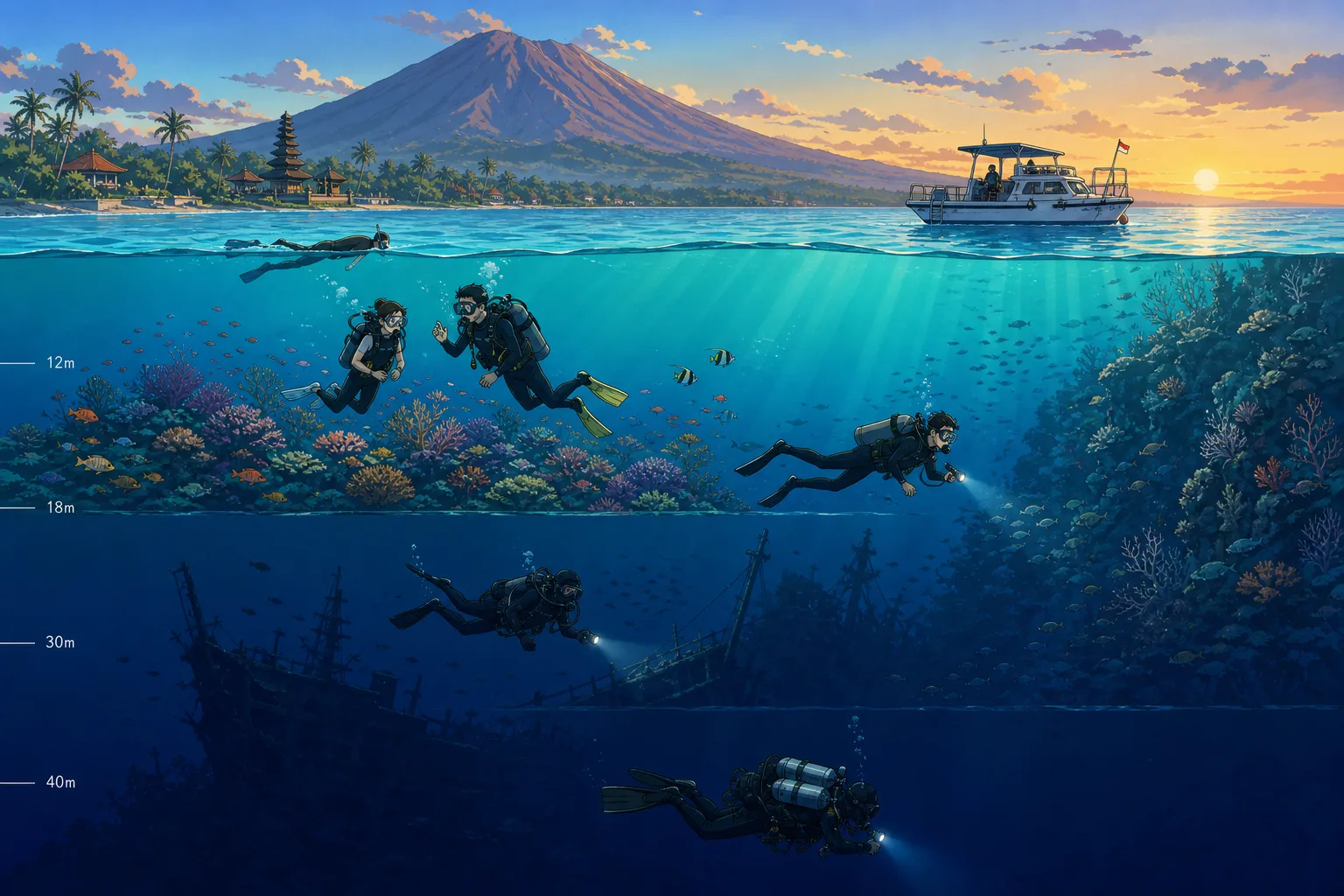
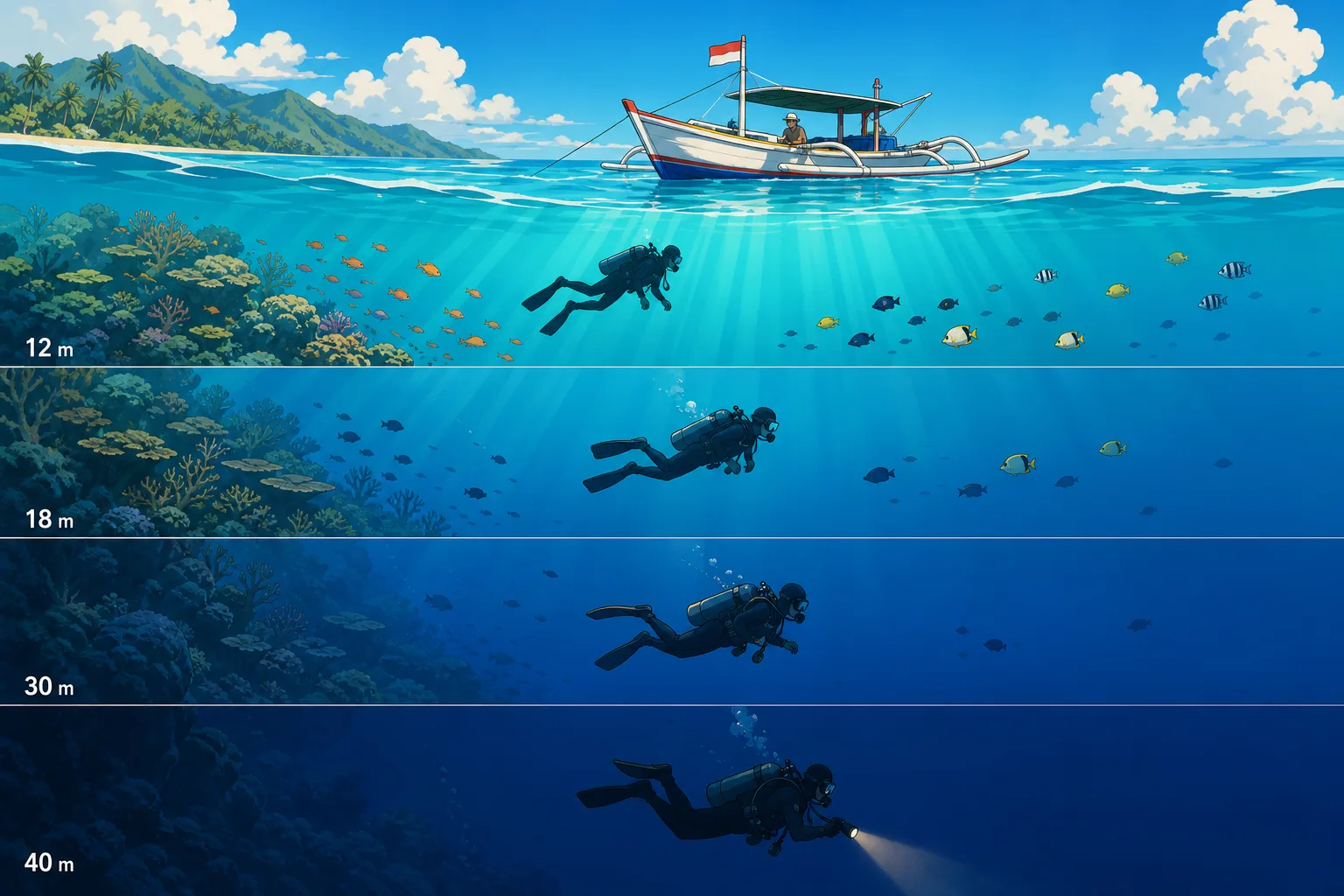
How deep can you scuba dive? Here is the short answer before the long one: as a beginner on a supervised try dive you go to 12 metres, a certified Open Water diver is trained to 18 metres, an Advanced Open Water diver to 30 metres, and 40 metres is the absolute ceiling for recreational diving anywhere in the world. Below 40 metres you are in technical diving territory, which is a different sport with different equipment, different gases and years of additional training. And here is the part almost nobody tells you: most of the best diving on the planet, including nearly everything worth seeing in Bali, happens shallower than 25 metres.
We teach the full ladder of PADI courses in Bali from our shop in Sanur, and the depth question is the single most common thing guests ask on the drive to the dive site, usually right after asking about sharks. It is also the most misunderstood. New divers assume depth is the goal, the score, the thing that makes a dive impressive. Fifteen years of guiding tells us the opposite: the divers who chase numbers on their computer have the shortest, coldest, darkest dives, and the divers who understand what actually changes at 10, 20 and 30 metres get the best hours of their diving lives. This guide covers the real limits by certification level, the physics and physiology behind them, what each extra 10 metres costs you and buys you, and, because we are a Bali operator, exactly how deep you need to be for the Liberty wreck, Manta Point, Crystal Bay and the other sites you are probably planning this around.
Scuba diving depth limits at a glance
Every major training agency (PADI, SSI, NAUI, RAID) uses essentially the same depth ladder. These numbers are not arbitrary marketing tiers; they map onto real physiological thresholds that we explain further down.
| Level | Maximum depth | What it means in practice |
|---|---|---|
| Try dive / Discover Scuba (no certification) | 12 metres / 40 feet | Diving under the direct supervision of an instructor, no licence needed |
| PADI Scuba Diver | 12 metres / 40 feet | Half-certification, must dive with a professional |
| Open Water Diver | 18 metres / 60 feet | The standard worldwide certification, dive independently with a buddy |
| Advanced Open Water Diver | 30 metres / 100 feet | Unlocks the deeper half of most famous dive sites |
| Deep Diver Specialty | 40 metres / 130 feet | The recreational maximum, full stop |
| Technical diving (TDI, PADI TecRec) | 40 to 100+ metres | Decompression diving with mixed gases, redundant equipment and serious training |
Junior divers have their own sub-ladder: a 10 or 11 year old Junior Open Water diver is limited to 12 metres with a parent or professional, a 12 to 14 year old to 18 metres with an adult, and all restrictions lift at 15. If you are planning a family trip, our guide to diving with kids in Bali covers the age rules in detail.
One important nuance: these are training-depth limits, not laws. There is no depth police underwater. The limits are enforced by dive operators (we will not take an Open Water diver to 30 metres, and neither will any reputable shop), by insurance policies that may not pay out if you exceeded your certification depth, and ultimately by physics, which does not negotiate.
Why 40 metres is the recreational limit
The 40-metre ceiling traces back to the US Navy in the 1950s, but it survives because three separate problems all get serious at roughly the same depth.
1. Your air disappears fast
Pressure increases by one atmosphere every 10 metres. At the surface you are at 1 atmosphere; at 10 metres, 2 atmospheres; at 30 metres, 4; at 40 metres, 5. Because your regulator delivers air at the surrounding pressure, every breath at 40 metres pulls five times as much air out of your tank as the same breath at the surface. A tank that lasts an hour at 10 metres lasts barely 15 minutes at 40. Deep dives are short dives, always.
2. No-decompression time collapses
The deeper you go, the faster your body absorbs nitrogen, and the less time you can stay before you owe mandatory decompression stops on the way up. At 18 metres you have roughly 50 minutes of no-decompression time. At 30 metres, about 20 minutes. At 40 metres, around 8 to 10 minutes. Recreational diving is defined as diving where you can ascend directly to the surface at any moment; beyond 40 metres the no-stop times get so short that the definition stops making sense.
3. Nitrogen narcosis
Breathing nitrogen under pressure has an anaesthetic effect that divers call narcosis, the martini effect, or being narked. It typically becomes noticeable around 30 metres and unmistakable at 40: slowed thinking, tunnel vision, odd euphoria or anxiety, fumbled tasks that would be trivial at the surface. It is completely reversible (ascend a few metres and it fades within moments), but it is precisely the wrong state of mind in which to manage the fast air consumption and short no-stop times that the same depth imposes. Three problems, one depth. That is why 40 metres is the line.
Below that line, technical divers manage the same physics with different tools: helium-based gas mixes to blunt narcosis, twin tanks and stage cylinders for gas volume, staged decompression schedules for the nitrogen, and redundancy for everything. It is a genuinely different activity, and if the ladder eventually calls to you, it starts with the Deep Diver specialty and a few hundred logged dives, not with a big number on day one.
Depth limits by certification level, and what each one actually unlocks
No certification: 12 metres on a try dive
You do not need any licence to breathe underwater for the first time. On a try dive in Bali an instructor takes you to a maximum of 12 metres after a briefing and shallow-water practice, and in truth most first dives happily stay at 6 to 10 metres, which in Bali is where the coral gardens are at their brightest anyway. Our try diving guide walks through exactly how the day runs. The honest secret of the 12-metre limit: first-timers rarely feel limited by it, because at 8 metres over a healthy Bali reef there is more colour and life than at 30 metres almost anywhere.
Open Water Diver: 18 metres
The Open Water course is the world's standard scuba certification: three to four days, theory, pool training and four open-water dives, after which you can dive to 18 metres with a buddy anywhere on earth, for life. Eighteen metres sounds modest until you realise what lives above it: nearly every coral reef ecosystem, the shallow half of the USAT Liberty wreck, Manta Point at Nusa Penida in its entirety, every turtle you will ever meet, and about 80 percent of the named dive sites in Bali. We wrote a full breakdown of what the Open Water course in Bali involves if you are weighing it up.
Advanced Open Water: 30 metres
The Advanced Open Water course is five adventure dives over two days, one of which is a supervised deep dive to a maximum of 30 metres, where your instructor will typically demonstrate narcosis with a simple maths problem or a colour slate. Thirty metres is the certification that matters in Bali: it opens the stern of the Liberty wreck, the deep channel at Crystal Bay where the mola mola hold in season, the washing-machine corners at Nusa Penida, and the deeper walls at Menjangan. If you are only ever going to take one course beyond Open Water, this is the one, and our Advanced course guide explains why we run it the way we do.
Deep Diver specialty: 40 metres
The Deep Diver specialty is four dives over two days dedicated entirely to the 30-to-40-metre band: gas planning, narcosis management, emergency decompression procedures, and the discipline of turning a dive early. Forty metres is the recreational ceiling worldwide. There is no recreational card, from any agency, that certifies deeper. In Bali we teach the deep dives on the Liberty wreck and the Nusa Penida walls, which are two of the more forgiving places on the planet to learn deep discipline: clear water, known topography, and a reason to be there.
Beyond 40 metres: technical diving
Technical diving covers everything past the recreational line: extended range to 55 metres on air-based mixes, trimix diving to 100 metres and beyond, cave and wreck penetration, rebreathers. The world record for the deepest scuba dive is Ahmed Gabr's 332.35 metres in the Red Sea in 2014, a dive that took roughly 12 minutes to descend and nearly 14 hours to come back up. That ratio, 12 minutes down and 14 hours of decompression, is the entire story of why depth is expensive. For context on how the certification tree branches, our overview of scuba certification types maps the whole ladder.
What actually changes as you go deeper
The limits make more sense once you know what each 10 metres does to your dive. Four things change, and none of them are in your favour.
Colour drains away
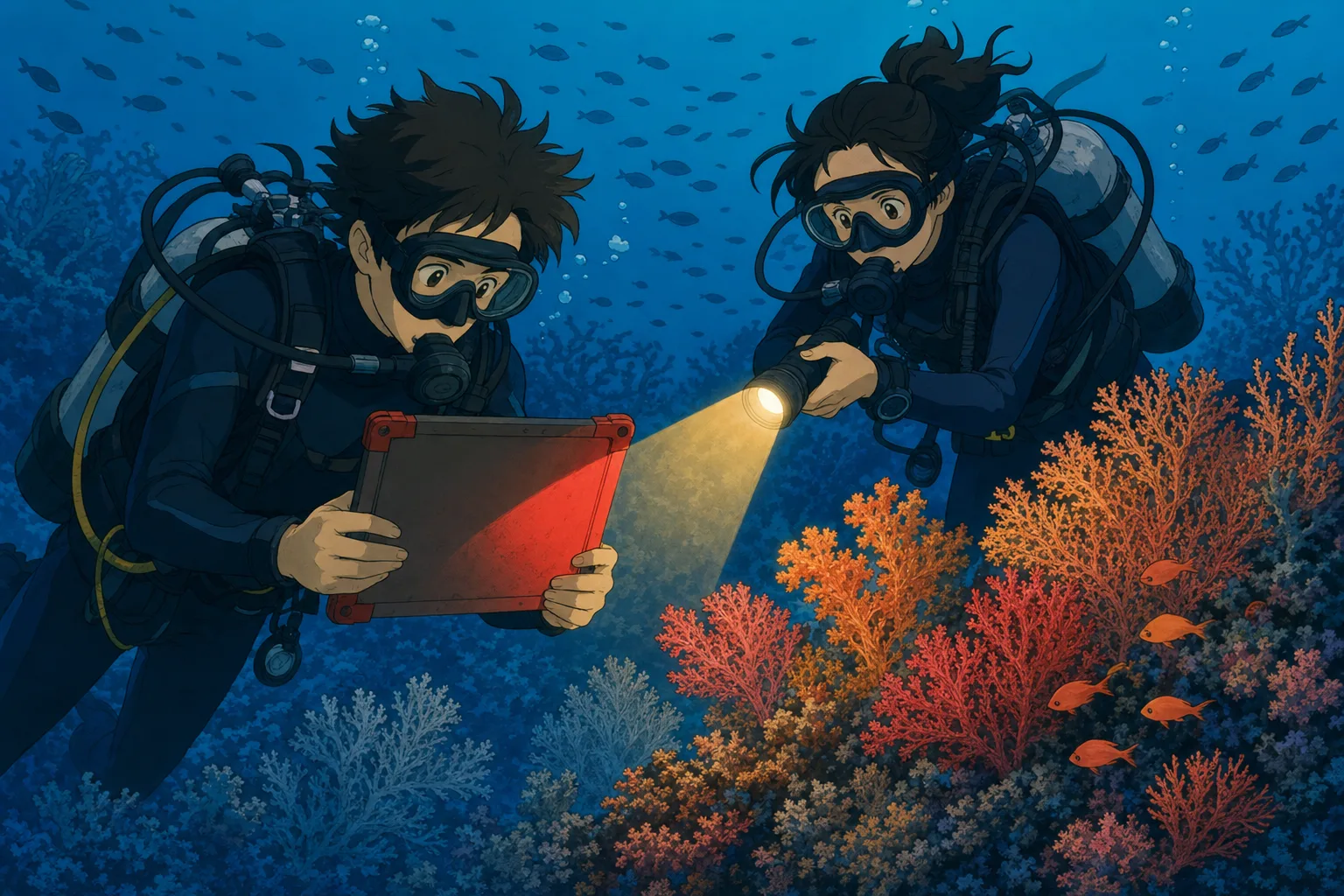
Water swallows sunlight one wavelength at a time. Red is gone by about 5 metres, orange by 10, yellow by 20; past 25 metres the world runs on blue and green unless you bring your own light. That electric red soft coral you saw in the brochure photo? At 30 metres it looks grey-brown until a torch beam hits it and the colour switches back on like a lightbulb. This is why experienced photographers in Bali spend most of their time above 20 metres, and why every diver should own a torch even for day dives.
Your gas goes faster
The pressure arithmetic again: at 30 metres you breathe your tank down four times faster than at the surface, at 40 metres five times faster. A relaxed diver with good buoyancy might get 55 minutes at 12 metres and 18 minutes at 35 metres from the same tank. Air is time, and depth is the exchange rate.
Your no-stop clock shrinks
Every dive computer runs the same trade: depth against time. Fifty-plus minutes of no-decompression time at 18 metres becomes about 20 at 30 metres and single digits at 40. Deep dives are not just short because of gas; they are short because your tissues are absorbing nitrogen at four to five times the surface rate.
Your brain slows down
Narcosis is dose-dependent and sneaky: the classic sign is not feeling drunk, it is not noticing things. Divers at 35 metres routinely miss their planned turn pressure by 20 bar, misread gauges, or fixate on one task while their buddy drifts away. The fix is simple and non-negotiable: ascend a few metres and it lifts. In Bali the deep sites also add cold to the mix; thermoclines at Crystal Bay and Blue Corner can drop the water from 28°C to 18°C in two metres of descent during mola mola season, and cold accelerates both gas consumption and narcosis.
There is one more change worth naming because it surprises people: below about 25 metres there is simply less to see on most reefs. Reef-building coral needs sunlight, so the density of life thins with every metre. The deep is where you go for specific reasons, a wreck, a wall, a seasonal fish, and the shallows are where the ocean actually lives.
How deep do you actually need to go in Bali?
Here is the section we wish every guest read before booking. These are the real operating depths of Bali's signature sites, from the day trips we run out of Sanur.
USAT Liberty wreck, Tulamben: 5 to 30 metres
The most famous wreck in Indonesia starts at 5 metres and bottoms out around 30. An Open Water diver sees the bow, the cargo holds, the gun and 80 percent of the marine life without ever passing 18 metres. The stern section and the darker swim-throughs sit in Advanced territory at 20 to 28 metres. Nobody needs 40 metres here; the sand below the wreck is just sand.
Manta Point, Nusa Penida: 8 to 18 metres
The best big-animal dive in Bali is also one of its shallowest. The cleaning stations where the reef mantas circle sit at 10 to 14 metres. Open Water divers, even fresh ones, get the full show. Depth adds nothing at Manta Point except distance from the mantas, which hold near the cleaning blocks above you.
Crystal Bay, Nusa Penida: 10 to 30+ metres
The one Bali site where depth genuinely pays. The bay itself is a lovely 10-to-18-metre dive, but in mola mola season (roughly July to October) the sunfish hold at the thermocline along the channel wall, typically 20 to 35 metres. This is the dive that convinces people to take the Advanced course, and it is exactly why we teach the deep adventure dive here. Our Nusa Penida trips run it daily in season.
Blue Corner, Nusa Penida: 18 to 40 metres
Bali's serious drift dive. The plateau edge starts around 18 metres and the corner drops well past recreational limits into the Lombok Strait. Strong currents, down-currents on bad days, cold upwellings: this is an Advanced-minimum site and we mean it. The full profile is in our Blue Corner guide.
Menjangan Island: 10 to 30 metres
Wall diving in the calm northwest. The walls run from 10 metres down past 40, but the densest soft coral and fan growth is in the 12-to-25-metre band where the light still reaches. Open Water divers cruise the top of the wall; Advanced divers ride the middle. Below 30 the wall keeps going but the colour does not.
Amed, Padang Bai and the coral gardens: 5 to 20 metres
The east-coast reef sites, the Japanese wreck at Amed (2 to 12 metres, snorkellable), Blue Lagoon, the Jemeluk gardens, all live comfortably inside Open Water limits. This is where Bali quietly makes its case that the 18-metre card is not a restriction but a description of where the good stuff is.
The pattern across the whole island: an Open Water diver misses perhaps 15 percent of Bali, an Advanced diver misses almost nothing, and a Deep Diver card is a discipline qualification more than a sightseeing pass. If your trip has one goal, mantas, pick shallow. If it has another, mola mola in season, that is the argument for 30 metres.
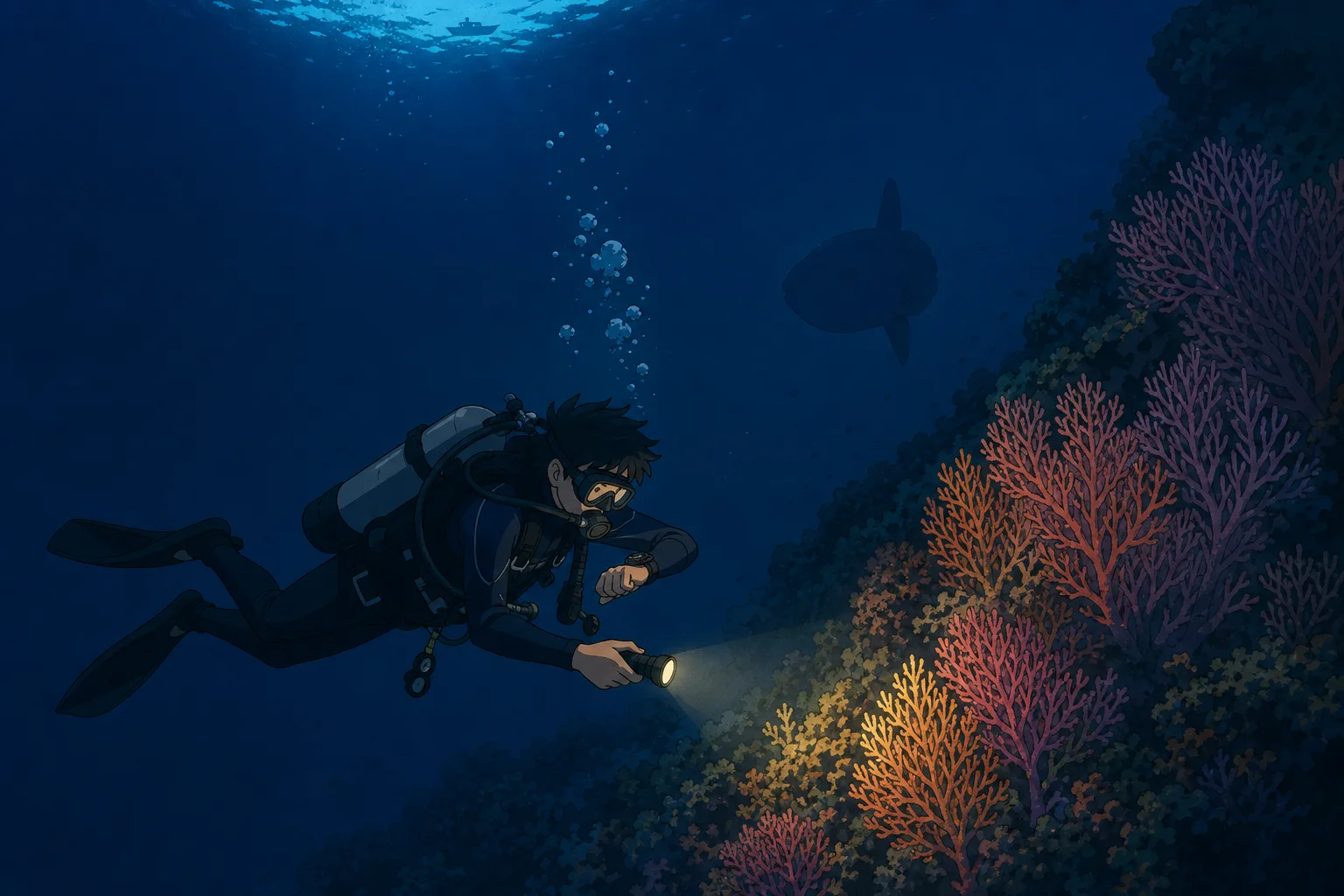
How to extend your depth range the right way
If deeper diving is calling you, there is a correct order of operations, and it is shorter than people expect.
Step one: get your buoyancy sorted first. Depth punishes sloppy buoyancy: over-weighted divers burn gas, saw up and down through the water column, and stir the bottom. The Peak Performance Buoyancy specialty does more for your deep diving than any depth course, because control is what deep diving actually is.
Step two: Advanced Open Water. Two days, five dives, 30 metres unlocked, with the deep dive done under instruction so your first experience of narcosis happens with a professional watching. In Bali we run the deep dive at Crystal Bay or the Liberty, so the training dive is also one of the best dives of your trip.
Step three: Deep Diver specialty, when you have a reason. Four more dives, 40 metres, real gas planning. Take it when there is something at 35 metres you actually want to see, not for the card.
A note on nitrox, because it is the most misunderstood course in diving: enriched air does not let you dive deeper. It does the opposite; the higher oxygen fraction imposes a shallower maximum depth (around 34 metres on 32 percent, versus 56 metres theoretical on air). What nitrox buys you is more time at moderate depths, nearly double the no-stop time at 18 to 24 metres, which on a three-dive Bali day trip is worth far more than ten extra metres of depth ever could be. Deep is short; nitrox makes moderate long.
And a note on what does not extend your range: bravado, a new dive computer, or a guide who says "just stay close to me." Your certification depth is your depth. Every year, somewhere, a 20-dive Open Water diver follows a group to 35 metres and discovers narcosis, gas planning and cold water all at once. The training exists because the problems are real.
The safety rules that matter more than the depth number
Whatever depth you dive to, the same short list of rules does most of the work of keeping you alive, and every one of them is about the ascent, not the descent.
Ascend slowly. No faster than 18 metres per minute, and modern computers prefer 9 to 10. The nitrogen you absorbed at depth has to leave through your lungs, gradually; ascend too fast and it bubbles in your tissues instead, which is decompression sickness.
Do the safety stop. Three minutes at 5 metres on every dive deeper than 10 metres. It is not mandatory in the legal sense; it is mandatory in the sensible sense.
Never hold your breath. The oldest rule in scuba. Air in your lungs expands as you ascend; keep breathing and it vents itself, hold your breath and it does not. This is why the rule is taught on day one at 3 metres, where the relative pressure change is largest.
Respect the surface interval and the flight rule. Wait at least 18 to 24 hours after multiple dives before flying. In Bali this has a local twist: the fast boats to the Gilis and the sunrise trek up Mount Batur (1,717 metres) are both altitude exposures that most tourists never think of. Plan your last dive day accordingly.
Dive sober and hydrated. Alcohol and nitrogen are a genuinely bad combination, worse than most divers realise; we wrote up the physiology in our diving and alcohol guide. Bintang after the dive, never before.
Plan your gas, not just your time. The rule of thirds is technical-diving doctrine, but the recreational version is simple: know your turn pressure before you descend, check your gauge every few minutes, and surface with 50 bar. At 30 metres, "I lost track of my air" is not a story you want to be telling.
Depth myths, quickly dispatched
"Deeper divers are better divers." No. Better divers have better buoyancy, better gas consumption and better awareness, all of which are learned shallow and merely tested deep. The best diver on any Bali boat is usually the one who comes up with 80 bar after an hour, not the one bragging about 38 metres.
"You get crushed by pressure at depth." Your body is mostly water and water does not compress. The air spaces (ears, sinuses, mask) need equalising, which you learn in the first pool session. At 40 metres you feel exactly like you do at 10, just narked and colder.
"The good stuff is down deep." Occasionally (wrecks, molas, hammerheads). Overwhelmingly not: coral needs light, and light lives above 20 metres. The densest, most colourful 10 minutes of diving in Bali are at 8 metres on the Liberty at dawn with the bumphead parrotfish, a dive a brand-new Open Water diver can do.
"Freedivers go to 100 metres, so scuba limits are just lawyers being careful." Different physiology entirely. A freediver takes one breath of surface-pressure air down and back; a scuba diver breathes pressurised gas continuously, loading nitrogen the whole time. The freediver's problem is oxygen; the scuba diver's problem is everything else. The 40-metre recreational limit has half a century of decompression science behind it.
The bottom line
How deep can you scuba dive? Twelve metres on your first try dive, 18 as an Open Water diver, 30 with an Advanced card, 40 at the recreational maximum with the Deep specialty, and beyond that lies technical diving, which is its own sport. But the better question, the one we wish more guests asked on the drive to Tulamben, is how deep should you dive, and the answer in Bali is almost always: shallower than you think. The mantas are at 12 metres. The bumpheads are at 8. The wreck starts at 5. The molas, fine, the molas are at 28, and that is exactly what the Advanced course is for.
If you are starting from zero, a try dive will settle in one morning whether this sport is for you. If you are ready for the card, the Open Water course runs year-round from Sanur, and the full menu of PADI courses in Bali, from first bubbles to Divemaster, is on the site. Come dive with us, and we promise the best moments will not be the deepest ones.
Frequently Asked Questions
On a try dive (PADI Discover Scuba Diving) you can go to a maximum of 12 metres under the direct supervision of an instructor, with no licence required. In practice most first dives stay at 6 to 10 metres, which in Bali is where the coral is brightest anyway. The instructor stays within arm's reach for the entire dive and manages your equipment, so you only have to breathe, equalise and look around.
An Open Water Diver is trained and certified to 18 metres (60 feet). This is not a legal limit but it is the depth your training prepared you for, the depth reputable operators will hold you to, and often the depth your travel insurance covers. Around 80 percent of Bali's dive sites, including Manta Point in its entirety and the shallow half of the USAT Liberty wreck, sit comfortably within it.
40 metres (130 feet), worldwide, across every training agency. Reaching it requires the Advanced Open Water certification plus the Deep Diver specialty. Beyond 40 metres you are in technical diving, which requires decompression training, redundant equipment and usually helium-based gas mixes. No recreational certification from any agency goes deeper than 40 metres.
Three problems converge there. First, gas: at 40 metres you breathe your tank down five times faster than at the surface. Second, time: your no-decompression limit shrinks to roughly 8 to 10 minutes. Third, narcosis: nitrogen under pressure has a noticeable anaesthetic effect at that depth, slowing your thinking exactly when the other two problems demand sharp management. Technical divers solve all three with different equipment and gases; recreational training does not.
Narcosis is an anaesthetic-like effect of breathing nitrogen under pressure: slowed thinking, tunnel vision, mild euphoria or anxiety, and fumbled simple tasks. Most divers notice it around 30 metres and everyone has it by 40, whether they notice or not. It is completely reversible; ascending a few metres clears it within moments. The Advanced Open Water deep dive exists largely so your first experience of it happens under supervision.
No, the opposite. Enriched air nitrox has more oxygen and less nitrogen, and oxygen becomes toxic beyond a certain partial pressure, so nitrox actually imposes a shallower maximum depth (around 34 metres on EANx32). What nitrox buys you is more bottom time at moderate depths, nearly double the no-stop time at 18 to 24 metres, which on a multi-dive Bali day trip is far more valuable than extra depth.
The wreck lies on a sand slope from about 5 metres at the shallowest point to roughly 30 metres at the deepest section of the stern. An Open Water diver can see the majority of the wreck and most of its marine life without passing 18 metres, while the deeper stern and swim-throughs are Advanced territory. It is one of very few world-class wrecks that a brand-new diver can genuinely experience.
In season (roughly July to October) mola mola typically hold at cleaning stations along the thermocline at 20 to 35 metres, most famously in the channel at Crystal Bay, Nusa Penida. This is the one Bali sighting where the Advanced Open Water certification (30 metres) genuinely matters. Some lucky encounters happen shallower when a mola rises to the reef, but planning for one means planning for 25 to 30 metres and cold water.
Junior Open Water divers aged 10 to 11 are limited to 12 metres and must dive with a parent, guardian or dive professional. From 12 to 14 the limit is 18 metres with an adult. At 15 the junior certification converts to a full Open Water certification with standard limits. Bubblemaker pool experiences for 8 and 9 year olds are capped at 2 metres in a pool.
Ahmed Gabr's 332.35 metres in the Red Sea in 2014, a technical world record that took about 12 minutes to descend and nearly 14 hours of staged decompression to surface from. It illustrates the core economics of depth: every metre down is paid for many times over on the way up. Recreational diving, by design, stays in the zone where you can always ascend directly to the surface.