
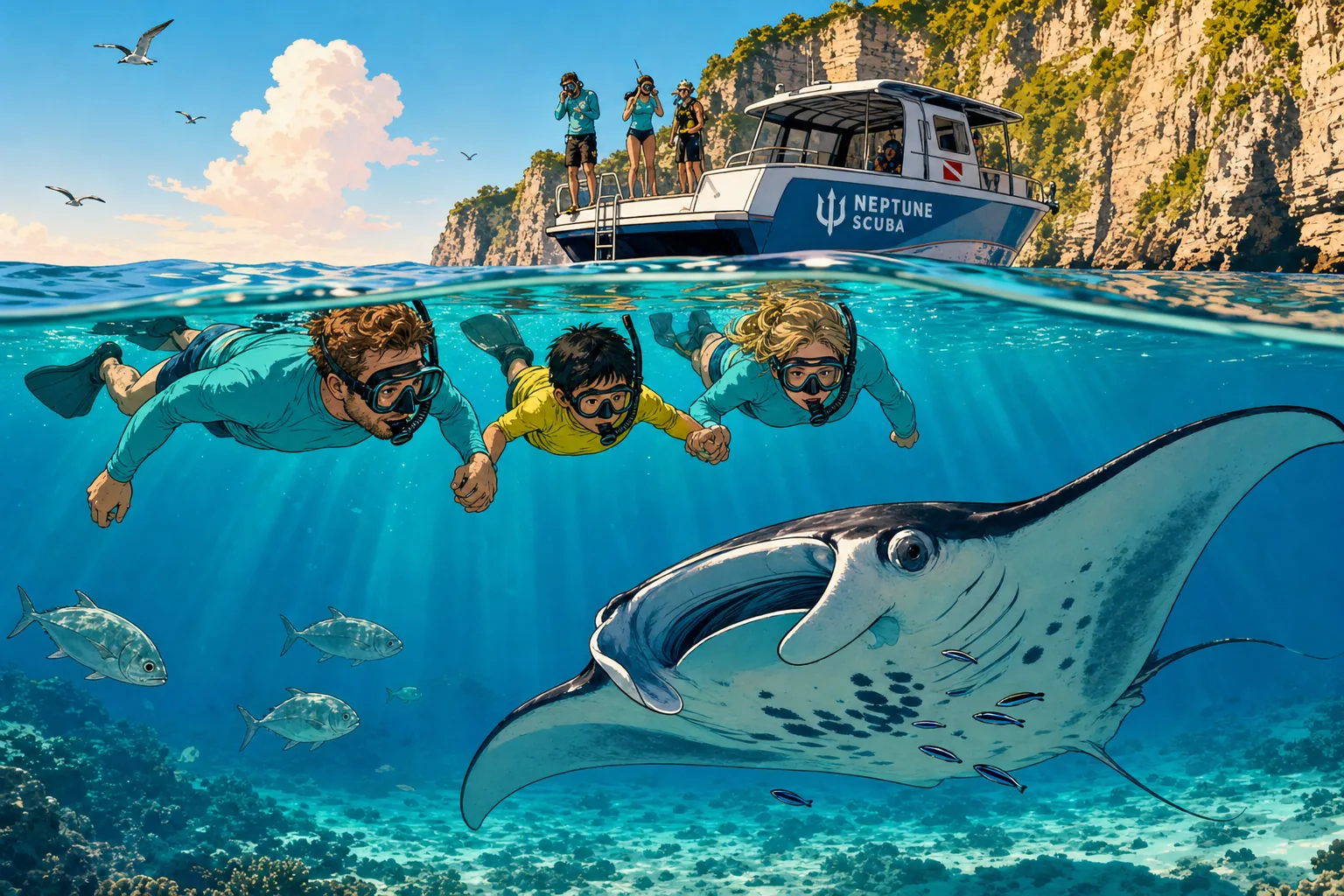
Snorkeling in Nusa Penida is one of the few things in Bali that genuinely lives up to the Instagram photos. The island sits in the deep Lombok Strait about 40 minutes from Sanur by speedboat, and the cold nutrient-rich upwelling that makes it world-famous for diving also gives it the visibility, the manta cleaning stations and the dense reef life that snorkelers travel halfway around the planet to see. We have been running our Snorkeling Nusa Penida day trip out of our Sanur shop since the mid-2000s and it is the single snorkel day we book most often, by some distance. The catch, and there always is one, is that not every Penida snorkel tour is the same, the currents are real, and the sites you read about on travel blogs are often not the ones you actually want to be at when the tide is wrong.
This guide is the long version of the conversation we have at the shop every morning with snorkel guests. We will cover the four main snorkel sites in clockwise order around Nusa Penida island, what each one actually delivers in terms of marine life and difficulty, when in the day and the year to dive each, the real safety concerns with the Wall of Death current and the Manta Point swell, the difference between a IDR 1,150,000 (≈ 65 USD) bus-tour snorkel and a IDR 2,070,000 (≈ 115 USD) proper operator-run day, how the boat day flows from a Sanur 06:45 pickup, and the practical things that nobody tells you (no flippers means no Manta Point, the tide turns hard at 11:00, lunch is at Toyapakeh village). For context on the wider menu of Bali snorkeling options we run from the same shop, we have a separate overview page. No glossy brochure phrasing, no pretending the Wall of Death does not exist. If something is dangerous we will tell you bluntly.
Comparing operators rather than planning one specific day? The Nusa Penida snorkeling tour guide sets out every tour format side by side, with typical prices, group sizes and what each one includes.
Why Nusa Penida Snorkeling Is in a Different League
Most Bali snorkeling is gentle. The Sanur lagoon is calm, shallow and warm; Amed is a quiet bay with a sandy entry; Menjangan is a national park with mooring buoys and almost no current. Nusa Penida is different. The 600 metre deep Lombok Strait separates Nusa Penida from mainland Bali, and the upwelling brings 22 to 26 degree water to the surface in dry season. That cold deep water carries plankton, which feeds the mantas; it carries clear visibility, often 25 to 30 metres on a good day; and it carries genuine current, which you have to plan around rather than ignore.
The marine life mix you can realistically expect to see from the surface is unmatched anywhere else within day-trip range of Sanur. Manta rays at the cleaning station at Manta Point (year-round, with peak sightings October to April, full deep-dive article on manta encounters at Nusa Penida), green and hawksbill sea turtles at Crystal Bay and Gamat Bay (every trip, usually 3 to 8 turtles in a day), large schools of pyramid butterflyfish at Toyapakeh and a wide variety of the colourful reef fish you typically see in Bali, occasional reef sharks resting on the sand at Mangrove Point, a healthy hard coral wall at Crystal Bay that has resisted bleaching better than most of Bali, and on the lucky days during mola mola season in August and September, a glimpse of the giant sunfish drifting up from depth before it sinks back down. Snorkelers will not see the mola the way divers do; if you want the underwater perspective, the diving Nusa Penida guide and the path through a try dive or a full PADI Open Water course is how you get there.
The trade-off is that Nusa Penida is not a beginner's wading-in-the-shallows snorkel. Even at the easiest sites you are swimming in 5 to 15 metres of water above a reef wall that drops to 30 metres, the boat is anchored 30 to 50 metres from shore, and you have to be a confident swimmer with fins on. We will refuse to take non-swimmers to Manta Point or the Crystal Bay drop-off; we will happily run a calmer half-day at the Sanur house reef instead for those guests, or suggest one of our other gentler Bali day trips. If you are weighing snorkel against scuba in the first place, the snorkeling vs diving comparison explains where each one wins. The honest assessment matters because the alternative is somebody panicking in a current 500 metres from a 60 metre limestone cliff, and we are not interested in being that operator.
The Four Snorkel Sites You Will Actually Visit
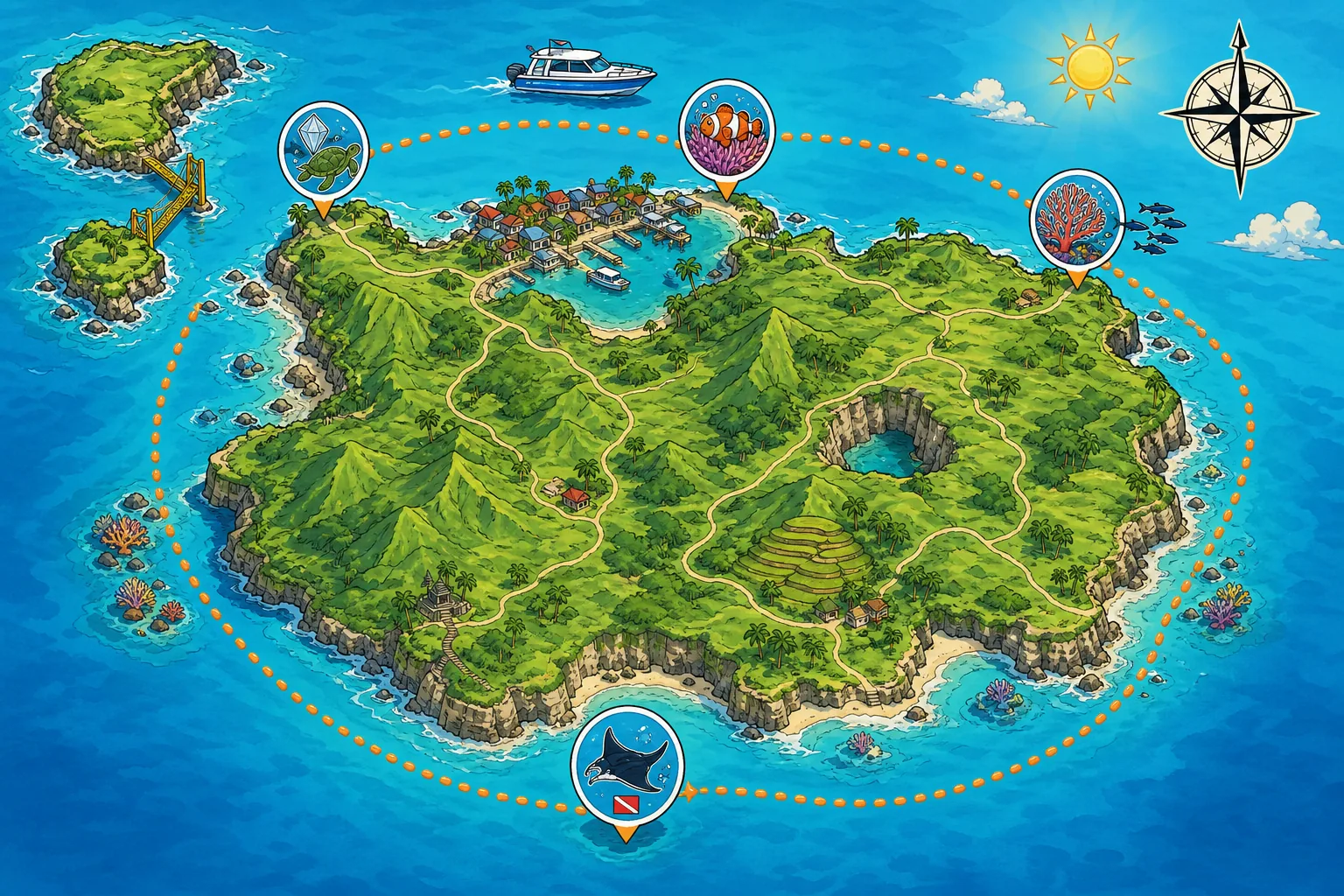
Every reputable Nusa Penida snorkel day trip from Sanur visits the same four sites, in the same clockwise order, because the swell, tide and crowd patterns make it the most sensible loop. The order is: Manta Point first (south coast, early morning while the swell is usually lowest, with Manta Bay as the backup when it is too big), Crystal Bay second (north-west coast, late morning when the tide turns), Gamat Bay third (north coast, lunch and easy reef), Toyapakeh last (north-east coast, afternoon protected reef). Total in-water time across the day is 3 hours 15 minutes to 4 hours, split into four 45 to 60 minute sessions with surface intervals on the boat for snacks and warm-up.
Manta Point (south coast, first stop, 08:00 to 08:45). This is the trophy snorkel of the day, the reason guests book the Penida trip in the first place. The boat anchors about 80 metres off the cliff face above a cleaning station in 8 to 12 metres of water. Mantas come up from the deep to be cleaned by wrasse, and they often pass within 2 to 4 metres of snorkelers floating at the surface. Manta Point is an easy site in one important respect: there is no real current. What it does have is swell. The site faces the open Indian Ocean, big swells are common, and on those days the snorkel can be uncomfortable and seasickness is more likely, which is why it is best snorkeled early, when the sea is usually calmest. We have a roughly 85 percent manta encounter rate at this site across the full year, dropping to 60 percent in the rough months of June and July. We hold a safety line off the back of the boat for guests who do not want to swim freely. Most snorkel incidents here come from the swell (panic-induced inhaled water, fins kicked off by a breaking wave), so we keep a strict 1-guide-to-4-snorkelers ratio and a second crew member in the safety dinghy. When the swell is too big, we snorkel Manta Bay instead: a more sheltered bay closer to the rest of the loop where mantas come to feed, with less consistent sightings.
Crystal Bay (north-west coast, second stop, 09:30 to 10:30). The visibility postcard of Penida. The bay forms a horseshoe of clear water between Nusa Penida and tiny Nusa Ceningan; the inner bay is calm and shallow, the outer wall drops to 40 metres and hosts the densest hard-coral garden we still have in southern Bali. Visibility is consistently 20 to 30 metres. Turtles patrol the bay all day; on a calm morning we have seen 12 different individuals in a single 50-minute snorkel. This is the site where guests who were nervous at Manta Point recover their confidence and remember why they came. The cold thermocline at 12 to 15 metres is what holds the mola mola in dry season; surface-snorkeling guests will not see them, but the water itself goes from 27 degrees on the surface to 19 degrees just below your face. Bring a 2 mm shorty if you have one. See the Blue Corner article for the geological context of why this bay is so clear.
Gamat Bay (north coast, third stop, 11:30 to 12:15, then lunch). The friendly site. Shallow protected bay with no current, anemones, clownfish, juvenile reef fish, easy coral garden in 3 to 6 metres of water. The site we save for tired snorkelers and for the children in any family group. After Gamat Bay we anchor at Toyapakeh village for a 45-minute hot lunch on the boat or on the village pier; rice, grilled fish, fresh fruit, water and tea included.
Toyapakeh (north-east coast, fourth stop, 13:15 to 14:15). A wall site protected from the prevailing swell, with a permanent school of pyramid butterflyfish numbering in the thousands. The wall starts in 4 metres and drops to 25, so even a surface snorkeler sees the whole vertical reef. The current here is gentle in the afternoon (the morning current is too strong for snorkelers and is best left to the divers). This is the wind-down site and the one that closes the loop before the 90-minute boat ride back to Sanur. Full details of all the Penida sites for divers and snorkelers are on the Nusa Penida dive sites page for cross-reference.
When You Will See What: Month-by-Month Penida Snorkeling Calendar
Nusa Penida is technically year-round, but the experience changes meaningfully with the season. Two factors drive it: surface conditions (wave, wind, rain) and water temperature (which controls what marine life surfaces from depth).
April to June (sweet spot). Dry season starting, surface calm, water 26 to 28 degrees, manta sightings consistent (around 80 percent), turtle sightings every dive, visibility 20 to 25 metres. Crowds are still low because the peak European summer has not yet arrived. This is our personal favourite window for a snorkel trip.
July to September (peak season, mola month). Dry season peak. Water cools to 22 to 25 degrees on the surface and a chilly 18 to 20 degrees at the thermocline. Mola mola peak window for the divers; snorkelers occasionally see one rise. Surface conditions can be choppy on the windward southern side of the island so Manta Point may get bumpy. Sites are crowded with day-tripper boats from 09:30; this is the season we tell our guests to take our 06:45 pickup specifically to be first on the water. See our best time to visit Bali article for context on the broader season planning.
October to December (manta-peak shoulder). Surface flattens again, water warms back to 27 to 28 degrees. Manta sightings increase as plankton density rises ahead of the wet season; we see our highest manta encounter rates of the year in November and December (close to 95 percent). Visibility is excellent. This is genuinely our second favourite window.
January to March (wet season). The hardest call. Rain showers are common but brief and often clear by 09:00. Surface conditions can range from glass-flat to rough depending on the day; we are not afraid to cancel and rebook a Penida day for the next morning if the forecast is genuinely bad. Manta sightings stay strong (around 80 percent), turtles unchanged. The rainy season diving article explains how we adapt; the same logic applies to snorkel days. About 1 day in 12 we cancel and offer a Sanur house-reef snorkel instead.
The Real Currents and Safety Reality of Penida Snorkeling
This is the section that most blog posts skip, and it is the one that matters most. Nusa Penida has currents that have killed people, including snorkelers, in living operator memory. We are not being dramatic; this is documented in the dive operator association incident logs. The good news is that with a professional operator who knows the tide windows and runs the right ratios, snorkeling Penida is genuinely safe; we have run it weekly for almost 20 years without a serious incident at our shop. The bad news is that not every operator advertising a Penida snorkel tour is a professional operator.
The dangerous current is the down-current at the south-west tip of the island, in the channel between Nusa Penida and Nusa Lembongan, around the area dive sites are nicknamed "Wall of Death" and "Toyapakeh Cleaning Station" (the latter for divers, not snorkelers). The current can flip from a manageable 1 knot drift to a 3 to 4 knot down-current within 15 minutes of the tide turning. A snorkeler caught in that current at the surface gets pushed offshore fast; recovery requires a chase boat, a thrown line, and a guide who knows what they are doing. This current does not affect Manta Point itself, which has no real current; the risk there is swell, covered below. We never anchor at Wall of Death proper on a snorkel day, and we time the north-coast sites around the tide. Some cheaper operators ignore the tide for cost reasons; the difference in safety is real.
The second risk is swell at Manta Point. The site has no real current, but it opens onto the Indian Ocean, big swells are common and they can build through the morning, making the snorkel uncomfortable even for strong swimmers. We have a hard rule: if the swell exceeds 1.5 metres at the manta anchor point, we do not put snorkelers in and switch to the more sheltered Manta Bay, or to Toyapakeh Reef if both are too rough. This is the call our captains make on arrival and we will not negotiate it. About 8 days a year we substitute for this reason.
The third risk is the cold thermocline at Crystal Bay. The 19-degree water just below the surface is genuinely cold; a snorkeler floating face-down for 50 minutes without thermal protection can develop mild hypothermia, especially small children. We provide 2 mm shorty wetsuits for all snorkelers as part of the trip; please wear them at Crystal Bay even if you feel warm on the surface. The pre-trip preparation article on diving and alcohol covers the broader rest-and-hydration guidance, which applies equally to snorkelers.
What we ask of you: be honest about your swimming ability at booking. If you cannot comfortably tread water for 5 minutes in 3 metre depth with no float, please tell us so we can plan accordingly (a private guide for Manta Point, or a different itinerary). Wearing fins is non-negotiable for Manta Point. No alcohol the night before. Stay within 5 metres of your guide at all times in the water. Surface, do not dive down (this is snorkeling, not freediving; the freedive ascent in current with no spotter is how people drown). Follow these and you will have a perfect day. Ignore them and we will end your snorkel early.
Crystal Bay Up Close: The Best Single Snorkel Site on the Penida Loop
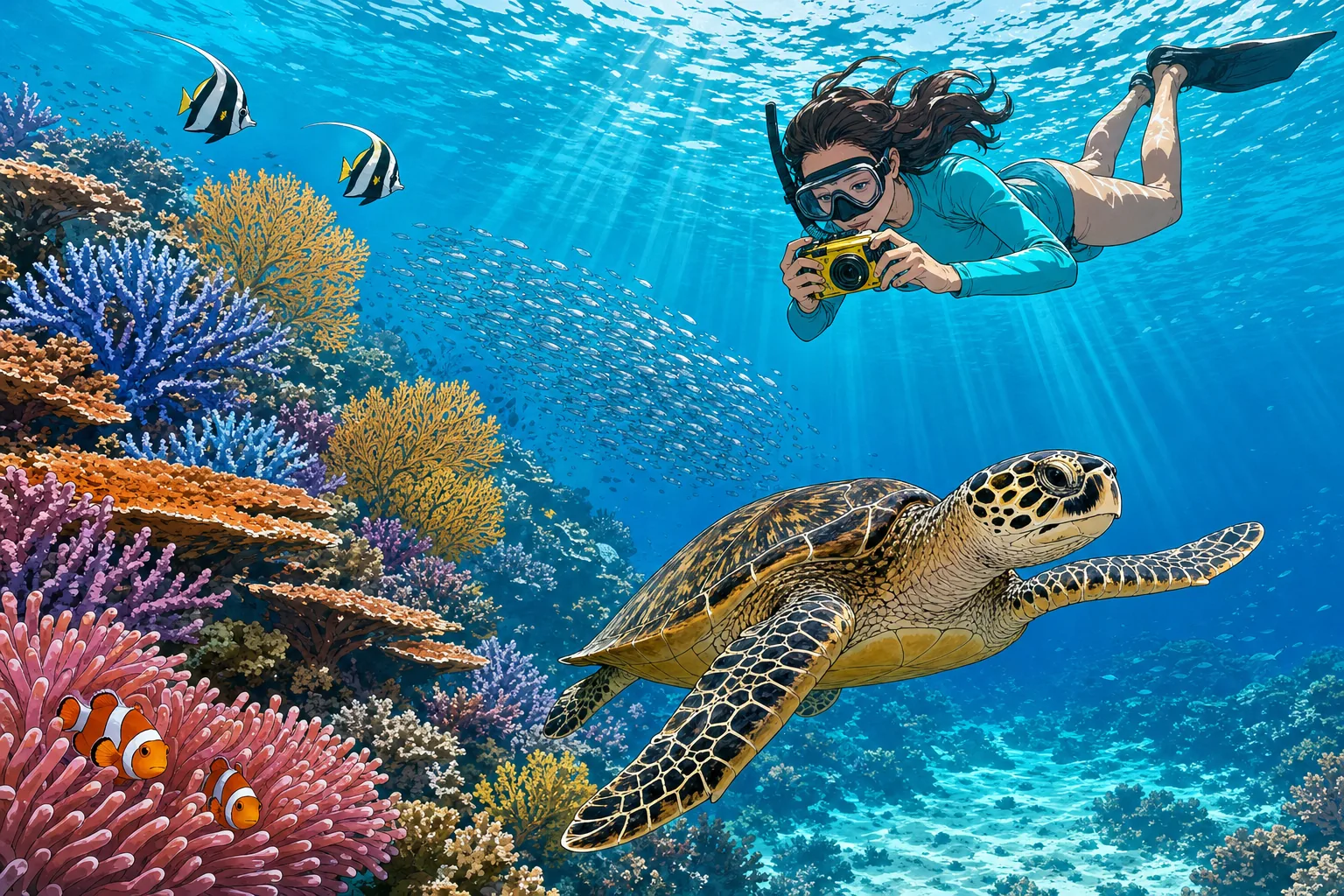
If you have to pick one site to spend the longest time at, make it Crystal Bay. The bay is a natural amphitheatre formed between the cliffs of Nusa Penida and the smaller Nusa Ceningan; the entrance to the bay funnels clean water in from the open strait and the inner bay is sheltered, calm and reflective. Visibility on a typical morning is 25 to 30 metres, the best you will find anywhere within day-trip range of Sanur. The bay is also the site where snorkelers most consistently see green sea turtles, both juveniles cruising the shallows and large adults patrolling the deeper wall.
The coral health at Crystal Bay is the second story here. The bay has resisted the 2016 and 2024 bleaching events that hit much of the rest of Bali; the inner bay coral garden is one of the few intact hard coral reef sections still functioning in central Bali. You will see pink staghorn forests, orange table corals up to 1.5 metres across, purple soft corals waving in the current, and bright yellow gorgonian sea fans on the outer wall. We point this out at the briefing because guests are sometimes underwhelmed by Bali reef compared to the photos they have seen from Raja Ampat or the Maldives; Crystal Bay is the one place in Bali where the reef genuinely matches those reference photos.
The other Crystal Bay specific is the underwater photography. The bay is the easiest site on the Penida loop for snorkel photography (calm water, clear visibility, no current to fight). If you are bringing a GoPro or an underwater camera, save your battery for here. The morning light at 09:30 to 10:30 comes in over the cliff at an angle that lights the coral from the side, which is photographically much better than the overhead noon light at the other sites.
What you will not see at Crystal Bay (because guests sometimes ask): the mola mola itself, normally. The mola lives at 25 to 40 metres in the colder water below the thermocline; only divers see them at depth. Surface snorkelers see a glimpse when one rises briefly to warm up, maybe once every 30 trips during the August-September window. Manage your expectations. The reef, the turtles and the visibility are the real reasons to come here, and they deliver every single trip.
How the Snorkel Day Actually Flows From a 06:45 Sanur Pickup

The chronology of a Penida snorkel day matters because every operator runs it slightly differently. Here is exactly how ours runs, in real time, so you know what you are agreeing to. This applies to guests staying in Sanur. For guests staying in Seminyak, Canggu, Ubud or Kuta, see our west-Bali pickup guide; add 60 to 90 minutes to the morning pickup time.
06:45 hotel pickup. Our driver collects you from any hotel or guesthouse in Sanur. We send a WhatsApp confirmation the night before with the driver name and vehicle plate. Please be ready and have eaten a light breakfast; if your hotel breakfast does not open before 06:30 we will stop at a warung along the way.
07:00 shop arrival and briefing. 15 minutes at our Sanur dive centre for paperwork, gear fitting (snorkel mask, fins, 2 mm shorty wetsuit, optional rash vest), and the safety briefing. Snorkelers and divers are briefed separately but on the same boat.
07:30 boat departure from Sanur beach. Walk down to the beach. Our snorkel boat is anchored 8 metres off the sand; we wade out and climb the rear ladder. The crossing to Nusa Penida takes 40 to 55 minutes depending on swell; the boat is fast and stable but the chop can be lively on a windy morning. Coffee and biscuits served on the boat during the crossing.
08:00 to 08:45 Manta Point. Direct to the manta cleaning station. 45 minutes in the water at the surface with the guide. Manta encounters typically happen in the first 20 minutes; if mantas are not present after 20 minutes we extend the session and the boat moves to a secondary cleaning station 200 metres west. The session ends by about 09:00 regardless of sightings, before the swell builds and the day-trip boats arrive. If the swell is too big on arrival, we move to the more sheltered Manta Bay instead.
09:15 to 09:30 boat transit to Crystal Bay. Crew serves bananas and water, you warm up in the sun.
09:30 to 10:30 Crystal Bay. 60 minute snorkel session, the longest of the day. Guide leads a slow loop around the inner bay coral garden and along the deeper wall.
10:45 to 11:30 transit to Gamat Bay. Snacks and warm tea on the boat.
11:30 to 12:15 Gamat Bay. 45 minute easy snorkel session for tired guests and children.
12:30 to 13:15 Toyapakeh village lunch. 45 minute lunch break, hot rice and grilled fish with fresh fruit. Bathrooms available on the pier. Tip your boat crew here if you want to (IDR 90,000–180,000 (≈ 5–10 USD) per crew member is standard; not expected, always appreciated).
13:15 to 14:15 Toyapakeh Reef. Final 60-minute snorkel session on the wall. Pyramid butterflyfish, occasional reef shark resting on the sand, beautiful afternoon light.
14:30 boat departure back to Sanur. 50 to 70 minute return crossing depending on afternoon wind. Free coffee, water and snacks on board.
15:45 to 16:15 Sanur beach arrival. Wade ashore, walk back to the shop, rinse gear, change. Driver waiting to take you back to your hotel; expect to be back in your hotel by 17:00 to 17:30 depending on traffic. Total trip duration door-to-door: about 11 hours.
The IDR 1,150,000 (≈ 65 USD) Bus-Tour Snorkel vs the IDR 2,070,000 (≈ 115 USD) Real Snorkel Day: Honest Cost Breakdown
If you Google Penida snorkel tour you will find prices from IDR 650,000 (≈ 35 USD) to IDR 2,700,000 (≈ 150 USD) per person. The range is real and the difference between the cheap and the proper option is genuine, not marketing. Here is the breakdown.
The IDR 650,000–1,150,000 (≈ 35–65 USD) bus-tour snorkel. These are run mostly out of Padang Bai or as bolt-ons to a "Nusa Penida Instagram tour" that combines the snorkel with a 5-hour island bus tour visiting Kelingking, Diamond Beach and Atuh. The boat is a 25 to 35 person ferry-class craft (not a dedicated snorkel boat), the ratio is 1 guide to 20+ snorkelers, you spend 25 to 30 minutes at each site (versus 45 to 60 in a proper day), gear is basic mask-and-snorkel only with no fins or wetsuit, lunch is a packed sandwich, and you visit 3 sites instead of 4. The Wall of Death current is not respected because they cannot run the tide windows for 30 people. Marketing aside, this is the budget option and the safety margin is genuinely thinner. Many guests have a fine day on these tours; some do not. If you book this option, accept it for what it is.
The IDR 2,070,000–2,700,000 (≈ 115–150 USD) operator-run snorkel day. This is what we offer at the shop on our standard Snorkeling Nusa Penida tour and what most professional Bali snorkel and dive shops run. Maximum 12 to 16 snorkelers per boat, 1 guide per 4 in-water, dedicated snorkel boat with covered seating, full gear (mask, fins, 2 mm shorty wetsuit, optional rash vest), the 4-site clockwise loop with conservative swell calls at Manta Point, hot lunch at Toyapakeh village, 4 in-water sessions of 45 to 60 minutes each, hotel pickup and drop-off included. The 2026 price at our shop is from IDR 2,070,000 (≈ 115 USD) per person for the standard two-session day (IDR 2,700,000 for three sessions). Children aged 6 to 12 are welcome. For family snorkel days with kids, the operator-run option is the only realistic one because the bus tour is not safe for children at Manta Point. See our full pricing breakdown for context on how snorkel pricing compares to dive pricing.
What you actually pay for in the difference. Boat ratio (small boat instead of ferry, you can hear the briefing, you have a seat under shade), guide ratio (1:4 vs 1:20, makes the difference between a guide and a tour leader), conservative swell calls at Manta Point (real safety, not theoretical), gear quality (especially fins and wetsuit), site time (45 to 60 minutes vs 25 to 30 lets you actually enjoy each site), lunch quality, pickup logistics (door-to-door vs meet-at-Padang-Bai harbour). For a IDR 920,000 (≈ 50 USD) difference per person on a once-in-a-trip Penida day, the upgrade is what we recommend to every guest.
Combining Snorkeling and Diving on the Same Boat (for Mixed Groups)
About 40 percent of our Penida snorkel guests are travelling with a partner or family member who dives. The combined snorkel-plus-dive day is one of our most popular bookings because the same boat carries both divers and snorkelers to the same sites, with the same lunch break and the same pickup. The schedule is identical to the snorkel-only flow above, except divers do two scuba dives during the morning and the snorkelers do four snorkel sessions; everyone meets back on the boat in between.
Logistically: the boat anchors at each site, divers descend on the dive guide while snorkelers stay at the surface with the snorkel guide; both groups surface within a 60-minute window and we move on together. The dive guide and snorkel guide are different people and the boat carries both. Divers get the deeper sites including the Crystal Bay drop-off (where mola mola live in season) and the SD Point drift; snorkelers stay at the inner bay reef and the Manta Point surface. The day works because Penida is one of the few Bali destinations where divers and snorkelers genuinely see the same animals (mantas, turtles) just at different depths.
Pricing for the combined day: from IDR 2,070,000 (≈ 115 USD) snorkel per person, from IDR 3,150,000 (≈ 175 USD) dive per person (two-dive Penida price), same boat and lunch. Many couples book a "two snorkel days plus three dive days" itinerary as part of our Bali dive trip itinerary planning; the combined snorkel-plus-dive days work best in the middle of the week when neither partner is jet-lagged. The full Nusa Penida day trip from Sanur article has the diver perspective if you want the matched view.
One thing to know: snorkelers on a combined boat sometimes feel like the "side activity" if the operator caters primarily to divers. We deliberately run a roughly equal split (8 snorkelers + 8 divers on a typical day) so the snorkel briefing is as detailed as the dive briefing and the snorkel guide has full attention. Some shops run "5 divers + 1 snorkeler" days where the snorkeler ends up with no dedicated guide; ask the operator before booking what the typical ratio is. We work at 1 snorkel guide per 4 snorkelers; anything worse than 1 per 6 is a red flag.
What to Bring, What We Provide, and the Practical Stuff Nobody Tells You
The packing list is shorter than you would think because we provide everything in the water. Here is the operator-honest list of what to bring versus what we give you.
What we provide on the boat: snorkel mask (fitted at the shop in the morning), fins, 2 mm shorty wetsuit, optional rash vest, towel, drinking water unlimited, coffee and tea, banana and biscuit snacks, hot lunch (rice and grilled fish with fresh fruit at Toyapakeh), shaded boat seating, sunscreen-rinse fresh water rinse after each session, dry bag storage for valuables.
What you should bring: swimwear under your clothes (so you are ready at the shop), a long-sleeve rashguard or t-shirt for sun protection (you will be at the surface for 4 hours), reef-safe sunscreen (we sell it at the shop if you forgot), a cap or wide-brimmed hat for between sessions on the boat, a waterproof phone case or dry bag for your phone (we provide one but you can bring your own preferred one), a small underwater camera or GoPro if you want photos (we do not provide cameras; we can rent one for IDR 450,000 (≈ 25 USD) for the day), motion sickness tablets if you are prone (take one with breakfast, not on an empty stomach), at least 50,000 IDR cash for the Penida marine park fee (paid on the boat, 100,000 IDR per person, we cover the rest), and an extra 100,000 IDR cash for tipping the boat crew at lunch if you want to.
What you should NOT bring: your own old mask from home that you have not tested recently (Penida is not the place to discover your mask leaks; we have brand-new masks at the shop), large dry bags that take up boat space (we have storage for small valuables), single-use plastic water bottles (Penida marine park is a no-plastic zone and we will ask you to leave them on the boat).
The things nobody tells you: the boat ride out has zero shade until you reach the cliffs, wear sun protection on the crossing; the swell at Manta Point can push you away from the boat, so always stay between the boat and the guide; Crystal Bay water is cold enough to numb your fingers in 30 minutes, the shorty matters; Toyapakeh village pier has the only proper toilets of the day, use them at lunch; do not feed the fish (illegal in Penida marine park and you will be asked to leave the water); your hotel breakfast probably does not open at 06:00, ask the night before for a packed breakfast or eat at the shop. The broader Bali packing list has the rest, including what to bring for the wider trip.
If you have read this far and you are still not sure whether Penida snorkeling is right for your group, send us a WhatsApp or email with your group size, ages, swimming confidence, dive certification levels and date range. We will reply within 12 hours with a custom suggestion. The default answer for most travellers is yes, the operator-run Penida day is one of the best snorkel days in Asia and the safety record at a proper shop is excellent. The cases where we suggest a different option are usually non-swimmers (we recommend the calmer Sanur snorkel or Menjangan day instead), guests with very young children under 6 (Sanur lagoon is safer), and guests staying north or west of Ubud where the pre-dawn pickup becomes painful. For everyone else, this is the trip we book most often, and there is a reason for that. Direct booking is at the online booking page or just walk into the shop in Sanur.