

Most people planning a Bali holiday work backwards from beaches, temples and rice fields, then try to wedge the diving in somewhere. We do the opposite at the shop, because we have seen what happens when a dive trip gets squeezed into the leftover hours of a beach holiday: shortened bottom times, missed boat windows, and the heartbreak of cancelling the second dive day because someone is flying out the next morning. A proper Bali dive trip itinerary starts with the dive days and arranges everything else around them. After 17 years of running Bali dive packages out of our Sanur base, we have a pretty firm view on what works for 5, 7, 10 and 14 nights, and what reliably does not.
This guide is the long version of the planning conversation we have at the shop with every multi-day guest. We will walk through four full itineraries with day-by-day breakdowns, explain why the order of dive sites matters more than which sites you pick, cover the flight and surface-interval buffers that most websites quietly skip, and tell you which of our standard Bali day dive trips slot into each plan. Everything here is built from real schedules we run weekly, with the actual times and pickup windows our drivers and skippers actually use. No filler, no glossy brochure phrasing, no pretending that traffic and seasonal swell are not real factors. If a day is awkward, we will say so.
Why Bali Diving Needs an Actual Itinerary, Not a Day Plan
Bali is a paradoxical dive destination. The diving itself is world class, with sites that would justify a one-week trip almost anywhere else: the USAT Liberty wreck at Tulamben, manta cleaning stations and the mola mola migration off Nusa Penida, drift dives at Gili Tepekong and Mimpang from Padang Bai, and macro critter heaven at Amed and the Tulamben coral garden. But the dive sites are spread along about 110 km of east and south coast, the boat departures are tied to current and tide windows you cannot move, and the road network was designed for ox-carts. Squeezing all of this into a 4-day window without an itinerary is how holidays turn into a stress test.
The trick is to think in terms of zones rather than sites. Zone one is south Sanur (our centre, the boats for Penida, the house reef). Zone two is the Padang Bai cluster (Blue Lagoon, Jepun, the Gilis). Zone three is the Tulamben-Amed strip on the far east coast. Zone four is Menjangan in the far north-west. Each zone is a self-contained day or set of days; you do not zig-zag between them, you do them in geographic order. The itineraries below are all built that way, which is why they actually work.
The other reason itineraries matter for Bali specifically is the no-fly buffer. PADI recommends 18 hours minimum between your last dive and your flight, and we enforce a strict 24 hours. That means the last full day of your trip cannot be a dive day. Then the first full day after arrival is usually a recovery day (jet lag, dehydration, paperwork). So a 5-night trip is not 5 dive days; it is 2 to 3 dive days at best. This single fact changes every plan and we will reference it throughout. For first-timers, our first time diving in Bali article explains what to expect on that very first day.
Three Things to Lock In Before You Build Your Itinerary

Before you spend an hour reshuffling days in a spreadsheet, lock down three constraints. They drive every decision that follows and most planning mistakes come from skipping them.
One: your flight times and the 24-hour no-fly window. Write your arrival time and departure time at the top of the page. Cross out the last full day before departure as a non-dive day. If your flight leaves before noon, cross out the morning of departure day too (you cannot dive that morning either). The remaining days are your potential dive days, before you have even chosen a site.
Two: your certification level and dive count. A diver with 8 logged dives all done on a try-dive holiday in Thailand 4 years ago is not the same as a diver with 80 dives and a current dive computer. Some Bali sites have current, depth and surge issues that demand recent experience: Crystal Bay and Manta Point on Penida, the Liberty wreck below 18 m, the Gili Tepekong canyon. If you are rusty, plan a half-day Sanur refresher dive as day one of your dive itinerary. Two hours in a calm controlled environment buys you the confidence to enjoy the trophy dives later. We will not skip this step for guests who have not dived in more than 12 months, even at the cost of a planned dive day; it is a safety issue, not a sales upsell.
Three: your season. Bali has two seasons that matter for diving. Dry season (April to October) is the classic period for the mola mola at Penida, calmer surface conditions, easier visibility. Wet season (November to March) is manta season at its best and has fewer crowds, but more weather days. Our best time to visit Bali article and the mola mola season guide have the month-by-month breakdown. The seasonal call also affects your buffer: if you are diving in February we will quietly add a buffer day to your plan because we know we lose roughly 1 day in 10 to swell or rain. The rainy season diving article explains how we adapt.
With those three locked in, you can pick the itinerary that fits the number of nights you have. The next four sections give you the day-by-day plans for the four most common trip lengths we book.
The 5-Day Bali Dive Itinerary: One Dive Day, One Trophy
A 5-night trip is the minimum we encourage for any dive-focused Bali visit. It gives you 2 realistic dive days, 1 buffer day, and the arrival-departure days for travel. If you have any less than 5 nights, we will be honest and tell you to dive in Bali on a future trip and use this one for surface holidaying. The maths simply does not work for less.
Day 1 (arrival). Land at DPS, transfer to Sanur (40 minutes on a quiet afternoon, 90 in the worst traffic). Check in. Wander to the beach promenade for a Bintang, sleep early. No diving on arrival day, ever. The cabin-pressure dehydration alone makes you a poor dive partner the next morning.
Day 2 (refresher and warm-up). Half-day Sanur house-reef try-dive or refresher session, 07:30 to 13:00. Easy reef in 12 to 14 m of water, no current, perfect to get your buoyancy back and re-check your gear with our instructors. Afternoon is for lunch, beach, possibly a sunset boat ride. If you are confidently current (50+ dives, dived within the last 12 months) you can swap this for the Padang Bai easy day and save it as a second trophy.
Day 3 (trophy day). The big dive day. Two options depending on season: a Nusa Penida manta or mola day trip (06:30 pickup, two dives at Manta Point and Crystal Bay or similar, back to Sanur by 16:30) or the Tulamben USAT Liberty day trip (05:45 pickup, two dives on the wreck and coral garden, back to Sanur by 17:30). Pick one. With only 2 dive days, do not try to do both; you will be exhausted on the boat ride home and you will sleep through your last evening.
Day 4 (buffer day, no diving). This is the day people want to dive and end up regretting it. The no-fly window means day 4 cannot be a dive day if you fly out day 5. Use day 4 for surface holiday activities: rice fields, temple, spa, day trip to the volcano viewpoint, or the cheap version, lying by your hotel pool reading. We sometimes book guests onto a half-day Sanur snorkeling trip on day 4 because snorkeling has no nitrogen load and lets you stay in the water without compromising your flight schedule.
Day 5 (departure). Transfer to airport. Done. The 5-day itinerary is honest and effective; you get a refresher and a trophy dive, no exhaustion, and you fly out healthy. The trade-off is that you only really see one zone of Bali diving. Almost everyone who does this itinerary tells us they should have booked longer; about a third of them come back the same year for a second trip.
The 7-Day Bali Dive Itinerary: The Sweet Spot
The 7-night trip is the most popular itinerary we run, and for good reason. It gives you 3 to 4 realistic dive days, real recovery time, and you get to see two of the four dive zones properly. If you have the holiday budget for a 7-night trip, take it; the value of the extra dive days is far higher than the value of the extra accommodation cost.
Day 1 (arrival). Same as the 5-day. DPS to Sanur, no diving.
Day 2 (refresher and reef warm-up). Morning Sanur house-reef refresher dive, afternoon free. Same logic as the 5-day. Skip only if you are very current.
Day 3 (Padang Bai day). Two-tank Padang Bai day trip to Blue Lagoon and Jepun, 06:30 pickup, back by 16:00. Easy reef diving with good visibility, soft corals, and a chance at a juvenile reef shark or two. Great for getting your dive count up before you tackle the harder sites later in the week.
Day 4 (rest and lunch). No diving. This is the critical rest day that the 5-night itinerary cannot afford. Use it. The whole point of having 7 nights is that you can take a full day off after day 3 and still have 3 dive days left. Most guests do an Ubud or volcano excursion; some just sleep, eat and swim in the hotel pool.
Day 5 (Tulamben trophy day). Tulamben USAT Liberty day trip. 05:45 pickup, two dives on the wreck (one shallow at 12 m on the stern, one deeper at 22 m on the bow), hot Indonesian lunch on the beach, back to Sanur by 17:30. The Liberty is the single most famous dive in Bali and is generally the dive most guests talk about for years afterward. See the full USAT Liberty wreck article and the broader Tulamben diving guide for context before the dive.
Day 6 (Nusa Penida day). Nusa Penida manta or mola day trip. 06:00 pickup, two dives at Manta Point or Crystal Bay (mola season is July to October), back to Sanur around 16:30. This is the highlight of the trip for almost everyone; mantas at the cleaning station are unforgettable and the mola sightings during the right months are equally remarkable. Spend the evening at one of the Sanur seafood restaurants on the beach, you have earned it.
Day 7 (departure). 24-hour no-fly buffer means no diving today, even if your flight is in the evening. We offer a free gear rinse and pack-down service for guests with afternoon or evening flights; drop off your kit at the shop in the morning, pick it up clean and dry before your transfer. Saves you wet wetsuit in suitcase, which everyone has experienced once and never wants to experience again.
This 7-day plan is the operator favourite. We have run it hundreds of times. It gives you four dives across three of the most distinct zones in Bali diving, with proper rest in between, and you leave fresh rather than wrecked. If your trip is 7 nights, this is the default we will quote you unless you specifically ask for something different. Many guests use those rest hours to start a PADI Open Water or Advanced Open Water eLearning module if they are working toward certification.
The 10-Day Bali Dive Itinerary: East Coast and Penida, Properly
A 10-night trip changes the conversation. You now have 5 to 6 dive days, multiple rest days, and the option to do the things the shorter trips force you to skip: a night dive, a deep specialty, a second crack at Penida, an Amed muck day, or an Open Water certification course. This is also the point at which we start recommending you split your accommodation, two or three nights up the east coast, the rest in Sanur.
Day 1 (arrival). DPS to Sanur. No diving.
Day 2 (refresher). Half-day Sanur refresher or, if you are very current, jump straight to a Padang Bai day.
Day 3 (Padang Bai). Two-tank Padang Bai day trip, Blue Lagoon and Jepun. Easy day, builds your dive count, friendly site to get reacquainted with the gear and currents.
Day 4 (rest). No diving. Cultural day in Ubud or Sanur, lunch, sleep.
Day 5 (Tulamben trophy). USAT Liberty two-tank day trip.
Day 6 (Tulamben night dive bonus). Optional but recommended: spend a night up at a Tulamben hotel and do the dawn Liberty dive plus the Tulamben night dive the following evening. Night diving on a wreck with bioluminescence and bobtail squid is one of the experiences that turns recreational divers into hooked-for-life divers. If you skip the overnight, day 6 is a Sanur house-reef day with a refresher of any skills (drift, navigation) you want to brush up on. The PADI Night Diver specialty can be completed in two evenings if you want certification with it.
Day 7 (rest). No diving. Pool. Spa. Sleep. This rest day is essential after four diving days in five with a night dive thrown in.
Day 8 (Nusa Penida day 1). Manta or mola day trip from Sanur. Same logistics as the 7-day itinerary.
Day 9 (Nusa Penida day 2 or Amed). If the Penida day 1 was a knockout, go back for a second day at the Penida sites you missed, this time with confidence (Toyapakeh, SD Point, or Crystal Bay if you missed the mola). Use the Nusa Penida dive sites page to choose. Alternative: drive up to Amed for a slower day of macro and reef in the calmer Lipah Bay area; the Amed diving guide has the site list. Either is excellent. About 60 percent of our 10-day guests pick the Penida repeat, about 40 percent pick Amed.
Day 10 (departure). No-fly buffer day. Transfer to airport.
The 10-day plan gets you 5 to 6 dive days across three or four distinct zones, with sufficient rest, and the option of certification embedded in the schedule. It is the itinerary we quote for guests who are serious about diving but cannot quite commit to a full 14-night trip. The honest trade-off is that you still cannot do Menjangan or a liveaboard inside 10 nights without sacrificing one of the trophy days. For that, you need the full 14.
The 14-Day Bali Dive Itinerary: Add Liveaboard, Menjangan or Komodo
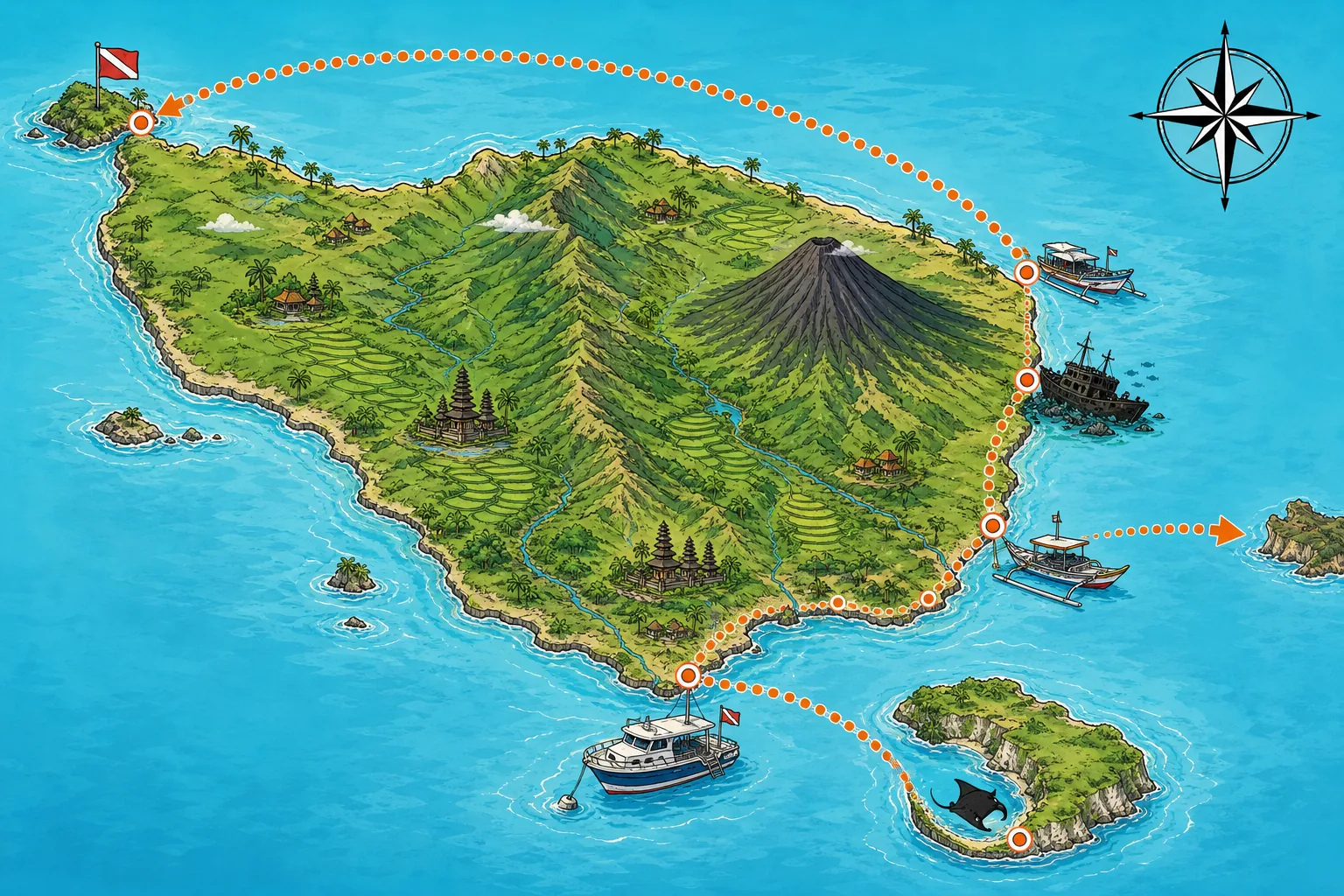
Two weeks in Bali for diving is the gold standard. You have time to do everything the island offers and to add a major regional dive trip (a Komodo liveaboard, a Menjangan multi-day, or a Banda Sea trip) without compromising the Bali highlights. The 14-night itinerary is the only one in this guide that does not feel rushed; it is also the one returning divers consistently book.
Days 1-2 (arrival and refresher). Same as the 10-day. DPS, Sanur, half-day refresher.
Days 3-4 (Padang Bai + rest). Padang Bai two-tank, rest day next.
Days 5-6 (Tulamben overnight with night dive). Drive to Tulamben on day 5 morning, two dives on the wreck and coral garden in the afternoon. Overnight in Tulamben at a small dive resort. Dawn Liberty dive day 6 morning, breakfast on the beach, second site like Drop Off or Coral Garden mid-morning, drive back to Sanur in the afternoon.
Day 7 (rest in Sanur). Half day at the beach, half day for laundry and admin. Plan your second week.
Days 8-9 (Nusa Penida double). Two consecutive Penida day trips. Day 1 manta and Crystal Bay, day 2 SD Point and Toyapakeh or a return to Manta Point if conditions favoured a different sighting. Most guests get their best Penida dives on day 2 when they know the site briefings and the dive guide knows their air consumption.
Day 10 (rest). No diving. Recovery day.
Days 11-13 (the big regional add-on). Three options here, all excellent. First option: a 3-day, 2-night King Neptune Komodo liveaboard or 4-day Komodo liveaboard trip out of Labuan Bajo, flown from DPS. This is the high-impact option; you dive Komodo, you eat on the boat, you sleep on the boat, you come back transformed. Second option: a 3-day Menjangan trip, drive to the north-west coast on day 11, dive Menjangan and Pemuteran on days 12 and 13, drive back. Lower intensity, beautiful coral, no liveaboard nights. Third option: a slow Amed week with three macro days and one mola hunt back at Penida. See the Komodo vs Bali diving comparison article if you are deciding between the regional add-ons.
Day 14 (return to Sanur, no-fly buffer). If you did the liveaboard, fly back from Labuan Bajo to DPS in the morning, return to Sanur, day 14 is your no-fly buffer. If you did Menjangan or Amed, drive back to Sanur on the afternoon of day 13 and use day 14 as buffer.
Day 15 (departure). Transfer to airport, fly home. Wait, you only had 14 nights, you say? Yes, the maths is: 14 nights = arrival day + 13 intervening days + departure day = 15 calendar days for planning purposes. Always count nights, not days, when booking flights and dives.
The 14-day plan is what we book for honeymoons, dive holiday milestones, retirement trips, and anyone serious about underwater photography or videography. You will get 8 to 10 dive days in total, two or three distinct regional experiences, and you will see Bali properly on the surface as well. The trade-off is cost: a 14-night trip is roughly double the dive cost and accommodation cost of a 7-night trip. If your budget is tight, the 7-night plan is genuinely excellent; if your budget allows 14, this is the one that creates the deepest memory.
Match the Itinerary to Where You Are Actually Staying
All four itineraries above assume you are based in Sanur or willing to relocate there. The reality is that many divers arrive in Bali with hotels already booked in Seminyak, Canggu, Ubud, Kuta or Jimbaran. The good news: every plan in this guide still works from those areas, with our included hotel pickup from the south-west and central Bali. The cost is extra van time, typically 1 to 1.5 hours extra per dive day. The pickup itself is included in our day trip prices, with no surcharge.
If you are doing the 5-day itinerary from a Seminyak hotel, the maths is fine; two dive days with longer mornings is annoying but bearable. If you are doing the 7-day plan from Seminyak, we will gently suggest you relocate to a Sanur hotel for two of the central nights; you save 4 to 6 hours of van time across the dive week, and you arrive at the boat fresher. If you are doing the 10-day or 14-day plan from a non-Sanur hotel, we will more firmly suggest relocating, because the cumulative fatigue from long van rides will start to compromise the back half of your dive days.
Ubud is the interesting case. Despite being inland it is actually closer to Padang Bai and Tulamben than Seminyak is, so the Padang Bai and Tulamben days are easy from an Ubud base. Penida is the awkward dive day from Ubud (the boat leaves Sanur at 07:30 and pickup is 05:30 from Ubud). Many Ubud-based guests do their Penida day on the morning they relocate down to Sanur, killing two logistical birds with one stone.
Kuta, Legian, Jimbaran are the easiest non-Sanur hotel zones to dive from because the airport-bypass road is fast in the early morning. The Sanur diving area page explains what relocation looks like, and the Sanur dive centre page has our facility details.
The Logistics That Decide Whether Your Itinerary Survives Reality
An itinerary on paper is the easy part. Surviving contact with Bali is the hard part. Here are the operational details that most guides skip and that we treat as non-negotiable.
Pickup windows. Standard pickup from a Sanur hotel is 30 to 45 minutes before boat departure. From Seminyak, Canggu or Ubud, pickup is 90 to 120 minutes before boat departure (we factor in the morning traffic). We send a WhatsApp confirmation the night before with the driver name, van plate, and a Google Maps pin. About 80 percent of late starts are caused by a confused hotel security guard who was not warned; tell your front desk the night before that a Neptune Scuba van will arrive at the pickup time.
Gear handling. We provide all gear (BCD, regulator, fins, mask, computer, wetsuit) on every day trip; you bring swimwear and a rash vest if you have one. If you bring your own mask or computer, label it. Lost gear during the panic of a 06:00 pickup is a real thing. Our standard rental gear is Aqualung BCDs and regs serviced every 6 months; computers are Suunto Zoop Novo. The full Bali dive packing list covers what to bring versus what we provide.
Cash for marine park fees. Penida marine park fee is 100,000 IDR per person per day in cash, collected on the boat. Tulamben village fee is 25,000 IDR per dive. Carry small bills; the boat does not have change for a 200,000 note. We will remind you the night before but bring it anyway.
Surface interval and back-to-back day rules. Two dives per day, 60-minute surface interval, is the standard schedule we run. We do not do three-dive days on any of our standard trips because the safety margin gets thin and the fatigue is real. We also enforce a recovery day after every three consecutive dive days; the 7-day itinerary builds this in, the 10-day and 14-day allow more flexibility. If you push for back-to-back dive days without rest we will say no and explain why.
Nitrox. Available at our shop for IDR 360,000 (≈ 20 USD) per day if you are certified. We strongly recommend nitrox for guests doing more than 3 dive days in a row; the reduced surface-interval fatigue and the small bottom-time gain compound across a multi-day trip. If you are not nitrox certified, you can do the enriched air specialty course as a 1-day evening eLearning plus one in-water session add-on. Worth doing on day 2 of a 10-day or 14-day plan.
Bookings and confirmations. We confirm every dive day the evening before by WhatsApp. If weather looks marginal we may move sites (Penida day to Padang Bai, for instance, if the Lombok Strait is rough). We never cancel a guaranteed dive day; we substitute, refund or reschedule. About 5 days per year we move a Penida day to Padang Bai because the swell does not allow safe boating; about 2 days per year we cancel and refund a dive day entirely because of weather. Both are part of the operator-honest plan.
Pricing summary for 2026. Sanur house-reef single dive IDR 1,150,000 (≈ 65 USD), Padang Bai two-tank IDR 2,700,000 (≈ 150 USD), Nusa Penida day trip IDR 2,950,000 (≈ 165 USD), Tulamben USAT Liberty day trip IDR 2,950,000 (≈ 165 USD), Tulamben night dive IDR 3,500,000 (≈ 195 USD), multi-day Bali dive packages starting at IDR 6,500,000 (≈ 360 USD) for 3 days. All prices include door-to-door hotel pickup, all gear, marine park fees, lunch and water. The full price list has every option, and direct online booking is the fastest way to lock in dates.
The End-of-Trip Send-Off (and the Things to Skip)

Every multi-day dive trip we run ends the same way: a sunset on Sanur beach with the last group of guests sharing a Bintang and trading stories about the dive that surprised them. We do not formally organise this; it just happens because the boat comes back, the gear gets rinsed, and the guests gravitate to the beach. We mention it because it is the single most reliable predictor of whether someone will come back the following year. The guests who skip the last evening because they have an early flight or a packed schedule are the ones who tell us six months later that they should have stayed one more night. Build the buffer day in. Have the sunset Bintang. We will be there.
The other category of advice for closing out your trip is what to skip. Three things in particular waste itinerary days for dive-focused guests:
One, two-hour temple tours that involve four hours of driving. The temples are beautiful and worth seeing, but pack them into a single day rather than spreading them across the dive week. Two, beach clubs in Seminyak on a dive afternoon; the dehydration plus alcohol plus residual nitrogen combination is not worth it for the photos. Three, attempting Nusa Lembongan as a separate dive trip if you are also doing Penida from Sanur; you will dive essentially the same sites with worse logistics.
What is genuinely worth adding to the surface days: a half day of snorkeling at Sanur for non-diving travel companions, an Ubud rice paddy walk on a rest day, a sunrise Mount Batur trek if you are not diving the following day, and a proper lunch at one of the family-run warungs near our shop. Bali is more than its dive sites and a smart itinerary leaves room for that.
If you are still in the planning stage and want a second opinion, send us a WhatsApp or email with your arrival and departure dates, certification level, dive count, season, hotel area, and budget bracket. We will reply within 12 hours with a custom 5, 7, 10 or 14-day plan built around your specific constraints, not a copy-paste of one of the templates above. We do this for every multi-day booking and the suggestion is built around your travel logistics rather than around what is easiest for us to sell. Families diving with kids get a different plan from honeymooners; certified divers get a different plan from first-time divers; mola-mola chasers get a different plan from manta seekers. The right itinerary is the one that survives contact with your actual trip, not the prettiest one on paper.