
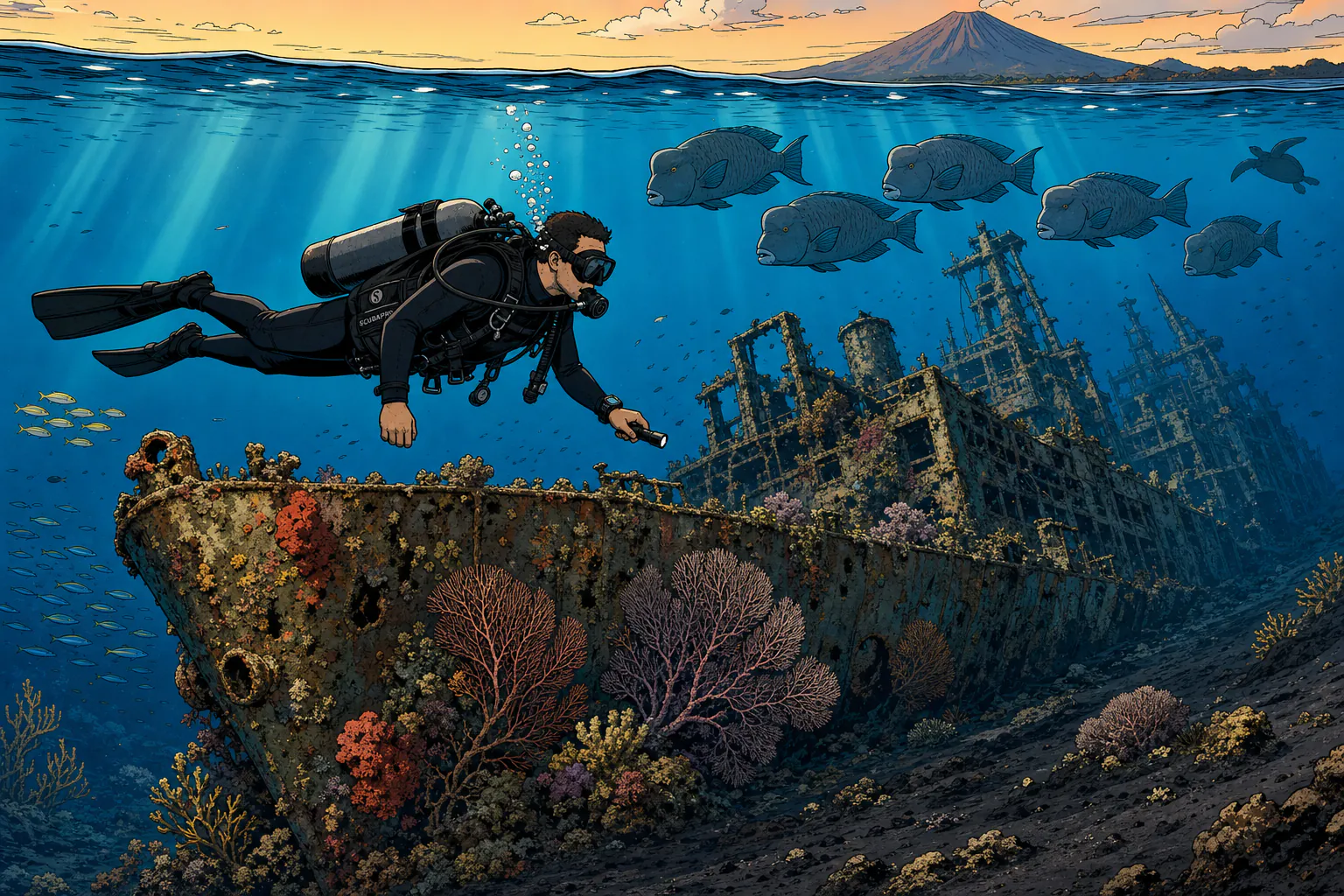
If you only get to dive one place in Bali, dive Tulamben. That is not the answer most operators want to give you (we make money taking people to Nusa Penida and Komodo), but it is the honest one. Tulamben packs more variety into a 300-metre stretch of black sand beach than most destinations manage across an entire island. World-class shipwreck five metres from shore. Macro that rivals Lembeh. Wall dive that drops into deep water without a boat ride. Year-round diving for every skill level, beach entries, and the most reliable conditions on the island.
This is the article we wish we could send to every diver who asks "Tulamben, is it really worth the three-hour drive from Sanur?". Yes. Here is everything we tell guests at the briefing the night before the trip, plus the operator-level detail nobody writes down because there is no money in giving it away. We run Tulamben trips four to five times a week year round, mostly out of Sanur, occasionally as 2 or 3 day overnight packages. This guide covers every dive site in the bay, when to come, what to bring, who it is for, and what to expect.
Where Tulamben is, and why it became Bali's best dive destination
Tulamben is a tiny coastal village on Bali's north-east coast, sitting at the base of Mount Agung, the active volcano that dominates the eastern half of the island. By road it is about three hours from Sanur, two hours from Ubud, and an hour from Amed. The village itself is maybe 800 metres long, a single road, half a dozen dive resorts, a handful of warungs, and a beach made of black volcanic pebbles that locals call "stones the size of an elbow" with good reason.
The reason Tulamben is what it is comes down to a 1942 World War II submarine torpedo and a 1963 volcanic eruption. The USAT Liberty was a US Army cargo ship torpedoed by a Japanese submarine just off Lombok in January 1942. The crew managed to beach her at Tulamben to salvage the cargo, and there she sat for 21 years on the beach until Mount Agung erupted in 1963 and the tremors pushed her down the slope into the water. She now rests on a sand slope between 5 and 30 metres, parallel to shore, with the bow accessible from a 20-metre swim off the beach.
That is the headline. The full story is that the same volcanic geology that buried the wreck created one of Indonesia's most unusual coastal environments: a steeply shelving black sand slope with no fringing reef to stop you, drop-offs that fall straight into open ocean within metres of shore, dense nutrient flow from the deep, and very little human pressure historically (the village was too remote until the 1980s). The wreck happened to land in the perfect lab for marine life to colonise. Forty years later it is a thriving artificial reef, and the dives either side of it are arguably better.
The dive sites of Tulamben Bay
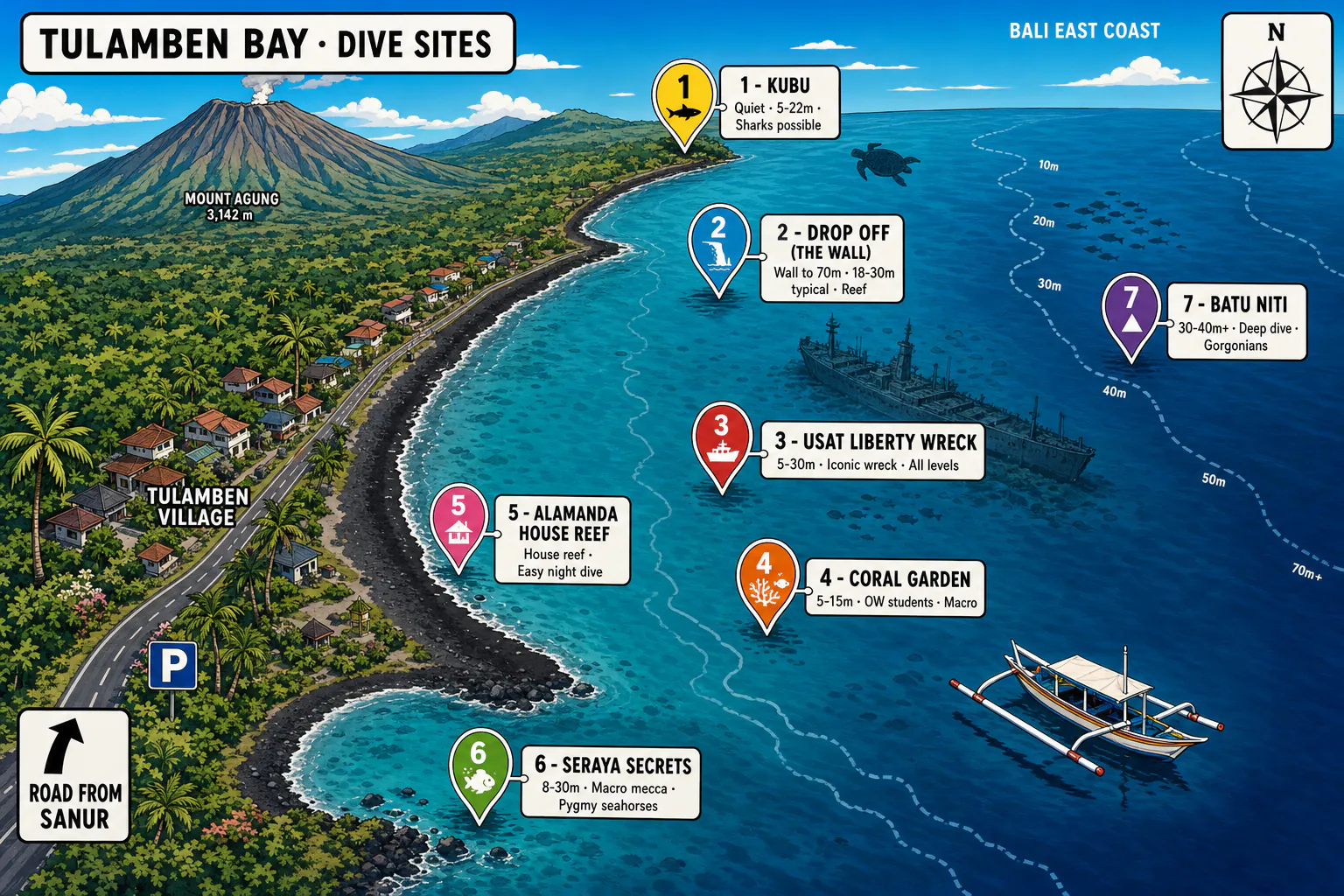
The Tulamben "dive area" is really one continuous black sand slope about a kilometre long. The seven sites we run are pinned to specific features, but in practice the bay flows together and a 70-minute dive can easily cross two named sites. All entries are off the beach, no boat required for any of the main sites.
1. USAT Liberty wreck
The flagship. The wreck lies parallel to shore between 5 and 30 metres, broken into a few main sections (bow, midsection, stern) with the gun deck around 28 metres being the deepest commonly-dived point. The wreck is encrusted in coral and sponges, schools of jackfish swirl around the midsection at dawn, and a resident pair of giant trevally hunt the bow. Bumphead parrotfish come in at first light and graze the wreck for about an hour before moving on. Pygmy seahorses live on dedicated gorgonian fans growing off the hull (your guide knows which ones).
The Liberty is divable for every level from Open Water up. Most divers do it twice in a day: once at dawn before the crowds, once around 9am with a focused subject (the gun deck, the wheelhouse, or one of the pygmy seahorse fans). For the full breakdown including the history, the layout, navigation tips and the photo composition spots, see our dedicated USS Liberty Bali article.
2. Coral Garden
One hundred metres north of the Liberty, Coral Garden is the shallow sister site that most divers underrate. Depth profile 5 to 15 metres, gentle slope, a healthy mix of hard and soft coral patches scattered across black sand, with old wreck artefacts and the famous "underwater statues" placed by a local restoration project decades ago. The statues (a small Buddha, a few mooring blocks, broken propeller pieces) have become small ecosystems in their own right.
This is the site most Open Water students do their final two dives at, because everything they need to practice (controlled descents, neutral buoyancy along contours, navigation across sand patches) is here at safe depth. It is also the best dive in the bay for macro between dives at the Liberty, with high frogfish counts, multiple ghost pipefish species, and one of the densest nudibranch populations we have ever surveyed in Bali. See our Bali macro guide for what you will actually find here.
3. Drop Off (The Wall)
Two hundred metres south of the Liberty, the bay floor pitches over a vertical wall that drops to 70 metres. You dive it as a wall dive, hugging the rock face down to 25 or 30 metres, drifting north with the gentle current, then turning around on a reciprocal heading to come back along the same wall at 12 to 15 metres on the safety stop. The wall itself is encrusted with massive fan corals (some over two metres across), barrel sponges the size of a small car, schooling fusiliers, and on a good day, white tip reef sharks resting on the ledges. Hammerheads are reported occasionally in the cooler months but we treat those as a bonus, not a target.
This is the most "tropical reef" feeling dive in the bay and a good change of pace after two wreck dives. Advanced Open Water is recommended because the wall does tempt you deep, but with a competent guide it can be done by Open Water divers staying above 18 metres on the upper section.
4. Seraya Secrets (and Seraya 1, 2, 3)
A 10-minute drive south of Tulamben village (or a 25-minute beach walk for the adventurous), Seraya is technically a different bay but operationally part of the Tulamben dive area. It is the macro site of the east coast, a long featureless black sand slope from 8 to 30 metres dotted with isolated bommies that act as critter magnets. Harlequin shrimp, pygmy seahorses on dedicated fans, multiple frogfish species, ornate ghost pipefish, mimic octopus on dusk dives, and so many nudibranchs your slate will fill before the dive does.
Most Tulamben guests do Seraya as one of their three dives on day two of an overnight package. The full Seraya breakdown lives in our Bali macro and muck guide, which treats it as the flagship critter site of the east coast.
5. Kubu (north of Liberty)
A 15-minute drive north of Tulamben village, Kubu is what Tulamben was 20 years ago: empty, untouched, and barely on any operator's regular menu. The site profile is similar to Coral Garden, 5 to 22 metres of mixed coral patches over black sand, but the resident fish are bigger and bolder because almost nobody dives here. We see white tip reef sharks more reliably at Kubu than at Drop Off, the schooling barracuda are tighter, and the macro hunt at the bommies turns up species we rarely see at the busier sites.
We run Kubu as the optional third dive on busy weeks when Coral Garden has too many groups. It is the "secret" Tulamben dive that does not appear on any list except this one. Bring it up when you book if you want the local-knowledge variation.
6. Batu Niti (deep dive)
Five minutes north of the main bay, Batu Niti is the deep-dive option, a sloping wall that drops to 40+ metres with several big bommies at 28 to 35 metres. The bommies hold schooling fish, and the wall fauna includes the largest gorgonian fans in the bay (one specific fan at 32 metres has resident pygmy seahorses and is a known photographer's stop). Current is mild but persistent, usually pushing south, so you plan a one-way dive and exit at a different spot on the beach than you entered.
This is a true deep dive that we only run for Deep Diver specialty students or experienced divers with their own dive computer comfortable below 30 metres. Best dived with nitrox 32 for extra bottom time.
7. Alamanda house reef (and the other resort reefs)
Most of the resorts along the Tulamben bay (Alamanda, Liberty Dive Resort, Mimpi, Tauch Terminal) have their own short-walk house reefs that are dives in their own right. None of them rival the Liberty or Seraya, but they are perfect for unlimited shore diving in the afternoon, between rain showers, or for divers who want one more dive without paying for transport. If you are staying overnight in Tulamben, plan to use the house reef at least twice. The pier at Alamanda is the easiest night dive in Bali (more on that below).
Conditions: what to actually expect
| Factor | Typical range | What it means |
|---|---|---|
| Visibility | 15 to 30 metres (dry season), 8 to 20 metres (wet season) | Among the best visibility in Bali year round. |
| Water temperature | 26 to 30 degrees surface, 24 to 26 degrees below the thermocline (around 25 metres) | 3 mm wetsuit fine for most divers, 5 mm if you feel cold. |
| Current | Generally mild, occasionally moderate on the wall sites | One of the easiest Bali destinations from a current standpoint. Most dives are diveable for new Open Water graduates. |
| Surface conditions | Calm in dry season, occasionally choppy in November to March | Beach entries are exposed; a rough morning can shut beach entries for half a day. Rare, but it happens. |
| Visibility on Coral Garden | 10 to 25 metres | Often slightly less than the Liberty due to sediment kicked up by the volume of student divers. |
| Best dive time | 5:30am to 8:30am (dawn dive on Liberty); 4:00pm onwards (afternoon and dusk on Coral Garden / Seraya) | Dawn is for the bumpheads and emptiness; dusk is for macro and the night-dive transition. |
Best time of year for Tulamben diving
Honestly: Tulamben is the most year-round divable site in Bali. Unlike Nusa Penida (which can shut down for current in extreme tides) or Padang Bai (which gets choppy in wet season), Tulamben is the bay that almost never closes. Coverage is genuinely 365 days a year, and we run dives almost every day except a handful of unusually big-seas mornings in the deep wet season.
April to October (dry season). Peak conditions. 20 to 30 metre visibility, calm seas, water 28 to 30 degrees. Liberty has more divers on it (book the dawn slot to avoid crowds). Drop Off wall in best condition. This is when most international guests come, and prices reflect it. If you have flexibility, the shoulder months of April-May and September-October offer the best balance of conditions and crowds.
November to March (wet season). Almost no crowds at the Liberty. Visibility drops slightly (still 12 to 20 metres on most days) but biomass is often higher, with more frogfish, more ghost pipefish, and more activity from the resident schooling fish. Surface intervals get rained out occasionally. See our rainy season guide for the honest take on Bali in wet season.
Special bonus: night and dusk dives. The Alamanda pier and the Coral Garden shallows come alive at sunset. Mandarin fish are not reliable here (Secret Bay is the place for that), but octopus, crustacean activity, sleeping parrotfish in mucous cocoons, and the parade of nocturnal nudibranchs make a dusk plus night dive combo one of the great experiences of any Bali trip. Night Diver specialty can be completed in two evenings here.
Tulamben for every diver level
Complete beginners (uncertified)
Tulamben is one of the best places in Bali to do a Try Dive (Discover Scuba Diving), because the entries are forgiving, the depths are manageable, and the Liberty wreck delivers a "wow" payoff that no other Bali Try Dive site can match. Most Try Divers do their pool/confined skills at the resort, then a guided shore dive at Coral Garden in the morning and a guided Liberty bow dive (no deeper than 12 metres) in the afternoon. For the bigger picture of what diving Bali looks like for first-timers, read First-Time Diving Bali.
Open Water students
Most of our Open Water Diver courses finish at Tulamben. Days 1-2 are pool and confined work in Sanur, day 3 is a transfer to Tulamben with two open-water dives at Coral Garden, day 4 is two more open-water dives (one on the Liberty bow, one on Drop Off at 14 metres), and you are certified by lunchtime on the final day. The combination of safe entries, predictable depths, and the Liberty pay-off on the final day makes it our recommended OW finishing destination over Padang Bai or Sanur.
Advanced Open Water students
Tulamben is the natural location for the deep, wreck, and underwater navigation dives of an Advanced Open Water course. The Liberty fulfils both wreck and deep adventure dives in a single day. Drop Off provides the navigation dive. Coral Garden handles peak-performance buoyancy. The whole AOW can be done in 3 days based out of Tulamben without ever moving locations, which is unusual in Indonesia.
Experienced divers and photographers
For divers with 50+ logged dives and especially photographers, Tulamben is where to base a 5-7 day trip. Multi-day passes let you do 3 dives per day across all 7 sites, and the macro hunt at Seraya combined with the Liberty's pygmy seahorses gives you a portfolio you cannot build anywhere else in Bali in a week.
A typical Tulamben dive day, hour by hour
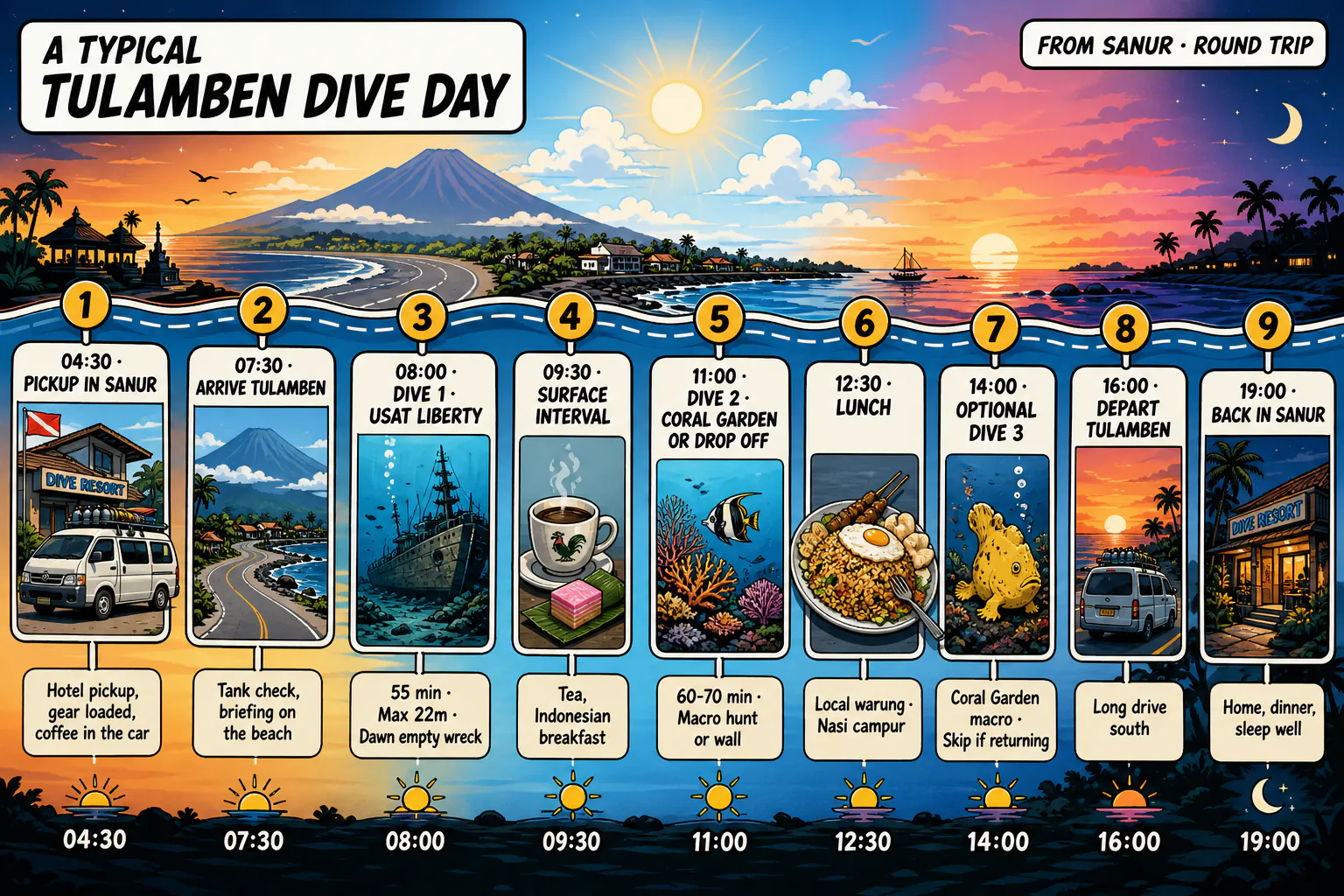
Day-trip version (return to Sanur same day)
04:30. Hotel pickup in Sanur. Coffee in the car, sleep through the dark winding road up the east coast.
07:30. Arrive Tulamben. Tank check, gear assembly, briefing. The benefit of the early start: you beat 90 percent of the other operators to the Liberty wreck.
08:00. Dive 1, Liberty bow and midsection. 50-60 minutes, max depth around 22 metres.
09:30. Surface interval, tea and Indonesian breakfast.
11:00. Dive 2, Coral Garden or Drop Off depending on conditions and your level. 60-70 minutes.
12:30. Lunch at one of the warungs (nasi campur, nasi goreng, mie goreng). Surface interval and a short nap if needed.
14:00. Optional third dive (extra cost) at Coral Garden or Seraya. Most day-trippers skip this and head back.
16:00. Depart Tulamben.
19:00. Back in Sanur. Long day, but worth it for the dawn Liberty.
Two-day overnight version (recommended)
Day 1. Mid-morning departure from Sanur, lunch at Tulamben, two dives in the afternoon (Coral Garden + Liberty mid afternoon). Sunset, dinner, sleep.
Day 2. Dawn dive on the Liberty (the actual reason you came), breakfast, Drop Off mid morning, Seraya in the afternoon. Optional sunset / night dive on the house reef. Sleep.
Day 3 (optional). One more morning dive, late breakfast, drive back to Sanur, home by mid-afternoon.
Almost every diver who tries both formats comes back to us next time asking for the overnight version. The day-trip option exists because some travellers genuinely cannot spare a night; if you can spare it, take it.
Where to stay in Tulamben
Tulamben has a dozen dive-focused resorts strung along the bay, ranging from IDR 360,000 (≈ 20 USD)-a-night homestays to IDR 3,600,000 (≈ 200 USD)-a-night dive resorts with private pools. Recommendations from our experience running guests here:
| Style | Typical price (2026) | Best for |
|---|---|---|
| Backpacker homestay / dive resort fan rooms | IDR 360,000–700,000 (≈ 20–40 USD) per night | OW students, budget backpackers, solo divers |
| Mid-range dive resort with AC and small pool | IDR 1,100,000–1,800,000 (≈ 60–100 USD) per night | Couples, photographers, most divers |
| Upscale dive resort with private terrace, full restaurant, dedicated camera room | IDR 2,700,000–4,500,000 (≈ 150–250 USD) per night | Photographers, longer stays, comfort-first travellers |
The big advantage of the upscale tier is the dedicated camera rinse/charging room, which matters if you are doing 3 dives per day with strobes. The budget tier is perfectly fine for non-photographers who just want a clean bed between dives.
What to pack for Tulamben specifically
Tulamben has a couple of quirks that catch first-time visitors. Pack for these:
Reef-walking boots with hard sole. The beach entry at the main Tulamben Bay is black volcanic stones the size of golf balls, painful in bare feet and tough on dive boots. The hardier sole the better.
3 mm wetsuit minimum, 5 mm if you feel cold. The thermocline drops to 24 degrees below 25 metres and you will spend time there.
Dive light or focus torch. Even on day dives, the wreck has shaded interiors where a small torch transforms the experience. Mandatory for dusk and night dives.
Local guide tips. The Tulamben porter system is a village institution: women carry full sets of gear (tank, BCD, weights, the lot) from the road to the beach on their heads. Tip them well, around 30,000 IDR (roughly $2) per set carried each way is standard and fair. The dive guide tip is separate.
Anti-mosquito repellent and a long sleeve. The mosquitoes at dusk in Tulamben are persistent, especially in wet season.
Costs (honest 2026 numbers)
| Item | Typical cost |
|---|---|
| Tulamben day trip from Sanur (2 dives, return same day, with transfers, guide, lunch, tanks, weights) | IDR 3,050,000–3,600,000 (≈ 170–200 USD) |
| Optional third dive on a day trip | IDR 900,000–1,150,000 (≈ 50–65 USD) |
| Tulamben 2-day, 4-dive package with overnight (mid-range resort) | IDR 8,100,000–9,900,000 (≈ 450–550 USD) |
| Tulamben 3-day, 7-dive package with overnight (mid-range resort) | IDR 12,200,000–14,700,000 (≈ 680–820 USD) |
| Open Water course finishing in Tulamben (4 days) | IDR 9,300,000–11,100,000 (≈ 520–620 USD) |
| Advanced Open Water course (3 days, Tulamben based) | IDR 7,600,000–9,000,000 (≈ 420–500 USD) |
| Night dive add-on (Alamanda pier or Coral Garden) | IDR 1,250,000–1,600,000 (≈ 70–90 USD) |
| Underwater porter tip (per gear set, each way) | 30,000 IDR (~$2) |
| Dive guide tip (per day, optional) | IDR 180,000–360,000 (≈ 10–20 USD) |
These reflect what we charge with a 1 guide to 2 divers ratio (or 1 to 1 for photographers and OW students), inclusive of nitrox when requested. You can dive Tulamben for less, the saving comes almost entirely off the guide ratio. Big-group operators run 1 guide to 6 divers, which is fine for fit experienced divers and miserable for everyone else.
Tulamben combined with other Bali destinations
The most common Bali dive itineraries we run pair Tulamben with one or two other regions. The pairings that actually work:
Tulamben + Amed (2 to 4 days, east coast). Amed is 20 minutes south, with its own dive sites (Japanese Wreck, Jemeluk Bay reef, Lipah Bay). Stay in Tulamben for the dives, day-trip Amed if you want variety. See our Amed diving guide.
Tulamben + Nusa Penida (5 to 7 days, big-animal combo). Three days in Tulamben for the wreck and macro, two days in Sanur for Nusa Penida day trips (mantas, mola mola in season). This is our most-requested itinerary. See our Nusa Penida manta guide.
Tulamben + Menjangan (4 to 5 days, west coast extension). Tulamben for the wreck, then drive across to Pemuteran for Menjangan's wall diving and Puri Jati macro. A longer, slower itinerary suited for repeat divers.
Tulamben + Komodo (7 to 14 days, big trip). Bali macro and wreck for a week, fly to Labuan Bajo, run a Komodo land-based or liveaboard trip for big-animal currents and pelagics. The full Indonesia experience. See our Komodo vs Bali comparison for the case for both.
Common Tulamben mistakes we still see
Even experienced divers make the same handful of mistakes on their first Tulamben trip. None of these are dangerous, they just diminish the experience.
Diving the Liberty at 10am with everyone else. The dawn dive is the entire reason to come. If you sleep in and arrive on the wreck at 10am with 80 other divers and 40 students, you are diving a different site. Set the alarm.
Skipping Coral Garden because it looks shallow. Coral Garden has higher critter density per square metre than Seraya. Photographers who skip it because "I am here for the wreck" miss the most photogenic 70-minute dive of the trip.
Doing only a day trip. The dawn dive on the Liberty (which is the single best dive in the bay) only works if you sleep in Tulamben the night before. Day-trippers get there at 8am at the earliest. The maths is unforgiving.
Bringing split fins. Tulamben has occasional moderate current on the wall sites, and the macro hunt at Coral Garden / Seraya needs precise control. Stiff blade fins, even rented, beat split fins every time here.
Not asking about pygmy seahorses. The pygmies on the Liberty and at Drop Off are not on most guides' default tour. They are tiny, easy to swim past, and require a guide who knows the specific fan they live on. Ask at the briefing, every reputable guide will say yes.
Frequently asked questions
How to book Tulamben diving with us
Tulamben packages are mostly customised because the right itinerary depends on your level, your time, and whether you are joining other destinations. The fastest path:
1. Tell us your dates, certification level, and whether you want day trip or overnight.
2. We propose a draft itinerary with site selection per dive.
3. We confirm guide, transfers, accommodation if overnight, and pricing.
4. You arrive, we dive, and you understand why people say "if you only get to dive one place in Bali...".
Start with the booking page for a structured request, browse our standard packages for ideas, or look at the full menu of Bali dive trips we run if you want to combine Tulamben with Nusa Penida or Menjangan. For pricing details across Bali, see our Bali scuba diving price guide. Quotes typically come back within 24 hours.
Before you book: a short pre-trip checklist
We send this list to every guest the week before they arrive. It costs nothing to read, and the divers who follow it have noticeably better trips.
Service your regulator if it has been more than a year. Tulamben is no place to discover your second stage free-flows at 25 metres on the wall. Either bring a serviced reg from home or rent ours, we service every set quarterly.
Pre-load any required nitrox certification cards in a digital wallet. We need to see the card before the first nitrox tank goes in your hands. Photos in your phone are fine, paper cards are increasingly rare.
Confirm your travel insurance covers diving. Most general policies do not. Bali diving is safe by Indonesian standards, but the closest hyperbaric chamber is in Sanur, a 3-hour drive, so do not skip the insurance question.
Drink water before the trip, not just during. The 4:30am pickup, dry season heat and three dives in a day add up. The most common preventable problem we see is mild dehydration making people uncomfortable on dive 3, especially with nitrox.
Bring a quick-dry rashguard for surface intervals. Tulamben's beach has minimal shade. A light long-sleeve shirt makes the difference between a great surface interval and a sunburn.
Phone or camera in a dry bag. The beach is wet, sandy, and crowded with porters. Treat your electronics accordingly. We have lost count of the phones flooded in puddles by guests who set them on a "dry" rock.
The bottom line
Tulamben is the dive destination Bali should be more famous for. The combination of world-class wreck, world-class macro, year-round conditions, beach entries for every level, and accommodation prices a fraction of equivalent destinations elsewhere in Indonesia is rare. The fact that you can do all of it inside a 300-metre bay you walk down to from your hotel makes it close to unique globally.
If you have three days in Bali and have never dived here, do Tulamben. If you have five days, do Tulamben for three and add Nusa Penida for two. If you have a week or more, build the trip around Tulamben as the anchor and add macro day trips or a Komodo extension on either side. We have seen guests come for a 2-day taster trip and stay a week. The opposite has never happened.