

The water temperature in Bali stays between about 26 and 30°C at the surface all year, warm enough to swim, snorkel and dive in a thin wetsuit or none at all. The big exception is the south, where cold upwellings from July to October can drop the water at sites such as Crystal Bay to around 20°C, and briefly lower, a few metres below the surface. Those cold layers are also what bring mola mola into reach of Nusa Penida diving trips each year.
For most visitors the Bali water temperature only changes one decision: what to wear in the water. Someone on a snorkelling trip in Bali in January will be comfortable in a rash guard, while a diver doing two deep dives at Penida in August may want a 5 mm suit and a hood. Most other Bali dive trips, from Tulamben to Menjangan, sit in the 26 to 29°C range most of the year.
The figures below combine long-term satellite averages of sea surface temperature with the readings divers routinely log on their computers at depth, which is where the surprises happen. The guide to Bali diving conditions covers currents and visibility; this article is about the temperature alone.
What is the water temperature in Bali?
The water temperature in Bali is 26 to 30°C at the surface all year, warmest from November to April and coolest from July to October, when upwellings chill the south.
- Warmest: about 28 to 30°C
- Coolest surface: about 26°C
- Penida thermoclines: 16 to 22°C
- North coast: the most stable
Surface readings describe the top metre of the sea, while divers can meet water several degrees colder below 10 metres in the cool season.
The water is warmest and most even on:
- Menjangan Island diving in the north-west
- Tulamben dive trips on the north-east coast
- Shallow reef snorkelling off Sanur
In short: Bali water is warm all year, except at depth around Nusa Penida from July to October.
Bali water temperature by month
Bali's sea surface is warmest in the wet season, from about November to April, and coolest in the dry season, with the lowest readings usually in August and September. The table shows typical ranges for most of the island and for diving depths around Nusa Penida, where the seasonal swing is largest.
| Month | Surface, most of Bali | Nusa Penida at depth | Typical diving wetsuit |
|---|---|---|---|
| January | 28-30°C | 26-28°C | 3 mm shorty or full |
| February | 28-30°C | 26-28°C | 3 mm shorty or full |
| March | 28-30°C | 26-28°C | 3 mm shorty or full |
| April | 28-29°C | 26-28°C | 3 mm full |
| May | 27-29°C | 25-27°C | 3 mm full |
| June | 27-28°C | 23-27°C | 3 mm full, 5 mm at Penida |
| July | 26-28°C | 20-26°C, thermoclines to 18°C | 5 mm at Penida |
| August | 26-27°C | 18-25°C, occasionally 16°C | 5 mm and hood at Penida |
| September | 26-27°C | 18-25°C, occasionally 16°C | 5 mm and hood at Penida |
| October | 26-28°C | 20-26°C | 5 mm at Penida |
| November | 27-29°C | 24-27°C | 3 mm full |
| December | 28-30°C | 26-28°C | 3 mm shorty or full |
November to April: the warmest water
The wet season brings the warmest sea of the year, often 29 or 30°C in the shallows around Sanur and the north coast. Rain falls mostly in short afternoon or overnight bursts, and river run-off can cloud the water close to shore after heavy storms, as described in the guide to diving Bali in the rainy season. The temperature itself rarely gives anyone a reason to stay out of the water.
May and June: the turn
As the dry season sets in, the south-east trade winds strengthen and the surface cools by a degree or two. Most of Bali stays at 27 to 29°C, but the first cold pulses start to appear at Nusa Penida in June, usually as short-lived layers a diver swims through rather than a whole dive in cold water.
July to October: the cold season in the south
This is when the south of Bali earns its reputation for cold water. Surface readings around most of the island fall to 26 or 27°C, which still feels warm to most swimmers, but the water below 10 to 15 metres at Penida, the Bukit and the Candidasa islands can sit around 20°C for a whole dive. The same months are the main mola mola season, which the article on the mola mola season in Bali dates from mid-July to early October.
Best month for warm water
For the warmest water and the fewest cold surprises, November to April is the safe choice, and March and April combine warm water with the end of the rains. Visitors who want mola mola have to accept cold water, because the two arrive together. The wider question of when to travel, including weather and crowds, is covered in the guide to the best time to visit Bali.
Bali sea temperature by area
Bali's sea temperature varies more by coast than by month. The sheltered north is warm and steady, the east is warm with occasional cool pulses, and the south and the Nusa islands, facing the Indian Ocean and the Lombok Strait, have the widest range.
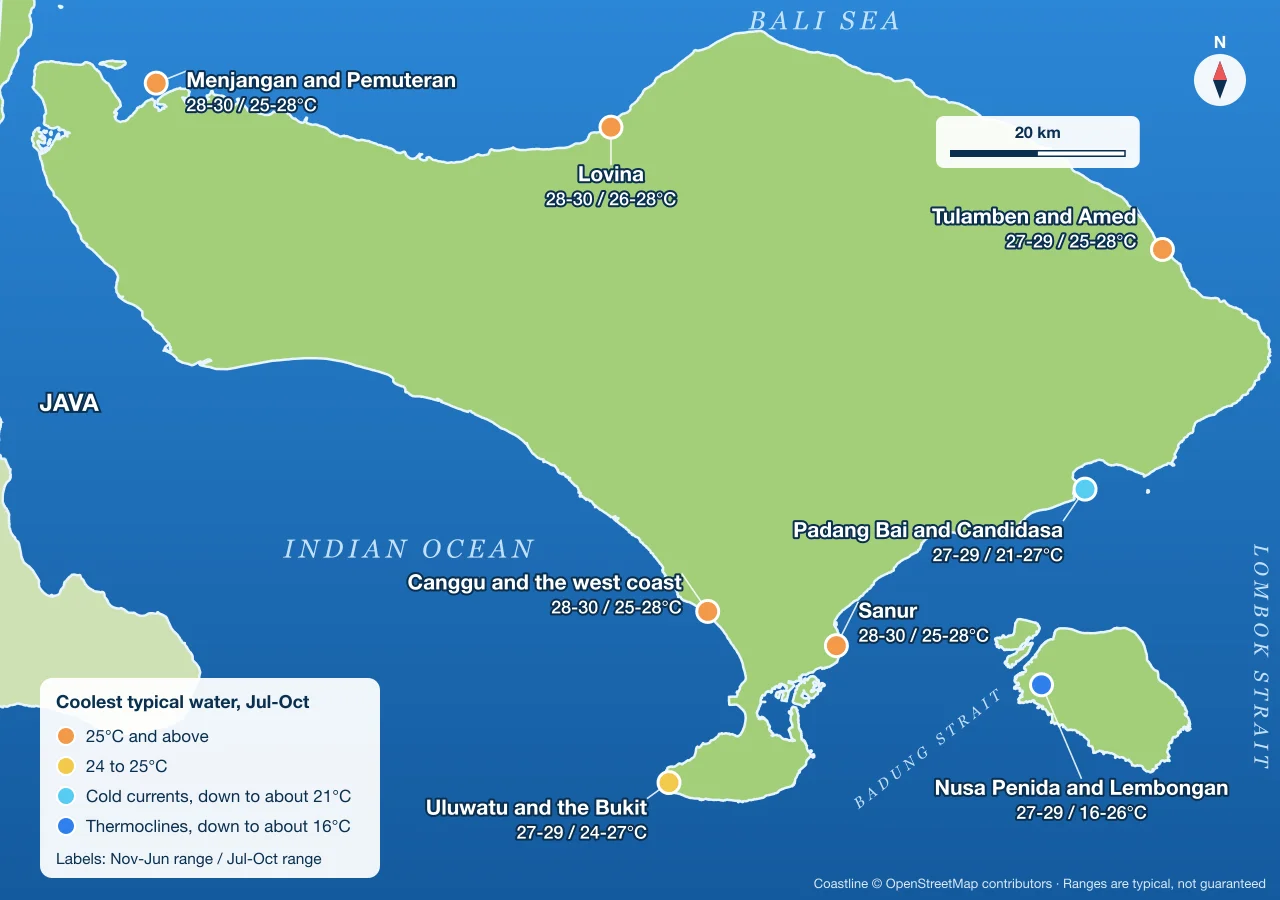
| Area | November to June | July to October | What to expect |
|---|---|---|---|
| Menjangan and Pemuteran | 28-30°C | 25-28°C | Calm, sheltered, very stable |
| Lovina | 28-30°C | 26-28°C | Warm, flat Bali Sea |
| Tulamben and Amed | 27-29°C | 25-28°C | Occasional cool pulses at depth |
| Padang Bai and Candidasa | 27-29°C | 21-27°C | Cold currents at the offshore islets |
| Sanur | 28-30°C | 25-28°C | Warm shallow reef flats |
| Nusa Penida and Lembongan | 27-29°C | 16-26°C | Strong thermoclines below 10 m |
| Uluwatu and the Bukit | 27-29°C | 24-27°C | Cooler surf, open ocean swell |
| Canggu and the west coast | 28-30°C | 25-28°C | Warm surf beaches |
North-west: Menjangan and Pemuteran
The north-west coast faces the sheltered Bali Sea and has the most stable water on the island. Menjangan's walls and Pemuteran's reefs rarely drop below 25°C, which makes the area the easiest choice for anyone who feels the cold, children included, and for long snorkelling sessions.
North-east: Tulamben and Amed
The water along the black sand coast below Mount Agung is usually 27 to 29°C, and the USAT Liberty wreck at Tulamben is dived comfortably in a 3 mm suit most of the year. In the dry season, divers on Amed diving trips sometimes report brief cool pulses of 24 or 25°C at depth, when water from the Lombok Strait pushes along the coast.
East: Padang Bai and the Candidasa islands
Padang Bai's bays are generally warm, but the small rocky islands off Candidasa sit in the path of the Lombok Strait and can be cold. The dive sites of Gili Mimpang and Tepekong regularly bring 21 to 24°C water in the cool season, together with strong currents, while the sheltered bays used on Padang Bai diving days stay warmer.
South-east: Sanur
Sanur's reef is shallow and protected by an outer reef, so the water inside the lagoon heats up quickly in the sun and can feel almost bath-warm at low tide. Outside the reef the temperature follows the open water of the Badung Strait, which is why snorkellers often find the outer edge of the reef a degree or two cooler than the lagoon.
The Nusa islands: Penida, Lembongan and Ceningan
Nusa Penida and its neighbours have the widest temperature range in Bali. In the warm season they are as pleasant as anywhere on the island, but from July to October the west and south coasts take the full force of the upwelling. Crystal Bay, Manta Point and the drift sites along the north-west coast, including Blue Corner off Lembongan, are where divers meet the coldest water.
South and west: the Bukit and the surf coast
The beaches of Uluwatu, Bingin and Padang Padang on the Bukit peninsula, and Canggu and Seminyak up the west coast, face the open Indian Ocean. The water stays warm enough for board shorts most of the year, but the Bukit can feel noticeably cooler on dry-season mornings when the upwelling is strong.
Why does the water get cold at Nusa Penida?
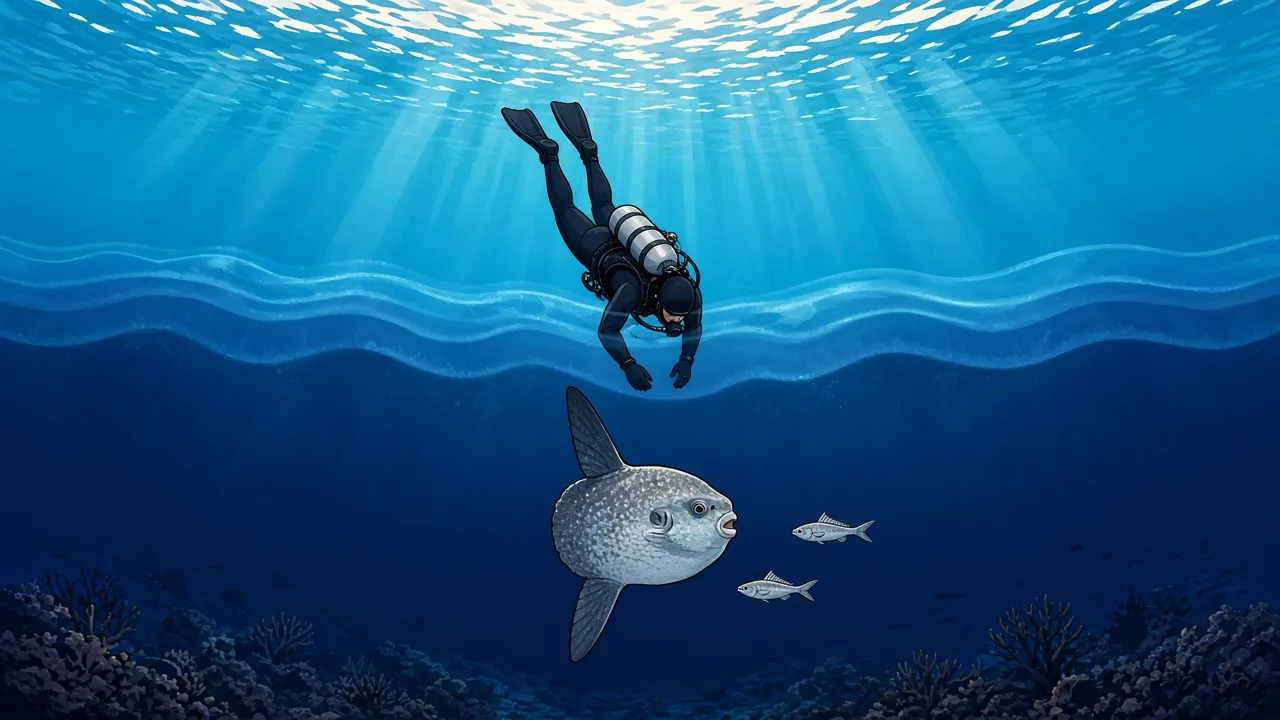
The cold water at Nusa Penida comes from a combination of seasonal winds, upwelling from the deep Indian Ocean and the enormous flow of water through the Lombok Strait. Each part is well documented by oceanographers, and together they explain why a diver can descend through 27°C water into 18°C in a few metres.
1. The south-east monsoon pushes surface water away
From roughly June to September, steady south-east trade winds blow along the southern coasts of Java and Bali. The wind, combined with the rotation of the Earth, drives warm surface water away from the coast, and colder water rises from below to replace it. This process is called coastal upwelling.
2. The upwelling peaks in August and September
A 2001 study in Geophysical Research Letters by the oceanographers Dwi Susanto, Arnold Gordon and Quanan Zheng described this upwelling along the coasts of Java and Sumatra, peaking in the dry season and moving east with the winds. The same work found that it tends to be stronger in El Niño years, which is why some years at Penida are colder than others.
3. The Lombok Strait is a gateway between two oceans
The strait between Bali and Lombok is one of the main channels of the Indonesian Throughflow, the current that carries water from the Pacific to the Indian Ocean. Measurements from the international INSTANT programme between 2004 and 2006 put the average flow through the Lombok Strait at around 2.6 million cubic metres of water a second. Nusa Penida sits right at the southern mouth of this channel.
4. Tides lift cold water from depth
As strong tides push water over the shallow sill at the southern end of the strait, they create large internal waves, slow underwater swells between warm and cold layers that are visible in satellite images. These waves can lift deep, cold water up the reefs of Penida for minutes or hours at a time, which is why the temperature can change sharply during a single dive.
5. A thermocline is the line you can see
A thermocline is the boundary between a warm surface layer and colder water below. Where the difference is large, the boundary shimmers like heat haze over a road, because water of different temperatures bends light differently. Divers feel it first on the hands and face, then across the whole body as they sink below it.
6. Worked example: Crystal Bay in August
Take a certified diver on a morning dive at Crystal Bay in August, in a 3 mm full wetsuit. The surface is 26°C and the first 8 metres feel comfortable. At about 10 metres the water starts to shimmer, and by 15 metres the dive computer reads 19°C. Divers on the same site often log 18°C, and on the coldest days of the season, readings of 16°C are reported at depth.
A 7 to 10 degree drop over a 50 minute dive is enough to make most people in 3 mm neoprene shiver by the safety stop, and cold divers use more air and tire faster. The same diver in a 5 mm suit and a hood would usually finish the dive comfortable. The cold water is also why mola mola rise from the deep to be cleaned on the reef during these months, and why many divers accept the chill.
What wetsuit do you need in Bali?
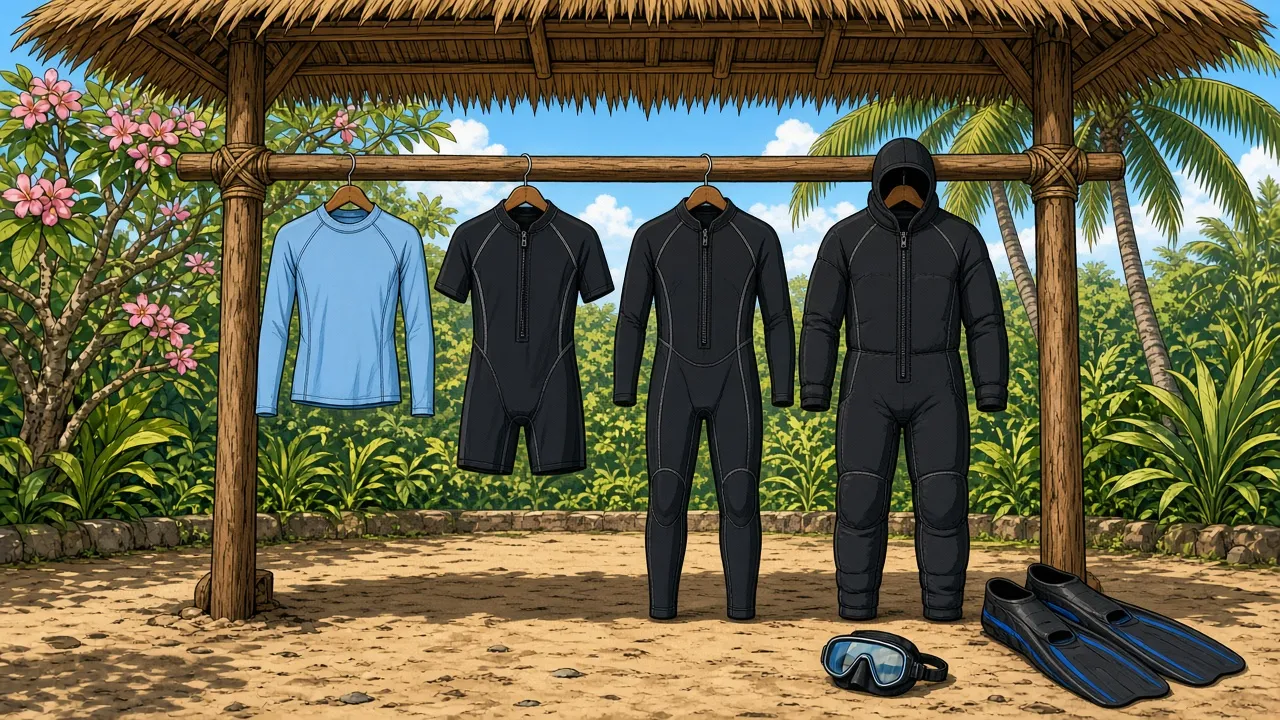
Most divers are comfortable in a 3 mm wetsuit in Bali for most of the year, and swimmers and snorkellers rarely need more than a rash guard. A 5 mm suit, often with a hood, is the usual choice for Nusa Penida and the Candidasa islands from July to October.
| Water temperature | Snorkelling and swimming | Diving |
|---|---|---|
| 29°C and above | Swimwear or rash guard | Rash guard, skin suit or 3 mm shorty |
| 27-28°C | Rash guard | 3 mm shorty or full suit |
| 25-26°C | Rash guard or 2 to 3 mm top | 3 mm full suit |
| 22-24°C | Shorty for long sessions | 5 mm full suit |
| 18-21°C | Full suit | 5 mm full suit and hood |
| 17°C and below | Full suit | 7 mm or 5 mm with hood and vest |
Everyone feels the cold differently
The table gives typical choices, not rules. Body size, body fat, the number of dives in a day and how much the diver moves all change how cold the water feels. Slim divers, children and anyone doing three or four dives a day get cold sooner than the figures suggest, and a suit that felt fine on the first dive may not on the third.
Renting or bringing a wetsuit
Dive centres in Bali usually rent 3 mm full suits as standard, and many also carry 5 mm suits and hoods for the cold season. Divers who know they feel the cold, or who need an unusual size, often bring their own. Rental suits, hoods and other equipment can be checked in advance at a dive shop in Bali, and the Bali scuba diving packing list covers what is worth packing.
The hood makes the biggest difference
A neoprene hood is the cheapest way to stay warm in a thermocline, because the head loses heat quickly and feels the cold first. Many divers at Penida in August wear a 3 mm suit with a hood and a vest rather than a full 5 mm suit, which keeps the core warm without restricting movement in strong currents.
Sun protection still matters
In warm water, the main job of a rash guard or thin suit is protection from the sun, coral scrapes and jellyfish stings rather than warmth. Snorkellers floating face down for an hour in the middle of the day burn quickly on the back of the legs and neck, which is why long-sleeved rash guards and leggings are common in Bali even when the water is 29°C.
Is the water warm enough for swimming and snorkelling in Bali?
Yes. At 26 to 30°C, Bali's sea is warm enough for swimming and snorkelling every month of the year, and most people stay comfortable for an hour or more without a wetsuit. Thermoclines affect divers far more than snorkellers, because the coldest water sits below the surface layer.
Snorkellers
Snorkellers float in the warmest water, the top metre, so even in August most sites feel warm. The exception is the Penida coast, where cold water occasionally reaches the surface at Crystal Bay or Manta Bay and snorkellers feel sudden cool patches. A rash guard or a thin shorty helps on long manta snorkelling days, and Nusa Penida snorkelling trips usually include several stops.
Children
Children lose heat faster than adults, and a child who has been in 27°C water for 45 minutes can start to shiver even on a hot day. Short sessions, a thin wetsuit or rash guard and a towel and drink between swims keep them comfortable. The warm, shallow lagoons at Sanur and the calm bays of Pemuteran suit young swimmers best.
Swimmers and surfers
Pool-like water temperatures make Bali easy for swimmers, and the real risks at the surf beaches are rip currents and waves rather than the cold. Most surfers ride the Bukit and the west coast in board shorts or a rash vest all year, and a thin spring suit is an option on windy dry-season mornings.
New divers
First-time divers usually start in the warmest, calmest water. A Discover Scuba Diving session goes no deeper than 12 metres, and the open water dives on the PADI Open Water course are normally done at sheltered sites with stable temperatures, where the cold-water drift dives of Penida are left for later.
Bali vs Komodo, Raja Ampat and the Gili Islands: how does the water compare?
Bali's water is similar to the rest of Indonesia for most of the year, warmer than southern Komodo in the dry season and a little cooler than Raja Ampat, which stays close to 28 to 30°C all year.
| Destination | Warm months | Cool months | Coldest spots |
|---|---|---|---|
| Bali | 28-30°C | 26-28°C | Nusa Penida, 16-22°C thermoclines |
| Komodo | 27-29°C | 23-26°C, June to September | The southern sites |
| Raja Ampat | 28-30°C | 27-29°C | Rarely cold anywhere |
| Gili Islands | 27-29°C | 25-27°C | Occasional cool currents |
Komodo
Komodo is a near match for Bali in the warm months, with the north of the park at 27 to 29°C, but its southern sites cool to 23 to 26°C from June to September when upwelling reaches the park. The comparison of Komodo vs Bali diving covers both seasons, and Komodo diving trips usually plan the colder southern sites around the conditions of the day.
Raja Ampat and the Banda Sea
Raja Ampat, close to the Equator in West Papua, has some of the most consistent water in Indonesia, and a 3 mm suit is the usual choice all year on a Raja Ampat liveaboard. The Banda Sea is similarly warm during its main diving seasons, the windows used by trips such as the King Neptune liveaboard.
The Gili Islands
The Gilis, off the north-west coast of Lombok, sit on the far side of the Lombok Strait and share some of its cool currents, though less dramatically than Nusa Penida. Water is usually 27 to 29°C, dropping a degree or two in the dry season.
Example: warm-water and cold-water dive days from Sanur
Neptune Scuba Diving runs day trips from its dive centre in Sanur, and the example below shows how one operator matches sites to the season. It is one way to plan around the water temperature, not the only one.
- Warm-water days: shore dives at Tulamben and Amed, listed among the day trips around Bali, where the water is usually 27 to 29°C and a 3 mm suit is enough.
- Cold-water days: two boat dives at the Nusa Penida dive sites, with 5 mm suits and hoods recommended from July to October.
- Non-divers: snorkelling tours around Bali, where the surface water stays warm in every season.
- Divers wanting to learn the currents that come with the cold water can look at the PADI Drift Diver specialty.
The cold-water Penida dives are not suitable for new divers on their first dives after a course, for anyone who chills easily and has not brought a thicker suit, or for divers uncomfortable with currents, which often arrive with the coldest water. Divers flying home should leave at least 18 hours after the last dive, as Divers Alert Network recommends after multiple dives.
Key takeaways
- Bali's sea is 26 to 30°C at the surface year-round, warm enough for swimming and snorkelling in every month.
- The warmest water runs from November to April; August and September are the coolest months.
- From July to October, upwelling brings 16 to 22°C thermoclines to Nusa Penida and the Candidasa islands.
- The north coast, from Menjangan to Tulamben, has the most stable temperatures on the island.
- A 3 mm wetsuit suits most Bali diving; Penida in the cool season calls for 5 mm and a hood.
- The cold water is what brings mola mola to Penida, so warm water and sunfish rarely come together.