
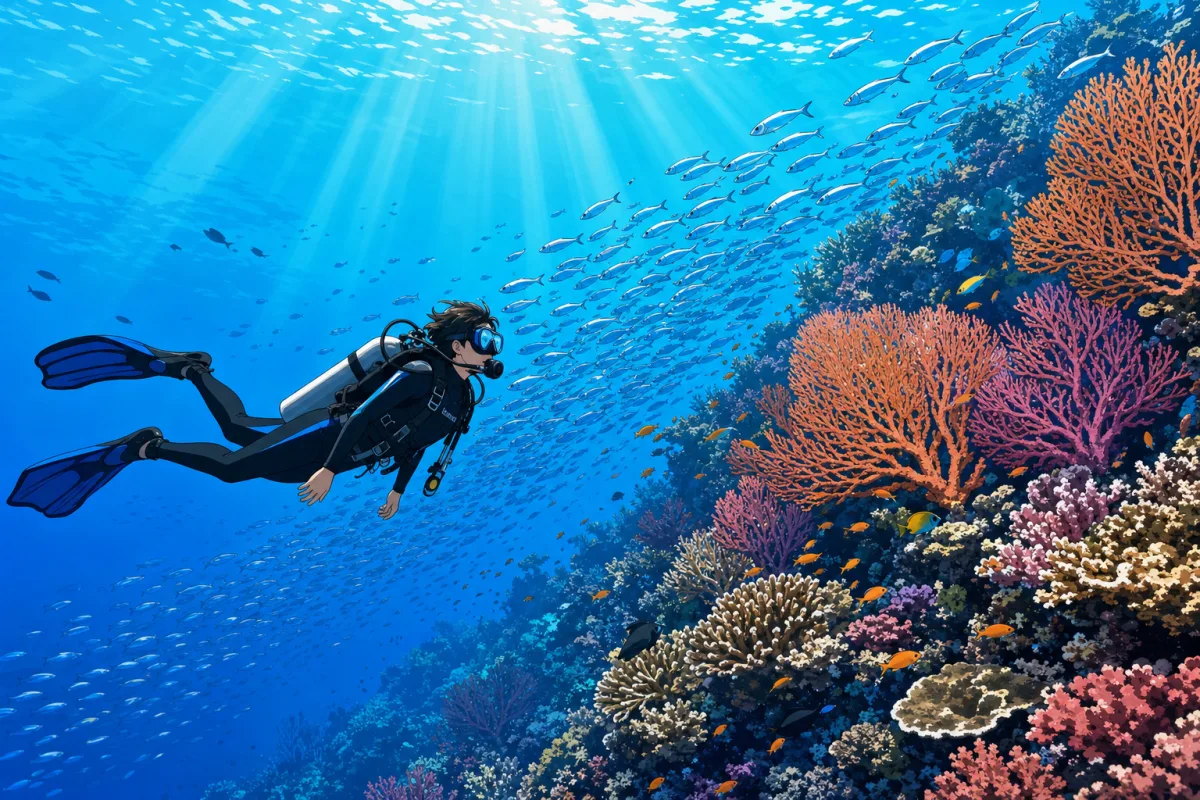
Bali diving conditions in one paragraph: water of 26 to 29°C most of the year (with famous cold-water exceptions), visibility that routinely hits 20 to 40 metres in the dry season, and currents that range from non-existent at the sheltered east-coast sites to genuinely world-class drifts around Nusa Penida, all diveable twelve months a year. That mix, warm, clear, and just wild enough in the right places, is what makes Bali diving suitable for a nervous first-timer and a thousand-dive veteran on the same boat. But averages hide the interesting part. Bali sits on one of the most significant stretches of ocean on the planet, and understanding why the water does what it does, why Crystal Bay can be 10 degrees colder than Tulamben on the same day, why Manta Point has surge when the north coast is glass, why your guide checks tide tables before breakfast, will make you a better, safer, and considerably more fascinated diver here.
This guide explains the machinery behind the conditions: the currents, the visibility, the temperatures, the seasons, and how they differ site by site, drawn from fifteen years of running daily trips from Sanur. Consider it the owner's manual for the water you are about to enjoy. It pairs naturally with our site-focused guides, which tell you what you will see at each location; this one tells you what the ocean will be doing while you see it, and why the two questions are inseparable everywhere on this island. Fair warning: reading it has converted more than one guest into the sort of diver who asks the crew for the tide table.
Why Bali's ocean is special: the river between two oceans
Look at a map of Indonesia and you will see that Bali sits in a chain of islands separating two giants: the Pacific Ocean to the north and the Indian Ocean to the south. The Pacific sits slightly higher, warmer and less salty than the Indian Ocean, and physics does not tolerate imbalance: an enormous, permanent flow of water pours between the islands from Pacific to Indian Ocean. Oceanographers call it the Indonesian Throughflow, and it moves roughly 15 million cubic metres of water per second, on the order of a thousand Amazon Rivers, through a handful of straits. One of the largest of those straits is the 35-kilometre gap between Bali and Lombok, and squeezed right into its mouth sits Nusa Penida.
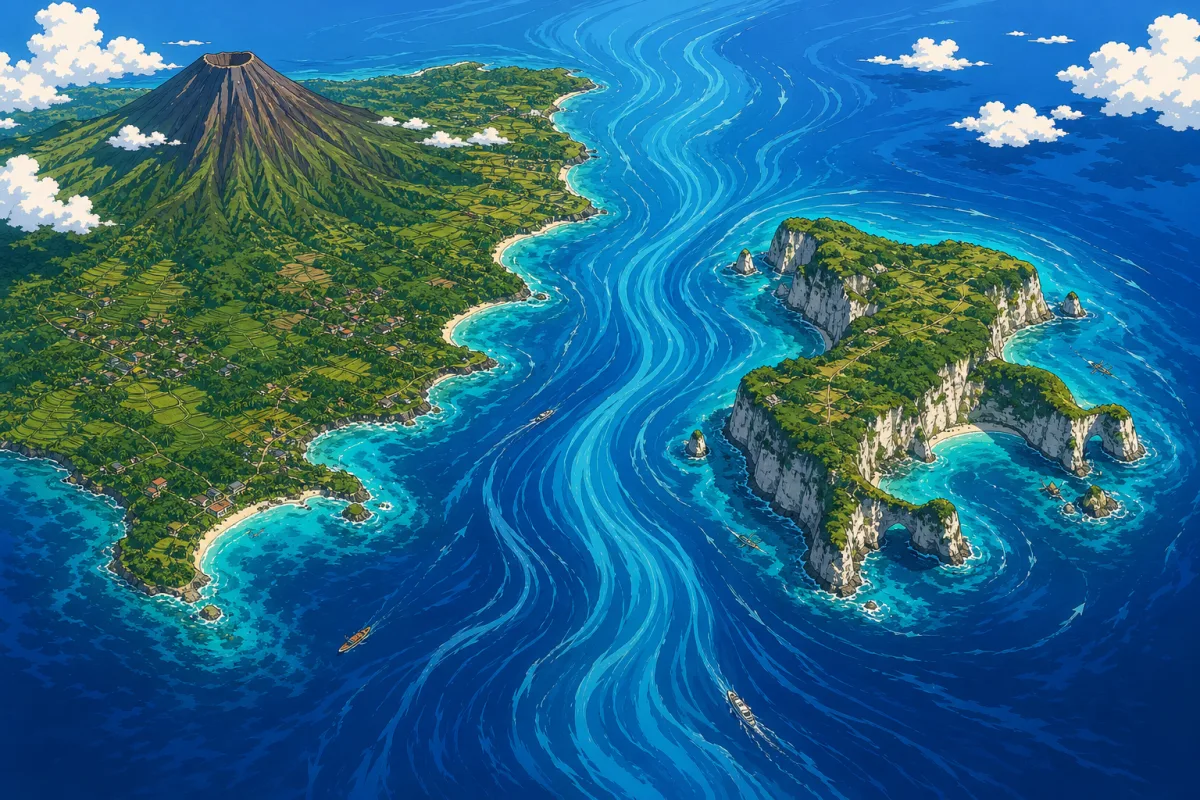
This is the single most useful fact for understanding Bali diving. The Throughflow is why Penida has drift dives at all; it is why deep, cold, nutrient-rich water rises along its walls and summons mola mola every dry season; it is why the reefs are so absurdly well-fed and healthy; and it is why the same channel that delivers manta rays and sunfish also demands local knowledge and tide-table planning. The Lombok Strait is also the line Alfred Russel Wallace drew between Asian and Australian wildlife, the Wallace Line, and it runs, quite literally, through our dive sites. When you drift along Penida's north coast, you are riding the plumbing that connects two oceans.
Meanwhile, Bali's east coast, Tulamben, Amed, Padang Bai, sits tucked out of the main flow in the island's lee, which is why those sites offer some of the calmest, easiest diving in Asia a mere ninety minutes from the channel's drama. Two completely different oceans of experience, one small island. That range is the reason we can honestly claim, in our overview of Bali's best dive sites, that the island serves every certification level without anyone compromising.
Water temperature: warm, with famous exceptions
The baseline is easy: most Bali dive sites sit at 26 to 29°C year-round, comfortable in a 3mm wetsuit, which is what we provide on all our dive trips. The east coast (Tulamben, Amed, Padang Bai) and Menjangan barely deviate from this all year. If that were the whole story, this section would be one sentence.
The exception is the upwelling season around Nusa Penida and the channel sites. From roughly June to October, the southeast monsoon and the Throughflow conspire to pull deep, cold water up the slopes of the Penida sites, Crystal Bay and the southern corners especially. Thermoclines arrive like walls: you descend through 27°C water and cross a shimmering, blurry boundary into 20, 18, occasionally 16°C. Ten metres horizontally can separate bathwater from Baltic pool.
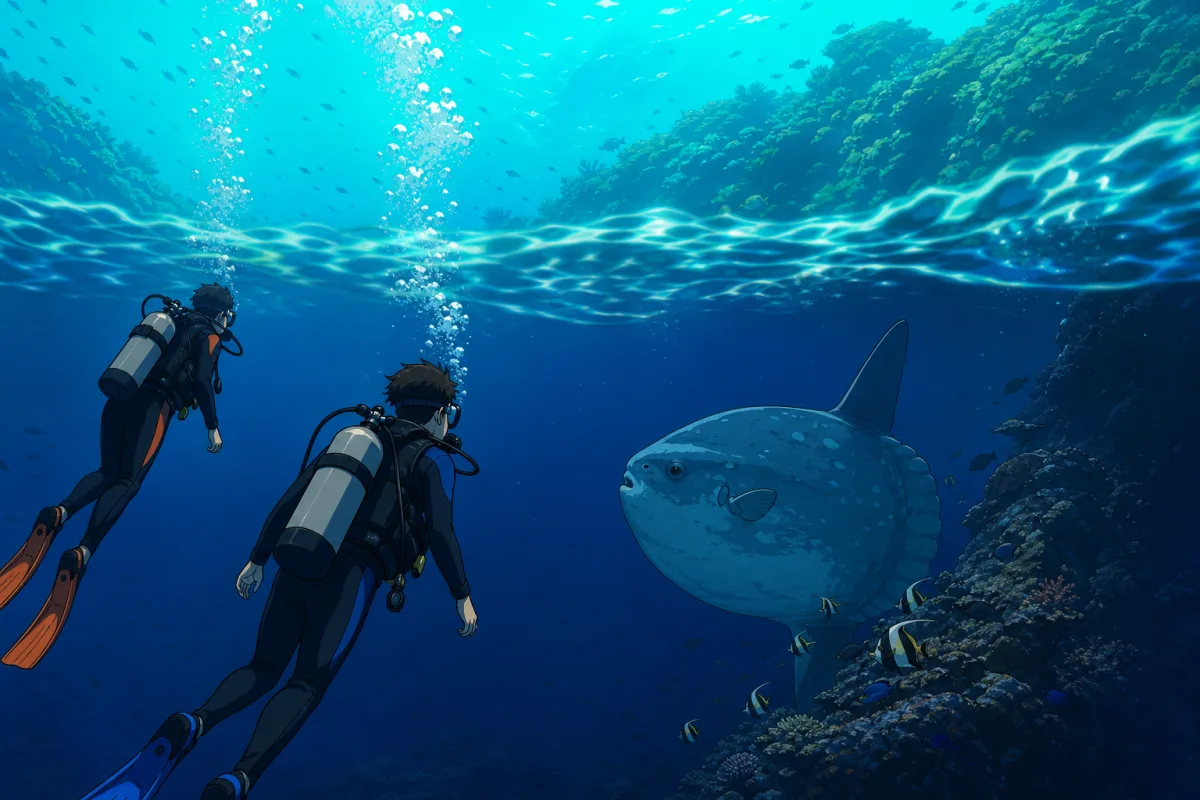
Divers react to this news in two ways, and both are correct. The shiver: we issue 5mm suits and hooded vests for Penida in the season, and we still recommend a windbreaker for the boat ride. The thrill: that cold water is the entire reason the season exists, because it carries the nutrients that feed the reef and it is precisely what brings the mola mola up to cleaning stations between July and October. Cold fingers are the price of admission to one of diving's great spectacles, and our mola season guide covers the trade in detail. Pack accordingly, our Bali dive packing list has the full wardrobe, and remember that cold is also a physiology variable: chilled divers use air faster and load nitrogen less forgivingly, which is one more reason profiles run more conservative in the season, a principle explained in our diving safety guide.
Visibility: what "20 to 40 metres" actually depends on
Bali visibility headlines are honest: on a dry-season day at Menjangan, Gili Mimpang or Penida's north coast, 30-plus metres is normal, and 40 happens. But visibility is a moving target with three main levers.
Season. The dry months (April to October) are the clear months. In the wet season (roughly November to March), rain swells the rivers and near-shore runoff can trim visibility at sites close to river mouths; Padang Bai and Sanur feel it most, typically dropping to a still-perfectly-good 10 to 20 metres, while offshore sites like Penida and Gili Mimpang barely notice. Our rainy-season diving guide makes the case that wet-season diving remains excellent; it just asks for slightly more flexible site selection.
Tide and current. Moving water is usually clean water. The same currents that demand respect at the channel sites also sweep them clear; slack tides at silty sites can actually read hazier. Incoming (flood) tides generally bring clear oceanic water onto the reefs, one more reason the tide table, not the clock, writes our daily schedule.
Plankton, the glorious nuisance. Upwelling season water carries more life in suspension: slightly greener, sometimes milky at depth, and directly responsible for the mantas at Manta Point having anything to eat. When a guest grumbles about 15-metre visibility while a four-metre manta barrel-rolls overhead, we gently point out the connection.
For photographers and macro hunters, note that visibility matters far less at muck sites; the critters of Bali's macro scene are photographed from centimetres away, wet season or dry.
Currents: from zero to conveyor belt
Current is the variable that actually sorts Bali's sites by experience level, so here is the honest ladder.
The still end: Tulamben, Amed, Menjangan
Shore entries, barely a knot of movement on most days, and the reason Tulamben's USAT Liberty wreck might be the most beginner-friendly wreck dive on earth. These are the sites where Open Water courses and try dives live, and where a diver can spend an hour composing photographs without once thinking about water movement. Menjangan's walls in the far northwest add gentle, predictable along-wall movement at most.
The middle: Padang Bai and the Penida north coast on a kind tide
Padang Bai's bays are sheltered, with occasional mild movement outside them. Penida's north-coast reefs (SD, Ped, Sental) are classic drift dives: you descend, the guide deploys nothing more strenuous than a relaxed fin-kick, and the reef scrolls past like scenery from a train window, ideal first drifts, and the experience that convinces most divers to take the PADI Drift Diver specialty and make a hobby of it.
The serious end: the channel corners
Crystal Bay's outer corner, Toyapakeh at exchange, Blue Corner, and Gili Mimpang and Tepekong off Candidasa: these sites sit where the Throughflow accelerates around underwater topography, and on the wrong tide they produce strong, shifting, occasionally downward-flowing water. On the right tide, they produce the best diving in Bali: sharks, molas, thick schools riding the flow. The difference between wrong and right tide is not luck; it is arithmetic done the evening before with a tide table and a decade of site-specific pattern-matching. These sites carry experience minimums (Advanced certification or equivalent logged experience, comfortable buoyancy control, and a working SMB), and they get cancelled or relocated without apology when the water says no.
Three drift-diving habits worth internalising before your first channel dive: stay behind the guide (they are reading the water, not sightseeing), keep the reef on the agreed shoulder, and if you are ever caught in water moving down, swim horizontally away from the reef rather than fighting vertically, inflate gradually, and stay with your buddy. Your briefing will cover it; the habit of listening to briefings is itself the primary safety skill, as our first-timer's guide keeps repeating.
Bali diving conditions by season
| Months | Season | Water temp | Visibility | Highlights |
|---|---|---|---|---|
| April - June | Early dry | 27-29°C everywhere | 20-40 m | Arguably the sweet spot: calm seas, peak visibility, thinner crowds, mantas year-round |
| July - October | Dry + upwelling | 26-29°C east coast; 16-22°C thermoclines at Penida | 15-30 m (plankton-rich at Penida) | Mola mola season, busiest boats, bring the 5mm |
| November - March | Wet season | 27-30°C, warmest of the year | 10-25 m near shore, better offshore | Quiet sites, warm water, flexible site picks; short morning showers, diveable virtually every day |
The one-line summary we give at the counter: there is no bad month for Bali diving, only different menus. Mantas are resident year-round, turtles and the reefs do not check calendars, the wrecks never close, and the only strictly seasonal headliner is the mola. For trip-planning beyond diving, our best time to visit Bali guide covers the topside half of the equation.
Site-by-site conditions cheat sheet
The reference table our guides would tattoo on their forearms if the font were smaller. Conditions given as the typical range; individual days vary, which is the entire point of the morning check.
| Site | Entry | Current | Water temp | Typical visibility | Level |
|---|---|---|---|---|---|
| Tulamben (Liberty wreck, Coral Garden) | Shore | None to mild | 27-29°C | 15-30 m | Everyone, from try dives up |
| Amed (Jemeluk, Pyramids) | Shore / jukung | None to mild | 27-29°C | 15-30 m | Everyone |
| Padang Bai (Blue Lagoon, Jetty) | Jukung boat | None to moderate | 26-29°C | 10-25 m | Everyone; night dives too |
| Gili Mimpang / Tepekong | Boat | Moderate to strong, tidal | 24-28°C, seasonal thermoclines | 15-30 m | Advanced |
| Nusa Penida north (SD, Ped, Sental) | Boat | Mild to strong drift | 26-29°C; cooler patches in season | 20-40 m | Open Water+ on the right tide |
| Crystal Bay | Boat | Slack windows; strong at corners | 18-28°C in upwelling season | 20-40 m | Bay: Open Water+; corners: Advanced |
| Manta Point (Penida south) | Boat | Mild current, ocean surge | 22-27°C | 10-25 m, plankton-dependent | Open Water+, swell permitting |
| Menjangan Island | Boat | Mild along-wall | 27-29°C | 25-40 m | Everyone |
| Sanur reef | Boat, 10 min | Mild, tidal | 27-29°C | 8-20 m | Everyone; best at high tide |
Full site descriptions, marine life and itinerary pairings live in the individual guides linked throughout this article and in the dive sites overview.
What these conditions grow: the biodiversity dividend
Conditions are not just comfort statistics; they are the reason Bali's reefs look the way they do. The island sits inside the Coral Triangle, the global maximum of marine biodiversity, with more coral and reef-fish species in a single good bay than the entire Caribbean. But position only supplies the guest list; the Throughflow supplies the catering. That constant river of oceanic water delivers larvae from across the archipelago, keeps temperatures within coral tolerance, flushes the reefs clean, and, in the upwelling season, lays on the nutrient buffet that supports everything from the sardine clouds at Manta Point to the sponge gardens the hawksbill turtles work through, as covered in our sea turtle guide and marine life overview.
The pattern is visible underwater once you know to look. High-current sites wear their nutrition openly: Gili Mimpang's dense fish soup, the swirling jacks at Crystal Bay's corner, gorgonian fans spread like sails exactly where the flow feeds them fastest. Sheltered sites spend the same budget differently, on fragile, intricate growth: the delicate table corals of Menjangan's walls, Amed's pastel gardens, the muck sites' population of creatures that would be swept away anywhere windier. Even the volcanic sand matters: Bali's black-sand slopes drain nutrients from an actual volcano into the sea, part of why the macro life at Tulamben and Amed is world-class. When divers ask why one small island offers wrecks, walls, drifts, mantas, molas and muck within two hours of each other, the honest answer is: the conditions built it that way.
Surface conditions: the boat-ride briefing
Underwater comfort gets all the attention, but the surface interval matters to actual humans. Bali's seas are generally kind: the Sanur-to-Penida crossing runs 30 to 45 minutes and is calm most mornings, with the dry season's southeast trade winds picking up a chop by afternoon, one of several reasons dive boats leave early. The east-coast sites are jukung-and-shore territory with barely any ride at all. The south-facing sites (Manta Point especially) take Indian Ocean swell directly and can be surgy or unworkable on big-swell days, in which case the manta itinerary flips to Manta Bay or the north coast; the mantas, helpfully, use multiple sites too. If you are seasickness-prone: take the tablet the night before and again in the morning, sit low and central, watch the horizon, and tell your guide, who has managed this small crisis approximately one thousand times, mostly successfully, with ginger sweets from the crew box.
How conditions map to your experience level
Never dived: perfect conditions await; you simply start on the calm shelf. Try dives and first-dive experiences run at Padang Bai, Tulamben, Amed and Penida's gentlest reefs, all shallow, warm, and current-managed. Open Water divers: the entire east coast, Menjangan, Sanur, and the north-Penida drifts on favourable tides, which is most of the island's famous diving already. Advanced divers: the channel opens: Crystal Bay's mola corners, Gili Mimpang and Tepekong, deeper wreck lines, and the full drift menu; the Advanced Open Water course exists precisely to bridge this gap, and Bali is one of the best places anywhere to take it because the sites you train on are the reward. Rusty divers: conditions forgive skills that have faded, but currents do not; after a long break, the refresher plus one calm-site day before the channel is the professional's route back.
Five Bali conditions myths, corrected
"You can't dive Bali in the rainy season." The most persistent one. Wet-season mornings are commonly calm and sunny, the water is at its warmest, and the rain does its work overnight; we lose essentially no days to weather from November to March, we just choose sites a little more carefully.
"Tropical means warm everywhere, so skip the thick wetsuit." Tell that to anyone who met an 18°C thermocline at Crystal Bay in August in a shorty. Penida in upwelling season is genuinely cold at depth; the packing list is seasonal for real reasons.
"Strong current sites are only for daredevils." Current diving done properly is the least strenuous diving there is: you hang in the water column and the ocean does the finning. What it requires is not courage but procedure, briefings, tide timing, an SMB, and a guide who knows the site's moods.
"Bad visibility means a bad dive." The two best wildlife dives in Bali, mantas in season and molas at the stations, frequently happen in the murkiest water of the year, because the murk is food. Ask the photographers which they would rather have.
"Conditions are unpredictable, so planning is pointless." Backwards. Bali's conditions are driven by tides and monsoons, two of the most predictable systems in nature; that is exactly why the tide-table ritual works. What is unpredictable is any single hour at any single site, which is why flexibility, not fatalism, is the operating principle.
How we make the daily call
Guests sometimes ask how we decide, on any given morning, where the boats go. The honest answer is a routine so fixed it bores us: tide tables consulted the afternoon before, because the channel sites are diveable in specific windows around slack and the schedule is built backwards from them; a weather and swell check at dawn, particularly for south-facing sites; radio intelligence from our own boats and befriended crews already on the water, the freshest data in the system; and a standing rule that conditions override bookings, meaning a site that is not behaving gets swapped for one that is, even if it disappoints someone's checklist. The east coast is the system's shock absorber: when the channel misbehaves, Tulamben, Amed and Padang Bai are almost always calm, which is why a Bali diving week nearly never loses a day entirely, wet season included.
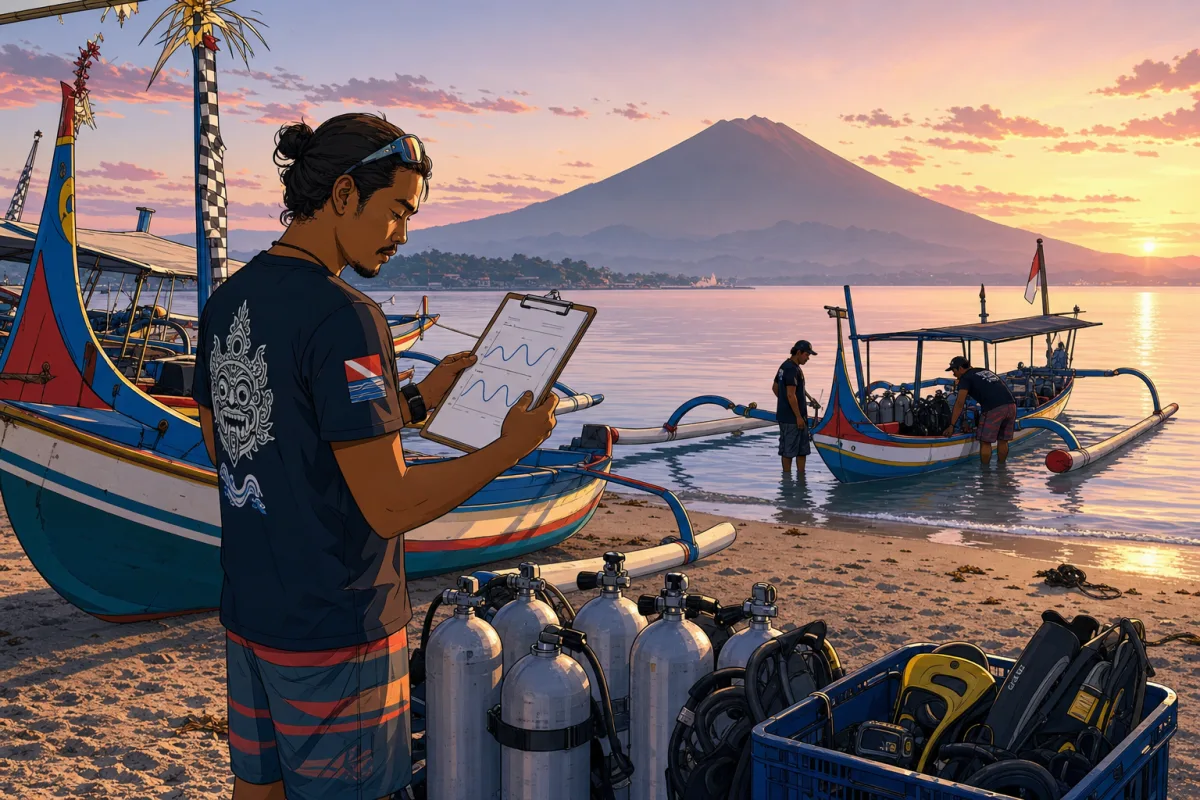
That flexibility is, frankly, the strongest argument for diving Bali with an operator who runs the full circuit of sites rather than a single house reef, and for keeping your own itinerary loose enough to follow the water. Book the days, not the sites, and let the conditions serve the menu; the full trip-construction logic lives in our Bali dive itinerary guide.
The bottom line
Bali diving conditions are a gift with a personality: warm, clear, generous water across most of the island all year, plus one world-famous channel where two oceans trade places and the diving graduates from lovely to legendary, on a schedule written by tides and monsoons rather than brochures. Learn the machinery, thermoclines that summon sunfish, plankton that feeds mantas, currents that polish visibility, and every quirk becomes a feature. Or skip the homework entirely and borrow ours: fifteen years of tide tables, dawn checks and radio calls, included free with every dive trip and course we run out of Sanur. The water is doing something interesting today; it always is. Come see which version you get.
Frequently Asked Questions
Warm (26-29°C at most sites), clear (20-40 m visibility in the dry season, 10-25 m near shore in the wet), and diveable year-round. Currents range from nearly zero at the east-coast sites (Tulamben, Amed, Padang Bai) to strong tidal drifts around Nusa Penida, where the Lombok Strait funnels the Indonesian Throughflow between the Pacific and Indian Oceans. There is a site for every level in every month.
Most sites hold 26-29°C all year, comfortable in a 3mm wetsuit. The exception is the June-October upwelling season around Nusa Penida, when thermoclines can drop parts of a dive to 16-22°C, especially at Crystal Bay. In that season we dive Penida in 5mm suits with hooded vests. That cold water is also what attracts the mola mola.
The dry season, April to October, delivers the best visibility: 20-40 metres is routine at Menjangan, Nusa Penida and the offshore sites. April to June is arguably the sweet spot, combining peak clarity with calm seas and fewer crowds. Wet-season visibility near river mouths drops to a still-good 10-20 metres, while offshore sites are barely affected.
At the sheltered east-coast sites, current is negligible, which is why beginners train there. Around Nusa Penida and the channel sites, currents are real and demand respect: they are exactly why those sites are dived with experienced local guides who plan around tide tables, carry surface marker buoys, enforce experience minimums, and relocate dives when conditions are wrong. Managed that way, the drifts are a highlight rather than a hazard.
Crystal Bay sits on the Lombok Strait, where the Indonesian Throughflow pushes enormous volumes of water between the Pacific and Indian Oceans. In the southeast monsoon (roughly June to October), this drives upwelling: deep, cold, nutrient-rich water rises along Nusa Penida's slopes, creating sharp thermoclines of 16-22°C beneath 27°C surface water. That cold water feeds the reef and brings mola mola to cleaning stations.
Yes, and it is underrated: November to March brings the warmest water of the year (27-30°C), quiet sites, and rain that mostly falls in short bursts overnight or early morning. Near-shore visibility can dip from river runoff, so site selection shifts toward offshore and east-coast sites on rainier days. Virtually no diving days are lost entirely.
A thermocline is the boundary between warm surface water and colder deep water, visible underwater as a shimmering, blurry layer. On most Bali sites you will never meet one; at Nusa Penida in the June-October upwelling season you very likely will, crossing from about 27°C into 18-22°C in seconds. Proper exposure protection (5mm plus hooded vest) turns it from ordeal into anecdote.
The north-coast drift reefs (SD, Ped, Sental) suit Open Water divers on favourable tides, and even try divers at the gentlest spots. The channel corners, Crystal Bay's outer point, Blue Corner, Toyapakeh at exchange, and Gili Mimpang/Tepekong, require Advanced certification or equivalent logged experience, solid buoyancy, and comfort with drift procedures. Guides match sites to the group and the tide every morning.
Tulamben and Amed top the list: shore entries, minimal current, warm stable water, and the USAT Liberty wreck starting at five metres, which is why courses and try dives concentrate there. Padang Bai's sheltered bays and Menjangan's gentle walls come next. These sites stay calm even when the Nusa Penida channel is running hard, so a dive day is almost never lost to conditions.
A fixed routine: tide tables the afternoon before (channel sites are planned around slack-water windows), a dawn weather and swell check for the south-facing sites, live reports from boats already on the water, and a standing rule that conditions override bookings, swapping sites rather than forcing them. Ask any operator how they make the call; a specific answer like that is what competence sounds like.