
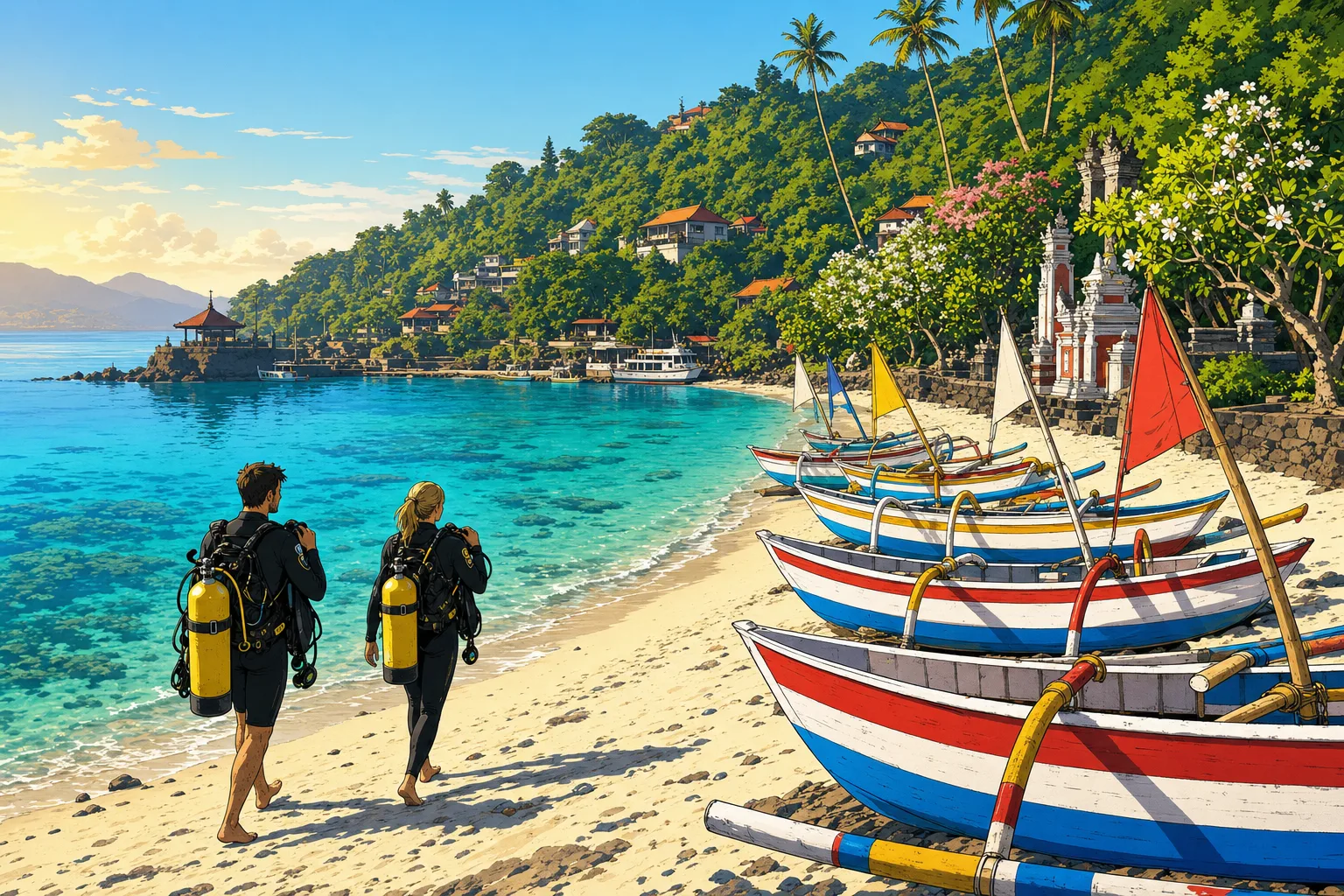
Padang Bai is the dive site that almost nobody asks for by name, and then asks to do twice. Most first-time visitors to Bali book Tulamben because they have read about the USAT Liberty wreck, or Nusa Penida because they want to see a manta. When they ask us at the shop for "another easy dive", we suggest a Padang Bai day trip from our Sanur dive centre and a few hours later they come up grinning, the way divers grin when they realise they have just found their favourite site of the trip. We have been running Padang Bai dives for years and this is the honest 2026 version of why we keep going back.
This guide is everything we wish a first-time guest knew before booking a Padang Bai diving trip with us. The town itself is one hour east of Sanur, much closer than Tulamben or Amed, and the diving covers a wider skill range than either of those. There is the shallow easy coral garden at Blue Lagoon for an Open Water-level diver, the artificial reef at Jepun for new divers and macro hunters, and the dramatic Gili Mimpang and Gili Tepekong sites just offshore for advanced divers who want sharks, currents and the occasional mola mola. We will cover every site we run, who each one suits, what conditions to expect month by month, how a typical day looks from pickup to drop-off, and exactly what it costs.
Why Padang Bai Punches Above Its Weight
Padang Bai is a working ferry port on Bali's east coast, the place locals go to catch the boat to Lombok or the Gilis. That is the first thing to understand: it is not a resort. It is a small fishing-and-ferry village with a deepwater harbour, a sweep of white-sand beach, a row of traditional jukung outrigger boats on the sand and about eight dive shops squeezed along two streets. That working-port feel is also why the diving is so good. The natural deepwater bay protects the coastline from the worst of the swell, the steep underwater topography around Gili Mimpang and Gili Tepekong concentrates currents and big fish, and the lack of beach development means the coral has not been bleached or trampled.
From an operator's perspective, Padang Bai also solves a logistics problem. Tulamben is a 2 hour 40 minute drive each way from Sanur, which makes a 7am pickup and a 10pm drop-off realistic. Amed is two and a half hours. Padang Bai is one hour. That single fact means a guest can do two Padang Bai dives, eat lunch at a beach warung, drive back to Sanur in time to swim in the hotel pool before dinner, and still have an early night before their day-2 dive. That is the reason about 40 percent of our day-trip bookings end up at Padang Bai. It is just easier on the body than a Tulamben day for someone on a one-week Bali holiday.
The other thing worth saying is that Padang Bai gives you variety in a single day. You can be in 6 metres of bathwater inside Blue Lagoon for dive one, then drop into 25 metres of cool current-swept water at Gili Tepekong for dive two. Few sites in Bali let you do that without a long boat ride. The two locations are eight minutes apart on a fast boat. We will sometimes flip the order if the morning conditions favour the offshore sites and afternoon wind is forecast for the bay; the guide makes that call on the day after looking at the surface.
The Five Dive Sites Worth Driving For
Padang Bai has more than five dive sites if you count every named patch of reef, but only five are worth your trip. The others are either redundant (an interior reef that is essentially a worse version of Blue Lagoon) or only divable in very particular conditions. Here are the ones we book guests on, ordered roughly easy-to-challenging.
1. Blue Lagoon
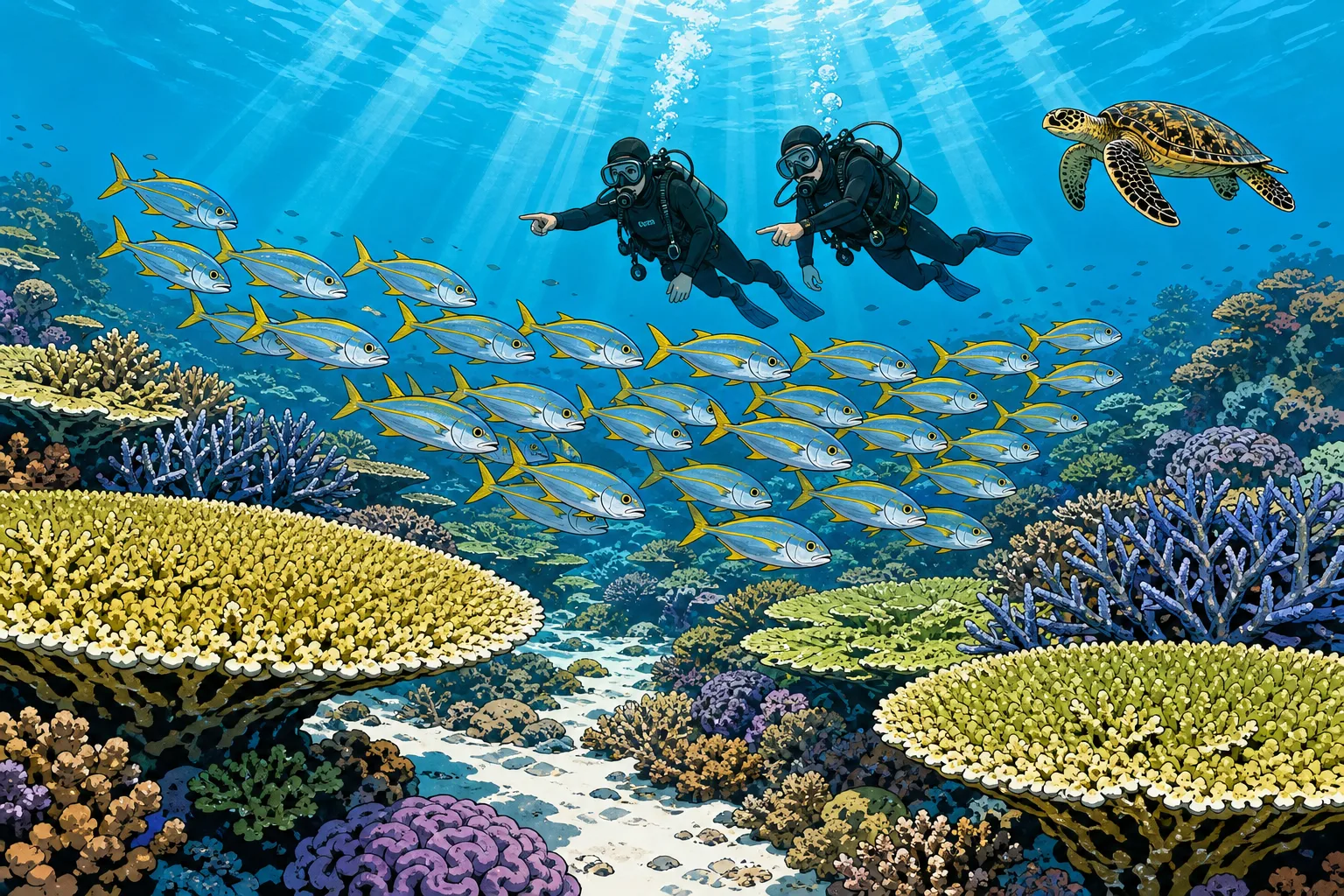
This is the headline site, and it is in some ways the polar opposite of the dramatic offshore stuff. Blue Lagoon is a small enclosed bay with a maximum depth of 18 metres, almost no current, white sand bottom and a genuinely healthy hard coral garden running along three sides. It is the site we use for guests who have not dived in five years, for first-time Open Water graduates, and for anybody doing the PADI Peak Performance Buoyancy speciality because the conditions are forgiving enough to actually focus on technique. The reef itself is more impressive than the brochure shots suggest: table corals 2 metres across, blue staghorn, brain coral, the occasional gorgonian fan deeper down, and big schools of yellowtail snappers cruising in the open. Hawksbill turtles show up on maybe 70 percent of dives, usually sleeping in a coral overhang on the south wall.
It is also one of the few sites in east Bali where the snorkeling is genuinely as good as the diving. The shallow water above the coral garden is 1 to 4 metres deep, calm enough for non-swimmers in a noodle vest, and the same fish and turtles you see scuba diving show up on the surface. For families and mixed-skill groups, our Padang Bai snorkeling day trip runs alongside the dive trip, same boat, same beach, different briefings. That is the reason we list Blue Lagoon as our top recommendation for a first dive in Bali.
2. Jepun
Jepun is the unsung hero of the Padang Bai sites. It sits just outside Blue Lagoon, between 5 and 18 metres, and the headline feature is an artificial reef: a series of concrete pyramid structures and a sunken 12-metre wooden boat, dropped about a decade ago to give the local fish population somewhere to colonise. It worked. The structures are now thick with soft corals and small reef fish, and the surrounding sand is a macro playground for ghost pipefish, harlequin shrimp, leaf scorpionfish, ribbon eels and a steady population of mototi octopus. We rate it as one of the best macro sites on the east coast, second only to Seraya Secrets near Tulamben. If your photo style leans macro, ask the guide for Jepun specifically. Dive plan: enter from the boat, descend onto the structures, work slowly across the sand looking for the small stuff, exit on the inside reef closer to Blue Lagoon. Easy current, friendly for any certification level, and a good site for muck diving photography in Bali.
3. Tanjung Sari
Tanjung Sari is the wall site. It runs along the north edge of Padang Bai bay, a slope that drops from 5 metres to 35 metres covered in big gorgonian fans, barrel sponges and soft corals. Most of our dives here stay between 12 and 22 metres because the upper section has the best light and the best fish life. Reliable schools of bannerfish, yellowtail snappers and the occasional school of jacks pass through in the morning. It is also a popular site for guests doing the deep adventure dive on PADI Advanced Open Water because the wall makes it easy to control depth and the visibility is usually good. One honest warning: current can pick up on Tanjung Sari faster than at Blue Lagoon, especially on a turning tide, so this is not a beginner-only site even though the depth profile is gentle.
4. Gili Mimpang
Now we leave the bay. Gili Mimpang is a cluster of three small rocky outcrops about 1 km offshore from Padang Bai. The dive is around the outer faces of the rocks, in 12 to 30 metres, and the conditions can swing from glassy and calm to ripping current within an hour. The reward for showing up on a good day is one of the most reliable big-fish sites on Bali's east coast. Resident white-tip reef sharks on the deeper ledges, the occasional eagle ray cruising in midwater, big schools of fusiliers and unicornfish hunting in the upper layer, and from late July through early November, real chances of seeing a mola mola sunfish coming up from the deep to be cleaned. Two cleaning stations on the back side of the rocks are where the molas usually appear. We recommend Mimpang for divers with Advanced Open Water or at least 30 logged dives, and we are strict about it because the current can be challenging. For Open Water-only divers we will do a backup dive at Blue Lagoon while the advanced group goes to Mimpang on the same boat. The site also features in our comparison of Bali drift dive sites as the east-coast equivalent of Nusa Penida's bigger drifts. If drift diving is the speciality you want, take a look at the PADI Drift Diver course we run from Sanur.
5. Gili Tepekong (The Shark Cave)
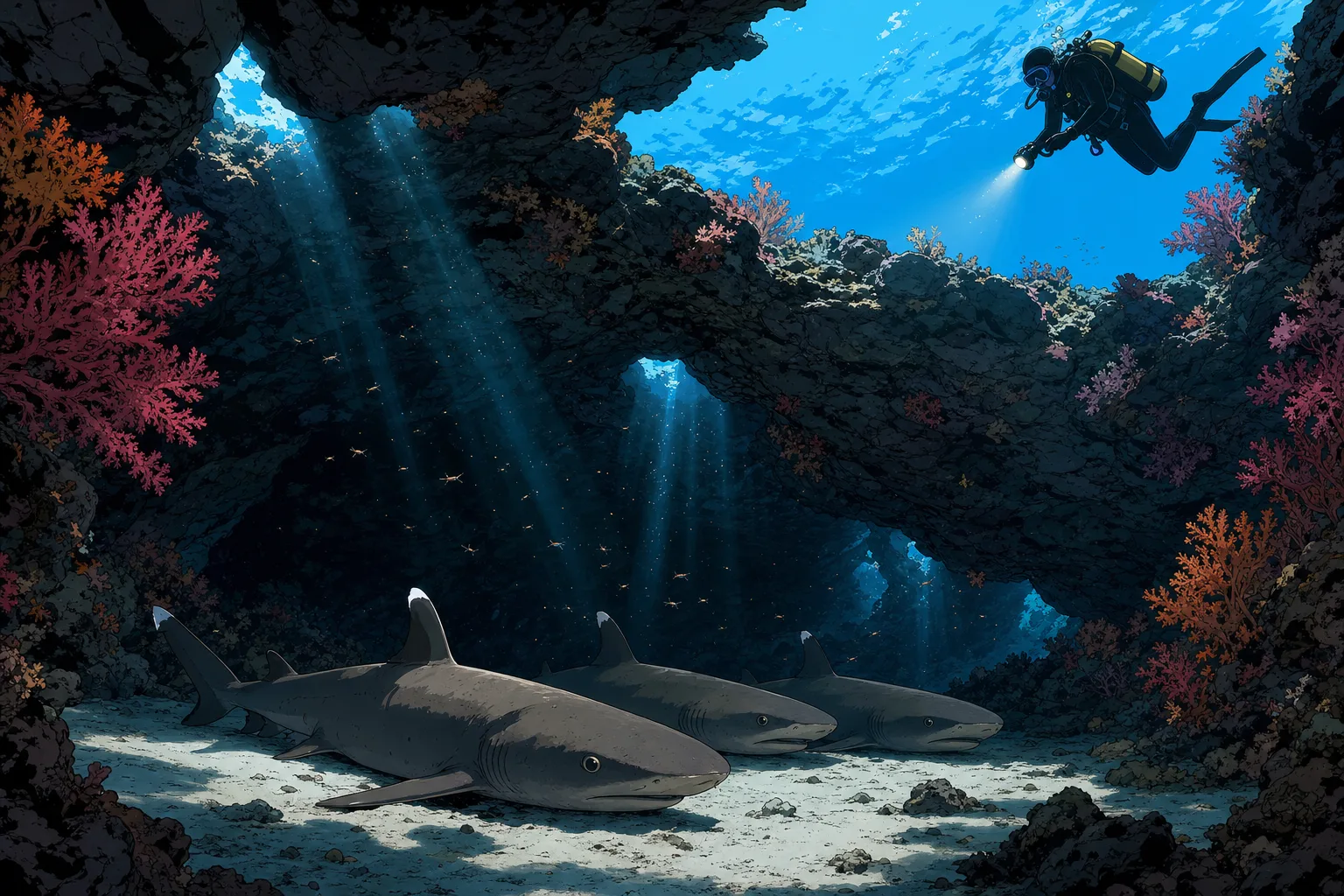
Tepekong is the most dramatic dive in Padang Bai and the one we are most careful about. It is a single rocky islet 1.5 km offshore, with vertical walls dropping into deep blue water on all four sides, and the famous "Shark Cave" on the south side: a wide rocky overhang at 18 to 22 metres where four to seven white-tip reef sharks habitually rest on the sand floor. The cave is open at both ends, so divers do not actually enter an enclosed space; we hover at the edge for a few minutes, observe the sharks from a respectful distance, then move on. Currents at Tepekong can be brutal. Down-currents on the corners of the islet are the real hazard, and a poorly briefed dive group can find itself sinking faster than expected. We never run Tepekong for a beginner. Minimum is Advanced Open Water plus 50 logged dives, and our guide reserves the right to switch the dive to a less exposed corner of the Mimpang and Tepekong area if conditions look wrong. Other species we see regularly: green and hawksbill turtles, big schools of trevally, bumphead parrotfish in winter, and during mola season the population sometimes shifts from Mimpang to the deep blue off Tepekong's south corner. When Tepekong fires, it is one of the best dives in Indonesia. When it does not, we take you to Blue Lagoon and you have a great safe dive instead. Either way we deliver.
The Other Padang Bai: World-Class Shore Snorkeling
Most dive blogs skip the snorkeling section because they assume their readers are all certified divers. We do not. About 30 percent of the groups we drive to Padang Bai have a mix of divers and non-divers, often a couple where only one dives, or a family with a teenager who is not certified yet. Padang Bai gives a non-diver a genuinely good day on the water without forcing them to wait in the boat for hours.
The headline snorkel site is Blue Lagoon itself. The same coral garden the divers go down to is shallow enough on its inshore edge that a snorkeler in fins and a mask can see everything from the surface: hard corals, the school of yellowtail snappers, the occasional turtle. We rent the kit at the shop, brief the snorkelers on the same boat as the divers, and we usually deploy a local guide in the water with the snorkeler group so they actually see the fish rather than swim in circles. There is also a small protected snorkeling-only area near the rocks at the south end of Blue Lagoon beach which is calmer still, and ideal for nervous swimmers or children under twelve.
The second site, slightly less famous, is Tanjung Jepun, the same artificial reef the divers visit at Jepun. The structures top out around 5 metres, which is too deep to see well from the surface for everyone, but a confident swimmer with fins can free-dive down to 3 to 4 metres and get within a few metres of the pyramids. For full details on the snorkel-specific schedule and pricing, our Padang Bai snorkeling page has the rates. If you are travelling with a non-diver who you would like to introduce to scuba in a controlled, no-pressure setting, the Discover Scuba Diving "try dive" we run at Blue Lagoon is the gentlest way to do it; the same beach, same instructor, no certification commitment.
Skill Levels, Currents and Who Each Site Suits
Padang Bai has the widest skill spread of any single dive area in Bali. That can be a strength (something for everyone) or a problem (you book a trip thinking you will see sharks at Tepekong and discover the next day you are not certified deep enough). Here is the honest matrix.
If you are an Open Water diver with fewer than 25 logged dives, you should be at Blue Lagoon or Jepun. Both sites are forgiving, max depth is comfortable, and the marine life is plenty rewarding. Save Mimpang and Tepekong for a future trip after you finish Advanced Open Water and get a few dozen more dives in your log. We will not certify you and then put you on Tepekong the same week; the law of averages catches up with that approach.
If you are Advanced Open Water with 25 to 50 logged dives, Mimpang is in scope on a calm day. Tepekong is borderline; we will assess on the day with the guide, and you may be paired with a more experienced diver in a small group of two or three rather than a larger group of four. Pre-trip, take an honest look at how much current you have actually dived in. Penida day trips at Toyapakeh and Crystal Bay are good preparation; the Nusa Penida day trip from Sanur is the route most of our guests use to log current dives before stepping up to Tepekong.
If you are an experienced diver with 50+ logged dives and any kind of cold-water or strong-current background, you will probably love Mimpang and Tepekong and find Blue Lagoon a fun warm-up. Bring your own SMB and reel, ideally a pair of good fins (we rent perfectly serviceable Mares Avantis but if you have your own free-diving-style or carbon paddle fins you will appreciate them on a Tepekong current). We can plan a Mimpang-then-Tepekong two-tank day specifically for experienced divers, on quieter days of the week, with a small group cap. Just ask when booking.
One more category: divers fresh off the boat with no proof of recent experience. PADI guidelines say if you have not dived in 12 months, you need a refresher. We take that seriously at Padang Bai because the current sites do not forgive bad buoyancy or fumbled gear checks. Our PADI ReActivate refresher runs in a single morning at our Sanur house reef before your Padang Bai trip; book it as a half-day add-on and the cost is around IDR 1,700,000 (≈ 95 USD).
How a Padang Bai Day Runs From Sanur
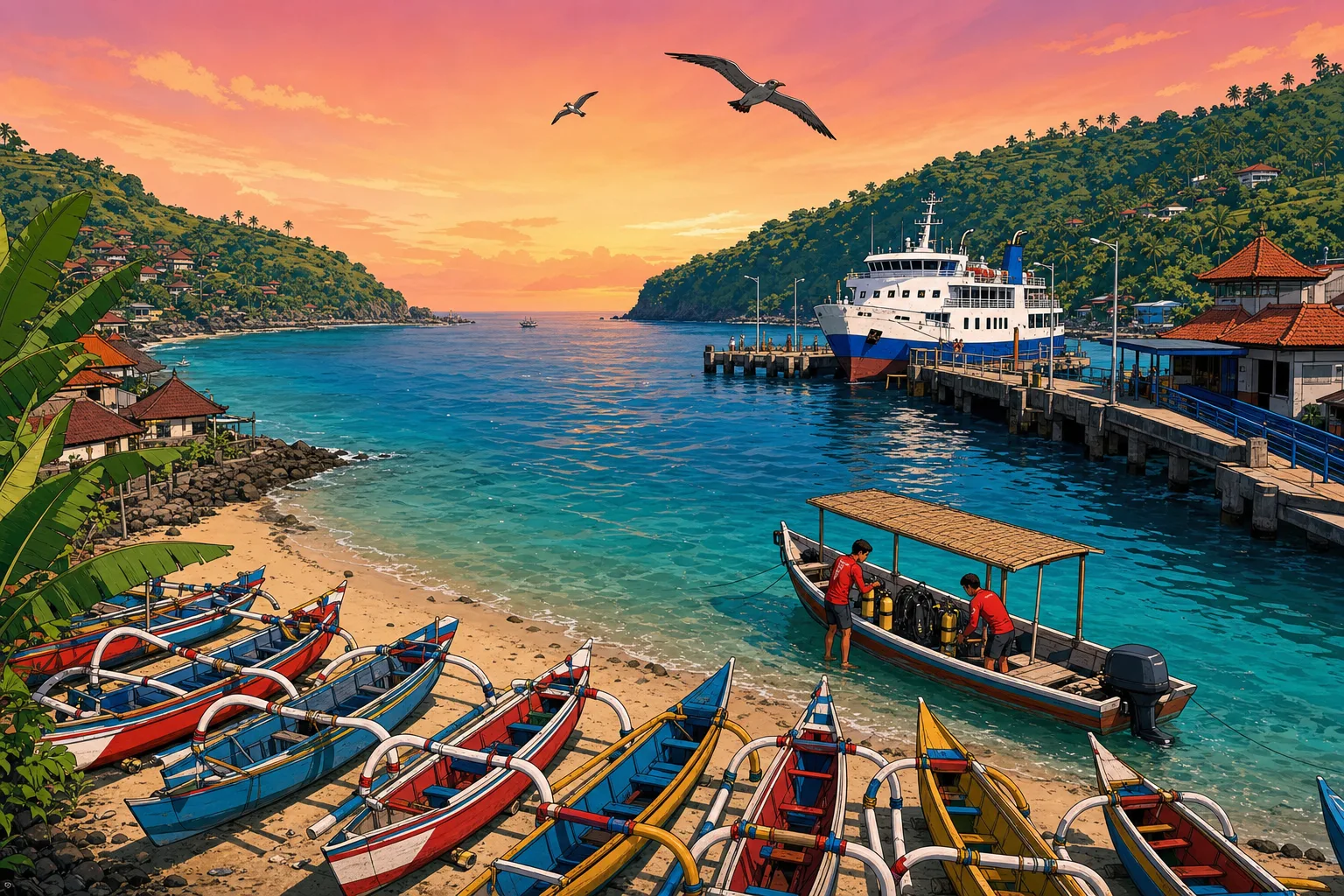
The standard Padang Bai day from our Sanur centre is a two-tank, lunch-included trip. We run it five days a week, sometimes six in high season. Here is the actual timeline of a typical day so you know what you are signing up for.
06:45: Pickup from your villa or hotel in Sanur, Denpasar or Seminyak. We use a small van that fits eight divers plus gear. We hand out water, a small banana cake snack pack and a quick rundown of the day. Drive to Padang Bai takes one hour through gradually quietening morning traffic. We usually pass the temple at Goa Lawah on the right; if it is your first day on the east coast, look out for the cliff swallows around the bat cave temple, they are dramatic.
07:45: Arrive at Padang Bai. The dive shop we partner with is a five-minute walk from the harbour. Quick log book check, computer check, fitting any rental gear you did not bring, and a briefing on the boat. Boats leave the harbour about 08:15.
08:30: First dive. Site choice depends on certification and conditions. For an Open Water level group, this is almost always Blue Lagoon or Jepun. For an advanced group, it is usually Gili Mimpang as dive one because the current is gentlest in the morning. Dive time 45 to 55 minutes, surface back at the boat or the beach depending on site, swap tanks and warm up.
10:15: Surface interval. About an hour. We anchor the boat back near Padang Bai beach, dry off, eat fresh fruit and drink tea, and the guide reviews any photos with you on the computer. This is the time to ask questions about the next dive site.
11:30: Second dive. If dive one was at Blue Lagoon, dive two is Jepun or Tanjung Sari. If dive one was at Mimpang, dive two could be Tepekong if conditions look good, or a return to Mimpang for a longer second pass. Around 45 minutes underwater.
12:45: Surface, gear off, walk up to a beachside warung in Padang Bai village for lunch. Included in the trip price. Choices are usually nasi goreng (fried rice), mie goreng (fried noodles), chicken sate, or a fish-of-the-day if you want to upgrade for about 50,000 IDR extra. We sit, eat, talk through the dives, sometimes have a coffee.
14:30: Leave Padang Bai. Drive back along the coast, sometimes a quick stop at Candidasa beach for a swim if the group has time and energy. Back in Sanur or your hotel by 15:45 to 16:00, in time for a swim, a nap, or an early dinner.
That is a comfortable day. Compared with a Tulamben trip, you are home four to five hours earlier, which makes a big difference on day three of a multi-dive holiday. We schedule Padang Bai trips for guests who want to dive but also want to enjoy the rest of Bali above water, and for families diving with kids in Bali where the early return is essential.
Seasonality, Visibility and Mola Mola at Tepekong
Padang Bai is divable year-round but the conditions and the species mix shift through the year. Here is the honest seasonal breakdown from our log book, not from a tourist brochure.
April through June: the sweet spot. Dry season is established, water temperatures are 28 to 29 degrees on the surface and 26 to 27 at depth, visibility at Blue Lagoon is consistently 15 to 25 metres, and at Mimpang and Tepekong sometimes pushes to 30 metres on a flat morning. Currents are moderate and predictable. This is when we recommend a first-time visitor book Padang Bai.
July through October: peak season, peak everything. Visibility stays excellent, water at depth can dip to 22 to 24 degrees on a Tepekong dive (a 5 mm full wetsuit is more comfortable than a 3 mm), currents get stronger, and the mola mola show up. Mola sightings at Mimpang and Tepekong peak in August and September; we see them on maybe 35 to 45 percent of advanced trips in those months. October still produces sightings but the frequency drops. The downside of peak season is that the sites get busier with other dive boats; we now book our advanced trips for off-peak days of the week (Tuesday, Wednesday, Thursday) to keep the underwater crowd manageable.
November through March: wet season. Surface conditions are still mostly diveable but cancellations rise to maybe 18 percent in January and February. The reasons are the same as for our Tulamben night dives: heavy rain ruining the inshore visibility, evening squalls, and unusual swell on exposed sites. Mimpang and Tepekong are the first to be called off; Blue Lagoon and Jepun are protected enough that they remain divable most of the time. Visibility at Blue Lagoon in heavy-rain weeks drops to 8 to 12 metres which is still acceptable, just less spectacular. The plus side of wet season is that the offshore sites are quieter, water is warmer at 29 to 30 degrees, and the manta sightings off Nusa Penida shift to nearer Bali, which sometimes means you get a manta cruising past Mimpang. Rare but it happens. For the full breakdown across Bali sites, we have a separate Bali rainy season diving guide.
One more seasonal note worth knowing: the Lombok ferries that run through Padang Bai harbour are noisier than guests expect. The ferry channel is on the outer side of the dive zone, not over Blue Lagoon or Jepun, but a passing ferry creates a low underwater rumble you can feel for about 30 seconds. It does not affect the marine life or the safety of the dive. It is just a thing you notice the first time and then forget.
Padang Bai as a Town: Where to Eat, Stay and Skip the Tourist Traps
If you fall in love with Padang Bai diving and want to extend your trip there, here is the honest local intel. The town has perhaps thirty small guesthouses and bungalow operations, mostly Indonesian-owned, ranging from 200,000 IDR per night for a basic fan room to 800,000 IDR for an air-conditioned ocean-view room with breakfast. We do not run accommodation ourselves but we have a short list of three places we send returning guests to, all family-run, all within a five-minute walk of the dive boats. Ask at the shop and we will share the names; we keep it off the website on purpose because the small operators do not want bookings.com type pressure.
Food in Padang Bai is mostly nasi-and-mie style warungs along the main road. The genuinely good ones are the warung at the south end of the bay near the headland (best fresh-grilled fish), and the small place behind the dive shop strip that serves a particularly good chicken bakar (grilled chicken) for around 50,000 IDR. The tourist-trap places are the obvious Italian/pizza restaurants along the harbour road with English menus and laminated photos of every dish; the food is not bad, just overpriced and not very Indonesian. If you ever wanted to learn how to eat in a Balinese fishing village, Padang Bai is a good four-day immersion.
Things to skip: the boat-touts at the ferry pier offering one-way crossings to Lembongan, Gili Air or Lombok. These are legitimate boats but the prices for walk-ups can be triple what you would pay booking online a day in advance. If you are continuing on to the Gilis after a Padang Bai dive trip, book the ferry through your accommodation or any small travel agent the day before and pay 350,000 to 500,000 IDR for the same speedboat the touts will quote you at 900,000 to 1,200,000 IDR. Things worth doing above water: the short walk over the headland on the south side of the bay to Bias Tugel beach (a small white-sand cove with no road access), and an early-morning visit to the local fish market when the night boats land their catch. Bring small denominations of cash.
If you are basing yourself in Sanur and only coming to Padang Bai for the day, you do not need to worry about any of this. We pick you up, drive you, dive you, feed you, drive you back. The lunch warung we use is one of the good ones (we have known the owner since 2017), and you are off the streets before the heat of the afternoon.
Cost, What Is Included, and How to Book
Pricing as of 2026, transparent and the same for any guest with their own certification:
Padang Bai two-tank day trip from Sanur (transport, two dives, gear, marine park fees, lunch, drinking water): IDR 2,700,000 (≈ 150 USD) per certified diver. This is the standard package about 80 percent of guests book.
Padang Bai two-tank advanced trip (Mimpang and Tepekong, same inclusions): IDR 2,950,000 (≈ 165 USD) per certified diver. The price difference covers the longer boat trip out to the offshore sites and the smaller group size cap of four divers per guide instead of six.
Single dive add-on (any site, if added to a multi-day package): IDR 900,000 (≈ 50 USD).
Padang Bai snorkeling day trip for non-divers in a mixed group (transport, gear, lunch, guide in the water): IDR 1,150,000 (≈ 65 USD) per person.
Discover Scuba Diving "try dive" at Blue Lagoon for first-timers: IDR 2,350,000 (≈ 130 USD), one supervised dive after a beach briefing and pool-substitute skills, full instructor attention.
What is included in every booking: door-to-door transport in our van, all hard gear (tank, BCD, regulator, fins, mask, wetsuit, computer, weights), all soft gear (SMB, marker lights, dive guide service), the marine park fee where applicable, lunch at a local warung, drinking water and the usual snack pack. Tips for the dive guide are not included and not expected, but 50,000 to 100,000 IDR to the guide is appreciated and shared with the boat crew if you had a great day.
What is not included: alcoholic drinks at lunch (around 30,000 IDR per large Bintang), GoPro or camera rental (we do not rent cameras), and travel insurance which should cover diving to 30 metres. DAN World membership is the cleanest way to handle the dive insurance side, around IDR 1,350,000 (≈ 75 USD) per year, and we recommend it for any diver going to Tepekong or Mimpang.
To book, the simplest path is to email or WhatsApp our Sanur centre with your dates, the certifications and approximate logged-dive counts in your group, and whether you want the standard or the advanced trip. We will reply within 12 hours, usually faster. For multi-day combinations the best value is our Bali diving package which lets you stack Padang Bai with a Tulamben night dive day, a Nusa Penida manta trip, and our Sanur house-reef refresher. You can also see the full price list including how our Bali dive prices compare on the pricing page, and direct online booking is available for the standard two-tank day trip.
One last bit of honest advice. If this is your first Bali dive trip, do not book Padang Bai for day one. You will be jet-lagged and you will get more out of the day if your body has had 24 hours to adjust. Day two or day three is the right window. Save the dramatic offshore sites (Mimpang and Tepekong) for day four or five once your buoyancy has come back to you, and book Blue Lagoon as your warm-up. That sequencing turns Padang Bai from a "decent dive day" into one of the highlights of your Bali holiday. We see it work that way every week.