
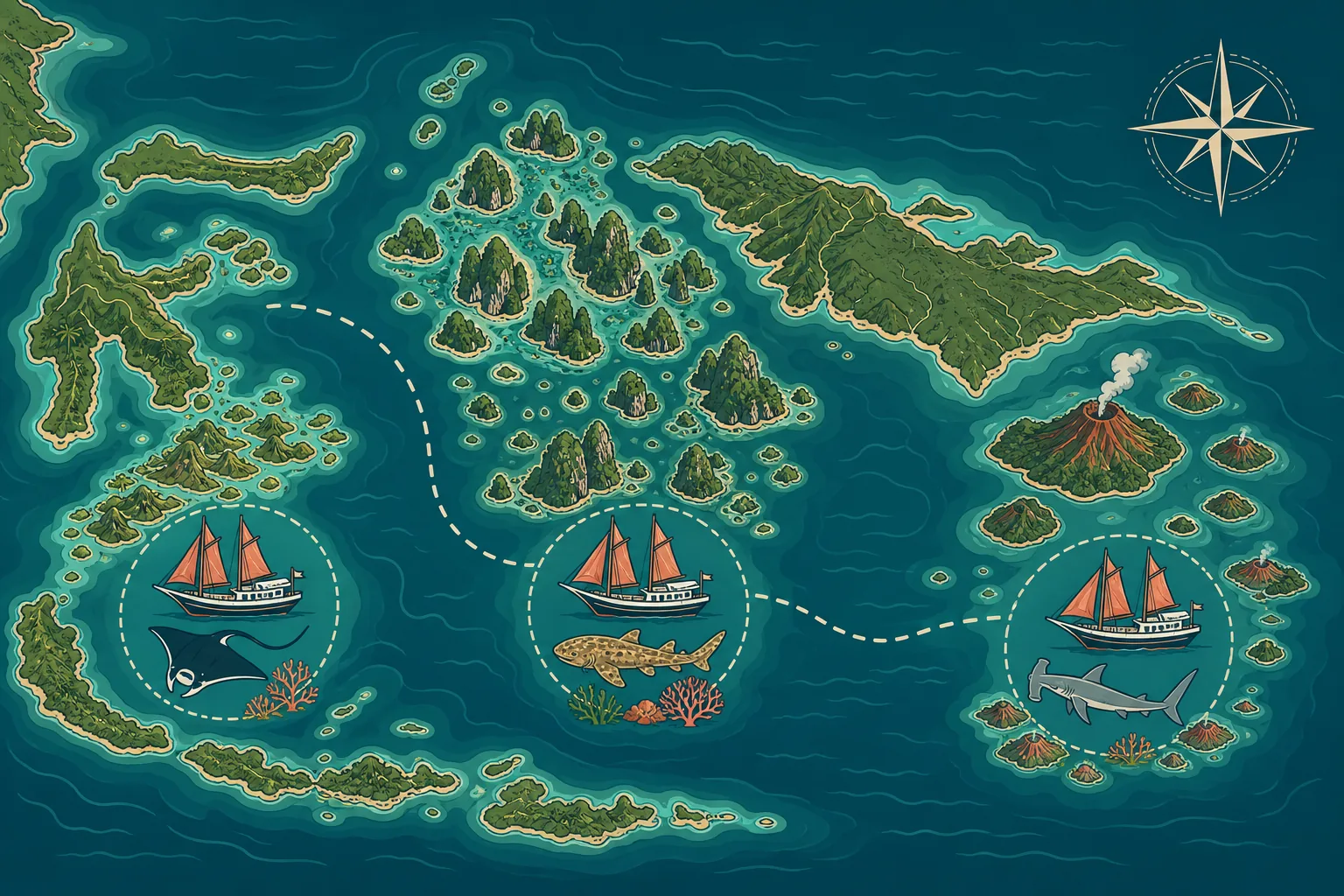
Every week at the shop in Sanur we get the same question from a guest who has just finished a few Bali day dives and decided that Indonesia is going to eat the rest of their diving life: which Indonesia liveaboard should I actually book, Komodo, Raja Ampat or the Banda Sea? It is a great question and an awful one, because the three regions are all world-class, all completely different, and the wrong choice can mean spending 3,200 USD on a boat trip where the marine life you specifically flew in for is on the other side of the country. We have been running guests onto Indonesian liveaboards since 2008, we operate our own boat the King Neptune across all three regions on a published seasonal schedule, and the honest answer is almost never the one the slick booking websites give.
This guide is the long version of the conversation we have at the shop when someone sits down with a coffee and asks us to be straight with them. We will cover what you actually dive in each region (not what the brochure says), what each one costs all-in for 2026 in real USD, what the dive difficulty really is, when in the year each region works, and the marine life encounter rates we have actually logged over hundreds of trips. We have skin in this game, our boat sails all three regions, so when we tell you the Banda Sea is not for first-time liveaboard guests, that is a judgement call we make every booking, not a sales pitch. If you are still picking between Bali day diving and going liveaboard at all, our Bali dive packages page is the smarter starting point. If you have already decided you are going liveaboard, keep reading.
Still deciding between a liveaboard, a dive resort and day trips? The diving in Indonesia guide compares every major region, from Bali and Komodo to Lembeh and Wakatobi, with seasons, 2026 park fees and the experience each one requires.
The 30-second answer: who picks which region
If you only read one paragraph, read this one. Komodo is the easiest, the cheapest, the closest to Bali (one short flight or even a single ferry hop), and the one we recommend for anyone doing their first Indonesia liveaboard or anyone with fewer than about 50 logged dives. The diving is huge, the topside is dramatic (Komodo dragons, the pink beach, Padar lookout), and you can do a perfectly satisfying 4-night trip without taking two weeks off work. Raja Ampat is the dream, the place with the densest reef life on the planet, but you pay for it: it is the longest flight chain (Jakarta or Makassar then Sorong), the longest minimum itinerary (most boats need 8 to 11 nights to make it worth the airfare), and the most expensive per night. Banda Sea is the connoisseur's pick: scalloped hammerhead schools, volcanic islands, virgin reefs, but it is the most remote, the season is the narrowest (roughly mid-September to early November), and it is only sold as a crossing between Ambon and Saumlaki or as a Komodo-Banda combo. Three boats and three different trips. Pick wrong and you will not even know what you missed.
So the rough sorting is: first liveaboard, want maximum reliability, only have one week → Komodo. Want the absolute best reef in the world, can carve out 11 to 14 nights → Raja Ampat. Already done Komodo and Raja Ampat, want hammerheads and remote volcanic dives, have the dive count and the budget → Banda Sea. We will spend the rest of this article unpacking why those answers are the answers, and what we are leaving out of the 30-second version.
Komodo: what you actually dive, what it costs, when it works

Komodo National Park is the warm-up to Indonesian liveaboard diving, in the sense that anyone with an Open Water cert and 20 to 30 logged dives can handle most of it. The park covers Komodo, Rinca, Padar and a constellation of smaller islands sitting between Sumbawa and Flores, and the diving splits cleanly into two zones with completely different personalities. The north (Castle Rock, Crystal Rock, Batu Bolong, Cauldron, Tatawa Besar) is warm, blue and fishy: schooling jacks, hunting trevally, white-tip reef sharks, the occasional grey reef shark and oceanic manta if you are lucky. The south (Manta Alley, Cannibal Rock, Yellow Wall of Texas, Pink Beach, Nusa Kode) is cold (24 to 26 °C versus 28 to 29 °C in the north), green, and absolutely loaded with macro: frogfish, pygmy seahorses, nudibranchs, soft-coral walls that look painted, and the south-side manta cleaning station at Manta Alley where reef mantas queue up most mornings between July and October. Most Komodo liveaboards spend two and a bit days north, two and a bit days south, with a Padar sunrise hike thrown in. Our long-form Komodo diving guide walks through each site with the briefings we actually give onboard.
Cost in 2026, for a real boat with proper safety standards and a dedicated cruise director, sits at roughly 280 to 450 USD per night for a standard cabin, with the bracket depending on whether the boat is a mid-range phinisi or a top-end luxury one. Our own King Neptune runs at the upper-mid end of that range and the price includes all diving, all meals, all soft drinks, transfers from Labuan Bajo, and the park fees which are the line item that everyone forgets (park fees are about 25 USD per day per diver in 2026, and they really do get checked by rangers). Nitrox is usually 100 to 150 USD for the trip on top. Flights from Bali to Labuan Bajo are 70 to 130 USD one-way and take 80 minutes. The minimum sensible trip is 4 nights / 12 to 14 dives. The sweet spot is 6 nights / 18 to 22 dives, which gives you proper time in both the north and the south without the boat racing between sites. If you only want to dive Komodo from Bali without committing to the boat, our Komodo tour from Bali page covers the land-based option as well.
Komodo runs almost year-round but the genuinely good months are March to early November. The peak window for manta encounters is July through October, with the south side getting cold (down to 23 °C with thermoclines at Cannibal Rock) and the north staying tropical. January and February are technically possible but several operators including us do not run liveaboards in that period because of the west-monsoon winds, which compress your usable diving down to whichever side of the islands has lee. If a website is selling you a January Komodo liveaboard at half price, that is why. Our Komodo vs Bali diving comparison digs into the seasonal call in more detail, our best time to visit Bali guide maps the same logic across the calendar, and we also operate a budget-friendlier sister boat, the Komodo Sea Dragon, on the same schedule for guests who want the trip without the King Neptune cabin tariff. Land-based Komodo divers should also see the Komodo diving overview for resort and day-boat alternatives.
Raja Ampat: what you actually dive, what it costs, when it works
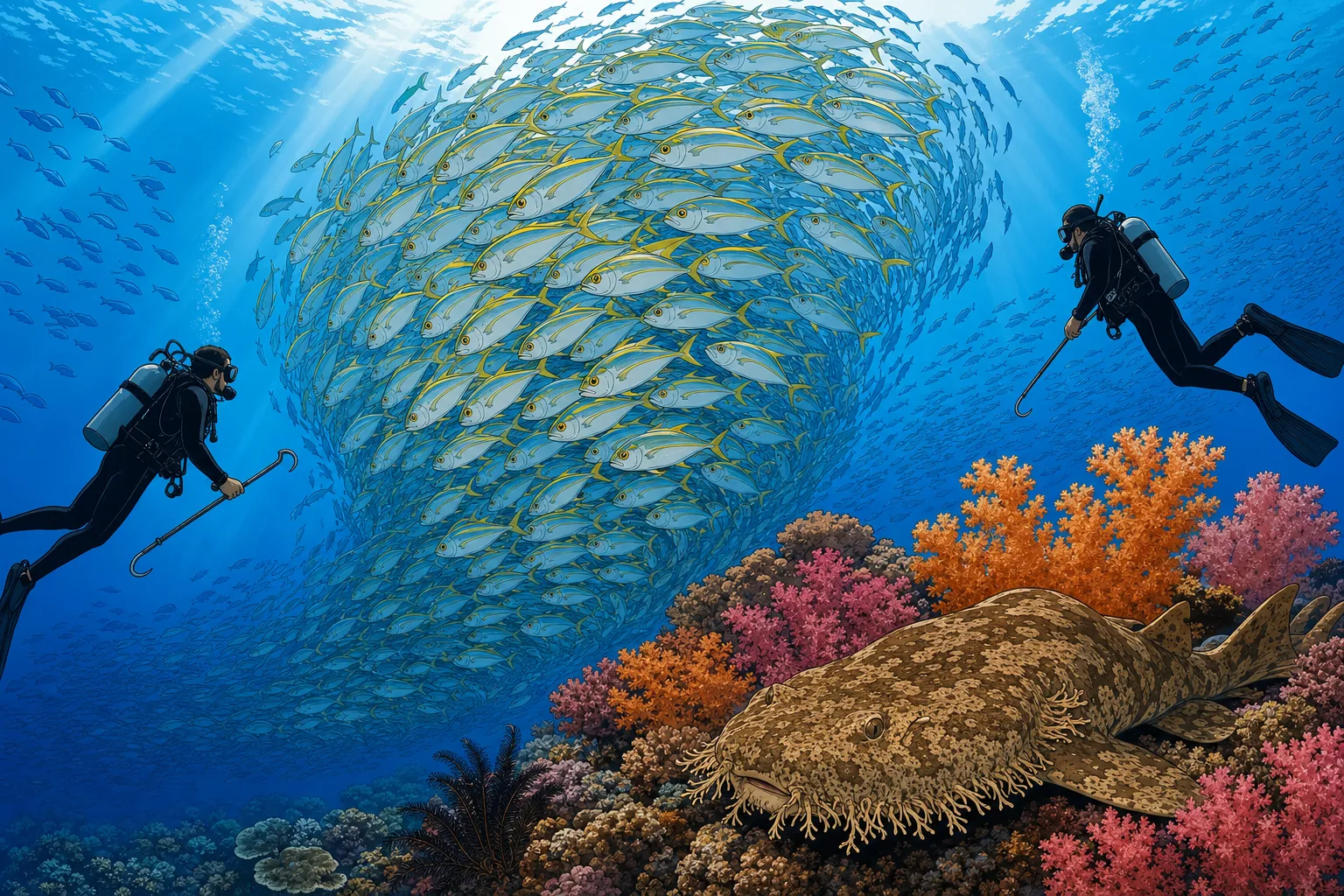
Raja Ampat is the place. Marine biologists have logged more reef fish species per hectare in the Dampier Strait than anywhere else on the planet, the soft-coral coverage on sites like Sardine Reef and Cape Kri is hard to overstate, and the karst limestone island scenery topside is what people put on calendars. The diving is dramatically richer than Komodo, but it is also dramatically harder to get to: from Bali you fly Denpasar to Sorong (almost always via Makassar or Jakarta, total transit usually 6 to 9 hours plus an overnight), then a 2-hour speedboat to Waisai or directly onto your boat. The minimum viable Raja Ampat liveaboard is 7 nights and most operators sell 8 to 11 night itineraries because the boat has to traverse a lot of ocean to make the airfare worthwhile. We do 10-night Raja trips on the King Neptune and that is the length we genuinely recommend.
The diving splits into three main regions and any half-decent boat will give you all three. The Dampier Strait (Cape Kri, Sardine Reef, Mike's Point, Blue Magic, Manta Sandy) is the most famous, with current-swept reef diving, big-fish action, schools of trevally and barracuda that tornado around you, and the manta cleaning station at Manta Sandy where reef mantas line up like aircraft at a runway. Misool in the south is the quieter, prettier sister: pinnacles bursting with soft coral, walls covered in sea fans, the Magic Mountain seamount where oceanic mantas turn up between November and April, and topside scenery that genuinely outdoes the brochures. The far north (Wayag, Aljui Bay) is the postcard you have seen a thousand times, lots of remote bays, pearl-farm dives, and easier check-out diving. Most 10 to 11 night itineraries hit all three; the shorter 7-night trips have to pick two. Our Indonesia liveaboard hub has the current departure schedule and which itinerary length covers what.
Cost is the bit that catches people. Per-night pricing in 2026 sits at 380 to 700 USD for a quality boat, with the King Neptune in the 420 to 520 USD range depending on cabin. So a sensible 10-night trip is 4,200 to 6,500 USD per person before park fees, before flights, before Nitrox. Raja Ampat park fees total 1,700,000 IDR (about 105 USD) per diver: a 700,000 IDR marine park card valid for 12 months plus a 1,000,000 IDR regency visitor levy charged on every visit since January 2026. Most boats arrange both for you. Flights Bali to Sorong return through Makassar are 350 to 600 USD depending on season. Nitrox is usually 200 USD for the trip. Add an extra night in Sorong on either side (you really should, the flight schedules are brutal) and you are looking at a full all-in cost for a 10-night Raja trip of around 5,500 to 8,500 USD per person. It is a lot of money. It is also the best diving on earth. The right way to think about it is: if you can only do one Indonesia liveaboard in your life, and you can find 14 days off work, Raja Ampat is the one. If you are going to do three or four trips over the years, do Komodo first.
Season for Raja Ampat is essentially the inverse of Komodo. The window is roughly mid-October through early May, with November to April being the proper season and December to March being the peak. That is also the rainy season in Bali, so a lot of guests effectively do Bali dry season (May-September) on Komodo plus a Raja Ampat trip in the Bali wet season, and quietly avoid the Bali rain. Outside the season, June to early September, the south-east monsoon makes Raja Ampat genuinely uncomfortable: the Dampier Strait gets choppy, Misool can be unreachable for days, and the manta hit-rates drop sharply. A few boats run "shoulder season" trips at discounted prices, and we have seen them be excellent and we have seen them be cancelled mid-trip. We do not personally book Raja in July or August.
Banda Sea: hammerheads, volcanic walls, and the catch nobody mentions

The Banda Sea is the trip every other guest at the shop has heard of from a divemaster friend and wants to do, and we are honestly going to talk most first-timers out of it. Not because it is not extraordinary, it is, but because the demands are real and the season is the narrowest in Indonesia. The Banda Sea is a deep volcanic basin between Maluku and the islands south-west of Papua, and the diving is essentially three things: scalloped hammerhead schools at sites like Manuk and Suanggi, virgin reef diving on volcanic seamounts (sites like Gunung Api with its sea-snake migration), and the historic spice islands of Banda Neira with their old Dutch forts and nutmeg plantations topside. The diving is mostly blue-water hangs over walls and pinnacles, deeper than Komodo or Raja, with currents that can be sudden and significant. We require an Advanced cert and 50+ logged dives for our Banda departures.
The catch is timing. The Banda Sea has a usable diving window of roughly mid-September to early November, full stop. Outside that, the seas are simply too big for safe small-boat operations across open ocean crossings. Most Banda Sea liveaboards are sold as one-way crossings: Ambon to Saumlaki, Ambon to Sorong, or as a Banda extension on the front or back of a Raja Ampat trip. That means you almost never fly home from the city you flew into, your luggage logistics get more complicated, and you absolutely should buy a flexible flight ticket because Maluku domestic schedules are not reliable. Prices in 2026 sit at 400 to 650 USD per night, similar to Raja Ampat, but trips are usually 10 to 13 nights minimum. All-in for a proper Banda crossing including flights to and from Indonesia, you are looking at 6,000 to 9,500 USD per person.
So why do experienced divers keep coming back to Banda? The hammerhead encounters are genuinely one of the most reliable in the world for that animal, which is not an easy claim. On our last three October Banda Sea crossings we have logged hammerhead schools on 11 of 14, 9 of 13 and 13 of 15 dives at the relevant sites, which is unheard of anywhere else outside Galapagos or Cocos. The reefs are pristine in a way Komodo and Raja simply are not anymore, because nobody has been diving them for very long. The topside is historic and walkable in a way the other regions are not. And the boats are emptier, often single-charter or 8 to 12 guests, because demand is low. The honest summary is: Banda is the trip you do once you know you love Indonesian liveaboards. Do not make it your first.
Cost compared: 2026 all-in numbers per diver
This is where most comparison articles get vague. We will be specific. The numbers below are for a single diver in a standard twin cabin (so half the room cost), all-in including domestic flights from Bali, park fees, transfers, Nitrox and reasonable buffer. They are 2026 figures from our own bookings and from what we have paid out on behalf of guests. Solo travellers in a single supplement cabin add roughly 30 to 60 percent. Luxury boats add 30 to 100 percent over these numbers.
| Region | Trip length | Per-night boat cost | Flights from Bali | Park fees | Realistic all-in |
|---|---|---|---|---|---|
| Komodo | 4 nights | 280-450 USD | 120-260 USD (DPS-LBJ rtn) | 100-130 USD | 1,600-2,500 USD |
| Komodo | 6 nights | 280-450 USD | 120-260 USD | 150-180 USD | 2,200-3,400 USD |
| Raja Ampat | 7 nights | 380-600 USD | 350-600 USD (via UPG/CGK) | 105 USD (park card + levy) | 3,400-5,200 USD |
| Raja Ampat | 10 nights | 380-600 USD | 350-600 USD | 105 USD | 4,600-7,000 USD |
| Banda Sea | 10 nights | 400-650 USD | 500-800 USD (DPS-AMQ-DPS) | 50-80 USD | 5,000-7,800 USD |
| Banda Sea crossing | 13 nights | 400-650 USD | 600-900 USD | 80-120 USD | 6,600-9,500 USD |
Two notes that catch people out. First, the Komodo park fee is per diver per day and gets added at the end of the trip, while the Raja Ampat fee is an annual tag and you pay it once. If you are doing Komodo plus Raja in the same year, the Raja tag is the bargain of Indonesian diving. Second, almost every boat now quotes "all inclusive" and then adds Nitrox, alcoholic drinks, port fees, fuel surcharges and tipping on top. A 5 percent budget buffer over the bracket numbers above is realistic. If you want to see how this stacks up against staying in Bali and doing day diving, our scuba diving Bali price breakdown runs the equivalent maths for the Sanur-based alternative.
Difficulty and current honestly compared
The three regions are not the same difficulty and the bookings sites tend to underplay this. Komodo's south side has cold green water with occasional thermoclines and moderate current; the north has serious current at Castle Rock and Crystal Rock where you have to drop fast, hook in and ride. Raja Ampat is mostly mild to moderate current with set-piece dives like Cape Kri where the current is part of the experience, plus a handful of dives like Blue Magic and Manta Sandy where things can pick up unexpectedly. Banda Sea is the most demanding because the dives are deeper, bluer, and the current can swing through 90 degrees in the middle of a dive in a way that simply does not happen on a sheltered reef site.
| Region | Min cert | Min logged dives | Typical current | Water temp | Honest difficulty |
|---|---|---|---|---|---|
| Komodo (north) | Advanced | 30 | Strong, predictable | 27-29 °C | Moderate, current-aware |
| Komodo (south) | Open Water | 20 | Mild to moderate | 23-26 °C, thermoclines | Easy on dive, cold for some |
| Raja Ampat (Dampier) | Advanced | 40 | Moderate, peaks strong | 28-30 °C | Moderate |
| Raja Ampat (Misool) | Advanced | 40 | Mild to moderate | 28-30 °C | Moderate, gentler |
| Banda Sea | Advanced + Nitrox | 50 | Variable, can be strong | 27-29 °C | Demanding, blue water |
If you are a newly-certified diver and someone is selling you a Banda Sea trip on the strength of the hammerheads, please go back to them and ask for honest minimum requirements. We turn away Banda enquiries weekly from divers with sub-50 logged dives, not because we cannot teach you on the boat, but because the dive profile is fundamentally different from what you learned in Bali. The same is true of Komodo's northern current sites. If your liveaboard guide does not run a check-out dive on day one and adjust your trip plan based on what they see, that is the operator we would walk away from. Our standard practice across all three regions is a sheltered easy check-out (usually a sandy slope at Sebayur in Komodo, Yenbuba in Raja, or Pulau Hatta in the Banda Sea) and a frank conversation with anyone who is struggling with buoyancy or air consumption before we put the boat at a current site.
Marine life by region: what you will actually see
This is the question the booking websites mangle worst. Every region "has mantas, sharks and turtles". That is technically true and practically useless. Here is what we have actually logged on our boats over the last three full years of operation, expressed as the percentage of trips where the listed animal was seen at least once. These are the numbers we share with guests at the booking call.
| Animal | Komodo (Jun-Oct) | Raja Ampat (Nov-Apr) | Banda Sea (Sep-Nov) |
|---|---|---|---|
| Reef manta | 92% | 96% | 40% |
| Oceanic manta | 30% | 55% (Misool/Magic Mtn) | 15% |
| Scalloped hammerhead schools | 5% | 10% | 85% |
| Wobbegong (tasselled) | 15% | 95% | 10% |
| Pygmy seahorse | 70% | 92% | 50% |
| Frogfish (any) | 80% (south) | 70% | 40% |
| Mola mola | 0% (wrong region) | 0% (wrong region) | 0% (wrong region) |
| White-tip / black-tip reef shark | 100% | 100% | 95% |
| Grey reef shark schools | 40% | 70% | 60% |
A couple of notes on those numbers. Mola mola does not happen on any of these three liveaboard regions because the cold-water upwelling that brings sunfish up to recreational depths is specific to the strait between Bali and Nusa Penida, peaking July to October. If you came to Indonesia specifically for mola, our mola mola Bali season guide is the page you want and you should be diving Penida from Sanur, not booking a liveaboard. Conversely, scalloped hammerhead schools effectively do not happen reliably on Komodo or Raja Ampat liveaboards: if that is the trophy, Banda is the only sensible answer. Reef mantas are roughly as good on Komodo and Raja, but the Komodo experience is a single cleaning station (Manta Alley or Cauldron) while Raja has multiple stations spread across both Dampier and the south. For the equivalent reef-manta experience in Bali itself, our Nusa Penida manta diving guide covers Manta Point and Manta Bay, and the always-asked safety question is answered in are manta rays dangerous. The richness of "everything else", soft coral, fish density, macro variety, is where Raja Ampat genuinely beats the other two regions, which is the unspoken reason it keeps winning the "best diving in the world" polls. For a fuller picture of why Indonesian reefs hit so much harder than the equivalent depth in the Maldives or the Caribbean, our Bali vs Maldives diving comparison explains the Coral Triangle biogeography, and our best places to scuba dive in Bali ranks the home reefs by the same standards.
How we would pick if it were our only Indonesia trip
The question we get asked most at the booking call, after price, is: "if you were me, what would you book?" The answer depends on three things we will probably ask you in return, in this order. How many liveaboard nights you have done before, how many days off work you can realistically take including travel, and whether you have a specific trophy animal in mind. From those three answers we can almost always sort the right region in about five minutes. Here is roughly how we sort.
Total beginner, first liveaboard, one week of leave, no specific trophy: Komodo. 5 or 6 nights on a mid-range phinisi out of Labuan Bajo. You will dive the north and the south, see mantas, see sharks, dive coral that will reset your expectations of what a tropical reef looks like, and you will not exhaust yourself in transit. Add two nights in Sanur on the way to acclimatise and do a day of refresher diving on the USAT Liberty wreck before the boat. The whole thing fits inside 10 days off work.
Experienced diver, this is your big-trip-of-the-year, you have 14 days: Raja Ampat. 10 or 11 nights on a quality boat out of Sorong. Do not cheap out on flights, get the early-morning Garuda direct to Makassar so you arrive in Sorong with a day to spare. Add a Sorong overnight on each side. This is the trip people talk about for years afterwards. If you have already done Komodo, this is the obvious second Indonesia liveaboard, and our Raja Ampat liveaboard schedule has the King Neptune departures.
Experienced diver, hammerheads are the thing, you have 14 days and an October window: Banda Sea. There is no real substitute. Book the Komodo-to-Banda or Ambon-to-Sorong crossing on a properly equipped boat with a guide who has done the route at least three times before. Add flexible flights. Accept that one dive day will probably get blown out by weather and bring a book for the long crossing day.
Two divers, mixed experience, mid-budget, want to do both Indonesia and a Bali holiday in one trip: Komodo liveaboard plus a week of Bali day diving from Sanur. This is genuinely the most popular combination we book and it works. The Komodo trip gives you the liveaboard experience and the bucket-list dives; the Bali week gives the non-diver in the group temples and rice terraces while the diver hits Penida, Tulamben and Amed. Total budget for two people for 14 days is roughly 6,000 to 9,000 USD all-in. Our Bali dive trip itinerary guide has the planning template for the Bali half.
Three divers, all advanced, want to maximise diving and minimise tourist stuff, two-week budget: Raja Ampat 10-night plus three nights in Bali on the way home for Nusa Penida day trips as a contrast. The Penida cold water and the Raja warm reefs are completely different diving and they bookend the trip nicely. The most famous Penida current site is covered in our Blue Corner Nusa Penida guide for anyone wanting to time the dive properly. We have run this exact itinerary for guests three times in the last 18 months and it has worked every time. For a more relaxed alternative on the Bali half, the macro diving at Tulamben is a complete change of pace from the big-fish Raja experience.
The thing we will not do, ever, is sell you a 4-night Raja Ampat liveaboard. They exist and they look cheap on aggregator sites, but the math does not work: by the time you have spent two days in transit each way to Sorong and back, you are diving for 36 hours of actual seabed time and paying 5,000 USD for the privilege. If you only have a week, Komodo is the right call. Save Raja for when you have the time to do it properly. Same logic for "weekend Banda" trips, which fundamentally do not exist for a reason. Guests who want a short Komodo taster without a full liveaboard can also look at the smaller Neptune One for 3 to 4-night Komodo charters, which is the closest thing to a "weekend" option that actually works in this part of Indonesia. For Bali-side day boats as a comparison framework, our Bali dive trips page lists every site we currently run.
Booking, packing and the things nobody tells you
A few practical things we wish someone had told us before our first Indonesian liveaboard. Book 6 to 9 months ahead for peak Komodo (July to September) and 9 to 12 months ahead for prime Raja Ampat (December to March); the good cabins on the best boats are gone earlier than you think. Travel insurance with diving coverage is non-negotiable, and DAN World membership is essentially a 100 USD/year requirement that no serious dive operator should be flying without; we will ask for proof at check-in. Bring your own DIN to yoke adapter if you are a DIN diver, do not assume the boat has spares. Bring your own SMB even if the boat provides them. Bring more than you think you need of seasickness medication, because the Banda Sea and the Raja Ampat crossings are not kind to people who think they are immune. The full Bali-side gear list is in our Bali scuba diving packing list, and 95 percent of it applies to liveaboard travel as well, with an added wetsuit layer for the Komodo south.
Cash is the other thing. Almost every Indonesian liveaboard runs a tab for Nitrox, alcohol, park fees and tipping that is settled in cash on the last morning. Tipping convention in 2026 is roughly 10 to 12 percent of the boat cost, split between deck crew and dive guides through the cruise director. Bring USD or IDR in mid-denomination bills (50s and 100s); credit cards work on perhaps half the boats and almost never have a reader connection at sea. Park fee rangers in Komodo specifically ask for IDR small bills, and the boats handle that for you but the cost shows up on your tab. For Raja Ampat there are two charges in IDR, the 12-month marine park card and the per-visit regency levy, which the boat usually buys on your behalf. For Banda the rules vary by which province you transit and the cruise director is the right person to ask.
Finally, weather and itinerary changes. Every single Indonesian liveaboard contract has a clause saying the captain can change the itinerary for weather and safety reasons. They will use it. On our last six trips combined we have skipped a planned site for swell in five of them, and we are a relatively conservative operator. This is not a deal-breaker, it is how liveaboard diving works, and the sites we move to are usually as good or better. The right mindset is to arrive having read the briefing pack and then trust the cruise director's calls. If you want the cruise director's day-one decisions to be informed by your specific goals, tell them at check-in: "I came for mantas", "I'm here for macro", "I want one good shark dive". Good cruise directors will rejig the schedule for you. Ours certainly does, but only if asked. The Komodo liveaboard departure page and the King Neptune page both list current cruise directors so you can match the human to the route.
There is a fourth option worth knowing about before you commit to a region, and it is not a region so much as a detour. Whale sharks gather year round at the fishing platforms in Saleh Bay, Sumbawa, which sits on the Lombok to Komodo crossing, so a boat sailing east can include them without adding a separate trip. Our guide to whale sharks in Indonesia covers how that compares with the full expedition to Cenderawasih Bay in West Papua.
If you still are not sure which region to book, or you want to talk it through with someone who has run all three and has no booking incentive to push you one way, write to the Sanur dive shop or stop in next time you are in town. We will not always tell you what you want to hear, but we will tell you what we would book for ourselves. After 17 years of running Indonesian boats, that is the most honest service we can offer.
Frequently Asked Questions
Komodo, by a long way. It is closer to Bali (one short flight), the minimum trip length is shorter (4 to 6 nights versus 8 to 11 for Raja Ampat), it is roughly half the all-in cost, and the diving is forgiving enough for divers with 30 to 50 logged dives. Raja Ampat is genuinely the better diving on a site-by-site basis, but the transit time, the cost and the minimum trip length make it a poor first liveaboard. Do Komodo first, then come back and do Raja when you have the time and budget to do it properly.
All-in, including flights from Bali, park fees, Nitrox and a one-night Sorong stopover on each side, expect 4,600 to 7,000 USD per person for a quality boat in a standard twin cabin. Solo travellers in a single supplement cabin add 30 to 60 percent. Top-end luxury boats can run to 9,000 USD or more for the same itinerary. The boat tariff itself is usually 380 to 600 USD per night; the rest is flights (350 to 600 USD return through Makassar), the 65 USD annual Raja Ampat tag, Nitrox at 200 USD, and Sorong hotel and transfer fees.
Komodo runs best March to early November with peak manta season July to October. Raja Ampat runs October to early May with peak conditions December to March. Banda Sea has the narrowest window of any major Indonesian region: mid-September to early November is essentially the only safe diving window for the open-ocean crossings. Notice that Komodo and Raja Ampat are almost inverse seasons, which is convenient if you are planning multiple Indonesia trips across a year.
Yes, with the right boat and the right week. Over our last three October Banda crossings we have logged scalloped hammerhead schools on 11 of 14, 9 of 13 and 13 of 15 dives at the relevant sites (Manuk, Suanggi and the volcanic seamounts). That is roughly 85 percent of trips seeing schools at least once, which is unheard of anywhere else outside Galapagos or Cocos. Outside the September to early November window the seas are too big for safe small-boat operations across the open ocean crossings, so the hammerhead trips do not run.
Komodo south accepts Open Water with 20 logged dives. Komodo north needs Advanced with 30 dives because of the current at sites like Castle Rock and Crystal Rock. Raja Ampat needs Advanced and 40 dives realistically, with Misool a bit easier than the Dampier Strait. Banda Sea is Advanced plus Nitrox, with 50 logged dives as a hard minimum on our boat. We routinely turn away Banda enquiries from divers with fewer logged dives. If you are short on dives, do a week of refresher diving in Bali before the boat to build your count and your comfort.
Yes, and this is the most popular combination we book. A typical 14-day plan is two or three nights in Sanur for jet-lag recovery and a USAT Liberty wreck day at Tulamben, then fly to Labuan Bajo for a 5 or 6-night Komodo liveaboard, then back to Bali for the remaining days of beach, temples or more day diving. Bali domestic flights to Labuan Bajo are 80 minutes and run multiple times daily. Budget about 6,000 to 9,000 USD all-in for two divers for 14 days on this template.
Almost always extra. The standard 2026 add-on is 100 to 150 USD per diver for a Komodo trip and 200 USD for a Raja Ampat or Banda Sea trip, paid in cash on the last morning along with park fees and tips. Some luxury boats include Nitrox in the headline price but they are the exception. If you are doing multiple dives per day for a week or more, the Nitrox surcharge is one of the best value bits of the trip; we recommend it for anyone certified.
Komodo cruising is mostly inside sheltered waters between islands and is usually fine even for sensitive guests. Raja Ampat has one or two open-water crossings per itinerary and they can be uncomfortable, especially the Misool transits in November and April shoulder weather. Banda Sea is genuinely open-ocean cruising with crossings of 12 to 18 hours, and even experienced sailors have rough nights. Pack seasickness medication for all three regions and start it the morning of the first long transit, not when you already feel sick.
Yes, but the cheapest end of the market in 2026 (under 250 USD per night for Komodo, under 350 USD for Raja) has a noticeably higher rate of cancelled itineraries, missing safety equipment and underpaid crew. We have personally run rescue assistance for guests off cheap boats in both regions over the last three years. The honest mid-range is 280 to 450 USD per night for Komodo and 380 to 600 USD per night for Raja, and at that bracket there are several genuinely safe and well-run boats including our own. Below that, ask hard questions about boat documentation, cruise director certifications and oxygen kits before you book.
Yes to both. Any serious Indonesian liveaboard operator including us will check for diving-specific travel insurance and DAN World (or equivalent) membership at check-in. Standard travel insurance does not cover scuba diving accidents above 18 metres or beyond standard recreational limits. DAN World membership is roughly 100 USD per year and covers emergency evacuation to the nearest hyperbaric chamber, which in eastern Indonesia is not somewhere you want to be paying for out of pocket. The closest chambers to the dive regions are in Denpasar and Manado, hours of evacuation from any of these liveaboard zones.