
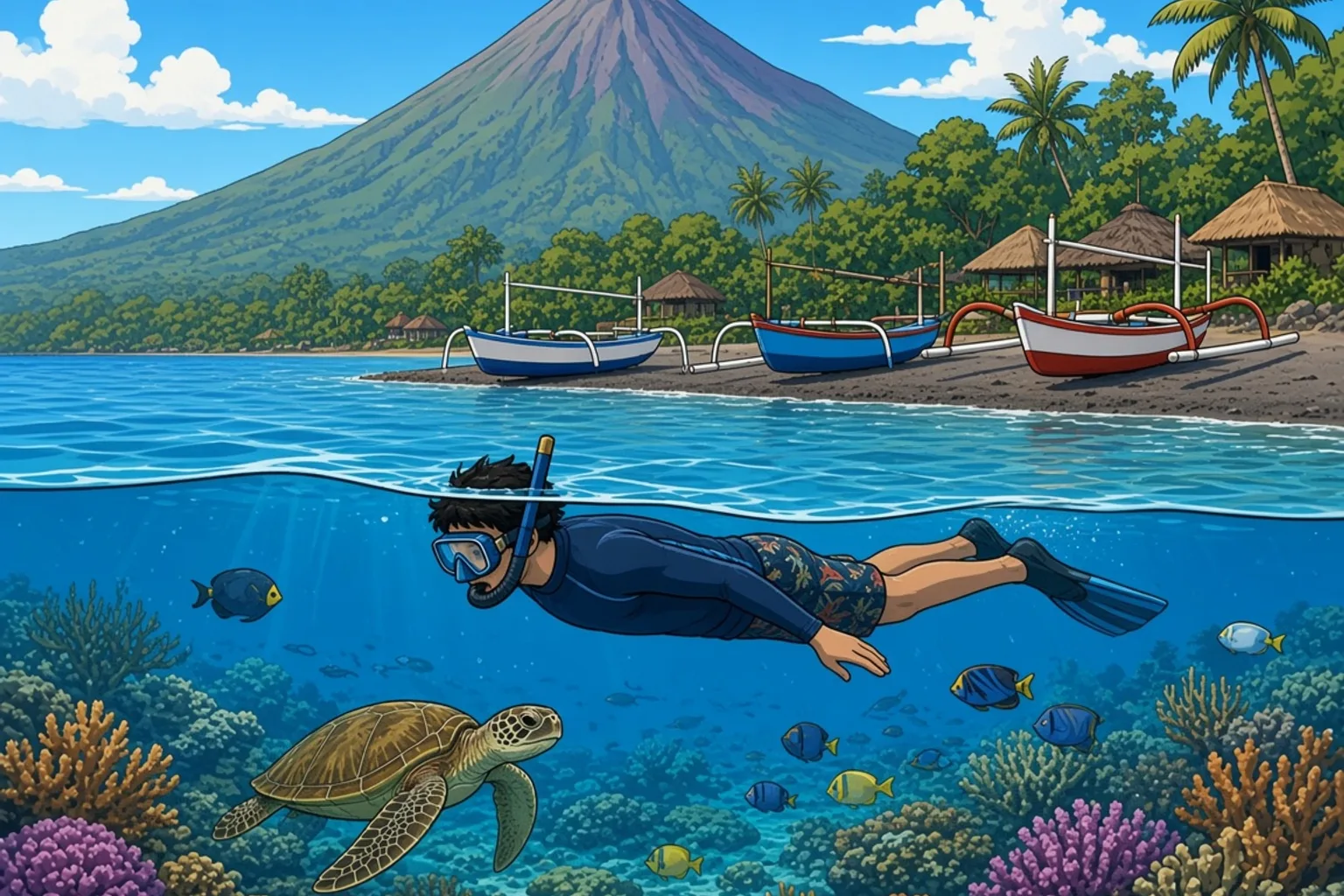
Amed snorkeling is some of the easiest and most rewarding in Bali: a string of sheltered bays on the island's north-east coast where healthy coral starts a few metres from the beach, turtles are seen most days and a small shipwreck lies in water shallow enough to see from the surface. Most spots are reached on foot from the shore or by a short ride in a jukung, the local outrigger boat, and the coast is also a regular stop on snorkeling trips in Bali that leave from the south of the island. This guide covers each spot, what it costs, when the water is calmest and how to get there.
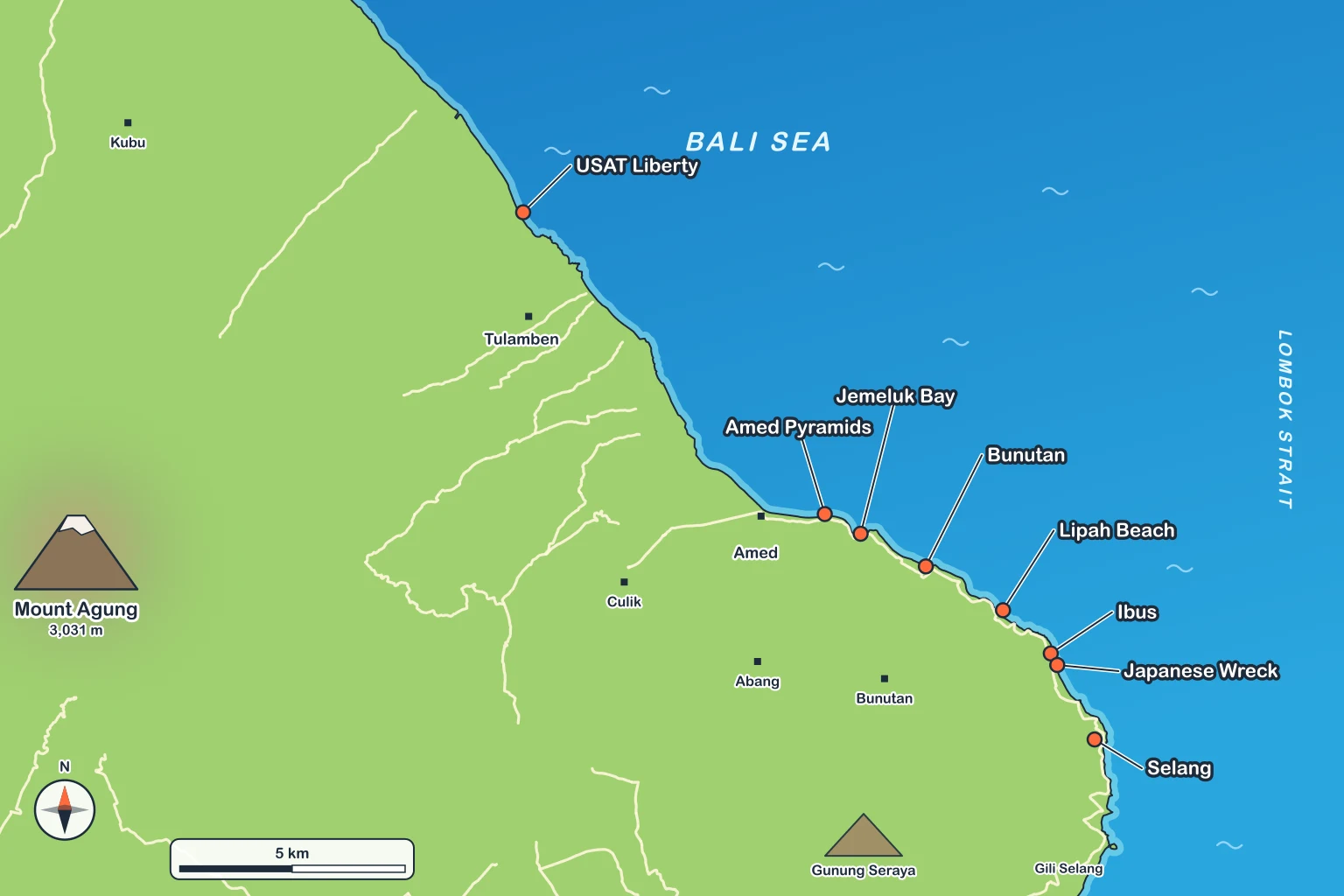
Amed is not a single beach but a stretch of roughly 14 km of fishing villages, from Culik and Jemeluk in the north-west to Lipah, Banyuning, Selang and Aas in the south-east, all sitting beneath Mount Agung. Compared with Bali's other snorkeling areas, covered in this overview of snorkeling in Bali, Amed is quieter, cheaper and better suited to independent snorkelers, because almost every site can be reached without a guide. The trade-off is distance: it is roughly two and a half to three hours by road from Sanur, Seminyak or the airport.
Amed snorkeling at a glance
- Best spots: Jemeluk Bay (underwater shrine and statues), the Japanese Wreck at Banyuning, Lipah Beach, the Amed Pyramids (Turtle Point), Bunutan, Selang and Ibus. The USAT Liberty in Tulamben is 15 to 20 minutes away.
- Depth: most reefs start at 1 to 3 m and drop to 10 to 15 m; the Japanese Wreck lies at about 2 to 12 m.
- Best time: April to October, between about 7:00 and 10:30, at mid to high tide.
- Costs: gear rental IDR 50,000 to 100,000 a day; a two-hour private jukung trip from about IDR 180,000 to 450,000 per person depending on group size.
- Level: Jemeluk, Lipah, the Japanese Wreck and Ibus suit beginners in calm conditions; Bunutan and the outer reef at Selang are for confident swimmers.
Is Amed good for snorkeling?
Yes. Amed is one of the best places to snorkel in Bali because its bays are sheltered from the prevailing swell, the reef begins within swimming distance of the beach and the water is usually clear and warm, at about 26 to 30 °C all year. It is a better choice than the south of the island for beginners and families who want to snorkel from the shore rather than from a crowded tour boat.
The coast is volcanic. Lava flows from Mount Agung created a steep underwater slope, so the reef runs from a shallow flat into a drop-off only 20 to 70 m from the waterline. That shape is why snorkelers see both coral gardens in 2 to 5 m and schools of fish hanging over deeper water on the same swim. The beaches are black sand or smooth black pebbles, which heat up quickly in the sun but do not cloud the water the way fine white sand can.
The reefs also have legal protection. Since July 2023 the coast from Tulamben to Amed and Seraya has been part of the Karangasem marine protected area, designated by Ministerial Decree No. 123/2023 of the Ministry of Marine Affairs and Fisheries. The area covers 5,478 hectares and is divided into zones, with tourism allowed in the main snorkeling bays and small core zones closed to both fishing and tourism.
Amed is also where many visitors first try scuba diving, since the same bays serve as training sites. The differences between the two activities are covered in this comparison of snorkeling and scuba diving, and anyone who wants to go deeper can book an Amed diving day on the same trip.
Where are the best snorkeling spots in Amed?
The best snorkeling spots in Amed are Jemeluk Bay, the Japanese Wreck at Banyuning and Lipah Beach, followed by the Amed Pyramids, Bunutan, Selang and Ibus. Jemeluk and Lipah are the easiest; Bunutan and Selang have the strongest currents and the best chance of larger fish.
| Spot | Entry | Depth | Currents | Best for | Highlights |
|---|---|---|---|---|---|
| Jemeluk Bay | Shore (pebble and sand) | 1 to 12 m, wall to 40 m | Mild to none inside the bay | Beginners, families | Underwater shrine and statues, drop-off |
| Japanese Wreck, Banyuning | Shore (large pebbles) | 2 to 12 m | Mild, some surge in swell | Beginners at mid to high tide | 20 m steel wreck covered in sea fans |
| Lipah Beach | Shore (soft black sand) | 1 to 8 m | Mild | Beginners at high tide | Shallow coral gardens |
| Amed Pyramids (Turtle Point) | Shore or jukung | 3 to 10 m | Moderate, along the shore | Confident swimmers | Turtles on artificial reef |
| Bunutan | Jukung recommended | 3 to 15 m+ | Moderate to strong | Experienced snorkelers | Drift along the reef, garden eels |
| Selang | Shore (inner reef) or jukung | 2 to 15 m+ | Moderate to strong near the headland | Experienced snorkelers | Quiet reef, occasional reef sharks |
| Ibus Beach | Shore | 2 to 10 m | Mild near shore | Anyone wanting quiet | Few people |
| USAT Liberty, Tulamben | Shore (large stones) | 4 to 30 m, snorkel at 4 to 8 m | Very mild | Beginners and up | 120 m Second World War wreck |
Jemeluk Bay
Jemeluk is the classic Amed snorkel and the easiest to reach, with warungs, sun loungers and gear rental along the beach and a parking fee of around IDR 10,000. The bay is crescent-shaped, so the water inside is usually calm. The best coral lies on the right-hand side when facing the sea, where the reef flat at 0.5 to 2 m gives way to a drop-off at about 2 to 6 m, 20 to 70 m from the beach.
Jemeluk's best-known feature is a small underwater shrine with Balinese-style statues and a carved postbox at about 3 to 5 m, usually marked by a buoy. The postbox was installed in October 2011 by the national postal company, PT Pos Indonesia, with the Reef Check Foundation, according to The Bali Times. The statues are visible from the surface, although a short duck dive gives a better look. Stronger swimmers can follow the reef left towards the headland, where Jemeluk Wall drops from about 5 m to nearly 40 m and attracts larger schools of fish. Divers use the same bay, which is described in this guide to diving in Amed.
The Japanese Wreck at Banyuning
The Japanese Wreck is the only shipwreck in Bali that snorkelers can see in detail from the surface without diving down. It lies off the pebble beach at Banyuning, about 15 minutes' drive south-east of central Amed, and is covered in the next section.
Lipah Beach
Lipah, about 3 km south-east of Jemeluk, has the softest entry in Amed: a black-sand beach with a sandy channel at its eastern end that lets snorkelers swim out without stepping on coral. The shallow coral gardens here, at 1 to 8 m, are some of the densest on the coast, with clownfish, parrotfish, sweetlips and blue-spotted ribbontail rays. Lipah is best at high tide. At low tide parts of the reef sit very close to the surface, which risks scraping both snorkelers and coral.
Amed Pyramids and Turtle Point
Off the shore between Amed village and Jemeluk, dozens of hollow concrete pyramids were sunk as an artificial reef and are now overgrown with coral and sponges. Hawksbill and green turtles visit the structures regularly, which is why many jukung captains now call the site Turtle Point. The shallowest pyramids are at about 3 to 5 m, but currents can run along the shore, so it is often done from a boat. More on where and how to see turtles responsibly is in this guide to sea turtles in Bali.
Bunutan
Bunutan is Amed's drift snorkel. The reef slopes from 3 m to beyond 15 m, and a current usually runs parallel to the coast, so a jukung drops snorkelers up-current and follows them along the reef. Garden eels, trevally and larger reef fish are more common here than in the bays. It is not a site for weak swimmers or for anyone who has not snorkeled in current before.
Selang and Ibus
Selang, near the south-eastern end of the Amed road, faces the Lombok Strait and is more exposed to swell and current than the bays further north. The inner reef in front of the beach is snorkelable in calm conditions, with a steep slope, giant barrel sponges and occasional white-tip reef sharks. The water around the islet of Pulau Selang offshore can have strong, shifting currents and should only be visited with a local captain. Ibus Beach, a small pebble cove, has no single attraction but is often almost empty in the morning.
The USAT Liberty in Tulamben
Tulamben, 15 to 20 minutes' drive north-west of Amed, is home to the USAT Liberty, a 120 m United States Army cargo ship torpedoed in January 1942 and later pushed off the beach by the 1963 eruption of Mount Agung. Its shallowest sections are about 4 to 5 m deep and roughly 30 m from the shore, so snorkelers see the top of the hull clearly in good visibility. Local community fees are about IDR 20,000 per person. The wreck's history is told in this guide to the USAT Liberty wreck, and snorkeling in Tulamben is a common add-on to an Amed day. Certified divers can explore the full wreck on a Tulamben dive trip.
How do you snorkel the Japanese shipwreck in Amed?
Snorkel the Japanese shipwreck by entering from the pebble beach at Banyuning and swimming 15 to 20 m out to a black buoy that marks the bow. The wreck lies at about 2 to 12 m, so its shape is clear from the surface at mid to high tide in the morning, when visibility is usually best.
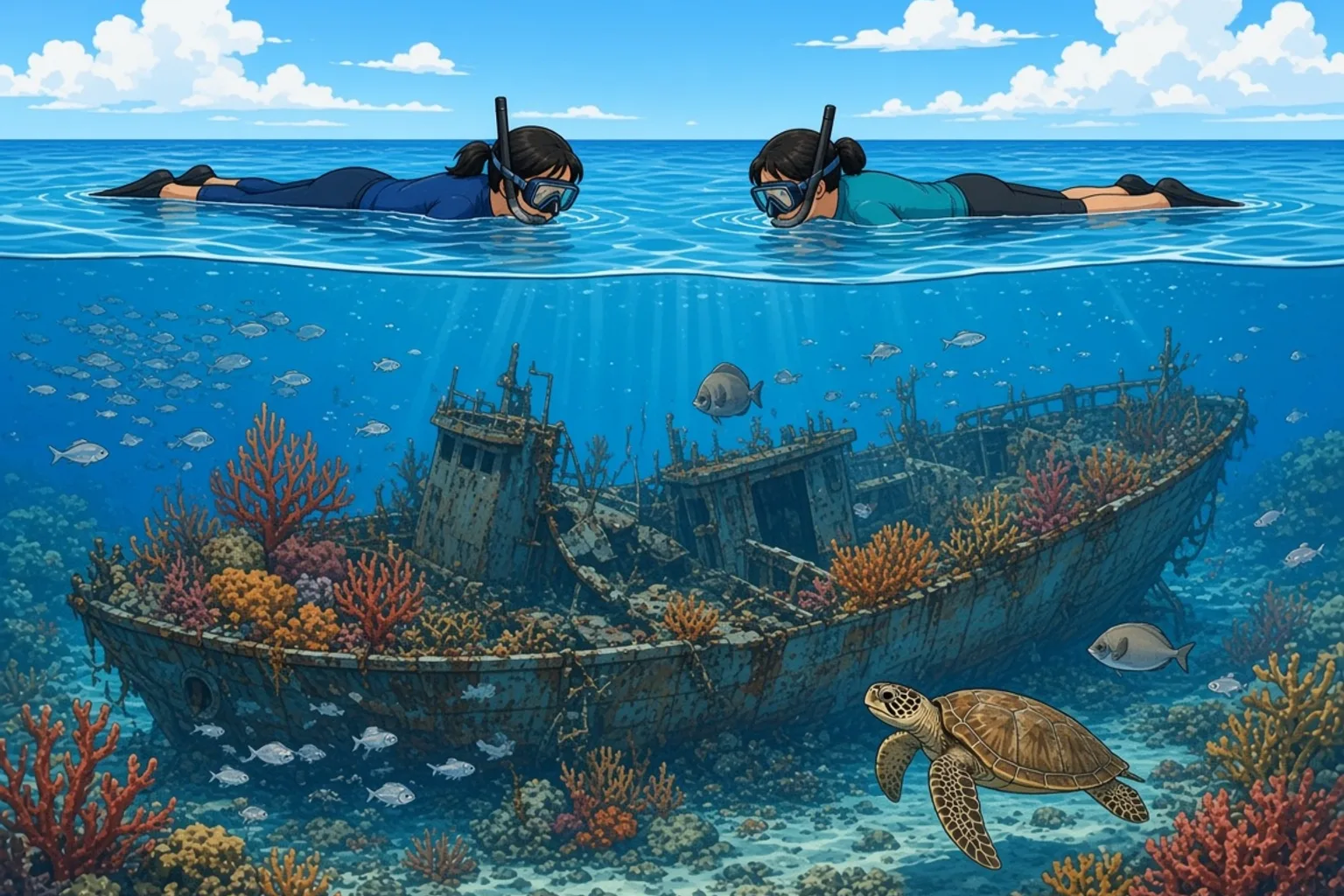
Very little is known about the ship. A survey by the Bali office of the government's cultural heritage agency, BPCB Bali, recorded a steel hull about 20 m long, 5 m wide and just over 2 m high at 6 to 12 m depth, and concluded that its history, type and purpose could not be confirmed. Local tradition and the name point to a Japanese vessel from the occupation of 1942 to 1945, often described as a small patrol boat. Early dive guides placed it in Lipah Bay, which is why some older sources still call it the Lipah wreck.
Today the hull is broken into sections and works as an artificial reef. Gorgonian sea fans, sponges and black coral grow on the steel, glassfish and batfish shelter inside, and hawksbill turtles and blue-spotted rays are regular visitors. The shallowest part can sit less than a metre below the surface at low tide, which makes it hard to swim over without touching it.
Practical points for the wreck:
- Wear reef shoes or booties. The beach is made of large, smooth black stones that shift underfoot, and fins are easier to put on once floating.
- Go between about 8:00 and 10:30, at mid to high tide. Afternoon wind adds chop and stirs up sediment.
- A rash guard helps, since most of the time is spent floating face-down in shallow water.
- Parking or community fees are around IDR 10,000 to 20,000.
- Do not stand on, hold or kick the wreck. It is both a reef and a recorded heritage site.
Should you snorkel Amed from the shore or by jukung?
Snorkel from the shore at Jemeluk, Lipah, the Japanese Wreck and Ibus, where the reef starts close to the beach. Hire a jukung for the Pyramids, Bunutan, the outer reef at Selang and Jemeluk Wall, where the swim is long or the current is stronger, or simply to visit three or four spots in one morning.
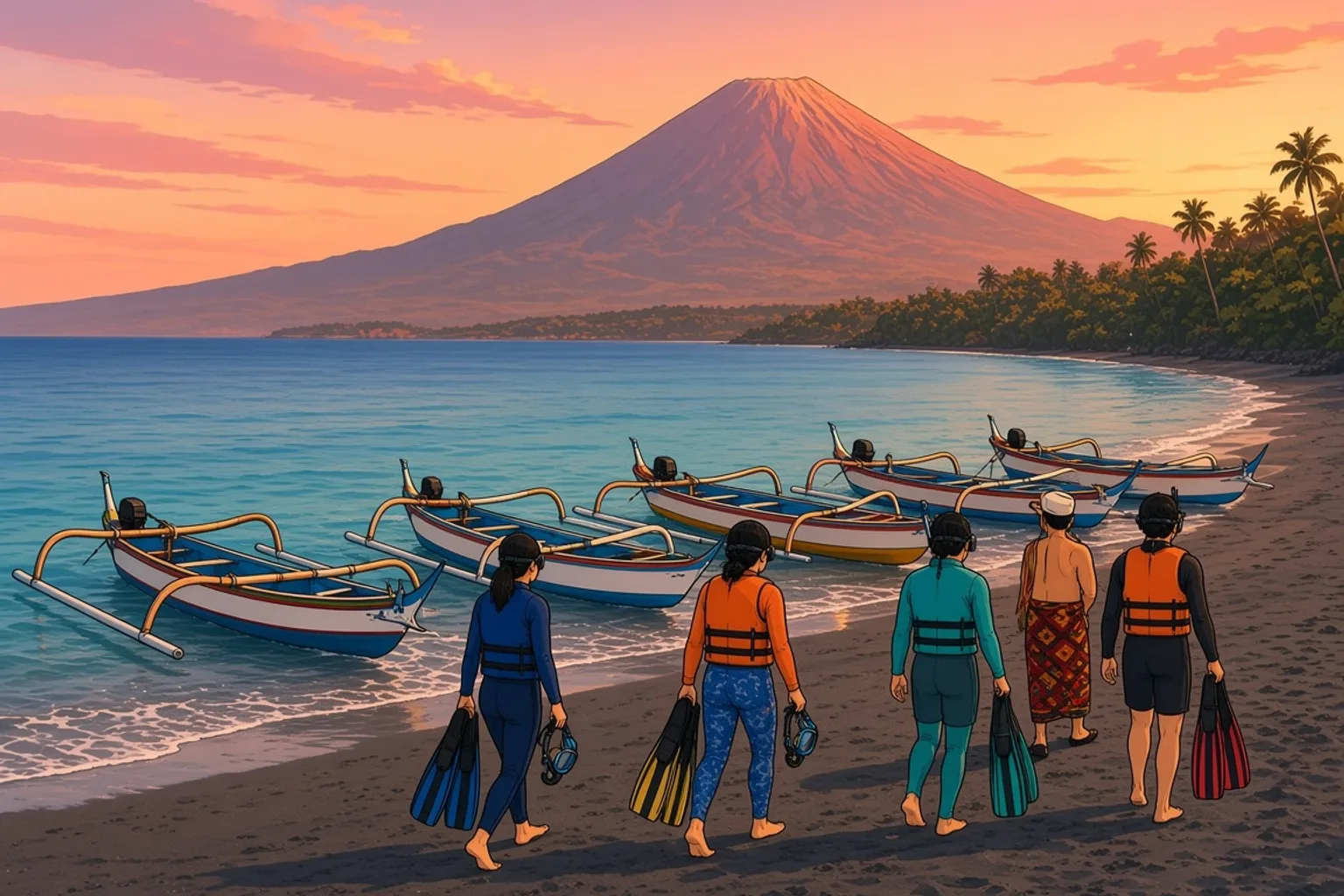
A jukung is a narrow wooden canoe with bamboo outriggers on each side and a small outboard engine. Most carry three passengers and the captain, so larger groups need two boats. Captains usually include masks, snorkels, fins and life jackets, and many will pick up guests directly from the beach in front of their hotel. A typical private trip lasts about two hours and visits three or four spots for 20 to 30 minutes each.
| Shore snorkeling | Jukung trip | |
|---|---|---|
| Best spots | Jemeluk, Lipah, Japanese Wreck, Ibus | Pyramids, Bunutan, Selang outer reef, Jemeluk Wall |
| Typical cost | Gear rental and parking, under IDR 150,000 | About IDR 180,000 to 450,000 per person |
| Flexibility | Snorkel any time, stay as long as you like | Fixed two-hour slot, usually morning |
| Current handling | Swim back to your entry point | Boat drops you up-current and follows |
| Group size | Any | Up to three per boat |
Snorkelers who prefer a guide can add one to most jukung trips, typically for around IDR 200,000. A guide is worth it at Bunutan and Selang, or for anyone less confident in open water, because the guide watches the current and points out animals that are easy to miss, such as frogfish and nudibranchs. The fish most commonly seen are described in this guide to types of fish in Bali.
When is the best time to snorkel in Amed?
The best time to snorkel in Amed is the dry season from April to October, early in the morning between about 7:00 and 10:30, at mid to high tide. Visibility in these conditions often reaches 15 to 25 m, and the water is at its calmest before the afternoon wind.
| Period | Conditions | Visibility | Notes |
|---|---|---|---|
| April to June | Calm, dry, warm | 15 to 25 m | Often the best months overall |
| July to September | Dry, occasional wind | 15 to 25 m | Peak holiday crowds; go early |
| October | Calm, warming | 15 to 25 m | Good conditions before the rains |
| November to March | Rain showers, calmer mornings | 5 to 15 m, lower after heavy rain | Still snorkelable most days; runoff can cloud the bays |
The tide matters more in Amed than the month. On the shallow reefs at Lipah and over the Japanese Wreck, a low spring tide leaves too little water to swim over the coral safely, so check a tide table for Amed or Padang Bai before setting out. The wind usually picks up from late morning, adding surface chop, and exposed spots such as Bunutan and Selang can become rough while the sheltered bays remain calm. If whitecaps are visible offshore, stick to Jemeluk or Lipah.
Water temperature stays between about 26 and 30 °C, so a rash guard or a thin shorty wetsuit is enough for most people. How the seasons affect the rest of the island is covered in this guide to Bali diving conditions.
How much does Amed snorkeling cost?
Amed snorkeling costs from about IDR 60,000 for gear rental and parking at a shore site to IDR 180,000 to 450,000 per person for a two-hour private jukung trip. A full-day tour from south Bali, with transfers, gear and lunch, typically costs IDR 900,000 to 1,300,000 per person.
| Item | Typical 2026 price | Notes |
|---|---|---|
| Mask, snorkel and fins from a beach warung | IDR 50,000 to 100,000 per day | Dive centres charge about IDR 100,000 to 150,000 for better equipment |
| Reef shoes or booties | IDR 30,000 to 50,000 | Useful at the Japanese Wreck and Tulamben |
| Parking and community fees | IDR 5,000 to 20,000 | Tulamben charges about IDR 20,000 per person |
| Private jukung trip, about 2 hours, 3 to 4 spots | About IDR 180,000 to 450,000 per person | Cheapest per person with more people; published local rates start at 180,000 for a group of six |
| Snorkeling guide on a jukung trip | About IDR 200,000 | Optional add-on |
| Private day tour from south Bali with transfers, gear and lunch | About IDR 900,000 to 1,300,000 per person | Price per person falls with group size |
| Guided group snorkeling day from Sanur (example: Neptune Scuba Diving, Tulamben) | IDR 1,350,000 per person | Includes transfers, lunch and a guide for every four snorkelers |
Prices are almost always quoted in rupiah and paid in cash, so bring small notes for warungs, parking and captains. Some jukung operators quote per boat rather than per person, which is worth checking before agreeing a price. For comparison, a Nusa Penida snorkel day from the south costs more, because of the fast-boat crossing: snorkeling Nusa Penida with a guided operator is around IDR 2,070,000 per person. For those who want to add scuba, Bali diving prices start at around IDR 2,700,000 for a two-dive day with transfers.
How do you get to Amed for snorkeling?
Amed is reached by road only, in about 2 hours from Ubud, 2.5 hours from Sanur and 3 hours from Seminyak, Canggu, Kuta or the airport. Most visitors either hire a private driver for the day or stay one or more nights in Amed itself.
| From | Approximate drive | Notes |
|---|---|---|
| Ubud | 2 hours | Via Klungkung and Karangasem |
| Sanur | 2.5 hours | Along the east coast bypass |
| Seminyak, Canggu, Kuta | 3 hours or more | Traffic around Denpasar adds time |
| Ngurah Rai Airport | About 3 hours | |
| Candidasa | About 1 hour | Close enough for a half-day trip |
| Padang Bai | About 1 to 1.5 hours | Also the fast-boat port for Lombok and the Gilis; see diving in Padang Bai |
| Tulamben | 15 to 20 minutes | Easy to combine in one day |
A day trip works if the aim is two or three spots, but the long drive means arriving after the calmest morning hours. Staying overnight allows an early snorkel at slack water before the day-trippers arrive. Accommodation ranges from homestays at around IDR 270,000 a night to beachfront resorts at IDR 1,450,000 to 2,700,000, and the trade-offs between Bali's coastal bases are compared in this guide to where to stay in Bali for diving. Amed, Tulamben and Padang Bai are also compared directly in Tulamben vs Amed vs Padang Bai.
Example itinerary: east coast snorkeling day from Sanur
The following is one operator's schedule, shown as an example of how a guided day from the south is organised. Neptune Scuba Diving's Tulamben snorkeling day runs as follows:
- About 7:00: hotel pickup and meeting at the dive centre in Sanur for gear fitting and a briefing.
- About 9:30: arrival on the east coast after a 2.5-hour drive.
- Late morning: snorkeling over the USAT Liberty wreck and the Tulamben reef, with one guide for every four snorkelers.
- Midday: lunch at a local restaurant, included in the price.
- Afternoon: the drive back, arriving in Sanur at about 17:00.
The price is IDR 1,350,000 per person, including transfers, equipment, the guide and lunch. Independent travellers staying in Amed can build a similar day for less with a jukung and a driver, but without a guide in the water.
What marine life can you see snorkeling in Amed?
Snorkelers in Amed commonly see hawksbill and green turtles, blue-spotted ribbontail rays, clownfish in anemones, parrotfish, Moorish idols, sweetlips, surgeonfish, batfish and schools of glassfish and trevally. Blacktip and white-tip reef sharks are seen occasionally along the deeper edges, particularly at Jemeluk Wall and Selang.
| Animal | Where | How likely |
|---|---|---|
| Hawksbill and green turtles | Amed Pyramids, Japanese Wreck, Lipah | Common on a two-hour jukung trip |
| Blue-spotted ribbontail rays | Sandy patches at Lipah, Jemeluk and the wreck | Common |
| Clownfish and anemones | Lipah, Jemeluk reef flat | Very common |
| Glassfish and batfish | Inside and around the Japanese Wreck | Very common |
| Garden eels | Sandy slopes at Bunutan | Common, but shy |
| Bigeye trevally schools | USAT Liberty, Jemeluk Wall | Frequent |
| Blacktip or white-tip reef sharks | Jemeluk Wall, Selang, Tulamben | Occasional |
| Manta rays | Not in Amed; see Nusa Penida | Rare |
Amed does not have manta rays or mola mola, which are found off Nusa Penida in the south. Snorkelers who want mantas should plan a separate day there. Its strength is variety in a small area: coral gardens, wrecks, artificial reefs and walls within a few kilometres. For a different reef close to Candidasa, snorkeling in Padang Bai offers the Blue Lagoon, about an hour south, and the north-west coast has its own clear-water reefs around Menjangan Island.
Divers who want the same reefs from below can start with a try dive in Bali, which needs no certification, or the PADI Open Water course, which qualifies divers to 18 m. The calm, shallow bays at Jemeluk and Lipah are among the training sites used for both.
Is snorkeling in Amed safe?
Snorkeling in Amed is safe for competent swimmers in the sheltered bays in calm conditions. The main risks are currents at exposed points such as Bunutan and Selang, boat traffic, slippery pebble entries and sea urchins, all of which are manageable with local advice and basic precautions.
- Currents: currents in the Lombok Strait can be strong. Stay inside the bays unless you are with a jukung captain or guide, and never try to swim to Pulau Selang from the shore.
- Boats: jukungs move in and out of every bay. Snorkel with a partner, look up before surfacing and consider towing a small surface buoy.
- Entries: the black stones at the Japanese Wreck and Tulamben are slippery and move with the waves. Wear reef shoes and put fins on in the water.
- Sea urchins and coral: sea urchins live on the rocky shallows. Never stand on the reef; float or swim to a sandy patch instead.
- Sun: the equatorial sun burns quickly on a floating back. A long-sleeved rash guard works better than sunscreen, and any sunscreen used should be reef-safe.
- Children: most guided operators take children from about five years old with a life jacket. Jemeluk and Lipah at high tide are the best spots for them.
Amlapura, the regency capital, is about 40 minutes by road and has the nearest general hospital. Travel insurance that covers water activities is worth having, particularly for anyone combining snorkeling with diving on the same trip.
Rules and reef etiquette
Amed's reefs lie within the Karangasem marine protected area, where collecting coral or shells, fishing in core zones and damaging the reef are prohibited. Beyond the formal rules, local operators ask snorkelers not to touch or chase turtles, not to feed fish and not to stand on coral, even when the water is shallow. These practices matter because the same small bays receive thousands of visitors a year. More on how Bali's east coast is dived and managed is in this guide to diving in Amed Bali and on the USAT Liberty dive site page.
Amed rewards snorkelers who plan around the tide and the morning calm, whether independently or on one of the guided Bali snorkeling tours. A first visit usually starts at Jemeluk and the Japanese Wreck from the shore, then adds a jukung trip to the Pyramids for turtles. Those with more time can combine it with Tulamben and Padang Bai for a full picture of the east coast, or with one of the Bali dive trips that cover the same sites underwater. For questions about planning a day on the coast, the Neptune Scuba Diving team in Sanur can be contacted directly, and a broader view of scuba diving in Bali is available for anyone considering their first dive.
Sources: Ministry of Marine Affairs and Fisheries, Decree No. 123/2023 (Karangasem marine protected area); Coral Triangle Atlas (Kawasan Konservasi Karangasem, 5,478.41 ha); BPCB Bali (survey of the Japanese Wreck at Banyuning); The Bali Times (Jemeluk underwater postbox, 2011); Wikipedia: USAT Liberty; published 2026 rates from Amed jukung operators and gear rental warungs.