
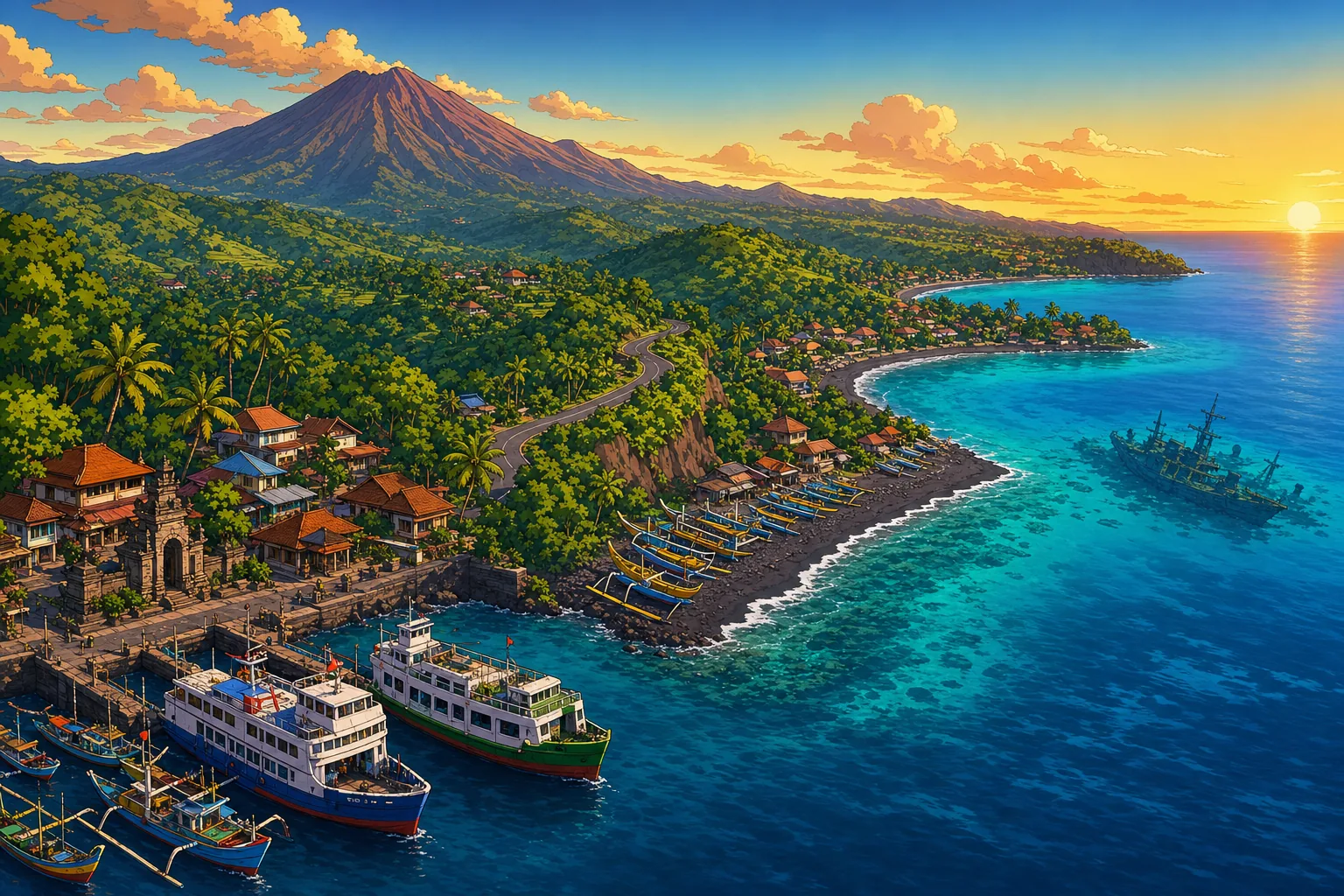
Pick the wrong east Bali dive town for your trip and you will burn two days realising you should have based yourself 40 minutes up or down the coast. Tulamben, Amed and Padang Bai are the three dive bases on Bali's east and north-east coast, they all sit on the same volcanic shoreline, they all share Mount Agung as their inland backdrop, and to a first-time visitor scrolling Google Maps they look essentially interchangeable. They are not. We run Bali day-dive trips into all three from our Sanur shop and we have spent the last fifteen years watching guests pick the wrong base for the trip they actually wanted. This article is the operator-side comparison we wish more people read before they booked the hotel.
Tulamben is the wreck town. Amed is the slow town. Padang Bai is the boat-access-and-Penida-springboard town. Each one accesses a different cluster of dive sites, each one suits a different kind of traveller, and each one has trade-offs that the colour-graded Instagram reels do not mention. This guide compares the three head-to-head on site access, certification fit, cost, food, season, transport and the small daily logistics (ATMs, scooter rental, internet) that decide whether your week feels effortless or constantly mid-shuffle. If you would rather have us fold all three into a curated multi-night itinerary, see our Bali dive packages or the wider Bali dive trip itinerary planner. And if you are not yet sure that Bali is the right Indonesian dive trip for you at all, Komodo vs Bali diving and Bali vs Maldives diving are the wider comparisons that sit one level above this one. No marketing fluff. If a town is wrong for your trip we will tell you, and if a town is right for half your trip we will say which half.
The three towns in 60 seconds: geography, distances and personalities
All three towns sit on the eastern coast of Bali, all three look out at Lombok and the Lombok Strait, and all three are downwind of Mount Agung which is the 3,031-metre active volcano that defines the region. From south to north along the coast: Padang Bai is roughly 90 minutes from the airport and is the main fast-boat harbour to the Gili Islands and Lombok; Amed is another 90 minutes north of Padang Bai, a string of small fishing villages along a 10 kilometre stretch of black-sand bays; Tulamben is another 20 minutes north of Amed, a single very small village built around one single dive attraction. The total drive from south Bali to Tulamben is about 3 hours by private car, or 2.5 hours from Sanur. The three towns are connected by one winding coastal road that nobody enjoys at night, so transit between them is a daylight activity.
Personality-wise they could not be more different. Padang Bai feels like a working port that happens to have dive shops, because that is exactly what it is: ferries come and go to Lembongan, Penida, Lombok and the Gilis, and the dive sites are within 5 to 25 minutes by traditional jukung boat. There is a backpacker scene at Bias Tugel beach but the town itself has the energy of a transit hub. Amed feels like the Bali your grandmother saw in the 1970s: black sand beaches, no chain hotels, salt-makers walking the beach at dawn, and a coastline so spread out that the "town" of Amed is actually seven different bays with their own personalities (Jemeluk, Bunutan, Lipah, Selang and so on). Tulamben is the smallest of the three by a wide margin: a single coastal road with maybe fifteen dive shops, twenty hotels and the USAT Liberty shipwreck which is genuinely the only reason anyone built a town here. If you want to feel like you escaped Bali, go to Tulamben. If you want to feel like Bali around 2003, go to Amed. If you want to combine a dive trip with the Gilis or Nusa Penida day trips, go to Padang Bai.
One factor most blog posts miss: the three towns are not equidistant from each other in dive-day terms. Amed and Tulamben are functionally one dive cluster, because the boat ride from Amed to Tulamben is 20 minutes by jukung and you can comfortably day-trip the Liberty wreck from an Amed base. Padang Bai is more isolated; it takes 90 minutes by road to reach Tulamben from Padang Bai, which is too far to commute for a single dive day. So if you want all three towns' sites in one trip without changing hotels, base yourself in Amed for the middle nights and take a Sanur or Padang Bai day or two on the front or back of the trip. We will get to the seven-night itinerary at the end.
Tulamben as a dive base: a single famous wreck and everything around it
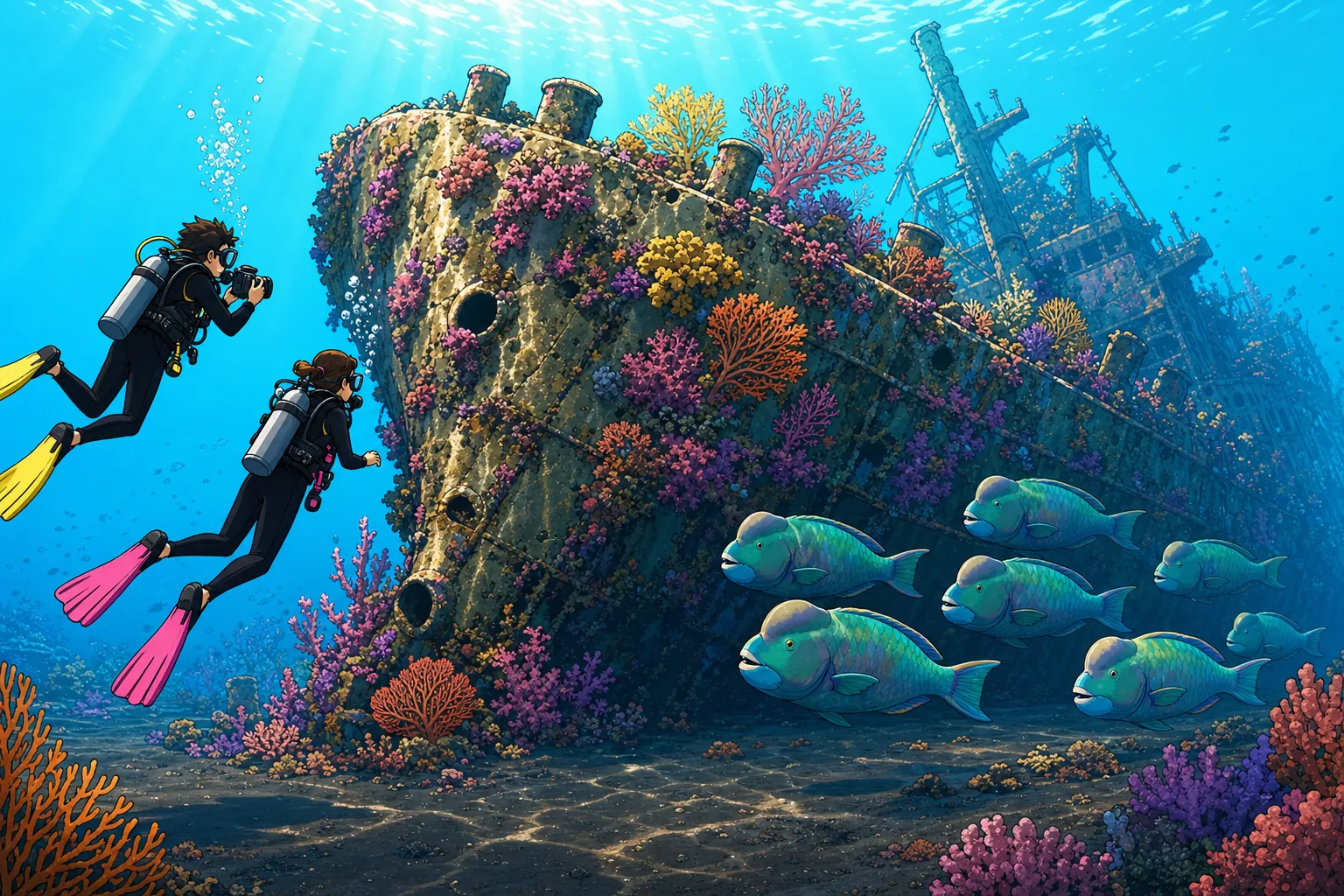
Tulamben exists because of one shipwreck. The USAT Liberty is a 120-metre US Army cargo ship torpedoed by a Japanese submarine in 1942, beached at Tulamben for salvage, then pushed into the bay by the 1963 Mount Agung eruption. It sits in 5 to 30 metres of water, fully accessible from a 20-metre shore swim, and you can dive it on a single 80-bar tank with an Open Water cert. That single fact is why the village exists. Everything else in Tulamben (the dive shops, the warungs, the homestays, the dive guides leaning against bemos) is a satellite of that wreck. Our complete Tulamben dive guide covers every site individually, but as a comparison base what you need to know is this: Tulamben is the right base if your trip is structured around the wreck and around the macro-photography sites that surround it.
Beyond the Liberty itself, Tulamben has the Coral Garden (a shallow reef restoration project with biorock artificial structures, ideal for second dives and night dives), the Drop-Off (a vertical wall from 5 to 70 metres with very strong macro fauna), Seraya Secrets and the Shipyard (some of the best macro and muck diving in Bali, with hairy frogfish, harlequin shrimp, mimic octopus and a constant rotating cast of nudibranchs), and Kubu (a less-dived current site with bigger fish). The full Tulamben menu is about 8 to 10 named sites in a 2 kilometre radius, which is enough for 4 to 5 days of two-tank diving before you start repeating. For longer stays we shuttle people up to Amed on day 5 (20-minute drive) or down to Tulamben Bay Reef for night dives. There is no boat ride here in the conventional sense; almost all Tulamben diving is shore entry over volcanic cobblestones, which we will get to under logistics because it matters more than people think.
The strongest argument for Tulamben as your base: if you came to Bali to dive the Liberty and to maximise time on the wreck, sleeping 200 metres from the wreck entry means you can do four dives a day on it (dawn dive, morning, afternoon, dusk) without ever sitting in a car. We have guests who book Tulamben for five nights and dive nothing but the Liberty across 15 to 18 dives, going for the bumphead parrotfish school at dawn, the schooling jackfish at midday, the resident giant grouper at depth, the macro fauna in the bow plates, and the night dive lights-out experience. That trip is brilliant from Tulamben and miserable from any other base. The strongest argument against Tulamben: there is essentially nothing to do here that is not diving. The village has perhaps six small warungs, two coffee shops, no nightlife, no shopping, no beach in the conventional sense (the "beach" is volcanic cobblestones that are unpleasant to walk on barefoot) and the WiFi reaches the dive shops but not always the homestays. Travel with a non-diving partner at your peril.
Amed as a dive base: variety, shore diving and the friendliest learning environment

Amed is the broad middle ground of east Bali diving, both in geography and in dive personality. The Amed region spans seven bays across roughly 10 kilometres of coastline (Melasti, Jemeluk, Bunutan, Lipah, Selang, Banyuning, and the small bays around Aas), each with its own shore-entry dive sites. The shore-dive density here is the highest in Bali: from your hotel in central Jemeluk you can walk to two named dive sites, scooter to another four within 10 minutes, and reach a fifth (the Japanese Wreck at Banyuning) in a 15-minute boat ride. The full Amed dive guide lists each site individually, but as a base the headline is: Amed is where you go when you want shore-entry simplicity, you want a quieter-feeling town than Tulamben, and you want a slightly broader marine life mix than the wreck-and-macro fixation of its northern neighbour.
The Amed site menu is genuinely varied. Jemeluk Bay is a beginner-friendly slope from 5 to 20 metres with an underwater temple statue arrangement that takes excellent photographs and a turtle hit rate around 60 to 70 percent. Pyramids is a current-friendly drift over an artificial reef in 15 to 22 metres with reliable hawksbill turtles and a manta sighting maybe once every 50 dives. The Japanese Wreck at Banyuning is a small WWII patrol boat in 6 to 12 metres with extensive coral growth and is suitable as a snorkel or a first dive. Bunutan and Lipah have decent macro fauna and the occasional schooling pelagic. The Boga wreck is a deliberate sinking from 2012 in 14 to 38 metres, only for Advanced divers, with notably less marine growth than the Liberty but a more intact structure for photography. Add in the day-trip Liberty wreck (20 minutes north by jukung) and you have 6 to 7 days of varied diving from an Amed base before you start repeating. That breadth, combined with the warmer water of the protected bays, is why we recommend Amed for PADI Open Water courses more often than the other two towns.
The Amed base argument: if you are a couple where one diver wants the variety and the other wants Bali, Amed is the best of the three towns at delivering both. There are actual restaurants here (not just warungs, though those are excellent too), a sunset bar scene at Jemeluk viewpoint, yoga classes for non-divers, salt-farming and snorkelling tours, day-trip access to Tirta Gangga and Lempuyang Temple, and accommodation from IDR 270,000 (≈ 15 USD) a night to IDR 3,600,000 (≈ 200 USD) beachfront villas. The Amed counter-argument: the seven-bay layout means whichever bay you pick will be 15 minutes by scooter from at least half the dive sites. This is fine if you have a scooter and like riding in a wetsuit, less fine if you do not. The internet is improving but still patchy. And the boat-access sites (Boga wreck, Gili Tepekong if you push that far) require a longer ride than the same sites from Padang Bai. None of these are deal-breakers; they are the small daily frictions of basing yourself in a stretched-out region rather than a single point.
Padang Bai as a dive base: the boat-diving and Penida-springboard town

Padang Bai is the structural opposite of Amed and Tulamben. Where the other two are shore-dive bases with a few boat trips, Padang Bai is a boat-dive base with one decent shore option (Blue Lagoon, the dive in the image above). The town is built around the fast-boat ferry harbour, and the dive sites are the three current-rich pinnacles offshore: Gili Mimpang, Gili Tepekong and Gili Biaha. These three small islands are 5 to 15 minutes by jukung from Padang Bai harbour, they sit in the channel between Bali and Penida where the cold upwelling water funnels through, and they give you the closest thing to a Nusa Penida experience without crossing the strait. The full Padang Bai dive guide covers each site, but as a base the proposition is: Padang Bai is for divers who want big-fish encounters, sharper currents, and easy access to both Nusa Penida day trips and the Gili Islands stopover.
Gili Tepekong is the headline dive: a deep wall and pinnacle with regular white-tip and grey reef shark sightings, a mola mola hit rate of around 20 to 30 percent in July to October, and a current strong enough that you need Advanced certification and decent buoyancy to enjoy it. Gili Mimpang is the more forgiving sister site with a beautiful soft coral plateau, schooling sweetlips, and a mola sighting rate of around 15 percent in season. Gili Biaha is the cave dive, with a shark cave at 18 metres where white-tip reef sharks reliably rest in numbers between dives. Blue Lagoon, the one shore-friendly Padang Bai site, is a gentle hard-coral garden in 8 to 18 metres with a high macro density and is suitable for Open Water students and night dives. There is also Jepun, a small site with deliberately sunken Hindu statues, which is divisive (some guests love the underwater archaeology aesthetic, others find it kitsch). That is the Padang Bai menu: small, but with a much higher big-fish hit rate per dive than the other two towns offer.
The Padang Bai base argument: if you came to Bali to see sharks and mola mola and to optionally tack on a few days at Nusa Penida or the Gilis, Padang Bai puts you 5 minutes from your boat instead of the 35 to 45 minutes that the same trip takes from Sanur. We run our own Sanur dive centre as the main base because the southern access to Manta Point and Crystal Bay is faster from Sanur, but if your trip is specifically the Padang Bai pinnacles plus the Gili Islands, basing in Padang Bai for those nights saves you a daily commute. The Padang Bai counter-argument: the town is loud, busy, and obviously a transit harbour. Ferry horns at 06:00, taxi drivers offering rides every 10 metres, and the food scene is functional rather than memorable. The dive sites are also fewer in number than at Amed or Tulamben, so a stay longer than 3 nights here means revisiting sites. Most of our guests treat Padang Bai as a 2 to 3 night insert in a longer Bali dive trip, not as a week-long base. And it is the worst of the three towns for guests with a non-diving partner; there is genuinely very little to do here besides dive and eat.
Head-to-head: which dive sites are accessible from each base
The single most useful comparison for picking a base is not "how many sites" but "which sites and how far". The table below lists the major east Bali dive sites and what each town's access looks like. "Easy" means you can dive it any day from this base, "Day trip" means it requires a half-day excursion that some operators run and others do not, and "No" means the commute is impractical and you should not pick this base if this site is on your must-dive list. For the southern cluster (Penida, Crystal Bay, Manta Point) all three east Bali towns are too far for a comfortable day trip and we would route you through our Sanur dive centre or a Nusa Penida-based operator for those.
| Dive site | From Tulamben | From Amed | From Padang Bai |
|---|---|---|---|
| USAT Liberty wreck | Easy (10 min walk to entry) | Easy (20 min by jukung or 25 min by road) | Day trip (2 hr drive) |
| Coral Garden & Drop-Off | Easy (shore entry) | Day trip (25 min by road) | No (too far) |
| Seraya Secrets / muck sites | Easy (10 min by jukung) | Easy (25 min by road) | No |
| Jemeluk Bay & Pyramids | Easy (15 min drive) | Easy (shore entry) | Day trip (90 min drive) |
| Japanese Wreck (Banyuning) | Easy (15 min drive) | Easy (10 min by boat) | No |
| Boga wreck (deep sunk) | Easy (30 min drive) | Easy (15 min by boat) | No |
| Bunutan / Lipah / Selang | Day trip | Easy | No |
| Blue Lagoon (Padang Bai) | Day trip | Day trip (90 min drive) | Easy (5 min by boat) |
| Gili Mimpang / Tepekong / Biaha | No (too far) | Day trip from south Amed only | Easy (5-15 min by boat) |
| Nusa Penida sites | No | No | No (route via Sanur) |
| Menjangan Island | Day trip (90 min drive) | Day trip (2 hr drive) | No (too far) |
What this table makes obvious: the only town that gives you "easy" access to the Padang Bai pinnacles is Padang Bai, and the only town that gives you "easy" access to both the Liberty and the Tulamben muck sites is Tulamben. Amed is the broadest, with easy access to the most categories of sites but rarely the best access to any single category. Boat-access sites favour Padang Bai; shore-entry sites favour Tulamben and Amed. If your wishlist includes more than one cluster (for example: Liberty wreck plus Tepekong sharks plus a Penida day), the right answer is not one town for the whole trip but a multi-base itinerary which we cover at the end of this article and in the longer Bali dive trip itinerary planner.
Cost, accommodation and the food reality
All three towns are cheaper than south Bali, but the per-day cost structures are not the same. The figures below are real 2026 numbers from guests we have hosted in the last 18 months. The "two-tank day price" is what a credible local operator charges; the cheaper aggregator quotes you will see online (40 to 60 USD) are almost always either a one-tank deal, gear extra, or one of the operators we will not recommend for the safety reasons covered in our Bali scuba diving price breakdown. Accommodation ranges are based on a mid-shoulder week, not peak July to August prices which can be 30 to 50 percent higher.
| Cost item | Tulamben | Amed | Padang Bai |
|---|---|---|---|
| 2-tank shore-dive day | IDR 1,250,000–1,700,000 (≈ 70–95 USD) | IDR 1,350,000–1,800,000 (≈ 75–100 USD) | N/A (boat-dive only) |
| 2-tank boat-dive day | IDR 1,550,000–2,000,000 (≈ 85–110 USD) | IDR 1,700,000–2,250,000 (≈ 95–125 USD) | IDR 1,800,000–2,350,000 (≈ 100–130 USD) |
| Open Water course (3-4 days) | IDR 6,100,000–7,600,000 (≈ 340–420 USD) | IDR 6,100,000–7,900,000 (≈ 340–440 USD) | IDR 6,500,000–8,300,000 (≈ 360–460 USD) |
| Budget homestay | IDR 270,000–450,000 (≈ 15–25 USD)/night | IDR 270,000–550,000 (≈ 15–30 USD)/night | IDR 270,000–450,000 (≈ 15–25 USD)/night |
| Mid-range hotel | IDR 700,000–1,450,000 (≈ 40–80 USD)/night | IDR 800,000–1,600,000 (≈ 45–90 USD)/night | IDR 650,000–1,250,000 (≈ 35–70 USD)/night |
| High-end villa / resort | IDR 2,150,000–3,600,000 (≈ 120–200 USD)/night | IDR 2,700,000–5,400,000 (≈ 150–300 USD)/night | IDR 1,450,000–2,500,000 (≈ 80–140 USD)/night |
| Warung meal | 30-50k IDR (2-3 USD) | 30-60k IDR (2-4 USD) | 25-50k IDR (1.5-3 USD) |
| Restaurant dinner with drinks | 120-180k IDR (8-12 USD) | 180-350k IDR (12-23 USD) | 100-180k IDR (7-12 USD) |
| Scooter rental | 60-80k IDR/day | 60-90k IDR/day | 60-80k IDR/day |
| Airport transfer (private car) | IDR 700,000–1,000,000 (≈ 40–55 USD) (3 hr) | IDR 650,000–900,000 (≈ 35–50 USD) (2.5 hr) | IDR 450,000–650,000 (≈ 25–35 USD) (1.5 hr) |
Two observations matter. First, the cheapest base by total cost is usually Padang Bai (cheap accommodation, cheap food, no high-end villa premium), but only if you do not factor in the boat-dive premium of IDR 270,000–450,000 (≈ 15–25 USD) per day over a Tulamben shore day. Across a 5-night trip with diving every day the totals are roughly: Tulamben IDR 11,700,000–16,200,000 (≈ 650–900 USD), Amed IDR 12,600,000–18,000,000 (≈ 700–1,000 USD), Padang Bai IDR 12,600,000–17,100,000 (≈ 700–950 USD) before flights. Second, Amed has the most stretched accommodation range of the three towns and is the only one with genuine high-end resort offering (Hoshinoya Bali, Bayu Cottages, etc.). If you want to spend more than IDR 3,600,000 (≈ 200 USD) a night on a beachfront villa, Amed is where you can; in Tulamben and Padang Bai there are very few options at that price point. The food story has Amed clearly winning the restaurant scene, Padang Bai winning warung price, and Tulamben winning at being a place where you stop caring about food because the diving is great.
When each town is at its best: the seasonal calendar
The east Bali coast does not behave like a single weather system. Tulamben and Amed share microclimates and are in the rain shadow of Mount Agung, which means they get noticeably less rain than south Bali and Padang Bai does. Padang Bai sits at the southern end of the east coast, more exposed to swell coming up from the Lombok Strait, and is the most affected by the December to February west monsoon. Within these patterns, each town has a peak window, a shoulder window, and (for Padang Bai only) a genuinely bad off-season window when many dive days get cancelled. Our broader best time to visit Bali article maps the wider Bali calendar; Bali rainy season diving explains what to actually expect in the worst months if you cannot pick your dates.
| Month | Tulamben (Liberty) | Tulamben (muck) | Amed | Padang Bai (Tepekong) | Mola mola (Tepekong) |
|---|---|---|---|---|---|
| Jan | Good | Excellent | Variable | Cancelled often | 0% |
| Feb | Good | Excellent | Variable | Cancelled often | 0% |
| Mar | Excellent | Excellent | Good | Variable | 0% |
| Apr | Excellent | Excellent | Excellent | Good | 0% |
| May | Excellent | Excellent | Excellent | Excellent | 5-15% |
| Jun | Excellent | Excellent | Excellent | Excellent | 10-20% |
| Jul | Excellent | Excellent | Excellent | Excellent | 30-45% |
| Aug | Excellent | Excellent | Excellent | Excellent | 40-55% |
| Sep | Excellent (peak vis) | Excellent | Excellent (peak vis) | Excellent (peak vis) | 35-50% |
| Oct | Excellent | Excellent | Good | Good | 15-25% |
| Nov | Good | Excellent | Good | Variable | 0% |
| Dec | Good | Excellent | Variable | Cancelled often | 0% |
Three nuances this table flattens. First, Tulamben muck diving is the most weather-resilient dive product in Bali. Because the muck sites are shallow, sheltered and depend on small subjects rather than visibility, we run them almost every day of the year. Tulamben is the right base if your trip is in January or February and you still want to dive credible-quality water. Second, Padang Bai is the most weather-dependent of the three. In December to February the Gili Tepekong pinnacles can be blown out for a week at a time and we have had January trips where the only diveable option was Blue Lagoon. Do not pick Padang Bai as a primary base in west monsoon. Third, the mola mola season at Tepekong is real but smaller than the comparable Penida hit rate. If mola is the entire reason for your trip, Nusa Penida via a Sanur day trip or our Sanur shop is the higher-probability option; if mola is a bonus on a Padang Bai trip you would do anyway, Tepekong in August to September is a credible add-on.
Certification levels and who each town actually suits
Match the town to your certification level, not the other way around. The mistake we see most often is an Open Water diver booking 5 nights in Padang Bai because the photographs of Gili Tepekong sharks looked spectacular, then spending most of the week at Blue Lagoon because the pinnacle sites need Advanced cert and the operator quite rightly refuses to take them. Conversely, we see experienced Advanced and Rescue divers booking 7 nights in Tulamben for the Liberty and getting bored on day 4 because the wreck is well within their comfort zone. The right fit looks like this.
Brand new diver (Discover Scuba, no certification): Amed is the best of the three. Jemeluk Bay shore entries, gentle conditions, an actual beach to walk into, and a smaller jukung boat rather than a fast pinnacle boat means a less intimidating introduction. Our try-diving in Bali guide explains what a Discover Scuba day looks like. Padang Bai also works but the boat-dive emphasis and stronger currents make it slightly less forgiving.
Open Water student doing the course in Bali: Amed is the best base for the same reasons. The variety of shore-entry sites lets your instructor pick the right site for each skill set on each day, and the warmer protected bays are easier to teach in. Tulamben is also good for Open Water training, with the Liberty as the qualifying dive at the end. Our PADI Open Water course in Bali guide covers what to expect in any of these towns.
Newly certified Open Water diver (15 to 30 logged dives): Tulamben is excellent. The Liberty in light current is one of the most divable wreck experiences in the world for this level, the muck sites are forgiving on air consumption because they are shallow, and the lack of strong-current sites means you cannot accidentally end up on a dive that exceeds your skills. Amed is also good. Padang Bai is borderline; you can dive Blue Lagoon and Mimpang on the easier days but Tepekong and Biaha are out of bounds for you.
Advanced Open Water diver (40 to 100 logged dives): All three towns work. Padang Bai unlocks for you: Tepekong, Biaha, the deeper Boga and the Tulamben drop-off all become accessible. This is probably the cohort that gets the most variety out of the east Bali region as a whole, and the most natural fit for the multi-base itinerary at the end of this article.
Advanced photographer or tech-curious diver: Tulamben is the right base. The muck-photography sites here (Seraya, Shipyard, the Liberty itself) are world-class for macro and close-focus wide-angle work. Some operators including ours run Nitrox at the Liberty for extended bottom time. The Divemaster and tech divers we work with in this region almost always overnight in Tulamben.
One certification-adjacent point worth making: if you have not dived in more than a year, do a PADI ReActivate refresher on the first morning in shallow water before doing anything serious. We run them at Blue Lagoon, Jemeluk Bay and Tulamben Coral Garden as appropriate. Skipping the refresher because "I dived loads in 2019" is the leading cause of the cancelled-dive-day stories we hear, especially for Padang Bai trips where the first booked dive is often Tepekong.
Logistics, transfers and the one-week verdict matrix
The small daily logistics decide whether a trip feels effortless or constantly mid-shuffle. The summary by town: Tulamben has a single road and walking-distance shop access, so transit inside the town is essentially zero, but the airport transfer at 3 hours each way is the longest of the three. Amed has the most stretched-out geography of any Bali dive town and most days will involve a 10 to 20 minute scooter ride to your specific shop or restaurant, so plan to rent a scooter (60 to 90k IDR per day) or pay for short driver rides (50 to 100k IDR each). Padang Bai is the most compact of the three at 800 metres end to end, but the ferry traffic, the constant taxi solicitation and the lack of beach mean it feels less restful than the other two.
ATM and cash reality: Tulamben has two ATMs, both can be empty on a Sunday, bring 3 million IDR in cash if you plan to pay for diving in cash. Amed has more ATMs (six or seven across the seven bays) but they cluster around Jemeluk and Bunutan, with little ATM access in the southern bays. Padang Bai has reliable ATM access at the harbour and accepts card payment at more establishments than the other two. International cards work at all three but the foreign-transaction fee bias of east Bali ATMs is real (BCA is best, BNI is OK, Mandiri sometimes refuses Visa). Internet: Telkomsel 4G works across all three towns, hotel WiFi quality is best at Padang Bai (because the ferry company demands it) and worst in the further-out Amed bays. If your work depends on reliable video calls, base in Padang Bai or central Jemeluk.
The travel-with-others reality: Padang Bai is the worst of the three towns for guests with a non-diving partner; there is genuinely very little to do here besides dive and eat. Amed is the best by a wide margin, with yoga, Tirta Gangga and Lempuyang day trips, salt-making tours, sunset bars and a coffee scene. Tulamben sits in between, with the small-scale Tulamben to Tirta Gangga day-trip option, the Jatiluwih rice terraces in 90 minutes' drive, and not much else. If you are travelling with kids, see our diving with kids in Bali guide for the specifics; Amed is the only town of the three we recommend for family trips. If you are travelling solo and want to dive the most while spending the least, Tulamben wins.
Now the verdict matrix. Pick the town that matches the highest-priority row for your trip.
| If your priority is... | Pick | Reason |
|---|---|---|
| The USAT Liberty wreck, multiple times, in low-stress logistics | Tulamben | Walk-in shore dive, four dives a day possible |
| Macro and muck photography | Tulamben | Best concentration of muck sites in Bali |
| Open Water course or Discover Scuba | Amed | Most variety of beginner-friendly shore sites |
| Variety of dive experience across one week | Amed | 7 bays plus Liberty day-trip plus Boga wreck |
| Diving with a non-diving partner | Amed | Restaurants, temples, beaches, sunset bars |
| Sharks and big pelagic action | Padang Bai | Tepekong and Biaha 5-15 min by boat |
| Combining diving with Gili Islands or Lombok | Padang Bai | Same harbour as the fast boats |
| Lowest total cost over a week | Padang Bai or Tulamben | Cheap homestays, cheap warung food |
| December to February rainy-season trip | Tulamben | Muck sites unaffected, in Agung rain shadow |
| One trip, all three towns | Amed base + Tulamben day + Padang Bai day | Amed is geographically centred |
If you have a single week and you want to experience the whole region, the itinerary we run most often looks like this: nights 1 to 4 in Amed (dive Jemeluk, Pyramids, Japanese Wreck, day-trip Liberty on day 4), night 5 transfer to Tulamben (one extra Liberty dive at dawn the next morning), then nights 6 and 7 in Padang Bai (Tepekong, Mimpang, Blue Lagoon night dive on the last evening). Total: 12 to 14 dives across 7 nights, all three town characters experienced, no day wasted in transit. The fuller version of this itinerary lives in the Bali dive trip itinerary planner, and the best places to scuba dive in Bali ranking sits one layer above it. If you would rather we book and run the whole thing for you including transfers, accommodation and a guide who knows each town's quirks, contact our Sanur dive centre and we will route the trip end to end through our Bali dive packages. For first-timers nervous about any of the above, our first-time diving in Bali guide is the gentler primer and our Bali scuba diving packing list covers what to actually bring.
Related guides from Neptune Scuba Diving
- Diving Tulamben Bali (2026): The Complete Guide to Bali's Best Dive Destination
- Diving Amed Bali: Bali East Coast Dive Sites
- Diving Padang Bai Bali (2026): The Complete Diver's Guide
- USAT Liberty Wreck Tulamben (2026): The Definitive Diver's Guide
- The Ultimate Bali Dive Trip Itinerary: 5, 7, 10 or 14 Days (2026)
- Macro & Muck Diving in Bali (2026): The Complete Guide
- Best Places to Scuba Dive in Bali (2026)
- Bali vs Raja Ampat Diving in 2026: Which Should You Book?
- Gates of Heaven & Tulamben Diving: One Epic Bali Day Trip
- Amed Snorkeling Guide (2026): Best Spots, the Japanese Wreck and When to Go
Frequently Asked Questions
Amed has the broadest single-base menu: roughly 8 to 10 named sites within shore-entry or 15-minute boat range from central Jemeluk, plus easy day-trip access to the USAT Liberty wreck in Tulamben (20 minutes by jukung or 25 by road). Tulamben has fewer named sites (8 to 10) but they are all within walking distance of each other, so you can dive 3 to 4 times a day without ever sitting in a car. Padang Bai has the smallest site menu of the three (5 sites) but they include the strongest current pinnacles in east Bali, so the appeal is depth of experience rather than breadth.
It is the only place to dive the Liberty as a primary site. The wreck is a 20-metre swim from the Tulamben village beach. However, you can absolutely day-trip to it from Amed in 20 minutes by jukung or 25 minutes by road; this is the trip we run most often for guests basing in Amed. From Padang Bai it is a 90 to 120 minute drive each way, which is too long for a comfortable day trip and we would generally recommend overnighting in Tulamben or Amed instead.
Yes if you base in Amed for the middle nights of your trip; Amed is the geographically centred town and is within day-trip range of both Tulamben (north) and a long but possible Padang Bai day (south, 90 minutes by road). It is not practical to day-trip all three towns from south Bali (Seminyak, Canggu, Ubud) because the round-trip drive times are 5 to 7 hours; if you are basing in south Bali our south-Bali diving article covers the realistic options including our Sanur pickup service.
Amed by a wide margin. It has restaurants (not just warungs), yoga classes, sunset bars at Jemeluk viewpoint, day trips to Tirta Gangga water palace and Lempuyang temple, salt-farming tours, and accommodation from IDR 270,000 (≈ 15 USD) homestays to 250+ USD beachfront villas. Padang Bai is the worst of the three for non-divers; there is genuinely very little to do there besides dive and eat. Tulamben is in between, with the village itself offering nothing for non-divers but Tirta Gangga and Lempuyang within 60 minutes by car.
Minimums we recommend before the variety runs out: Tulamben 3 nights minimum for the Liberty and the muck sites to be worth the journey, 5 nights to fully exhaust the site list, more than 5 only if you are macro-photography focused. Amed 3 nights minimum, 5 to 7 nights ideal because the site variety supports it. Padang Bai 2 nights minimum (the site menu is small), 3 nights as the practical cap unless you are also using it as a Gili Islands jump-off. Below those minimums you spend more time transferring than diving and the trip stops making sense.
Amed is our first choice for both. The variety of gentle shore-entry sites lets your instructor pick the right site for each skill set on each day, the warmer protected bays are easier to teach pool skills in, and the lack of strong currents means a student is not going to accidentally end up on an inappropriate site. Tulamben is also good for Open Water training with the Liberty as the qualifying dive at the end. Padang Bai is workable for Open Water but the boat-dive emphasis and stronger surface conditions make it less forgiving. Our Open Water in Bali article covers each option in detail.
Yes, but with different products. Tulamben runs the most night dives, with the Liberty Coral Garden and Drop-Off as the regular night sites; the macro-fauna activity here is exceptional after dark. Amed runs night dives mostly at Jemeluk Bay and at the Japanese Wreck, with a strong cephalopod presence. Padang Bai runs night dives at Blue Lagoon, which is the calmest and most beginner-friendly night dive on the east coast. None of the boat-only sites (Tepekong, Mimpang, Biaha) are dived at night for safety reasons. Our Bali night diving guide covers each option.
Amed clearly wins the food scene with the broadest restaurant range, several genuinely good Western and Italian options for non-warung nights, plus excellent traditional warungs. Padang Bai is the cheapest of the three for both warungs and restaurants but the quality ceiling is lower. Tulamben sits in the middle with maybe six small warungs, two coffee shops and a couple of hotel restaurants; the food is functional and you will not remember it but it will not let you down either. If food matters to your trip, base in Amed or pad the trip with a Sanur or Ubud night.
Menjangan is feasible but a long day from all three (90 minutes from Tulamben, 2 hours from Amed, more from Padang Bai). We would only recommend it as a day trip from Tulamben, and even then only if Menjangan is a clearly higher priority than a third Liberty dive. Our Menjangan diving guide explains why an overnight at Pemuteran is usually the better way to dive Menjangan. Nusa Penida is not practical as a day trip from any of the three east Bali bases; the route there crosses the Lombok Strait from Sanur or Padang Bai harbour and the timing only works if you are based on or close to the south Bali coast.
The itinerary we run most often: nights 1 to 4 in Amed (dive Jemeluk Bay and Pyramids on day 1 as a refresher and warm-up, Japanese Wreck and Bunutan on day 2, Boga wreck and Lipah on day 3, day-trip the Liberty in Tulamben on day 4), night 5 in Tulamben (dawn Liberty plus muck dive at Seraya), nights 6 and 7 in Padang Bai (Tepekong and Mimpang on day 6, Biaha or a Blue Lagoon night dive on day 7). Total of 12 to 14 dives, all three town characters experienced, no wasted transit days. Read the longer 5, 7, 10 and 14-day breakdowns in our Bali dive trip itinerary planner, or have us build a custom itinerary through our Bali dive packages.