
There is a seven-week window every year when the most experienced divers we know stop talking about Komodo and Raja Ampat and start watching flight prices to Ambon. From roughly mid-September to early November, the Banda Sea liveaboard season delivers the single most reliable scalloped hammerhead encounter in Indonesia, and arguably one of the top three on the planet. On our last three October crossings we logged hammerhead schools on 11 of 14, 9 of 13 and 13 of 15 dives at the relevant sites. Those are numbers you otherwise only hear from Galapagos and Cocos boats, and both of those trips cost roughly double once the flights are counted. We are not neutral observers here, and we will say so up front: our own boat sails this route every season, so this guide is written from the wheelhouse, not from a press release.
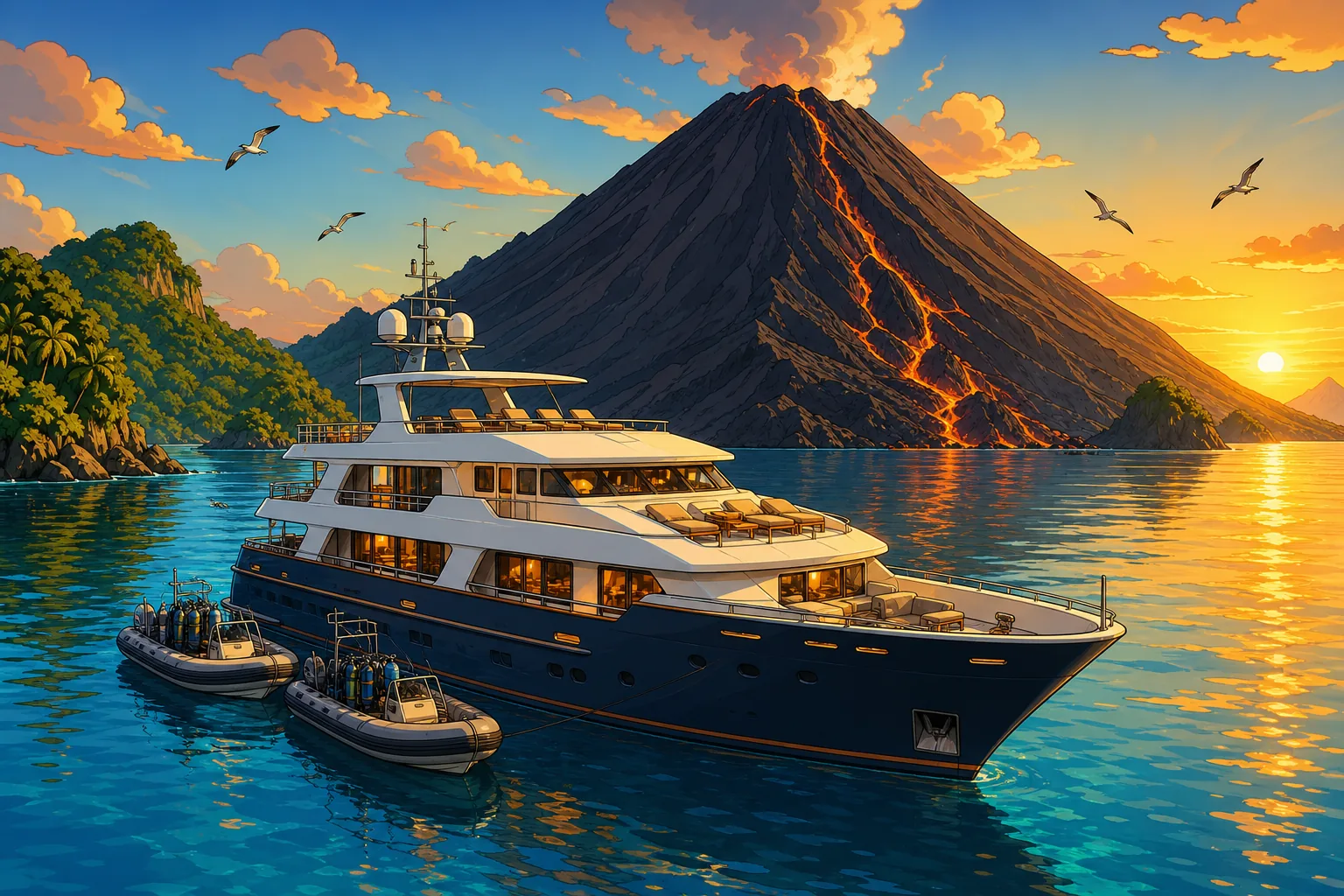
That boat is King Neptune, a 46-metre steel-hulled liveaboard purpose-built for exactly this kind of remote crossing: 20 guests in 10 en-suite cabins, a crew of 20, a 3,000-nautical-mile range, onboard Nitrox, and two 8-metre RHIB tenders that matter more in the Banda Sea than anywhere else we operate, because the sites are open-ocean seamounts where the pickup has to be fast and exactly where you surface. This article is the full briefing we give guests who book the crossing: what the hammerhead migration actually looks like underwater, the dive sites from Manuk to Suanggi and why each one earns its place, the day-by-day rhythm of an Ambon crossing, the topside day in Banda Neira that guests consistently rank alongside the diving, the honest entry requirements (they are strict, and we will explain why we hold the line), and the full cost picture with nothing hidden. If you are still deciding between regions rather than booking one, start with our Komodo vs Raja Ampat vs Banda Sea comparison and come back when the hammerheads win the argument.
Why the Banda Sea is the connoisseur's Indonesian liveaboard
The Banda Sea is a deep volcanic basin in eastern Indonesia, sitting between Maluku to the north and the arc of islands running toward Timor in the south. Almost nothing about it behaves like the Indonesia most divers know. The water is deep blue oceanic rather than reef-green, the islands are the exposed summits of volcanoes rising from 4,000-plus metres of water, and several of the dive sites are literally the flanks of active volcanoes, with Manuk and the Banda Api cone still steaming. This is the Ring of Fire diving that brochures promise and rarely deliver. Because the region is remote, there is no land-based dive tourism worth mentioning: no day boats, no dive resorts, no fly-and-flop option. The only way to dive the Banda Sea properly is a liveaboard crossing, and that single fact has kept the reefs in a condition that genuinely shocks guests who thought they had seen healthy coral in Komodo or Raja Ampat.
Three things define the diving. First, the hammerheads, which we will treat properly in the next section because they are the reason most guests book. Second, the walls: sites like Hatta, Suanggi and the Banda Neira house reefs are sheer vertical drops into abyssal blue, plastered with hard coral and gorgonians, with visibility that regularly exceeds 40 metres in October. Third, the strangeness. Manuk is an island so thick with banded sea kraits that you stop counting at fifty on a single dive. Gunung Api's lava flows from the 1988 eruption now carry some of the fastest-growing table coral ever studied. Serua and Nil Desperandum are seamounts that see perhaps a few hundred divers a year. If your diving history is built on Bali and you want to understand how different this is, our sharks in Bali article explains why shark encounters around Bali are occasional treats; in the Banda Sea in season, sharks are the baseline expectation of the trip.
The hammerhead migration: what actually happens from September to November
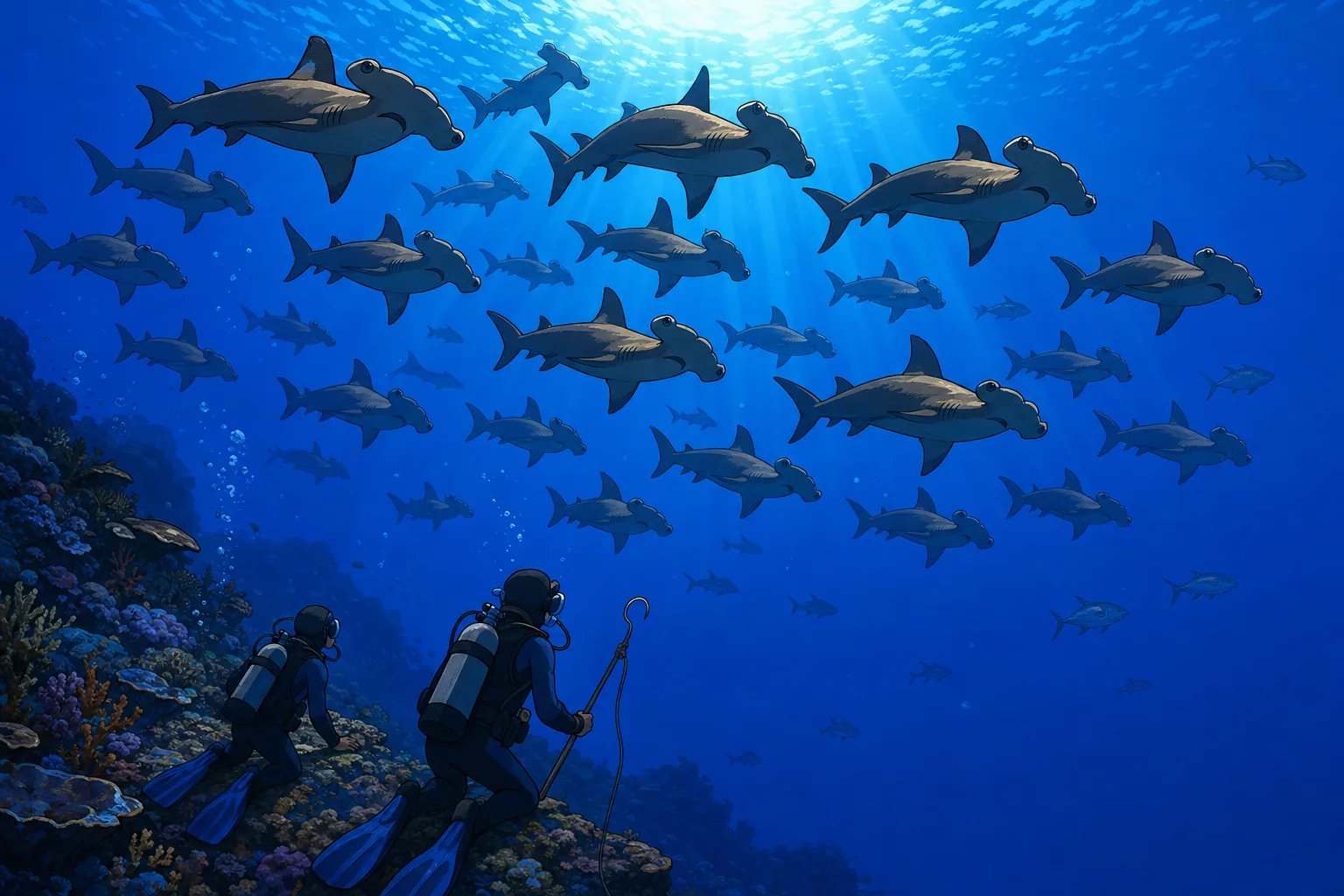
Scalloped hammerheads school in the Banda Sea year-round in deep water, but for most of the year they sit below sport-diving depths. What changes in late September is the thermocline. As the south-east monsoon dies off, cooler nutrient-rich water rises along the seamount flanks and the schools follow it up into the 25-to-40-metre band where divers can meet them. The behaviour is consistent enough that we plan whole itineraries around it: the schools patrol the up-current corners of Manuk and Suanggi in the early morning, and the standard play is a 06:30 negative entry, a controlled descent to 30 metres on the corner, hook in, and wait. When it works, and in October it works most days, the school comes past as a wall: sometimes 30 animals, sometimes a genuine hundred-plus aggregation that fills your entire field of view and keeps coming. Guests who have dived Blue Corner at Nusa Penida know the feeling of big animals in blue water; this is that feeling multiplied by an order of magnitude, and it is why the Banda Sea converts so many experienced divers into repeat guests.
Some honesty about the hit rates, because operators routinely oversell this. Across our logged season data, the per-dive probability of a hammerhead school at the key sites in the peak window is roughly 85 percent, which makes the per-trip probability effectively certain across a 10-or-11-night crossing with multiple mornings at the right seamounts. But individual dives still blank: the school can sit at 50 metres in warm-water years, a current swing can push it off the corner, and we have had two consecutive empty mornings at Suanggi followed by the best hammerhead dive of the season on the third. This is wild-animal diving in open ocean, not an aquarium schedule. What we can promise is that we structure the route so the boat is at the highest-probability sites at the highest-probability hours, we run Nitrox as standard so repeat 30-metre mornings do not wreck your no-deco budget, and our guides have done this route for years and read the current lines rather than the clock. Whale encounters, for the record, are the bonus lottery: blue whales and sperm whales transit the basin in October and we see blows from the deck on most crossings, but an in-water encounter is rare luck, not a product.
The dive sites: Manuk, Suanggi, Serua, Hatta and the volcano walls
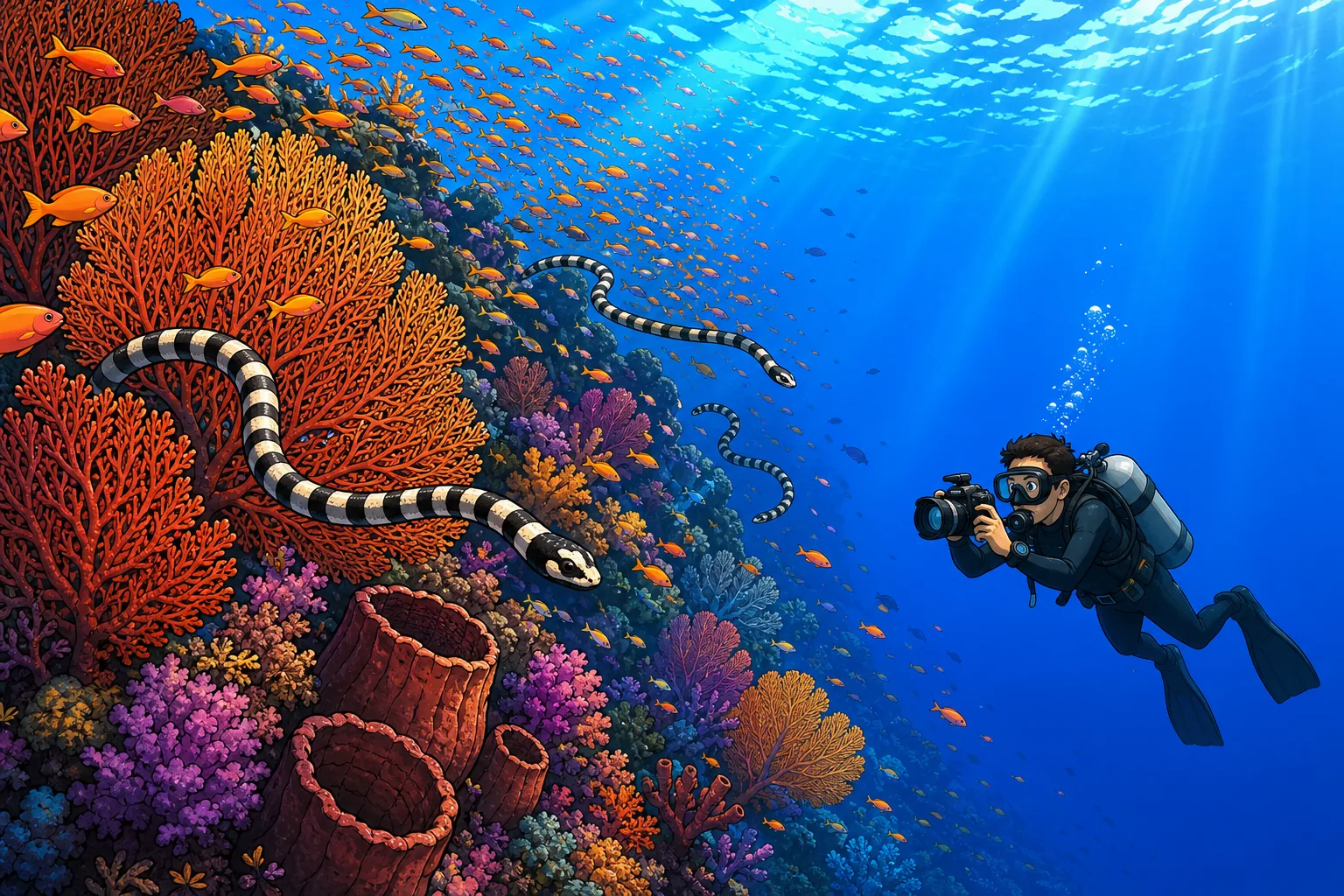
Manuk is the poster child: an uninhabited active volcano ringed by reef, a full day's sail from anywhere, and home to the densest sea snake population either of us has seen anywhere in the world. Banded sea kraits hunt in packs here, weaving through gorgonians and following divers around with a curiosity that unsettles people for the first ten minutes and delights them for the rest of the dive (they are docile, and in thousands of logged dives here we have never had an incident). The same up-current corners hold the hammerhead schools, and the reef itself, huge fans, barrel sponges, unbroken hard coral, would be a destination even without the animals. Suanggi, north of the Banda Islands, is the other marquee hammerhead seamount: a lonely rock in blue water whose sloping flanks concentrate everything the open ocean sends past, including dogtooth tuna, mobula rays and, on the right morning, the biggest schools of the trip. Serua and Nil Desperandum are the deep-south seamounts on the longer crossings: fewer boats, wilder conditions, and the sites where a hundred-plus hammerhead aggregation is most likely.
The Banda Islands themselves offer the change of pace that makes an 11-night trip sustainable. The Banda Neira and Gunung Api house reefs include the famous 1988 lava-flow dive, where the eruption sterilised the slope and the coral that recolonised it grew into vast unbroken tables at a speed that made it a research site; it is one of the most quietly moving dives in Indonesia once the guide explains what you are looking at. Pulau Hatta has a sheer wall and a swim-through arch with 40-metre visibility on a good October day, and doubles as our standard check-out site because it is sheltered and forgiving. Pulau Ai and Pulau Run (the island the Dutch famously traded Manhattan for) have pristine hard-coral gardens where the macro hunters on board get their fix: pygmy seahorses on the fans, ghost pipefish in the rubble patches, and the kind of nudibranch density familiar to anyone who has done our Bali muck diving circuit. And Koon, near Seram at the north end of the route, ends many crossings with a fish-soup drift the guides call "Too Many Fish" without irony. Depth is the recurring theme: the interesting action on the seamounts sits at 25 to 40 metres, which shapes who this trip is for, and we will get to that.
Banda Neira: the spice-islands day that guests rank with the diving
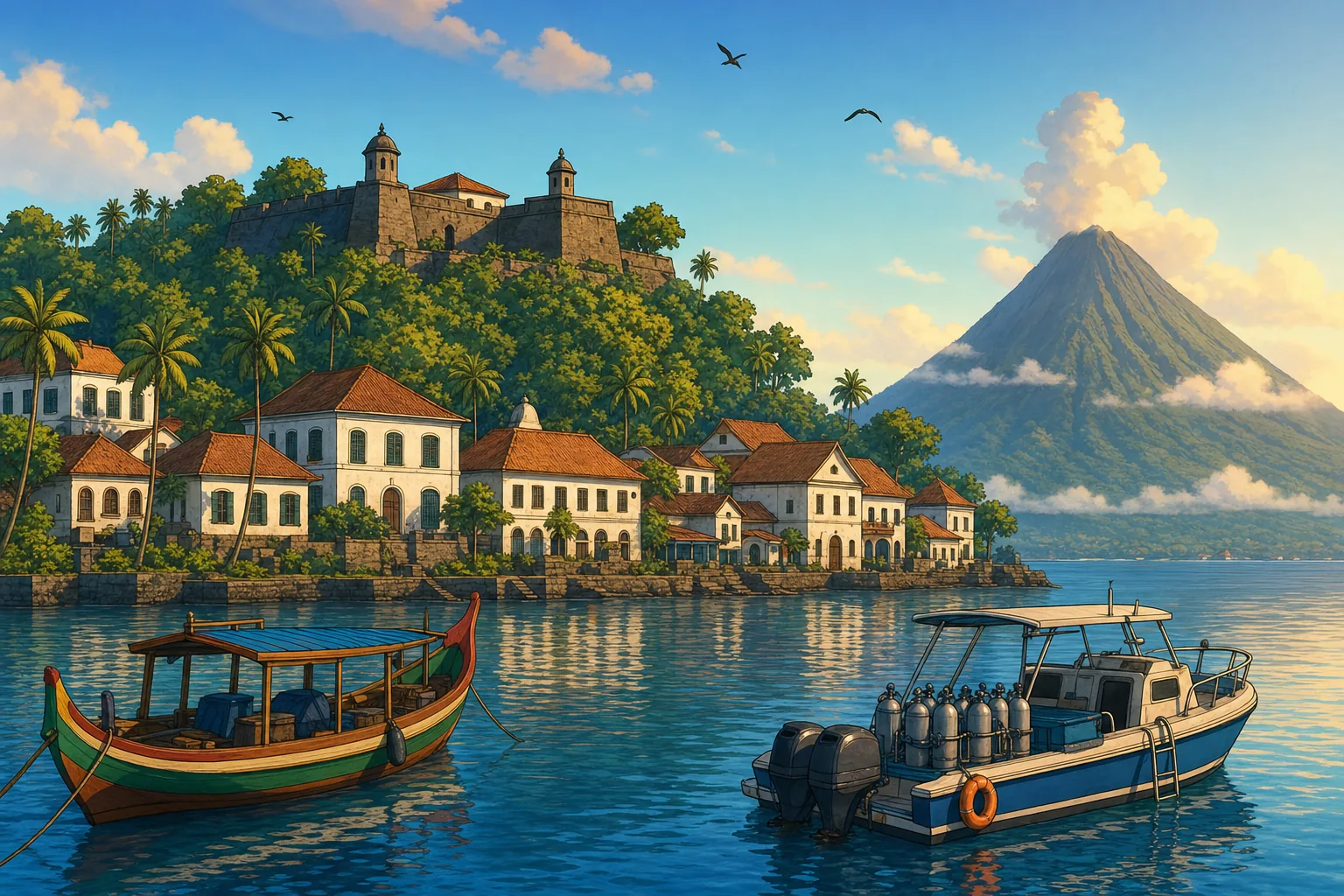
Halfway through every crossing we tie up at Banda Neira for a topside afternoon, and on the feedback forms it consistently rates alongside the hammerheads. These ten small islands were, for about two centuries, the only place on Earth that grew nutmeg, which made them the most valuable real estate of the colonial era and the site of some of its darkest history. The walking tour is short and remarkable: Fort Belgica, the pentagon fortress the Dutch built in 1611, restored and standing above the town; the old Perkenier plantation houses with their crumbling columns; the nutmeg groves under towering kenari trees, where you can crush fresh mace in your fingers; and a small museum that does not flinch from the story of the 1621 massacre. Across the narrow strait the Banda Api volcano rises 640 metres straight out of the sea, and the energetic guests climb it at dawn for a view over the entire island group (bring proper shoes; the cinder path is real work). The history-minded should read up on the Manhattan-for-Run trade before the trip, because standing on Run with that fact in your head is a strange and wonderful experience.
This matters for a practical reason too. Eleven nights of dawn starts and four-dive days is a lot, even for the dive-obsessed, and the Banda Neira day works as a natural intermission that resets the group. Non-diving partners, and King Neptune is genuinely non-diver friendly in a way most expedition boats are not, get their best day of the trip here, along with the volcano sails, the deck whale-watching and the snorkelling on the shallow reef tops. If you are travelling as a mixed diver-and-non-diver couple and hesitating between this and a resort trip, the honest answer is that the Banda crossing works for a non-diver who loves boats, books and remoteness, and fails for one who needs a beach bar and a phone signal. There is no mobile coverage for most of the route; the boat's satellite internet is included and fine for messages, but this is a trip you largely spend offline, which most guests list as a feature by day three.
King Neptune: the boat, and why the vessel choice matters more here
In Komodo you can get away with a marginal boat because the anchorages are sheltered and help is never far. The Banda Sea does not extend that courtesy. The crossings involve long open-water passages, the sites are exposed seamounts, and the nearest hyperbaric chamber is a flight away, which is why we tell guests that in this region the vessel is not a comfort decision, it is a safety decision. King Neptune was purpose-built for exactly this profile: 46 metres of steel hull with a 9.3-metre beam that rides the crossing swell instead of corkscrewing through it, twin 600-horsepower Yanmar engines cruising at 10 knots, a 3,000-nautical-mile range on a 40,000-litre fuel capacity, and a watermaker producing 10 tonnes of fresh water a day so an 11-night trip never rations showers. The dive operation runs off two 8-metre RHIB tenders with 150-horsepower engines, which sounds like a spec-sheet detail until you surface 400 metres down-current of a seamount in open ocean and the pickup takes ninety seconds instead of fifteen minutes. Every guest carries a Nautilus Lifeline GPS unit on every dive as standard, there is oxygen on board and on both tenders, and the crew of 20 includes guides who have run this route for years.
| King Neptune spec | Detail | Why it matters in the Banda Sea |
|---|---|---|
| Length / hull | 46 m, steel and aluminium | Stability on long open-ocean crossings |
| Guests / cabins | 20 guests, 10 en-suite cabins | All main or upper deck with sea views; no lower-deck bunks |
| Crew | 20 (local and international) | 1:1 crew-to-guest ratio for a remote expedition route |
| Range | 3,000 nm, 40,000 L fuel | The full Ambon crossing without refuelling stops |
| Fresh water | 45,000 L tank + 10 t/day watermaker | No rationing across 11 nights |
| Dive tenders | 2 x 8 m RHIB, 150 HP | Fast pickups at exposed seamounts |
| Nitrox | Dedicated Coltri system, 20 USD/day | Repeat 30 m mornings without shredding no-deco time |
| Safety | Nautilus Lifeline GPS per diver, oxygen units, RADAR, SSB radio | Open-ocean diving a flight away from the nearest chamber |
| Connectivity | Free satellite internet | Only link to the world for most of the route |
Comfort-wise the short version is that this is the top of our fleet: individually air-conditioned cabins with en-suite bathrooms, a camera station with a separate rinse basin (the photographers on board will care), buffet meals mixing Western, Indonesian and Chinese cuisine with dietary requirements handled at booking, and a sun deck that becomes the whale-watching platform on crossing days. Our smaller Neptune One runs the Komodo and Raja Ampat routes and is the right choice for those regions on a tighter budget, but we do not send it on the Banda crossing; that route is King Neptune's job for the reasons above.
The crossing itineraries and a day in the life on board
Banda Sea trips are sold as one-way crossings, not loops, and this confuses first-timers so it is worth spelling out. The classic patterns are Ambon to Saumlaki (or the reverse) running the seamount chain south, typically 10 to 11 nights, and Ambon to Sorong, which runs the Banda Islands and the eastern route and works as a front-end extension to a Raja Ampat liveaboard season opener, typically 11 to 12 nights. Because the boats reposition from Komodo to Raja Ampat as the seasons hand over, the Banda crossing exists precisely in that mid-September to early November corridor, which is also, conveniently, the hammerhead window. You fly into one port and out of the other: Ambon (AMQ) connects through Jakarta or Makassar, Saumlaki and Sorong connect back the same way. We handle airport transfers at both ends as part of the package, and our office will tell you honestly which inbound flights are reliable and which Indonesian domestic connections to never book with under three hours of buffer.
The daily rhythm: wake at 06:00, light breakfast, first dive at 06:30 when the hammerhead odds are best, proper breakfast after, second dive around 10:30, lunch, third dive around 14:30, then either a fourth dive, a night dive at anchorages that allow it, or a crossing leg with the sun deck and the whale watch. Repeat for ten days with the Banda Neira intermission in the middle. It is a demanding, wonderful routine, and it is also why we insist guests arrive in Indonesia at least one full day before departure: a missed domestic connection with a one-way crossing does not have a recovery plan, and jet-lagged divers make poor decisions at 30 metres on day one. Many guests pair the crossing with a few warm-up days of Bali day diving out of our Sanur shop the week before, which doubles as a gear shake-down; the Bali dive trip itinerary planner shows how the pieces fit together, and if your last logged dive is more than a year old we will quietly steer you to a ReActivate refresher in Bali first rather than have you rediscover your buoyancy on a seamount corner.
Who should book this trip, and who we will honestly turn away
Our minimum for the Banda crossing is Advanced Open Water with 50 logged dives, and unlike some operators we treat that as a floor, not a suggestion. The reasons are concrete. The action sits at 25 to 40 metres, so every serious dive is a deep dive on the tables. The sites are open-ocean seamounts where the current can swing through 90 degrees mid-dive, which demands the kind of instinctive buoyancy and awareness that only dive count builds. Negative entries, reef hooks and SMB deployment are assumed skills, not things we teach on the corner at dawn. And the remoteness removes the margin: this is not the place to discover you panic in blue water. We turn away enquiries from divers with sub-50 logbooks regularly, and we would rather lose the booking than compromise the trip, because one out-of-depth diver reshapes every dive for the other nineteen guests. If you are close to the threshold, the path is straightforward: an Advanced course in Bali, a stack of drift dives at Penida with our Sanur dive centre, and the crossing next season. It will be a far better trip for the wait, and the hammerheads are not going anywhere.
Beyond the certification line, the trip suits divers who are comfortable with four-dive days, cool with 26-to-27-degree water carrying colder thermoclines (a 5 mm suit or a 3 mm with a hooded vest is the standard call; our packing list covers the full kit), and genuinely at peace with eleven days offline. Dive insurance covering evacuation is mandatory, not recommended; we check certificates at boarding. Seasickness planning is real: the crossing legs are open ocean, and the guests who suffer are almost always the ones who declared themselves immune, so bring more medication than you think you need. Nitrox certification is strongly recommended and cheap to add in Bali beforehand; on repeat 30-metre profiles it is the difference between watching the school and watching your computer, as our certification guide explains. And it should go without saying on a trip like this, but the boat runs a hard no-alcohol-before-diving line; the reasoning is in our diving and alcohol article.
What the trip costs: the full number, with nothing hidden
Banda Sea crossings are premium trips and we would rather show the whole number than let you discover it in instalments. The boat price on King Neptune includes all meals and snacks, drinking water, soft drinks, tea and coffee, the full diving package, airport and hotel transfers at both ends, and cabin and dive towels. The mandatory extra is the park and port fee, 200 to 320 USD per person depending on the exact route and provinces transited, paid on board. Optional extras are Nitrox at 20 USD a day (take it), rental gear if you are not bringing your own, a private dive guide, alcoholic drinks and crew gratuities. Below is what a realistic all-in budget looks like per person; the wider context on why Indonesian dive pricing looks the way it does is in our Bali dive pricing article.
| Cost item | Typical range (USD, per person) | Notes |
|---|---|---|
| King Neptune cabin, 10-11 nights | 4,400-6,500 | Varies by cabin category and departure date |
| Park & port fees | 200-320 | Mandatory, paid on board |
| Nitrox (whole trip) | 200-220 | 20 USD/day; strongly recommended |
| International flights | 900-1,800 | To Jakarta/Bali, varies by origin |
| Domestic flights (in via AMQ, out via Saumlaki/Sorong) | 300-550 | Book flexible fares; connections are the fragile link |
| Pre-trip night + buffer day | 80-250 | Non-negotiable in our view |
| Dive insurance with evacuation | 60-150 | Mandatory; checked at boarding |
| Gratuities | 250-400 | Customary for a crew of 20 over 11 nights |
| Realistic all-in | 6,000-9,500 | Consistent with our region comparison guide |
Is it worth it? Put against its true competitors the answer is clearer than the sticker suggests. The comparable hammerhead trips, Galapagos and Cocos, run 7,000 to 12,000 USD for the boat alone before the longer flights, and neither adds active volcanoes, virgin hard coral or a UNESCO-grade history stop. Against other Indonesian routes, the Banda crossing costs roughly 40 percent more than a comparable Komodo liveaboard week and buys you an experience perhaps one percent of Indonesian dive tourists will ever have. The honest framing we give guests: do Komodo first, do Raja Ampat when the budget recovers, and book the Banda Sea when you know you love expedition liveaboards, because this is the route where all that experience pays out. That is also, not coincidentally, the order in which the trips teach you the skills the next one needs.
Booking timeline, best departures and final practicalities
The season is seven weeks long and King Neptune carries 20 guests per crossing, which is the arithmetic behind our standard advice: book 8 to 12 months out. The mid-October departures are the first to sell because they sit at the statistical peak of the hammerhead window; late September runs slightly warmer water with marginally deeper schools, and early November trades a small drop in hammerhead odds for the calmest crossing seas and the emptiest sites. If your dates are fixed, book whatever fits and do not agonise, the differences are real but small. If your dates are flexible, tell us the animals you care about and we will point you at the departure that fits. Visa logistics are painless for most nationalities (30-day visa on arrival, extendable, with the current details in our Indonesia e-visa guide for divers), and your passport needs six clear months beyond the travel dates, which is the single most common document problem we catch at booking.
Final practical notes, in the order guests ask. Camera gear: bring every battery and memory card you own, there is no resupply after Ambon, and the camera station has dedicated rinse and charging space. Money: bring the park fee and gratuities in cash (USD or IDR both fine); there are no ATMs after Ambon airport and the on-board card facility depends on satellite whims. Health: no special vaccinations are required beyond standard travel cover, but bring seasickness medication and a basic personal medical kit; the boat carries oxygen and first-aid-trained crew but no doctor. Fitness: nothing heroic is required, but you will climb a tender ladder in a swell twenty times, so shoulder injuries should be declared honestly at booking. And finally, the question every guest asks in the last email before flying: yes, it really is like the photos, and no, the photos do not do the hammerhead wall justice. Book the crossing through our Banda Sea liveaboard page, or write to the shop and a human who has done the route will answer within a day. For the wider view of when everything in Indonesian diving peaks, our best time to visit guide maps the full calendar, and first-time liveaboard guests should read the first-time Bali diving primer and our hand signals refresher before the pre-trip briefing makes both feel familiar.
Related guides from Neptune Scuba Diving
- Indonesia Liveaboard Compared: Komodo vs Raja Ampat vs Banda Sea (2026)
- Diving Komodo (2026): The Complete Guide
- Komodo vs Bali Diving: Which Should You Choose?
- Advanced Open Water Course in Bali (2026)
- Bali Scuba Diving Packing List (2026)
- The Ultimate Bali Dive Trip Itinerary: 5, 7, 10 or 14 Days (2026)
- Bali e-Visa 2026: The Diver's Guide
Frequently Asked Questions
The usable window runs from roughly mid-September to early November, about seven weeks. It exists because the liveaboard fleet repositions from Komodo (whose season ends around October) to Raja Ampat (whose season starts around November), and the crossing route happens to pass the Banda seamounts exactly when the post-monsoon thermocline brings the scalloped hammerhead schools up into diveable depths. Outside this window the seas are rougher, the schools sit deeper, and the boats are simply elsewhere. A secondary window exists in March to May, but September to November is when the hammerhead odds peak and when King Neptune runs the route.
At the key seamounts (Manuk, Suanggi, Serua) in the peak window, our logged per-dive rate is roughly 85 percent, and across a 10-or-11-night crossing with multiple mornings at those sites, seeing schools at some point in the trip is close to certain. On our last three October crossings we logged schools on 11 of 14, 9 of 13 and 13 of 15 dives at the relevant sites. Individual dives still blank, because warm-water years push the schools deeper and current swings move them off the corners, so treat any operator promising a specific dive-by-dive guarantee with suspicion.
On King Neptune the minimum is Advanced Open Water (or equivalent) with 50 logged dives, and we enforce it. The hammerhead action sits at 25 to 40 metres, the sites are open-ocean seamounts with shifting currents, and negative entries, reef hooks and SMB deployment are assumed skills. Nitrox certification is strongly recommended. If you are under the threshold, do an Advanced course and a stack of drift dives at Nusa Penida first, our Sanur shop runs both, and book the crossing for the following season.
Banda Sea crossings are one-way: the classic routes are Ambon to Saumlaki (or reverse) and Ambon to Sorong. You fly into Ambon (AMQ) via Jakarta or Makassar and fly out from the other end the same way. Airport transfers at both ends are included. Build at least one full buffer day before departure, since Indonesian domestic connections are the fragile link, and a one-way crossing has no recovery plan for a guest who misses the boat.
Realistically 6,000 to 9,500 USD per person once everything is counted: the cabin (4,400 to 6,500 USD for 10 to 11 nights depending on category and date), mandatory park and port fees (200 to 320 USD), Nitrox (around 200 USD for the trip), international and domestic flights, a pre-trip buffer night, mandatory dive insurance with evacuation cover, and gratuities. The boat price includes all meals, soft drinks, the full diving package, transfers and towels. Comparable hammerhead destinations (Galapagos, Cocos) cost roughly double once flights are included.
Surface water runs 26 to 28 °C, but the seamounts carry genuine thermoclines that can drop the bottom water several degrees, and you will be doing repeat 30-metre mornings hooked into current. Most guests are comfortable in a 5 mm full suit, or a 3 mm with a hooded vest. Bring gloves for reef-hook work if your certification agency and habits allow them. Our Bali scuba diving packing list article covers the complete kit, including the spares (mask, computer battery, fin strap) that matter on a route with no resupply.
Qualified yes. King Neptune is genuinely non-diver friendly, with a sun deck, salon, good food and free satellite internet, and the Banda crossing offers more topside interest than most dive routes: the Banda Neira spice-islands day, the Banda Api volcano climb, whale blows from the deck on crossing legs, and snorkelling on sheltered reef tops. But the trip is eleven days on a boat with no mobile signal, no beach bars and a schedule built around dawn dives. It works for a non-diver who loves boats, books and remoteness; it fails for one who needs entertainment brought to them.
The reliable cast: banded sea kraits in remarkable density at Manuk (docile, curious, unforgettable), dogtooth tuna and mobula rays at the seamounts, whitetip and grey reef sharks, huge schooling fish at Koon, pygmy seahorses and ghost pipefish on the Banda Islands reefs, and some of the healthiest hard coral in Indonesia, including the famous fast-growing lava-flow tables at Gunung Api. The lottery tickets: thresher sharks, oceanic mantas, and blue or sperm whales, which we see blowing from the deck on most crossings but rarely meet in the water.
Different products for different career stages. Komodo is the best first Indonesian liveaboard: shorter, cheaper, huge variety, manta-heavy. Raja Ampat is the biodiversity spectacle with the gentlest conditions. The Banda Sea is the expedition: the narrowest season, the deepest and bluest diving, the strictest requirements, the most remote route, and the one world-class animal encounter the other two cannot offer: reliable scalloped hammerhead schools. Our full three-way comparison article covers the decision in detail, but the short version we give guests is: Komodo first, Raja Ampat second, Banda when you know you love expedition boats.
Eight to twelve months. The season is seven weeks long, King Neptune carries 20 guests per crossing, and there are only a handful of departures each year; the mid-October dates sell out first because they sit at the statistical peak of the hammerhead window. Late September and early November departures hold availability longer and are only marginally different in the water. If your dates are flexible, contact us with the animals you most want to see and we will recommend the specific departure. Booking through our Banda Sea liveaboard page carries no booking fees and a best-price guarantee.