
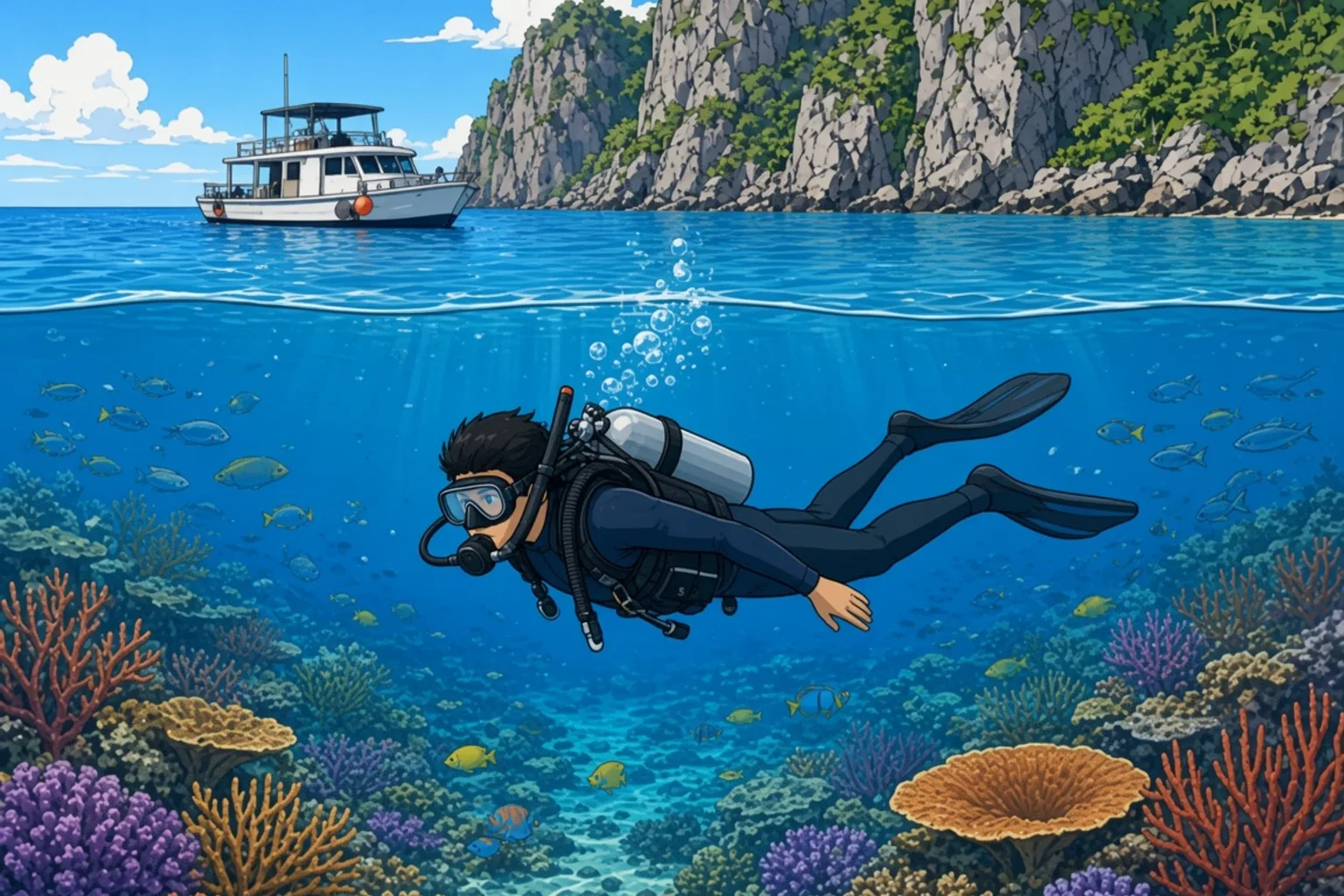
Diving in Indonesia means choosing between more than a dozen distinct regions spread across an archipelago of over 17,000 islands, from the reefs of Raja Ampat and the current-swept channels of Komodo to the wrecks and manta sites of Bali. The country sits at the centre of the Coral Triangle, the most species-rich marine region on Earth, and most of its best sites are reached either from a land base or on a multi-day Indonesia liveaboard. The right region depends on the month, your experience level, and how far you are willing to travel from the international airports.
For most visitors the trip starts in Bali, which has the country's busiest international airport, year-round diving of its own, and direct domestic flights to the other major dive hubs. Scuba diving in Bali covers everything from first-time courses to the USAT Liberty wreck and the manta rays of Nusa Penida, which is why many itineraries combine a few days on Bali with a week further east. This guide compares the main regions, their seasons, costs and difficulty, using 2026 prices and park fees.
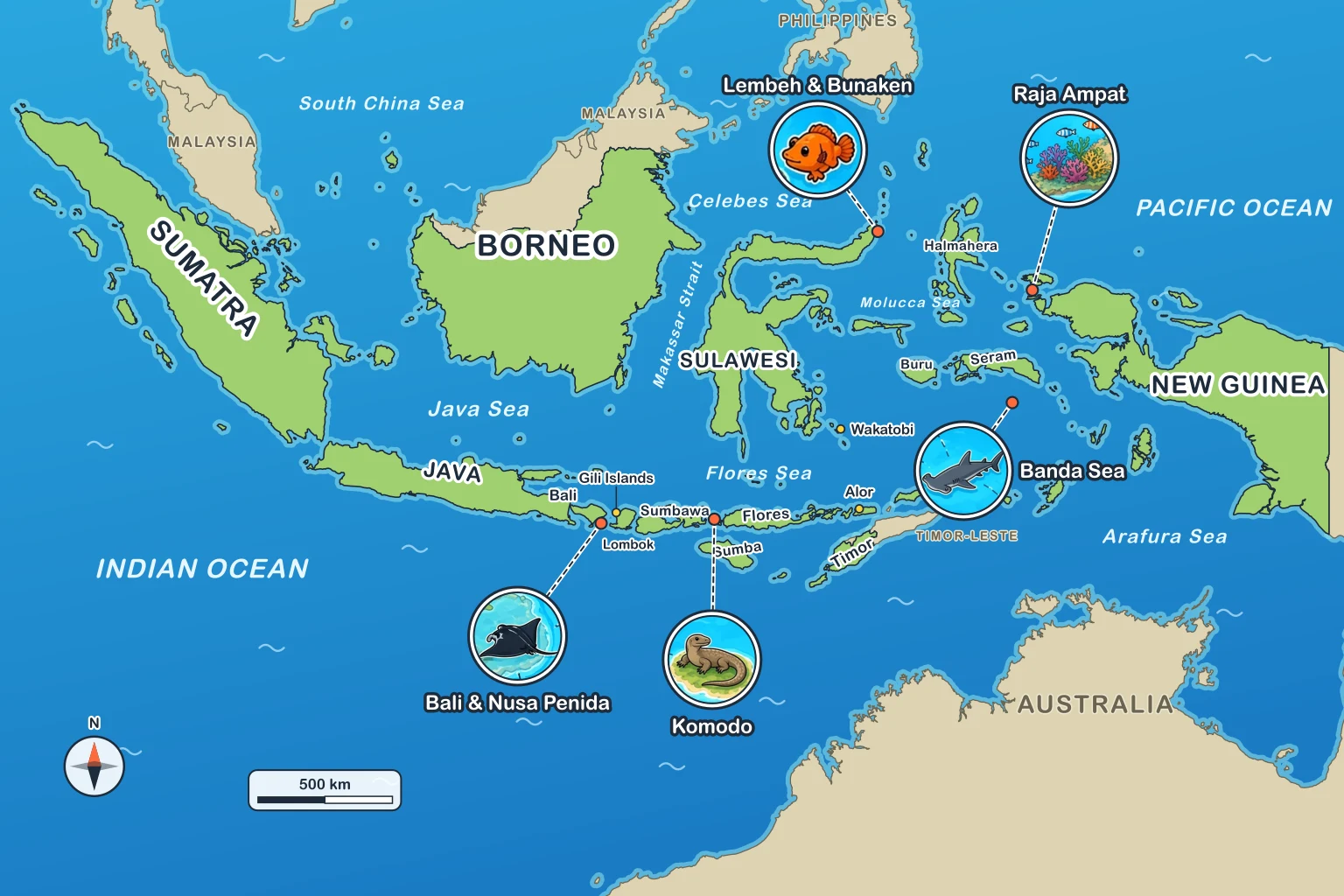
- Top regions: Raja Ampat (reef biodiversity), Komodo (big animals and currents), Banda Sea (hammerheads), Bali and Nusa Penida (wrecks, mantas, mola mola), Lembeh Strait (macro), Bunaken and Wakatobi (walls and pristine reefs), Alor (advanced wall diving).
- Seasons: Bali, Komodo, Wakatobi and North Sulawesi peak from about April to November. Raja Ampat peaks from October to April. The Banda Sea is dived mainly from September to November.
- Cost: about IDR 2,700,000 for a two-dive day trip in Bali with transfers; USD 280 to 700 per night on a quality liveaboard, depending on region and cabin.
- Park fees: about IDR 300,000 per diver per day in Komodo; IDR 1,700,000 per visit in Raja Ampat; IDR 100,000 per day at Nusa Penida.
- Level: Bali, Lembeh, Bunaken, Wakatobi and the Gili Islands suit new divers. Komodo, Raja Ampat's Dampier Strait, Alor and the Banda Sea reward experience with currents.
Is Indonesia good for scuba diving?
Indonesia is widely regarded as one of the best scuba diving countries in the world, because it holds a large share of the Coral Triangle, the region with the highest marine biodiversity on the planet. It also offers diving for every level, year round, at prices below those of the Maldives or the Red Sea liveaboard circuit.
The numbers behind that reputation come from the Coral Triangle Initiative, the six-government partnership that manages the region. Covering only 1.6 percent of the world's ocean area, the Coral Triangle contains 76 percent of all known coral species and 37 percent of all known coral reef fish species. Indonesia holds the largest share of it. Within the country, Raja Ampat stands out: Conservation International surveys have recorded 553 species of reef-building coral there, more than 75 percent of the world's total, and more than 1,400 species of reef fish.
Biodiversity is only part of the appeal. Indonesia sits between the Pacific and Indian Oceans, and the water that moves between them through narrow straits creates the nutrient-rich currents that feed manta rays at Komodo and Nusa Penida, bring mola mola up to Bali's reefs, and attract schooling hammerheads to the Banda Sea. The same geology produces the black volcanic sand of the Lembeh Strait, one of the best places in the world to find rare small creatures. Few countries offer big-animal diving, pristine reefs and world-class macro within a few hours' flight of each other.
The trade-offs are distance and logistics. The best-known regions are far apart, domestic flights connect through hubs such as Denpasar, Makassar and Jakarta, and the most remote areas are practical only on a liveaboard.
Where is the best diving in Indonesia?
The best diving in Indonesia is in Raja Ampat for reef life, Komodo for big animals and currents, the Banda Sea for hammerheads, the Lembeh Strait for macro, and Bali for variety and ease of access. Which one is best for you depends on your level and the month of travel.
| Region | Best for | Level | Best months | Access |
|---|---|---|---|---|
| Raja Ampat (West Papua) | Reef biodiversity, mantas, reef sharks | Intermediate to advanced | October to April | Fly to Sorong, then speedboat or liveaboard |
| Komodo National Park | Mantas, sharks, schooling fish, currents | Intermediate to advanced | March to early November | Fly Bali to Labuan Bajo (about 80 minutes) |
| Banda Sea | Schooling hammerheads, remote walls | Advanced | September to November | Liveaboard from Ambon |
| Bali and Nusa Penida | Wreck, mantas, mola mola, macro, courses | Beginner to advanced | April to November | Denpasar international airport |
| Lembeh Strait (North Sulawesi) | Muck diving and rare macro life | Beginner and up | Year round | Fly to Manado, then drive to Bitung |
| Bunaken (North Sulawesi) | Walls, turtles, clear water | Beginner to intermediate | April to October | Manado, then a short boat ride |
| Wakatobi (Southeast Sulawesi) | Pristine hard coral reefs | Beginner to intermediate | April to November | Domestic flights via Makassar or Kendari |
| Alor (East Nusa Tenggara) | Cold-water walls, strong currents | Advanced | March to November | Fly Kupang to Alor, or liveaboard |
| Gili Islands (Lombok) | Turtles, easy reefs, dive training | Beginner | April to November | Fast boat from Bali |
| Cenderawasih Bay (West Papua) | Resident whale sharks | Intermediate | Liveaboard departures vary | Liveaboard from Nabire or Manokwari |
Raja Ampat
Raja Ampat is the region most divers put at the top of their list. Its reefs combine hard and soft coral cover with dense fish life, manta cleaning stations in the Dampier Strait and at Misool, and wobbegong sharks resting under ledges. Currents in the channels can be strong, so many sites suit divers with some experience. Most visitors dive it on a Raja Ampat liveaboard, because the islands cover more than four million hectares of sea and land-based resorts reach only part of them. For a direct comparison with Indonesia's most accessible island, read Bali vs Raja Ampat diving.
Komodo National Park
Komodo sits between the Flores Sea to the north and the Indian Ocean to the south, and the tides that push water between them create some of the strongest currents in recreational diving. Those currents feed reef mantas, grey and white-tip reef sharks, giant trevally, dogtooth tuna and dense schools of fusiliers. Central sites such as Batu Bolong and Manta Point in Komodo are reachable on day trips from Labuan Bajo, while the northern pinnacles such as Castle Rock and Crystal Rock are best reached on a Komodo liveaboard or from a resort inside the park. This complete guide to diving Komodo covers the individual sites and how the currents behave.
Banda Sea
The Banda Sea is Indonesia's most remote major dive region: volcanic islands, steep walls and, in season, schools of scalloped hammerheads. It is dived almost entirely by liveaboard, usually on crossings from Ambon, and the window is narrow, from roughly mid-September to early November, with a shorter spring window in some years. A Banda Sea liveaboard suits experienced divers who have already seen Komodo or Raja Ampat and want fewer boats and blue-water encounters.
Bali and Nusa Penida
Bali offers the widest range of diving in a single place in Indonesia. The USAT Liberty wreck at Tulamben lies close to shore in 5 to 30 metres of water, Amed and Padang Bai have easy reefs and good macro life, Menjangan Island in the north-west offers calm walls inside a national park, and the Nusa Penida dive sites off the south-east coast add manta rays year round and mola mola from about July to October. Because the island has an international airport and dozens of dive centres, it is also the easiest place in Indonesia to learn. This round-up of the best places to scuba dive in Bali covers the island site by site.
Lembeh Strait and Bunaken
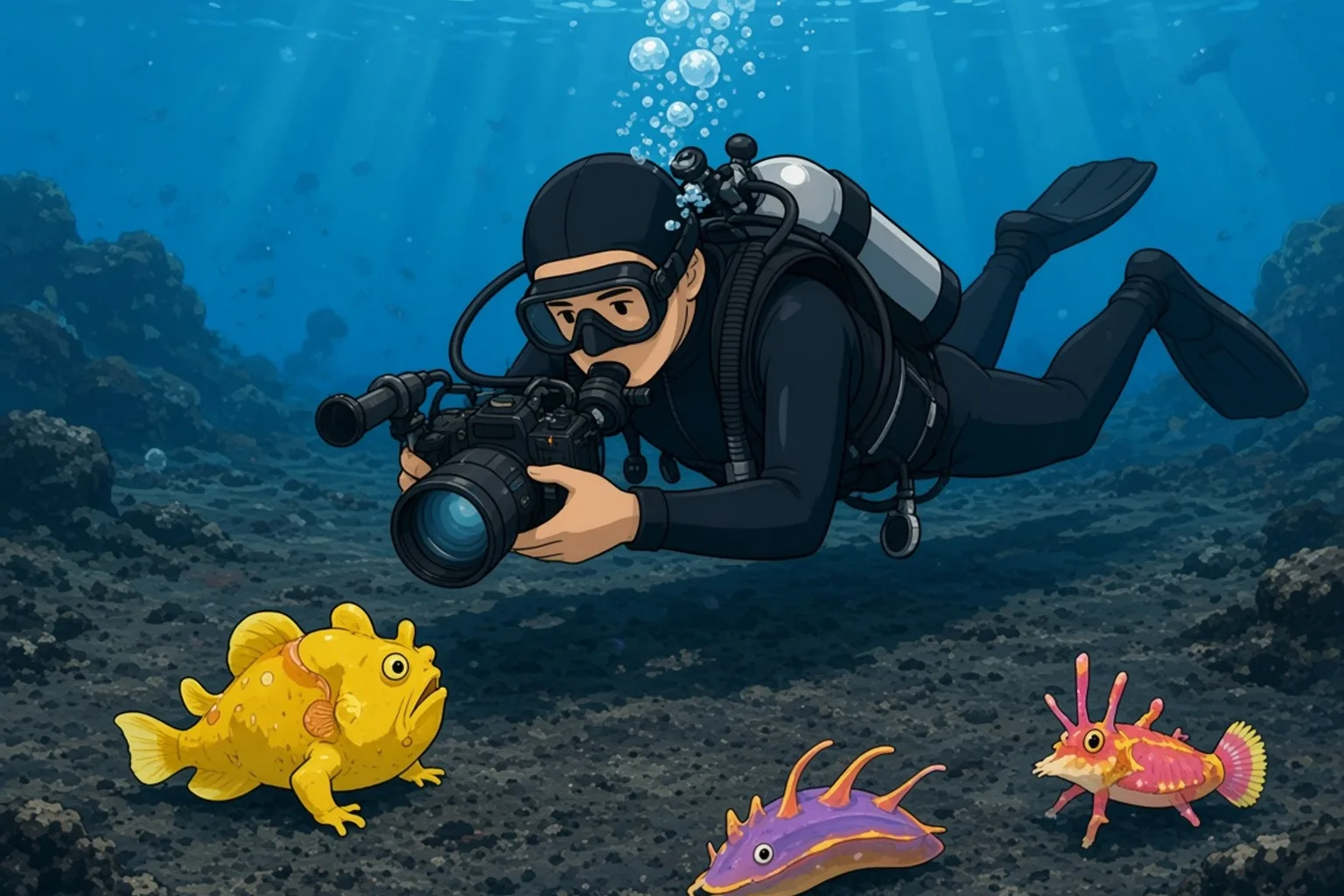
North Sulawesi has two contrasting areas an hour apart. The Lembeh Strait, near the port city of Bitung, is the best-known muck diving site in the world: dark volcanic sand where divers look for frogfish, mimic octopus, flamboyant cuttlefish and dozens of nudibranch species. Visibility is often only 5 to 15 metres, but conditions are generally calm and shallow. Bunaken Marine Park, a short boat ride from Manado, is the opposite: vertical walls, clear water and large numbers of green turtles. Many divers split a week between the two. Similar macro life can be found closer to Bali, as described in this guide to macro and muck diving in Bali.
Wakatobi, Alor and the Gili Islands
Wakatobi, a 1.39 million hectare national park and UNESCO biosphere reserve in Southeast Sulawesi, is known for healthy hard coral and gentle conditions, and is reached by domestic flight or resort charter. Alor, east of Flores, has cold upwellings, steep walls and strong currents, and is best for advanced divers from about March to November. The Gili Islands off Lombok are the opposite end of the scale: shallow reefs, many green and hawksbill turtles, and dive schools that specialise in beginner courses.
When is the best time to dive in Indonesia?
There is good diving somewhere in Indonesia every month. Bali, Komodo, Wakatobi, Alor and North Sulawesi are at their best from about April to November, during the dry season, while Raja Ampat is at its best from October to April. The Banda Sea is dived mainly from September to November.
The pattern follows the two monsoons. The south-east monsoon, from roughly April to October, brings dry weather to Bali and Nusa Tenggara but rougher seas to parts of West Papua, which is why most Raja Ampat liveaboards move west during those months. The north-west monsoon, from roughly December to March, brings rain and wind to Bali and Komodo, although diving continues on most days and the southern Komodo sites are often calmer then.
| Region | Peak months | Shoulder or off season | Water temperature |
|---|---|---|---|
| Bali and Nusa Penida | April to November | December to March, wetter; diving continues | 26 to 29°C; can drop below 20°C at Nusa Penida from July to October |
| Komodo | March to early November | December to February, rainier; south often calmer | 27 to 29°C north; 22 to 26°C south |
| Raja Ampat | October to April | May to September, rougher surface conditions | About 28 to 29°C |
| Banda Sea | Mid-September to early November | Most boats do not operate outside the window | About 27 to 29°C |
| Lembeh and Bunaken | April to October | Year-round diving; January and February wettest | 26 to 29°C |
| Wakatobi | April to November | December to March, wet season | 26 to 30°C |
| Alor | March to November; hammerheads September to November | December to February, most operators pause | Often 22 to 26°C with upwellings |
If you have a fixed travel window, the table can be read the other way round. From April to October, Bali, Komodo, Alor, Wakatobi and North Sulawesi all work at the same time, which makes these the most flexible months. Between December and March, Raja Ampat and the Bird's Head region are the strongest choice, with Bali and Lembeh as reliable backups. The mola mola season in Bali is the one strongly seasonal big-animal event close to the main airport.
Liveaboard, dive resort or day trips: which is best in Indonesia?
Day trips work best in Bali, the Gili Islands and North Sulawesi, where good sites are close to shore. Dive resorts suit Lembeh, Wakatobi and parts of Komodo and Raja Ampat. Liveaboards are the best way to see Raja Ampat, the northern and southern Komodo sites, and they are the only practical way to dive the Banda Sea.
| Format | Works best in | Dives per day | Advantages | Limitations |
|---|---|---|---|---|
| Day trips from a hotel | Bali, Gili Islands, Bunaken, Labuan Bajo (central Komodo) | 2 to 3 | Flexible, cheaper, non-divers can join | Limited range; long drives on Bali |
| Dive resort | Lembeh, Wakatobi, Komodo, Raja Ampat | 3 to 4 including night dives | Stable base, house reef, comfortable for families | Sites limited to boat range from the resort |
| Liveaboard | Raja Ampat, Komodo, Banda Sea, Alor, Cenderawasih | 3 to 4 including night dives | Reaches remote sites; most dives per day | Fixed dates; higher cost; seasickness risk |
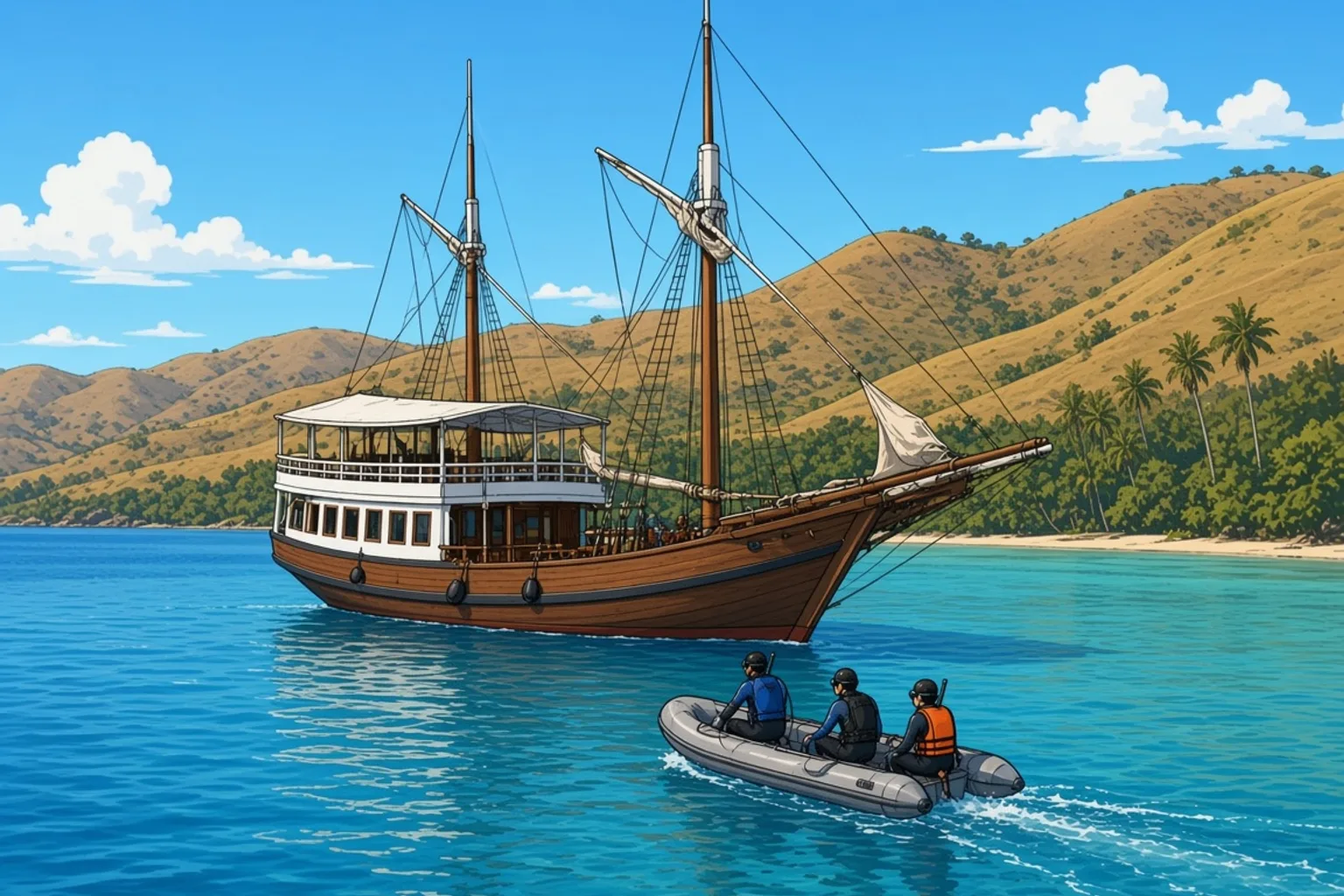
Most Indonesian liveaboards are phinisi, traditional two-masted wooden schooners adapted with cabins and dive decks. Trips range from three nights in Komodo to twelve nights or more on Banda Sea crossings. For a detailed comparison of the three main liveaboard regions, including encounter rates and all-in costs, see Komodo vs Raja Ampat vs Banda Sea liveaboards. The Neptune Liveaboards blog also publishes a liveaboard-focused guide to the best diving in Indonesia.
Resorts inside or near the marine parks are a middle ground. In Komodo, a resort on an island within the park, such as the Komodo Resort, can reach sites that day boats from Labuan Bajo cannot, while keeping a fixed room and a house reef. Day trippers in Komodo usually book a Komodo diving package through a dive centre in Labuan Bajo or on one of the islands.
How much does diving in Indonesia cost?
Diving in Indonesia costs from around IDR 2,700,000 for a two-dive day trip in Bali with transfers, to USD 280 to 700 per night on a liveaboard. Marine park fees, domestic flights and nitrox are usually extra and can add several hundred dollars to a trip in the eastern regions.
| Item | Typical 2026 price | Notes |
|---|---|---|
| Two-dive day trip in Bali, with hotel transfers | About IDR 2,700,000 for certified divers | Example: Tulamben or Padang Bai day with Neptune Scuba Diving |
| PADI Open Water course in Bali | IDR 7,200,000 to 10,800,000 | Three to four days; price depends on group size and location |
| Komodo liveaboard, standard cabin | USD 280 to 450 per night | Mid-range to upper-mid phinisi |
| Raja Ampat liveaboard | USD 380 to 700 per night | Longer minimum trips, usually 8 to 11 nights |
| Nitrox on a liveaboard | USD 100 to 200 per trip | Often free or discounted on some boats |
| Flight Bali to Labuan Bajo | USD 70 to 130 one way | About 80 minutes |
| Flights Bali to Sorong, return | USD 350 to 600 | Usually via Makassar or Jakarta |
Marine park fees and levies
Most of Indonesia's famous dive sites lie inside national parks or marine protected areas, each with its own fee. Liveaboards and resorts usually collect them and pay on your behalf, but they are rarely included in headline prices.
| Fee | Amount for foreign visitors | Validity |
|---|---|---|
| Komodo National Park (entry, diving surcharge, harbour fee) | About IDR 300,000 | Per diver, per day |
| Raja Ampat Marine Park card | IDR 700,000 | 12 months |
| Raja Ampat regency visitor levy | IDR 1,000,000 | Per visit (raised in January 2026) |
| Nusa Penida Marine Protected Area | IDR 100,000 per day, or IDR 200,000 for a month | Per person |
| Bunaken National Park | IDR 150,000 | Per person, per visit |
| Bali foreign tourist levy | IDR 150,000 | Once per trip to Bali |
Komodo has also introduced a daily visitor quota. Since 2026, park entries are booked in advance through the SiOra online system, and licensed operators register divers' passport details before the trip. Independent travellers joining a boat in Labuan Bajo should confirm that the operator has handled this. Current prices for diving on Bali itself are listed on the Bali diving price page.
What certification and experience do you need to dive in Indonesia?
An Open Water certification is enough to dive Bali, the Gili Islands, Bunaken, Lembeh and Wakatobi. For Komodo, Raja Ampat's current sites, Alor and the Banda Sea, an Advanced Open Water certification and experience with drift diving are strongly recommended, and many liveaboards require them.
An Open Water Diver certification allows diving to 18 metres, which covers most reef sites in Indonesia. Many Komodo and Raja Ampat liveaboards ask for the Advanced Open Water certification, which extends the limit to 30 metres and includes a deep dive and usually a drift dive, and some also set a minimum number of logged dives. Operators commonly ask for recent diving experience too, because a first dive in two years is not the right place to meet a Komodo current. Divers who have not been in the water for a while can do a short refresher before the trip.
| Region | Minimum sensible level | Why |
|---|---|---|
| Bali (most sites), Gili Islands | Open Water, or a first course on site | Calm shore and boat dives; many dive schools |
| Lembeh, Bunaken, Wakatobi | Open Water | Generally gentle conditions; some current on Bunaken walls |
| Nusa Penida | Open Water with good buoyancy; Advanced for drift sites | Currents and cold thermoclines at some sites |
| Komodo | Advanced Open Water recommended | Strong currents, down-currents at some sites |
| Raja Ampat (Dampier Strait) | Advanced Open Water recommended | Current-swept channels and pinnacles |
| Alor, Banda Sea | Advanced Open Water and drift experience | Remote, strong currents, blue-water dives |
Bali is the most common place in Indonesia to learn. The PADI Open Water Diver course in Bali takes three to four days, and the Advanced Open Water course takes two, so both can be completed before flying on to Komodo or Raja Ampat. The same courses are also taught at dive centres in Labuan Bajo and at the Komodo dive center, for divers who prefer to train where they will dive.
How do you get to Indonesia's dive regions?
Most divers fly into Bali (Denpasar) or Jakarta and continue on domestic flights. Bali has direct flights to Labuan Bajo for Komodo, while Sorong for Raja Ampat, Ambon for the Banda Sea and Manado for Lembeh and Bunaken are usually reached with one connection through Makassar or Jakarta.
| Region | Gateway airport | From Bali |
|---|---|---|
| Komodo | Labuan Bajo (LBJ) | Direct, about 80 minutes; boats and ferries also run |
| Raja Ampat | Sorong (SOQ) | Via Makassar or Jakarta, 6 to 9 hours total; then 2 hours by speedboat |
| Banda Sea | Ambon (AMQ) | Via Makassar or Jakarta |
| Lembeh and Bunaken | Manado (MDC) | Via Makassar or Jakarta; some direct international flights |
| Wakatobi | Wangi-Wangi (WNI) or resort charter | Via Makassar and Kendari |
| Alor | Alor (ARD) | Via Kupang |
| Gili Islands | Lombok (LOP), or fast boat | Fast boat from Bali, about 2 hours |
Domestic schedules change often and some routes run only a few times a week, so experienced travellers leave a spare night on either side of a liveaboard, especially in Sorong and Ambon. Flying after diving also needs planning: most agencies recommend waiting at least 18 hours after multiple dives or multiday diving before a flight, which matters when a liveaboard ends in the morning and the flight home leaves the same day.
Komodo is the easiest remote region to add to a Bali trip. Travellers who want the dragons and the diving without organising flights can join a Komodo tour from Bali.
Example itinerary: two weeks from Bali
A common two-week plan for a certified diver uses Bali as the hub. The example below reflects the kind of combination offered by Bali-based operators such as Neptune Scuba Diving.
- Days 1 to 2: arrive in Bali, check-out or refresher dives at Sanur or Padang Bai.
- Days 3 to 5: day trips to Tulamben for the USAT Liberty and to Nusa Penida for manta rays.
- Day 6: fly Bali to Labuan Bajo.
- Days 7 to 11: Komodo liveaboard or resort, three to four dives a day.
- Day 12: no-dive day before flying, visit Rinca or Komodo Island to see the dragons.
- Days 13 to 14: fly back to Bali and home.
The same outline works from November to March with Raja Ampat in place of Komodo, adding two travel days. The Bali days can be booked as part of Bali dive trips, and operators on the same schedule, such as the King Neptune liveaboard and the Komodo Sea Dragon, move between Komodo, the Banda Sea and Raja Ampat as the seasons change.
What marine life can you see diving in Indonesia, and when?
Indonesia offers manta rays year round at Nusa Penida and Komodo, mola mola at Nusa Penida from about July to October, schooling hammerheads in the Banda Sea and Alor from September to November, resident whale sharks in Cenderawasih Bay, and rare macro life in the Lembeh Strait in every month.
| Animal | Where | When | Notes |
|---|---|---|---|
| Reef manta ray | Nusa Penida, Komodo, Raja Ampat | Year round | Fully protected in Indonesia since 2014 |
| Oceanic sunfish (mola mola) | Nusa Penida, Bali | About July to October | Rises from deep, cold water; best at Crystal Bay |
| Scalloped hammerhead | Banda Sea, Alor | September to November | Usually in blue water, 25 m or deeper |
| Whale shark | Cenderawasih Bay; seasonally Saleh Bay, Sumbawa | Cenderawasih year round | Seen at fishing platforms called bagan |
| Frogfish, mimic octopus, flamboyant cuttlefish | Lembeh Strait, Bali (Amed, Tulamben, Padang Bai) | Year round | Muck and macro diving |
| Wobbegong and epaulette sharks | Raja Ampat | Year round | Found under ledges and on reef flats |
| Green and hawksbill turtles | Gili Islands, Bunaken, Nusa Penida, Komodo | Year round | Very common on shallow reefs |
Whale sharks are the animal most often misunderstood by visitors. They are not reliably seen around Bali, and the places where encounters are regular involve long journeys and, in some cases, welfare concerns. The guide to whale sharks in Indonesia explains where they can be seen responsibly. Mantas, by contrast, are one of the most accessible big animals in the country, with cleaning stations at both Nusa Penida and Komodo that are dived daily.
Is diving in Indonesia safe?
Diving in Indonesia is safe with a reputable operator and dives chosen to match your experience. The main risks are strong currents in Komodo, Raja Ampat, Nusa Penida and Alor, cold thermoclines at some sites, and long distances to recompression chambers in the remote east.
Recompression chambers operate in several dive hubs. Bali has two: one at the Ngoerah hospital in Denpasar, which older guidebooks call Sanglah, and one in Gianyar on the east coast. Siloam Hospitals in Labuan Bajo has had a multiplace chamber since October 2018, the first in East Nusa Tenggara, and Siloam Hospitals Manado has had a six-person chamber since the same month. Chambers are also listed in Sorong and Waisai for Raja Ampat, but their operating status varies. On a Banda Sea or Alor trip, the nearest chamber can be a day or more away, which is why dive insurance with medical evacuation cover, from DAN or a similar provider, is essential rather than optional. The Bali-specific details are in this article on barotrauma and dive injuries in Bali.
Currents are the risk that most shapes the choice of region. In Komodo, operators plan dives around the tide tables and use reef hooks and surface marker buoys; in the Banda Sea, many dives are in open blue water. Divers new to these conditions should carry a surface marker buoy and a whistle, stay with the guide, and follow the guide's decision to abort a dive. Good operators cancel or switch sites when conditions are unsafe.
Rules and conservation
Indonesia gave manta rays full legal protection in 2014 under Ministry of Marine Affairs and Fisheries Decree No. 4/KEPMEN-KP/2014, and Raja Ampat became the first regency in the country to declare its waters a shark sanctuary in 2010, banning the capture of sharks, rays, dugongs and turtles. Touching, chasing or feeding marine life is prohibited in the national parks. Divers can help by keeping good buoyancy over fragile coral, using reef hooks only on dead rock, and choosing operators that respect group-size limits at busy sites such as Manta Point.
For a first trip, Bali combined with Komodo covers the widest range of Indonesian diving with the least travel. Divers with more experience and a November to April window can look at Raja Ampat, and those chasing hammerheads can plan around the Banda Sea season. Details of the Indonesia liveaboard schedules referenced in this guide, and of diving in Bali, are available from the contact page.
Sources: Coral Triangle Initiative Regional Plan of Action (coral and reef fish diversity figures); Conservation International and The Nature Conservancy surveys summarised by the Bird's Head Seascape programme (Raja Ampat species counts and the 2010 shark sanctuary); Raja Ampat Marine Park Authority (entry permits); Komodo National Park SiOra booking system (2026 fees and quota); Bali Provincial Government, Love Bali (foreign tourist levy); Bunaken National Park Authority (entrance fee under Government Regulation No. 36/2024); Indonesian Ministry of Marine Affairs and Fisheries Decree No. 4/KEPMEN-KP/2014 (manta ray protection).