
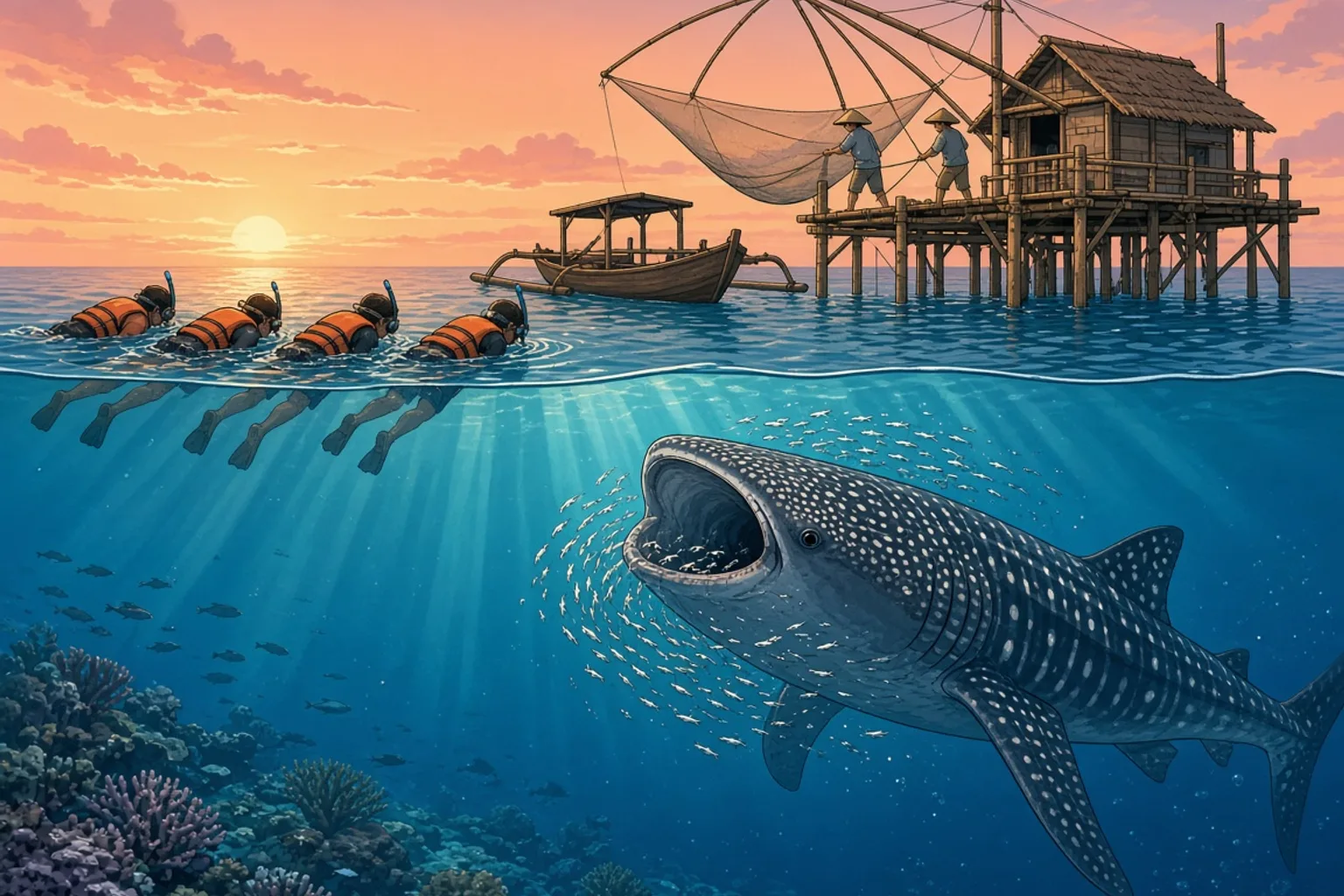
Guests ask us about whale sharks in Indonesia almost every week, usually somewhere between the second and third dive of a Nusa Penida day, and the honest answer disappoints them at first. You are not going to see one here. In eleven years of running boats out of Sanur we have had exactly two credible whale shark sightings reported by our own guides, both at Tulamben, both in plankton-heavy water, both over in under a minute. If a whale shark is the reason you are getting on a plane, scuba diving in Bali is not where you should point yourself. The good news is that the two best whale shark sites on the planet are both Indonesian, and one of them sits on a route our boats already sail.
That site is Saleh Bay, on the north coast of Sumbawa, roughly halfway between Lombok and Flores. It holds the second-largest documented whale shark population in the country and it is close enough to the Lombok to Komodo corridor that several operators build it into an itinerary as a dedicated stop. If you are already thinking about a Komodo liveaboard, adding whale sharks to that trip is a conversation worth having before you book rather than after. The other site, Cenderawasih Bay in West Papua, is a different proposition altogether: the only place on earth where whale sharks do not migrate away, and a fortnight of your life to reach.
- Not in Bali. Whale sharks pass Nusa Penida and Tulamben occasionally in plankton season. Nobody sells a Bali whale shark trip because nobody can deliver one.
- Saleh Bay, Sumbawa: the realistic option. 108 individuals documented between 2017 and 2022, present year round, sightings peaking in August and September. Normally reached as a liveaboard stop on the Lombok to Komodo run, or overland from Lombok if you are doing it the hard way.
- Cenderawasih Bay, West Papua: around 160 resident sharks, the only known year-round population in the world. Liveaboard only, 10 to 14 nights, roughly USD 400 to 600 a day.
- Cost at Saleh Bay: most divers arrive by liveaboard on the Lombok to Komodo corridor, which puts it inside a trip costing roughly USD 1,700 to 4,500 per person. Going overland under your own steam is far cheaper, from about IDR 650,000 for a shared boat, and far more work.
- Snorkeling, not diving. Almost every encounter happens in the top few metres. You do not need a certification.
Whale sharks are one of many reasons divers travel to Indonesia. The diving in Indonesia guide covers the other big encounters, such as mantas, hammerheads and mola mola, and when and where each one is most reliable.
Are There Whale Sharks in Bali?
Technically yes, practically no. Whale sharks are recorded in Balinese water every year, and every year a handful of divers get spectacularly lucky. The problem is that there is no aggregation site, no cleaning station, no feeding platform, nothing that concentrates them in one predictable place at one predictable time. They are passing through. That is the whole difference between Bali and Sumbawa.
Where the sightings do happen, they cluster in two places. Tulamben on the northeast coast gets the occasional visitor when the water goes green and thick with plankton, usually in the same window that brings the mola mola in. Nusa Penida gets them even less often, though the cold upwellings that make that channel so productive are exactly the conditions a filter feeder likes. If you want the honest odds, put it this way: we see mantas at Manta Point on roughly nine trips in ten. We have seen a whale shark twice in eleven years.
Nobody in Bali sells a whale shark trip, and you should be suspicious of anyone who does. What you will find instead are operators selling Nusa Penida days on the strength of mantas and mola mola, which is a fair deal because those animals genuinely are there. Our guide to the mola mola season covers the one genuinely seasonal big animal Bali does reliably deliver. If big-animal diving is what you came here for, the cleaning stations on the Nusa Penida dive sites and the reef sharks along the wall at Menjangan Island are the realistic Balinese version of it.
Where to See Whale Sharks in Indonesia
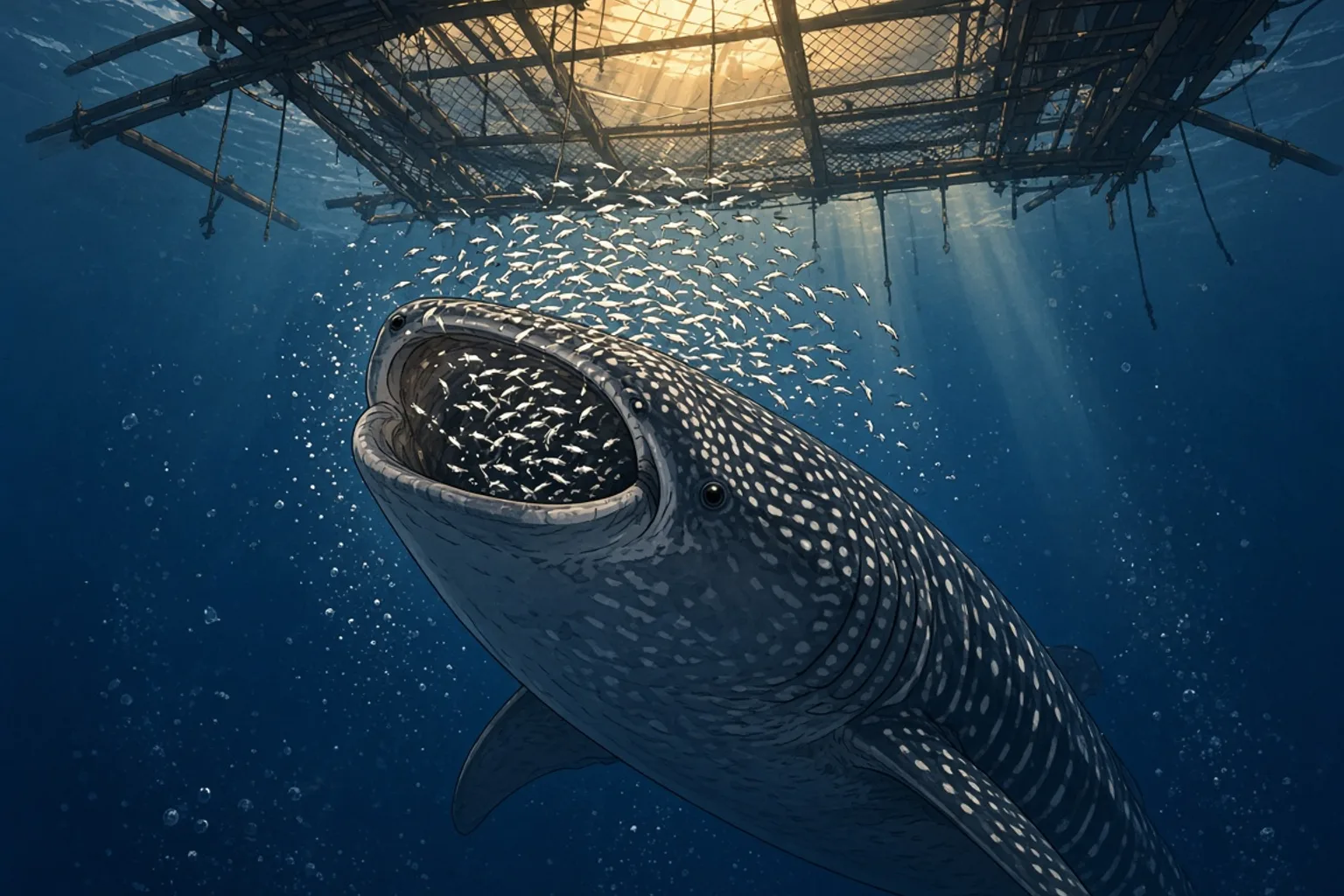
There are four places in Indonesia where whale shark encounters are reliable enough to plan a trip around, and all four work the same way: the sharks come to traditional lift-net fishing platforms called bagans to hoover up the baitfish that spill out when the nets come up. No bagans, no encounter. That single fact explains the geography, the 4am starts and most of the ethical complications further down this article.
| Site | Reliability | Getting there | Realistic budget |
|---|---|---|---|
| Saleh Bay, Sumbawa | Year round, peaks Aug to Sep | Usually a liveaboard leg on the Lombok to Komodo route. Overland from Lombok or fly to Sumbawa Besar if going independently | USD 1,700 to 4,500 as part of a liveaboard, or from IDR 650,000 overland |
| Cenderawasih Bay, West Papua | Year round, the world's only resident population | Liveaboard only from Manokwari, Nabire or Biak | USD 4,000 to 8,000 for the trip |
| Triton Bay and Kaimana, West Papua | Good, usually part of a longer route | Liveaboard, often combined with Raja Ampat | USD 3,000 plus |
| Gorontalo and Derawan | Variable, and tourism management is patchy | Domestic flights plus local boat | Low, but quality varies wildly |
For most people reading this the choice collapses to the first two. Gorontalo and the Derawan Islands both have whale sharks and both have been flagged by Indonesian researchers for tourists touching the animals and for operators ignoring group-size limits, so we are not going to recommend them until that changes. Triton Bay is genuinely wonderful and genuinely expensive, and it makes most sense as a leg on a longer eastern Indonesia route rather than a destination in its own right. If that is the kind of trip you are weighing up, our comparison of Komodo against Raja Ampat and the Banda Sea lays out what each route actually delivers, and the Indonesia liveaboard routes we run show which of those corridors we can actually put you on.
Saleh Bay, Sumbawa: The One You Can Actually Reach
Saleh Bay is the answer for about ninety percent of people who ask us this question. It is a 1,459 square kilometre bay sheltered behind the bulk of Sumbawa, it has been a designated marine conservation area since the whale sharks were properly surveyed, and Konservasi Indonesia documented 108 individual animals there between 2017 and 2022. That makes it the second-largest known aggregation in the country. Most of the sharks are juveniles, mostly male, averaging around six metres, which has led researchers to treat the bay as a nursery rather than a stopover.
Getting There: Boat or Overland
Most divers who see Saleh Bay arrive on a boat, not in a car. The bay sits directly on the sailing corridor between Lombok and Labuan Bajo, so liveaboards crossing to Komodo can drop anchor overnight and put you in the water at the bagans at first light without anyone having to drive anywhere. That is the normal way this gets done, it is comfortable, and it is why the whale sharks turn up on Komodo itineraries at all. Ask specifically whether Saleh Bay is on the route, because it is an optional leg rather than a standard one, and some boats sail straight past it.
The overland alternative exists and it is genuinely cheap, but there is no comfortable way to do it. You can fly into Sultan Muhammad Kaharuddin III airport at Sumbawa Besar, which has domestic connections from Denpasar and Lombok, then drive about three hours east to the fishing village of Labuan Jambu. Or you go the whole way from Lombok: two hours on the ferry from Kayangan to Poto Tano, then roughly five hours of road. Most Lombok packages leave around 9am and get you into the village at ten at night.
If you are going overland, plan to sleep in the village. People do attempt it as a single punishing day trip from Sumbawa Besar with a 2am pickup, and they arrive at the bagan wrecked. A homestay in Labuan Jambu runs about IDR 350,000 and meals at the warungs are IDR 20,000 or so, which is not the part of the budget worth optimising. If you are flying between islands to string this together with diving elsewhere, remember the surface interval rules still apply, and our note on flying after diving explains how much slack to leave.
What the Morning Actually Looks Like
You wake at four. You get into a begoq, the local motorised outrigger, in the dark, and you spend up to two hours crossing the bay to wherever the bagans are working that night. Nobody knows in advance which platform has sharks under it, so the boat crew ask around on the radio and you go where the answer is. Somewhere around half past five you tie up alongside a wooden platform with a handful of fishermen on it, and then you wait while they haul the net.
That is the moment. As the net lifts, baitfish spill, and if there are whale sharks in the area they come up. They feed vertically, hanging nose-up at the surface with the mouth open, which is not the horizontal cruise most people picture and is far more extraordinary in person. You slide in off the boat. You do not jump. Two hours later you are heading back, and you are in the village by ten in the morning with the whole day still in front of you.
We will be straight about the failure rate. Sightings are described as near-guaranteed by every operator selling the trip, and in peak season that is close to true, but this is a wild animal at a working fishing platform and there are mornings when nothing comes up. Budget for the possibility. If you have travelled two days for one shot at it, you have designed the trip badly.

What It Costs
The honest answer splits in two, and the gap between the halves is enormous. If you get there by liveaboard, which is how most divers do, the whale sharks are not a separately priced item at all. They are a morning inside a trip. Berths on the Lombok to Komodo corridor run roughly USD 280 to 450 a night for a decent boat with a proper cruise director, so a six to ten night crossing that includes Saleh Bay lands somewhere between USD 1,700 and 4,500 per person before international flights, park fees and Nitrox. Dedicated east Sumbawa expedition routes are longer still, ten nights minimum because of the sailing distances involved, and those push past USD 4,000 comfortably.
Doing it independently from the village is an order of magnitude cheaper and a great deal more effort. A shared open trip out to the bagans from Labuan Jambu is around IDR 650,000 per person. A private boat split ten ways works out near IDR 540,000 each, but that curve is steep in the wrong direction: two people pay about IDR 1,900,000 each and a solo traveller is looking at IDR 3,640,000. Whale sharks are a group activity whether you like it or not. A two-day, one-night package from Lombok covering transport, ferry, hotel, boat, gear and fees sits around IDR 2,390,000 per person, or roughly USD 295 to 320 a head for private versions in groups of four or five.
Arranged completely independently, the component costs are the begoq at IDR 800,000 to 1,000,000 for up to ten people, a bagan owner and crew fee of IDR 1,500,000 per platform, IDR 50,000 conservation fee, IDR 50,000 village entrance fee and about IDR 500,000 for a local guide. Pay the conservation and village fees whichever way you arrive. They are the mechanism by which the community has a reason to keep the sharks alive.
Cenderawasih Bay: The Only Resident Population on Earth
Cenderawasih is the one serious divers talk about, and the superlative attached to it is real rather than marketing. Every other whale shark aggregation on the planet is seasonal. Ningaloo, the Maldives, Donsol, the Galapagos: the animals arrive, they feed, they leave. In Cenderawasih Bay roughly 160 documented whale sharks simply live there, year round, because the bagans operate year round and the food never stops. Satellite tagging by Konservasi Indonesia and the Elasmobranch Institute Indonesia, published in 2026, confirmed what operators had been claiming for over a decade.
It is Indonesia's largest marine park at 14,535 square kilometres, it has Japanese wartime wrecks including the 120 metre Shinwa Maru, and there is almost no current anywhere in it. Water sits at 27 to 30 degrees and visibility typically runs 15 to 30 metres. Up to ten or fifteen sharks can gather at a single platform. In April 2026 TIME listed the bay among the world's greatest places specifically for the prospect of being surrounded by several whale sharks at once, which is not a thing that happens anywhere else.
Now the cost of admission. There is no land-based option worth considering and no short itinerary: the nearest ports are far enough away that ten nights is the practical minimum and twelve to fourteen is better. You fly to Manokwari, Nabire or Biak, which from Bali means at least one and usually two domestic connections. Boats run USD 400 to 600 a day depending on the vessel, so a realistic all-in figure is USD 5,000 to 8,000 before international flights. Book six to twelve months out for the July to October window, when the seas are calmest and the flight connections are most reliable.
Whether that is worth it depends entirely on what you want. For a diver with two weeks and a serious budget who has already done the obvious Indonesian routes, it is arguably the single best wildlife encounter in the country. For someone with ten days and a first trip to Indonesia in front of them, we would honestly push you towards diving in Komodo or a Raja Ampat liveaboard and leave Cenderawasih for the trip after. Both deliver more diving per day for less money and less flying.
When Is Whale Shark Season in Indonesia?
There is no single Indonesian whale shark season, which is a useful thing to know because a lot of published advice treats the country as one place. It is not. The two main sites are both year-round sites, and what changes month to month is the sea state getting you there rather than the presence of the animals.
At Saleh Bay, whale sharks are present all year with sightings peaking in August and September. The practical window is April to November, because December to March brings rain and rough water that makes the crossing unpleasant and the visibility poor. July and August are the busiest months by a distance, and busy at a bagan means five or six boats clustered around one platform. May, June, September and October give you the same animals with a fraction of the crowd, and those are the months we would pick.
At Cenderawasih Bay the sharks never leave, so the calendar is purely about comfort. June to October is the window, with July to September the sweet spot for calm seas and clear water. November to April the diving inside the bay stays calm but the open-water transit to reach it gets rough. If you are combining Cenderawasih with Raja Ampat on a crossing itinerary, October to November and March to April line both destinations up.
One planning note that catches people out. The Saleh Bay season overlaps almost exactly with the Komodo diving season of April to November, which is why combining the two makes sense, but it runs opposite to Raja Ampat's October to April peak. You cannot have everything in one trip, and anyone telling you otherwise is selling something.
Are Whale Sharks Dangerous?
No. Whale sharks are filter feeders with no interest in you whatsoever, and there is no record of one deliberately harming a person. They are the largest fish in the ocean, they can exceed twelve metres, and they eat plankton, small baitfish and shrimp by straining water through gill rakers. The teeth are vestigial, a few thousand of them, each a couple of millimetres long and useless for anything.
The risks in the water are all mechanical and all avoidable. A six-metre animal turning suddenly can catch you with a pectoral fin or a tail, which will not injure you badly but will knock the wind out of you and can push you into the platform. Stay off the tail. The greater hazard at a bagan is the human infrastructure: outriggers, net frames, mooring lines, propellers and five other snorkelers all trying to get the same photograph. We treat whale shark briefings the same way we brief guests before Manta Point in Komodo, which is to say the animal is the least of your problems. The same logic applies to whether manta rays are dangerous, and the answer there is the same as here.
It is also worth saying plainly, since people conflate the two: this is a shark in name and taxonomy only. If the word is what worries you, our guide to sharks in Bali works through what is actually in the water in Indonesia and how little of it cares about humans.
The Bagan Problem: Why These Encounters Are Complicated
We said we would be honest about this, so here it is: whale shark tourism in Indonesia is built on a food source that humans provide, and the animals are getting hurt. A study led by Dr Edy Setyawan at the Elasmobranch Institute Indonesia, published in 2025, examined 268 individual whale sharks across Cenderawasih Bay and Kaimana. Of the 206 carrying injuries or scarring, 80.6 percent had damage attributable to human causes. Most of it was non-life-threatening abrasion from the sharks rubbing against bagans and tour boats. Serious lacerations, amputations and blunt trauma showed up in 17.7 percent of animals.
The underlying issue is that the encounter and the harm come from the same place. Sharks are drawn to the platforms by escaping baitfish, they press against the nets, they take fish directly out of them and sometimes damage them doing it, and the tour boats add propellers to the mix. Some operators go further and deliberately hand-feed to hold the animals in place, which is prohibited under the national code of conduct and which researchers believe conditions behaviour in ways nobody has measured the long-term consequences of.
None of that means don't go. Whale sharks have been fully protected in Indonesia since ministerial decree 18 of 2013, and the protection exists in large part because the sharks became worth more alive to fishing villages than they had ever been otherwise. Saleh Bay was declared a conservation area on the strength of them. The conservation fee you pay is not a token. What it does mean is that your choice of operator matters more here than it does almost anywhere else, and that the researchers' own proposed fix, which is modifying bagan outriggers and net frames to remove sharp edges, is something worth asking a prospective operator whether they have pushed for.
Our position, for what it is worth as a dive operator rather than a scientist: go, pay the fees, pick carefully, follow the rules exactly, and refuse point blank to get on a boat that feeds. We take the same line on the dolphin boats at Lovina in north Bali, where the animals are wild and the boats are the problem.
How to Behave Around a Whale Shark
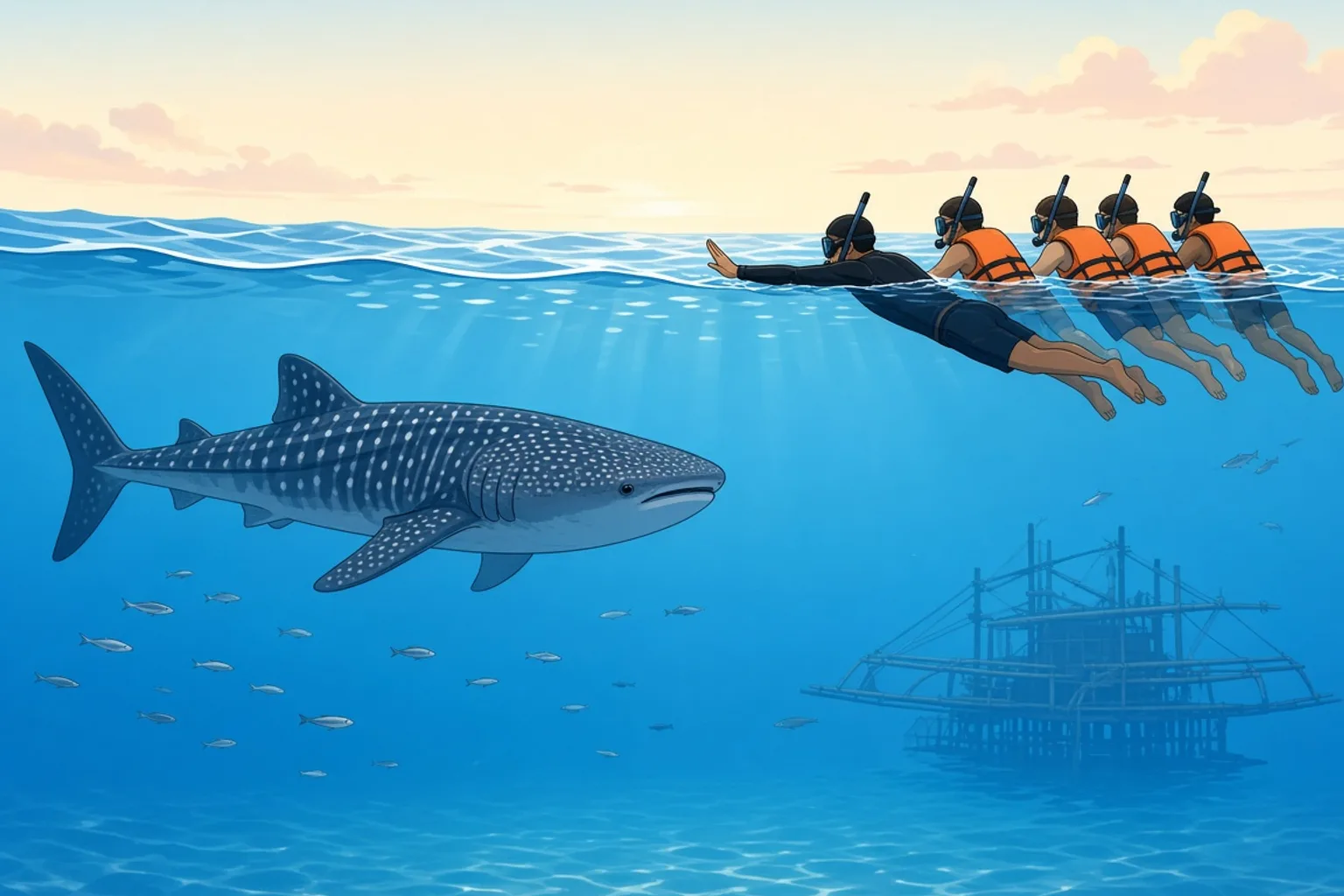
Indonesia has a written code of conduct for whale shark interaction, and the rules are specific enough to check an operator against before you pay them. Learn them before you arrive rather than in a rushed briefing on a dark boat.
- Keep your distance. The national minimum is three metres. West Nusa Tenggara sets a stricter five to ten metres at Saleh Bay, specifically so that bagang boats and propellers cannot make contact. Use the stricter number.
- Never touch, ride or chase. This should not need saying and it does. Researchers observing at Derawan recorded snorkelers touching sharks routinely.
- Six in the water at once, fifteen minutes. Maximum four boats at one platform, and no more than forty snorkelers per bagan per day. If your boat is the fifth, it should wait.
- Engine off. Boats do two knots inside fifty metres of a platform with sharks and ten knots inside a kilometre, then cut the engine.
- No flash, no strobes. This applies to the compacts as much as the housed systems. You will be shooting large animals in available light, near the surface, which is the easiest lighting you will ever get anyway.
- Slide in, do not jump. The guide enters first and leads, everyone follows calmly, and the guide is the last person out of the water.
- No feeding, no loud noise, no sudden movements, no rubbish over the side.
Enforcement is uneven and you should assume responsibility for your own behaviour rather than expecting the boat to police it. The most common failure we hear about is distance, because a whale shark that approaches you is thrilling and the instinct is to reach. Hold position and let it pass. You will get a better photograph anyway.
Snorkeling or Diving? What You Actually Need
Snorkeling, in almost every case, and you do not need a certification for any of it. The whole encounter happens in the first few metres of water because that is where the net is and that is where the baitfish are. Scuba gear puts bubbles under an animal that is trying to feed and buys you nothing, which is why most bagan operators do not offer it and some prohibit it outright. On liveaboard itineraries at Cenderawasih you will dive, but the good whale shark time is still shallow.
What you actually need is modest. A mask that fits, because two hours of leaking in the dark is miserable. A rash guard or thin wetsuit, less for warmth in 28 degree water than for sun once it comes up. A life vest, which most operators insist on and which is genuinely useful when you are hanging at the surface for long periods trying to stay still. Fins are optional at a bagan and occasionally a liability in a crowded space. If you are weighing up the two ways of seeing big animals in general, snorkeling against diving goes through the trade-offs.
If you are not a confident swimmer, say so. Floating in open water at dawn beside a working fishing platform with a six-metre animal underneath you is not the place to discover you are uncomfortable. Get some hours in first. A couple of easy snorkeling trips in Bali will tell you honestly whether you are comfortable in open water, and the drift at Nusa Penida is a fair approximation of hanging in current beside a boat.
How We Would Build the Trip
The version that works best for most of our guests treats whale sharks as one chapter of an eastern Indonesia trip rather than the whole book, because the travel time is punishing if it is all you do. Two shapes work.
The first is Bali, Lombok, Sumbawa, Komodo, running west to east across roughly two weeks in the April to November window. You dive Bali at the start while you get your ears and your buoyancy back, then join the boat. The cleanest version has you board on the Lombok side and sail east, with Saleh Bay as an overnight stop before the boat carries on to Labuan Bajo for the Komodo leg on King Neptune or Komodo Sea Dragon. That removes the overland misery entirely, and it is the reason we push people towards the crossing itineraries rather than flying straight into Labuan Bajo. If the dates do not line up with a boat that stops there, the overland detour from Lombok is the fallback, and it costs a fraction of the fare but two days of your holiday.
The second is the Papua version, which is a different budget and a different kind of holiday: ten to fourteen nights on a boat in Cenderawasih, possibly crossing to Raja Ampat, booked most of a year in advance. That one is for divers who have already done Komodo and want the thing almost nobody has done. If you want a feel for what an expedition-length eastern Indonesian route is actually like day to day, our Banda Sea itineraries run on a similar rhythm, and Neptune One is the boat we would put you on for the longer crossings.
A practical warning about the middle of that itinerary. Sumbawa is rural, the food is excellent and the plumbing is not always, and a rough stomach two days before a liveaboard is a genuinely expensive problem. Read our guide to Bali belly before you go and carry oral rehydration salts. If your route involves a domestic flight out of Sumbawa Besar or Labuan Bajo shortly after diving, check how long to wait before flying, because those connections are tighter than people expect.
The short answer to the question people actually came here with: Indonesia is the best country in the world for whale sharks, Bali is the wrong part of it, and Saleh Bay is two days of awkward travel away from most Bali itineraries. We would rather tell you that than sell you a Nusa Penida day on a maybe. If you want help slotting it into a wider trip, talk to us about diving Komodo and we will work backwards from your dates. For the Bali end of things, diving in Bali stands up perfectly well on its own, whale sharks or not.
Whale sharks are listed as endangered on the IUCN Red List, and the scarring research referenced above is summarised by the Elasmobranch Institute Indonesia's 2025 study. WWF Indonesia publishes the operational code of conduct that good operators work to.