
We get this question at the shop most weeks, usually from someone standing at our Sanur counter with a logbook in one hand and a phone showing photos of limestone islands in the other. They have just finished two days of Bali dive trips with us, they loved it, and now they want to know whether they should be saving for Raja Ampat instead. So let us settle the Bali vs Raja Ampat diving debate properly, with real numbers rather than travel-brochure adjectives.
Here is our position up front, and it will probably surprise you coming from a dive shop that sells both. Most divers asking the question are not ready for Raja Ampat yet, and going too early is the most expensive mistake in recreational diving. We sell Raja Ampat liveaboard trips, and we still turn people away from them. Not because the diving is beyond them in some mystical sense, but because a diver with 20 logged dives spends 6,000 US dollars to be nervous in a current, and comes home having seen less than a relaxed diver with 60 dives sees in a week.
That said, Raja Ampat is genuinely the richest reef on the planet. The comparison is not close on biodiversity. What is close, and what nobody writes about honestly, is the question of which one is the right trip for you this year. Those are different questions and this guide answers the second one.

Bali and Raja Ampat are only two of Indonesia's dive regions. The diving in Indonesia guide sets them alongside Komodo, the Banda Sea, Lembeh and Wakatobi, with a season table, typical costs and how to travel between them.
The short answer, in one paragraph each
Book Bali if you have fewer than about 40 logged dives, if you have 10 days or less, if your budget for the whole trip is under 3,000 US dollars, or if someone in your party does not dive. Bali gives you black sand volcanic slopes, a 120 metre shipwreck you can reach from the beach, reef mantas on a reliable cleaning station, and the strangest big fish in the ocean for four months of the year. You can certify here from zero and be diving real reefs inside a week.
Book Raja Ampat if you have 40 or more dives, at least 14 days of leave, and 6,000 US dollars or more that you are comfortable spending on diving alone. You get reef density that has no equal anywhere, a fish count record that has stood since 2012, sharks that walk on their fins, and karst scenery topside that people photograph more than the reef. You also get four flights, a time zone change, and a trip where diving is the only thing on the schedule.
If you are somewhere in the middle, keep reading, because the middle is where the interesting decisions live. And if Komodo is also on your list, our Komodo versus Bali comparison covers that pairing, while the three-way liveaboard comparison handles Komodo against Raja Ampat against the Banda Sea.
Bali vs Raja Ampat diving: the differences that decide it
Seven things actually change the answer. Everything else is detail.
| Factor | Bali | Raja Ampat |
|---|---|---|
| Getting there | Direct international flights to Denpasar | No international flights, 2 to 3 legs via Makassar or Jakarta to Sorong |
| Trip shape | Day trips from a hotel base in Sanur | Liveaboard, 7 to 11 nights, no realistic day-trip option |
| Minimum sensible trip | 4 days | 14 days including travel |
| Experience needed | Open Water works at most sites | Advanced plus roughly 40 dives to enjoy it |
| Cost for the diving | IDR 2,700,000 to 4,500,000 per day of diving | 380 to 700 US dollars per night, all in |
| Biodiversity | Excellent by world standards | Highest ever measured, roughly 1,700 fish species |
| Non-divers in the party | Easy, Bali entertains them for a month | Difficult, the boat schedule is built around diving |
Notice that only one row favours Raja Ampat outright. That row happens to be the one divers care about most, which is exactly why the decision is hard. Biodiversity is not a tiebreaker you can dismiss, but it is also not the only thing that determines whether a trip was worth the money.
What Bali actually delivers underwater
Bali is four quite different diving regions inside a two hour drive of each other, and that variety is the thing people underrate. In one week you can dive a wreck, a wall, a muck slope and a high-current channel without changing hotel.
Tulamben holds the USAT Liberty, a 120 metre American army cargo ship torpedoed in 1942 and pushed into the sea by the 1963 eruption of Mount Agung. It sits between 5 and 30 metres, 30 metres off a black pebble beach, and you walk to it. No boat. We have guests who dive it four times in two days and find something new each time, which is why we wrote a full guide to the Liberty. Water there runs 27 to 29 degrees most of the year.
Nusa Penida is the serious diving, 30 to 45 minutes by fast boat from our Sanur beach. Manta Point is a reef manta cleaning station on the exposed south coast where we see animals on roughly 9 out of 10 trips across the year. Wingspans of 3 to 4 metres are normal. Crystal Bay is where the mola mola shows up between July and October, a fish that can reach 3 metres tall and looks like something that was drawn wrong on purpose. Our mola mola season guide has the month-by-month odds. Be warned, that fish arrives on cold water, and thermoclines at Crystal Bay drop to 20 degrees, occasionally 18.
Amed and Padang Bai are the gentle end, and the muck diving around Amed produces frogfish, ghost pipefish and enough nudibranchs to fill a memory card. Gili Mimpang and Tepekong off Padang Bai deliver Bali's punchiest currents and the occasional reef shark. Up in the northwest, Menjangan has the walls, dropping past 40 metres with visibility that regularly beats everywhere else on the island.
What Bali does not have is density. The reefs are healthy and the fish are there, but you do not get that Raja Ampat sensation of not being able to see the coral for the fish. It is very good diving. It is not the best diving on earth, and we tell people so.
What Raja Ampat actually delivers underwater
The numbers do the arguing here. Raja Ampat holds roughly 1,700 fish species and more than 600 coral species inside one archipelago, which is more coral species than the entire Caribbean. In 2012 a survey dive at Cape Kri in the Dampier Strait counted 374 fish species on a single dive, a world record that still stands. You feel that number in the water. The reef is not decorated with fish, it is upholstered in them.
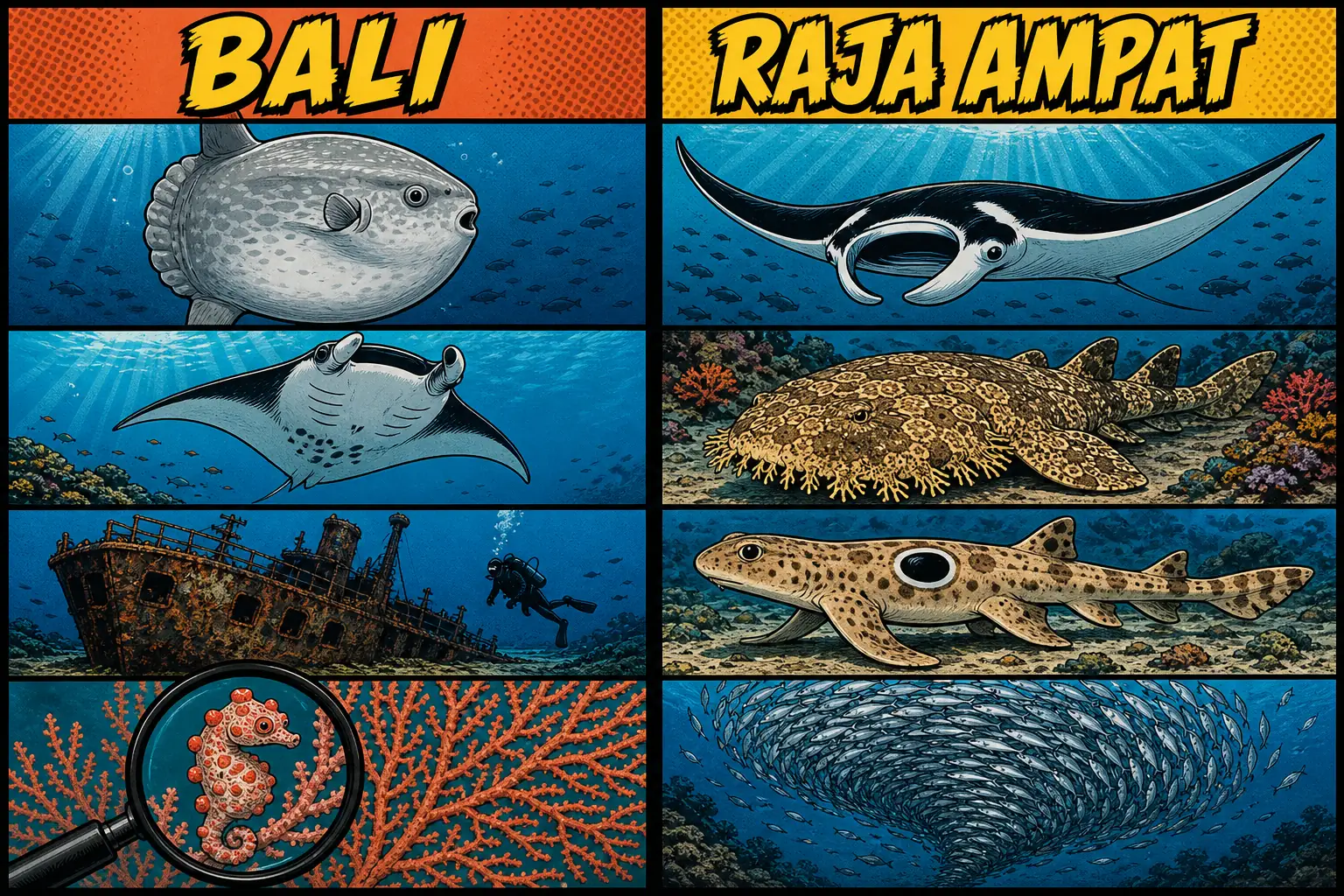
The signature animals are different from Bali's, not just more numerous. Tasselled wobbegongs are flat carpet sharks with a fringe of fleshy lobes around the head, and they lie under coral ledges looking exactly like coral ledges. Epaulette sharks, the ones everyone calls walking sharks, prop themselves on their pectoral fins and stroll across the rubble on night dives. Three species of pygmy seahorse live there, and Misool in the south is one of the few places on earth where you can find all three on the same trip. Oceanic mantas, the bigger cousins of the animals we see at Penida, patrol the cleaning station at Magic Mountain between November and April.
Geographically it splits into three. The Dampier Strait in the centre holds the famous fish-soup sites, Cape Kri, Blue Magic, Sardine Reef, Mike's Point and Manta Sandy. Misool in the south has the soft coral, and it is a genuinely different kind of beauty, walls upholstered in orange and pink with almost no other divers. The north around Wayag and Aljui Bay is the remote end, with the postcard karst lagoons. Reaching all three in one trip is the whole reason liveaboards exist there. Sorong to Misool is up to 16 hours of sailing, which no day boat is going to do.
Water sits at 27 to 29 degrees, warmer and more consistent than Penida. Visibility runs 20 to 30 metres in season. Our destination guide to Indonesia liveaboard diving covers how the regions link up across a season.
Getting there: one flight against three
This is the part that decides more trips than the diving does, and the part travel articles skate over.
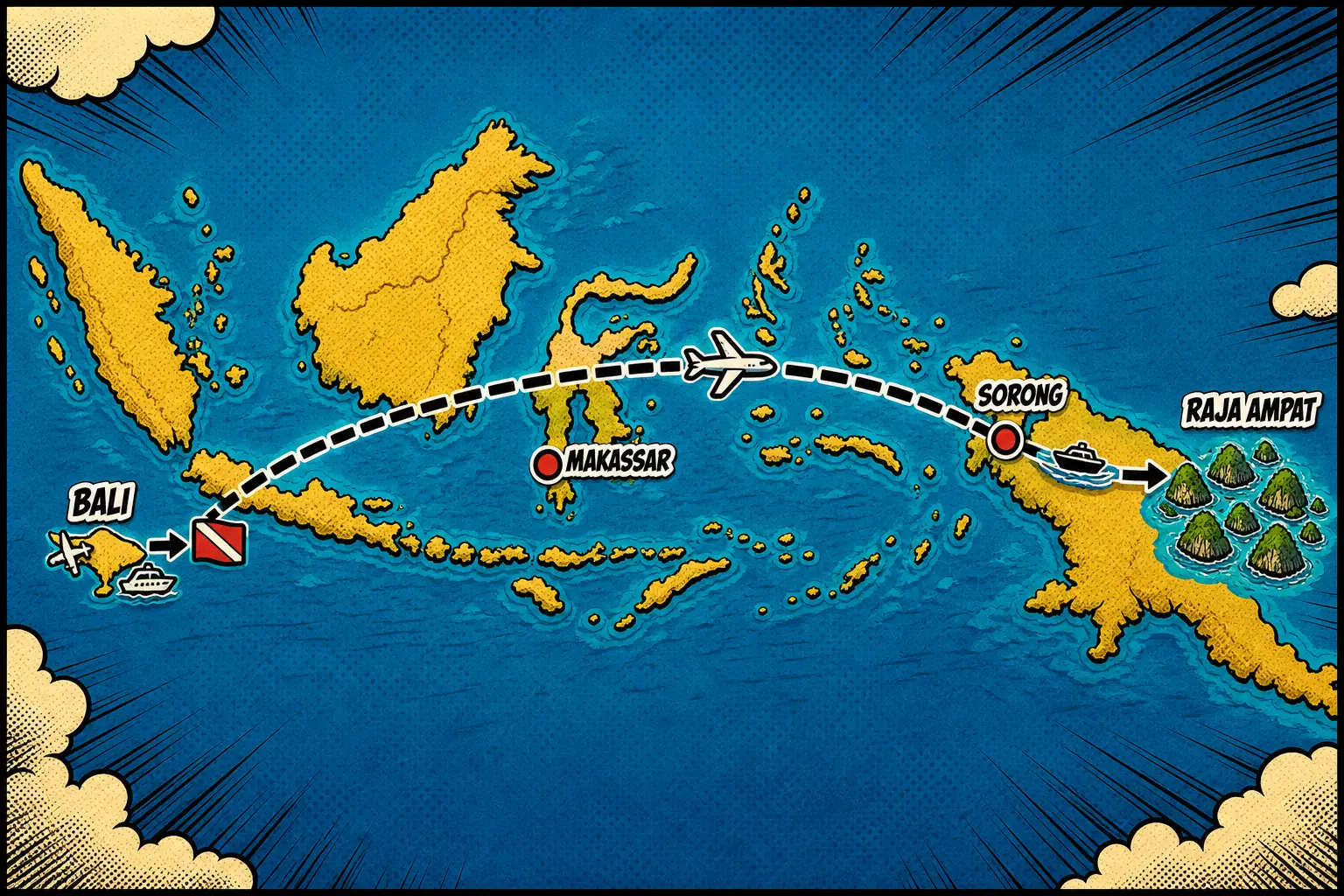
Bali you already understand. You fly into Denpasar from almost anywhere, we collect you in Sanur, and you are underwater the next morning. Pickups run between 06:30 and 07:15 depending on where you are staying and which site you are diving. That is the whole logistical story.
Raja Ampat is a different category of journey. The gateway is Sorong in West Papua, airport code SOQ, and despite being designated an international airport in 2025 it has no international routes, so every traveller connects through an Indonesian hub first. From Bali you route through Makassar in South Sulawesi, or through Jakarta, and the fastest published connection is around 6 hours 45 minutes of travel time. Garuda has run a seasonal direct Denpasar to Sorong service, roughly 3 hours 10 minutes, but the frequency changes between seasons and we would not build a non-refundable itinerary around it without confirming the current schedule.
Then there are the details that catch people. Sorong runs on Indonesia Eastern Time, one hour ahead of Bali. Domestic baggage allowances on the Sorong legs are tighter than international ones, which matters when you are carrying regulators and a camera housing. Indonesian domestic airlines reschedule, so we tell every guest to arrive in Sorong a full day before the boat sails rather than connecting on the morning of departure. We have seen too many people miss a 6,000 dollar trip to save one hotel night.
Liveaboard guests board in Sorong harbour and never touch the Waisai ferry, which is the route land-based visitors take. That is worth knowing, because a lot of Raja Ampat travel writing is about the ferry and it simply does not apply to a boat trip.
What each trip costs in 2026
Real numbers from our own price list, not estimates. Bali first.
| Bali, 2026 | Price |
|---|---|
| Two-dive day, Tulamben, Amed or Padang Bai | IDR 2,700,000 (about 150 USD) |
| Two-dive day, Nusa Penida | IDR 3,150,000 (about 175 USD) |
| Two-dive day, Menjangan | IDR 4,500,000 (about 250 USD) |
| Open Water course, 3 to 4 days | IDR 9,540,000 (about 530 USD) |
| Advanced Open Water course | IDR 8,100,000 (about 450 USD) |
| Enriched Air Nitrox specialty | IDR 3,060,000 (about 170 USD) |
A realistic Bali dive week, six days of diving with a mix of sites, lands between 900 and 1,200 US dollars including transport, guide, tanks and weights. Add flights and a Sanur hotel and most guests do the whole trip for 2,000 to 2,800 US dollars. Our full Bali diving price list and the cost breakdown article have every line item.
Raja Ampat works differently because you are buying a boat, not a day. Quality vessels run 380 to 700 US dollars per night in 2026. Our King Neptune, a 46 metre boat built in 2025 carrying 20 guests across 10 cabins, sits in the 420 to 520 range depending on cabin. Neptune One is the smaller option at 39 metres and 16 guests.
| Raja Ampat, 10 nights | Cost per diver |
|---|---|
| Boat, cabin and diving | 4,200 to 6,500 USD |
| Return flights from Bali via Makassar | 350 to 600 USD |
| Marine park permit, valid 12 months | IDR 700,000 (about 40 USD) |
| Visitor entry ticket, per visit | IDR 300,000 (about 17 USD) |
| Nitrox for the trip | Around 200 USD |
| Sorong hotel nights either side | 60 to 140 USD |
| Realistic all-in total | 5,500 to 8,500 USD |
Worth flagging the park fees, because the rules changed in 2025 and a lot of older articles still get this wrong. There are now two separate charges. The marine park permit is IDR 700,000 for international visitors and is valid for 12 months, so a second trip inside the year is covered. The visitor entry ticket is IDR 300,000 and is charged per visit. Together they come to IDR 1,000,000, which is where the frequently quoted figure comes from, but only 700,000 of it is annual. Children under 12 are exempt from the permit. Our boats handle both for you.
So the honest ratio: a Raja Ampat trip costs roughly three times a Bali trip. Not 30 per cent more. Three times.
What a diving day actually feels like on each
Cost tables tell you what you pay. They do not tell you what you are buying, and the daily rhythm of these two trips could hardly be less alike.
A Bali day with us starts with a pickup between 06:30 and 07:15, depending on your hotel and where you are diving. If it is Padang Bai, that is about an hour and a quarter in the car. Tulamben is closer to two and a quarter, north along the coast road with Agung on your right, and yes, it is an early start, and yes, people grumble about it until the first dive. Two dives with a surface interval, lunch included, and we usually have you back in Sanur between 16:00 and 17:30. Penida days are different again: down to our beach for around 08:00, 30 to 45 minutes across the channel in the fast boat, two dives, and back by early afternoon. Either way your evening is yours. Guests go for a massage, walk the Sanur boardwalk, eat somewhere with a tablecloth. Diving is the main event of the day but it is not the whole day.
A Raja Ampat day is a different proposition entirely. You are woken around 05:45. Briefing, then the first dive goes in at about 06:15, before breakfast, because that is when the fish behave best. Breakfast after. Second dive mid-morning, lunch, third dive early afternoon, then a sunset or night dive if the site suits it. Dinner around 19:30 and most of the boat is asleep by 21:30 because you are doing it again in eight hours. Four dives a day for ten days is 35 to 40 dives in a single trip, which is more than many of our Bali guests log in three years.
The things nobody mentions about that rhythm: there is no shore. You are with the same 16 to 20 people for the whole trip, phone signal comes and goes and mostly goes, and there is no evening off because there is nowhere to have it. For committed divers that is not a drawback, it is the entire appeal. Nothing competes with the diving. But if your partner does not dive, or if you personally need a day off in the middle of a week, understand that a liveaboard does not offer either. Bali is a holiday with diving in it. Raja Ampat is diving with sleep in it.
The dive count question, answered honestly
Our boats carry a formal minimum of Advanced Open Water plus 25 logged dives for Raja Ampat. Our own destination guide recommends 40 to 50. Those two numbers disagree and we should explain why rather than pretend they do not.
Twenty-five dives is the number at which we are confident you are safe. Forty is the number at which we are confident you will enjoy it. The gap between those is where the money gets wasted. Raja Ampat diving involves negative entries into moving water, drift diving along walls where the guide sets the pace, and reef hooks at a couple of sites. None of that is hard once your buoyancy is automatic and your air consumption is settled. All of it is stressful when you are still thinking about your buoyancy.
Here is the part where we argue against our own liveaboard sales. If you have 20 dives and 6,000 dollars, we would rather sell you a Bali week with an Advanced Open Water course and a Nitrox certification, then have you come back for Raja Ampat next year with 55 dives and money still in the bank. You will see more, breathe less, and remember the trip differently. Nusa Penida is genuinely good preparation, because if you can handle a drift along the Penida wall in a running current you can handle the Dampier Strait. A Drift Diver specialty is not a bad investment either.
If you have never dived at all, none of this applies yet. Start with a try dive or go straight into the Open Water course here, and treat Raja Ampat as a two-years-away goal. Nitrox is close to essential on a liveaboard doing four dives a day, and we cover why in our Nitrox guide.
Seasons: the two are almost opposites
This is the fact that reshapes itineraries, and most people learn it too late. Western Indonesia and West Papua run on different weather.
| Months | Bali | Raja Ampat |
|---|---|---|
| December to February | Rainy season, diveable, visibility variable | Peak season, calmest water, best visibility |
| March to April | Good, improving visibility | Good, season winding down through April |
| May to June | Very good | Southeast trades build, most boats leave |
| July to October | Best of the year, mola mola season | Low season, Misool largely unreachable |
| November | Good | Season opens, boats reposition in |
Raja Ampat's window runs roughly October to April, with November to March the reliable core and December to February the technical sweet spot for flat water and visibility. Bali's best months are July to October, which is precisely when Raja Ampat is at its worst. Combining both properly in one trip means going in the shoulder, and even then you are compromising on one of them.
Two honest admissions while we are here. We will tell you not to book Raja Ampat in July or August, no matter how well the dates suit your work calendar, because the southeast trades make the Misool crossings genuinely unpleasant and you will have paid premium money for a compromised itinerary. And on the Bali side, we cancel Nusa Penida trips a handful of days each year when the swell on the south coast gets up, and when that happens we move you to Tulamben rather than push a boat into conditions we do not like. Our Bali against the Gili Islands comparison goes deeper on Bali's seasonal detail.
Who should book which
Strip out the romance and the decision comes down to four inputs: your dive count, your budget, your days available, and whether anyone travelling with you stays dry.
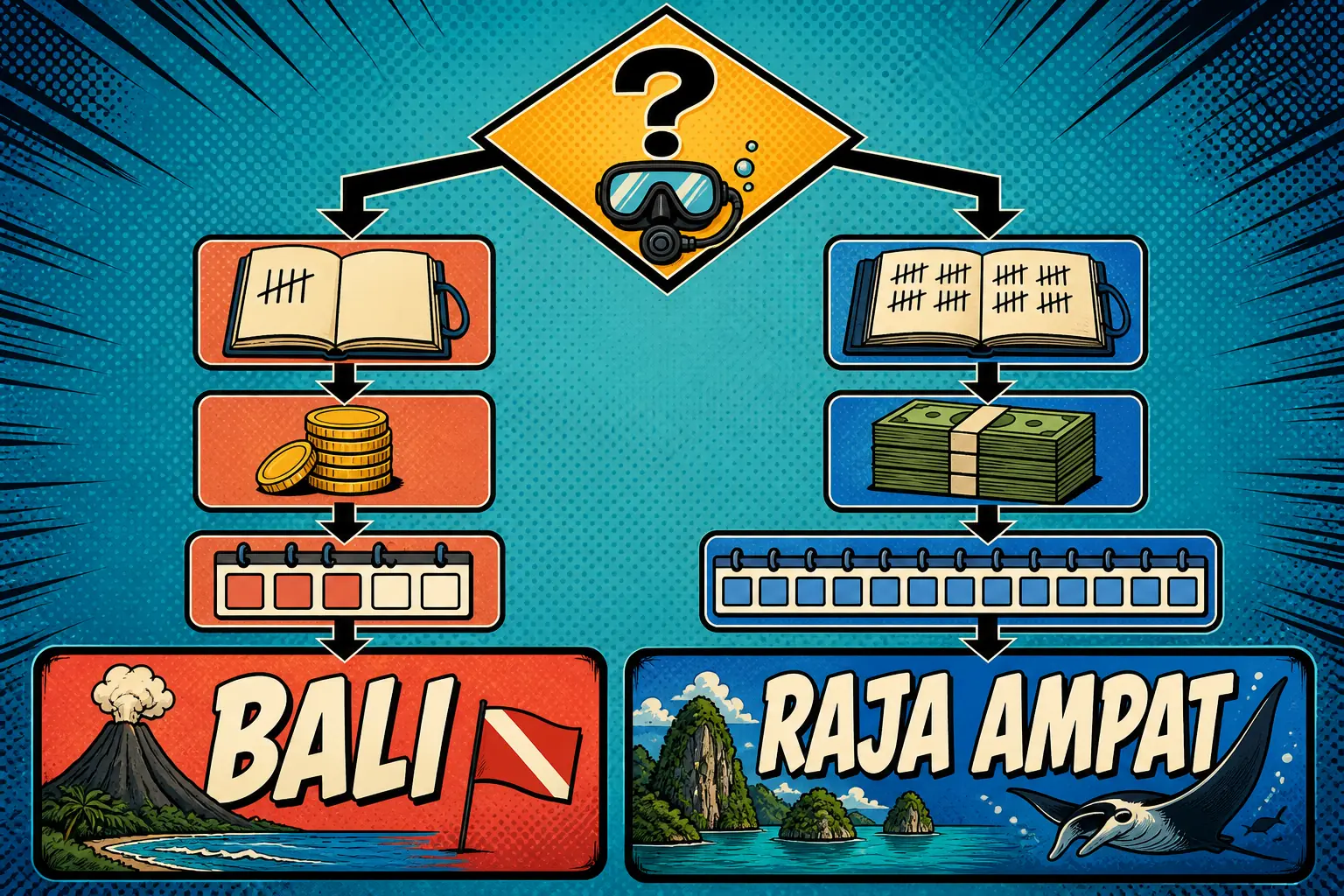
Book Bali if any of these is true. You have fewer than 40 logged dives. You have 10 days or fewer, including flights. Your total dive budget is under 3,000 US dollars. Someone in your group does not dive, or dives rarely. You want to certify or add a specialty on this trip. You want to see a mola mola, which Raja Ampat does not have. You want the option of a temple, a volcano hike or a beach day between dives.
Book Raja Ampat if all of these are true. You have 40 or more dives and your buoyancy is genuinely automatic. You can take 14 days. You have 6,000 US dollars or more for the trip. You are travelling alone or with other committed divers. Your dates fall between November and March. You want reef density above everything else, and you accept that the schedule is dive, eat, dive, eat, dive, sleep.
If you sit between the two, the tiebreaker is usually dates. If your leave falls in the northern summer, Bali wins on conditions and you should not fight it. If it falls in January, Raja Ampat is at its best and Bali is at its wettest, and that is the year to make the bigger trip happen.
The route most of our guests take
There is a well-worn path through this, and it has become the thing we recommend most often. Certify in Bali, build to 40 or 50 dives over one or two Bali trips, then do Raja Ampat as the trip you have been saving for. Repeat guests who follow that order come back saying the same thing: Raja Ampat was worth it, and it would not have been worth it three years earlier.
Komodo sits neatly in the middle of that path, which is why we suggest it so often. It is closer, cheaper, has strong currents that teach you something, and a 4 to 6 night trip fits a normal holiday. Our Komodo liveaboard trips are the standard stepping stone between a Bali day-trip habit and a Raja Ampat expedition. Plenty of guests do Bali, then Komodo, then Raja Ampat across four or five years, and that sequence gets the most diving out of the money.
One practical note for whichever you choose. Leave a proper surface interval before flying home. The last dive day should not be the day before a long-haul flight, and on a Raja Ampat itinerary that ends in Sorong you have a domestic leg to think about too. We explain the intervals in our guide to flying after scuba diving.
Booking either trip with us
We run both sides of this comparison, which is why we can afford to be blunt about them. If Bali is the answer, message us with your dates and your certification level and we will build the week around the sites that suit you, whether that is a gentle Amed and Tulamben pairing or a run at Penida in manta season. If Raja Ampat is the answer, tell us your dive count honestly and we will tell you whether we think you are ready, then look at cabin availability on our boats for the season that fits.
And if the honest answer is that Raja Ampat is two years away, say so and we will plan the Bali trip that gets you there in shape. That conversation costs nothing and it saves people thousands. Get in touch and we will tell you what we would do in your position.