
Barotrauma is the most common injury in recreational diving, and it accounts for more interrupted dive holidays than sharks, currents and decompression sickness combined. It rarely makes a dramatic story, which is part of why it is underestimated. We run Nusa Penida day trips most weeks of the year, and pressure injuries to the ears and sinuses are the most common reason a diver who arrived in good health pauses diving partway through a trip.
The word sounds clinical, so it is often assumed to be rare. The opposite is true. Barotrauma simply means physical damage caused by pressure changing the volume of air trapped inside your body, so if you have ever felt your ears ache on a descent, you have felt the beginning of the mechanism. Most cases are minor and heal on their own. A small proportion cause lasting damage, and one form is confused with decompression sickness often enough that the instinctive emergency response can be the wrong one. If you are booked on an Open Water course or diving in Bali for the first time, this is worth reading closely, because the early warning signs are felt by the diver long before anyone else can see them.

What follows is what happens physically, which body parts are at risk and in roughly what order, the conditions in Bali that raise the odds, and how to think about the rest of a booked trip if it does happen. We are a dive shop in Sanur rather than a medical authority, so where this crosses into medicine it points you toward the people qualified to examine you.
Barotrauma in one minute, and why it is not the bends
Your body is mostly water, and water does not squash. The air pockets inside you do. Descend ten metres and the pressure doubles, which means any sealed pocket of air tries to shrink to half its volume. Your middle ears, your sinuses, the space behind your mask, sometimes a gap under a filling, and of course your lungs. If air can flow in to replace the lost volume, nothing happens and you never think about it. If it cannot, something has to give, and the something is tissue.
That is the whole mechanism. Squeeze on the way down, expansion on the way up. Tissue gets stretched, blood vessels tear, fluid weeps into a space that should be full of air, and in the worst cases a membrane rips.
Here is the part that matters more than the physics. Barotrauma is not decompression sickness, and the two get mixed up constantly. Decompression sickness is dissolved nitrogen coming out of solution because you ascended faster than your tissues could offgas. It is a decompression problem, it shows up after the dive, and the treatment is recompression in a chamber. Barotrauma is a mechanical problem, it almost always announces itself during the dive, usually on descent, and recompression is not the answer. In one specific case it is actively harmful.
The single most useful thing to keep in your head is timing. Trouble that starts as you go down, in a joint-free part of the body like an ear or a sinus or a tooth, is a pressure injury. Trouble that starts twenty minutes to a few hours after you surface, in your shoulder, elbow, knee or skin, is far more likely to be decompression sickness. That distinction changes what you do next, and we come back to it below.
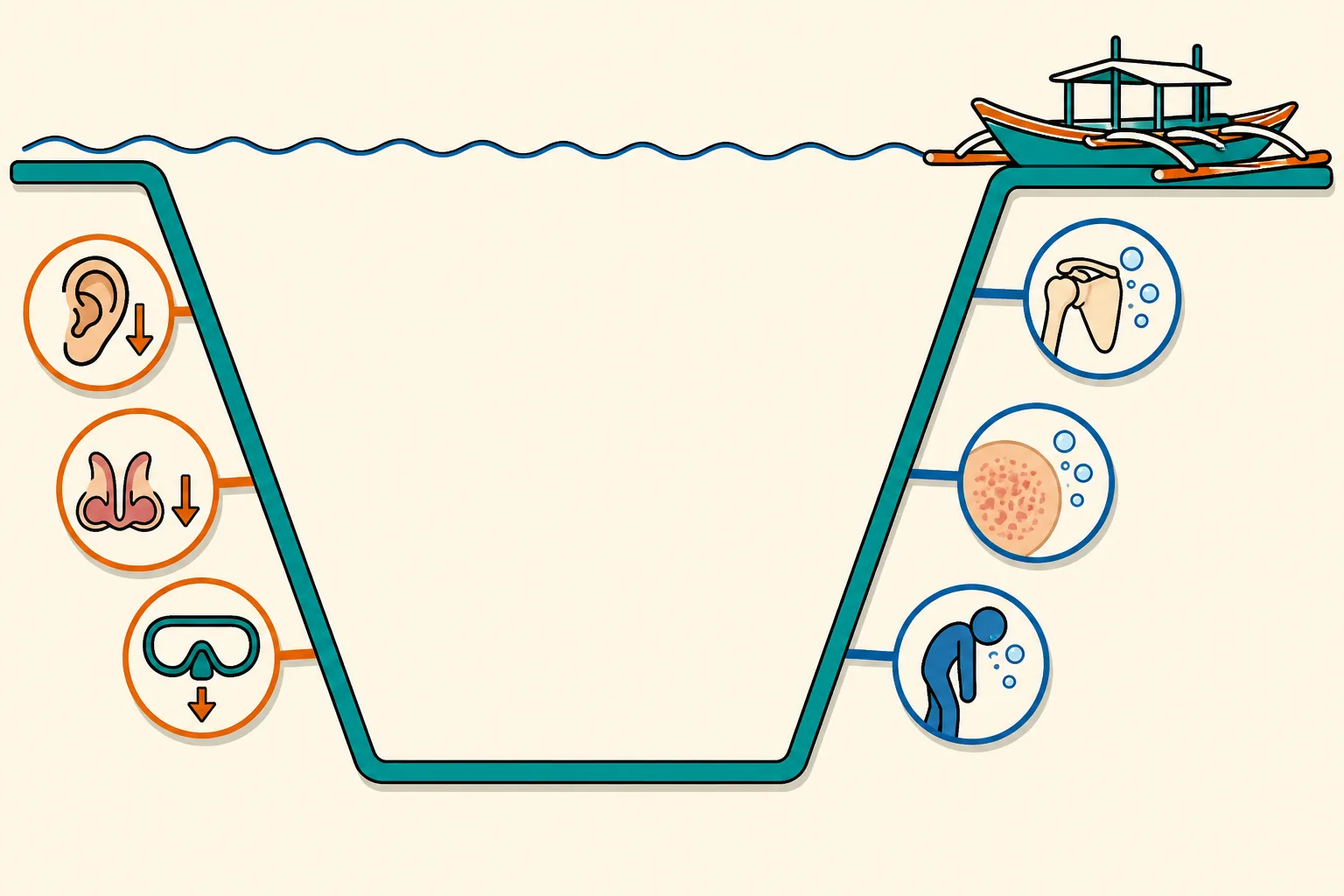
Ear barotrauma, where most of it happens
Roughly four out of five pressure injuries we see involve the middle ear, and the reason is anatomy. Your middle ear is a sealed air pocket whose only vent is the Eustachian tube, a soft collapsible passage running to the back of your throat. Every time you swallow, yawn or pinch and blow, that tube opens briefly and lets air in. That is equalising, and when it works you feel a click and think nothing of it.
When it does not open, the pressure differential across the eardrum climbs. It begins as fullness, then pressure, then genuine pain. If the descent continues, the middle ear starts filling with fluid and blood, because the body will fill that volume with something if it cannot fill it with air. Beyond a certain point the eardrum can perforate, which brings a sharp relief of pain followed by a rush of cold water into the middle ear. Cold water reaching the balance organ can trigger violent spinning vertigo, and vertigo while breathing from a regulator is one of the genuinely dangerous situations in diving, because vomiting with a regulator in the mouth is how a survivable injury can become a drowning.
Doctors grade middle ear barotrauma on the modified Teed scale, from zero to five, based on what they see through an otoscope. It sounds academic, but it is the assessment that determines how long a diver needs to wait. Broadly, grades one and two are redness and mild bruising of the eardrum and tend to settle in one to two weeks. Grade three and above involves visible bleeding, or fluid and blood behind the drum, and typically means three to six weeks out of the water, sometimes longer if fluid lingers. Grade five is a perforation, which needs to heal completely before any further pressure exposure.
A Teed grade cannot be self-assessed. Nobody can see their own eardrum, and the difference between grade one redness and grade four blood behind the membrane is a two minute examination with a light. That is the practical case for getting checked rather than estimating, because the mild and the significant versions can feel similar from the inside.
Technique itself is covered in a separate guide rather than repeated here. For the practical side, including the seven equalising techniques, the reverse block, and what to do when equalising stops working partway down, see our guide to how to equalise your ears and why it fails. This article deals with the injury itself: what it is, how it is graded, and what recovery involves.
One detail is worth knowing in advance, because it is easy to dismiss: ear barotrauma can appear late. A muffled ear, ringing, or a sense of fullness that develops twelve to seventy two hours after a dive is a recognised pattern rather than imagination, because fluid can collect in the middle ear slowly. Symptoms that surface on the evening of day two of a five day trip are worth having examined, since a decongestant may mask the sensation without addressing what is behind it.
Inner ear barotrauma, and why the chamber can be the wrong answer
This section covers the least understood form of barotrauma, and the one where the distinction matters most.
Behind the middle ear sits the inner ear, which holds both your hearing organ and your balance organs, in fluid rather than air. A violent pressure differential, most often from a hard forceful Valsalva against a blocked tube, can rupture one of the delicate membranes between the two. That is inner ear barotrauma, and it is a different animal from a squeezed middle ear. Symptoms come on suddenly and are dominated by severe spinning vertigo with nausea and vomiting, often with hearing loss and ringing. The hearing loss can be immediate, and it can be permanent.
Set that alongside inner ear decompression sickness, which produces sudden vertigo, nausea and hearing changes as well. The two present almost identically, and their treatments point in opposite directions. Decompression sickness is treated with recompression. Inner ear barotrauma is not, because putting a torn membrane through another pressure cycle risks worsening the damage. The accepted advice in a suspected case is to avoid pressure change of any kind, including altitude, along with nose blowing, straining and heavy exertion.
This is why the instinctive response, which is to drive a dizzy diver straight to a chamber, is not automatically the right one. It is not a decision for a dive shop or a travel companion. It belongs to a doctor trained in diving medicine, who will weigh the timing, the dive profile, the appearance of the eardrums and the pattern of symptoms before deciding. The most useful contribution anyone else can make is accurate information: maximum depth, descent rate, whether equalising was difficult on the way down, when the dizziness began, and whether it began during the dive or after surfacing. Symptoms that started during a difficult descent point one way. Symptoms that began well after an uneventful dive point the other.
We have written separately about the hyperbaric chambers in Bali, where they are and what treatment involves, and it is worth reading before it is ever needed. Bali has two working chambers, one in Gianyar on the east coast and one at Ngoerah in Denpasar that older guidebooks still call Sanglah. Knowing they exist matters. Knowing that vertigo alone does not automatically indicate a chamber is treatment matters just as much.
Sinus barotrauma, and the Bali reason sinuses block
Your sinuses are air pockets in the bones of your face, venting through passages narrow enough that a head cold closes them completely. When they cannot equalise, the same physics applies: fluid and blood fill the space instead of air. Sinus squeeze usually feels like pressure or pain across the forehead, the cheekbones or behind the eyes, and the classic tell is a small amount of blood in your mask or in your nose when you blow it after the dive. That is alarming to see and usually minor.
The Bali version is easy to miss, because the rainy season is the usual suspect and often is not the culprit. The more common cause here is a dry season combination of dust, traffic fumes on the road east, and long stretches in strong air conditioning, followed by an early start. Mild congestion from those conditions does not feel like illness, so it frequently goes unnoticed until the descent makes it obvious.
Decongestants deserve their own note. A spray or a tablet can open the passages enough for a comfortable descent, and the risk is that the effect fades at depth. That leaves air in a space which has since closed, and the result is a reverse block on ascent, which is the harder direction to manage, because an ascent cannot be postponed indefinitely. Plenty of experienced divers use them, so this is not a blanket warning. The practical point is that medication can make a marginal descent possible without changing the underlying congestion, so needing it is useful information when deciding whether to dive.
The air spaces nobody warns you about
Ears and sinuses are the headline. Four other spaces show up often enough to be worth a paragraph each.
Mask squeeze. The pocket of air between the mask and the face is an air space, and it needs equalising like any other. Exhaling a little air through the nose on descent does it, which most divers do without thinking about it. If that does not happen on a quick descent, the mask acts like a suction cup and pulls at the soft tissue around the eyes. The result is bloodshot eyes, bruising, and sometimes dramatic-looking purple around the eye sockets. It looks considerably worse than it is and resolves over a week or two. It is also a reliable sign that the descent outpaced the equalising, which makes it useful feedback. It shows up most often with freedivers moving to scuba, and with an unfamiliar low-volume mask.
Tooth squeeze. If you have a filling with a small void underneath, or recent dental work, air trapped in that void will squeeze on descent and expand on ascent. It feels like a sharp specific toothache at a specific depth, and it is memorable enough that people usually recognise it. In rare cases the tooth or restoration cracks. Worth a mention to your dentist before a long trip rather than during it.
Gut. Gas in the stomach and intestines expands on ascent. Usually it vents without being noticed. A large breakfast, a carbonated drink and a quantity of swallowed air can combine to produce genuine cramping on the way up. It is almost always harmless, and the real risk is that discomfort prompts a faster ascent than planned. Swallowing air is common on a first try dive, when breathing through a regulator is still new, so it is worth knowing about in advance.
Suit squeeze. Mostly a drysuit problem, so mostly not a Bali problem given our water temperatures. Worth knowing if you dive cold water at home: folds of the suit pinch skin and leave neat linear bruises.
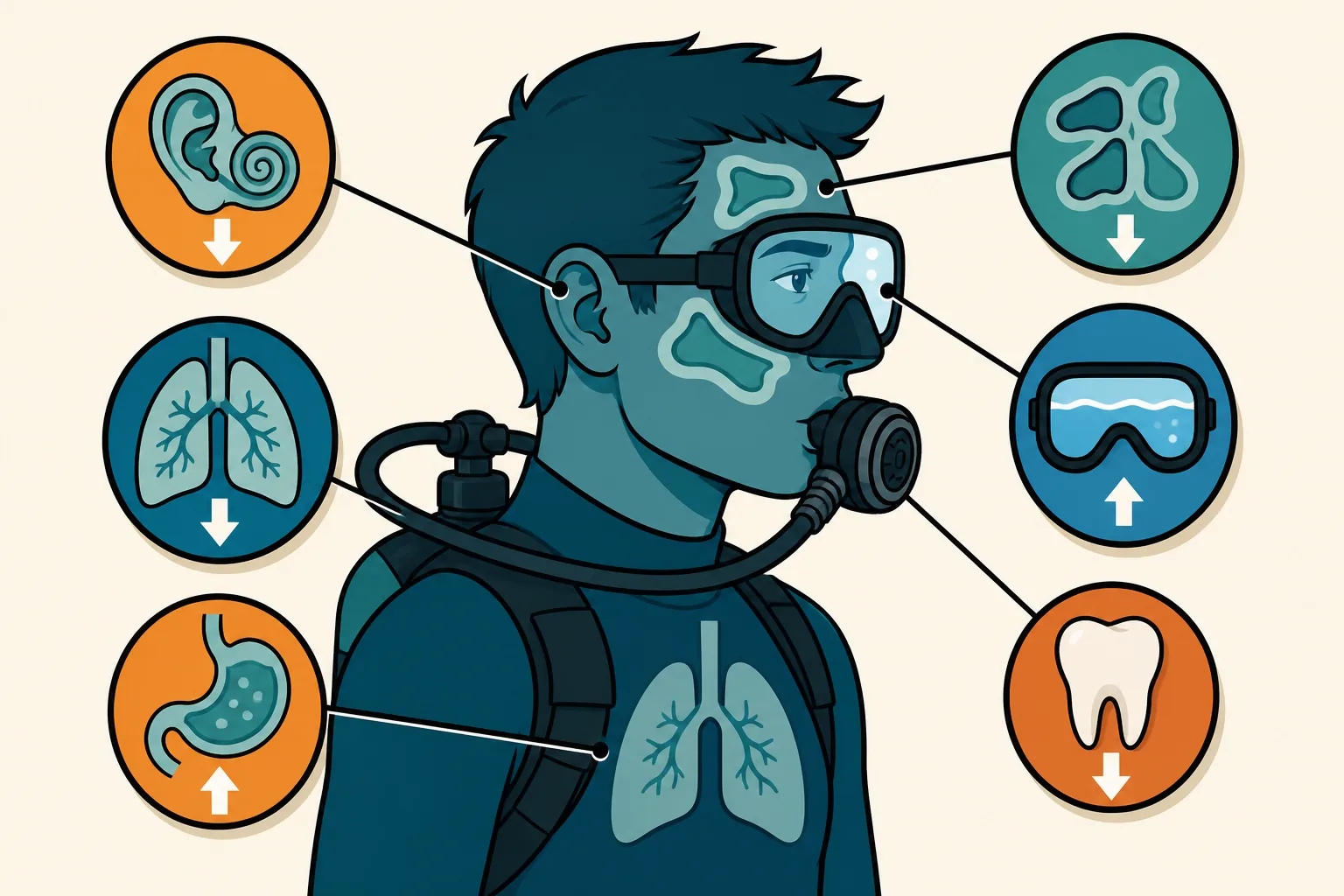
Pulmonary barotrauma, rare but serious
The lungs are the air space where the stakes change. On the way up, the air in your lungs expands. Breathe normally and it vents out with every exhale and nothing happens, which is why millions of dives pass without incident. Hold your breath on ascent and the expanding gas has nowhere to go. It can tear lung tissue, push air into the chest cavity, or force gas bubbles into the arterial circulation, which is an arterial gas embolism and a genuine emergency.
Two points of genuine reassurance. First, it is rare in recreational diving, and it is rare precisely because the rule that prevents it is the first rule every course teaches: keep breathing and never hold your breath on ascent. Second, when it does occur it clusters in a small number of identifiable situations. A rapid unplanned ascent. A breath held reflexively while a regulator is out of the mouth. An ascent from shallow water, where the proportional pressure change is largest.
That last point deserves emphasis, because the arithmetic is counterintuitive. Rising from ten metres to the surface doubles the volume of gas in the lungs. Rising from forty metres to thirty increases it by about a quarter. The shallowest part of the dive is where the greatest relative expansion occurs, which is the opposite of how it tends to feel.
Pre-existing conditions also change the picture, particularly anything that can trap air in part of the lung. Asthma or a history of lung problems is a conversation for a diving doctor rather than a dive shop, and our article on diving with asthma gives useful background before that appointment.
Prevention is straightforward, if unglamorous. Breathe continuously, and exhale on ascent. Good buoyancy control keeps an ascent deliberate rather than accidental, which is much of the value of the Peak Performance Buoyancy course and of a few dives spent practising it. Buoyancy is also worth consolidating before adding depth, including the depth an Advanced Open Water course opens up.
Where Bali diving raises the risk
General barotrauma advice does not describe where the risk actually concentrates on this island. These are the conditions we see most often.
Negative entries at Crystal Bay and Blue Corner. Several of the sites that make Nusa Penida worth the boat ride call for a prompt descent, deflating on entry and heading down immediately so the current does not carry the group off the site before it reaches shelter. That is the correct technique and we brief it thoroughly. It also runs against what ears prefer, which is slow and early. It is the most common setup for ear trouble in our operation. Anyone whose ears feel less than clear on a Penida morning is better off mentioning it before entering the water, when the plan can still change, and plenty of Penida sites do not require a fast descent at all.
Cold thermoclines. Penida in mola mola season, roughly July to October, can drop from comfortable surface water to sixteen to twenty degrees below twenty metres. Cold tissue equalises less readily, cold water encourages a quicker descent, and cold air on the boat tends to make noses run.
Early starts. Tulamben pickups leave Sanur at 05:45, so the Tulamben run puts divers in the water not long after a two hour drive. That combination of mild dehydration, hours of air conditioning and very little time upright means overnight congestion has often not cleared. The USAT Liberty is also a shore entry, so there is no line to regulate descent rate, just a slope that is easy to walk down faster than the ears can keep up with.
Repetition. A three dive day at Padang Bai or Amed means three descents, and a middle ear that became mildly inflamed on the first dive equalises less easily on the second and third. Multi-day trips compound the effect. The pattern is rarely one dramatic dive. More often it is several days of minor discomfort accumulating into something that needs attention.
Courses and try dives. Skills such as mask removal and regulator recovery involve small depth changes and divided attention at exactly the stage when equalising has not yet become automatic. Anyone on a try dive or in the first days of a course is statistically in the highest-risk group for ear barotrauma. That is why our instructors descend deliberately slowly with students, and why course descents take longer than experienced divers may expect.
What to do if it happens partway through a trip
This is the conversation we have at the counter most often, usually when several days of diving are still booked. Here is the framework we use.
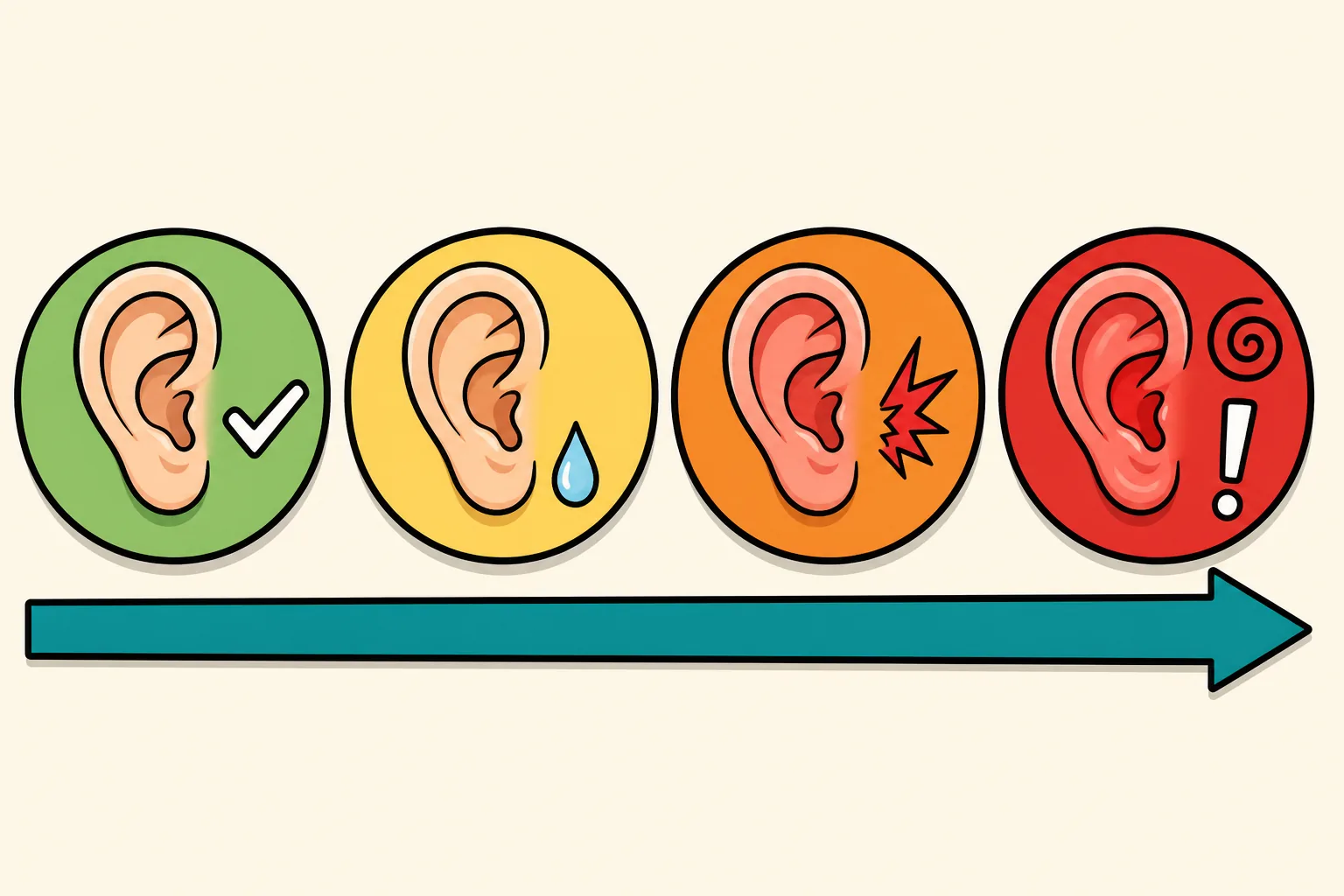
The first step is working out which description fits. Equalising worked, there is no pain, no fullness, no muffled hearing and no dizziness: that is an uncomfortable descent rather than an injury, and diving continues as planned. This covers the large majority of cases.
Mild fullness or slightly reduced hearing that appears after a dive and eases within a few hours is worth a day out of the water rather than pushing on. Diving on a mildly inflamed middle ear is the most common way a one to two week recovery becomes a six week one. A single day off mid-trip is a small cost against that.
Persistent pain, clear hearing loss, discharge or blood from the ear, or a pop followed by sudden relief all warrant stopping and getting examined. Those can indicate a perforation, and water in a perforated middle ear carries an infection risk alongside the injury itself.
Vertigo, spinning, severe nausea or sudden hearing loss warrant stopping immediately, telling someone, and seeking medical assessment rather than self-managing. That is the inner ear category described earlier, where the difference between diagnoses changes the correct treatment.
Then there is the flight, which is the question we are asked most. A cabin is an altitude exposure, so it puts the same injured tissue through another pressure cycle, this time expanding. If equalising is not working on the ground, the descent into Denpasar or the climb out can be painful and can aggravate the injury. There is no universal number of days that makes it safe, which is precisely why this needs an examination rather than a general rule. Separately, the ordinary surface interval before flying after diving still applies, and that one concerns nitrogen rather than ears. They are two independent considerations, and both matter.
Return to diving follows the same logic. Published guidance is consistent and unromantic: do not dive again until symptoms have fully resolved, any perforation has healed, inflammation has settled, and you can equalise properly, ideally confirmed by somebody looking in your ear. For the lower Teed grades that is often one to two weeks. For the higher grades it is commonly three to six weeks. For inner ear injuries it is assessed individually by a specialist and can be months, and in some cases the answer is no.
One further point, because it affects future trips rather than the current one. An ear that has been injured once is more susceptible afterwards. Scar tissue changes how the eardrum behaves, and repeated inflammation can narrow the Eustachian tube over time. After a grade two or worse, an ENT assessment before the next dive trip is a sensible precaution rather than something to arrange later.
Where to get checked in Bali
Bali has good options for this, and they are more accessible than many visitors expect.
An ear assessment needs an otoscope and someone familiar with what a diver's eardrum should look like. The international-standard hospitals and clinics around Denpasar, Sanur, Kuta and Nusa Dua handle this routinely, and an examination is quick and inexpensive by Western standards. Bringing a dive computer or logged profile helps, because depth and descent rate are genuinely useful clinical information.
For anything involving vertigo, hearing loss or a suspicion of decompression sickness, you want diving medicine specifically, not a general clinic, and that is where the chamber facilities and their associated doctors matter. Our guide to the hyperbaric chamber in Bali has the locations and the practical detail. The Divers Alert Network medical line exists for exactly this kind of triage and is worth having saved before you travel.
Insurance is worth a direct mention. Ordinary travel insurance frequently excludes diving, and dive-specific cover is inexpensive relative to the cost of chamber treatment or an evacuation. We ask about it and recommend it as standard, and it matters even more on our Komodo trips and aboard King Neptune, where the distance to a hospital is greater than it is in Sanur.
How we handle ear trouble at the shop
Prevention is mostly a matter of how a dive is run, so here is what we do about it.
We slow descents down whenever a diver needs it. Telling a guide that your ears are being slow is genuinely useful information rather than an inconvenience, and the group waits. We also change sites. If the plan called for a fast negative entry and someone's ears are marginal that morning, there are gentler alternatives at Gili Mimpang and Tepekong, up at Menjangan, or on the sheltered side at Amed.
We also do not run a dive that the ears are not ready for. Occasionally that means a planned dive becomes a surface day, and we would rather offer that than risk a longer recovery. It reflects the same principle behind what we have written about whether diving is actually dangerous, which is that the sport has an excellent safety record because a small number of straightforward rules are respected consistently.
A few times a year that means a trip finishes early for someone, and no part of that is enjoyable for anyone involved. It remains the better outcome, because the alternative risks a permanent hearing loss in exchange for a handful of extra dives.
If you already know your ears equalise slowly, mentioning it at the time of booking helps a great deal. We can plan the order of the week around it, start somewhere forgiving, and build in the extra time on descent. Get in touch and let us know, and for practical preparation before you fly, our ear equalising guide is the most useful place to start.