
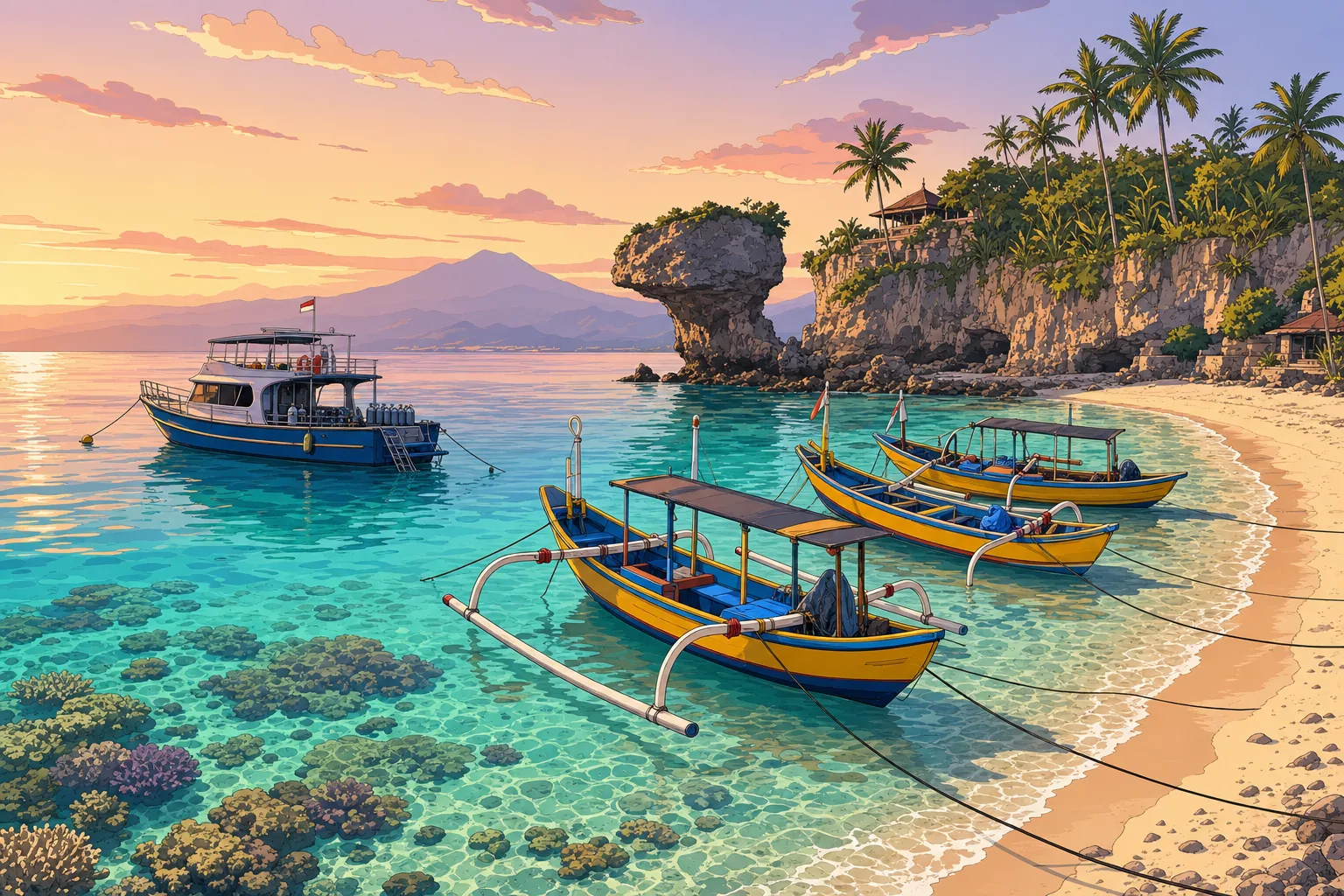
Nusa Lembongan is the dive island most people end up on by accident. They came to Bali to dive Nusa Penida, somebody at the hostel mentioned this calmer, prettier sister island 12 minutes north, and 48 hours later they are standing on Jungutbatu beach with a tank in each hand wondering why nobody warned them about the current at Blue Corner. We have been running Nusa Penida dive site day trips out of our Sanur shop since the mid-2000s, and a meaningful slice of those bookings have actually been Lembongan-based guests dropping down to dive with us for a single day to access the south Penida sites. Lembongan is not Penida lite. It is its own thing, with its own dive personality, its own currents and its own quiet trade-offs. This guide is the long version of the conversation we have every morning at the shop with the guests who ask whether they should sleep on Lembongan or commute from Sanur.
We will cover the five dives that actually matter at Lembongan in clockwise order around the island, what each one delivers and what it does not, the real current and visibility reality (this is the Lombok Strait, the currents are not optional), the difference between staying on Lembongan and day-tripping from Sanur with a proper operator, how the boat day flows from a 06:45 Sanur pickup vs an on-island 08:30 brief, the seasonal calendar including the September swell window, and the practical stuff nobody writes down (no ATM on Ceningan, the village pickup truck system, the new harbour fee). For the wider menu of Bali day-dive trips we run out of the same Sanur shop, and the multi-day Bali dive packages that fold Lembongan into a longer Bali itinerary, see the respective product pages. If you have not yet read our broader Nusa Penida diving guide, that is the companion piece. This one is Lembongan-first, but the two islands share more dive water than they share dry land. No marketing fluff. If a site is overrated we will tell you, and if we cancel a Lembongan trip we will say why.
Lembongan vs Penida vs Sanur as a dive base: who picks what
The first decision is not which sites to dive, it is where to sleep. Lembongan, Nusa Penida itself, and Sanur on the Bali mainland all give you access to the Penida-Lembongan-Ceningan dive cluster, but each one funnels you toward a different subset of sites and a very different daily rhythm. Sanur-based diving means a 06:45 pickup, a 40-minute speedboat across the Badung Strait, two morning dives on the south Penida sites (Manta Point and Crystal Bay are the classic combo), a lunch back at the boat or at Toyapakeh village, and back at your Sanur hotel by 16:30. Lembongan-based diving means waking up where you ate dinner, an 08:00 to 08:30 brief at the shop on the beach, a 5 to 15 minute boat ride to the dive sites along the channel, two dives, lunch on the boat or back at the village warung, second-dive group out by 13:00 if you want it, and the rest of the afternoon in a hammock. Nusa Penida island-based diving (staying in Toyapakeh village or Ped) is a third option that we will mention but not focus on, because the accommodation is thin and the dive operators on Penida itself are sparser than on Lembongan.
The dive geography matters here. From Lembongan you are in easy boat range of the channel sites: Mangroves on the north-east tip, Toyapakeh in the channel, Blue Corner on the Penida side of the channel, the Ceningan reefs around the islet to the south, and Jangka Point on the south end of Ceningan. You can also reach Crystal Bay (south-west Penida) in about 25 minutes, and Manta Point on the south coast of Penida in about 40 to 50 minutes, which is the longest boat ride a Lembongan-based diver typically does. From Sanur, with our speedboat going faster than a Lembongan operator's traditional jukung or local boat, we hit Manta Point and Crystal Bay in 35 to 40 minutes, but reaching the north Penida channel sites takes us a full hour because we have to go around. So the rough split is: Lembongan-based diving favours the channel and Ceningan, Sanur-based diving favours the south Penida coast. Our standard day-trip menu and prices are on our Bali day-dive trips page if you want the operator-side reality without the marketing language.
The third axis is who you are travelling with. If you are a solo diver or a dive-focused couple and you want to maximise dive count in a week, stay on Lembongan: you will dive 5 to 7 days back to back with minimum logistics, and the per-dive cost is the lowest of the three options. If you are travelling with a non-diving partner who wants Bali properly, Sanur is the right base: they get temples, beaches, a Balinese town to explore, and you can dive 2 or 3 days from Sanur without giving them the awkward Lembongan experience (the island is lovely but it is a small dive-and-surf place, not a Balinese cultural base). If you are in a group of mixed experience, Sanur lets us segment you across our different Bali dive packages more easily because we have more boats and more guides on rotation. None of these is wrong. They are different products. The mistake we see most is people booking 5 nights on Lembongan, doing 2 dives, getting bored on day 3 and trying to ferry-hop to Sanur with luggage, which is a miserable day. Plan around how many dive days you actually want.
Mangroves: the famous drift (and the day it is actually disappointing)
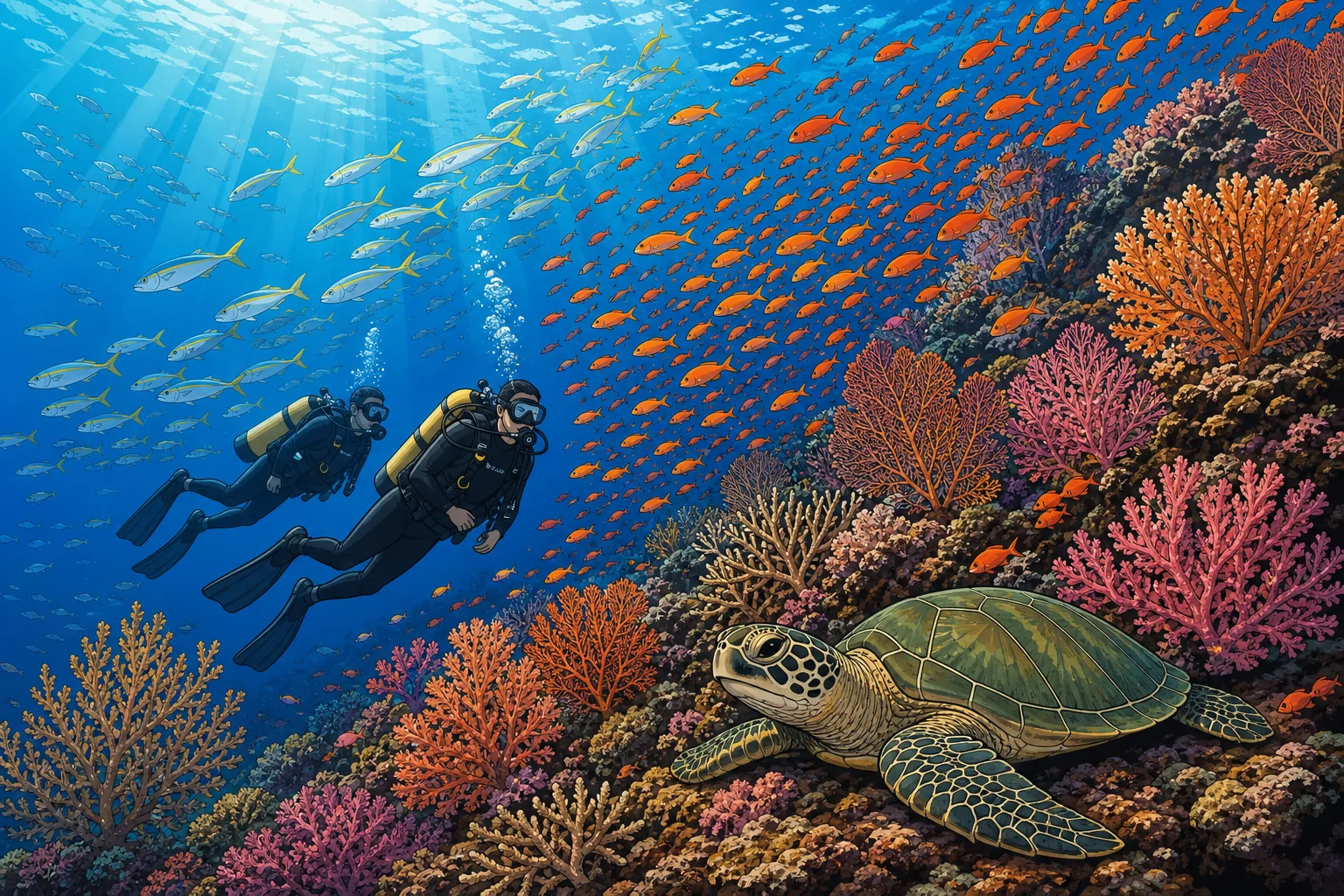
Mangroves is on the north-east tip of Lembongan and it is the dive that every Lembongan-based shop runs first. The reef structure is a moderate slope from about 5 to 28 metres, dropping into deeper blue, with extensive hard and soft coral coverage that the name "Mangroves" does not really hint at (the mangroves themselves are on the shore behind the dive site, not underwater). On a good incoming tide with mild current, Mangroves is exactly what the brochure promises: a fast, fun drift along a fish-busy slope with anthias clouds, schooling fusiliers, a 70 to 80 percent green sea turtle hit rate, the occasional white-tip reef shark cruising the deeper end, and visibility regularly 25 metres plus. On a good day it is genuinely one of the most enjoyable easy drift dives in Bali, and the reason it deserves its reputation as the friendliest Lembongan site. We rate it as suitable for Open Water divers with 10 plus logged dives in moderate current conditions.
And then there are the other days, which is what the brochures will not tell you. About 1 in 4 Mangroves dives in our experience, the current is either negligible (which turns the dive into a slow swim past pretty coral, not a drift) or running the wrong way (which means the boat picks you up where it dropped you off and the drift itself never happens). On those days Mangroves underwhelms, especially if the operator over-sold it. About 1 in 10 dives the current is genuinely strong and the dive becomes a downcurrent ride along the slope where you cannot stop to look at anything, which is fine if you knew that was the deal and frustrating if you did not. The honest version: Mangroves on a good day is brilliant, Mangroves on an average day is fine, Mangroves on a flat-tide day is forgettable. The tide timing matters more here than at any other Lembongan site. A competent local guide will time the dive to the incoming tide window, which for most months is roughly 90 minutes either side of high water; an operator running on a fixed 09:00 timetable regardless of the tide is the operator we would walk away from. Worth noting that for guests doing day trips out of Sanur, we more often skip Mangroves entirely in favour of Toyapakeh because Toyapakeh is more reliable across tide states; this is also why our Sanur day-trip article does not feature Mangroves as a flagship.
Blue Corner: the serious one, and why we gate-keep certs here
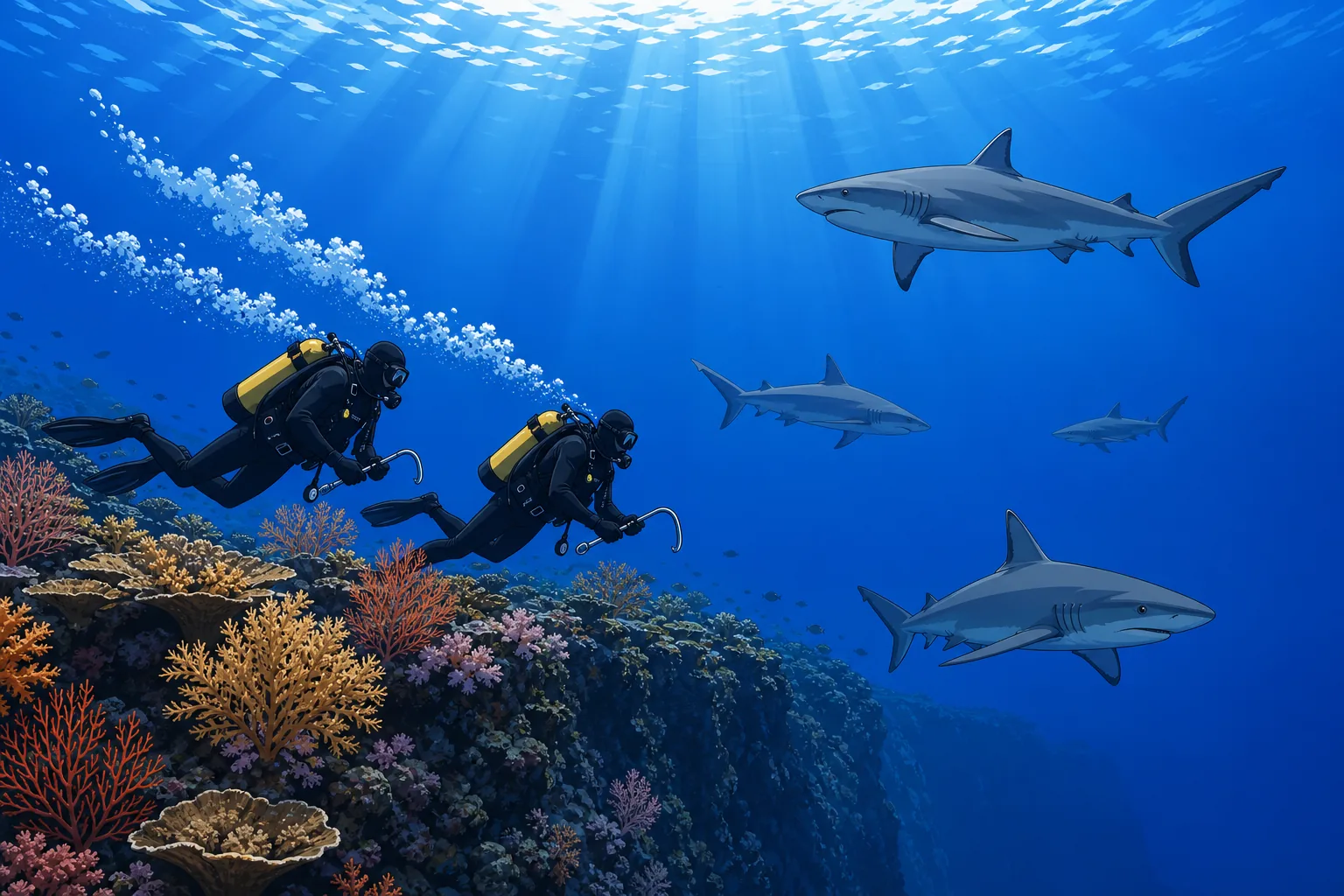
Blue Corner is on the Penida side of the channel, technically a Penida dive site, but it is operationally a Lembongan dive because the boats are right there. It is also genuinely the most exciting dive in the channel and the dive we will refuse to take guests on without specific minimum standards, which we will explain. The site is a corner of reef that drops sharply from about 6 metres on top to over 60 metres in the blue, where two opposing currents meet and channel up the corner with serious force. On the right day, with the right team, Blue Corner gives you the biggest big-fish-action dive in the Penida cluster: schooling barracuda, dogtooth tuna, the entire reef alive with hunting trevally, schooling jacks, and the regular grey reef sharks that cruise the corner looking for prey washed up by the upwelling. On the wrong day it can flush you down to 35 metres into the blue before you have noticed. Our Blue Corner Nusa Penida deep dive covers the site briefing in full detail.
We will not take an Open Water diver to Blue Corner. Full stop. Minimum requirements on our boat are Advanced Open Water with 40 logged dives, Nitrox is strongly recommended, a reef hook is essential (we provide them but you should know how to use one), and you must demonstrate competent buoyancy and air consumption on a check-out dive on a calmer site like Toyapakeh first. The reason is not snobbery. Blue Corner has a known incident pattern of divers getting flushed into the blue and panicking, and panic plus depth plus current is the classic recipe for an emergency we cannot fix from a small boat 20 minutes off Lembongan. If your operator is willing to take you on Blue Corner with 25 logged dives and no Advanced cert, that is a major red flag and you should book somewhere else. We turn down 4 or 5 Blue Corner enquiries every month for this reason, and we are completely fine with the lost business. Done within limits it is the trip-of-the-week dive. Done outside limits it is the dive that ends your holiday.
Toyapakeh: the quiet over-achiever
Toyapakeh sits in the channel between Lembongan and Nusa Penida, off Toyapakeh village on the Penida side, and it is the site we recommend most often as the first dive of a Lembongan or Sanur day trip. It is a gentle slope from 4 to 30 metres with a long stretch of healthy reef, soft coral covered bommies and a sand channel that runs out into the blue. The current is consistently mild to moderate (rarely the dangerous up-or-down currents of Blue Corner), the visibility is regularly 25 metres plus, and the fish density is among the highest in the Penida cluster: schooling unicornfish, sweetlips, snappers, big resident bumphead parrotfish in the deeper section, and reliable green and hawksbill turtles on the reef plateau. The hit rate on something genuinely interesting (a mola sighting in season, a passing manta off the wall, an oceanic trigger if you are lucky in shoulder season) is higher here than at Mangroves by a noticeable margin.
The reason Toyapakeh does not get the same hype as Blue Corner or Manta Point is precisely why we like it: nothing here is trying to kill you, the briefing is short, and the photographs come out beautifully because you have time to compose them. It is suitable for Open Water divers with 15 plus logged dives in normal current conditions, and it is the site we run Discover Scuba Diving introductions on when guests want to dive Penida-region water on their first ever dive (with a controlled experience and a private guide). Toyapakeh is also the best site in the cluster for macro photography fans who want to see the reef-fish side of the Penida ecosystem without committing to a dedicated muck-dive day at Tulamben. The village itself is the lunch stop for most boats running the cluster, and after a Toyapakeh morning dive you can be eating freshly grilled fish at a 25k IDR warung 20 metres from the beach.
Jangka Point and Ceningan Wall: the soft-coral surprises
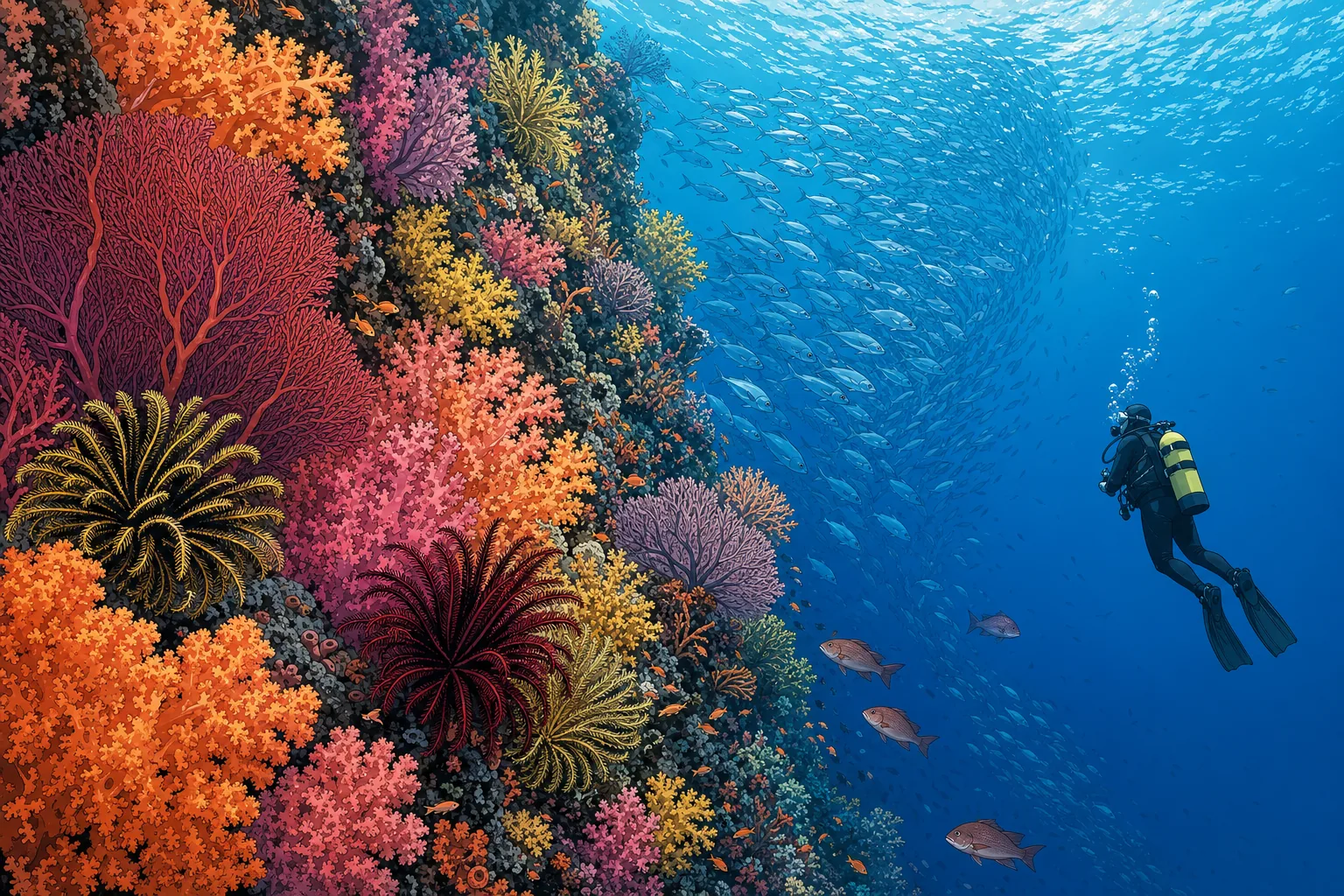
South of Lembongan, across the bridge to Nusa Ceningan, are two dives that consistently surprise repeat guests. Jangka Point sits on the southern tip of Ceningan and is a current-prone pinnacle dive (current dependent, sometimes very mild, sometimes serious) with a beautifully colourful wall absolutely covered in red and yellow gorgonian fans, soft corals and crinoids. The depth profile is friendly (top of pinnacle at 8 metres, sloping to 30 plus), and on the right day the visibility is the best in the cluster at 30 metres plus. Marine life is reliable rather than spectacular: white-tip reef sharks resting in the cracks, big-eye trevally schools, the occasional eagle ray passing through, and the soft-coral macro fauna (orangutan crabs, soft-coral cowries, candy crabs) for divers with a sharp eye. We rate Jangka as Advanced-only because the current can pick up without warning.
Ceningan Wall, on the eastern side of Nusa Ceningan, is the underrated star of the southern cluster. It is a sheer vertical wall from 4 metres down to over 40, absolutely plastered with soft coral in every colour the genus offers, large sea fans extending out into the current, and a thermocline often visible at 18 to 22 metres where the cold Penida upwelling hits the warmer surface water. We have logged mola mola here in season (July to October) on roughly 1 in 8 dives, which is far less than Blue Corner or Crystal Bay but more reliable than most operators will tell you. The wall structure also means the dive is suitable for divers with weaker buoyancy (you can hover at any depth without worrying about kicking the reef), making it a good Advanced check-out site after Toyapakeh. Our mola mola Bali season guide explains why the cold-water sightings cluster in this specific geographic band, and our Penida manta diving guide covers the manta side of the same upwelling system. For broader context on Bali's best big-fish destinations alongside this cluster, best places to scuba dive in Bali ranks Lembongan against Tulamben, Amed and Padang Bai.
Day trip from Sanur vs staying on Lembongan: cost, time, depth of access
This is the question we get asked daily. There is no universal answer, but the numbers below are the actual figures for 2026, in real USD per diver. The Sanur day-trip column is what we charge as a proper operator; aggregator sites will quote IDR 1,150,000 (≈ 65 USD) for the same trip on the cheapest local boats and we cover why that is in our Bali scuba diving price breakdown. Lembongan-based numbers are what we see guests pay on the island for a comparable two-tank day with a credible local operator. Per-night accommodation costs for Lembongan are not included here, since they vary from IDR 450,000 (≈ 25 USD) (basic guesthouse) to IDR 4,500,000 (≈ 250 USD) (private villa on the south coast).
| Aspect | Day trip from Sanur (us) | Lembongan-based dive day |
|---|---|---|
| 2-tank day price 2026 | IDR 2,150,000–2,600,000 (≈ 120–145 USD) | IDR 1,600,000–2,350,000 (≈ 90–130 USD) |
| Pickup time | 06:30-07:00 from hotel | 08:00-08:30 walk to shop |
| Boat transfer to first site | 35-45 min by speedboat | 5-25 min by local boat |
| Typical dive sites | Manta Point, Crystal Bay, Toyapakeh | Mangroves, Toyapakeh, Blue Corner, Ceningan |
| Back at hotel/base | 16:00-16:30 | 13:00-14:00 |
| Easy add-on third dive? | Rare (long boat day already) | Yes, common (14:00 second group) |
| Best for | Mantas, mola, south Penida walls | Channel sites, multi-day diving, soft coral |
| Sea sickness risk | Moderate (open Badung Strait crossing) | Low (sheltered channel) |
| Group size on boat | 8-16 (mixed Western operators) | 4-10 (smaller boats) |
| Non-diver friendly? | Yes (partner stays in Sanur) | Limited (Lembongan is a small island) |
Two things this table does not capture. First, the marine-life targets do genuinely differ by base. From Sanur in mola season (July to October) and manta season (year-round at Manta Point), the south Penida coast is the obvious play and the south sites are 15 minutes closer for us than they are for a Lembongan boat. From Lembongan, the channel sites are 30 minutes closer and you can run three dives a day comfortably, which racks up dive count faster if that is your goal. Second, the operator quality variance on Lembongan is higher than in Sanur. The genuinely good island operators are excellent, but the gap between the best and the worst Lembongan dive shops is large, and the cheap-looking deal on the corner of Jungutbatu beach is sometimes the boat that left the oxygen kit at the shop. We have personally run boat assistance for guests of other operators in this cluster on three occasions in the last 18 months, twice on the Lembongan side, once on the Penida side. For perspective on what a serious dive operator actually does for safety, the Sanur dive centre page explains our operating standards in full.
Seasonal calendar: when each site works and the September swell reality
The Lembongan cluster runs year-round but the experience varies enormously by season. The peak window is May through October, with the mola mola sightings concentrated July through September, the calm seas of August and the consistently strong visibility of September. The shoulder window is March-April and November, when the diving is still very good but the south Penida sites get the occasional swell day. The off-season is December through February, the west monsoon, where rain is heavy on the islands, the south coast sees regular swell, and several sites get blown out for days at a time. Our best time to visit Bali guide maps this against the wider Bali calendar; the Bali rainy season diving article covers what to actually expect on the water in December-February if you cannot pick when you fly.
| Month | Mangroves | Toyapakeh | Blue Corner | Ceningan Wall | Manta Point | Mola mola |
|---|---|---|---|---|---|---|
| Jan-Feb | Variable | Good | Cancelled often | Variable | Cancelled often | 0% |
| Mar-Apr | Good | Excellent | Good | Good | Good | 0% |
| May-Jun | Excellent | Excellent | Excellent | Excellent | Excellent | 10-20% |
| Jul-Aug | Excellent | Excellent | Excellent | Excellent | Excellent | 50-65% |
| Sep | Excellent | Excellent | Excellent (peak vis) | Excellent (peak vis) | Excellent | 40-55% |
| Oct | Good | Excellent | Good | Good | Excellent | 20-30% |
| Nov-Dec | Good | Good | Variable | Variable | Variable | 0% |
The single most important seasonal nuance is the September swell window. In a typical year, mid-September sees the cleanest visibility of the year (35 metres plus is common at Ceningan Wall and Blue Corner) but also a 7 to 10 day period where a southern ocean swell wraps around the south of Penida and shuts down Manta Point and sometimes Crystal Bay for two or three consecutive days. If you have a single fixed week and you booked specifically to see mantas, do not pick mid-September. If you booked to see mola and you can tolerate one or two reshuffled days, mid-September is genuinely the best dive week of the year. We will tell you which window applies to your dates if you write us through the Sanur shop contact page.
Getting there, accommodation and the cash/ATM trap
Lembongan is 35 to 45 minutes by fast boat from Sanur or 25 minutes from Padang Bai if you happen to be coming from east Bali. Three operators run the Sanur route on a public schedule (Maruti, Scoot Cruise, Rocky), with one-way tickets 200,000 to 350,000 IDR (13 to 23 USD). They go from a different beach area than the dive boats; check the ticket carefully because the difference between Sanur Beach and Sanur Sindhu pier is a 5,000 IDR taxi and a 20-minute walk if you get it wrong. Boats depart from Sanur 08:00, 10:30 and 12:30 most days, with the 08:00 the only sensible choice if you want a full first dive day on arrival. Coming from the airport, allow 45 minutes by Grab to Sanur, so a 06:30 airport arrival can have you on the 08:00 boat. Going the other way, the last boat off Lembongan is typically 16:30 in most months, which catches out guests who plan an evening flight; we recommend a Sanur overnight on the way home rather than trying to make a same-day Lembongan-to-airport transit.
Accommodation on Lembongan is concentrated in three areas: Jungutbatu beach in the north (cheapest, closest to the harbour, most backpackery), Mushroom Bay on the west coast (mid-range, prettiest beach, closer to surf breaks than dive sites), and the south Lembongan and Ceningan high-end villas (IDR 4,500,000 (≈ 250 USD) plus per night, total quiet, 15-minute scooter to anywhere). For dive-focused guests we recommend Jungutbatu within walking distance of the dive shops, because the morning routine of scooter-with-hangover to a 08:00 brief gets old fast. The transit around the island is by scooter (rentals 70k IDR per day), or by the orange village pickup trucks that operate as an informal bus system (10k to 30k IDR per ride). There are no public buses. Walking is fine for getting around Jungutbatu and to the closer dive shops but anything else is too hot in the day.
Two cash warnings worth knowing. First, there is essentially no working ATM on Nusa Ceningan, and the two ATMs on Lembongan are unreliable (one out of service on roughly 1 in 3 of our visits). Bring 1.5 to 2 million IDR per person per dive day in cash, in mixed 50k and 100k notes, drawn at a Sanur ATM before you board the boat. Card payment works at most dive shops but the network drops out regularly. Second, there is now a 25,000 IDR per person tourism fee for the Klungkung district (which includes Lembongan, Ceningan and Penida) collected at the harbour, which is small but catches everyone out on arrival. Save the receipt; it covers your whole stay. The newer Bali tourism levy (150,000 IDR for the whole province) you should have already paid through the Love Bali app before flying, but if you have not, the same harbour office will take it from you. Our Bali e-visa article runs through the entry-fee landscape for 2026 in detail.
How we would dive Lembongan over 2, 3 or 5 days
The question every guest asks the night before their first dive. The right answer depends on your goal: dive count, marine-life targets, or just a good time at a moderate pace. Here is the day-by-day template we suggest for guests of mixed experience based on a Lembongan stay. Modify by skill level and weather; the order matters because it builds up to the harder sites once we have seen you in the water.
2 dive days (4 dives total): Day 1 morning, Toyapakeh + Mangroves (check-out dive on Toyapakeh, fun drift on Mangroves). Day 2 morning, Ceningan Wall + Crystal Bay (soft coral and a chance at a mola if you are in season). You will have skipped Blue Corner, which is the right call for 4 dives unless you are already Advanced with current experience. Add an afternoon snorkel at Manta Bay on a separate boat for the third day if you have it; the Snorkeling Nusa Penida day trip runs every morning from the same Sanur boats.
3 dive days (6 dives total): Day 1 morning, Toyapakeh + Mangroves. Day 2 morning, Ceningan Wall + Jangka Point (Advanced check-out at Jangka). Day 3 morning, Crystal Bay + Manta Point (a south Penida day, with the longer boat ride; some operators sub Blue Corner for Jangka if you have logged enough dives). This is the sweet spot for most divers and the configuration that gives you the most variety per dollar.
5 dive days (10 to 12 dives): The same 6 above, plus a day at Blue Corner + Toyapakeh once you have proven your buoyancy and trim on the first three days, a second visit to Manta Point if you missed the mantas the first time, and ideally one off-cluster day where you boat south to Padang Bai for Mimpang and Tepekong (different geography, different big-fish reality). Day 4 or 5 should be a single-tank day with the afternoon off, because diving 10 days back to back without a rest day burns even experienced divers out. We see a noticeable air-consumption drop on day 6 in guests who have not rested. Our Bali dive trip itinerary guide covers the wider-Bali multi-day templates if you are combining Lembongan with Tulamben or Amed or a Komodo liveaboard. First-time Bali divers should also see our first-time diving Bali guide before committing to a 5-day Lembongan plan, and the Bali scuba diving packing list covers what to actually bring on the boat.
One final practical note. Lembongan is small enough that the dive shops mostly know each other and the boat schedules overlap. If a particular site is blown out for swell or current on a given morning, the on-island shops will reshuffle to whichever site is working that day. Sanur-based operators including us have less flexibility because we have already crossed the strait by the time we know the conditions on the south side. On a marginal-weather day, Lembongan-based diving is logistically more forgiving. On a blue-bird normal day, Sanur day-tripping with a proper operator gets you to the marquee south Penida sites faster and with a better-equipped boat. There is no universal winner. Pick the base that fits your trip and book with operators (us or otherwise) who will tell you the honest seasonal trade-off rather than the marketing version. If you are coming to Bali specifically to dive Penida-region water, our Bali vs Maldives diving comparison explains why the Coral Triangle delivers reef richness the Maldives simply does not. If you want to talk through your specific dates and goals, write to the shop directly; that is the conversation we have most mornings, and we will not push you toward something that does not fit.
Frequently Asked Questions
Yes, with caveats. Mangroves on a moderate-tide day and Toyapakeh in normal current conditions are both suitable for Open Water divers with 10 to 15 logged dives, and Toyapakeh in particular is where we run Discover Scuba Diving introductions. However, Blue Corner is not a beginner dive under any circumstances (we require Advanced plus 40 logged dives) and Jangka Point can pick up current unexpectedly. If you have fewer than 15 logged dives, stay on Mangroves and Toyapakeh, do a check-out dive with the guide before anything harder, and absolutely do not let an operator sell you Blue Corner because the photos look good.
Stay on Lembongan if you want to dive 5 to 7 days back-to-back at a relaxed pace, your priority is the channel sites (Mangroves, Toyapakeh, Blue Corner, Ceningan Wall) and you have no non-diving travel partner. Day-trip from Sanur if you want the south Penida sites (Manta Point, Crystal Bay) as priorities, you have a partner who wants Bali proper, you want a wider menu of dive packages and operators, or you only have 2 to 3 dive days planned. Both work for the Penida cluster; the right choice is about your trip, not about which base is "better".
Three operators (Maruti, Scoot Cruise, Rocky) run fast boats from Sanur beach to Jungutbatu on Lembongan, taking 35 to 45 minutes for 200,000 to 350,000 IDR (13 to 23 USD) one way. From the airport, take a Grab or Bluebird taxi to Sanur (45 minutes), then board at Sanur Beach (not Sanur Sindhu, they are different piers). Departures are typically 08:00, 10:30 and 12:30 most days. A 06:30 airport arrival can comfortably make the 08:00 boat with breakfast. Last boat off Lembongan is typically 16:30, so plan a Sanur overnight on the way home rather than trying to make a same-day Lembongan-to-airport transit for an evening flight.
The peak season is May to October, with the cleanest visibility in September (often 35 metres plus on the walls), the calmest seas in August, and the mola mola sightings concentrated July through September. The shoulder months of March-April and November are still excellent. December to February is the wet monsoon and the south Penida sites blow out regularly for swell, though the protected channel sites (Mangroves, Toyapakeh, Ceningan Wall) still run on most days. The single seasonal warning is the mid-September southern swell window when Manta Point can shut down for 7 to 10 days even while visibility elsewhere is at the year's best.
A 2-tank Lembongan-based day with a credible local operator runs IDR 1,600,000–2,350,000 (≈ 90–130 USD) per diver in 2026, all equipment included. A 2-tank Sanur day-trip with a proper operator like us is IDR 2,150,000–2,600,000 (≈ 120–145 USD). Nitrox is typically IDR 180,000 (≈ 10 USD) per tank extra. A 3-dive day add-on is IDR 650,000–800,000 (≈ 35–45 USD). PADI courses (Open Water, Advanced) run IDR 6,800,000–8,600,000 (≈ 380–480 USD) on-island, with the course often spread across the same sites you would dive recreationally. Add accommodation IDR 450,000–4,500,000 (≈ 25–250 USD) per night, food IDR 90,000–270,000 (≈ 5–15 USD) per meal, scooter rental 70k IDR per day, and the 25,000 IDR Klungkung tourism fee on arrival.
No. Blue Corner is the most current-prone dive in the Lembongan-Penida cluster, with two opposing currents meeting at the corner that can flush an unaware diver from 8 metres to 35 metres in seconds. Our minimum requirements are Advanced Open Water certification, 40 logged dives, demonstrated competent buoyancy on a check-out dive, and reef-hook capability. If an operator is willing to take you on Blue Corner with an Open Water cert and 20 dives, walk away from that operator. Done within limits Blue Corner is the trip-of-the-week dive. Done outside limits it is a documented incident pattern of panicked divers in deep blue water in serious current.
Yes, in season. Mola mola sightings cluster July through October in the cold upwelling water of the Penida-Lembongan-Ceningan cluster, with the best hit rates at Crystal Bay and Blue Corner, and reliable sightings at Ceningan Wall on roughly 1 in 8 dives in our log. Lembongan-based boats reach all of these sites comfortably. Outside the July-October window the hit rate drops to essentially zero. Mola dives are deep (typically 25 to 35 metres) and cold (a 5mm wetsuit is the minimum, 7mm is more comfortable), so they are Advanced-only on our operation and we will not promise a sighting on any single dive. The seasonal pattern is real but it is still wildlife.
Bring cash. The two ATMs on Lembongan are unreliable (one is out of service on roughly 1 in 3 visits) and there is no working ATM on Nusa Ceningan. Card payment works at most dive shops and the larger restaurants but the network drops out regularly. Bring 1.5 to 2 million IDR per person per dive day, in mixed 50k and 100k notes, drawn at a Sanur ATM before boarding the boat. Tipping for guides and crew is settled in cash at the end of each dive day (50,000 to 100,000 IDR per diver per day is the convention in 2026).
The two share a dive cluster. Lembongan-based operations focus on the north Penida and channel sites (Mangroves, Toyapakeh, Blue Corner) plus the Ceningan dives, with shorter boat rides. Nusa Penida island-based or Sanur-based operations more easily access the south Penida sites (Manta Point, Crystal Bay) where the manta and mola action concentrates. The Penida island itself has much thinner dive-operator coverage and accommodation than Lembongan, so most "diving Penida" trips by tourists actually mean "Lembongan-based or Sanur-based diving Penida-region water". The reefs, fish life and seasonal patterns are nearly identical because it is one ecosystem.
Technically no, a Sanur boat can reach any of the cluster sites including Mangroves, Toyapakeh, Blue Corner, Ceningan Wall and Jangka Point. In practice though, the time cost from Sanur to Mangroves (about 60 minutes one way around the island) and to Ceningan Wall (about 50 minutes) is high enough that most Sanur day trips focus on the south Penida coast and let Lembongan-based operators run the channel and Ceningan sites. So while no site is technically Lembongan-only, the channel and southern Ceningan sites are the ones you will dive far more efficiently as a Lembongan-based guest. The reverse is true for Manta Point: technically reachable from Lembongan in 40 to 50 minutes, but Sanur-based boats with a faster speedboat get there in 35 minutes and run it as a flagship dive.