
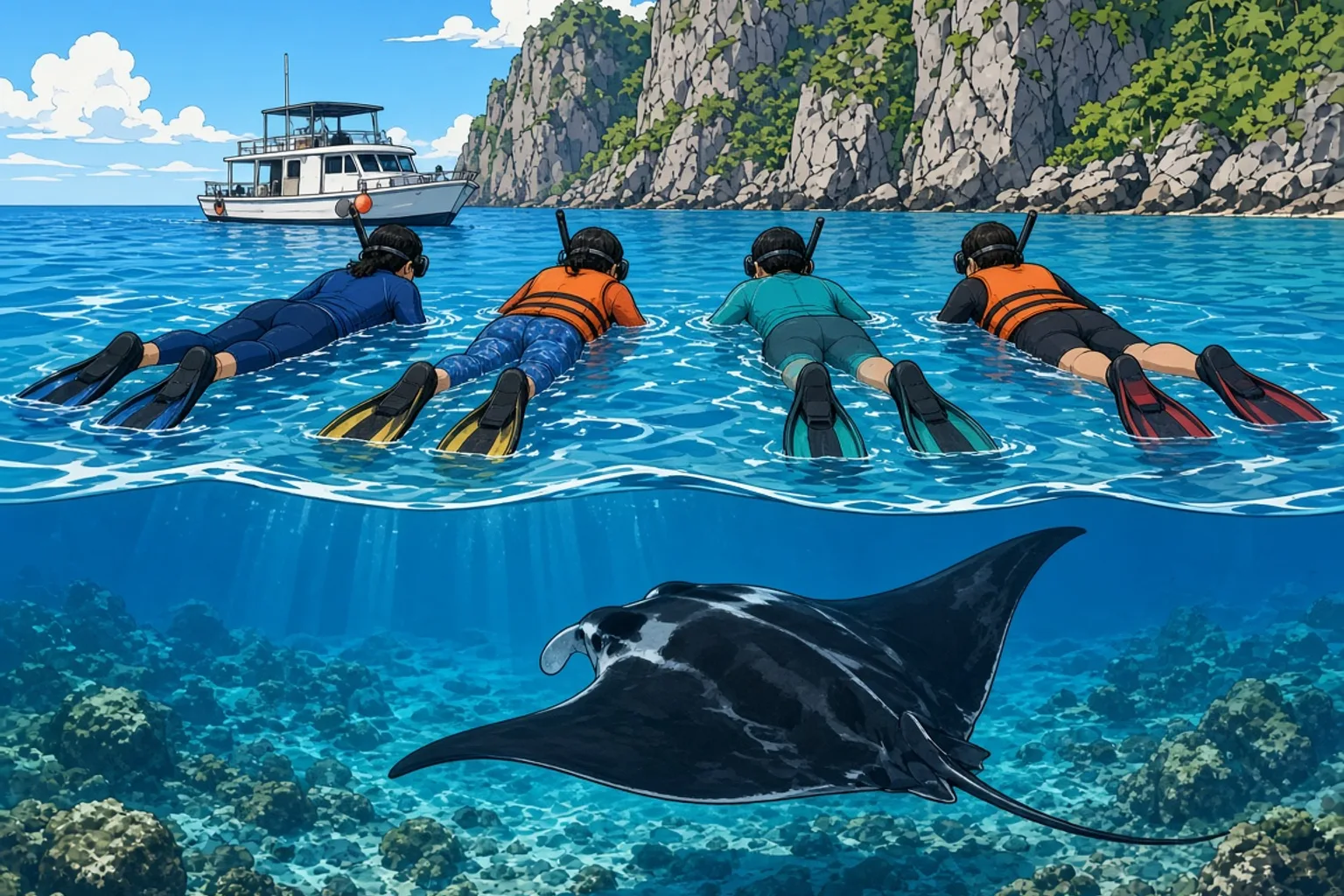
A Nusa Penida snorkeling tour is a boat trip to the snorkel sites around Nusa Penida, the island 40 to 55 minutes by fast boat south-east of Bali. Most tours visit a manta ray site (Manta Point or Manta Bay), then Crystal Bay, then a reef on the north coast. Expect 3 to 5 hours on the water and prices from about IDR 300,000 per person for a shared open trip that starts on the island to IDR 2,000,000 or more for a full day from Bali with pickup, guides and lunch. Tours such as this Nusa Penida snorkeling tour from Sanur are the most common way to see the mantas, because every good site is reachable only by boat.
This guide explains how the different tour formats compare, what each price actually covers, which manta site is better, which spots tours visit, how to judge an operator, and when to go. It is written for anyone choosing a tour, whether you book it from the mainland, from Nusa Penida itself or from Nusa Lembongan. Penida is one of several places to go snorkeling in Bali, but it is the only one with reliable manta rays, which is why it draws most of the demand and most of the confusion.
- Cost: IDR 300,000 to 500,000 per person for a shared open trip starting on Nusa Penida (fast boat, about IDR 350,000 return, plus pickup and lunch extra); from IDR 2,070,000 for a dedicated snorkel day from Sanur with pickup, guides in the water and lunch; IDR 1,250,000 to 2,500,000 or more per person for a private land and snorkel tour from Bali, depending on group size and whether the boat is private.
- Manta sites: Manta Point is a cleaning station with longer, more reliable encounters but is exposed to swell. Manta Bay is closer and more sheltered, with less consistent sightings.
- Usual route: Manta Point or Manta Bay, then Crystal Bay, then SD Point, Gamat Bay or Toyapakeh.
- Duration: 3 to 5 hours on the water; 7 to 11 hours door to door from a Bali hotel.
- Best season: April to November for calmer seas. Mantas are present all year.
- Rules: the sites lie inside the 20,057 hectare Nusa Penida Marine Protected Area, and manta rays are fully protected in Indonesia. Do not touch or chase them.
What Is Included in a Nusa Penida Snorkeling Tour?
Every Nusa Penida snorkeling tour is built from the same four parts: the crossing from Bali, a boat to move between sites, a guide, and snorkel gear. Prices differ mainly according to which of those parts the tour provides and which it leaves to you.
The crossing. Nusa Penida is a separate island across the Badung Strait. Public fast boats leave Sanur from shortly after 07:00, take 40 to 55 minutes depending on sea conditions, and cost around IDR 350,000 return. Tours that start "in Nusa Penida" expect you to make this crossing yourself and reach the meeting point, usually Toyapakeh or Banjar Nyuh, by 09:00 or 09:30. Tours that start "from Bali" normally include it, together with hotel pickup. If a listing does not state that the crossing is included, assume it is not.
The snorkel boat. This ranges from a small speedboat or local jukung carrying six to ten people to a large 25 to 35 seat boat running snorkel stops as part of an island circuit. Boat size largely determines how long you spend at each site, whether you can hear the safety briefing, and whether there is shade on the way back.
The guide. Listings almost always mention an "experienced local guide", but the phrase covers very different roles. On some tours the guide swims with the group, watches the current and points out wildlife. On others the guide stays on the boat. The two numbers worth asking for are whether the guide is in the water and how many snorkelers each guide is responsible for.
The gear. Better tours supply mask, snorkel, fins, a shorty wetsuit and a life vest. The cheapest supply a mask and snorkel only. Fins matter at Nusa Penida because the manta sites have swell and surge.
How Much Does a Nusa Penida Snorkeling Tour Cost?
A Nusa Penida snorkeling tour costs from about IDR 300,000 to over IDR 3,000,000 per person, depending on the format and on whether the price includes the crossing from Bali. The table below compares the five formats sold on booking platforms and by local operators in 2026.
| Format | Typical price per person | Usually excluded | Group and guide | Time snorkeling |
|---|---|---|---|---|
| Shared open trip starting on Nusa Penida | IDR 300,000 (Manta Bay) to 500,000 (Manta Point) | Fast boat (about IDR 350,000 return), hotel pickup, lunch | 8 to 15 per boat, one guide | 2 to 3 hours |
| Private land and snorkel tour from Bali | IDR 1,250,000 to 2,500,000 or more | Sometimes lunch; private snorkel boat often an upgrade | Private car and driver; snorkel boat shared or private | 1.5 to 2 hours; the rest is driving |
| Large-boat snorkel add-on | IDR 650,000 to 1,150,000 | Often fins and wetsuits | 20 or more per guide | 25 to 30 minutes per site |
| Dedicated snorkel day from Sanur | From IDR 2,070,000 | Tips | Up to 16 per boat, 4 to 6 per guide in the water | 3 to 4 hours |
| Private snorkel boat from Nusa Penida | IDR 1,700,000 to 3,000,000 per boat (up to 4 people) | Fast boat, pickup, lunch | Your group only | Flexible |
Open trips from Nusa Penida
Open trips are the low-priced listings, usually run by small operators based on the island. The group meets at the harbour mid-morning, visits three sites and returns around lunchtime. For travellers already staying on Nusa Penida they are good value. For travellers based on mainland Bali, the true cost is higher than the headline: adding the return fast boat (about IDR 350,000), a car to Sanur harbour (around IDR 500,000 per car) and lunch typically brings a IDR 450,000 Manta Point trip to IDR 1,000,000 or more per person for a couple. The later start also means arriving at the manta site at its busiest time.
Private land and snorkel tours from Bali
These are usually sold as private tours: hotel pickup, the fast boat, and a private car and driver on Nusa Penida, with the snorkel boat either shared with other groups or private as an upgrade. Prices of IDR 1,250,000 to 2,500,000 per person are typical for two travellers, falling slightly for larger groups and rising for solo travellers or a fully private boat. The day combines a short morning snorkel with an afternoon drive to the island's viewpoints, typically Kelingking Beach, Broken Beach and Diamond Beach. They suit travellers who want to see the viewpoints and snorkel in one day. They suit snorkelers less well, because much of the day is spent on narrow roads; the drive to Kelingking alone can take 45 minutes each way in the afternoon.
Large-boat snorkel add-ons
The cheapest tours sold on mainland Bali use a large boat, large groups and short stops, and often supply only a mask and snorkel. They are inexpensive, but the format leaves little time in the water and little individual supervision, which matters most at the exposed manta sites.
Dedicated snorkel days
Dive centres and specialist snorkel operators run full days from Sanur with hotel pickup, a boat used only for snorkeling, small in-water groups, full gear and lunch, and a schedule set around the tide at Manta Point rather than around public ferry times. The higher price reflects those costs. A sample itinerary for this format appears below, and full details of one such trip are on the snorkeling Nusa Penida trip page.
Private snorkel boats
Operators on Nusa Penida hire out private snorkel boats for about IDR 1,700,000 (Manta Bay plus other spots) to IDR 3,000,000 (Manta Point plus other spots) for up to four people, with the crossing from Bali extra. Private yacht charters from Bali cost considerably more. For groups of four or more, a private boat becomes reasonable value: the group sets the pace, can stay longer at Manta Point when the mantas are active, and can mix divers and snorkelers on the same boat.
Manta Point vs Manta Bay: Which Is Better?
Manta Point is better for manta encounters; Manta Bay is easier to reach and more often accessible. Knowing which one a tour visits is the most useful single piece of information when comparing Nusa Penida snorkeling tours, and many listings do not state it clearly.
| Manta Point | Manta Bay | |
|---|---|---|
| Location | South-west coast, below limestone cliffs | South coast, further east and closer to the harbours |
| Why mantas are there | Cleaning station: mantas circle while small fish remove parasites | Feeding on plankton, usually passing through |
| Encounter quality | Long, repeated passes; often several mantas at once | Shorter, less predictable |
| Conditions | Exposed to Indian Ocean swell and surge | More sheltered |
| Accessible | On suitable days, best early in the morning before the swell builds | Most days |
| Crowds | Moderate | Very busy by mid-morning |
The mantas at Nusa Penida are reef mantas (Mobula alfredi), with adults commonly three to four metres across. At the cleaning station at Manta Point they hover over the rocks at roughly 5 to 12 metres, which is shallow enough to watch clearly from the surface. All-black individuals are seen regularly. Manta Point has no real current, but it faces the open ocean and big swells are common, which can make snorkeling uncomfortable. Careful operators go there first thing in the morning, when the sea is usually calmest, and use Manta Bay as a fallback when the swell is too large for snorkelers.
No operator can guarantee a sighting, but mantas are present year round. Operators that visit Manta Point report encounters on roughly 85 to 90 percent of trips, with the lowest rates in the rougher weeks of June and July and the highest in November and December. For more on the animals themselves, see this guide to manta rays at Nusa Penida, and for the most common first-timer worry, whether manta rays are dangerous. They are not: mantas have no sting and feed on plankton.
How to behave around manta rays
Both manta species have been fully protected in Indonesia since Ministerial Decree No. 4/KEPMEN-KP/2014. The Manta Trust's code of conduct, used by operators worldwide, sets out how to swim with them:
- Enter the water quietly, no closer than 10 metres to a manta.
- Keep your fins below the surface to avoid splashing.
- Stay at least 3 metres away and let the manta approach you.
- Approach from the side, never from the front, and never block its path.
- Do not chase, touch or dive down onto a manta.
The distance rule has measurable effects. In Manta Trust research at snorkel sites in the Maldives, mantas showed avoidance behaviour 31 percent of the time when snorkelers came within 3 metres, compared with 3 percent at 4 to 5 metres. Tours that let guests crowd the animals end up with shorter encounters for everyone.
Which Snorkel Spots Do Nusa Penida Tours Visit?
Most Nusa Penida snorkeling tours choose three sites from a short list, because only a few places combine good marine life with water that is safe enough for groups. A detailed site-by-site guide with a monthly calendar is in the complete guide to snorkeling Nusa Penida.
| Site | What you see | Conditions | Suitable for |
|---|---|---|---|
| Manta Point | Adult reef mantas at a cleaning station | Exposed; swell and surge | Confident swimmers |
| Manta Bay | Passing mantas, reef fish | More sheltered; crowded | Most swimmers |
| Crystal Bay | Coral, turtles, reef fish, clear water | Calm inside the bay; strong current outside it | All levels, including families |
| SD Point and PED | Continuous hard coral, large fish schools, turtles | Gentle one-way drift | Relaxed swimmers comfortable drifting |
| Gamat Bay | Coral slope, clear water | Some surge | Confident snorkelers |
| Toyapakeh | Wall with dense fish life | Current can be strong | Better suited to divers |
| Mangrove (Nusa Lembongan) | Shallow coral garden | Current on some tides | Easy days |
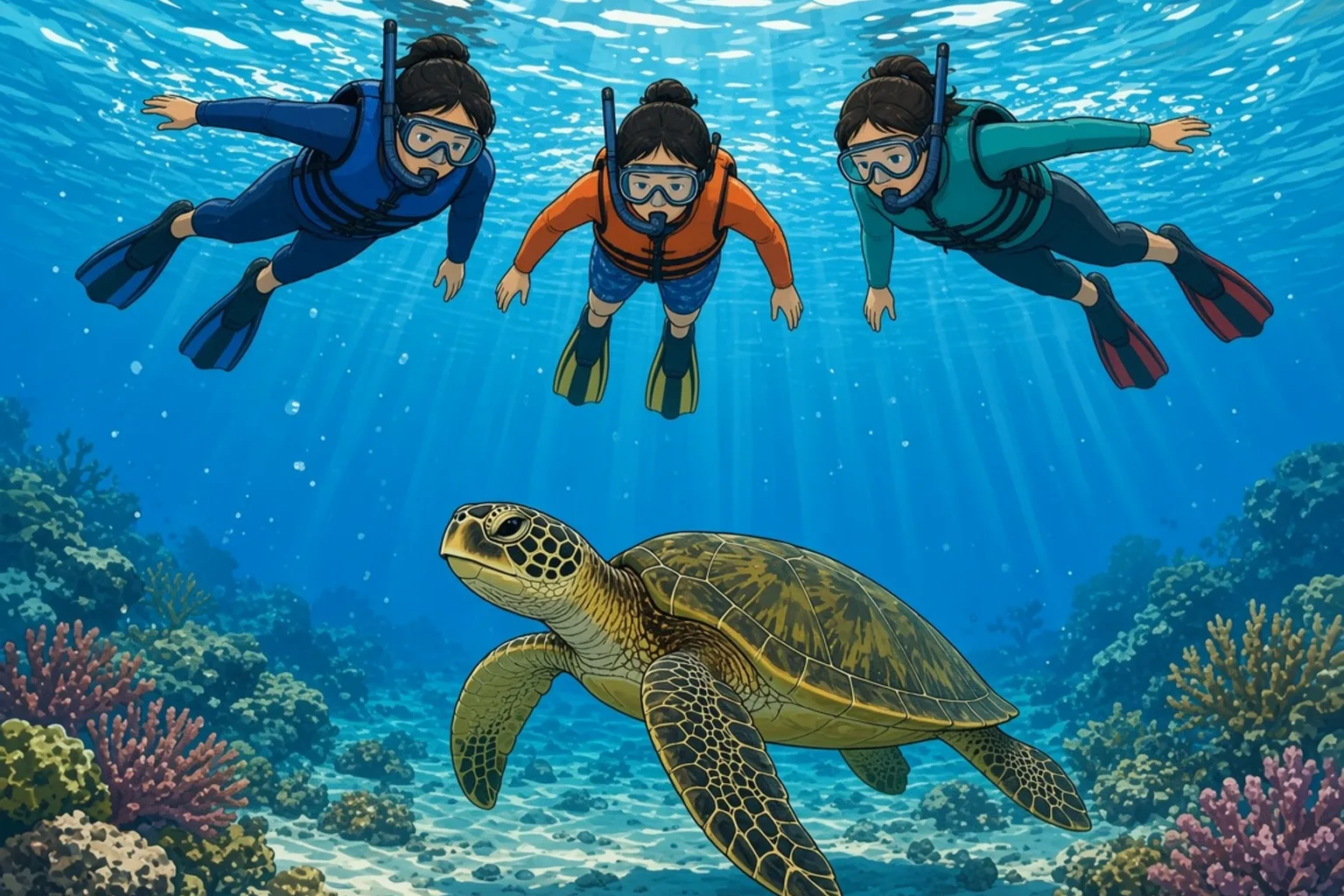
Crystal Bay is sheltered inside the bay, with coral starting a few metres down and visibility that often exceeds 20 metres on sunny mornings. Green and hawksbill turtles are regular visitors. The channel outside the bay carries a strong outbound current even on calm days, so snorkelers should stay inside the line between the headlands. Turtle etiquette follows the same logic as with mantas; this guide to sea turtles in Bali covers it in detail.
SD Point and PED, on the north coast, are drift sites. A gentle current runs along the reef, so snorkelers float rather than swim, and the boat collects the group at the far end. The hard coral here is continuous and healthy, with dense fish life and passing turtles. For first-time drift snorkelers they are the easiest introduction on the island.
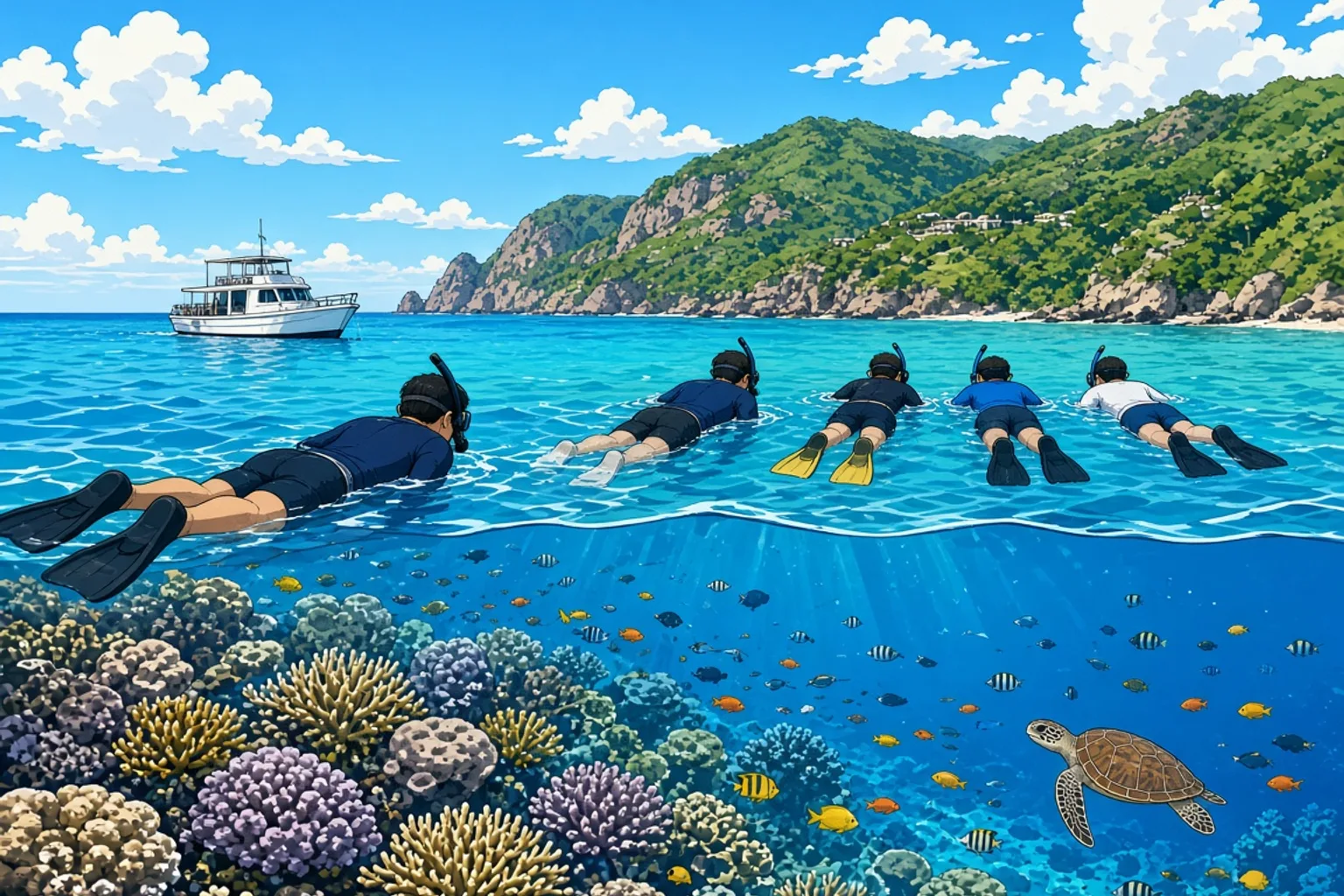
Not snorkel sites: Kelingking, Broken Beach and Angel's Billabong are clifftop viewpoints on the exposed south and west coasts. They take the full force of the ocean swell, and listings that mention snorkeling there refer to a photo stop from above.
What Does a Typical Nusa Penida Snorkeling Day Look Like?
A full-day tour from Bali starts early: operators aim to reach Manta Point first thing, while the swell is usually lowest and before most day-trip boats arrive, then move to the sheltered sites and time those around the tide. The example below is the schedule of the dedicated snorkel day run from Sanur by Neptune Scuba Diving on a normal dry-season morning.

Example itinerary: Sanur departure
- 06:45 Hotel pickup, free from Sanur, Kuta, Legian, Seminyak and Nusa Dua.
- 07:00 Gear fitting (mask, snorkel, fins, shorty wetsuit, optional vest) and safety briefing at the dive centre.
- 07:30 Boat departs Sanur beach; 40 to 55 minute crossing.
- About 08:15 Manta Point, around 45 minutes in the water, one guide per four snorkelers. Manta Bay is used instead if the swell is too large.
- About 09:30 Crystal Bay, around an hour in the water.
- Two-stop day Lunch, then return to Sanur around 14:00.
- Three-stop day After lunch, a drift at SD Point or PED, returning around 16:00.
On this format the two-stop day costs IDR 2,070,000 and the three-stop day IDR 2,700,000 per person, including pickup, boat, guides, gear, towels, lunch, snacks and water, with up to 16 snorkelers per boat. The operator's Bali price list shows how it compares with dive trips to the same sites. A land tour of the viewpoints is available as an optional add-on rather than part of the standard day.
Cancellations are part of snorkeling an exposed island. On roughly one day in twelve, sea conditions are not safe enough for the Penida sites, and responsible operators cancel or reschedule. A clear cancellation policy, covering rebooking or refund, is a good sign when comparing tours.
How to Choose a Nusa Penida Snorkeling Tour
The quality of a Nusa Penida snorkeling tour depends on a few details that listing photos do not show. These questions separate good operators from poor ones:
| Question to ask | Good answer | Warning sign |
|---|---|---|
| Which manta site do you visit? | Manta Point, with Manta Bay as the rough-weather backup | No clear answer, or "we always go regardless of conditions" |
| How many snorkelers per guide in the water? | 4 to 6 | Guide stays on the boat |
| Is the fast boat from Bali included? | Clearly stated either way | Not mentioned |
| How long at each site? | 45 to 60 minutes | Under 30 minutes |
| Are fins included? | Yes | Mask and snorkel only |
| What happens if the trip is cancelled? | Rebook or refund | Vague or no policy |
| How do guides manage manta encounters? | Distance rules explained in the briefing | Reviews showing guests touching or chasing mantas |
Reviews are most informative at the low end. One and two-star reviews reveal the details that matter, such as missing fins, crowded boats or guides who never entered the water. Recent guest photos are more reliable than an operator's own gallery. Be cautious of any tour that promises manta sightings; mantas are wild animals, and trustworthy operators quote a sighting rate instead.
Should You Start From Bali or From Nusa Penida?
Start from Bali if you are staying on the mainland; start from the island if you are staying on Nusa Penida or Nusa Lembongan. From Sanur, Seminyak, Canggu, Ubud or Nusa Dua, a tour that includes pickup and the crossing is simpler, and once the fast boat, transfers and lunch are added to a cheaper island-based trip, the price difference narrows considerably. A Bali departure also reaches Manta Point earlier.
Travellers spending two or three nights on Nusa Penida island can join a local open trip from Toyapakeh without the crossing, and can use the checklist above to choose one. Those staying on Nusa Lembongan have Mangrove on their doorstep and the Penida sites a short crossing away.
Combining snorkeling with a full land tour in one day from Bali is possible but makes for a long day of 10 to 11 hours. This Nusa Penida day trip from Sanur guide sets out what realistically fits into a single day.
Is a Nusa Penida Snorkeling Tour Safe?
Nusa Penida snorkeling tours are safe with a careful operator, but the island is more exposed than most snorkel destinations in Bali. The main risks are ocean swell and surge at Manta Point, strong currents outside sheltered bays, and boat traffic at busy sites. Guides in the water, small groups, fins, and a schedule built around the tide address all three.
Non-swimmers and weak swimmers. Life vests are provided on most tours and help considerably. However, anyone who cannot tread water for about five minutes in deep water without a float should tell the operator in advance and avoid Manta Point in a swell. Calmer alternatives include snorkeling in Padang Bai on Bali's east coast.
Seasickness. The crossing takes 40 to 55 minutes each way over open water, and Manta Point sits in the swell. Taking a non-drowsy tablet 30 to 60 minutes before departure, sitting in the middle of the boat and watching the horizon all help. Travellers who are severely affected may prefer a shore-based alternative such as snorkeling Tulamben, where the USAT Liberty wreck lies close to the beach.
Children. Children who are comfortable in open water can join, in a vest and with a parent and guide nearby; whether Manta Point is suitable is best decided on the morning, based on conditions. Very young or anxious children are usually happier on a calmer trip. This family guide to diving and snorkeling in Bali compares options by age.
Flying. Snorkeling has no flying restriction. Divers on the same boat need a surface interval before flying, so mixed groups should plan the Penida day early in the trip.
When to Go and What to Bring
The best time for a Nusa Penida snorkeling tour is April to November, the dry season, when seas are calmer and visibility is best. Mantas are present all year. From July to October, deep-water upwellings cool the surface to around 22 or 23 degrees Celsius on some days and bring mola mola into diving depths; snorkelers rarely see them, but this mola mola season guide explains when divers do. December to March is wetter and windier, yet manta numbers are often at their highest and many mornings are calm.
Time of day matters as much as season. Mornings are calmer, less windy and much less crowded; by about 10:30, Manta Bay and Crystal Bay are busy with boats.
What to bring
- Swimwear worn under your clothes
- A long-sleeve rash guard or T-shirt; you will spend three to four hours face-down in strong sun
- Reef-safe sunscreen and a hat for the boat
- A dry bag for your phone and valuables
- Seasickness tablets, if needed
- Your own mask, if you have one that fits well
- Cash for tips; IDR 90,000 to 180,000 per crew member is customary but not expected
- A wrist strap for any action camera, as the current claims many each year
Snorkeling or diving?
Because the mantas at Manta Point hover at 5 to 12 metres, snorkelers get good views from the surface. Divers get longer, closer encounters, the deeper reef and, in season, a chance of mola mola. A try dive in Bali requires no certification, and certified divers can explore the Nusa Penida dive sites. Many boats carry divers and snorkelers together. The differences are covered in detail in snorkeling versus diving.
In short: choose the tour format that matches where you are staying, confirm which manta site is visited and how many snorkelers share each guide, and book an early departure. Full details of the Sanur-based Nusa Penida snorkeling tour referenced in this guide are available from the dive center in Sanur, and questions can be sent through the contact page.
Sources: Manta Trust code of conduct and Maldives snorkeler-interaction research; Swim With Mantas 10-step guide; Indonesian Ministry of Marine Affairs and Fisheries Decree No. 4/KEPMEN-KP/2014 (manta protection) and Decree No. 24/KEPMEN-KP/2014 (Nusa Penida Marine Protected Area); IUCN Red List, which classifies the reef manta ray as Vulnerable.