
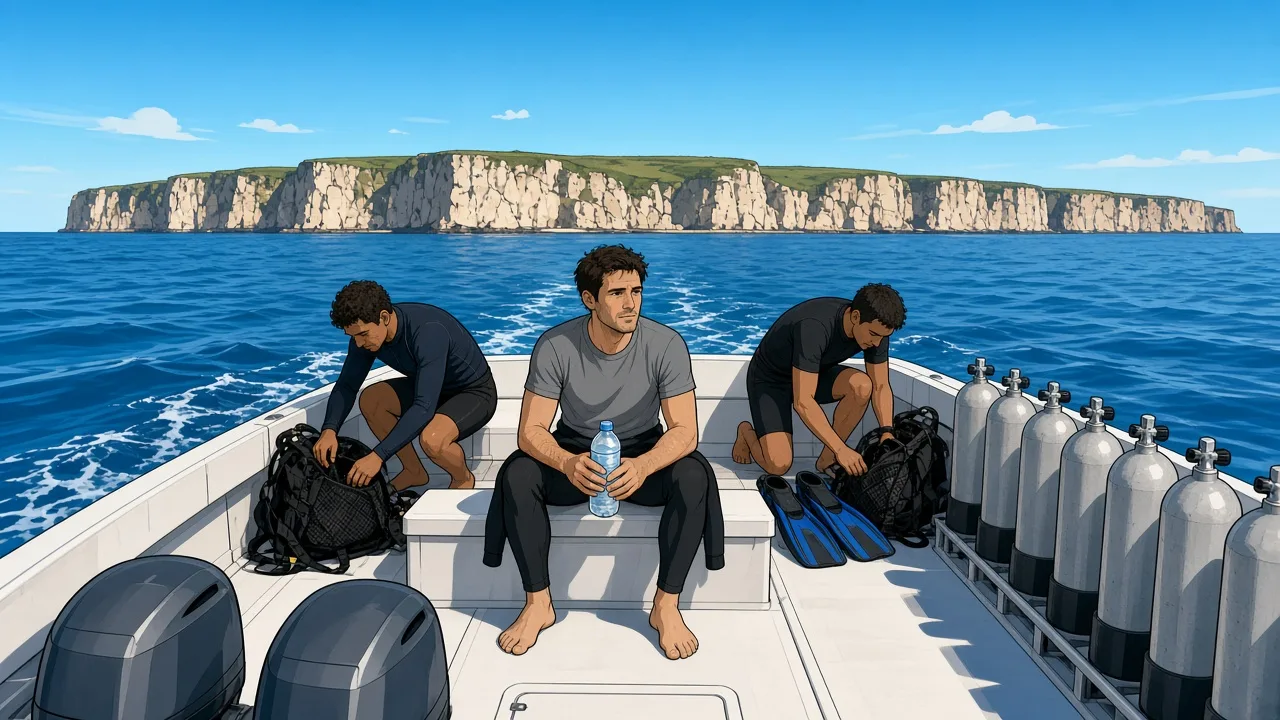
Seasickness and scuba diving are a common pairing: the boat ride to the site, not the dive, is where many divers feel worst. Once underwater, most people feel better almost immediately, because the motion that caused the nausea stops below the surface. The hard part is getting there, whether that means a 40-minute crossing for Nusa Penida diving or a choppy hour on any of the world's boat dive trips.
Seasickness is also very preventable. Choosing the right seat, eating the right breakfast and taking the right tablet at the right time stops most cases before they start, and the few minutes of planning matter most for beginners on a try dive or students in the open water stage of a PADI Open Water course, who have enough to think about without nausea.
Medication is where divers need the most care. Many seasickness tablets cause drowsiness, and drowsiness is a problem at depth. The differences between the common options, and how to test them, matter more for a diver than for a ferry passenger.
What is seasickness?
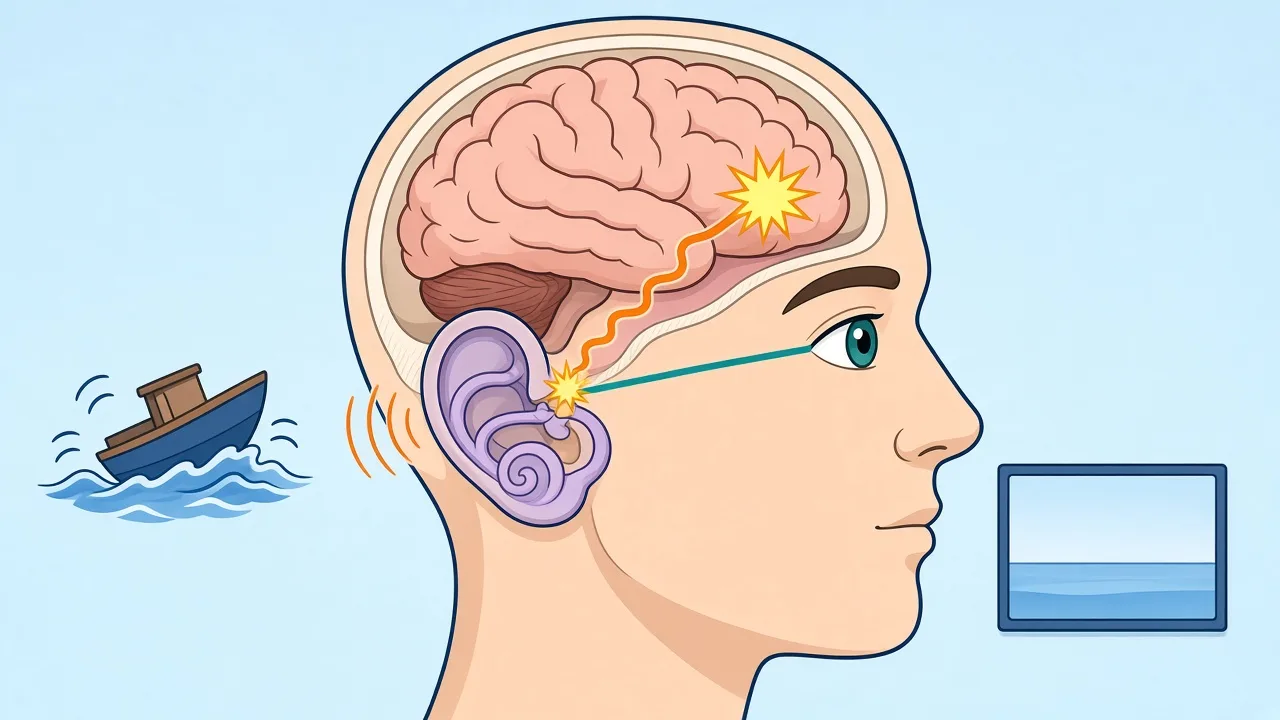
Seasickness is a form of motion sickness caused by a boat's movement, when the inner ear senses rocking that the eyes and body do not confirm.
- Yawning and drowsiness
- Cold sweats and pale skin
- Nausea and extra saliva
- Vomiting
It is a normal reaction of a healthy balance system rather than an illness, and it usually fades within minutes of the motion stopping, including on descent.
Divers who are prone to it usually reduce the risk with:
- Short crossings to sites such as Padang Bai
- Shore diving in Tulamben, with no boat at all
- A tested tablet taken before departure
In short: seasickness is a mismatch between what the ears feel and what the eyes see, and it is easier to prevent than to cure.
Why boats make divers seasick
Seasickness comes from sensory conflict: the balance organs in the inner ear report that the body is rocking, while the eyes, fixed on the boat or a phone, report that everything is still. The brain treats that mismatch as a warning and responds with nausea.
1. The inner ear and the eyes disagree
The inner ear holds three fluid-filled semicircular canals that sense rotation, plus two small organs that sense tilt and acceleration. A 2018 review of motion sickness in the Deutsches Ärzteblatt describes reading below deck on a rolling ship as the textbook case: the inner ear detects motion but the eyes, looking at a page that moves with the reader, detect none. Looking at the horizon brings the two signals back into line, which is why it works.
2. Passengers suffer more than the person steering
The same review notes that people carried passively are affected most, which explains why boat captains rarely get sick while their passengers do. Steering lets the brain predict each movement. A diver sitting still with nothing to watch gets no warning of the next roll.
3. Some people are far more susceptible
Susceptibility varies enormously. Medscape's clinical overview puts the prevalence of motion sickness in sea travel at roughly 3 to 60 percent depending on conditions, and the CDC Yellow Book says seasickness affects up to a quarter of cruise passengers even on ships with modern stabilisers. A ship's doctor, Dr. Leischker, quoted by Medscape in 2025, notes that women are more affected than men, children aged 6 to 12 are frequently affected, children under two rarely are, and people over 50 tend to suffer less as the balance system becomes less sensitive.
4. Small dive boats move more than ferries
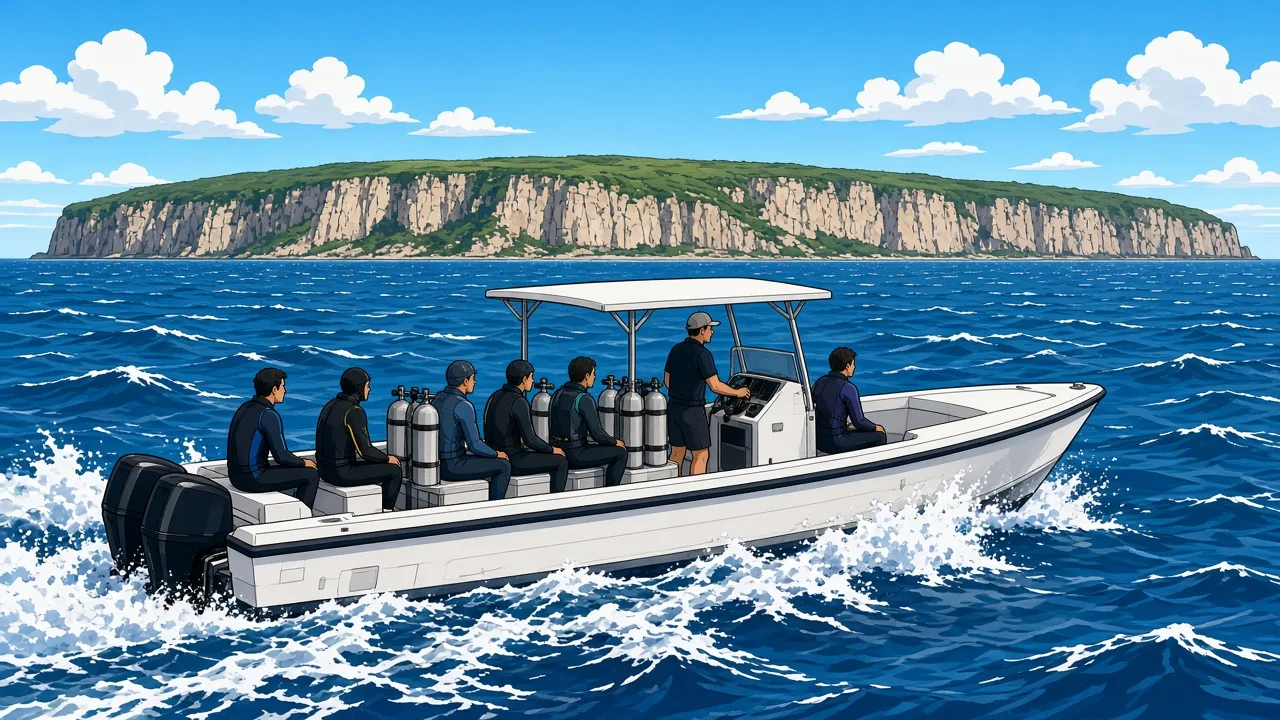
Dive boats are small, fast and often stop with engines idling while divers kit up or wait for a group to surface. A boat rolling side to side at rest is harder on the stomach than one moving forward at speed. Diesel exhaust drifting over the deck at idle makes it worse, which is why Divers Alert Network (DAN) advises keeping away from engine fumes, cigarette smoke and strong smells.
Other factors that make seasickness more likely include:
- A hangover or a late night, both of which DAN lists as things to avoid the day before.
- An empty stomach, or a large greasy meal.
- Looking down to assemble gear or check a camera while the boat moves.
- Anxiety about the dive, which a 2020 literature review in the Journal of Education, Health and Sport linked to stronger symptoms.
- Heat, and a tight wetsuit zipped up too early.
Seasickness and scuba diving: can you dive if you are seasick?
Yes, if the nausea is mild and fades once in the water, but not while vomiting repeatedly, dizzy or unable to keep water down. A diver who cannot think clearly or stay hydrated on the surface should sit the dive out.
Many divers find that getting in the water is the best cure. Below a few metres the surface motion disappears, and divers who felt awful on the boat often feel fine within a minute of descending. Some operators let a queasy diver gear up first and enter the water as soon as the boat is in position, to cut down the time spent rolling at the surface.
The picture changes when seasickness becomes severe. Repeated vomiting causes dehydration, and while the research linking mild dehydration to decompression sickness is limited, it is still one of the risk factors listed in the guide to avoiding decompression sickness. A severely seasick diver is also slower to react, less able to manage buoyancy, and more likely to make poor decisions under pressure.
| How the diver feels | Usual decision |
|---|---|
| Slightly queasy, improves with the horizon | Dive, enter the water early |
| Nauseous but alert, keeping water down | Dive, stay shallow and tell the buddy |
| Vomited once, now feels better | Rehydrate first, then decide |
| Repeated vomiting or dizziness | Sit the dive out |
| Drowsy or confused after a new tablet | Sit the dive out |
How to vomit underwater safely
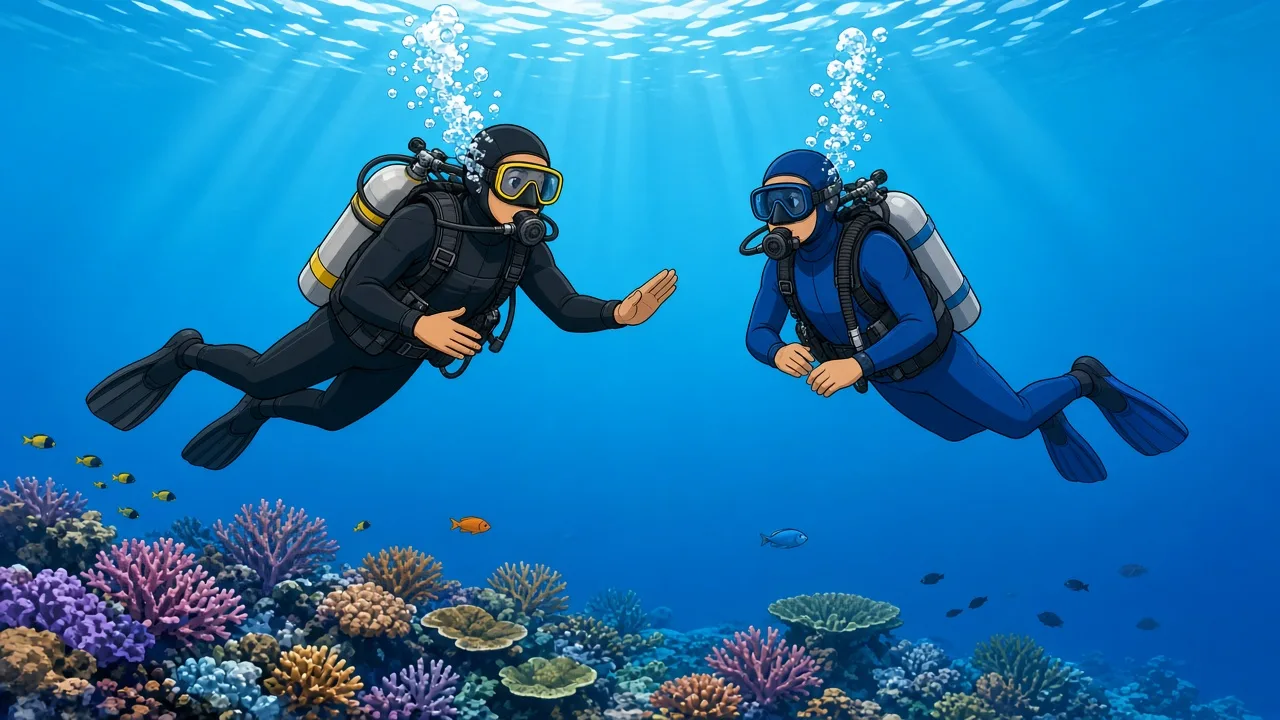
Vomiting underwater sounds alarming but is manageable with the right technique, which instructors teach because it does happen. The rule is to keep the regulator in the mouth and vomit through it. The exhaust valve clears most material, and a press of the purge button clears the rest before the next breath. Taking the regulator out risks inhaling water at the reflexive gasp that follows vomiting.
A diver who feels sick underwater should signal the buddy first, using the "something is wrong" sign shown in the guide to diving hand signals and pointing to the stomach. The buddy can then stay close, hold onto the diver if needed and help with a slow, controlled ascent with a safety stop. The urge to bolt for the surface is the real danger, since a rapid ascent carries far more risk than the nausea itself.
Seasickness is not the only cause of nausea on a dive holiday. A stomach bug, covered in the guide to Bali belly, causes nausea that does not improve underwater and often comes with cramps and diarrhoea. Divers with symptoms on dry land as well as on the boat are probably dealing with something other than seasickness.
Seasickness tablets for divers: which are safe?
No seasickness medicine is risk-free for diving, because most cause some drowsiness. The usual options are the scopolamine patch and older antihistamines such as cinnarizine, meclizine and dimenhydrinate, and each should be tested on a non-diving day first.
DAN's guidance is consistent on this point: experiment with a medication before using it while diving, and never dive on a medicine taken for the first time. Canadian Forces guidelines for diving medical officers go further, noting that the antihistamine and anticholinergic motion sickness drugs commonly cause sleepiness, visual disturbance, dizziness and confusion, "none of which are compatible with diving", and that a test dose should be used to check each person's reaction.
| Medicine | Common brands | Take it | Drowsiness | Notes for divers |
|---|---|---|---|---|
| Scopolamine (hyoscine) patch | Transderm Scop, Scopoderm | 8 to 16 hours before | Lower | Prescription; dry mouth, blurred vision |
| Cinnarizine | Stugeron | About 2 hours before | Moderate | Not sold in the US |
| Meclizine | Bonine, Dramamine Less Drowsy | 1 hour before or the night before | Lower to moderate | Long-acting, once a day |
| Dimenhydrinate | Dramamine, Gravol | 30 to 60 minutes before | Higher | Short-acting, repeat doses |
| Promethazine | Phenergan | 1 to 2 hours before | High | Usually avoided for diving |
The timings above are typical label directions and vary by product and country, so the packet and a pharmacist take priority. Newer hay fever antihistamines such as loratadine and cetirizine do not work for motion sickness, according to a 2022 Cochrane summary, and are not substitutes.
Drowsiness matters most on deeper dives, such as the deep adventure dive of an Advanced Open Water course, where nitrogen narcosis below about 30 metres can add to any sedation from a tablet. A diver who feels even slightly foggy on a medicine should stay shallow or skip the dive.
The scopolamine patch
DAN's travellers' medical guide calls the scopolamine patch the preferred treatment for divers and notes that the US Navy evaluated it and found minimal adverse effects in divers. The patch holds 1.5 mg of the drug, sits behind the ear and releases it steadily for three days. US Pharmacist reports that it works better when applied 8 to 16 hours before the trip than when applied less than four hours beforehand.
It has drawbacks that matter underwater. DAN lists dry mouth, drowsiness and blurred vision, and warns that a dilated pupil from touching the patch and then an eye can look like a neurological sign and "prompt an unnecessary evacuation or chamber treatment". Wearing a patch for more than three days can cause withdrawal symptoms that mimic decompression sickness. People with glaucoma or an enlarged prostate should not use it without medical advice.
Cinnarizine, meclizine and dimenhydrinate
These older antihistamines are the tablets most divers buy over the counter. A 2022 Cochrane review of antihistamines for motion sickness found they probably prevent symptoms under real travel conditions, with 40 percent of people protected compared with 25 percent on placebo, and that they make people drowsier than placebo.
Head-to-head comparisons are few. A double-blind crossover study of naval crew, comparing a scopolamine patch with 25 mg cinnarizine tablets on two voyages, found the patch more effective and less sedating: 34 percent reported moderate to high drowsiness on cinnarizine against 17 percent on the patch, and 41 percent preferred the patch against 12 percent who preferred cinnarizine.
Medicine works before symptoms start, not after
Both Cochrane reviews, on scopolamine in 2011 and on antihistamines in 2022, found no studies showing that these drugs relieve seasickness once it has begun. A tablet swallowed after the nausea starts is also likely to come straight back up. The practical lesson is to take the chosen medicine on time, before boarding, rather than waiting to see how the crossing goes.
How to prevent seasickness on a dive boat
Sit low and in the middle of the boat, watch the horizon, eat a light breakfast, stay hydrated and avoid alcohol the night before. Together these steps prevent most cases, with or without medication.
The day before
DAN advises avoiding alcohol and heavy meals the day before a boat dive, and some divers find that taking meclizine or dimenhydrinate the night before works better than taking it in the morning. Alcohol dehydrates, disturbs sleep and lingers into an early start, as the guide to scuba diving and alcohol explains. A full night's sleep helps more than most remedies.
The morning of the dive
DAN recommends a light meal 45 to 60 minutes before boarding, because an empty stomach is more easily upset. Dry toast, crackers, bananas or plain rice are typical choices; fried food, dairy, citrus juice and strong coffee are not. Drinking water steadily, rather than in large gulps, keeps hydration up without filling the stomach.
On the boat
- Sit low and in the middle. The centre of the boat moves least. The bow rises and falls the most, and an upper deck sways more than a lower one.
- Watch the horizon. A fixed point in the distance brings the eyes and the inner ear back into agreement. Phones, cameras and logbooks should wait.
- Set up gear early. DAN suggests assembling equipment on the dock or before the boat leaves, so there is no need to look down in a swell.
- Stay in fresh air. Sit upwind of the engines and away from smokers.
- Keep cool. Leave the wetsuit rolled down until shortly before the dive.
- Get in first. Ask the crew if a queasy diver can enter the water as soon as the boat is in position.
Ginger, wristbands and other remedies
Ginger has the best evidence of the non-drug options, though it is mixed. In a randomised trial of 80 Danish naval cadets in heavy seas, 1 gram of powdered ginger root reduced vomiting and cold sweats compared with placebo. The US National Center for Complementary and Integrative Health (NCCIH) summarises the wider evidence as some studies showing benefit and others none. Ginger causes no drowsiness, which makes it a reasonable first option for mild cases.
Acupressure wristbands are popular, but NCCIH states that research does not support acupressure or magnets for motion sickness. The same summary notes some evidence that fresh air, favourite music and slow diaphragmatic breathing can help, all of which cost nothing on a dive boat.
Once a diver starts to feel sick, the options are limited: move to the centre of the boat, look at the horizon, sip water, nibble a cracker, and get into the water as soon as the dive allows. Lying down with the eyes closed helps some people between dives, when there is room on deck.
Dizzy after a dive: seasickness, land sickness or something else?
A rocking sensation on land after a boat trip is usually land sickness, known medically as mal de débarquement, and it normally fades within hours. True spinning vertigo, ringing in the ears, hearing loss or numbness after a dive are not seasickness and need medical advice the same day.
Land sickness is the reverse of seasickness: the brain has adapted to the boat's motion and keeps expecting it after the diver steps ashore. It is common after a full day on the water or a week on a liveaboard, and it feels like the floor is gently moving. It needs no treatment and tends to pass after a night's sleep.
Dizziness after diving can also come from the ear itself. A forceful equalisation or a fast ascent can injure the inner ear, as the guide to diving barotrauma describes, and inner ear decompression sickness causes vertigo, nausea and vomiting that can look exactly like seasickness. The difference is timing and pattern: seasickness improves once the boat motion stops, while an inner ear injury does not, and it often comes with hearing changes or ringing.
Any diver with vertigo that starts or worsens after surfacing should breathe oxygen if it is available and contact DAN's emergency hotline or a dive doctor. The guide to the hyperbaric chamber in Bali covers how divers on the island are assessed. Divers who want to recognise these differences in others can learn them on a PADI Rescue Diver course, which covers assisting an unwell diver at the surface and underwater, while CPR and basic patient care are taught on the Emergency First Response course.
Choosing a dive trip if you get seasick
Divers who are badly affected can still dive plenty: shore diving needs no boat, short crossings leave little time to get sick, and larger boats roll less. Season matters too, since calmer months mean flatter crossings.
| Type of diving | Time on the water | Motion | Example |
|---|---|---|---|
| Shore diving | None | None | Tulamben, Amed |
| Short boat ride | 5 to 15 minutes | Low | Padang Bai, Menjangan |
| Speedboat crossing | 30 to 60 minutes | Moderate to high | Nusa Penida from Sanur |
| Liveaboard | Several days | Moderate, steadier hull | Komodo, Banda Sea |
Shore diving is the simplest answer. The USAT Liberty wreck lies about 30 metres from the beach in Tulamben, and many of the reefs around Amed are reached by walking in from the shore or with a five-minute ride in a traditional jukung. Menjangan Island diving in the north-west involves a crossing of around half an hour on usually sheltered water. These sites suit divers who want to build confidence before tackling a longer crossing.
Liveaboards surprise many divers. A larger liveaboard such as the King Neptune liveaboard or one of the other Indonesia liveaboards rolls more slowly than a small speedboat, and most guests adapt within a day or two. DAN notes that wider-beamed boats are more stable, and recommends choosing the largest boat available. Divers who know they suffer badly should still take precautions for the first night and discuss medicine with a doctor before a week of diving in Komodo or the Banda Sea, where open-water crossings between islands can be rough.
Timing helps as well. The months with lighter winds usually bring flatter seas, and the guide to Bali diving conditions sets out the seasonal pattern for each area. Morning departures are generally calmer than afternoons almost everywhere, because sea breezes build through the day. Non-divers in the group who also get seasick may prefer snorkelling trips from shore or from short boat rides.
Example: the Sanur to Nusa Penida crossing
The crossing from Sanur to Nusa Penida is a useful example because it is short but crosses open water. It covers about 12 km and takes 35 to 45 minutes on a dive speedboat: roughly ten minutes in the protected Sanur lagoon, around twenty across the Badung Strait, where swell can build, and a final five to ten in the calm lee of Nusa Penida. The full day is set out in the guide to a Nusa Penida day trip from Sanur.
Most mornings from May to October are smooth. When the south-east trade wind picks up, typically on June to August afternoons, or on days with a strong southern swell, the middle section gets bumpy for 15 to 20 minutes. Neptune Scuba Diving, which runs this crossing daily from its dive centre in Sanur, reports that about one in fifteen first-time passengers feels mildly seasick, and the return crossing is usually smoother because the wind eases after midday. The operator reschedules trips when the forecast shows swell above 2 metres or winds above 25 knots.
On a typical Nusa Penida dive trip, the first dive starts shortly after arrival, so a diver who feels queasy on the way is usually in the water within minutes of the boat stopping. Divers who know they suffer can take a tested tablet before the hotel pickup, sit in the middle of the boat, and ask to be among the first in the water.
This trip is not the best choice for divers who are severely seasick even on calm water, who may be happier starting with shore dives in Tulamben and Amed. Nusa Penida's currents also suit certified divers with some logged dives better than first-timers, and many divers take a Drift Diver specialty before the stronger sites. Divers flying home should allow at least 18 hours after the last of several dives, as DAN recommends.
Key takeaways
- Seasickness is motion sickness from a boat, caused when the inner ear feels rocking that the eyes do not see.
- Most seasick divers feel better within minutes of descending, but repeated vomiting, dizziness or drowsiness mean sitting the dive out.
- If you vomit underwater, keep the regulator in, vomit through it, purge, and ascend slowly with your buddy.
- Seasickness medicines prevent symptoms rather than cure them, so take a tested one before boarding.
- Sit low and central, watch the horizon, eat lightly and set up gear before the boat leaves.
- Vertigo or hearing changes after a dive are not seasickness and need medical advice.