
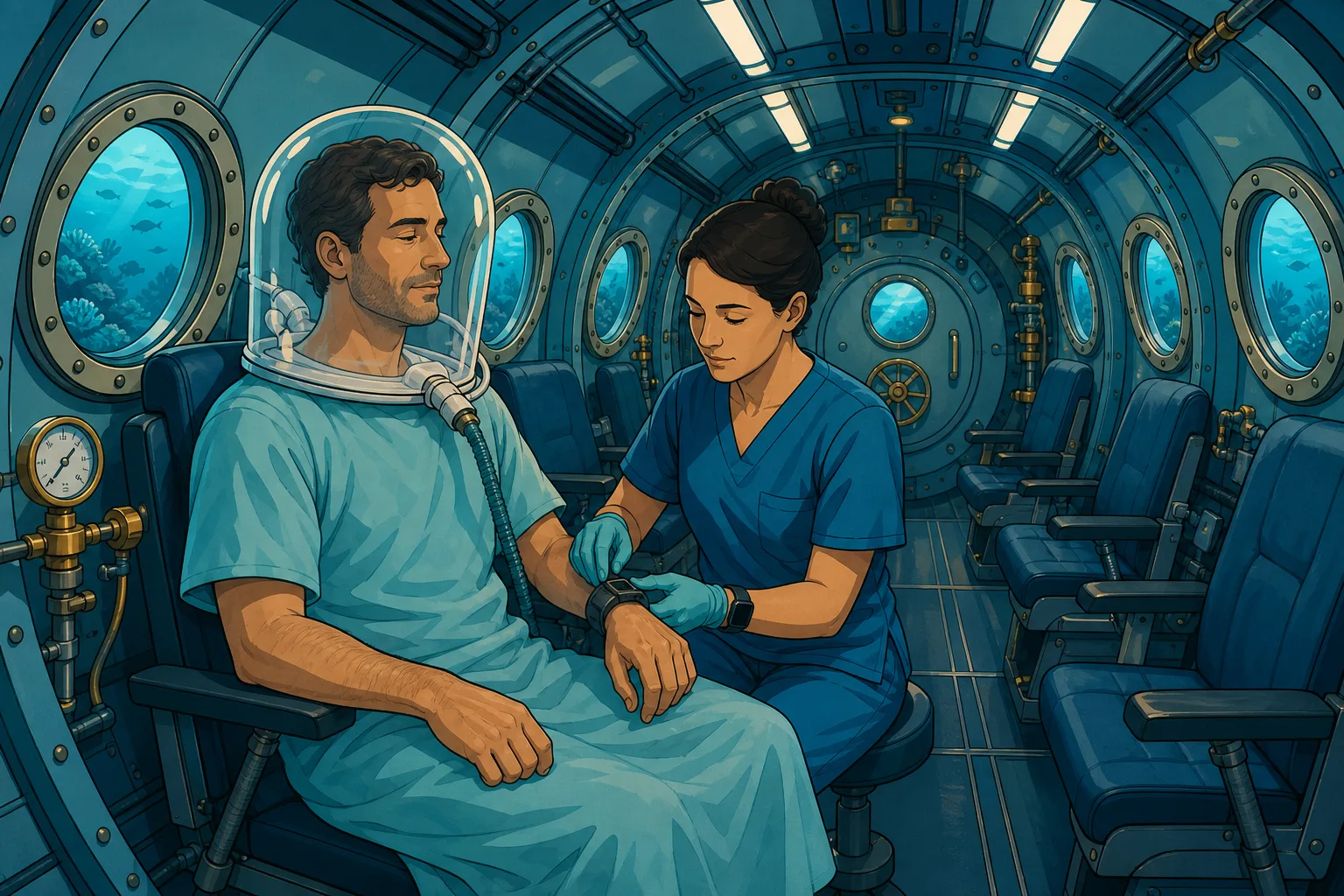
The nearest hyperbaric chamber in Bali is closer than most divers think, and it is almost never the one the internet tells you about. There are two working recompression chambers on the island. One sits in Denpasar, the other on the east coast at Saba in Gianyar, roughly forty minutes from Padang Bai and on the road you already drive to Tulamben. Knowing which is which, and who to call at 2am, is the sort of thing we cover properly in a PADI Rescue Diver course, because it is the difference between a bad afternoon and a permanent injury.
We run our boats out of Sanur. In the years we have been doing it, the number of guests we have sent for recompression is very small, and that is not luck. It is conservative profiles, honest briefings, oxygen on every boat, and guides who have done the Emergency First Response course and actually remember it. But small is not zero, and a guest who has read this page before they arrive is a guest who tells us about the tingling in their fingers at the surface instead of on the flight home.
This is the honest version. Where the chambers are, what the phone numbers are, what decompression sickness actually feels like, what a treatment run involves, roughly what it costs, and what we do to keep you out of one.
Hyperbaric Chamber in Bali: The Short Version
If you only read one section, read this one.
Bali has two hyperbaric chambers. The Hyperbaric and Diving Medicine Centre at Kasih Ibu Hospital Saba, in Gianyar on the east coast, opened in July 2019 and is a Divers Alert Network preferred provider with a multi-place chamber and 24 hour emergency cover. The second is at the big public hospital in Denpasar, now called RSUP Prof. dr. I.G.N.G. Ngoerah, which most older blogs and guidebooks still call Sanglah. It was renamed in 2022. Plenty of dive-safety pages have never caught up.
That naming lag matters more than it sounds. If you are in a car at midnight repeating a hospital name that no longer appears on the signage, you lose time you do not have.
There is no chamber on Nusa Penida. There is no chamber on the Gili Islands. If something goes wrong on a Nusa Penida dive trip, the treatment is on the other side of a boat crossing, and that shapes how we plan those days.
Where Bali's Two Hyperbaric Chambers Actually Are
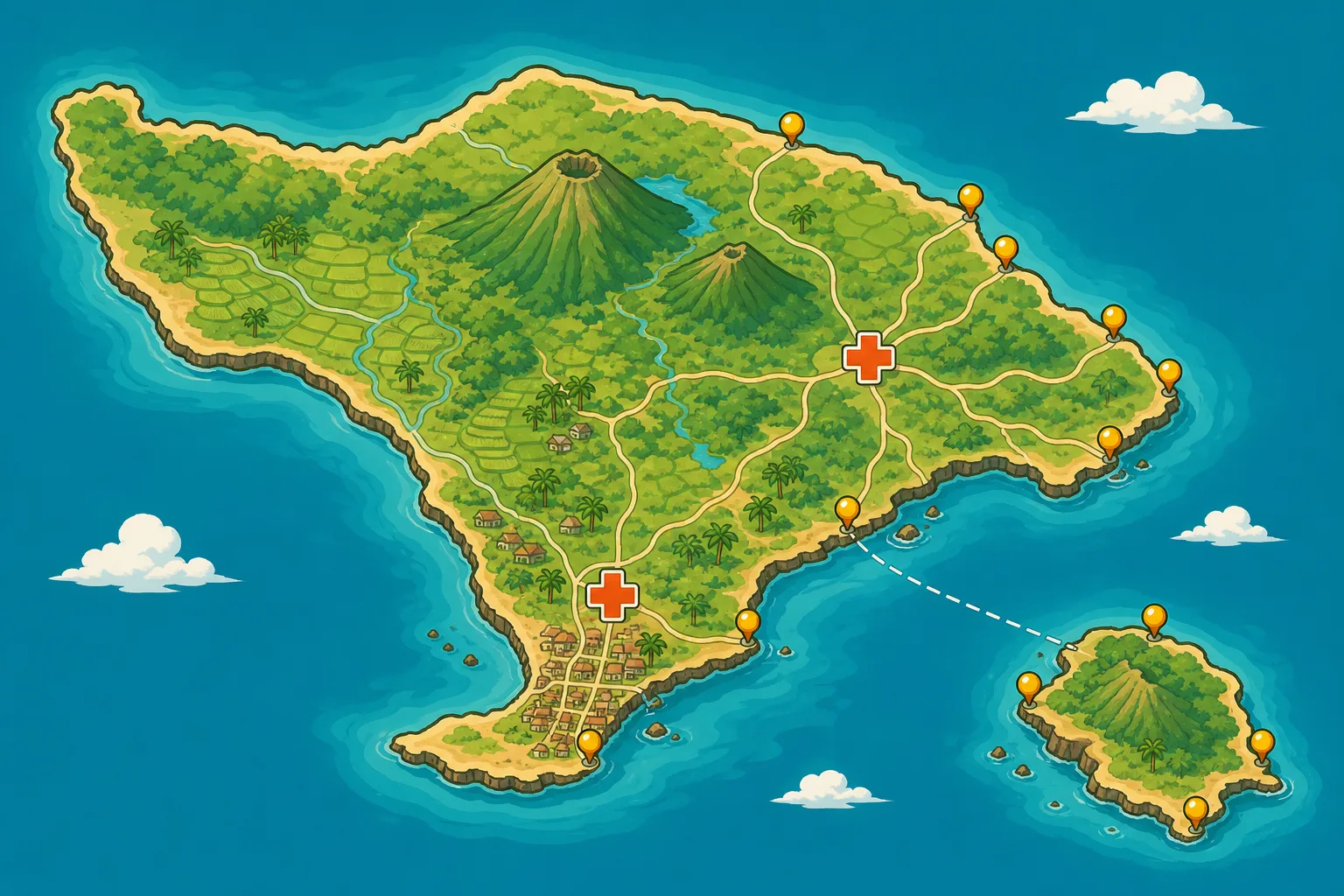
Here is the practical layout, with the caveat that follows every list like this one.
| Facility | Where | Chamber | Notes |
|---|---|---|---|
| Hyperbaric & Diving Medicine Centre, Kasih Ibu Hospital Saba | Jl. Pantai Saba No.9, Saba, Blahbatuh, Gianyar | Multi-place, 24/7 emergency | DAN preferred provider. Opened July 2019. Closest chamber to Padang Bai, Amed and Tulamben. |
| RSUP Prof. dr. I.G.N.G. Ngoerah (formerly Sanglah) | Jl. Diponegoro, Dauh Puri Klod, Denpasar | Older facility | Bali's main public hospital. Closest chamber to Sanur, Kuta and the airport. |
Verify before you rely on this. These details are accurate as we write this in August 2026. Chambers go offline for maintenance, staff rotate, and phone extensions change. DAN's own Recompression Chamber Network reports note that Indonesian chamber availability shifts often enough that they treat it as a live problem rather than a static list. Do not treat any blog post, including this one, as your emergency plan. Call DAN and let them tell you which chamber is actually accepting patients tonight.
The Numbers Worth Saving to Your Phone
Save these before you get on a plane, not after.
- DAN emergency hotline, within Indonesia: +62-21-5085-8719. DAN added a Bahasa Indonesia hotline team specifically because language was costing people time.
- DAN emergency hotline, international English: +1-919-684-9111, staffed 24 hours a day, every day. DAN medics will help whether or not you are a member.
- Kasih Ibu Hospital Saba, Gianyar: +62 361 300 3333.
- RSUP Prof. dr. I.G.N.G. Ngoerah, Denpasar: +62 361 227911.
- Your dive centre. If you dived with us, call us. We know the road, we speak the language, and we have made the call before.
One thing divers consistently get wrong: they call the hospital first. Call DAN first if you can. DAN medics triage, confirm which chamber is live, and start the insurance conversation in parallel. A hospital switchboard at 1am cannot do any of that.
What Decompression Sickness Actually Feels Like
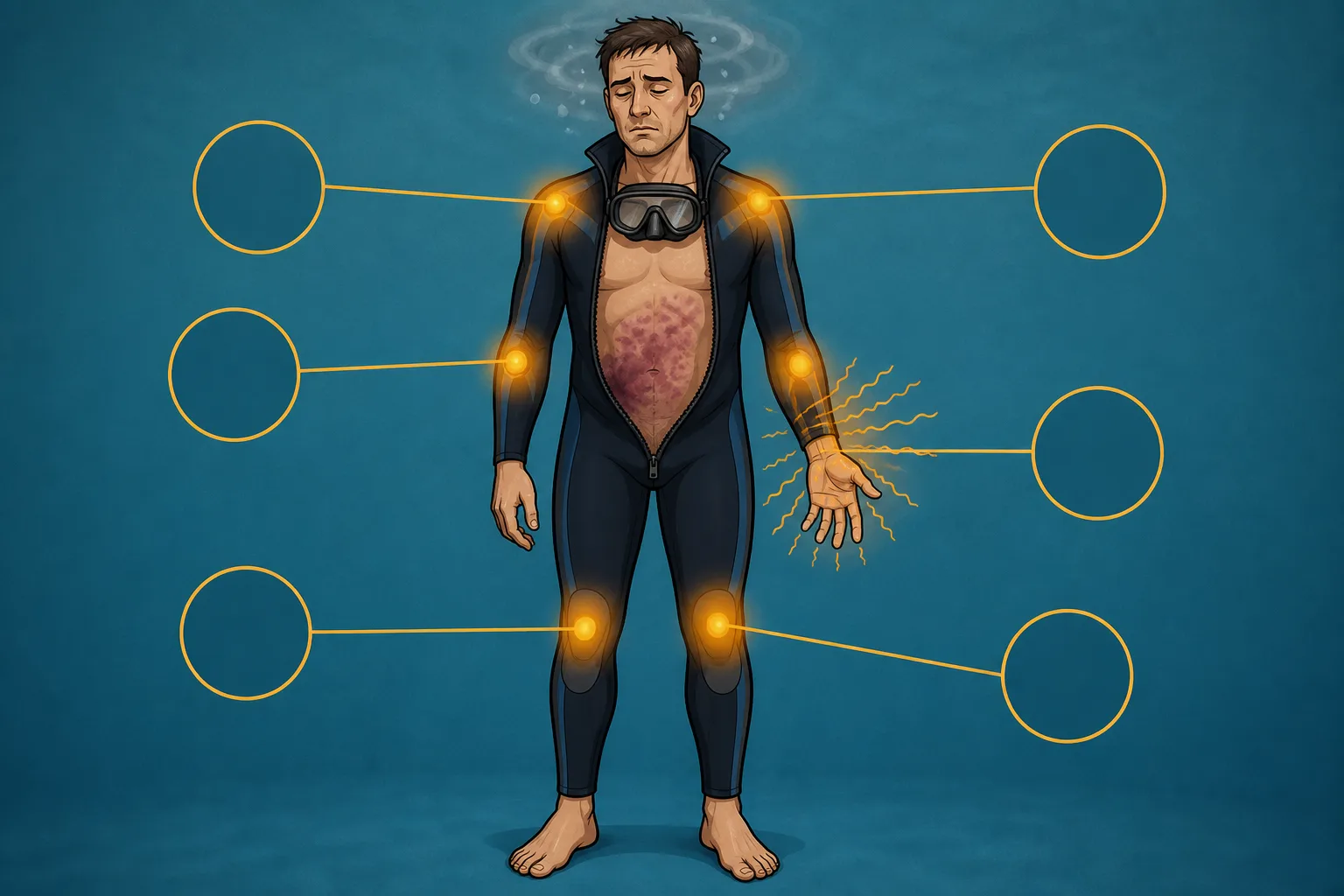
Forget the film version. Nobody clutches their chest and collapses on the swim step. Real decompression sickness in a recreational diver is usually boring, vague and easy to explain away, which is exactly why it gets missed.
The most common presentation we hear about is a deep, dull ache in a shoulder or an elbow that turns up an hour or two after the last dive. It does not feel like an injury. It does not have a sharp point you can press. Divers describe it as being inside the joint. The second most common is fatigue that is out of proportion to the day, the kind where a guest goes quiet on the boat ride home and puts it down to sun and salt.
| What you notice | What it might mean | Typical timing |
|---|---|---|
| Deep ache in shoulder, elbow, knee or hip | Joint or "type 1" DCS, the most common form | Often 1 to 6 hours after surfacing |
| Unusual, heavy fatigue | Frequently the earliest sign, and the most ignored | Within a few hours |
| Blotchy, marbled or itchy skin, often on the torso | Cutaneous DCS, sometimes a warning of more | Minutes to hours |
| Pins and needles, numbness, weakness in a limb | Neurological DCS, urgent | Minutes to hours |
| Dizziness, confusion, difficulty walking or speaking | Serious neurological involvement, emergency | Often rapid |
| Breathlessness or chest pain after a fast ascent | Possible lung overexpansion injury, emergency | Usually within minutes |
Most cases show up within six hours. Some show up later, which is why we ask guests to tell us about anything odd even if the boat is long since back on the mooring in Sanur.
The single most useful thing you can do is drop the phrase "I do not want to make a fuss." We would far rather put a guest on oxygen for forty minutes and have it turn out to be a stiff shoulder from lugging a tank than the other way round. Nobody has ever been embarrassed in front of us for reporting a symptom. We do not run that kind of shop.
It Is Not Always About Breaking the Rules
Here is the uncomfortable part that certification courses sometimes soften. You can get bent inside your computer's limits. Dehydration, a long hot drive, poor sleep, alcohol the night before, a hard current swim, being cold at depth, age, body composition and a patent foramen ovale you never knew you had all shift the odds. The tables and algorithms are population statistics, not personal guarantees.
That is why our answer to is scuba diving dangerous is never a flat no. It is a managed risk with a very good safety record, and the management is the whole point. Depth discipline is part of that, and so is alcohol, which we are blunt about at the counter: a heavy night before a deep morning is a genuinely bad combination, not a joke.
The Nusa Penida Problem: There Is No Chamber on the Island
This is the section most Bali dive-safety pages skip, and it is the one that actually changes how a trip should be planned.
Nusa Penida is the headline dive of most Bali trips. Manta Point, Crystal Bay, the cold upwellings that bring mola mola in season. It is also an island with no recompression chamber, reached by a 45 minute speedboat crossing from Sanur, through a strait that can turn genuinely unpleasant.
DAN's Recompression Chamber Network report published in July 2025 describes a case from October 2024: a request for a sea evacuation from Nusa Penida to Bali after a diving accident, with no chamber available on the island. The evacuation had to run at night in bad weather. DAN's account notes the effort involved in confirming the boat was seaworthy and the crew knew the conditions, and that the patient reached hospital at 2am. Under normal daylight conditions it would have been routine. It was not routine.
That is the honest picture of a Penida day. The diving is world class. The evacuation chain is a boat ride, a car, and a hospital admission, and every link takes time.
So we plan Penida days conservatively, and we say so at the counter. Shallower profiles than your computer would allow. Longer surface intervals than the schedule strictly needs. No third deep dive because somebody is keen. When the current at Crystal Bay is running hard and the group is mixed, we move to a gentler site rather than talk everyone into it. On somewhere between five and ten days a year the crossing or the conditions are bad enough that we cancel and offer Tulamben instead, which is a three hour drive but also an hour closer to a chamber, on land, the whole way.
Guests occasionally push back on that. We understand. You booked a holiday, not a risk assessment. But we would rather lose the argument at 7am than make the call DAN wrote up in that report. If you want the full picture of what those days look like, our diving Nusa Penida guide walks through the schedule, the currents and the conditions honestly.
The First Hour Matters More Than the Chamber
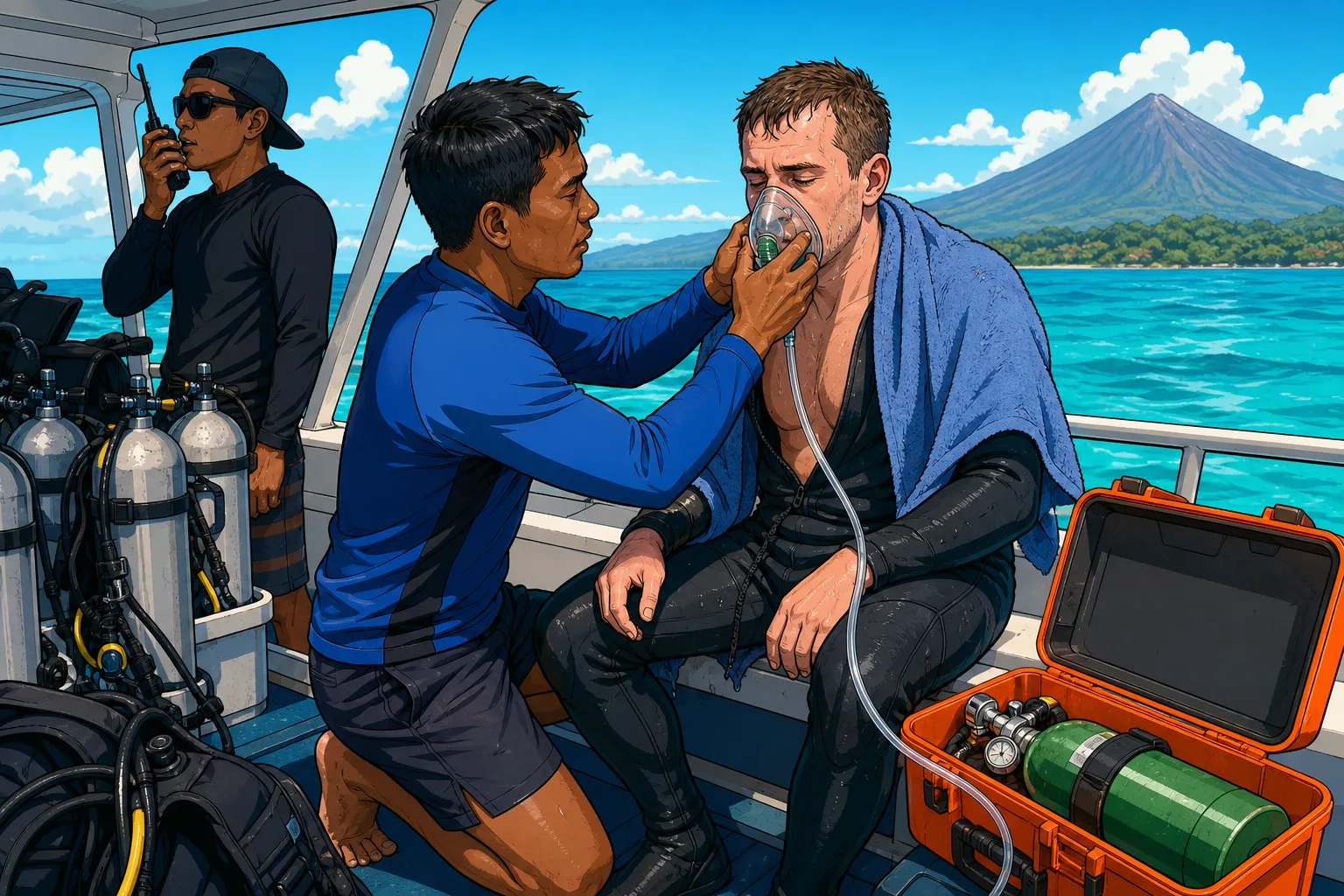
Here is the thing that surprises people. The chamber is the treatment, but the first hour on the boat is what most changes the outcome.
High-flow oxygen at the surface, delivered early and kept going, does real work. It steepens the gradient that pulls inert gas out of the tissues and it improves oxygen delivery to tissue that is already in trouble. Divers who get oxygen promptly tend to arrive at the chamber in better shape and often need fewer treatment runs. Divers who wait, because they were not sure, because they did not want to ruin the day, because the symptom was only a bit of tingling, arrive worse.
What that means in practice on our boats:
- Emergency oxygen with a non-rebreather mask goes on and stays on. Not for five minutes. Continuously, until somebody more qualified than us says otherwise.
- Fluids by mouth if the diver is fully alert and can swallow safely. Water, not coffee, and definitely not a celebratory Bintang.
- The diver lies flat and stays still. No walking around, no "let me just try the shoulder."
- Somebody writes down the dive profile while it is fresh. Max depth, bottom time, ascent rate, surface intervals, gas used, anything unusual. Photograph the computer screen. The chamber team will ask, and memory is unreliable when everyone is stressed.
- Somebody calls DAN. In parallel, not afterwards.
- Nobody, under any circumstances, goes back in the water to "recompress" the diver. In-water recompression with recreational gear kills people. It is not a debate.
This is exactly the content of the Rescue Diver course, and it is why we push it harder than any other certification. It is the course that stops being about you and starts being about the person next to you. If you only ever take one course beyond Open Water and Advanced, make it that one. It is also the point where a lot of people realise they want to keep going towards Divemaster.
What a Chamber Ride Is Actually Like
Divers imagine something out of a submarine film. The reality is closer to a very long, very dull flight in a steel tube where the entertainment system is a plastic hood over your head.
The standard first treatment for decompression sickness is a protocol usually referred to as US Navy Treatment Table 6. In broad terms, the chamber is pressurised to the equivalent of about 18 metres of seawater, you breathe pure oxygen in timed periods with scheduled air breaks in between so your body does not get too much oxygen at once, and the whole run takes somewhere in the region of four and three quarter hours before the chamber returns to surface pressure. Multi-place chambers, like the one at Saba, let an attendant sit inside with you, which most patients find enormously reassuring.
Things nobody warns you about:
- You have to equalise on the way down, exactly like a dive, except you are lying on a bench feeling unwell. Everything you learned about clearing your ears gently applies here too.
- It gets warm during pressurisation and cool on the way back up. That is just gas physics doing its thing.
- One run is often not the end of it. Many cases need follow-up treatments on subsequent days, typically shorter ones.
- You will not be flying home on schedule. Plan for that emotionally as well as financially.
On flying: this is where a lot of otherwise sensible divers come unstuck even without DCS. Standard guidance is a minimum of 12 hours before flying after a single no-decompression dive, and 18 hours or more after multiple dives across several days. We build that into every itinerary we plan, and we explain the reasoning in our article on flying after scuba diving. If you have actually been treated for DCS, the timeline is not 18 hours, it is whatever the treating physician tells you, and it is usually measured in days or weeks.
What It Costs, and Why Insurance Is Not Optional
We will be careful here, because precise pricing in this space is genuinely hard to pin down and we would rather under-promise than quote you a number that turns out to be wrong when it matters.
The honest summary: recompression treatment is expensive, and the figures quoted around Indonesia for a single chamber session run into the thousands of US dollars, not the hundreds. A typical course of treatment is several sessions rather than one. Add hospital admission, physician fees, and, if the incident happened somewhere like Nusa Penida or on a liveaboard, the cost of getting you to the chamber in the first place. Sea and air evacuation is the line item that turns a large bill into a catastrophic one.
Which is why the actual advice is short. Get dedicated dive accident cover. DAN membership with dive accident insurance exists precisely for this scenario, and it bundles the thing that is hardest to buy in a panic, which is 24 hour medical coordination by people who understand diving injuries.
Check three specific things in whatever policy you hold:
- Does it name recompression treatment? General travel insurance often excludes it, or excludes scuba entirely, or covers it only to a depth limit.
- Does it cover evacuation, by sea as well as air? In Indonesia the first leg is frequently a boat.
- Does it cover you to the depth you actually dive? A policy capped at 18 metres is not much use on an Advanced course or a Deep Diver specialty.
If you are joining a liveaboard, this stops being advice and becomes a requirement. On a trip like King Neptune in the Banda Sea you can be a very long way from any chamber, and every reputable operator will ask to see your cover. We do.
The Bali-Specific Risk Factors Nobody Puts on a Poster
Generic dive-safety advice was mostly written for cooler places. A few things about diving here genuinely shift your risk, and they are worth knowing before you arrive.
The Mountain Road Home
This is the one almost nobody thinks about, and it is the reason we plan north-coast trips the way we do.
If you dive Menjangan or anywhere on the north coast and then drive back to the south, one of the standard routes climbs over the central mountains through the Bedugul and Baturiti area. That road tops out well over a thousand metres. Driving to altitude after diving is not identical to flying, but it is the same category of problem: you are reducing ambient pressure while your tissues are still off-gassing, and the guidance for altitude exposure after diving is a good deal more conservative than most holidaymakers realise.
So we either route people back along the coast, which takes longer and is worth it, or we build in the surface interval before anybody gets in a car heading uphill. Guests who arrange their own transport sometimes discover this the hard way when a driver takes the scenic mountain route to save twenty minutes. Ask your driver which way they are going. It is a strange question to ask and a very sensible one. The same logic applies if you are pairing diving with the inland waterfalls and rice terraces. Order the trip so the mountains come before the diving, not after.
Heat, Dehydration and Bali Belly
Dehydration is a recognised contributor to decompression sickness, and Bali is very good at dehydrating people. Thirty degrees on the boat deck, sun off the water, a long transfer, and the diuretic effect of immersion itself all stack up before you have even considered last night's drinks.
Then there is the local variable. A guest who has spent the night with a stomach upset has lost fluid and electrolytes, slept badly, and often eaten nothing, and they will still turn up at 7am because they paid for the trip and do not want to waste it. We would rather move the booking. It is genuinely not a problem for us, and diving dehydrated on no sleep is a worse deal than losing a day. Our health and vaccinations guide for divers covers the wider medical side of a Bali trip.
Practical version: drink more water than feels necessary on the day before and the morning of, go easy on coffee and alcohol, and tell your guide if you have been unwell. We keep water on the boat and we will nag you about it.
Cold Water Where You Did Not Expect It
People pack for the tropics and then meet a Nusa Penida upwelling. Water that is a comfortable 28 degrees at Tulamben can drop dramatically at Crystal Bay in mola season, occasionally into the high teens. Being cold at depth changes your circulation and your off-gassing, and a shivering diver is also a diver who is task-loaded and breathing hard. A properly thick wetsuit is a safety item on those days, not a comfort item. We carry 5mm for Penida trips in season and we will tell you when you want one.
How We Try to Never Need Any of This
Everything above is the plan for a day we work hard to avoid. The avoiding is less dramatic and much more effective.
We dive more conservatively than the computer allows. Our guides run the group shallower than the no-stop limit, add a three minute safety stop as a minimum rather than a nicety, and ascend slower than most people's training habit. Nobody has ever complained on the boat home that the dive was too safe.
We use nitrox where it helps. On repetitive days, particularly multi-day trips around Amed and Menjangan, enriched air gives a real margin. It does not make you invincible and we say so, but the extra buffer on day three of five is worth having. Our nitrox diving in Bali guide explains when it earns its keep, and the Enriched Air Diver course is a two-session add-on for most people.
We care about your buoyancy, selfishly. A diver who cannot hold a stop is a diver who does sawtooth profiles and uncontrolled ascents. That is a DCS risk factor dressed up as a skills problem. It is why we nudge people towards Peak Performance Buoyancy far more often than we push any deep specialty.
We match the site to the diver, not the diver to the booking. If somebody has ten logged dives and wants a hard current site, the answer is a friendly no and a better suggestion, often Padang Bai rather than the harder water at Gili Mimpang and Tepekong. Our breakdown of Bali diving conditions by season is the same information we use ourselves.
We ask about health honestly, and we expect honest answers. The medical form is not paperwork theatre. Asthma, heart conditions, recent surgery and medication all matter. We wrote a whole piece on diving with asthma because the real answer is more nuanced than the internet's yes or no.
Oxygen is on every boat, checked, full and in date. Ask any operator you are considering to show you theirs. A good one will be pleased you asked. If they look annoyed or have to go and find it, book somewhere else. That advice applies well beyond us, and it is the single best filter for choosing a dive centre in Bali.
What We Tell Guests at 7am in Sanur
The counter conversation is short, and it is roughly this.
Bali has two chambers, one on the east coast at Saba and one in Denpasar, and we know the road to both. There is oxygen on the boat. Your guide has trained for this and so has the boat crew. If anything feels wrong today, at any point, including after you get back to your hotel tonight, you tell us. Not tomorrow. Tonight.
Then we go diving, and almost always nothing happens, because almost always nothing happens. Recreational diving with a competent operator is a low-risk activity, and the statistics are genuinely reassuring. That is not the same as risk-free, and the difference between the two is preparation.
If you are planning a trip and want to talk through profiles, insurance, or how we structure multi-day itineraries so the last dive and the flight home do not collide, get in touch. Current course and trip rates are on our pricing page, and if you have never breathed underwater before, a try dive in calm, shallow water is a perfectly good place to start.
Save the DAN number in your phone before you fly. It costs nothing, it takes ten seconds, and on the one day in a thousand it matters, it is the most useful thing in your contacts.