
Guests ask us this at the counter in Sanur more often than anything else about safety, usually phrased as "what do I do so I don't get bent?" It is a better question than it sounds, and the honest answer is not the one most dive blogs give. Knowing how to avoid decompression sickness has less to do with drinking two litres of water before breakfast and much more to do with how cold you are, how hard you work, and how carefully you come up. We run Bali dive trips most days of the year, and what we see on the boat lines up with the research rather than with the folklore.
The folklore is stubborn because it is comforting. Drink water, do your safety stop, you will be fine. The evidence is messier and more useful than that. If you are still in training, the tables and the stop get covered properly on an Open Water course, and a good instructor will already be teaching most of what follows. This article is for the certified diver who wants to know which levers actually move the needle, in what order, and what that means on a real dive day in Bali rather than in a textbook.
How to avoid decompression sickness: the short version
If you read nothing else, read this. The ranking below is roughly the order in which these things matter, which is not the order in which they usually get taught.
- Come up slowly and stop. No faster than about 9 metres a minute, then three to five minutes at 5 metres. This is still the biggest lever you personally control.
- Get the thermal timing right. Cool on the way down and at depth, warm on the way up. The order matters enormously, and almost nobody teaches it.
- Watch when you work hard, not just how hard. Effort at depth loads you up. Effort at the end of the dive, or straight after it, is when bubbles form.
- Leave margin in the profile. Surfacing with time still on the clock costs you a few minutes and buys you a lot.
- Take real surface intervals and treat day four of a diving week differently from day one.
- Drink water, but stop treating it as the main defence. It is genuinely secondary, and DAN says so plainly.
- No hot shower, hot tub or spa massage straight after diving. This one catches people in Bali constantly.
What decompression sickness is, and how likely it actually is
The one paragraph version. Breathing air under pressure pushes extra nitrogen into your tissues. Come up slowly and it comes back out through your lungs, quietly, the way it went in. Come up too fast, or with too much of it dissolved, and it comes out of solution where it is, as bubbles, in joints, skin, spinal cord or brain. That is decompression sickness. If you want the symptoms, the treatment and where Bali's chambers are, we wrote that up separately in our guide to the hyperbaric chamber in Bali, and there is no point repeating it here.
Now the number that matters for perspective, because divers routinely overestimate it. Decompression sickness occurs in roughly two to four of every 10,000 recreational dives. DAN's own dive log database, analysing 127,957 dives from 5,907 divers, recorded 628 cases, an incidence of 0.49 per cent, and that figure is higher than the general rate partly because the divers who volunteer their logs to a research database tend to be doing longer, deeper and more repetitive dives than a holiday diver on a Sanur day boat.
So this is a low probability event that you can nudge lower. That framing matters, because the alternative framings are both wrong: it is neither something to be frightened of on a two tank morning at Padang Bai, nor something to be casual about on your fourth day of four dives a day. If you want the wider risk picture rather than just decompression, our piece on whether scuba diving is dangerous covers the statistics properly.
What the biggest study of real recreational dives found
Most prevention advice on the internet is a list of sensible-sounding habits with no weighting. The DAN study above is more interesting because it ranked things. It built a model from real dives and found twelve independent predictors of decompression sickness, and the model discriminated well, with an area under the curve of 0.910.
The strongest single predictor was a measure of how supersaturated the diver was on surfacing, which is really just a precise way of describing the dive profile. Median values were 0.866 on dives that produced decompression sickness against 0.743 on dives that did not. Translated into plain language: how deep you went, how long you stayed and how you came up still dominates everything else. The profile is the main event.
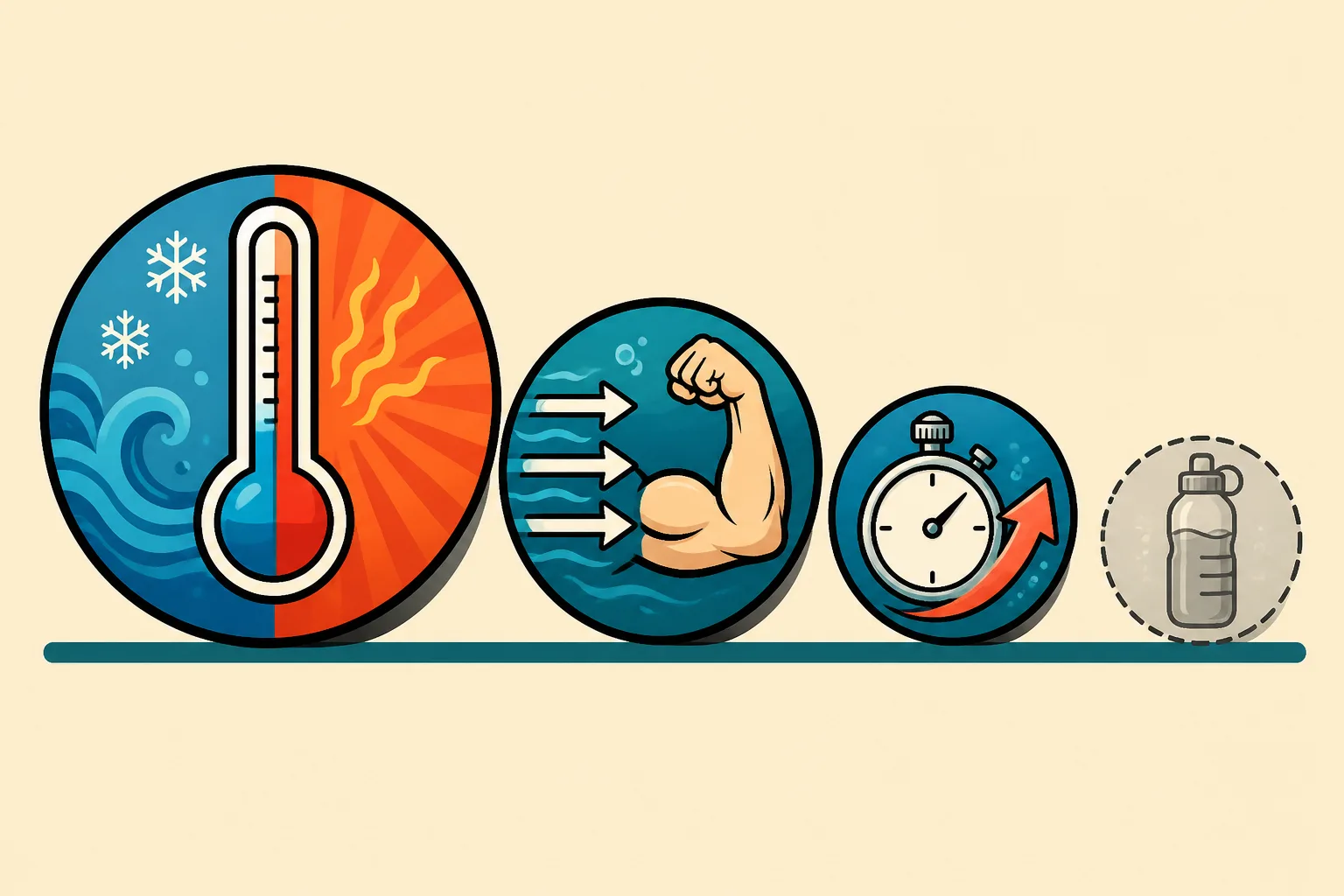
After the profile, the factors that a diver can actually influence lined up like this.
| Factor | Odds ratio | What it means on a dive day |
|---|---|---|
| Breathing more than one gas mix | 2.87 | Mostly a technical diving signal, not a recreational one |
| Thermal comfort during the dive | 2.83 | Your temperature is as influential as your gas plan |
| Exercise before diving | 2.06 | The morning gym session is not free |
| Workload during the dive | 1.61 | Fighting current at depth loads you up faster |
| Technical dive purpose | 1.36 | Longer, deeper, more staged profiles |
| Shorter surface intervals | 0.96 per hour | Every extra hour on the boat helps a little |
Two things are worth saying about this study rather than just quoting it. First, hydration does not appear in that list at all. Second, some of the findings are odd in ways that should make you cautious about reading any single number too literally. Feeling tired before a dive came out protective, at an odds ratio of 0.30, which almost certainly reflects tired divers choosing easier dives rather than fatigue being good for you. Doing more repetitive dives also came out mildly protective, which probably says more about regular divers being better divers than about repetitive diving being safe. A statistical model of real-world behaviour picks up the behaviour along with the physiology.
That caveat matters most for one finding we will state and then put in context: female divers in the dataset showed an odds ratio of 4.63. It is a real published result and we are not going to hide it, but it sits in the same category as the two findings above. It is not adjusted for suit type, thermal exposure, body composition, buddy pairing or who was working harder against the current, and no practical advice follows from it that differs from the advice everyone else gets. Nobody at our shop dives a different profile because of their sex, and no diving physician we know would tell them to.
Thermal timing: cool going down, warm coming up
This is the section that changes how people dive, and it is the one most divers have never been taught.
Your temperature does not just affect comfort, it changes how much gas you take on and how efficiently you get rid of it. Warm tissue is well perfused, so blood delivers nitrogen into it readily. Cool tissue is less perfused, so it takes on less. That means the ideal pattern is asymmetric: you want to be cool while you are loading up, and warm while you are unloading.
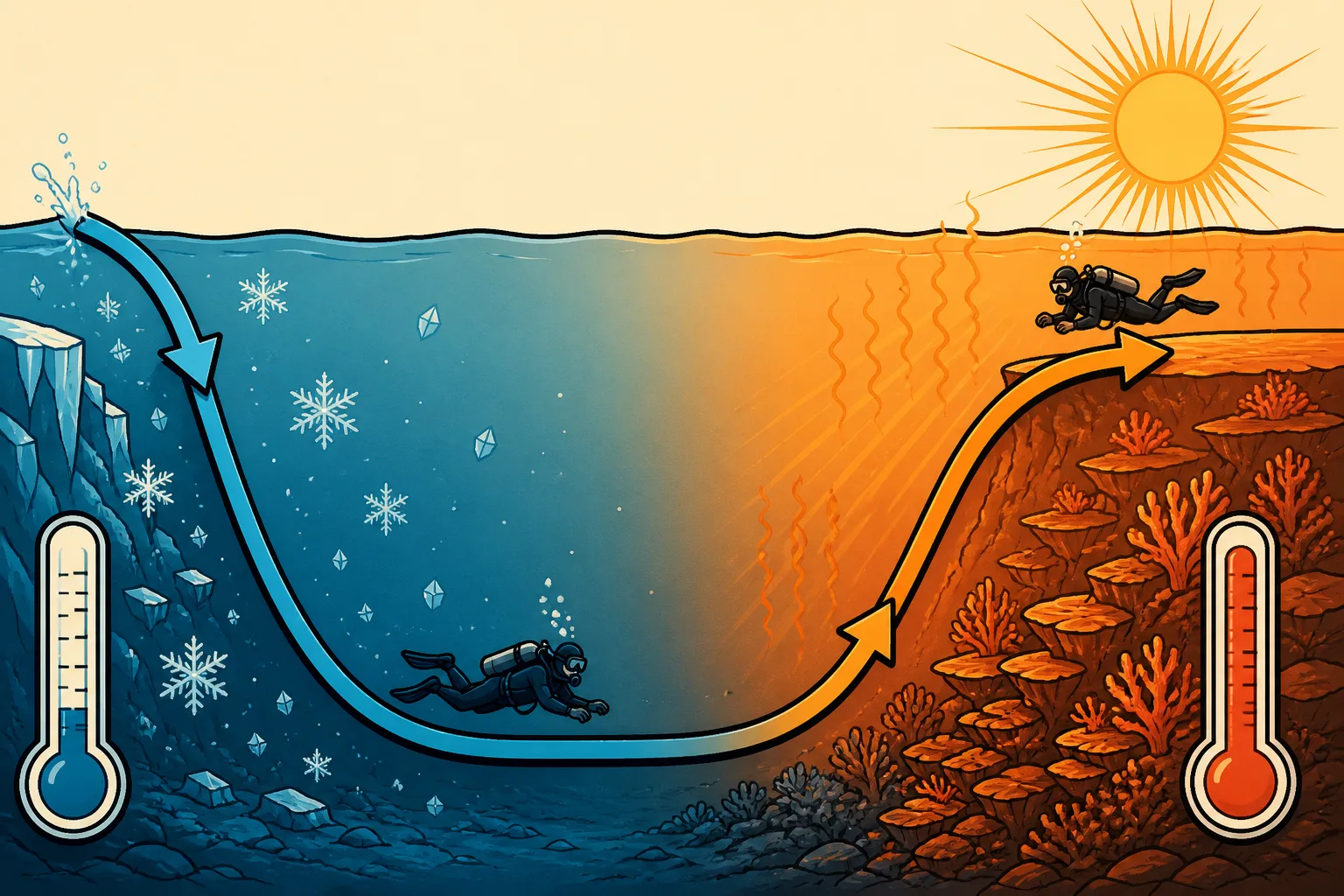
The evidence for this is unusually stark. A US Navy study split dives into a descent and bottom phase and an ascent and stop phase, and controlled the water temperature in each phase independently. Divers who were warm at depth and then cold during the ascent and stops had a decompression sickness rate of 22 per cent. Divers who were cool at depth and then warm during the ascent and stops had a rate of 1.3 per cent, and that was with bottom time extended to more than double. Same divers, same equipment, same physics. The only variable was which half of the dive they were warm in.
Practically, for a recreational diver in Indonesia, this shakes out as follows. If you dive a heated vest, and a few of our repeat guests do on Crystal Bay trips in mola season, leave it off or on its lowest setting going down and through the bottom phase, then turn it up for the ascent and the stop. If you do not dive a heated vest, which is most people in Bali, the lever you have is simpler: do not skip or rush the stop because you are cold, and do not let yourself get chilled at the end of a dive when you most need good circulation.
Bali is kinder here than it looks. Surface water in Sanur sits around 28 to 29 degrees, and the profile you get at Nusa Penida is naturally the good pattern rather than the bad one. You descend into the thermocline, which at Crystal Bay during mola mola season from July to October drops to 20 degrees and occasionally 18, and then you come back up into warmer water for the stop. Cool at depth, warm on the way up. That is the 1.3 per cent pattern, by accident of geography.
The pattern to actively avoid in Bali is the one that happens on the surface, not underwater, and it gets its own section below.
Exertion, and why the boat ladder matters more than the bottom time
Effort is the other big one, and like temperature it is a question of timing rather than amount.
Working hard during the descent and bottom phase increases how much gas you take on, for the same reason warmth does: you move more blood through your tissues. Working hard at the end of a dive, or in the hour or two afterwards, does something different and worse. Tissues that are still supersaturated respond to mechanical stress by forming bubbles, and high joint forces are particularly good at seeding them. DAN's guidance is specific: keep intensity as low as you can at depth, mild movement of no more than two to three times resting effort is fine and probably helpful during the upper ascent and stops, and high joint force exercise should be delayed after a dive for as long as you can manage.
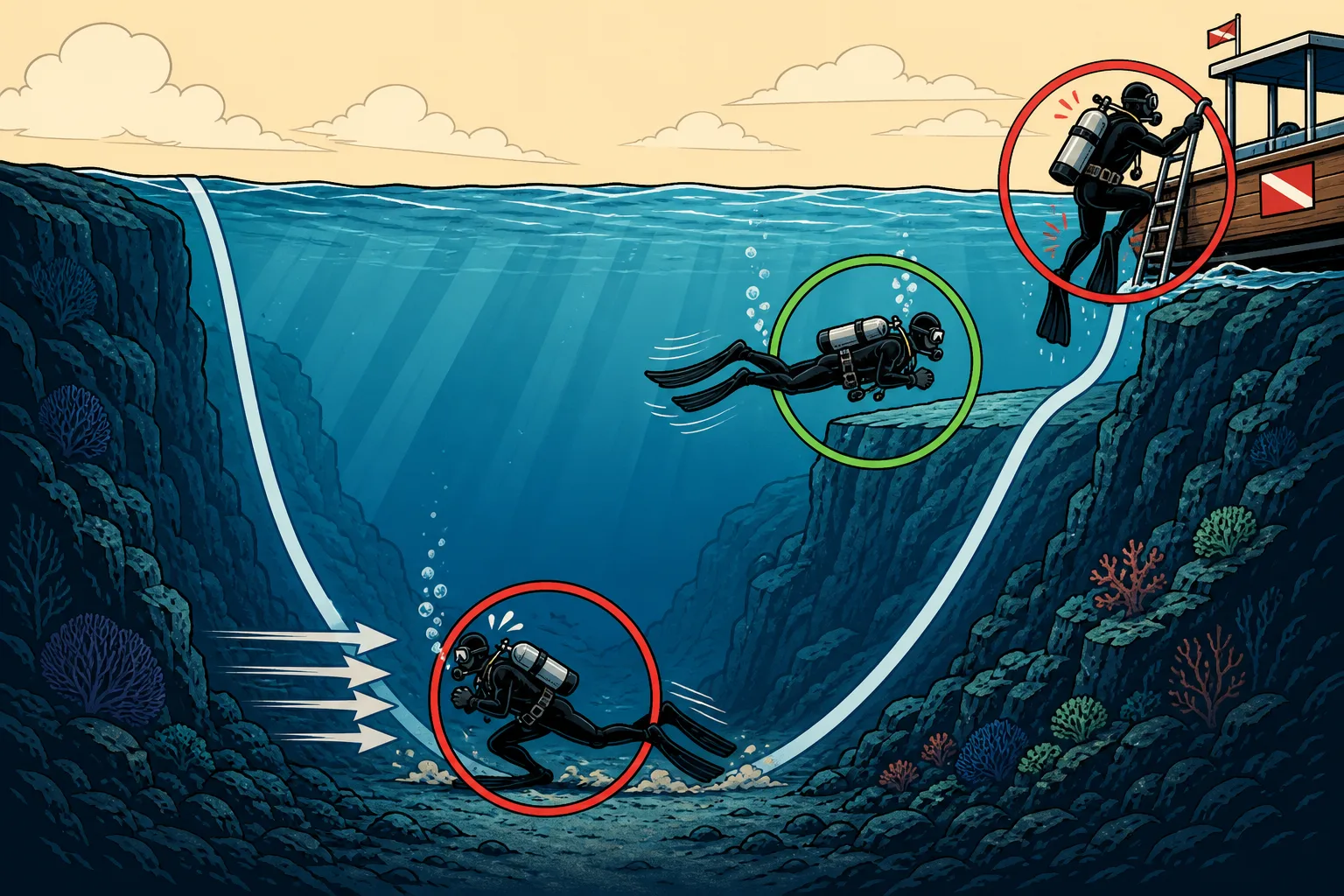
Read that last sentence again and think about what a normal dive day involves. You surface, you swim to the boat, and then you haul yourself up a ladder carrying a cylinder, weights and a wet wetsuit, in swell, using your knees and shoulders, about ninety seconds after leaving your safety stop. That is close to a textbook description of the worst possible timing.
This is where an operator can genuinely change your risk rather than just talk about it, and it is unglamorous. Our crew take your fins, then your weights, then your cylinder at the ladder, and we would rather spend the extra minute doing that in a bit of swell than have eight people climbing in full kit. On the shore entries it matters even more. The USAT Liberty wreck at Tulamben is entered over big rounded cobbles that shift under your boots, and the local porters who carry the tanks down and back are not a picturesque tradition, they are removing precisely the high joint force loading that DAN warns about, at exactly the moment it counts.
The other half of this is current. Nusa Penida is a drift diving destination and the water does the work when it is going your way, but the moment you start finning hard against it at 25 metres you are loading up faster than the person beside you who let go and drifted. That is a skill problem as much as a fitness one, and it is genuinely worth fixing: better trim and buoyancy means less work at depth for the same dive. Ours is not a sales pitch dressed as advice, but the two courses that reduce workload most are Peak Performance Buoyancy and Drift Diver, and the free version is simply more dives with a guide who is watching your trim rather than the fish.
One honest admission. We will not run a hard current dive at Manta Point for a guest who has told us they did a heavy gym session that morning and then hauled themselves up the ladder unassisted on the first dive. We will move them to the sheltered site instead, and about a handful of times a year that conversation is slightly awkward at 09:00 on a boat.
Hydration is important, just not the headline
Here is the part that annoys people, so let us attribute it clearly rather than claim it as our own opinion. DAN's dive medical reference states that dehydration "gets a substantial amount of attention in the lay diving community as a risk factor for DCS, but probably more than is warranted", and that "thermal stress and exertion level are far more important risk factors".
They also explain why the myth is so durable, and the explanation is good. First, serious decompression sickness causes large fluid shifts, so a bent diver often is dehydrated by the time anyone examines them, which makes a consequence look like a cause. Second, and more human, decompression sickness is fickle. A diver can repeat the same profile fifty times and get bent on the fifty-first. People want one thing to blame, and a water bottle is a comforting thing to blame.
None of which means turn up dehydrated. Being properly hydrated is straightforwardly good for you, and Bali will dehydrate you without any help from diving: 32 degrees on a boat deck, sun off the water, a long drive, and for many of our guests a Bintang or two the evening before. Alcohol deserves its own mention because it works on several of these levers at once, and we went into it in our piece on scuba diving and alcohol. Drink water, skip the second beer the night before a deep day, and then spend your remaining attention on your ascent and your temperature, because that is where the returns are.
Your dive profile is still the biggest lever you control
Everything above modifies risk at the margins. The profile sets the baseline, and it is worth being precise about the numbers.
Ascent rate. No faster than 0.15 metres per second, which is about 9 metres a minute, or roughly the speed of the slowest person you have ever dived with. Most modern computers will complain before you notice. The last 10 metres is where volume changes fastest and where people speed up without meaning to, usually because they are low on gas or looking at the boat.
The safety stop. Three to five minutes at about 5 metres, on every dive, including the shallow one. It is not a decompression obligation on a recreational profile, which is exactly why people skip it, and it is one of the cheapest risk reductions available. Plan your gas so you can afford it rather than discovering at 6 metres that you cannot.
Leave time on the clock. A no-decompression limit is a limit, not a target. Surfacing with a chunk of it unused is the single easiest habit to adopt and the one experienced divers adopt naturally. If you want the theory behind depth and time limits, our guide to how deep you can scuba dive goes through the certification levels and what each one actually unlocks.
Deepest first, and no sawtooth. Start deep and work shallow across the dive, and across the day. Repeatedly going up and down through the same depth band is harder on you than a single clean profile.
Surface intervals. Every extra hour helps, measurably. On our Nusa Penida day trips the interval between dives is typically 45 to 60 minutes because of how the boat schedule and the tides work, and on a two tank day that is fine. It is the three and four dive days, especially late in a diving week, where a longer interval earns its keep.
Nitrox, used correctly. Breathing less nitrogen means loading less nitrogen. It is a real reduction if you use it to add margin rather than to extend your bottom time to the new limit, which is the trap. We go through when it is worth paying for in our guide to nitrox diving in Bali, and the course itself is the Enriched Air Diver certification, one honest day in Sanur.
Altitude and flying. Going up after diving continues the decompression you already started, which is why the no-fly window exists, and in Bali the trap is usually not the flight. It is Kintamani, the Mount Agung sunrise trek and the drive over the mountains, all of which take you to altitude the day after diving. We covered the numbers and the Bali specifics in flying after scuba diving, and we plan trip itineraries around it as a matter of course.
The factors you cannot change, including PFO
Some of your risk is not behavioural, and it is worth knowing which parts so you can stop worrying about the rest.
Age, body composition and general fitness all appear in the literature, though less cleanly than dive shop conversation suggests. Nitrogen is more soluble in fat than in lean tissue, which is the mechanism usually cited, and being fit enough that a normal dive is not hard work reduces your workload at depth, which we know matters. Both point the same way without needing to be dramatic about it.
Previous injury to a joint is a genuine one, and it shows up in the way divers describe their symptoms: the shoulder that has always been the problem shoulder is often where the pain arrives.
Then there is the one guests read about online and arrive worried about, a patent foramen ovale, a small flap between the atria of the heart that never closed after birth and is present in roughly a quarter of the population. A large right to left shunt is a recognised risk factor for some kinds of decompression sickness, because it lets venous bubbles bypass the lung filter and reach the arterial side.
Here is the current guidance, because this is an area where a lot of diving content is out of date. The 2025 joint position statement from the South Pacific Underwater Medicine Society and the United Kingdom Diving Medical Committee is explicit that routine screening is not justified. Screening should be considered for a specific group: a history of cerebral, spinal, inner ear, cardiovascular or skin decompression sickness, a history of migraine with aura, a history of cryptogenic stroke, a first degree relative with a known PFO or atrial septal defect, or other congenital heart disease. Testing, if done, should be bubble contrast echocardiography with provocation manoeuvres, not a plain echo. If a significant shunt is found, the options are to stop diving, to dive with restrictions that reduce your gas load by limiting depth and duration, breathing a lower nitrogen mix and cutting back repetitive dives, or to have it closed. After closure, unrestricted diving should wait for a repeat contrast echo at least three months later confirming the shunt is gone, and for potent antiplatelet medication to have stopped.
Which is to say: if you have never had decompression sickness and you do not have migraine with aura, the answer is almost certainly that you do not need a test. If you have had an unexplained hit, particularly a neurological or skin one, that conversation belongs with a diving physician and not with a dive shop, ours included. It is also the clearest argument we know for the insurance we require, since we ask every guest to hold DAN cover or equivalent with explicit scuba and evacuation cover, and that is what pays for the specialist opinion as well as the chamber.
The Bali-specific risks we actually see
Now the part no general article can give you, because it comes from running these particular sites with these particular guests.
The post-dive spa. This is the most common one and it is almost unique to a place like Bali. You finish two dives, get back to Sanur at 15:30, and the villa has a plunge pool, or there is a 200,000 rupiah massage with a hot towel wrap, or you just want a very hot shower. Rapid warming of the skin while you are still supersaturated is a recognised way to bring on skin symptoms, and the standard medical advice is to avoid hot tubs, saunas and hot baths after diving. Warm is fine. Hot, soon, is not. Book the massage for the following morning.
The last day. Four days of diving, a flight tomorrow, and one more dive on offer. This is when the cumulative loading is highest, the surface intervals across the week have been shortest, and the pressure to squeeze value out of the trip is greatest. We plan multi-day packages to taper rather than crescendo, and if you are building your own week our Bali dive trip itinerary sets out how to sequence 5, 7, 10 or 14 days.
The Penida crossing. Thirty to forty five minutes each way in a fast boat, and on a lumpy day that is a genuine physical workout before you have even kitted up. Sit where the boat moves least, hold on with your legs rather than clenching your whole body, and do not do that crossing on an empty stomach.
Current at the wrong moment. Manta Point gives you swell, surge and a cleaning station you want to stay on, which is a recipe for finning steadily for twenty minutes at depth. We see mantas on roughly nine out of ten trips across the year and the temptation to hold position is the point of the dive. Hold onto the reef structure rather than your fins where you can.
Cold on the last dive of a long day. Third dive, thin wetsuit that has been wet since 08:00, wind on the deck between dives. Getting chilled during the dive where you most need good off-gassing is the bad half of the thermal pattern. A hooded vest costs very little and does more for you than most gear upgrades.
Liveaboards. Three or four dives a day for a week, which is a fundamentally different exposure from a day boat. Our own King Neptune and the Komodo liveaboard itineraries build in the conservatism, but the diver still has to accept the last dive of the day is optional.
Our second honest admission, since we made one already. We cancel Nusa Penida trips somewhere between five and ten days a year when the south coast swell gets up, and move those guests to Tulamben. Every single time, at least one person asks whether they can do a third dive to make up for it. Sometimes the answer is yes. On the day before a flight it is no, and that is not us being precious.
What we would do, and how we run a dive day around it
Concretely, if you asked us to design your week to keep decompression risk as low as it can reasonably go, without turning the holiday into an exercise in caution.
Dive two tanks a day rather than three for the first two days, and let the fourth day be the big one once you have found your buoyancy and your air consumption has settled. Pickups from Sanur hotels run between 06:30 and 07:15 depending on where you are staying, so you are diving before the wind gets up and the water is at its calmest, which means less work. Ask the crew to take your kit at the ladder, every time, even when you feel strong. Do the full stop rather than the token one, and be the last person on the line rather than the first up. Keep the gym for after the diving week, or at least separate it by a day from anything deep. Put the massage in the morning, not the afternoon. Book Kintamani or Agung for the day you are not diving, and put the flight at least a day after the last dive.
If you are not certified yet, or you have not dived in a few years, the honest starting point is skills rather than caution. Divers who are comfortable use less gas, work less at depth, hold a stop without fighting for it, and come up slowly because they are not stressed. That is what the Open Water course is really buying you, and it is why we would rather run a try dive or a refresher than take a rusty diver straight to Penida. Our Bali diving price list has what all of it costs in rupiah.
The thing we would most like you to take away is that this is not a coin toss. Decompression sickness at recreational depths is uncommon, and the factors that push it lower are almost all things you can decide on the boat, in the last five minutes of the dive, and in the hour afterwards. Come up slowly. Be warm when you are getting rid of gas and cool when you are taking it on. Let the crew carry the tank. Leave the hot shower until later.
If you want to talk through a specific plan, whether that is a deep week at Amed, a first Nusa Penida trip, or how to sequence a course and a liveaboard back to back, get in touch and ask. The practical questions we get most often are collected on our FAQ page. We would rather have this conversation before you book than on the radio to a chamber.