
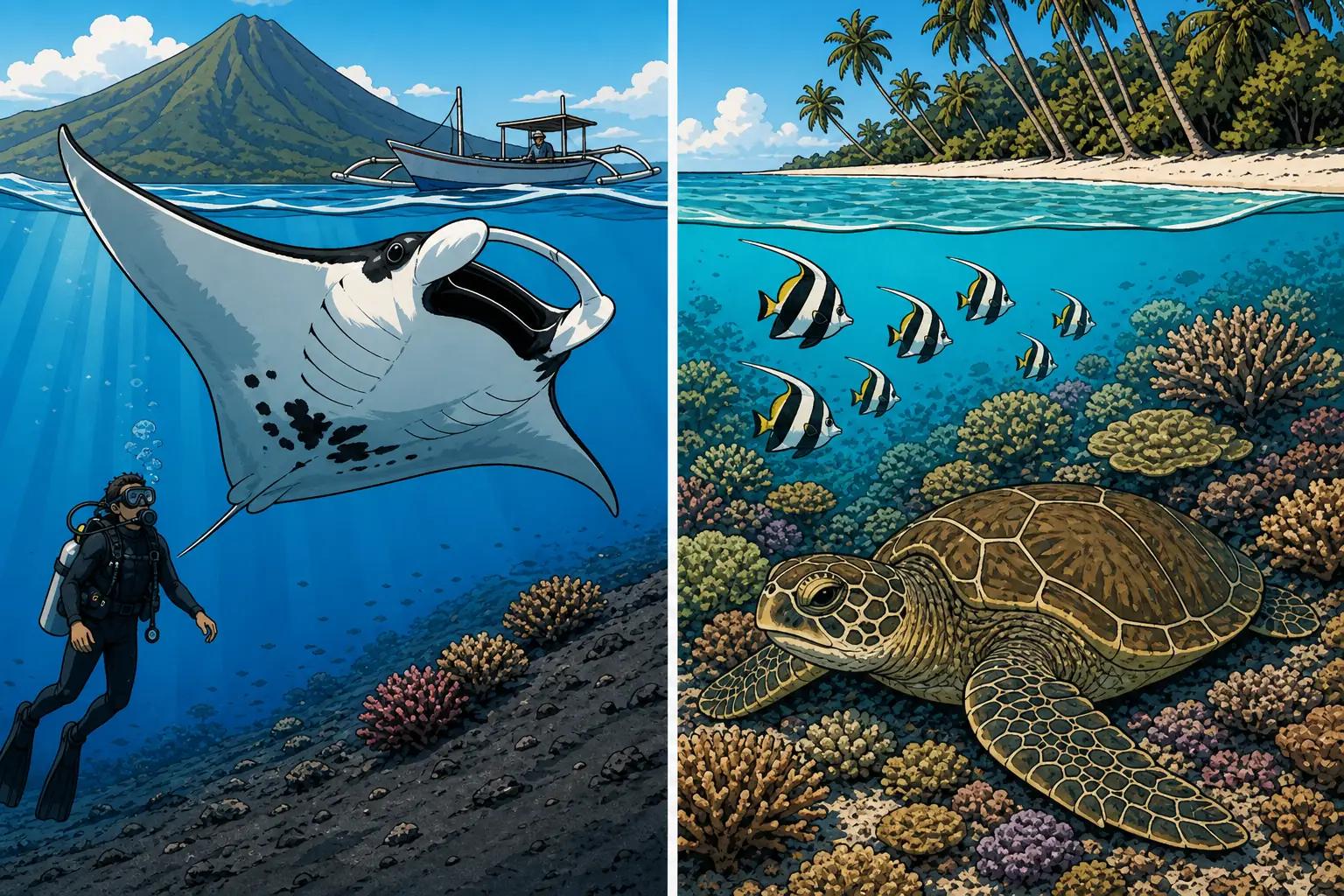
Bali vs Gili Islands diving is the question we field most often at check-in, usually from somebody who has already booked both and is quietly worried they have wasted half their week. Here is the short version from a shop that puts boats in the water at Sanur every morning. The Gilis will show you more turtles than anywhere else in Indonesia. Bali will show you more of everything else, starting with the oceanic mantas at Nusa Penida that no Gili operator can put you in front of.
We should be straight about our position before you read another word. We are a Bali operator. We do not run trips to the Gilis, and we make our living taking people to Tulamben, Padang Bai and the Nusa islands. So rather than pretend to be neutral, we have written down what we genuinely concede to the Gilis, what we know Bali does better, and the actual numbers behind both. A good part of what follows comes from guests who dived the Gilis the week before they dived with us, then told us all about it during the surface interval.
Bali vs Gili Islands diving: the short answer
If turtles and easy shallow reefs are the point of the trip, go to the Gilis. If you want big animals, a real wreck, world-class macro and twenty-odd genuinely different sites without changing islands, stay in Bali. If you have ten days or more, do both, and do Bali first. That is the whole article in three sentences. Everything below is the evidence.
| What matters | Bali | Gili Islands |
|---|---|---|
| Turtle encounters | Common at Amed, Menjangan and Padang Bai | Near certain, several per dive |
| Oceanic mantas | Year round at Nusa Penida, roughly 9 trips in 10 | Rare, despite a site called Manta Point |
| Mola mola | July to October, one of only a few places on earth | Effectively never |
| Wreck diving | USAT Liberty, 120 metres, from 5 to 30 metres | A sunken pontoon at about 15 metres |
| Macro | Among the best in the world at Tulamben and Amed | Genuinely good at Hans Reef, smaller range |
| Currents | From nothing to serious, site by site | Mild to moderate almost everywhere |
| Water temperature | 18 to 29 degrees depending on site and month | 27 to 29 degrees, all year |
| Getting to the diving | Road transfer of 40 minutes to 3 hours | Walk to the shop, 5 to 20 minute boat |
| Cost per dive | Higher, but transfers and lunch included | Lower, transfers not needed |
| Best suited to | Divers who want variety and big animals | Divers who want relaxed, cheap, turtle-heavy diving |
First, there are two sets of Gilis, and people book the wrong one
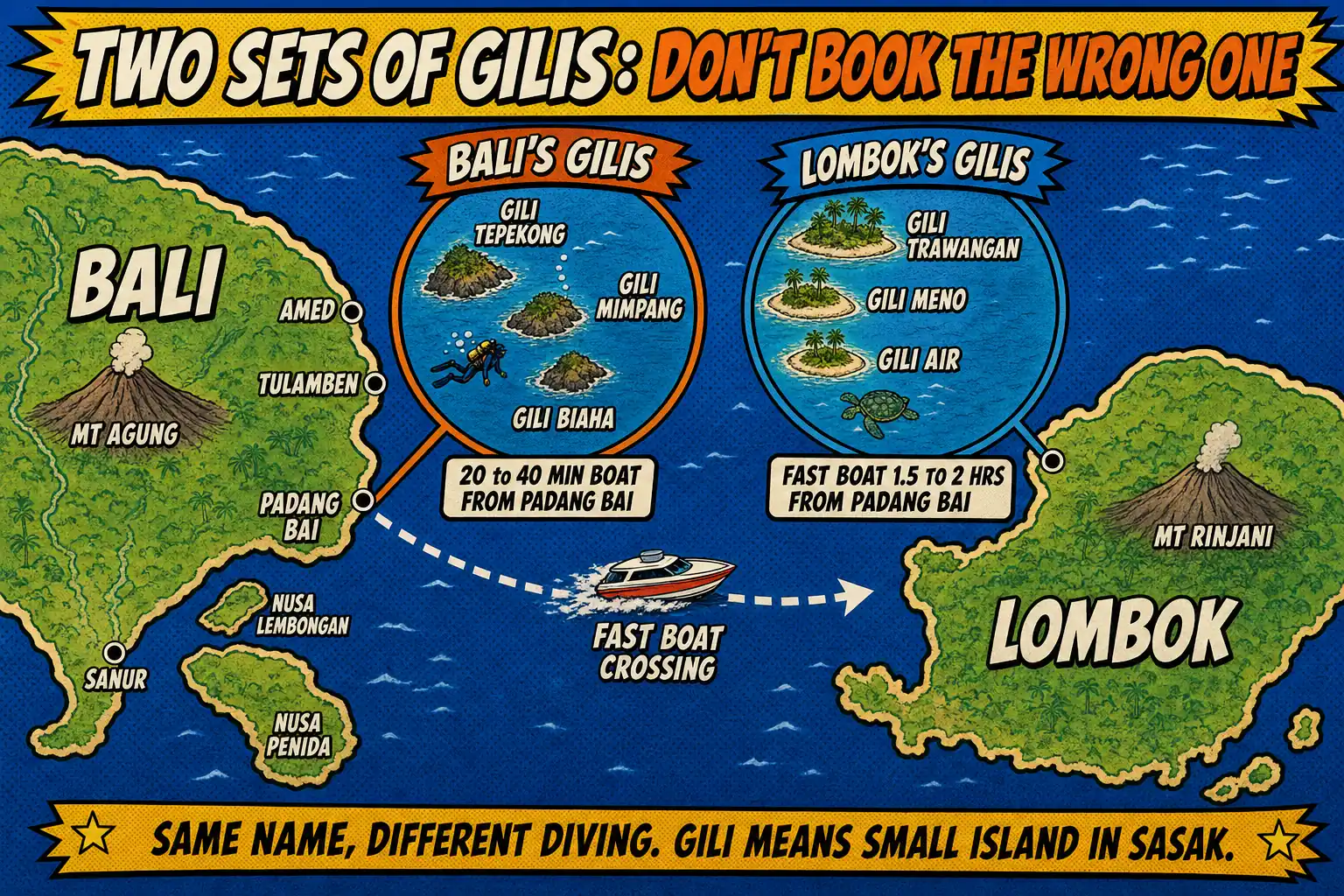
This trips up more people than any other part of the comparison, and it is worth two minutes of your time. The word gili simply means small island in Sasak, the language of Lombok. There are hundreds of gilis across the Indonesian archipelago. Two clusters matter to divers, and they are nothing alike.
The famous three, the ones on every backpacker itinerary, sit off the north-west corner of Lombok: Gili Trawangan, Gili Meno and Gili Air. Flat, sandy, palm-covered, no cars. When somebody says "the Gilis", this is almost always what they mean.
Then there are Bali's own Gilis, a cluster of bare rock pinnacles a short boat ride off Padang Bai on the east coast: Gili Tepekong, Gili Mimpang and Gili Biaha. No beaches, no bars, nobody lives on them. They are 20 to 40 minutes by boat from Padang Bai and about two hours by road from our shop in Sanur, and they are some of the most exciting diving on the island. Cold thermoclines, real current, white tip reef sharks under the ledges at Biaha, and mola mola in season.
We get emails every month asking whether we dive the Gilis, and something like half the people asking mean Tepekong without knowing it. If you booked "Gili diving" and you are staying in Sanur or Seminyak, check which one you actually bought. One is a day trip. The other is a different island and a boat crossing.
Getting there is the cost nobody puts in the spreadsheet
The Gilis are not in Bali. That sounds obvious written down, and yet the number of people who arrive at our shop expecting to dive Gili Trawangan on a day trip from Sanur tells us it needs saying. You get there on a tourist fast boat, and the crossing is the hidden line item in your trip budget.
From Padang Bai the crossing runs about an hour and fifteen to an hour and a half. From Sanur it is closer to two to two and a half hours. From Amed on the north-east coast it is roughly an hour and fifteen. Expect somewhere around IDR 400,000 to 700,000 per person each way depending on the operator and how far ahead you book, plus the road transfer to the harbour, which from Sanur to Padang Bai is a solid ninety minutes on a good day and a lot longer on a bad one.
Now count the real cost. Each crossing eats most of a day once you add transfers, the wait at the harbour and getting to your accommodation. On a seven day trip, going both ways costs you close to two dive days. On a fourteen day trip it barely registers. That single arithmetic decides the question for a lot of our guests before marine life ever enters the conversation.
The Lombok Strait also has opinions. It is deep, it funnels serious water between two land masses, and in the wet season from December to February, or when a strong south-easterly is running in July and August, crossings get cancelled or get very unpleasant. We have had guests turn up two days late for a Tulamben trip because the boat back was held in port. Build in a buffer day if you are catching a flight.
What you actually see underwater
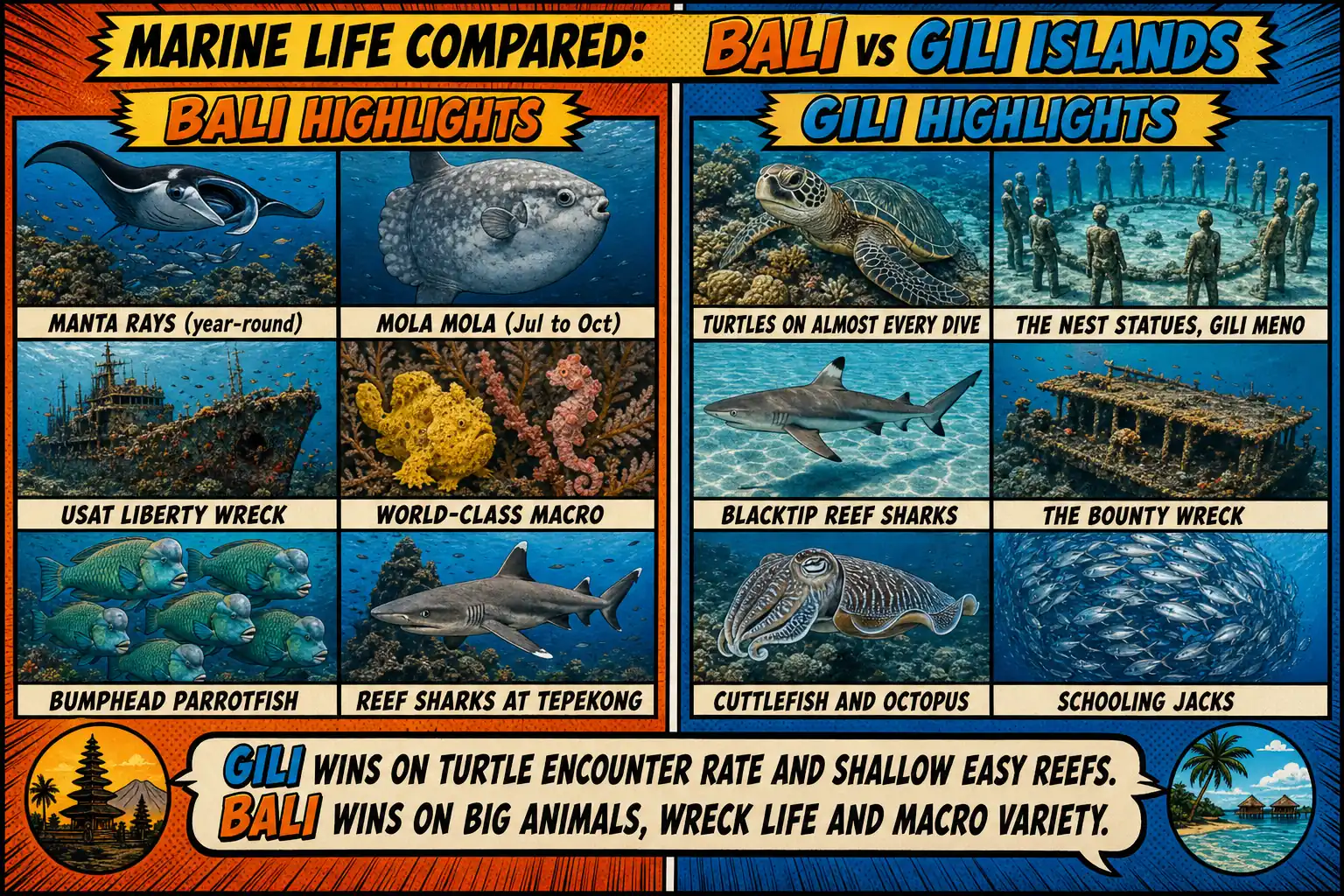
Both destinations sit inside the Coral Triangle, so the baseline is excellent in each. The difference is not quality, it is range. The Gilis do a narrow set of things extremely well. Bali does a much wider set of things, some of them better and some of them worse.
Turtles: the one thing the Gilis do better than almost anywhere
We are not going to argue this one. Meno Wall and the shallows around Gili Meno hold green and hawksbill turtles at a density we cannot match anywhere in Bali. Divers routinely come up having seen five, eight, a dozen. They sit on the coral, ignore you completely, and let you get close enough that a compact camera is plenty.
Bali has turtles and they are not hard to find. Amed, Menjangan, the Blue Lagoon at Padang Bai and the reefs at Nusa Penida all produce them regularly, and we cover where and when in our guide to sea turtles in Bali. But regularly is not the same as constantly. If a guest tells us that turtles are the single reason for their trip, we tell them to spend their week on Gili Meno. Sending them to Sanur instead would be taking their money under false pretences.
Mantas and mola mola: Bali has a monopoly
This is where the comparison stops being close. Manta Point on the south coast of Nusa Penida holds a resident population of oceanic mantas, the big ones, four metre wingspans and upward, that come in to be cleaned over a shallow rocky bommie. It works all year. Across our own trip logs we put guests in the water with mantas on roughly nine trips out of ten, and on a good day you get twenty minutes at five metres watching three or four of them circle a cleaning station.
The Gilis have a site called Manta Point too. Mantas there are a genuine surprise rather than an expectation. Ask any honest Gili instructor what their manta hit rate is and compare it with the paragraph above.
Then there is mola mola, the oceanic sunfish, which turns up in the cold water around Penida, Crystal Bay and Nusa Lembongan from roughly July to October with a peak through August and September. There are only a handful of places on the planet where recreational divers see them with any reliability, and this is one of them. We wrote a full month-by-month breakdown in our mola mola season guide. The Gilis do not have this at all.
An honest caveat, because you will find out anyway: Manta Point sits exposed to the southern swell, and in the July to September window we lose perhaps five to ten days a year when the surge makes it unsafe to drop. When that happens we move the day to Crystal Bay and Toyapakeh, or we offer Tulamben instead and reschedule. Anyone who promises mantas every single day of the year is guessing.
The wreck question is not close
The USAT Liberty at Tulamben is a 120 metre US Army cargo ship, torpedoed in 1942, beached on the shore and finally pushed into the sea by the 1963 eruption of Mount Agung. She now lies parallel to the beach between about 5 and 30 metres, close enough that you walk in over the rounded stones with your fins in your hand. Sixty years of growth means the structure has effectively become a reef with a shape. Get there for the 06:30 entry and you will often meet the resident school of bumphead parrotfish coming off the wreck.
The Gilis have the Bounty wreck, a sunken pontoon sitting at roughly 15 to 18 metres off Gili Meno. It is a pleasant dive with decent coral growth and a nice silhouette for photos, and it is nothing like the Liberty. There is a deeper Japanese wreck below 40 metres that is technical territory and out of reach for most visitors. If wrecks are on your list, that decision is made for you. Our Bali dive trips run to Tulamben most days of the week.
Macro: Tulamben and Amed against Hans Reef
The black volcanic sand slopes of the east coast are one of the great macro destinations anywhere. Frogfish in four colours, pygmy seahorses on their sea fans, harlequin shrimp, ribbon eels, mimic octopus, nudibranchs nobody has properly catalogued. Guides at Tulamben and Amed find things on a rubble slope that looks, to a new diver, like an empty car park.
Credit where it is due: Hans Reef off Gili Air is a properly good macro site, with frogfish, seahorses and ghost pipefish, and the sand between the islands turns up plenty. The Gilis simply have fewer of these sites, and none of them have the sheer density of the Tulamben and Seraya slopes. Photographers who book with us tend to give the east coast two days rather than one, because the second dive at the same site nearly always produces something the first one walked past.
Currents and difficulty: the Gilis are gentler, and that is a feature
Gili diving is mostly shallow sloping reef between 5 and 30 metres with mild to moderate current, warm water and good visibility. For a diver with fifteen logged dives, or one who has not been wet in three years, that is close to ideal. Nothing is trying to take you anywhere. You can concentrate on your breathing and your trim.
Bali is not one thing. Tulamben is a shore dive so calm you can teach in it. The Blue Lagoon at Padang Bai is a gentle bay. And then Nusa Penida has genuine current, Blue Corner has a downcurrent that has frightened experienced divers, and the channel at Gili Tepekong produces a feature the guides call the Toilet Bowl for reasons that need no explanation. We cover the whole picture in our guide to Bali diving conditions.
What that means in practice is that Bali rewards being honest on your booking form. Tell us you have twelve dives and a wobbly ascent and we will put you at Tulamben, Padang Bai and Toyapakeh, and you will have a wonderful week. Tell us you are an experienced diver when you are not, and we will find out at the mooring line and change the plan anyway. If drift diving is the skill you want, the PADI Drift Diver specialty is two dives and exists for exactly these sites.
Water temperature, and the mistake half our guests make
The Gilis are 27 to 29 degrees essentially all year. A 3mm shorty is plenty and many people dive in a rash guard.
Bali is warm too, until it very much is not. Tulamben, Amed and Padang Bai sit at 27 to 29 degrees. Nusa Penida has thermoclines that drop to 20 to 24 degrees without much warning, and in mola mola season the cold upwelling that brings the sunfish up can put Crystal Bay at 18 to 20 degrees. That is a genuinely cold dive in a 3mm.
So people arrive with Gili packing lists and shiver. If your trip includes Penida between July and October, bring a 5mm, and consider a hooded vest. It is the single most common piece of kit advice we give at check-in, and the difference between a great mola dive and a short one.
What it costs in 2026
Per dive, the Gilis are cheaper. There is no way to spin that, and we would rather you heard it from us than felt misled later. What matters is understanding why, because the two prices are not measuring the same thing.
| Item | Bali (our published rates) | Gili Islands (typical published rates) |
|---|---|---|
| Two dive day, certified | From IDR 2,700,000 (about 150 USD) at Tulamben, Amed or Padang Bai | Around IDR 1,100,000 to 1,300,000 (about 60 to 72 USD) |
| Nusa Penida day, certified | From IDR 3,150,000 (about 175 USD) | Not available |
| Menjangan day, certified | From IDR 4,500,000 (about 250 USD) | Not available |
| PADI Open Water course | IDR 9,540,000 (about 530 USD) | Around IDR 6,500,000 (about 360 USD) |
| Advanced Open Water | From IDR 8,100,000 (about 450 USD) | Around IDR 6,000,000 (about 330 USD) |
| Try dive, uncertified | From IDR 2,700,000 (about 150 USD) | Around IDR 1,300,000 (about 72 USD) |
| Full gear rental | Around IDR 650,000 to 850,000 per day | Usually included in the dive price |
| Hotel pickup and return | Included from Sanur, Kuta, Seminyak and Nusa Dua | Not needed, you walk |
Read the last two rows again, because they explain the whole gap. Our IDR 3,150,000 Penida day includes a driver at your hotel around 06:30, the road transfer to Sanur, the boat, a guide at a maximum ratio of one to four, tanks, weights, the marine park fee, lunch and water, and the whole trip back. On Gili Trawangan you finish breakfast, walk four minutes to the shop, and the boat leaves at nine. There is no transfer to pay for because there is nowhere to transfer from.
One more thing that surprises people: prices on the Gilis are standardised across the shops through the local dive association, so shopping around gets you almost nowhere on price and you should compare instructors, ratios and equipment instead. Worth confirming current rates before you travel, since ours are the only numbers here we can vouch for. Our full breakdown lives on the Bali diving prices page, and we go deeper on what drives the numbers in our article on scuba diving prices in Bali.
Learning to dive: the Gilis genuinely undercut us
An Open Water course with us is IDR 9,540,000 over three to four days. On the Gilis the same certification is commonly around IDR 6,500,000. That is a real difference and if the budget is tight it is a fair reason to certify there.
Where your money goes with us is worth knowing. Your four open water dives happen at different sites, so you finish the course having dived a sheltered bay, a shore entry and a reef with a bit of life on it rather than doing all four in the same shallow patch. There is a vehicle collecting you each morning and bringing you back. We hold ratios at one to four rather than the maximum PADI allows. And nobody has to sit on a fast boat.
If you are undecided, the cheaper way to find out whether you even like it is a try dive at IDR 2,700,000, which is a real dive with an instructor rather than a pool session. Already certified and wanting more? Advanced Open Water runs from IDR 8,100,000 over two days, and enriched air nitrox is a half day that meaningfully extends your bottom time on repetitive Penida days. For deeper work on the Liberty, the Deep Diver specialty is the right route.
Best time of year for each
| Months | Bali | Gili Islands |
|---|---|---|
| December to February | Wet season. Diving still good, plankton up, visibility variable. Mantas working. | Warm and quiet. Fast boat crossings least reliable. |
| March to May | Excellent. Water warming, visibility improving, fewer crowds. | Excellent and calm. One of the best windows. |
| June to August | Peak visibility. Cold upwelling starts. Mola mola from July. Busiest. | Busy and dry. South-easterly winds can roughen the crossing. |
| September to October | Our favourite. Mola peak into September, water clear, crowds thinning. | Very good, quieter than August. |
| November | Shoulder. Warm, green, good value, occasional rain. | Quiet, warm, pleasant. |
The pattern is that the Gilis are more consistent and Bali has higher peaks. September in Bali, with a mola mola at 20 metres in cold clear water and a manta on the same trip, is a better day of diving than any single day the Gilis can offer. February in Bali, with runoff in the water at Padang Bai, is not. If your dates are fixed and narrow, that consistency is worth weighing seriously.
What you do between dives
This decides more trips than the diving does, particularly when somebody in the party does not dive.
The Gilis offer something Bali physically cannot: no motor vehicles. You get around Gili Trawangan, Meno and Air on a bicycle or in a horse cart, you can walk the perimeter of Meno in about an hour and a half, and the loudest thing on the island is usually the sunset bar. Snorkelling with turtles happens straight off the beach, and the Nest, a ring of 48 life-size human statues off Gili Meno sitting in three to five metres, is one of the more genuinely memorable things you can see while holding your breath.
Bali gives you a whole island instead. Mount Agung, the Ubud rice terraces, Besakih and Tirta Empul, proper restaurants, a spa on every corner, and the Sanur beach path at six in the morning with the fishing boats coming in. Our shop sits in Sanur precisely because it is calm enough for a rest day and close enough to everything. Non-divers in your group will find far more to do here. If they want to get in the water without a tank, snorkelling in Bali covers the options.
What Bali cannot give you is quiet. Sanur is the gentlest corner of the south and it still has scooters. If your idea of a holiday is a beach where nothing has an engine, we would be doing you no favours pretending otherwise.
Who should pick the Gili Islands
- Turtles are the priority and you want to see them on every dive.
- You are newly certified, or rusty, and want gentle diving with no current to think about.
- You are on a tight budget and per-dive price is the deciding factor.
- You want to certify as cheaply as possible.
- You want a small island with no cars, walkable in an afternoon.
- You have two weeks or more, so a fast boat crossing costs you nothing meaningful.
Who should stay in Bali
- You want oceanic mantas, reliably, and mola mola if you are here between July and October.
- You want a real wreck rather than a pontoon.
- You are a macro or underwater photography diver.
- You have seven days or fewer and cannot afford to spend two of them on boats.
- You are travelling with non-divers, or with children, and need things to do on land.
- You want variety, and would rather dive twenty different sites than the same six.
- You want the reassurance of two hyperbaric chambers on the same island, which we wrote about in our guide to the hyperbaric chamber in Bali. Evacuation from the Gilis means a boat crossing or a flight first.
Doing both without wasting the week
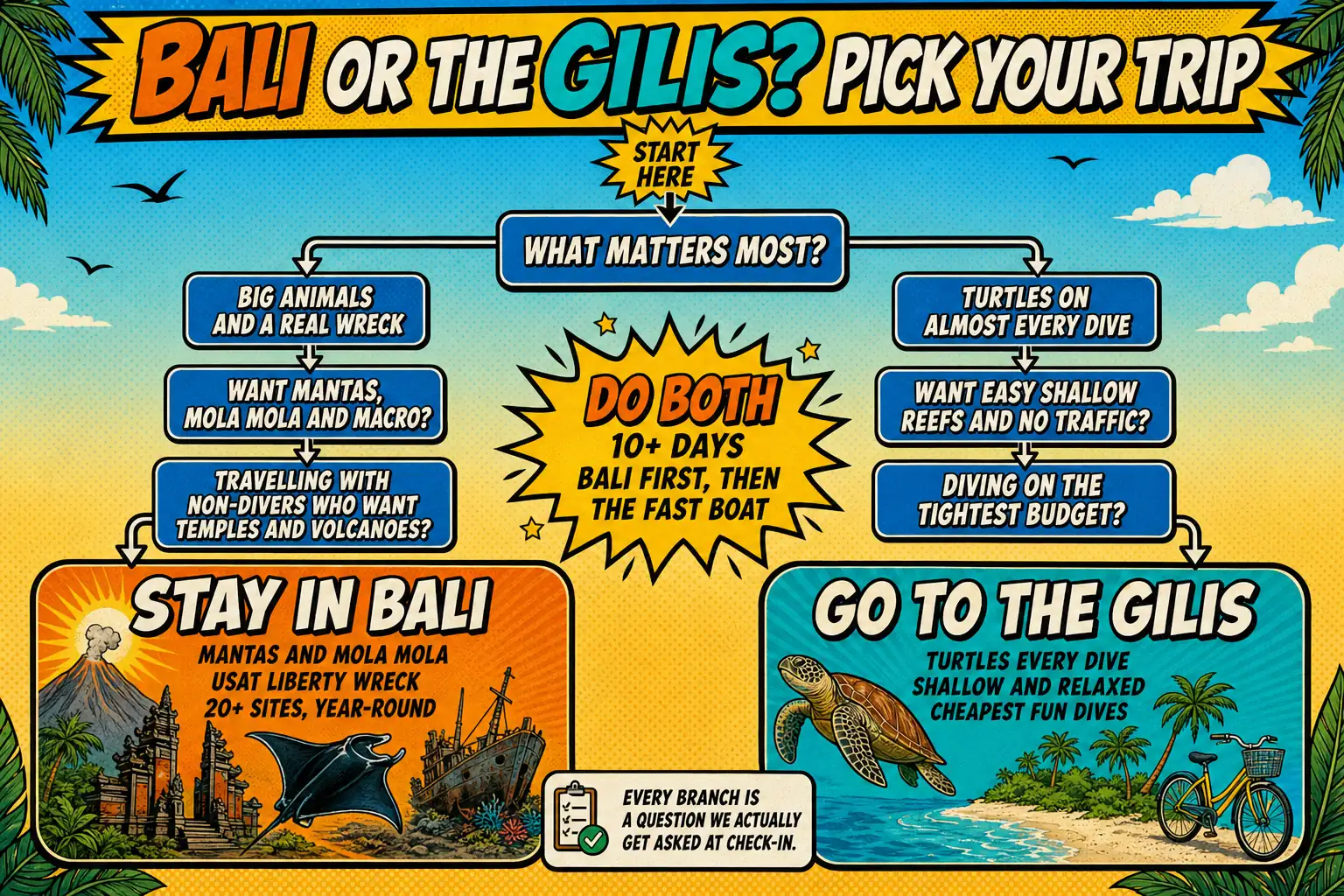
With ten days or more the answer stops being either. The order matters though, and it is Bali first, for two reasons. Fast boats leave from Padang Bai, which is on the way out of Bali rather than a backtrack. And the mantas and the wreck are the dives you would most regret missing if weather compressed your schedule, so front-load them.
A ten day shape that works: land in Denpasar and take a rest day, then four diving days out of Sanur covering Nusa Penida twice, Tulamben and Padang Bai. Transfer to Padang Bai, cross to Gili Trawangan or Gili Air, and give the Gilis three days of relaxed reef and turtle diving. Fly home from Lombok, or cross back for a final Bali day. Leave 18 hours between your last dive and any flight, and remember that a cancelled fast boat is the most likely thing to disturb this plan, so keep the day before your flight free of diving.
If the Gilis sound too small, the answer probably is not the Gilis
Sometimes a guest describes what they want and it is clearly neither of these places. They want current, big schools, pelagics, and reefs that have never seen a crowd. That is not the Gilis, and honestly it is beyond what Bali day trips can deliver either. That diver wants Komodo, and we compare the two directly in Komodo vs Bali diving. If you can give it a week on a boat, our King Neptune liveaboard reaches sites no day trip can. And if the shortlist in your head is really about which tropical destination to pick at all, our Bali vs Maldives comparison covers that decision.
What we actually tell people at check-in
The Gilis are lovely. They are relaxed, cheap, warm and full of turtles, and if that sentence describes your ideal week then you should go and we will happily say so. Nobody at this shop is going to pretend Meno Wall is not extraordinary.
But if you have one week in Indonesia and you want the diving to be the thing you talk about for years, Bali gives you more. Mantas that show up nine trips in ten. A 120 metre wreck you walk into off a stone beach. A sunfish the size of a dining table, in cold water, in September. Macro slopes that photographers plan whole trips around. Twenty sites instead of six, and no fast boat in the middle of it.
If you are still weighing it up, tell us your dates, your logged dive count and what you most want to see, and we will tell you honestly whether our boat is the right one for you. Look through the day trips we run, and get in touch. We are in Sanur, the boats leave early, and there is coffee.